
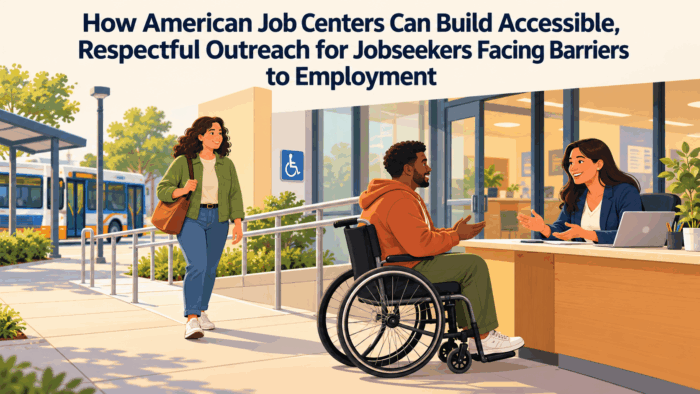
How American Job Centers Can Build Accessible, Respectful Outreach for Jobseekers Facing Barriers to Employment
Workforce programs keep a long list of barriers to employment. It includes disability, low literacy, limited English proficiency, a criminal record, homelessness, long-term unemployment, older age, single parenthood, aging out of foster care, and several others. The list is meant to identify people who deserve priority and extra support, and it reflects real obstacles that make finding and keeping work harder. But it carries a quiet assumption: that the barrier belongs to the person. A jobseeker has a disability, lacks literacy, has a record, has no address. The system, by implication, stands ready to help once the person arrives.
In practice, many of the barriers jobseekers encounter before they ever reach a career advisor are created by the system’s own communication. A brochure written at a reading level well above what many adults can comfortably manage is a barrier. A website that cannot be navigated with a screen reader is a barrier. An outreach flyer available only in English, in a community where many residents speak another language, is a barrier. A phone line that requires pressing through menus and leaving a voicemail is a barrier for someone with a hearing impairment, a cognitive disability, or a phone with limited minutes. An intake form that asks about criminal history on the first page, without explanation, is a barrier for someone who has learned that disclosure leads to rejection. None of these barriers appears on the list. All of them keep people away.
American Job Centers are expected by law to serve everyone, and the Workforce Innovation and Opportunity Act gives specific attention to individuals with barriers to employment. Its nondiscrimination provisions require equal opportunity and access. Its performance accountability system recognizes that serving people with greater barriers is harder and more important. Yet a job center can meet the formal requirements of accessibility and nondiscrimination while still communicating in ways that tell many jobseekers, implicitly, that the center was not designed for them. The difference between formal compliance and genuinely accessible, respectful outreach is the subject of this article.
Its central argument is that outreach to jobseekers facing barriers succeeds when accessibility and respect are built into communication from the start, rather than added as accommodations after a jobseeker asks. That means designing materials, channels, and first encounters that work for people with disabilities, limited literacy, limited English, limited digital access, and difficult histories; using language that recognizes people’s strengths rather than defining them by their obstacles; communicating in ways informed by an understanding of trauma and mistrust; working through partners people already trust; and being honest about what the center can and cannot do. When these elements are in place, the center’s outreach stops creating barriers of its own and starts removing them.
Barriers in the Person or Barriers in the System
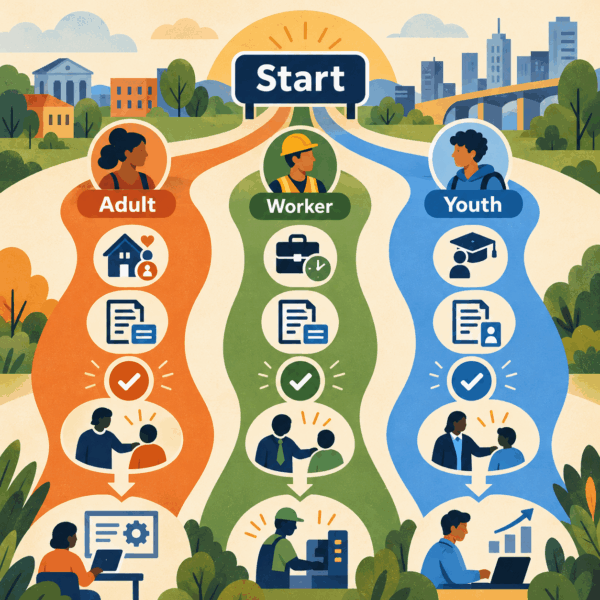 The way an organization thinks about barriers shapes how it communicates. When barriers are understood primarily as characteristics of individuals, outreach tends to focus on finding those individuals, explaining services to them in the organization’s standard way, and offering accommodations when they ask. When barriers are understood as the result of a mismatch between individuals’ circumstances and the organization’s design, outreach focuses on changing the design so that fewer people encounter obstacles in the first place. The second view does not deny that people face real challenges. It recognizes that many of the obstacles people experience in reaching services are produced, or worsened, by how those services communicate.
This distinction has practical consequences. Consider a jobseeker who reads at a basic level. Under the first view, she has a literacy barrier, and the job center may refer her to adult education. Under the second view, the job center also asks why its own outreach materials require advanced reading skills, and it rewrites them so that she can understand them before she ever needs a referral. Consider a jobseeker who uses a wheelchair. Under the first view, she has a disability, and the center provides an accommodation when she arrives. Under the second view, the center also asks whether its outreach events are held in accessible locations, whether its website works with assistive technology, and whether its materials make clear that people with disabilities are welcome, so that she knows before arriving that the center was designed with her in mind.
This way of thinking draws on principles widely used in disability policy and design, often described as universal design, which holds that environments and communication should be usable by as many people as possible without the need for special adaptation. Applied to outreach, universal design means plain language that most people can understand, materials available in multiple formats, channels that do not depend on a single ability or resource, and first encounters that can be completed in several ways. Universal design does not eliminate the need for individual accommodations, but it reduces how often people need to ask for them, and it signals inclusion rather than exception.
The second view also changes the emotional character of outreach. Jobseekers who face barriers have often experienced institutions that treated them as problems to be managed. They may have been turned away because they lacked documents, judged because of their records, talked down to because of their literacy or language, or overlooked because of their age or disability. Outreach that begins from their deficits risks repeating these experiences. Outreach that begins from the organization’s responsibility to be accessible, and from respect for the person’s goals and capabilities, communicates something different: the problem is not you, and we have tried to make this work for you.
Adopting this view requires honesty about the job center’s own practices. Many centers have never reviewed their outreach materials for reading level, tested their websites for accessibility, examined whether their intake processes discourage people with records, or asked jobseekers facing barriers what made it hard to reach them. These reviews often reveal uncomfortable findings. But they also reveal specific, fixable problems, and fixing them can expand access more efficiently than any targeted outreach campaign.
The remainder of this article proceeds from this view. It treats accessibility and respect as design responsibilities of the job center and its partners, examines how they apply to the many circumstances jobseekers bring, and considers how outreach can be built so that it removes barriers rather than adding to them.
Skilled & Connected: Communication Strategies for Workforce Development Agencies, Career Centers, and Local Employment Services
This article is part of our series on strategic communication for Workforce Development Agencies, Career Centers, and Local Employment Services. To learn more and to see the parent article, which links to other content just like this, click the button below.
Who Faces Barriers to Employment and What the Law Expects
The Workforce Innovation and Opportunity Act defines individuals with barriers to employment as members of one or more specific populations. These include displaced homemakers; low-income individuals; Indians, Alaska Natives, and Native Hawaiians; individuals with disabilities, including youth with disabilities; older individuals; individuals who have been incarcerated or otherwise involved with the justice system; homeless individuals and homeless children and youths; youth who are in or have aged out of the foster care system; individuals who are English language learners, individuals who have low levels of literacy, and individuals facing substantial cultural barriers; eligible migrant and seasonal farmworkers; individuals within two years of exhausting lifetime eligibility under the Temporary Assistance for Needy Families program; single parents, including single pregnant women; long-term unemployed individuals; and other groups the governor may designate.
This definition serves several purposes. It shapes state and local planning, which must describe how services will be provided to individuals with barriers. It informs performance accountability, since the statistical adjustment model used in negotiating performance levels takes into account the characteristics of participants served. And it signals a policy priority: the public workforce system is expected to serve people who face the greatest obstacles, not only those easiest to place.
Several related requirements reinforce this priority. In the Title I Adult program, priority of service applies to recipients of public assistance, other low-income individuals, and individuals who are basic skills deficient when providing individualized career services and training. Veterans and eligible spouses receive priority of service across Department of Labor-funded employment and training programs under separate federal law. WIOA youth programs focus substantial resources on out-of-school youth with barriers. Required one-stop partners include programs specifically designed for some of these populations, such as vocational rehabilitation, adult education, the Senior Community Service Employment Program, programs serving Native American communities and migrant and seasonal farmworkers, and reentry employment programs.
WIOA Section 188 and its implementing regulations establish nondiscrimination and equal opportunity obligations for programs and activities funded under the law. These include prohibitions on discrimination based on race, color, religion, sex, national origin, age, disability, political affiliation or belief, and, for beneficiaries, citizenship status or participation in WIOA-funded programs. The regulations require reasonable accommodations and modifications for individuals with disabilities, effective communication with individuals with disabilities, and reasonable steps to ensure meaningful access for individuals with limited English proficiency. They also require universal access to programs and activities, which includes outreach to broaden the composition of the pool of those considered for participation. The Americans with Disabilities Act and Section 504 of the Rehabilitation Act add further obligations.
These legal requirements set a floor. They establish that job centers must not discriminate, must provide accommodations, and must take steps to reach diverse populations. But they do not specify how outreach should be designed to be genuinely welcoming and effective for people facing barriers. A center can post nondiscrimination notices, provide interpreters on request, and still conduct outreach that most people facing barriers never see or understand. Meeting the spirit of these requirements, rather than only their letter, requires the communication design work described in the rest of this article.
It is also worth noting that the categories in the definition overlap and intersect. Many jobseekers belong to several groups at once: an older worker with a disability, a single parent with limited English proficiency, a person returning from incarceration who is also experiencing homelessness. Outreach designed for one category at a time may miss people whose circumstances combine several. Designing outreach to be broadly accessible, and then adapting it for specific circumstances, serves these individuals better than treating each category as a separate audience.
Accessibility as the Foundation of Respectful Outreach
Respect without accessibility is incomplete. A job center can use warm, respectful language in its materials, but if a person cannot read them, cannot access them online, or cannot understand them in her language, the respect never reaches her. Accessibility in outreach means that communication can be perceived, understood, and acted on by people with a wide range of abilities, literacy levels, languages, and resources. It is the foundation on which every other element of respectful outreach rests.
Accessibility for People With Disabilities
People with disabilities are a large and diverse population, including people with mobility, visual, hearing, cognitive, intellectual, learning, psychiatric, and chronic health conditions. Accessible outreach takes all of these into account. Printed materials should use clear fonts, adequate size and contrast, and simple layouts, and should be available in alternative formats such as large print, braille, or accessible electronic documents on request. Digital materials, including websites, online forms, social media content, and documents posted online, should meet recognized accessibility standards; the Department of Justice’s 2024 rule under Title II of the Americans with Disabilities Act established the Web Content Accessibility Guidelines version 2.1 at Level AA as the technical standard for state and local government web content and mobile applications. Videos should have accurate captions and, where visual content conveys important information, audio description. Outreach events should be held in physically accessible locations, with sign language interpretation, captioning, and other accommodations available, and with the availability of these accommodations stated clearly in event announcements.
Beyond formats, accessible outreach makes clear that people with disabilities are welcome and that accommodations are available. Many people with disabilities have encountered services that were not designed for them and may assume a job center is no different. Explicit, positive statements, such as noting that the center serves people with disabilities, that accommodations are available, and how to request them, placed prominently rather than in fine print, signal inclusion. Coordination with vocational rehabilitation partners can strengthen this outreach and ensure that information about disability-related services is accurate.
Accessibility for People With Limited Literacy
A substantial number of adults have limited literacy, and many of them are among the jobseekers who could benefit most from workforce services. Outreach materials written in complex language exclude them. Plain language, using short sentences, common words, active voice, and the most important information first, makes materials accessible to people with a wide range of reading levels without condescending to anyone. Visual elements, such as icons, simple illustrations, and clear headings, can support understanding. Spoken channels, such as phone calls, in-person conversations, video, and radio, reach people who struggle with written text. Testing materials with people who have limited literacy, often arranged through adult education partners, reveals where language is still too complex.
Accessibility for People With Limited English Proficiency
Residents with limited English proficiency need outreach in their languages, delivered through channels they use. Translated materials should be professionally prepared and reviewed by community members for clarity and cultural appropriateness. Interpretation should be available at outreach events and when residents call or visit, and its availability should be communicated in the relevant languages. Federal civil rights requirements call for reasonable steps to provide meaningful access, which includes outreach, not only services delivered after a resident arrives.
Accessibility for People With Limited Digital Access
Many jobseekers facing barriers have limited access to the internet, rely on phones with limited data, lack computers at home, or have limited digital skills. Outreach that depends on websites, online forms, and email excludes them. Accessible outreach provides multiple channels, including phone, in-person, printed materials distributed through trusted locations, and text messaging where appropriate, so that no one is required to navigate digital systems to learn about services or take a first step. Where digital channels are used, they should work on basic mobile phones and slow connections.
Accessibility across all these dimensions requires deliberate planning and ongoing review. Job centers that build accessibility into every outreach effort, rather than responding to individual requests, reach more people and communicate more convincingly that they are designed for everyone.
Respect in Language and Representation
The words and images a job center uses in outreach reveal how it sees the people it hopes to serve. Jobseekers facing barriers are often acutely sensitive to these signals, because they have frequently been described, categorized, and portrayed in ways that diminish them. Outreach that uses respectful language and honest, dignified representation invites them in. Outreach that relies on deficit language or stereotyped imagery confirms their suspicion that the institution sees them as problems.
The first principle is to describe people as people, not as categories. Workforce programs use categorical language for legitimate administrative reasons, but terms such as ex-offender, homeless individual, basic skills deficient, low-income individual, or individual with barriers should not appear in public outreach. People do not identify themselves this way, and many find these terms stigmatizing. Person-first or person-centered language, such as people returning from incarceration, people experiencing homelessness, people who want to improve their reading or math skills, or people looking for work after a long time out of the workforce, describes circumstances without defining people by them. Where communities have expressed preferences about language, such as some disability communities’ preference for identity-first language, outreach should follow those preferences, which is another reason to involve community members in reviewing materials.
The second principle is to lead with strengths and goals. People facing barriers bring skills, experience, determination, and goals, and outreach that recognizes these qualities speaks to them as capable adults. A message that says the center helps people use their experience to find a good job, or that it helps people with all kinds of backgrounds build a path to work, frames services as support for the person’s own aspirations. A message that emphasizes overcoming barriers or addressing deficits frames the person as the obstacle.
The third principle is to avoid pity and heroism. Outreach that portrays jobseekers as tragic figures needing rescue, or that portrays the program as heroic for helping them, places the program at the center and the person in a passive role. Respectful outreach portrays people as active participants who use available resources to pursue their goals. Success stories, in particular, should emphasize the person’s effort and choices, with the program as one source of support.
The fourth principle is honest and diverse representation. Images in outreach materials should reflect the actual diversity of the community, including people of different ages, races, ethnicities, genders, abilities, and backgrounds, in a range of occupations and settings. They should avoid stereotypes, such as consistently depicting certain groups only in low-wage roles or depicting people with disabilities only as recipients of help. Using real photographs of local participants, with their informed consent, is often more credible than stock imagery. Where people with disabilities are depicted, they should be shown as active participants in work and community life.
The fifth principle is to avoid euphemism that obscures meaning. Respectful language is not the same as vague language. Outreach to people returning from incarceration, for example, should not avoid mentioning records so carefully that people cannot tell whether the program will serve them. Saying plainly that the center works with people who have criminal records, and that a record does not disqualify anyone from services, is both respectful and clear. Respect is served by clarity, not by avoiding difficult subjects.
These principles apply to every channel: printed materials, websites, social media, presentations, phone scripts, and the language staff use in conversation. They also apply internally, because the language staff use among themselves tends to shape how they speak to the public. A job center that encourages respectful language in its internal discussions, case notes, and meetings is more likely to communicate respectfully in outreach.
Trauma-Informed Communication
Many jobseekers facing barriers have experienced trauma, whether through violence, abuse, incarceration, homelessness, displacement, discrimination, serious illness, or the cumulative stress of poverty. Others have experienced repeated negative encounters with institutions that left them wary and guarded. Trauma-informed communication recognizes that these experiences can shape how people perceive and respond to outreach, and it adjusts communication to avoid causing further harm and to build the safety and trust that engagement requires. It does not require staff to know or ask about anyone’s trauma history. It requires designing communication that works well for people regardless of what they have experienced.
Principles of trauma-informed approaches, as articulated in public health and human services practice, commonly emphasize safety, trustworthiness and transparency, peer support, collaboration, empowerment and choice, and attention to cultural, historical, and gender issues. Each of these has implications for outreach.
Safety, in outreach, means that people feel physically and emotionally safe when they encounter the job center. Outreach events held in familiar, comfortable locations, with welcoming staff and clear information about what will happen, feel safer than unfamiliar institutional settings. Messages that are calm, clear, and predictable feel safer than urgent or confusing ones. For people who associate government offices with surveillance or enforcement, explaining what the center is and is not, and what will happen if they reach out, can reduce fear.
Trustworthiness and transparency mean being clear and honest about what the center offers, what it requires, what information it collects, and what will happen next. Surprises, such as unexpected documentation requirements, unexplained questions, or changes in what was promised, can feel like betrayals to people who have been let down before. Outreach that sets accurate expectations, and staff who follow through on what they say, build trust over time.
Choice and empowerment mean giving people control wherever possible. Outreach can offer multiple ways to engage, such as calling, visiting, texting, or meeting at a partner location, and can make clear that people decide what to share and what services to pursue. Language that invites rather than directs, such as you can or if you would like, respects people’s agency. For people who have had little control in past institutional encounters, choice is a powerful signal of respect.
Collaboration and peer support mean involving people with lived experience in designing and delivering outreach. Peer navigators, outreach workers who share participants’ backgrounds, and advisory groups of people who have used the center can make outreach more credible and more attuned to what people need. They can also identify aspects of outreach that may unintentionally cause discomfort.
Attention to cultural, historical, and gender issues means recognizing that communities have different histories with public institutions and different norms about communication, help-seeking, and work. Outreach to communities that have experienced historical harm from government should acknowledge that history implicitly through respectful approaches and partnerships with trusted community organizations. Outreach should also consider gender dynamics, such as the needs of women who have experienced violence or of people whose gender identity has led to discrimination.
Trauma-informed communication also affects how staff respond when outreach encounters distress. People who reach out may disclose difficult circumstances or react with anger or anxiety. Staff who respond calmly, without judgment, and with clear information about available help maintain trust. Training staff in these skills, and supporting them in managing the emotional demands of this work, is part of a trauma-informed approach.
Outreach Designed Around Specific Circumstances
Broadly accessible, respectful outreach is the foundation, but people facing particular circumstances often have specific concerns, trusted channels, and information needs. Adapting outreach to these circumstances, while keeping it consistent with the center’s overall message, increases its effectiveness. The following examples illustrate how outreach might be adapted for several groups, recognizing that individuals often fall into more than one.
People With Criminal Records
People returning from incarceration or living with criminal records often assume that public programs and employers will reject them. Their most important question is whether a record will disqualify them. Outreach should answer this directly: the center serves people with records, and a record does not prevent anyone from receiving services. It should also be honest that some occupations and employers have restrictions, while noting that staff can help identify opportunities and, where relevant, connect people with resources for addressing records. Trusted channels include reentry programs, probation and parole offices, legal aid organizations, faith-based reentry ministries, and peer mentors who have been through reentry themselves. Outreach before release, in coordination with correctional facilities and reentry programs where possible, can connect people with services at a critical moment.
People Experiencing Homelessness
People experiencing homelessness face immediate needs that may take precedence over employment, practical barriers such as lack of an address, phone, or place to store documents, and frequent experiences of being turned away. Outreach should make clear that people without stable housing are welcome and that the center can work with them despite these practical challenges. Trusted channels include shelters, day centers, street outreach teams, meal programs, and health care for the homeless programs. Services offered at these locations, rather than requiring travel to the center, reduce barriers significantly.
Older Workers
Older jobseekers may face age discrimination in hiring, may doubt that training is worthwhile at their stage of life, and may be unfamiliar with current job search methods. Outreach should recognize their experience as an asset, make clear that the center serves people of all ages, and describe services relevant to them, such as help translating experience into current job markets and building digital job search skills. The Senior Community Service Employment Program, where available, serves low-income older workers and can be a partner in outreach. Senior centers, libraries, faith communities, and organizations serving older adults are trusted channels.
Long-Term Unemployed Jobseekers
People who have been out of work for many months often experience discouragement, depleted resources, and a sense that employers will not consider them. Some have stopped looking. Outreach should acknowledge that long periods of unemployment are difficult and common, emphasize that the center can help people re-enter the workforce, and avoid implying that the person has failed. Peer support, job clubs, and stories from people who returned to work after long absences can be encouraging.
People With Disabilities
Beyond the accessibility measures discussed earlier, outreach to people with disabilities should communicate that the center supports their employment goals, that accommodations are available, and that coordination with vocational rehabilitation can provide additional services. Disability service organizations, independent living centers, advocacy organizations, and health providers are trusted channels. Outreach should avoid assumptions about what people with disabilities can do and should present a range of employment possibilities.
Single Parents and Displaced Homemakers
Single parents and people re-entering the workforce after years of caregiving face challenges with childcare, scheduling, and confidence. Outreach should address these practically, describing flexible scheduling, help with childcare where available, and support for people returning to work after time away. Schools, childcare providers, family resource centers, and community organizations serving families are effective channels.
Native American Communities and Farmworkers
Native American communities and migrant and seasonal farmworkers are served by dedicated WIOA programs in many areas, and outreach should be coordinated with those programs and with tribal and community organizations. These communities have distinct histories, languages, and circumstances, and outreach should be developed in partnership with organizations they trust rather than designed from outside.
In each case, the adaptations build on the same foundation: accessible formats, respectful language, honesty about what the center offers, and trusted messengers.
Trusted Partners and Services Delivered Where People Are
 For many jobseekers facing barriers, the most significant obstacle to reaching a job center is not lack of information but lack of trust, transportation, time, or comfort with institutional settings. Outreach that asks them to travel to an unfamiliar office, during business hours, to meet strangers in a setting that may resemble places where they have been treated poorly, asks a great deal. Outreach that brings services to places people already go, through organizations they already trust, asks much less, and is far more likely to succeed.
Trusted partners are organizations that already have relationships with people facing barriers. They include community-based organizations serving specific populations, reentry programs, shelters and housing services, disability organizations and independent living centers, adult education programs, libraries, faith communities, community health centers, family resource centers, senior centers, tribal organizations, and organizations serving immigrants and farmworkers. Each has earned the trust of the people it serves through consistent, respectful engagement. When these organizations recommend a job center, they lend it some of that trust.
Effective partnerships go beyond distributing flyers. They involve briefing partner staff thoroughly on what the job center offers, so they can describe it accurately and answer questions. They involve establishing a direct referral contact at the center, with commitments to respond quickly and treat referred jobseekers well. They involve feedback to partners about referral outcomes, with appropriate consent, so partners can see that their trust was honored. And they involve listening to partners’ concerns about how people they refer are treated, and acting on what they hear. Partners who see their clients welcomed and helped become active advocates. Partners who see their clients turned away or treated poorly stop referring.
Delivering services at partner locations is often the most effective form of outreach for people facing barriers. Job center staff can hold regular office hours at shelters, reentry programs, libraries, community organizations, or family resource centers, offering information, registration, and some services on site. This approach reduces transportation and time barriers, takes place in settings where people feel comfortable, and allows trust to develop gradually through repeated contact. Mobile units, where available, can extend this approach to rural areas and neighborhoods without nearby services.
Partnerships should be reciprocal. Partner organizations have their own missions and constraints, and they are more likely to collaborate when the job center supports their work, for example by providing employment services their clients need, contributing to joint events, or sharing information that helps them serve their clients. Formal agreements, such as memoranda of understanding or, where resources allow, funded navigator roles at partner organizations, can strengthen partnerships and make them sustainable.
Peer navigators deserve particular mention. People who have experienced the same circumstances as the jobseekers being reached, such as reentry, homelessness, disability, or long-term unemployment, and who have successfully navigated the workforce system, can serve as navigators or outreach workers. Their lived experience gives them credibility and understanding that staff without that experience may lack. Peer navigator roles should be paid, supported, and supervised appropriately, and should be designed to respect the boundaries and wellbeing of the navigators themselves.
Finally, partnerships require coordination among job center partners. Required one-stop partners such as vocational rehabilitation, adult education, and programs serving older workers, Native American communities, and farmworkers each have their own relationships with specific populations. Coordinating outreach among these partners, so that a person reached by one is connected to the services of others, extends the reach of the whole system.
Communicating Supportive Services and Requirements Honestly
For many jobseekers facing barriers, the question of whether they can participate depends less on whether they want to work than on whether they can manage the practical demands of participation: getting to appointments, arranging childcare, affording work clothes and tools, covering costs while in training, and meeting documentation requirements. Supportive services can address some of these needs, and they are often among the most important things a job center can communicate. But communicating them honestly is difficult, because they are usually limited, conditional, and variable.
WIOA allows local areas to provide supportive services such as transportation, childcare, dependent care, housing assistance, needs-related payments, and assistance with work-related items like uniforms and tools, to individuals participating in certain programs who are unable to obtain them through other sources. Local boards set policies on which services are available, eligibility conditions, and limits. Availability can depend on funding, program enrollment, and individual circumstances. Partners and community organizations may offer additional support.
Outreach that mentions supportive services can be powerful, because it tells jobseekers that the center understands their practical obstacles and may be able to help. A message that says the center may be able to help with costs like transportation, childcare, or work clothes for people in its programs can make participation seem possible to someone who assumed it was out of reach. But outreach that overstates these services, implying that everyone will receive them or that they will cover all costs, creates expectations the center cannot meet. A single parent who enrolls expecting childcare assistance and then learns it is not available, or is limited to a short period, may have to drop out and will be unlikely to trust the center again.
Honest communication about supportive services describes what may be available, the conditions under which it is provided, and the fact that availability depends on individual circumstances and funding. Phrases such as may be available, for eligible participants, or staff can help you explore options are accurate without being discouraging. Outreach should also mention that staff can help connect people with other resources in the community, since job centers often cannot meet every need directly but can serve as connectors.
Requirements deserve the same honesty. Jobseekers facing barriers may struggle with documentation, such as proof of identity, eligibility to work, income, or other information required for program enrollment. Outreach should tell people, in plain language, what they may need to provide, while making clear that staff can help them obtain missing documents and that not having everything should not stop them from reaching out. Where alternatives are permitted, such as self-attestation for certain eligibility elements under state and federal rules, staff should understand and use them. Concealing requirements until intake leads to frustration and dropout; disclosing them early, with reassurance and help, prepares people to succeed.
Time commitments are another requirement worth communicating honestly. Training programs may require several months of full-time or part-time attendance. Career services may involve multiple appointments. People with jobs, caregiving responsibilities, or health conditions need to know what participation involves in order to decide whether and when they can commit. Clear information about time commitments, along with information about flexible options where they exist, respects their ability to plan.
Finally, honest communication includes acknowledging limits. A job center cannot solve every barrier. Some people will need housing, health care, legal assistance, or other help before they can focus on employment. Outreach that positions the center as a partner in a broader network of support, rather than as a solution to everything, sets realistic expectations and encourages people to reach out even if their needs extend beyond employment.
Making the First Encounter Accessible
Outreach succeeds only if the first encounter that follows it is accessible and respectful. A jobseeker facing barriers who responds to a welcoming message and then encounters a confusing phone system, an inaccessible building, an intimidating intake process, or a dismissive staff member will conclude that the message was not sincere. The first encounter, whether by phone, in person, online, or at a partner location, is where outreach is proven or disproven.
The phone is often the first point of contact. Phone systems with long menus, automated messages, and full voicemail boxes create barriers for people with hearing, cognitive, or speech disabilities, people with limited English, people with limited phone minutes, and people who are simply anxious about reaching out. A phone line answered by a person during reasonable hours, with clear options for language assistance and relay services for people who are deaf or hard of hearing, removes these barriers. When voicemail is necessary, messages should be returned promptly. Text messaging options can be helpful for people who find phone calls difficult, provided privacy is protected.
The physical environment communicates whether people are welcome. Accessible entrances, clear signage, accessible restrooms, seating that accommodates different needs, and quiet spaces for people who find busy environments overwhelming all matter. A staffed welcome point, rather than a sign-in sheet or a kiosk, allows staff to greet people warmly, explain what will happen, and identify any accommodation needs. Information about wait times, displayed or communicated directly, reduces anxiety. Assistive technology in resource rooms, such as screen readers, screen magnifiers, adjustable workstations, and captioned video, allows people with disabilities to use resources independently.
Intake processes often create the greatest barriers. Long written forms challenge people with limited literacy or limited English. Questions about criminal history, disability, income, or public assistance, asked early and without explanation, can feel intrusive and may discourage people who fear judgment or disclosure. Intake processes designed with accessibility in mind begin with conversation about the person’s goals, explain why information is needed, offer help completing forms, provide forms in multiple languages and accessible formats, and ask sensitive questions only when necessary and with clear explanation of how the information will be used. Staff should be prepared to offer reasonable accommodations, such as reading forms aloud, extending time, or conducting intake in a quiet space.
Digital first encounters require the same care. Online registration systems, which are increasingly common in state workforce systems, should be accessible, mobile-friendly, and available in multiple languages, with clear instructions and a way to get help. People who cannot or prefer not to use online systems should have alternatives that do not disadvantage them. Job centers using statewide systems they did not design should advocate with their state partners for accessibility improvements and provide in-person help in the meantime.
First encounters at partner locations, such as office hours at a shelter or reentry program, offer an opportunity to make the first contact as comfortable as possible. Staff should bring what they need to provide meaningful help on site, rather than simply telling people to come to the center. Where full intake cannot be completed on site, staff can begin the process, schedule a follow-up, and help with transportation if needed.
Throughout, the behavior of staff in the first encounter is decisive. A warm greeting, patience, clear explanation, respect for the person’s choices, and follow-through on any commitment made build the trust that outreach began. A rushed, impersonal, or judgmental encounter undoes it. Investing in staff preparation for first encounters is therefore one of the most important outreach investments a job center can make.
Disclosure, Privacy, and Choice
Many of the circumstances that make up barriers to employment are sensitive. A disability, a criminal record, a history of homelessness, limited literacy, public assistance receipt, or immigration-related concerns in one’s family are not things people share lightly. Jobseekers facing barriers often must decide how much to disclose to a job center, and their fear of what disclosure might mean can keep them from reaching out at all. Outreach that addresses disclosure and privacy honestly, and that gives people genuine choice, removes a significant hidden barrier.
Disability disclosure illustrates the issue. People with disabilities may worry that disclosing a disability will lead to assumptions about what they can do, to steering toward particular jobs, or to information being shared with employers. Some disabilities are visible, while many are not. Outreach can address these concerns by explaining that disclosure is voluntary, that people can share as much or as little as they choose, that disclosing a disability can open access to accommodations and additional services, and that disability information is kept confidential and not shared with employers without consent. Where WIOA and other programs collect disability information for reporting purposes, staff should be able to explain how it is used and protected.
Criminal record disclosure raises similar concerns. People with records may fear that disclosure will lead to rejection, judgment, or reporting. Outreach can explain that the center serves people with records, that staff ask about records only when relevant to identifying suitable opportunities or services, and that information is handled confidentially. Staff should understand the legal context, including any applicable fair chance hiring laws in the state or locality, so they can provide accurate guidance about how records may affect employment.
Other sensitive information requires similar care. People experiencing homelessness may worry that disclosing their situation will affect custody of their children or other matters. People receiving public assistance may worry that information shared with the job center will affect their benefits. People from immigrant families may worry about how information could be used. Outreach should not make promises the center cannot keep, but it should explain accurately what information is collected, why, how it is protected, when it might be shared, and what choices people have.
Privacy obligations shape these explanations. WIOA programs must protect personally identifiable information. Vocational rehabilitation records, education records, unemployment insurance information, and public assistance information are subject to their own confidentiality rules. Information shared among one-stop partners generally requires consent. Job centers should develop plain-language explanations of their privacy practices, reviewed for legal accuracy, that staff can share with people who ask, and should include brief statements about confidentiality in outreach materials.
Choice is the guiding principle. People should decide what to disclose, what services to pursue, and what information to share with partners and employers. Outreach that emphasizes this choice, for example by stating that people decide what they want to share, communicates respect and reduces fear. Staff should honor these choices in practice, never pressuring people to disclose more than they wish and never sharing information without proper consent.
Finally, disclosure decisions affect what services people can receive. A person who chooses not to disclose a disability may not receive disability-related accommodations or vocational rehabilitation services. A person who does not share income information may not be determined eligible for certain programs. Staff should explain these consequences honestly and without pressure, so that people can make informed choices that serve their own interests.
Preparing Staff for Respectful Outreach
Accessible materials and thoughtful partnerships set the stage, but staff deliver outreach and the first encounters that follow it. Their knowledge, attitudes, and skills determine whether jobseekers facing barriers experience the job center as welcoming or dismissive. Preparing staff for this work is one of the most consequential investments a job center can make, and it requires more than a single training session.
Staff need knowledge of accessibility and accommodation. They should understand the center’s obligations under WIOA Section 188, the Americans with Disabilities Act, and language access requirements, and they should know how to provide accommodations in practice: how to arrange interpretation, how to use relay services, how to provide materials in alternative formats, how to operate assistive technology in the resource room, and how to modify processes to meet individual needs. They should know whom to contact when they are unsure. Equal opportunity officers and vocational rehabilitation partners can contribute to this training.
Staff need knowledge of the circumstances jobseekers bring. Understanding how criminal records affect employment, what resources exist for people experiencing homelessness, how age discrimination operates, what supports are available for single parents, and how the system serves Native American communities and farmworkers allows staff to respond accurately and confidently. Partner organizations that serve these populations can provide valuable training, and their involvement strengthens partnerships.
Staff need skills in respectful communication. Using person-centered language, explaining processes clearly, listening without judgment, giving people choices, and responding calmly to distress are skills that can be learned and practiced. Training that uses realistic scenarios, such as a person disclosing a record, a person who is deaf arriving without having requested an interpreter, or a person becoming frustrated with intake requirements, allows staff to practice responses in a supportive setting. Feedback from peers and supervisors helps staff refine their approach.
Staff need an understanding of trauma-informed approaches. As discussed earlier, many jobseekers facing barriers have experienced trauma or negative institutional encounters. Staff who understand how these experiences can shape behavior, such as mistrust, anger, withdrawal, or difficulty following through, are better able to respond with patience and without taking reactions personally. Training should emphasize that staff do not need to know anyone’s history to communicate in trauma-informed ways.
Staff also need support. Working with people facing serious challenges can be emotionally demanding, and staff who are overwhelmed, burned out, or unsupported cannot sustain respectful communication. Reasonable caseloads, supervision that includes attention to staff wellbeing, opportunities to debrief difficult interactions, and recognition of the skill this work requires help staff maintain the patience and warmth respectful outreach demands.
Attitudes matter as much as skills. Staff who believe that people with records are unlikely to succeed, that older workers cannot learn new skills, or that people experiencing homelessness are not ready to work will communicate those beliefs, however subtly. Training that challenges assumptions, through exposure to the experiences and successes of people facing barriers, through peer navigators and people with lived experience sharing their perspectives, and through honest discussion, can shift attitudes over time. Leadership plays a role in modeling and reinforcing respectful attitudes.
Finally, staff preparation should include partner staff. Jobseekers do not distinguish between the job center’s staff and the partner staff they meet in the same building. Including partner staff in training ensures that the whole system communicates consistently, and shared training builds relationships that improve coordination.
Standards for Accessible Outreach Materials
Accessibility and respect are more likely to be achieved consistently when they are written into standards that apply to every outreach material, rather than left to the judgment of whoever is producing a flyer on a given day. Standards give staff and partners a shared reference, make it easier to review materials before they are released, and help new staff learn expectations quickly. They should be practical, brief enough to be used, and supported by templates that make compliance easy.
A workable set of standards for outreach materials typically addresses a consistent set of elements:
-
Plain language, with short sentences, common words, and the most important information first, tested with people who have limited literacy.
-
Readable design, including clear fonts, adequate size, sufficient color contrast, and simple layouts that do not rely on color alone to convey meaning.
-
Digital accessibility consistent with recognized standards, including accessible documents, alternative text for images, captioned videos, and websites and forms that work with assistive technology.
-
Availability in the languages most common in the local area, with professional translation reviewed by community members.
-
Clear statements that services are available to people with disabilities, that accommodations are available, and how to request them.
-
Clear information on how to request materials in alternative formats or languages.
-
Person-centered, respectful language that avoids deficit framing and administrative categories.
-
Honest, diverse representation of people in images, with consent for any real participants shown.
-
Accurate, honest descriptions of services, supportive services, requirements, and limits.
-
Multiple ways to make contact, including phone, in person, and text or online options, with relay service information.
-
A brief statement about confidentiality and choice in sharing information.
-
A review step before release, including accessibility and plain-language checks.
These standards apply to printed flyers, brochures, posters, and handouts; websites and social media posts; videos and presentations; letters and notices; and materials provided to partners for distribution. They should also inform the scripts and talking points staff use in outreach conversations.
Templates make standards easier to follow. A set of pre-designed templates for common materials, already meeting design and accessibility standards, allows staff without design training to produce accessible materials quickly. A library of approved plain-language descriptions of services, statements about accommodations and confidentiality, and translated text reduces the effort required for each new material and ensures consistency.
Review processes ensure standards are applied. A simple checklist used before materials are released, with a designated reviewer for accessibility and plain language, catches common problems. Periodic audits of existing materials, including the website and materials in circulation at partner locations, identify outdated or noncompliant materials that need to be replaced.
Standards should be developed with input from people facing barriers and from partners who serve them. Disability organizations, adult education programs, community organizations serving language communities, and peer navigators can review draft standards and test materials, ensuring that the standards reflect actual needs. Standards developed this way are more likely to produce materials that work.
Finally, standards should be revisited regularly. Technology, legal requirements, community demographics, and best practices change. Reviewing standards annually, and updating them when significant changes occur, keeps them relevant and useful.
Accessible Outreach in Practice
The following hypothetical example illustrates how a job center might apply the principles in this article. It does not describe an actual job center.
A comprehensive American Job Center serving a county with a mid-sized city and surrounding rural areas notices, through a review of its participant data, that people with disabilities, people returning from incarceration, and older jobseekers are underrepresented relative to the local population. It decides to review its outreach and first encounters with accessibility and respect in mind.
The center begins by asking for feedback. It convenes a small group that includes a vocational rehabilitation counselor, staff from an independent living center, a reentry program coordinator, a staff member from a senior center, an adult education instructor, and several people who have used the center, including a person who is blind, a person returning from incarceration, and an older worker. The group reviews the center’s website, brochures, phone system, and intake process.
The feedback is specific. The website cannot be navigated easily with a screen reader, and several key documents are scanned images. The main brochure is written at a reading level many adult education students would find difficult. The phone system requires pressing through several menus before reaching voicemail. The intake form asks about criminal history on the first page with no explanation. Nothing in the center’s materials mentions that accommodations are available, except a nondiscrimination notice at the bottom of the website. Images in the brochure show mostly young professionals. And the reentry coordinator reports that people leaving incarceration often believe the center will not serve them.
The center makes a series of changes. It works with its website administrator to fix accessibility problems and replace scanned documents with accessible versions. It rewrites its brochure in plain language, tests it with adult education students, and adds a prominent statement that the center serves people with disabilities, that accommodations are available, and how to ask. It adds a statement that the center serves people with records and that a record does not prevent anyone from receiving services. It replaces stock images with photographs of local participants of different ages and backgrounds, with their consent. It reconfigures its phone system so that calls are answered by a person during business hours and adds relay service information. It revises its intake process to begin with a conversation about goals, moves sensitive questions later with clear explanations, and trains staff to offer help with forms.
The center also strengthens partnerships. It begins holding monthly office hours at the reentry program and the senior center, and it establishes a referral process with the independent living center. It works with the reentry program to provide information to people before release. It trains staff, along with partner staff, on accessibility, respectful language, trauma-informed communication, and the circumstances of people with records and older workers, with partner organizations contributing to the training.
Over the following year, the center tracks how people hear about it, collects feedback after first encounters, and reviews participant data. It finds increased engagement from people referred by the reentry program and senior center, and positive feedback about the revised intake process. It also finds that people with disabilities remain underrepresented, and it plans further outreach with disability organizations.
The example illustrates the core principles: reviewing the center’s own communication for barriers, involving people with lived experience and partners in that review, making specific changes to materials, channels, and first encounters, building partnerships that bring services to people, preparing staff, and measuring results to guide continued improvement.
Measuring Accessibility and Respect
Accessibility and respect can seem difficult to measure, but job centers can track indicators that reveal whether their outreach is reaching people facing barriers and whether those people experience it as accessible and respectful. Measurement helps centers identify gaps, test improvements, and demonstrate progress to boards and partners.
Representation is a starting point. Comparing the characteristics of participants with the characteristics of the local population, particularly for groups identified as facing barriers, shows whether outreach is reaching them. If people with disabilities, people with records, older workers, or people with limited English proficiency are underrepresented relative to their presence in the community and their likely need, outreach to those groups may need strengthening. These comparisons are imprecise, since participant data depends on voluntary disclosure and community data may not align perfectly, but trends over time can be informative.
Accessibility can be measured directly through audits. Periodic reviews of the website using accessibility evaluation tools and manual testing, reviews of materials for plain language and design, reviews of physical facilities and assistive technology, and mystery shopping of phone and in-person first encounters reveal whether standards are being met. Audits conducted with people who have disabilities, limited literacy, or limited English provide insight that automated tools cannot.
Accommodation requests and responses provide another indicator. Tracking how many accommodation and language assistance requests are received, how quickly they are fulfilled, and whether any are denied or delayed shows whether the center is meeting individual needs. A very low number of requests may indicate that people do not know accommodations are available, rather than that no one needs them.
Experience is best measured by asking people. Brief surveys after first encounters, available in accessible formats and multiple languages, can ask whether people found information easy to understand, whether they felt respected, whether they were able to communicate effectively, whether their needs were accommodated, and whether they would recommend the center to others in similar circumstances. Focus groups or interviews with people facing particular barriers, often arranged through partner organizations, provide deeper insight into what works and what does not.
Partner feedback is valuable as well. Partners who refer people facing barriers can report whether those people were welcomed, whether they followed through, and what they said about their experience. Regular conversations with partners, and simple tracking of referral outcomes, reveal whether the center is honoring the trust partners extend.
The path from first contact to engagement can be tracked for people facing barriers, just as for other jobseekers. If people with particular circumstances are lost disproportionately at specific steps, such as intake or eligibility determination, those steps may contain barriers that need attention.
Finally, measurement results should be shared and acted on. Reporting to the board, partners, and staff on representation, accessibility audits, accommodation responses, and participant feedback makes accessibility and respect visible priorities. Using results to guide specific improvements, and tracking whether those improvements make a difference, turns measurement into progress. Equal opportunity officers and Section 188 monitoring processes can incorporate these measures, connecting accessibility work to the center’s broader compliance responsibilities.
How Barrier-Focused Outreach Compares With Other Agency Types
Many public agencies serve populations facing barriers, and their approaches offer useful comparisons for American Job Centers. Each sector has developed practices suited to its context, and workforce programs can adapt the most relevant of them.
Health care has led in developing trauma-informed approaches and in recognizing how institutional practices affect people who have experienced trauma. Community health centers, in particular, have developed models of welcoming, culturally responsive care for populations facing barriers, often employing community health workers who share patients’ backgrounds. These models demonstrate the value of peer roles and of designing services around patients’ circumstances. Job centers can learn from these approaches, particularly in designing first encounters and preparing staff.
Disability services, including vocational rehabilitation and independent living centers, have long practiced person-centered planning, emphasized choice and self-determination, and advocated for universal design. Their expertise in accessibility is directly relevant to job centers, and close partnership with these organizations is one of the most effective ways for job centers to improve accessibility.
Human services agencies serve many of the same people as job centers and face similar challenges with stigma, mistrust, and complex requirements. Some have redesigned their communications using plain language and human-centered design, simplifying notices and applications. These efforts show that complex programs can communicate clearly without sacrificing accuracy. They also show the difficulty of changing communication in large systems with legal constraints, and the value of testing with the people being served.
Reentry programs and organizations working with people with criminal records have developed approaches that address the specific fears and barriers of their population, often led by people with lived experience. Their emphasis on honesty about obstacles combined with encouragement about possibilities offers a model for job centers communicating with people with records.
Public libraries have become important points of access for people facing barriers, offering free internet, assistance with digital tasks, and a welcoming environment without eligibility requirements. Their success illustrates the value of low-barrier, universally accessible settings, and it explains why library partnerships extend job centers’ reach.
What distinguishes job center outreach is the combination of a broad, diverse set of populations facing barriers, a legal framework that both prioritizes these populations and requires documentation of eligibility, the involvement of multiple partner programs with their own expertise and requirements, and the central goal of employment, which requires engaging people in a process that takes time and effort. This combination means that job centers must integrate lessons from health care, disability services, human services, reentry, and libraries into a coherent approach that works across populations and partners.
Tying It All Together
Accessible, respectful outreach is not a side function of operating an American Job Center. It determines whether the people the public workforce system most intends to serve can actually reach it. Jobseekers facing barriers to employment encounter obstacles not only in their circumstances but in the communication of the institutions meant to help them, and job centers that recognize this can remove many barriers before anyone needs to ask for an accommodation.
The starting point is a shift in perspective, from seeing barriers solely as characteristics of individuals to recognizing that communication design can create or remove them. That shift, informed by universal design, leads job centers to review their own materials, channels, and first encounters for the obstacles they impose.
Accessibility is the foundation: outreach that people with disabilities, limited literacy, limited English, and limited digital access can perceive, understand, and act on. Respect builds on that foundation through person-centered language, emphasis on strengths and goals, honest and diverse representation, and clarity rather than euphemism. Trauma-informed communication adds attention to safety, transparency, choice, collaboration, and cultural and historical context.
Outreach adapted to specific circumstances, such as criminal records, homelessness, older age, long-term unemployment, disability, single parenthood, and the distinct contexts of Native American communities and farmworkers, addresses particular concerns while maintaining a consistent foundation. Trusted partners and services delivered at partner locations bring the job center to people rather than requiring people to come to it. Honest communication about supportive services, requirements, and limits sets realistic expectations.
The first encounter, by phone, in person, online, or at a partner location, is where outreach is proven, and it must be accessible and respectful in every detail. Disclosure and privacy deserve explicit attention, with people given genuine choice about what they share. Staff preparation, including knowledge, skills, trauma-informed understanding, and support, determines whether these principles are applied in practice. Standards for outreach materials, supported by templates and review processes, make accessibility consistent.
Finally, measurement of representation, accessibility, accommodations, experience, and partner feedback reveals whether outreach is succeeding and guides continued improvement. When all of these elements are in place, a job center’s communication stops adding barriers and starts removing them.
Strategic Communication Support
 Building outreach that is genuinely accessible and respectful requires a combination of expertise rarely found within a single job center: accessibility knowledge across disabilities, plain-language writing and testing, trauma-informed practice, culturally responsive communication, partnership development across many types of organizations, and staff training. Job center staff are often committed to serving people facing barriers but lack the time and specialized resources to redesign outreach comprehensively. External support can help centers identify the barriers their communication creates and build lasting practices to remove them.
Stegmeier Consulting Group (SCG) helps public agencies design communication that reaches people conventional approaches exclude. For American Job Centers, that work can begin with an accessibility and respect review: examining outreach materials, websites, phone systems, physical environments, and intake processes, and gathering feedback from people facing barriers and the organizations that serve them through interviews, focus groups, and observation. This review identifies specific barriers in the center’s communication and prioritizes changes by their likely effect.
From that review, SCG can help centers develop outreach standards, templates, and plain-language descriptions of services, accommodations, supportive services, and privacy practices, tested with people who have limited literacy, limited English, and disabilities. SCG can help design outreach approaches for specific circumstances, such as reentry, homelessness, older workers, and disability, in collaboration with the partner organizations trusted by those communities, and can help structure partnerships and on-site service arrangements.
Implementation support can include redesigning intake communication to be accessible and trauma-informed, developing staff and partner training on accessibility, respectful language, and trauma-informed communication, and creating leadership toolkits that help managers reinforce these practices. SCG can also help design peer navigator roles and the consent and privacy processes that support them.
Evaluation support helps job centers measure representation, conduct accessibility audits, track accommodation requests and responses, and gather feedback from people facing barriers and from partners. The aim is outreach that removes barriers rather than creating them, sustained by practices that center staff can maintain and improve.
Future Trends
Several established developments are shaping how American Job Centers reach jobseekers facing barriers. The most concrete is the strengthening of digital accessibility requirements. The Department of Justice’s 2024 rule under Title II of the Americans with Disabilities Act established specific technical standards for the web content and mobile applications of state and local governments. As job centers and state workforce systems rely increasingly on online registration, virtual services, and digital outreach, meeting these standards becomes essential both for compliance and for reaching people with disabilities. Centers that use statewide systems they do not control will need to work with state partners on accessibility while providing alternatives in the meantime.
The expansion of fair chance hiring policies in many states and localities, which limit when employers can ask about criminal history, has changed the employment landscape for people with records. These policies vary widely and continue to evolve. Job centers that understand the policies applicable in their area can communicate more accurately and encouragingly with people returning from incarceration, while being honest about remaining barriers in certain occupations. Coordination with reentry programs and legal aid organizations helps keep this information current.
An aging workforce means that older jobseekers are a growing share of the population seeking work, including people who need or want to work longer than previous generations did. Outreach that recognizes older workers’ experience, addresses digital job search skills, and counters assumptions about age will become more important.
Changes in public assistance policy may bring more people facing barriers into contact with job centers. Federal legislation enacted in 2025 broadened work requirements associated with SNAP and introduced community engagement requirements for certain Medicaid enrollees, with exemptions that vary and with implementation phased in by states. Some people subject to these requirements will face significant barriers, including disabilities, caregiving responsibilities, and limited literacy. Job centers will need to communicate accessibly and respectfully with these individuals, coordinate with human services agencies on exemptions and requirements, and avoid becoming perceived primarily as compliance offices. Because state implementation is still developing, centers should expect to adjust their approaches.
Emerging technologies, including automated chat tools and artificial intelligence applications, are being explored by some public agencies to answer questions and guide people to services. These tools could extend availability and offer support in multiple languages, but they also raise concerns about accessibility, accuracy, privacy, and the experience of people who need human support, including people with cognitive disabilities, limited literacy, or limited digital skills. Job centers considering such tools should test them with people facing barriers, ensure that human help remains easy to reach, and be transparent about their use. Their appropriate role remains unsettled.
Finally, the structure and funding of federal workforce programs may change. Budget proposals in recent cycles have contemplated consolidating funding streams, and the outcome is uncertain. Any changes could affect the resources available for accessible outreach, supportive services, and partnerships. Job centers that build accessibility into their standard practices, rather than relying on special projects, will be better able to sustain it through changing conditions.
Conclusion
The list of barriers to employment describes real obstacles, but it tells only half the story. The other half is written in the job center’s own brochures, websites, phone trees, intake forms, and first conversations. When those communications assume a reader with strong literacy, full sight and hearing, fluent English, reliable internet, and no reason to distrust institutions, they turn the list of barriers into a list of people who will never arrive. When they are designed for the full range of people the center serves, the list becomes what it was meant to be: a guide to whom the system should welcome first.
For workforce board members, job center operators, and partner leaders, the implication is that accessibility and respect are design responsibilities owned by the institution, not favors extended to individuals who ask. That responsibility calls for honest review of current communication with the people it excludes, standards that make accessible materials routine, partnerships that bring services to trusted places, staff prepared and supported to communicate with respect, and measurement that shows whether people facing barriers are being reached and treated well. It also calls for honesty about what the center can offer, because respect includes telling people the truth.
Job centers that accept this responsibility will reach people who have been told, implicitly or explicitly, that public services were not meant for them, and will give those people reason to believe otherwise. That is the most direct way to fulfill the promise of universal access on which the public workforce system was built.
Stegmeier Consulting Group’s Strategic Approach to Communication Systems
SCG approaches outreach for jobseekers facing barriers as a communication system that the institution is responsible for making accessible. That approach begins by reviewing the job center’s own communication with the people it currently excludes and the organizations that serve them, identifying the barriers embedded in materials, channels, and first encounters. It continues by building standards, templates, and plain-language content that make accessibility routine, by developing outreach adapted to specific circumstances in partnership with trusted community organizations, and by preparing staff to communicate with respect, transparency, and an understanding of trauma.
For American Job Centers, this means outreach that people with disabilities, limited literacy, limited English, and limited digital access can actually use; language and imagery that treat jobseekers as capable people with goals; honest communication about supportive services, requirements, and privacy; and first encounters that confirm the welcome outreach extends. It means bringing services to the places people already trust and measuring whether those who face the greatest barriers are being reached and served well.
Use the form below to connect with our team and explore how strategic communication support can help your American Job Center build accessible, respectful outreach for jobseekers facing barriers to employment.