How Youth Workforce Programs Can Reach Out-of-School Young Adults Who Are Disconnected From School and Work
Youth workforce programs have many names for the young people they most want to reach. Federal law calls them out-of-school youth. Researchers and foundations often call them opportunity youth or disconnected youth. Program applications describe them by their barriers: basic skills deficient, offender, homeless, pregnant or parenting, aging out of foster care, individual with a disability. Not one of these terms is a word a nineteen-year-old would use to describe herself. She might say she is figuring things out, taking a break, working when she can, helping her family, looking for something better, or just trying to get by. The distance between the program’s language and her own is a small illustration of a much larger gap, and that gap is where most youth outreach fails.
Young adults who are neither in school nor working steadily are among the populations the public workforce system most wants to serve, and among the hardest to reach. They have left the institutions that once organized their days and connected them to adults. Many have had difficult experiences with schools, social services, or the justice system and are wary of anything that resembles them. They move frequently, change phone numbers, and spend their time in places and online spaces where public agencies have little presence. They may be supporting themselves or others through informal or irregular work. They are not looking for a workforce program, and many do not know such programs exist. When they do hear about one, the message often arrives in a format, from a messenger, and in language that signals it was not designed for them.
Yet these young adults often want what youth workforce programs offer: a way to earn money, finish a credential, learn a trade, find steady work, and build a future that looks better than their present. The problem is rarely a lack of desire. It is a mismatch between how programs communicate and how young adults live. Programs advertise through channels young adults do not use, describe themselves in terms young adults do not recognize, require steps young adults cannot easily complete, and rely on messengers young adults do not trust.
This article examines how youth workforce programs can reach out-of-school young adults who are disconnected from school and work. Its central argument is that reaching these young adults depends on communication built around their lives rather than program structures: delivered through the people and places they already trust, framed in terms of what they want rather than what they lack, made easy to act on, and backed by a first experience that confirms the program respects them. It examines who these young adults are, why conventional outreach misses them, how to explain youth programs plainly, which channels and messengers work, how peer voices can lead, what messages resonate, how to reduce the friction between interest and enrollment, and how to conduct this work ethically and sustain it over time.
Who Out-of-School Young Adults Are
 Effective outreach begins with an accurate picture of the young adults it is meant to reach. Under the Workforce Innovation and Opportunity Act, out-of-school youth are generally young people aged sixteen through twenty-four who are not attending school and who meet at least one additional criterion, such as being a school dropout, being within the age of compulsory attendance but having missed a significant portion of the most recent school quarter, holding a high school credential but being low-income and either basic skills deficient or an English language learner, being involved in the justice system, being homeless or a runaway, being in or having aged out of foster care, being pregnant or parenting, having a disability, or being low-income and requiring additional assistance to enter or complete an educational program or secure employment. WIOA requires that a substantial majority of local youth funds be spent on out-of-school youth, a requirement that reflects a deliberate policy priority.
These categories are useful for eligibility and reporting, but they describe circumstances, not people, and they can obscure the diversity within this population. Some out-of-school young adults left high school before graduating, while others earned a diploma but found that it did not lead anywhere. Some are working in low-wage, irregular jobs, and others are not working at all. Some are caring for children, younger siblings, or ill family members. Some are navigating housing instability, sleeping on friends’ couches or in shelters. Some have been involved with the juvenile or adult justice system and face barriers created by records. Some have aged out of foster care without stable family support. Some are recent immigrants learning English. Some have disabilities that schools did not adequately support. Many face several of these circumstances at once.
What these young adults share is not a set of deficits but a position: they are outside the institutions that typically guide young people toward careers. They are no longer connected to schools, which provide counselors, structure, and information about pathways. They are not connected to stable employers, who provide training and advancement. Many are not connected to adults who can advise them on navigating education and work. As a result, information about opportunities that flows easily to young people inside these institutions does not reach them.
It is also important to recognize what many of these young adults bring. Many have taken on adult responsibilities early, supporting themselves and others through difficult circumstances. Many have developed resilience, resourcefulness, and practical skills that do not appear on a transcript. Many have clear ideas about what they want, even if they do not see a path to it. Outreach that sees them only through the lens of barriers misses these strengths and communicates a view of them that they are likely to reject.
The language programs use matters here. Terms like disconnected, at-risk, or opportunity youth may be meaningful in policy discussions, but they are rarely how young adults describe themselves, and some find them stigmatizing. Outreach materials and conversations should use language young adults recognize and accept, describing them as young people, young adults, or simply people who want to earn money, finish school, or find a better job. Program staff should be aware of the labels they use internally and avoid letting them leak into public communication.
Understanding the local population is essential. The composition of out-of-school young adults varies by community, and outreach should reflect local realities. Data from schools on dropout and graduation rates, from child welfare and justice agencies on young people leaving their systems, from community organizations serving young people, and from young adults themselves can help youth programs understand who they need to reach and where. This understanding should shape every subsequent decision about channels, messengers, and messages.
Skilled & Connected: Communication Strategies for Workforce Development Agencies, Career Centers, and Local Employment Services
This article is part of our series on strategic communication for Workforce Development Agencies, Career Centers, and Local Employment Services. To learn more and to see the parent article, which links to other content just like this, click the button below.
Why Conventional Outreach Misses Young Adults
Most youth workforce outreach relies on approaches developed for other audiences and adapted, often lightly, for young people. Flyers posted at career centers and community bulletin boards, announcements on the program’s website and social media accounts, presentations at schools, and referrals from partner agencies are the standard tools. These approaches reach some young people, particularly those still connected to schools or already involved with public agencies. They largely miss young adults who have left those institutions behind, and understanding why they fail is the first step toward designing outreach that works.
The first reason is that conventional channels are institutional, and out-of-school young adults are, by definition, outside institutions. School presentations reach students, not young people who have left school. Career center flyers reach people who visit career centers. Partner referrals reach young people connected to partner agencies. Program websites and social media accounts reach people who already know the program exists and seek it out. For the young adult who spends her days working a part-time job, caring for a child, staying with friends, or simply moving through a neighborhood, none of these channels intersects with her life.
The second reason is that the messengers are wrong. Information delivered by a government agency or a program staff member the young adult has never met carries little weight, especially for young people whose experiences with schools, social services, or law enforcement have taught them to be cautious about official institutions. Young adults tend to trust peers, family members, and adults they already know, such as a coach, a youth worker, a mentor, or a community member who has shown up for them before. Outreach that bypasses these relationships starts at a disadvantage.
The third reason is that the language and framing are wrong. Program materials often describe youth services in terms of eligibility, barriers, and program elements, using phrases like comprehensive youth development services, work-based learning opportunities, or support for youth with barriers to employment. These descriptions may be accurate, but they do not answer the concerns young adults actually have: whether they will get paid, whether they can finish a diploma, whether the program will feel like school, whether staff will treat them like children, and whether it will fit around a job or a child. Materials that do not answer these questions, in language young adults use, are unlikely to hold attention.
The fourth reason is that the process is daunting. Even when a young adult is interested, the path from interest to enrollment can be long and confusing. It may require visiting an office during business hours, providing documents she does not have or cannot easily obtain, completing forms, attending an orientation, and waiting for an eligibility determination. Each step is an opportunity to lose her, especially if she has had frustrating experiences with similar processes before. Conventional outreach generates interest and then hands it off to a process that was not designed to sustain it.
The fifth reason is timing. Young adults’ circumstances change quickly. A young person who is interested in a program today may have a new job, a new apartment, or a new crisis next week. Outreach that relies on scheduled recruitment periods or slow response times will miss many moments of readiness. Programs that can respond quickly when a young adult expresses interest, and that offer flexible entry points, are far more likely to engage young people when they are ready.
Recognizing these reasons does not mean abandoning conventional approaches entirely. Schools, partners, and program channels still reach some young people, and they should continue. But reaching young adults who are disconnected requires additional approaches designed specifically for their lives: different channels, different messengers, different language, simpler processes, and faster responses. The sections that follow describe these approaches.
Explaining What Youth Workforce Programs Offer
Before a youth program can communicate effectively with young adults, it needs a clear, honest, plain-language account of what it actually offers. Many youth programs struggle with this, because their services are organized around federal program elements and funding requirements that make sense to administrators but not to young people. Translating the program into terms young adults can understand and evaluate is a foundational task.
WIOA identifies fourteen program elements that local youth programs must make available, including tutoring and dropout recovery services, alternative secondary school services, paid and unpaid work experiences, occupational skills training, education offered concurrently with workforce preparation, leadership development, supportive services, adult mentoring, follow-up services, comprehensive guidance and counseling, financial literacy education, entrepreneurial skills training, labor market information, and activities that help youth prepare for and transition to postsecondary education and training. The law also requires that a significant share of local youth funds be spent on work experience. These elements are delivered differently in different local areas, sometimes by a single provider and sometimes by several.
None of this language works for outreach. A young adult will not respond to a description of fourteen program elements. She will respond to concrete statements about what she can get and do. A plain-language translation might say that the program can help young people earn money through paid work experience, finish a high school diploma or equivalency, get training for a specific job, get help with things like transportation or work clothes, and work with someone who helps them make a plan and stick with it. Each statement should be accurate for the local program, because promising paid work experience to every participant when slots are limited, for example, will damage trust.
The most important features to communicate are usually the ones young adults care most about. Paid work experience, where available, is often the strongest draw, because earning money is an immediate need for many young adults. The ability to finish a high school credential is important for those who left school. Training that leads to a specific job, with a recognizable title and wage, is more compelling than general career exploration. Flexibility, such as schedules that accommodate jobs and childcare, matters to young adults with responsibilities. Support, such as help with transportation, childcare, or other barriers, makes participation feel possible. And respect, the sense that staff will treat them as capable adults, matters greatly to young people who have often felt dismissed.
Honesty about eligibility and requirements is equally important. Young adults should understand, in plain terms, who the program serves and what they will need to provide to enroll. Programs should not suggest that everyone qualifies if eligibility depends on specific criteria, but they also should not lead with eligibility rules, which can discourage young people who might well qualify. A balanced approach describes what the program offers, says that it serves young people of a certain age range who are not in school or who face certain challenges, and invites young adults to reach out to find out whether it fits them.
Programs should also be honest about what participation requires. Young adults deserve to know how much time the program involves, whether there are attendance expectations, how long it typically takes to finish a credential or training, and what happens after. Programs that conceal these expectations to boost enrollment will see young people drop out when the reality emerges. Programs that are clear about them attract young people who are ready to commit and earn the trust of those who are not yet ready but may return later.
This plain-language account should be developed with young people, not only for them. Testing descriptions with current participants and with young adults outside the program reveals which words resonate, which features matter most, and which phrasing sounds institutional or condescending. The result is a description that young adults recognize as speaking to them.
Channels Young Adults Actually Use
Reaching out-of-school young adults requires going where they already are, both online and in person. Their media habits and daily routines differ from those of older adults and from those of young people still in school, and outreach channels should reflect these differences. Because these habits change quickly, programs should check their assumptions regularly with young people rather than relying on what was true a few years ago.
Social Media and Short Video
Young adults spend significant time on social media platforms, particularly those built around short video, images, and messaging. A youth program’s own social media account can be part of outreach, but it will reach few young people who do not already know the program unless its content is shared, discovered through platform algorithms, or promoted through paid placement. Content that performs well on these platforms tends to be authentic, visual, brief, and created by or featuring young people rather than polished institutional messaging. Short videos of participants describing their experiences in their own words, behind-the-scenes looks at work experience sites, or quick explanations of how to get paid while finishing a diploma are more likely to connect than graphics listing program elements. Programs should be realistic about the effort required to maintain an effective presence and should focus on one or two platforms where local young adults are most active, rather than spreading thin across many.
Paid social media advertising can extend reach to young adults in specific geographic areas and age ranges. Used carefully, with accurate messages and simple next steps, it can introduce the program to young people who would not otherwise encounter it. Programs should avoid targeting based on sensitive characteristics and should consider the privacy implications of advertising tools.
Text Messaging
Text messaging is often the most reliable way to communicate with young adults once contact is established. Many young adults respond to texts far more readily than to phone calls or emails. Programs can use texting for initial follow-up after a young person expresses interest, for appointment reminders, and for ongoing communication with participants. Texting should be done with consent, in a conversational tone, and with attention to privacy, since phones may be shared or seen by others. Young adults’ phone numbers change frequently, so programs should regularly confirm contact information.
Peers and Word of Mouth
The most powerful channel for reaching young adults is other young adults. A friend, cousin, or acquaintance who has participated in a program and found it worthwhile carries more credibility than any advertisement. Programs can strengthen this channel by delivering good experiences that participants want to talk about, by giving participants simple ways to share information, and, where appropriate, by recognizing participants who refer friends. The section on peer voices below explores this further.
Physical Places
Young adults spend time in places that outreach can reach: neighborhoods, parks, recreation centers, basketball courts, libraries, transit stops, community events, shopping areas, fast food restaurants, barbershops and salons, and other gathering places. Street outreach, in which staff or peer outreach workers engage young people directly in these places, can be effective, particularly when conducted by people who know the neighborhood and are known there. Community events, such as neighborhood festivals or youth sports, offer opportunities for informal conversations. Posting materials in places young adults frequent, such as recreation centers or laundromats, places information in their path.
Places Young Adults Pass Through
Some institutions encounter out-of-school young adults at specific moments: emergency shelters and youth drop-in centers, health clinics, public assistance offices, courts and probation offices, child welfare agencies, and community colleges where some young adults attempt and leave courses. Each of these is an opportunity to share information about youth programs through staff who interact with young people, and they are discussed further in the next section on trusted adults.
No single channel will reach all young adults. A combination of digital presence, texting, peer networks, physical outreach, and institutional touchpoints, adapted to local patterns and reviewed regularly, gives programs the best chance of reaching young people where they actually spend their time.
Trusted Adults and Community Messengers
Out-of-school young adults are often wary of institutions, but many still have relationships with particular adults they trust: a youth worker at a community center, a coach, a mentor, a case manager who treated them well, a pastor, a relative, a barber, or a former teacher. These adults are among the most effective messengers for youth workforce programs, because their recommendation carries the weight of an existing relationship. Building a network of trusted adults who understand the program and are willing to recommend it is one of the most important outreach investments a youth program can make.
Community and Youth-Serving Organizations
Community organizations that serve young people, including youth centers, recreation programs, mentoring organizations, arts programs, and organizations serving specific neighborhoods or cultural communities, often maintain relationships with young adults long after they leave school. Their staff know which young people are looking for work, struggling to finish school, or ready for a change. Youth programs can build partnerships with these organizations by briefing their staff on the program, providing simple materials, establishing a direct referral contact, and following up on referrals. Partnerships work best when they are reciprocal, with the youth program also supporting the partner’s work and respecting its relationships with young people.
Justice System Partners
Young adults involved with the juvenile or adult justice system are an important part of the out-of-school population, and the agencies they interact with, including probation offices, courts, diversion programs, and reentry programs, can connect them with youth workforce services. Probation officers and reentry staff who understand the program can recommend it at moments when young people are motivated to change their circumstances. Youth programs should coordinate with these partners while being sensitive to how young people perceive the connection. A program presented primarily as a court requirement may be resented, while one presented as a genuine opportunity, with the justice partner’s endorsement, is more likely to engage.
Child Welfare and Foster Care Partners
Young people aging out of foster care often lack the family support that helps others navigate the transition to adulthood. Child welfare agencies and independent living programs serving these young people are natural partners. Caseworkers and independent living coordinators can introduce youth workforce programs as part of transition planning, and youth programs can coordinate with them to provide consistent support.
Housing and Homelessness Services
Young adults experiencing homelessness or housing instability may be reached through youth shelters, drop-in centers, street outreach programs, and housing agencies. Staff at these organizations interact with young people at moments of significant need and can connect them with services that address employment and education alongside housing. Youth programs should recognize that young people in housing crisis may have immediate needs that must be addressed before they can focus on training or work, and partnerships should allow flexible entry.
Adult Education and Re-Engagement Programs
Adult education programs, high school equivalency preparation programs, and school district re-engagement centers serve young adults who left school and want to return. These programs are natural partners for youth workforce services, since many of their students also want to earn money and prepare for careers. Coordinated outreach and referral can help young adults combine education and work experience.
Faith, Family, and Informal Networks
Faith communities, extended families, and informal neighborhood networks are often overlooked as outreach channels, but they reach young adults directly. Parents, grandparents, aunts, and uncles who learn about youth programs can encourage young people in their families to participate. Faith leaders who work with young people can share information. Barbershops, salons, and local businesses where young adults spend time can display information and their owners can mention the program.
Across all these partners, the principle is the same: the program borrows credibility from relationships young adults already trust, so it must protect that credibility by treating referred young people well. A partner who refers a young person to a program that treats them poorly will not refer another. A partner who sees young people welcomed and supported becomes an advocate.
Peer Voices and Youth Participation in Outreach
No one is more credible to a young adult than another young adult who has been in a similar situation. When a twenty-year-old who left high school, struggled to find work, and then completed a youth program describes what it was like, other young people listen in a way they rarely listen to program staff. Peer voices can overcome skepticism, translate program language into terms young adults recognize, and demonstrate that the program is for people like them. Youth programs that involve young people in outreach, rather than only targeting them with it, consistently reach young adults who would otherwise remain out of reach.
The simplest form of peer outreach is word of mouth from satisfied participants. Programs can encourage this by making participation an experience worth talking about and by giving participants easy ways to share information, such as a link they can text to a friend, a card with a contact name, or an invitation to bring a friend to an information session. Recognizing participants who refer peers, through acknowledgment or small incentives where appropriate, signals that referrals are valued. Programs should be careful that incentives do not pressure participants or compromise their relationships.
A more structured approach involves employing young adults as peer outreach workers or youth ambassadors. These positions, often filled by current or former participants, involve conducting outreach in neighborhoods and online, speaking at community events, staffing information tables, and following up with young people who express interest. Paid peer outreach positions can themselves serve as work experience, building skills and providing income while extending the program’s reach. Peer outreach workers need training, supervision, and support, including guidance on describing the program accurately, maintaining boundaries, protecting privacy, and handling difficult situations. Their role should be genuine and respected rather than symbolic.
Young people can also contribute to the design of outreach. Youth advisory groups, focus groups with young adults inside and outside the program, and involvement of participants in creating content can help programs develop messages, images, and approaches that resonate. Young people know which platforms their peers use, which words sound authentic, and which approaches feel condescending. Programs that involve them in design avoid many common mistakes. WIOA’s emphasis on leadership development as a program element provides a natural framework for this involvement.
Participant stories are a powerful form of peer voice, but they require care. Young adults who share their stories publicly may be revealing difficult experiences, such as leaving school, involvement with the justice system, homelessness, or family challenges. They may not fully anticipate how their stories could be seen by future employers, classmates, or others. Programs should obtain informed consent that explains clearly how stories will be used, ensure that young people feel free to decline, allow them to withdraw consent later, and avoid including sensitive details unless the young person clearly wants to share them. For participants under eighteen, programs should also consider parent or guardian consent requirements under applicable law and policy. Stories should be told in the young person’s own words wherever possible, rather than rewritten into institutional language.
Authenticity matters more than polish. Content created by young people, even if it is less refined than professionally produced materials, often resonates more with their peers. A short video filmed on a phone in which a participant explains why she joined the program may outperform a professionally produced advertisement. Programs should resist the urge to over-edit youth voices into a corporate tone.
Peer involvement also strengthens the program itself. Young people who participate in outreach develop communication skills, leadership experience, and a sense of ownership. They often become more engaged in their own participation. And their feedback on what peers say about the program provides valuable insight into how the program is perceived and where it could improve.
Messages That Speak to Young Adults
The right channel and the right messenger still need the right message. Messages that work for out-of-school young adults differ from those that work for adult jobseekers or for students still in school. They must capture attention quickly, speak to what young adults actually want, avoid condescension, and make the next step obvious. They must also be honest, because young adults who feel misled will share that experience widely.
The first principle is to lead with what young adults want. For many, the most immediate want is money. Messages that begin with getting paid, whether through paid work experience, a job placement, or training for a better-paying job, capture attention because they speak to a real and pressing need. Other strong motivators include finishing a high school diploma or equivalency, getting a specific job or credential, gaining independence, supporting a child or family, and having a plan for the future. Messages that lead with these goals, rather than with program names or services, connect with young adults’ own priorities.
The second principle is respect. Young adults who have left school or struggled to find work often feel judged by adults and institutions. Messages that imply they are lacking, troubled, or in need of fixing will be rejected. Messages that treat them as capable people pursuing their own goals, and that position the program as a resource rather than an intervention, are more likely to resonate. Language such as get paid while you finish your diploma, learn a trade and get certified, or we will help you find a job that fits your life speaks to young adults as agents. Language about at-risk youth, barriers, or services for disconnected young people does not.
The third principle is concreteness. Abstract promises such as career pathways or youth development opportunities mean little to young adults. Concrete descriptions, such as earn while you learn to become a certified nursing assistant, a welder, or an electrician’s helper, or get paid to work at a local business for the summer, allow young adults to picture what they would actually do. Concrete examples should reflect real opportunities in the local program.
The fourth principle is addressing common hesitations. Young adults may assume a program will be like school, with rigid rules and adults telling them what to do. They may worry that it will not fit around their jobs or children. They may wonder whether it is legitimate or whether it will cost money. They may fear that their past, such as a record or having left school, will disqualify them. Messages can address these concerns directly: it is not like school, schedules can be flexible, it is free, and young people with many different backgrounds participate. These statements must be accurate for the local program.
The fifth principle is a simple, immediate next step. Young adults are unlikely to complete a long process based on a single message. The next step should be easy and quick: text a number, send a direct message, scan a code, stop by a specific place at a specific time, or tell a trusted adult who can make the connection. Programs that can respond quickly, ideally the same day, when a young adult takes this step will engage far more young people than programs that respond days later.
The sixth principle is honesty. It is tempting to emphasize the most appealing features, such as paid work or guaranteed jobs, without mentioning limits. But young adults who respond to messages promising pay and then discover that paid slots are limited, or that they must complete several steps first, will feel misled. Honest messages can still be appealing: phrases like paid work experience for eligible participants, or help finding a job, are accurate and still compelling.
Finally, messages should be tested with young adults before they are used widely. What program staff find appealing may not resonate with young people, and phrasing that seems neutral to adults may sound condescending to youth. Testing through youth advisory groups, current participants, and young adults outside the program can quickly reveal what works.
Reducing Friction Between Interest and Enrollment
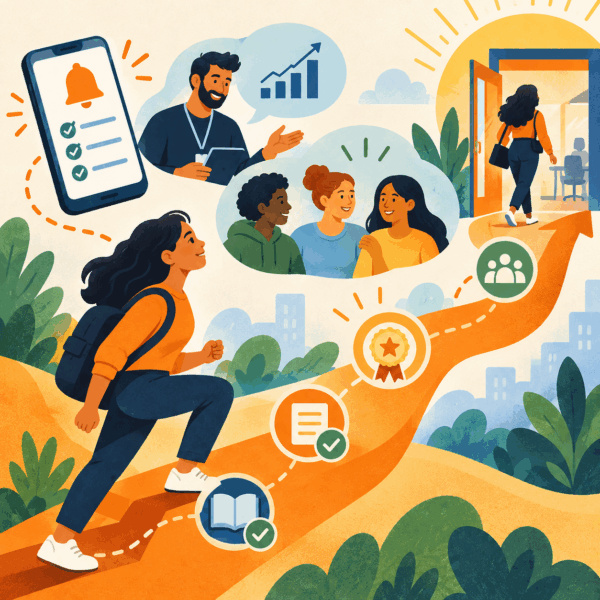 Outreach succeeds only if young adults who become interested actually enroll. For out-of-school young adults, the path from interest to enrollment is often where programs lose the most people. A young person who texts a number on Monday may have moved on by Friday if no one responds. A young person who agrees to come in for an appointment may not show if the appointment is weeks away or at an inconvenient time. A young person who arrives may leave discouraged if the intake process requires documents she does not have. Communication can reduce this friction, but only if the enrollment process itself is designed with young adults in mind.
Speed is the first priority. When a young adult expresses interest, a quick, personal response dramatically increases the chance of engagement. A same-day text or call from a named staff member, acknowledging the inquiry, answering immediate questions, and offering a concrete next step, shows the young person that the program is real and responsive. Delays of several days communicate the opposite. Programs should designate staff responsible for responding to inquiries quickly and should monitor response times.
Flexibility is the second priority. Young adults with jobs, children, or unstable housing need options for when and where they can meet. Appointments outside standard business hours, meetings at community locations, phone or video conversations, and walk-in opportunities make it easier to take the first step. Programs that require young people to come to a single office during weekday hours will lose many who are interested but unable to meet those conditions.
Documentation is often the largest obstacle. WIOA youth eligibility requires verification of age, school status, and other criteria, and programs must document eligibility to comply with federal and state requirements. But many out-of-school young adults lack ready access to birth certificates, identification, school records, or proof of income. Communication can help by telling young people in advance, in plain language, what they may need to bring, and by reassuring them that staff can help if they do not have everything. Programs should also use the flexibility available to them, such as alternative forms of documentation or self-attestation where state and federal rules permit, and should help young people obtain missing documents rather than turning them away. Staff should understand the applicable rules well enough to explain them clearly.
The intake experience shapes whether a young adult stays. An intake that feels like an interrogation, with long forms and personal questions asked without explanation, can confirm a young person’s suspicion that the program is just another institution. An intake that begins with conversation about the young person’s goals, explains why certain information is needed, and moves through paperwork efficiently feels different. Staff who are warm, respectful, and genuinely interested in the young person make the experience feel like the beginning of a relationship rather than a bureaucratic hurdle.
Waiting periods should be minimized and, when unavoidable, filled. If a young adult must wait for an eligibility determination, a program start date, or an available work experience slot, communication during the wait keeps the connection alive. Regular check-ins, invitations to workshops or activities, and honest updates about timing help prevent young people from drifting away. Programs should be candid about how long waits may last.
Finally, programs should track where young adults are lost between interest and enrollment. Recording how many inquiries are received, how many receive a response, how many lead to a first meeting, how many complete intake, and how many enroll reveals which steps are causing the most loss. This information can guide improvements to both communication and process.
Ethical Commitments in Youth Outreach
Outreach to young adults raises ethical questions that are heightened by their age, their circumstances, and the channels used to reach them. Some are still minors. Many are in vulnerable situations. Outreach often uses digital platforms that collect data, involves sharing personal stories, and relies on partners such as justice and child welfare agencies whose involvement carries its own sensitivities. Youth programs must navigate these questions carefully to protect young people and maintain the trust on which outreach depends.
Privacy is a central concern. Young adults may share personal information during outreach conversations, through online inquiry forms, or in text messages. Programs should collect only the information needed, explain how it will be used, protect it appropriately, and comply with applicable privacy requirements. For young people under eighteen, additional legal protections and parental consent requirements may apply, depending on state law and program policy. Information obtained through partners, such as justice or child welfare agencies, may be subject to strict confidentiality rules and should be shared only with proper authorization. Programs should be particularly careful not to disclose a young person’s involvement with the justice system, child welfare, or other sensitive circumstances to anyone who does not need to know.
Digital outreach raises specific concerns. Social media advertising tools can target audiences based on characteristics that may be sensitive, and programs should avoid targeting that could be discriminatory or invasive. Messages sent through social media or text may be seen by others, so they should not reveal sensitive information. Programs that maintain social media accounts should moderate comments to protect participants from harassment and should not post images or information about participants without consent. Young people should understand that what they share publicly online may be visible to employers and others.
Consent and voluntariness matter in storytelling and in participation itself. As discussed earlier, young people asked to share their stories should give genuinely informed consent, free from pressure, and should be able to withdraw it. Participation in the program should also be genuinely voluntary for most young people. Where participation is connected to a court order or other requirement, programs should be honest about that connection and should still treat young people as participants with choices within the program.
Honesty is essential. Young adults who are promised more than the program can deliver, such as guaranteed paid work, guaranteed jobs, or quick results, may make decisions based on false expectations and will lose trust when the promise is not kept. Outreach should accurately represent what the program offers, who is eligible, what participation requires, and what outcomes are realistic. Success stories should be presented as examples, not guarantees.
Dignity and fairness require attention to how young people are portrayed and whom outreach reaches. Materials should depict young adults respectfully and reflect the diversity of the community without relying on stereotypes. Outreach should avoid framing young people primarily by their problems. And programs should consider whether their outreach reaches young adults across neighborhoods, backgrounds, and circumstances, or whether it concentrates on those easiest to reach. Directing effort toward young people facing the greatest barriers aligns outreach with the program’s purpose.
Finally, programs have an obligation to be ready for the young people outreach brings in. Outreach that generates interest from young adults facing serious challenges, such as homelessness, mental health crises, or safety concerns, must be backed by staff prepared to respond appropriately and by partnerships that can address needs beyond the program’s scope. Staff should know how to recognize when a young person needs immediate help and how to connect them with appropriate resources.
Accessibility, Language, and Young Adults With Disabilities
Out-of-school young adults include young people with disabilities, young people who are learning English, and young people from immigrant families, and outreach must reach them as effectively as it reaches others. These young adults often face compounded barriers: a young person with a learning disability who left school without adequate support, or a young immigrant who arrived as a teenager and was not able to finish high school, may be among those who would benefit most from youth workforce services and among those least likely to hear about them through conventional channels.
Young adults with disabilities are explicitly recognized in WIOA youth eligibility, and the law’s nondiscrimination provisions require equal opportunity and access. Many young adults with disabilities did not receive adequate support in school, and some left school without a diploma or with a diploma that did not prepare them for work. Others have disabilities that were never formally identified. Outreach to these young people should be accessible in format, including materials that work with screen readers, videos with captions, and plain-language descriptions, and should make clear that the program welcomes young people with disabilities and can provide accommodations. Vocational rehabilitation agencies, which provide pre-employment transition services to students with disabilities and vocational rehabilitation services to eligible young adults, are important partners. Coordinating outreach and referrals between youth workforce programs and vocational rehabilitation can help young adults access the full range of available support.
Digital accessibility deserves particular attention because youth outreach relies heavily on digital channels. Websites, online inquiry forms, social media content, and videos should meet accessibility standards, consistent with the Department of Justice’s 2024 rule establishing technical standards for state and local government web content and mobile applications and with programs’ broader obligations. Images posted on social media should include descriptive text where platforms allow it, and videos should be captioned.
Young adults with limited English proficiency, and young people from immigrant families who may be fluent in English but whose parents are not, need outreach that reflects their circumstances. Federal civil rights requirements call for reasonable steps to provide meaningful access to people with limited English proficiency. For young adults themselves, materials and conversations in their primary languages may be necessary. For those who are bilingual, the issue may be less about language than about cultural relevance and the concerns of their families, such as uncertainty about whether participating in public programs could affect family members. Outreach through community organizations serving immigrant families, in-language media, and bilingual staff or peer outreach workers can address these needs.
Young parents face particular barriers that outreach should acknowledge. Childcare needs, schedule constraints, and the responsibilities of parenting shape whether young parents can participate. Outreach that mentions support with childcare, where available, and flexible scheduling, and that features young parents among participants, signals that the program is designed with them in mind. Partners such as family support programs, health clinics, and early childhood programs can help reach young parents.
Across all these groups, accessibility is not only about the format of materials but about whether the program experience is designed to include them. Outreach that invites young adults with disabilities, limited English proficiency, or parenting responsibilities must be backed by services that accommodate them. A young parent who responds to outreach and finds no help with childcare, or a young person who is deaf who responds and finds no interpreter, will not return. Coordinating outreach with service capacity ensures that the invitation is genuine.
Keeping Young Adults Engaged After Enrollment
Reaching young adults and enrolling them is only the beginning. Out-of-school young adults often face circumstances that make sustained participation difficult: unstable housing, family responsibilities, transportation problems, financial pressure, and the pull of immediate work opportunities that pay now rather than later. Many have previous experiences of starting something and not finishing it. Communication after enrollment plays a significant role in whether they stay, and the quality of that communication also shapes what they tell their peers, which in turn affects future outreach.
The relationship with a consistent staff member is often the most important factor. Young adults who have a case manager, mentor, or youth worker they trust, who checks in regularly, notices when something is wrong, and responds when they reach out, are far more likely to stay engaged. Communication in this relationship should be frequent, personal, and responsive. Text messages that check in, acknowledge progress, remind them of upcoming activities, and offer help with problems keep the connection alive between in-person meetings. Staff should be reachable through the channels young adults actually use.
Communication should recognize progress. Young adults who have experienced failure in school or work may not expect to succeed, and acknowledgment of milestones, such as completing a work experience placement, passing a section of a high school equivalency exam, or earning a credential, reinforces their motivation. Recognition can be personal, such as a message from a case manager, or public, such as a celebration or certificate, depending on the young person’s preferences.
When young adults miss activities or begin to drift, communication should be supportive rather than punitive. A message that says staff noticed they missed a session and want to know if everything is all right is far more likely to bring a young person back than a warning about attendance requirements. Many absences reflect real obstacles, such as a transportation breakdown, a childcare gap, or a family crisis, and staff who ask about these obstacles can often help resolve them through supportive services or schedule adjustments. Programs should still be honest about expectations, but they should communicate them in a way that preserves the relationship.
Young adults who leave the program should be able to return. Life circumstances change, and a young person who drops out may be ready to re-engage months later. Communication that leaves the door open, such as a message saying the program is still here when they are ready, and periodic check-ins with consent, can bring young people back. Programs that treat departure as final lose young people who might have succeeded on a second attempt.
Follow-up services, which WIOA includes as a required program element for a period after exit, are another opportunity for continued communication. Young adults who have completed the program and found work or entered education may still face challenges, and follow-up contact can help them navigate problems, advance in their jobs, or pursue further education. This contact also helps programs learn how young people fare after the program, which informs both program improvement and outreach.
Finally, engagement after enrollment is itself outreach. Young adults who have a positive experience become the most credible messengers to their peers. Programs that invest in keeping participants engaged and supported build a reputation in young adults’ networks that no advertising could create. Programs that lose participants through poor communication build a reputation that undermines every outreach effort.
Coordinating With Schools, Re-Engagement Programs, and Partners
Youth workforce programs do not reach out-of-school young adults alone. Schools, school district re-engagement programs, adult education providers, community colleges, Job Corps and YouthBuild programs where present, child welfare agencies, justice agencies, housing services, community organizations, and employers all interact with young people at various points. When these organizations coordinate their communication, young adults receive consistent information and smoother transitions. When they do not, young people may receive conflicting messages, be referred in circles, or fall through gaps between programs.
Schools are an important upstream partner, even though out-of-school youth have, by definition, left them. School districts know which students have left and may maintain contact information or relationships through counselors, attendance staff, or re-engagement programs. Some districts operate re-engagement centers or dropout recovery programs that actively seek out young people who have left school. Coordinating with these efforts allows youth workforce programs to reach young people soon after they leave, before disconnection becomes entrenched, and to offer combined pathways that include both education and work. Information sharing between schools and youth programs must comply with student privacy laws, which generally require consent for sharing education records, but schools can share information about youth programs with former students and families without disclosing protected records.
Adult education and high school equivalency programs serve many young adults who are trying to finish a credential. Coordinated outreach can present education and workforce services together, so that young adults see a combined path to a credential and a job rather than separate programs. Co-enrollment, where appropriate, allows young people to benefit from both.
Community colleges often enroll young adults who later stop attending. Colleges and youth workforce programs can coordinate to reach these young people, offering support that might help them return or alternative pathways if college is not the right fit at that moment. Career and technical programs at community colleges can also be destinations for youth program participants, and coordinated communication about these pathways helps young adults understand their options.
Within the workforce system, youth programs should coordinate with adult programs, since young adults aged eighteen through twenty-four may be eligible for both youth and adult services. Consistent communication about which program is the best fit, and seamless referral between them, prevents young adults from being bounced between programs. Coordination with Wagner-Peyser employment services and other one-stop partners ensures that young adults who come to the career center for other reasons are connected with youth services.
Coordination works best through shared practices rather than occasional meetings. A shared description of youth services that all partners use, clear referral pathways with quick response, regular communication among partner staff, and feedback on referral outcomes help partners act as a network. Some communities have established youth-serving collaboratives or networks that bring these organizations together around shared goals for young people, and youth workforce programs can participate in or help lead such efforts.
Finally, coordination should keep the young person at the center. Partners should agree that a young adult’s first point of contact, whether a school, a community organization, or a probation office, can connect them to youth workforce services without requiring them to start over. Information should follow the young person with their consent, so they do not have to repeat their story to every organization. This approach, a version of the no wrong door principle applied to young adults, reduces the friction that often causes young people to give up.
A Youth Outreach Effort in Practice
The following hypothetical example shows how the elements described in this article might come together. It does not describe an actual program.
A youth workforce provider in a mid-sized city has struggled to enroll out-of-school young adults. Its outreach has relied on flyers at the career center, presentations at high schools, and referrals from the local human services agency. Most participants are in-school youth or young adults already connected to public agencies. Staff know that many young adults in certain neighborhoods are neither working steadily nor in school, but few of them are enrolling.
The provider begins by convening a small group of current and former participants, along with several young adults recruited through a community youth center, to discuss how young people in their neighborhoods spend their time, what they think of programs like this, and what would make them interested. The group is blunt. Young people assume the program is like school, do not trust flyers from government offices, and mostly hear about opportunities from friends and on a particular short-video platform. What would get their attention is getting paid, getting a specific job, and being treated with respect.
Based on this input, the provider makes several changes. It rewrites its core description in plain language that leads with paid work experience and training for specific jobs, avoids terms like at-risk or disconnected, and states plainly that the program is free, flexible, and not like school. It hires two former participants as part-time youth ambassadors, trains them in describing the program accurately and protecting privacy, and supports them in conducting outreach at recreation centers, basketball courts, community events, and online. The ambassadors create short videos on their phones explaining what the program is like, with consent from anyone featured.
The provider establishes a texting line for inquiries and assigns staff to respond the same day. It offers evening and community-based meeting options and a walk-in afternoon each week at the youth center. It reviews its intake process, prepares a plain-language list of documents young people might need, and trains staff to help young people obtain missing documents rather than sending them away.
The provider strengthens partnerships with the youth center, a reentry program, the school district’s re-engagement office, a youth shelter, and a family support program serving young parents. It briefs staff at each organization on the program, gives them the texting line, and commits to responding quickly to referrals and letting them know whether young people connected.
Within several months, inquiries increase, many coming through the ambassadors, the texting line, and the youth center. More young people complete intake, partly because responses are faster and documentation help is available. Some still drop off, particularly young people facing housing crises, and the provider works with the youth shelter to offer more flexible entry for them. Feedback from participants indicates that the most common reason they enrolled was hearing about the program from a friend or an ambassador.
The example illustrates several principles: involving young people in designing outreach, using peer messengers and the channels young adults actually use, framing messages around what young people want, responding quickly, reducing documentation barriers, partnering with trusted organizations, and learning continuously from what young people say.
Measuring Youth Outreach
Youth outreach is difficult to measure because its target population is mobile, hard to count, and often reached through informal channels. But measurement is necessary to learn what works, to direct limited resources wisely, and to demonstrate progress to boards and funders. Useful measurement combines indicators of reach, engagement, the path from interest to enrollment, and young people’s own perceptions.
Reach can be tracked through the number of young adults contacted through outreach activities, the number of inquiries received through each channel, social media and video engagement, the number of partners actively referring young people, and the number of referrals each partner makes. These indicators show which channels and partners are producing contact with young adults.
The path from interest to enrollment is the most actionable area of measurement. Tracking how many inquiries receive a response and how quickly, how many lead to a first meeting, how many complete intake, and how many enroll reveals where young people are lost. Comparing these rates across channels shows which sources produce young people who follow through. Comparing them over time shows whether changes, such as faster response or documentation assistance, are working.
Who enrolls matters as much as how many. Comparing the characteristics of enrolled out-of-school young adults with what is known about the local population of young adults who are not in school or working steadily shows whether outreach is reaching the intended groups. If certain neighborhoods, groups, or circumstances are underrepresented, outreach can be adjusted.
Young people’s perceptions provide essential insight. Asking new participants how they heard about the program, what made them decide to enroll, what almost stopped them, and what they expected compared with what they found reveals which messages and channels are effective and where expectations are misaligned. Asking young adults outside the program what they know and believe about it, through youth advisory groups or community conversations, shows how the program is perceived in young people’s networks.
Questions that youth programs can track consistently include:
-
How did each new participant first hear about the program, and who encouraged them to reach out?
-
How quickly did the program respond to each inquiry, and how many inquiries led to a first meeting?
-
At which step between inquiry and enrollment are the most young people lost, and why?
-
Which partners and channels produce young people who enroll and stay engaged?
-
What do participants say almost kept them from enrolling, and what convinced them?
Measurement should also track engagement after enrollment, since outreach and retention are connected. Young people who enroll and quickly drop out may have been reached with messages that set inaccurate expectations, or may need more support than the program provides. Tracking retention by outreach channel can reveal these patterns.
Finally, measurement should be shared with partners and young people. Partners who see the results of their referrals become more engaged. Youth ambassadors and advisory groups who see how their input affected outreach feel their contributions matter. Boards and funders who see thoughtful measurement of outreach, including what has not worked, gain confidence in the program’s management.
How Youth Workforce Outreach Compares With Other Agency Types
Many public and nonprofit organizations try to reach young adults who are outside mainstream institutions, and comparing their approaches with youth workforce outreach reveals both transferable lessons and the particular demands of the workforce context.
Public health programs have long worked to reach young people with information about health services, often through peer educators, youth-friendly clinics, social media campaigns developed with young people, and partnerships with community organizations. These programs have demonstrated that young people respond to messages developed with their input, delivered by peers or trusted adults, and backed by services that treat them with respect and confidentiality. Youth workforce programs can draw directly on these lessons, particularly regarding peer involvement and the importance of a respectful first experience.
Street outreach programs serving young people experiencing homelessness use relationship-based approaches, meeting young people where they are, building trust over time, and connecting them with services when they are ready. Their patience and persistence offer a model for reaching young adults who are wary of institutions. Youth workforce programs that partner with street outreach programs can benefit from relationships these programs have built.
College access and dropout recovery programs work to reconnect young people with education, often through intensive personal outreach, mentoring, and flexible entry points. They have shown that young people who left school often want to return but need a path that accommodates their circumstances. Coordinating with these programs allows youth workforce services to offer combined education and work pathways.
Military recruitment and private employers are among the most effective organizations at reaching young adults, using sophisticated digital outreach, clear messages about pay and benefits, and recruiters who build personal relationships. While their goals differ from those of public youth programs, their emphasis on concrete benefits, personal follow-up, and presence in young people’s digital spaces illustrates approaches that public programs often underuse.
What distinguishes youth workforce outreach is its combination of a broad and diverse target population, eligibility requirements that must be documented, a service model that requires sustained participation, and a public funding context that limits marketing resources. Youth workforce programs must reach young adults facing very different circumstances, persuade them to commit to a process that takes time, verify their eligibility, and keep them engaged, often with modest staff and budgets. This combination makes partnerships, peer involvement, and efficient processes especially important, because programs cannot rely on advertising scale to compensate for weak relationships.
Tying It All Together
Youth outreach is not a side function of operating a youth workforce program. For out-of-school young adults, it is the difference between a program that exists on paper and one that actually reaches the young people it was designed to serve. These young adults are outside the institutions that normally carry information about opportunities, wary of the agencies that most often try to reach them, and living lives that conventional outreach never touches. Reaching them requires communication built around their lives rather than program structures.
That begins with understanding who they are, as young people with diverse circumstances, real responsibilities, and their own goals, rather than as a collection of barriers. It requires recognizing why conventional outreach fails: institutional channels, distrusted messengers, unfamiliar language, daunting processes, and slow responses.
Effective outreach translates program elements into plain statements of what young adults can get and do, leading with paid work, credentials, and specific jobs, and remaining honest about eligibility and requirements. It uses the channels young adults actually use, including short video and social media, text messaging, peer networks, and the physical places they spend time. It works through trusted adults in community organizations, justice and child welfare systems, housing services, education programs, faith communities, and families. And it puts young people themselves at the center, as peer outreach workers, advisors, and storytellers.
Messages that resonate lead with what young adults want, treat them with respect, are concrete, address common hesitations, and offer an immediate, simple next step. The path from interest to enrollment must be fast, flexible, and supportive, with quick responses, convenient options, help with documentation, and a respectful intake experience.
Ethical commitments to privacy, consent, honesty, dignity, and readiness protect young people and the trust outreach depends on. Accessibility and language access ensure that young adults with disabilities, those learning English, and young parents are reached and served. Engagement after enrollment keeps young people in the program and turns them into messengers for their peers. Coordination with schools, education programs, and partners creates a network in which any trusted contact can connect a young person to services.
Finally, measurement that tracks reach, the path to enrollment, who enrolls, and what young people say allows programs to learn and improve. Youth outreach is never finished. It must be renewed continually as young people’s lives, platforms, and communities change.
Strategic Communication Support
 Reaching out-of-school young adults requires capacities many youth workforce programs lack: research with young people outside the program, message development and testing with youth, design of peer outreach roles, digital content that feels authentic, partnership development across systems, and processes that reduce friction between interest and enrollment. Youth program staff are typically focused on case management and service delivery, and outreach often falls to whoever has time. External support can help programs build an outreach approach grounded in young people’s perspectives and sustainable with existing staff.
Stegmeier Consulting Group (SCG) helps public agencies communicate with audiences that conventional approaches miss. For youth workforce programs, that work can begin with research: focus groups and interviews with current participants, young adults who inquired but did not enroll, and young adults outside the program, along with conversations with community organizations, schools, justice and child welfare partners, and housing services. This research reveals how young people perceive the program, which channels and messengers they trust, what language resonates, and where young people are lost between interest and enrollment.
From that foundation, SCG can help programs develop a plain-language description of youth services that leads with what young adults want, test messages with young people, and design an outreach plan that combines peer messengers, trusted adults, partner organizations, and digital channels. SCG can facilitate the design of youth ambassador or peer outreach roles, including training materials that prepare young people to describe the program accurately and protect privacy, and can help create consent processes for participant stories.
Implementation support can include developing materials and short-form content with young people, partner briefing materials and referral tools, inquiry response protocols, plain-language documentation guidance, and staff training on respectful communication with young adults. SCG can also help programs coordinate outreach with schools, re-engagement programs, adult education, and other partners so that young people receive consistent information across systems.
Evaluation support helps programs track inquiries, response times, the path from interest to enrollment, the composition of enrolled young adults, and young people’s own feedback. The aim is an outreach approach that keeps learning from young people and reaches more of the young adults the program was built to serve.
Future Trends
Several established developments are shaping how youth workforce programs reach young adults. The most visible is the continued evolution of the digital platforms young people use. Short-form video, messaging apps, and platforms built around creators and communities have become central to how young adults discover information and form opinions. Platforms rise and decline in popularity relatively quickly, and the specific platforms young people favor today may change. Programs that build the capacity to create authentic content with young people, and that check regularly where local young adults actually spend time online, will adapt more easily than those that invest heavily in a single platform.
Growing public attention to young people’s mental health and wellbeing is also relevant. Many youth-serving organizations report that young people are bringing significant stress and mental health concerns into their programs. Youth workforce programs that communicate an understanding of these challenges, connect young people with appropriate support, and design their engagement practices with wellbeing in mind may find it easier to reach and retain young adults. Programs should approach this carefully, avoiding framing that pathologizes young people, while ensuring staff are prepared to respond to young people in distress.
Work-based learning, including apprenticeship and pre-apprenticeship pathways for young people, continues to receive policy attention. Where these pathways are available locally, they offer concrete, paid opportunities that can be powerful outreach messages, because they combine earning with learning in recognizable occupations. Programs should communicate these opportunities accurately, including their requirements and availability, rather than overstating them.
Changes in public assistance policy may affect young adults. Federal legislation enacted in 2025 expanded work requirements associated with SNAP and introduced community engagement requirements for certain Medicaid enrollees, with implementation phased in by states and with various exemptions. Some young adults may be referred to workforce services in connection with these requirements. As with other residents, youth programs should coordinate with human services agencies to provide clear and consistent information, and should welcome referred young people as participants with their own goals. Implementation details are still developing, so programs should expect to adjust.
The structure and funding of federal youth workforce programs may change. Federal budget proposals in recent cycles have contemplated consolidating workforce funding streams, and the outcome is uncertain. Changes could affect the resources available for outreach and services, as well as program requirements. Programs that build relationships with young people and community partners, rather than relying on program-specific branding, will be better able to sustain their reach through any changes.
Finally, digital accessibility requirements have become more specific with the Department of Justice’s 2024 rule establishing technical standards for state and local government web content and mobile applications. Because youth outreach depends so heavily on digital channels, ensuring that websites, inquiry forms, and digital content are accessible is both a legal obligation and a way to reach young adults with disabilities.
Conclusion
The young adults youth workforce programs most want to reach are not hiding. They are working irregular jobs, caring for family members, spending time with friends, scrolling through their phones, and figuring out their next steps in the places where their lives actually happen. What separates them from the program is not distance but design: outreach built for people inside institutions, in language they do not use, through messengers they do not trust, leading to processes that test their patience. Closing that gap is within reach of any program willing to rebuild its communication around young adults’ lives.
For youth program directors, board youth committees, and local workforce leaders, the implications are concrete. Young people should help design outreach, not only receive it. Peer messengers and trusted community adults deserve investment as core outreach infrastructure rather than as occasional supplements. Response time, documentation help, and flexible entry should be managed as seriously as enrollment targets, because they determine whether interest becomes participation. Messages should speak to young adults’ goals with respect and honesty. And leaders should measure where young people are lost and listen to what they say, then act on what they learn.
Programs that make these commitments will find that the young adults they struggled to reach were never unreachable. They were waiting for a program that sounded like it was meant for them, introduced by someone they trusted, and ready to treat them well from the first message.
Stegmeier Consulting Group’s Strategic Approach to Communication Systems
SCG approaches youth outreach as a communication system designed with young people rather than aimed at them. That approach begins with research that brings young adults’ perspectives into the program’s planning, revealing how they perceive the program, which channels and messengers they trust, and where interest fails to become enrollment. It continues through plain-language descriptions that lead with what young adults want, peer outreach roles that put credible voices at the front, partnerships with the trusted adults and organizations already in young people’s lives, and enrollment processes designed to keep momentum rather than test endurance.
For youth workforce programs, this means outreach that meets young adults in the places and platforms where they spend their time, messages that treat them with respect and honesty, rapid and flexible responses when they reach out, and a first experience that confirms the program was built for them. It means protecting young people’s privacy and dignity, ensuring accessibility for young adults with disabilities and those learning English, and coordinating with schools, education programs, and partners across systems. And it means measuring and learning continuously, so that outreach keeps pace with young people’s changing lives.
Use the form below to connect with our team and explore how strategic communication support can help your youth workforce program reach out-of-school young adults and keep them engaged.