
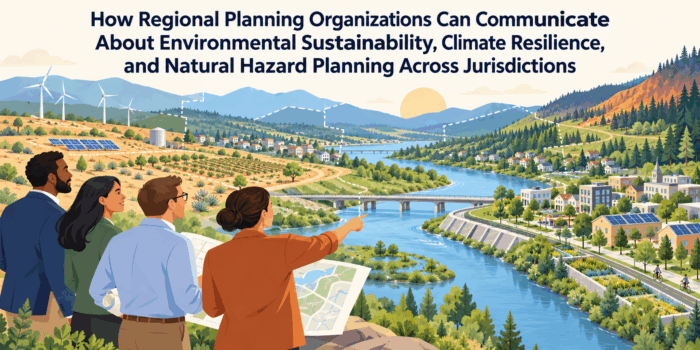
How Regional Planning Organizations Can Communicate About Environmental Sustainability, Climate Resilience, and Natural Hazard Planning Across Jurisdictions
Environmental sustainability and climate resilience are among the most technically complex and politically contested subjects in regional planning communication, and their multi-jurisdictional dimensions create communication challenges that local government environmental communication does not face. A city that is communicating about its own sustainability plan can speak directly to the specific measures it is taking within its own boundaries and can be held accountable by its own residents for the results. A regional planning organization communicating about environmental sustainability across a dozen or more jurisdictions is navigating the full range of political orientations toward environmental policy that those jurisdictions represent, the full diversity of environmental conditions and vulnerabilities that different parts of the region face, and the fundamental governance challenge that the most consequential environmental decisions are made by local governments and private actors rather than by the regional planning body itself.
Climate resilience communication is further complicated by the contested politics of climate change in many regional planning service areas, where some jurisdictions and some community members accept the scientific consensus on climate change and its regional manifestations while others remain skeptical of the premise that climate change requires the planning and investment responses that regional climate resilience plans call for. A regional planning organization that communicates about climate resilience only in the terms that climate science accepts as settled will reach some of its audiences effectively and will alienate others whose political rejection of climate policy framing prevents them from engaging with the substance of climate adaptation planning even when that planning directly addresses risks they experience and acknowledge. Finding the communication approaches that make climate resilience planning relevant and accessible across this political diversity is among the most demanding challenges in regional environmental communication.
Natural hazard planning communication spans the full spectrum of environmental risk communication, from the acute life-safety urgency of earthquake preparedness and wildfire evacuation to the slow-moving but ultimately catastrophic consequences of sea level rise, subsidence, and chronic flood risk that affect coastal and low-lying communities over planning horizons measured in decades. Each of these hazard types requires a different communication approach, a different relationship between urgency and long-range planning, and a different balance between the risk information that motivates protective action and the risk communication that can produce paralyzing anxiety or defensive denial rather than adaptive behavior.
This article examines how regional planning organizations can communicate environmental sustainability goals, climate resilience planning, and natural hazard risk across multi-jurisdictional service areas in ways that reach the full political and demographic diversity of regional communities, that connect abstract environmental projections to the specific local conditions that different communities experience, and that motivate the intergovernmental cooperation and individual protective behavior that regional environmental planning is designed to produce.
Communicating Across the Climate Policy Spectrum
 The political spectrum on climate policy within most regional planning service areas is wide enough to require genuinely different communication approaches for different political contexts, not simply different framings of the same message. A jurisdiction whose elected officials have adopted aggressive climate action plans and whose residents are engaged advocates for climate policy, receives regional climate resilience communication in a context of high receptivity that allows the regional agency to use the full vocabulary of climate science and climate policy without political filtering. A jurisdiction whose elected officials have actively opposed state climate mandates and whose residents are skeptical of climate change framing, receives the same regional communication in a context where the climate policy vocabulary functions as a political signal rather than as a planning communication tool.
Risk-based communication that focuses on specific hazards, specific vulnerabilities, and specific protective measures without leading with climate change as the causal frame, can reach politically skeptical audiences with the substance of climate resilience planning without triggering the political resistance that climate policy framing activates. The flooded highway that disrupts commutes every year due to increasingly frequent high-intensity rain events is a transportation reliability problem as well as a climate resilience problem, and communicating about the regional drainage investment that addresses it as a transportation reliability improvement reaches the skeptical audience that would reject a climate resilience investment frame. The substance of the investment is the same. The communication frame that makes it accessible to a specific audience is different.
Shared value communication that identifies the dimensions of environmental sustainability and climate resilience that cross political lines, including wildfire protection that most rural and suburban communities regardless of political orientation recognize as urgent, flood risk management that most property owners regardless of climate policy views recognize as a legitimate infrastructure investment, and drinking water quality protection that most communities regardless of political orientation support as a basic public health responsibility, builds the foundation for regional environmental communication across the political diversity of multi-jurisdictional service areas. Starting with the environmental planning dimensions that command broad cross-political support, before moving to the more contested dimensions of climate policy, is a communication sequencing approach that builds the political coalition that environmental planning requires before asking that coalition to extend to the more politically contested elements of regional environmental strategy.
Honest uncertainty communication is essential for regional environmental planning communication because the science of climate change projections, natural hazard risk assessment, and environmental outcome modeling involves genuine uncertainty that regional planning communication must acknowledge rather than conceal. The community that is told a specific flood elevation will be exceeded once every hundred years, and that subsequently experiences what regional planners told them was a hundred-year event three times in a decade, loses trust in regional environmental planning communication in ways that affect its response to future risk communication. Acknowledging the uncertainty ranges in natural hazard assessments, explaining what drives those uncertainties, and communicating how regional planning accounts for uncertainty in its investment and policy recommendations, is more honest and ultimately more credible than presenting environmental risk projections with false precision.
From Fragmentation to Coordination: Communication Strategies for Councils of Governments, Metropolitan Planning Organizations, and Regional Planning Agencies
This article is part of our series on strategic communication for Councils of Governments, Metropolitan Planning Organizations, and Regional Planning Agencies. To learn more and to see the parent article, which links to other content just like this, click the button below.
Communicating Specific Environmental Risks to Specific Communities
Flood and Stormwater Risk Communication
Flood risk is the most widespread and most community-specific natural hazard that regional planning organizations address, and it is a hazard whose communication requires geographic specificity that aggregate regional risk assessments cannot supply. A regional flood risk assessment that identifies a floodplain zone as subject to hundred-year flood risk is providing information that is meaningful for insurance and regulatory purposes but that does not tell specific communities along the floodplain how that risk translates into specific flood depths, specific flood durations, and specific asset losses during specific flood scenarios. Translating flood risk from aggregate zone designations to community-specific consequence assessments is the communication work that makes flood risk information actionable for the communities it is designed to serve.
Stormwater infrastructure communication that explains the regional stormwater system’s capacity, its performance during high-intensity rain events, where in the regional system capacity is most constrained, and what regional investment is needed to address those constraints, connects the stormwater infrastructure condition that regional planning agencies assess to the community flooding experience that residents and local governments experience after major rain events. The community that understands why its streets flood after a certain rainfall intensity, what regional stormwater infrastructure limitations produce that flooding, and what the regional investment timeline for addressing those limitations is, has a much more productive relationship with regional flood planning than the community that experiences flooding without any explanation of its systemic causes.
Climate-driven flood risk change communication that explains how flood frequencies and flood depths are projected to change in specific areas under different climate scenarios, using local historical flood data as a reference point for the projected changes, makes climate-driven flood risk concrete in terms of specific community experience rather than abstract in terms of global climate trends. A community that has experienced a specific flood event within living memory, and that is told that climate projections suggest events of that severity will occur with a frequency that is two to three times higher by mid-century, has received climate risk communication anchored in a personal reference point that abstract climate change communication cannot provide.
Wildfire Risk Communication
Wildfire risk communication in regional planning service areas that include wildland-urban interface communities requires the combination of acute preparedness communication and long-range planning communication that most regional environmental agencies have not fully integrated into a coherent regional wildfire risk communication program. The acute preparedness communication that helps residents of wildfire-prone neighborhoods create defensible space, prepare go-bags, and understand evacuation routes and triggers, is operationally urgent and locally specific. The long-range planning communication that addresses community siting decisions, regional fuel management strategies, and the infrastructure investments that reduce community wildfire vulnerability over decades, requires a different communication approach that connects individual protective action to the systemic planning dimensions that individual action alone cannot address.
Post-fire recovery communication that connects the regional planning response to a major wildfire event to the pre-fire planning decisions that shaped community vulnerability, honestly addresses what the regional planning program did and did not accomplish in reducing the affected communities’ wildfire exposure, and commits to specific changes in regional wildfire planning and investment in response to what the fire event revealed about regional planning adequacy. The community that has survived a major wildfire deserves regional planning communication that treats the fire event as a planning accountability moment rather than as a natural disaster that the planning process could not have foreseen or reduced.
Communicating Regional Environmental Planning Across Governmental Levels
Regional environmental planning operates within a complex multi-governmental framework that shapes what regional planning organizations can commit to, what they can require of member governments, and what they depend on state and federal agencies to provide. A regional climate resilience plan that identifies specific infrastructure investments as regional priorities cannot guarantee that those investments will be funded without federal or state program support. A regional natural hazard mitigation plan that identifies specific local land use changes as essential for risk reduction cannot require member municipalities to implement those changes without the state land use authority that most regional planning organizations do not possess. Communicating honestly about these governmental level dependencies, and about what regional planning can and cannot accomplish within its actual authority, is environmental planning transparency that most regional environmental communication programs have not fully developed.
Federal program relationship communication for regional environmental planning that explains what federal programs the regional plan depends on for implementation, what the regional agency is doing to position the region for federal environmental investment, and how changes in federal environmental policy affect regional environmental planning commitments, gives member governments and the public the federal governance context that makes regional environmental planning comprehensible as an element of a multi-governmental environmental management system rather than as a standalone regional program. The regional agency that communicates proactively about federal funding opportunities for regional environmental priorities, that explains how its planning positions the region for competitive grant applications, and that reports on the outcomes of federal environmental funding applications, is demonstrating the value of regional coordination in accessing federal environmental resources that no single local government could secure independently.
State regulatory relationship communication that explains how regional environmental planning connects to and is shaped by state environmental regulations, including state greenhouse gas emission reduction requirements, state natural hazard mitigation planning mandates, and state environmental review requirements for regional projects and programs, provides member governments with the regulatory context that makes regional environmental planning obligations comprehensible rather than appearing as bureaucratic requirements that the regional agency is imposing on its own initiative. Most regional environmental planning requirements originate in state or federal mandates that regional agencies are implementing, and communicating that context accurately prevents the misattribution of environmental planning obligations to regional agency overreach.
Environmental Justice in Regional Environmental Communication
The environmental justice dimensions of regional environmental planning deserve specific and prominent communication rather than treatment as a technical compliance dimension of environmental review. The communities that bear the greatest exposure to regional environmental hazards, that are located in the areas with the most significant air quality, water quality, and flood risk, and that have the least access to the resources needed to adapt to or recover from environmental disasters, are disproportionately communities of color and low-income communities. This pattern is not coincidental. It reflects historical environmental decision-making that sited polluting facilities, transportation infrastructure, and industrial land uses in communities with less political power to resist those decisions.
Environmental justice communication that honestly addresses this historical context, that identifies the specific communities that bear disproportionate environmental burdens in the regional planning area, and that explains what the regional environmental planning program is doing to address those disparities rather than perpetuating them, is the most credible and ultimately the most effective environmental justice communication available. The regional environmental plan that identifies environmental justice communities by name, documents the specific environmental burdens they face, and commits to specific investments and policy changes that address those burdens with the same specificity it applies to technical environmental measures, is a plan whose environmental justice commitment is substantive rather than rhetorical.
Community environmental monitoring programs that engage environmental justice communities in monitoring the environmental conditions they experience, that provide those communities with the training, the equipment, and the data interpretation support to conduct independent monitoring alongside the regional agency’s own monitoring program, and that treat community monitoring data as legitimate environmental evidence in regional planning decisions, are the most direct form of environmental justice partnership available to regional environmental planning organizations. Communication about these programs, including what communities are participating, what monitoring they are conducting, and what findings have emerged from community monitoring, demonstrates the environmental justice partnership in operational rather than only rhetorical terms.
Communicating Environmental Planning Success and Shortfall
 Regional environmental planning programs produce measurable outcomes in air quality, water quality, natural resource conditions, and greenhouse gas emissions that most regional organizations communicate inadequately, both when those outcomes represent genuine progress and when they reveal that regional environmental targets are not being met. Environmental plan performance communication that honestly reports current regional environmental conditions compared with plan targets, identifies whether conditions are improving or deteriorating relative to the plan’s projected trajectory, and explains what is producing the performance trends observed, is the environmental accountability communication that regional environmental planning legitimacy requires.
When regional environmental performance is falling short of plan targets, the communication challenge is to acknowledge the shortfall honestly without producing the despair or the defensive denial that environmental failure communication can generate if it is not accompanied by specific corrective commitments and evidence-based analysis of what will produce different outcomes. A regional air quality plan that is not meeting its ozone reduction targets deserves communication that identifies which emission sources are performing better or worse than expected, what the regional agency and its partners are doing to address the underperforming sources, and what the revised trajectory for meeting air quality targets looks like given current trends. This combination of honest shortfall acknowledgment and specific corrective commitment is more credible and more motivating than either the concealment of shortfall or the communication of failure without the remediation context that gives communities a reason to continue their engagement with regional environmental planning.
How Environmental Communication Compares With Other Regional Communication
Environmental sustainability and climate resilience communication differs from most other regional planning communication in the urgency that climate science attributes to the pace of action and the political contestation that environmental policy generates in most multi-jurisdictional service areas. Infrastructure investment communication can be deferred and still produce roughly similar outcomes at a later date. Environmental sustainability communication must grapple with the time-sensitivity of environmental action in ways that transportation or economic development communication does not.
The comparison with public health communication reveals a useful parallel. Both domains require communicating about risks that are real but not uniformly experienced, that are influenced by individual behavior but determined by systemic conditions, and that involve political contestation about the appropriate role of government in managing them. The communication disciplines that public health has developed for navigating these challenges, including the combination of individual risk information and systemic risk communication, the use of trusted messenger networks to reach politically diverse audiences, and the honest acknowledgment of scientific uncertainty alongside the specific guidance that uncertainty does not eliminate, are disciplines that regional environmental communication can adopt with appropriate adaptation.
Communicating Regional Environmental Monitoring Programs
Regional environmental monitoring programs that track air quality, water quality, biological conditions, and greenhouse gas emissions across the multi-jurisdictional planning area generate data that is directly relevant to local environmental planning and local environmental health decisions but that most local governments and most members of the public access rarely or never. Making regional environmental monitoring data accessible, timely, and locally relevant through effective communication programs is among the most important and most underinvested dimensions of regional environmental communication, because the data that monitoring programs generate has value only insofar as it informs the decisions of the local governments, the businesses, and the community members whose actions determine regional environmental outcomes.
Air quality monitoring communication that provides real-time and historical air quality data organized by community and by monitoring station, with plain-language interpretation of what the data means for public health and for local planning decisions, gives local governments and community members the environmental intelligence they need to evaluate local environmental conditions, to advocate for regional air quality investments, and to make daily decisions about outdoor activity that protect the health of sensitive populations. Most regional air quality agencies maintain public-facing air quality data portals, but those portals are designed primarily for technical audiences and do not provide the locally specific, plain-language interpretation that most community members need to use the data they contain.
Water quality monitoring communication that presents watershed-level water quality conditions and trends in terms that connect monitoring data to specific uses of regional water resources, including the recreational water bodies, the drinking water sources, and the aquatic habitat conditions that different community members care about for different reasons, gives the monitoring data the local relevance and the use-specific interpretation that transforms technical data into community-accessible environmental intelligence. A regional water quality report that presents nutrient loading data in technical terms serves the water quality scientists and regulators who use it as a compliance document. The same report that presents the nutrient loading data in terms of its implications for swimming safety, fishing quality, and drinking water treatment costs in specific local water bodies serves the community members and local officials who need environmental monitoring communication that connects to their specific environmental interests.
Greenhouse gas emissions monitoring communication that tracks regional progress toward regional and state greenhouse gas reduction targets, presenting emissions trend data by sector, by geography, and by the specific activities that regional planning programs are designed to affect, provides the accountability connection between regional climate planning commitments and measurable climate outcomes that makes regional climate communication credible. The regional planning organization that can show specifically how regional transportation emissions are trending relative to the plan’s targets, which emission sectors are outperforming or underperforming plan projections, and what regional planning investments and policies are contributing to the emissions trends observed, is providing the climate accountability communication that regional climate planning legitimacy requires.
Communicating About Regional Resilience Planning and Investment
Regional resilience planning addresses the full range of chronic stresses and acute shocks that climate change and other environmental drivers are creating for regional communities, infrastructure, and ecosystems. Communicating about resilience planning across multi-jurisdictional service areas requires communication that is specific about the different resilience challenges facing different parts of the region, honest about the limitations of regional resilience planning in addressing challenges that ultimately depend on local infrastructure investment and local land use decisions, and realistic about the cost and the time requirements of building genuine regional resilience rather than paper resilience that appears in plan documents but is not supported by investment.
Resilience planning communication that distinguishes between the short-term emergency preparedness dimension of resilience, including evacuation routes, emergency communication systems, and mutual aid coordination, and the long-term structural resilience dimension, including infrastructure hardening, land use risk reduction, and ecosystem-based adaptation, gives local governments and the public the planning framework for understanding how different resilience investments contribute to different dimensions of regional resilience over different time horizons. Most communities have better understanding of emergency preparedness as a resilience dimension than of the structural land use and infrastructure changes that reduce the vulnerability that emergency preparedness must manage.
Infrastructure resilience investment communication that explains the specific regional infrastructure investments being made to reduce climate vulnerability, the specific climate risks those investments address, the timeline for investment implementation, and the expected reduction in infrastructure failure frequency and severity that the investments will produce, provides the accountability connection between resilience planning commitments and resilience infrastructure delivery that regional resilience communication requires. A regional agency that commits to specific infrastructure resilience investments in its resilience plan and then reports annually on the progress of those investments, connecting the investment milestones to the risk reduction outcomes they are designed to produce, is demonstrating the institutional accountability for resilience planning that distinguishes genuine resilience commitment from resilience planning as a planning document exercise.
Nature-based solutions communication that explains the role of green infrastructure, wetland restoration, urban tree canopy, and other ecological approaches to regional resilience in the regional resilience plan, and that makes the specific co-benefits of these approaches, including stormwater management, heat island reduction, biodiversity support, and community amenity, visible alongside their primary resilience function, builds the multi-benefit case for nature-based resilience investment that is more compelling to diverse audiences than a single-benefit resilience investment case. Local governments that understand the multiple benefits of wetland restoration for flood attenuation, water quality improvement, and carbon sequestration, alongside its primary stormwater management function, are better positioned to make the land use and investment decisions that protect and restore regional wetlands than those who understand only its stormwater management value.
Communicating Environmental Standards and Regulations
Regional planning organizations that are responsible for air quality conformity, water quality planning, habitat conservation, or other regulatory environmental programs must communicate with local governments about environmental standards and regulatory requirements in ways that give those governments accurate information about their obligations, honest information about the consequences of non-compliance, and accessible technical assistance for meeting their environmental regulatory requirements within the planning and development processes that local governments manage. Environmental regulatory communication that is primarily enforcement-oriented, that emphasizes penalties and compliance timelines without providing the technical assistance that helps local governments meet those requirements, is communication that generates resentment rather than compliance and that damages the regional-local environmental planning relationship.
Technical assistance communication for environmental compliance that explains what regional environmental standards require, why those standards are necessary for the environmental quality conditions they protect, and what specific local planning and development decisions will most effectively meet those requirements, positions the regional environmental agency as a compliance support partner rather than only as a compliance enforcer. The local planning director who receives a regional environmental standards briefing that explains what development project characteristics would trigger regional environmental review requirements, what mitigation measures are most effective for different project types, and what regional technical assistance is available for environmental review, has a very different relationship with regional environmental regulation than one who receives only the regulatory notice that a specific project does not comply with regional environmental standards.
Environmental standards update communication that provides timely, accessible notification to local governments when regional environmental standards change, explains the specific changes and their implications for local planning and development decisions, and provides a reasonable transition period for local regulatory and plan updates, demonstrates the regional agency’s recognition that local governments need advance notice and technical support to implement regulatory changes effectively. Environmental standards changes that are communicated to local governments only through formal regulatory notices without adequate lead time and technical assistance produce compliance failures that are at least as much a communication failure as a regulatory failure.
Climate Communication Across Generations and Time Horizons
Climate change communication in regional planning faces the fundamental challenge of motivating action on risks whose most severe consequences will be experienced in a future that is beyond the planning horizon of most current political decision-making. A regional planning agency that is asking local governments and community members to invest in climate adaptation measures that will primarily benefit future residents, and that requires accepting near-term costs and constraints in exchange for long-term climate risk reduction, is asking for a form of governance commitment that democratic institutions, organized around election cycles and immediate constituent concerns, find structurally difficult to sustain.
Intergenerational equity framing for climate communication acknowledges the political difficulty of long-range climate commitment while making the case for it in terms that connect current governance responsibility to the interests of future generations who cannot yet advocate for themselves. The regional planning organization that frames its climate resilience investments as the fulfillment of a governance responsibility to future residents, and that communicates the specific future climate conditions that current investments are designed to prevent, is making a climate communication argument that transcends the usual political time horizons and that may reach community members and elected officials who are otherwise skeptical of long-range planning commitments.
Near-term co-benefit communication that identifies the immediate economic, health, and quality-of-life benefits of climate adaptation investments for current residents, alongside the long-range climate risk reduction that is the investments’ primary purpose, builds the political support for climate investment in the near-term political environment where most governance decisions are made. A regional green infrastructure investment that reduces current flooding frequency, improves current air quality through urban tree canopy, provides current recreational access, and reduces current energy costs through urban heat island mitigation, has a near-term benefit case for current residents and current elected officials that complements its long-range climate adaptation value.
Communicating About Regional Green Infrastructure Networks
Regional green infrastructure networks, including regional parks and open space systems, regional trail networks, regional watershed greenways, and regional habitat corridors, are among the most widely valued regional planning investments, and they are investments whose communication connects environmental planning to the recreational, health, and quality-of-life dimensions of regional environmental quality that community members most directly experience. Regional green infrastructure communication that grounds environmental planning in the specific parks, trails, and open spaces that community members use in their daily lives reaches the broadest range of community members across the political diversity of multi-jurisdictional service areas.
Regional trail and open space connectivity communication that explains how regional green infrastructure investments connect specific neighborhoods to the regional open space and trail network, what the specific connectivity gaps exist in the current system, and what the regional agency is doing to close those gaps, gives community members the specific green infrastructure picture that connects regional planning investment to their own recreational and health interests. The neighborhood not currently connected to the regional trail network but that knows a specific trail connection is committed in a specific planning horizon has a concrete regional environmental planning commitment that it can hold the agency accountable for.
Climate-ecological connectivity communication that explains the regional wildlife habitat network, the specific connectivity corridors that allow wildlife populations to move between habitat areas across the metropolitan landscape, and the specific land use and development decisions that threaten to fragment those corridors, makes the biodiversity dimension of regional environmental planning visible in terms that community members interested in regional wildlife can engage with as a specific planning priority. Regional planning that protects habitat corridors through land use policy and open space acquisition is doing conservation work that is invisible to most community members unless that work is communicated in the specific, geographically grounded terms that connect planning decisions to the wildlife values they protect.
Governance Communication as an Environmental and Equity Priority
The governance communication that regional planning organizations produce about their environmental sustainability, climate resilience, and natural hazard programs is not separate from the environmental and equity outcomes those programs are designed to achieve. Communication that makes environmental monitoring data accessible, that explains climate resilience investment rationale honestly, that engages underserved communities as genuine partners in environmental planning governance, and that holds the regional agency accountable for its environmental program outcomes, is itself an environmental and equity investment whose returns compound over time as community understanding, community trust, and community engagement improve the quality and the legitimacy of regional environmental planning decisions.
Regional planning organizations that treat governance communication as a compliance function that accompanies their substantive environmental and equity programs will produce communication that satisfies regulatory documentation requirements while failing to build the community understanding, the political coalition, and the institutional trust that their most ambitious environmental and equity goals require. Those that treat governance communication as integral to the environmental and equity outcomes they are pursuing, as the mechanism through which those outcomes are made democratically legitimate and politically sustainable, will produce communication that serves both the accountability function of democratic governance and the program function of genuine environmental and equity planning.
Tying It All Together
Environmental sustainability, climate resilience, and natural hazard planning communication across multiple jurisdictions is the most politically complex and technically demanding communication challenge in regional planning, because it requires navigating genuine scientific uncertainty, contested political framings, and the full range of community vulnerability and community political orientation that multi-jurisdictional service areas encompass. The regional planning organizations that communicate most effectively about environmental planning are those that lead with specific community risks and specific protective investments rather than with the political framework of climate change, that acknowledge uncertainty honestly while still providing the actionable guidance that uncertainty does not eliminate, and that ground environmental justice commitments in specific community investments rather than in rhetorical frameworks.
Regional environmental planning communication that builds the understanding and the motivation for protective environmental action across the political and demographic diversity of multi-jurisdictional service areas is communication that ultimately serves life safety, community resilience, and long-term environmental quality in ways that no single local government’s environmental program can achieve. The investment in this communication is an investment in the democratic engagement with regional environmental governance that genuinely serves the environmental interests of every community in the planning area, including those whose political orientation has historically led them to resist the environmental policy framing that regional environmental planning uses to justify its mandates and investments.
Strategic Communication Support for Environmental Planning
 Developing the politically diverse communication frameworks, community-specific risk communication programs, environmental justice partnership communication systems, and environmental plan performance reporting that effective regional environmental communication requires is work that most regional planning organization communication teams have not been resourced or trained to accomplish alongside their technical planning and regulatory compliance responsibilities.
Stegmeier Consulting Group (SCG) works with regional planning organizations to develop environmental sustainability and climate resilience communication programs that are built around the specific political diversity, environmental vulnerability landscape, and environmental justice context of each organization’s service area. SCG’s engagement begins with a communication context assessment that maps the political and cultural diversity of the service area relative to environmental policy, identifies the specific environmental risks that are most salient for different community types, and evaluates how current environmental communication is or is not reaching different audiences with the specific, actionable information they need to engage with regional environmental planning.
From that assessment, SCG develops the specific communication products and community engagement programs that address identified gaps, including risk-based communication frameworks for politically skeptical audiences that convey climate resilience substance without triggering climate policy resistance, community-specific flood, wildfire, and natural hazard risk communication materials that translate aggregate regional risk assessments into the locally specific consequence information that different communities need, and environmental justice community partnership communication programs that engage historically underserved communities as genuine partners in environmental monitoring and planning rather than as subjects of environmental documentation.
SCG also supports regional planning organizations in building the environmental plan performance communication systems that make regional environmental accountability visible and honest, including performance reporting frameworks that present environmental outcome data honestly relative to plan targets, corrective action communication protocols that acknowledge shortfalls specifically and commit to remediation with the same specificity, and intergovernmental environmental coordination communication that makes the regional agency’s relationships with federal and state environmental partners transparent to member governments and the public.
Future Trends in Environmental Planning Communication
Environmental planning communication is being reshaped by the increasing frequency and severity of climate-related disasters that are making abstract climate risk projections into lived community experiences that regional planning communication can no longer treat as distant future scenarios. The flooding, the wildfire, the extreme heat event, and the coastal storm surge that communities are experiencing now, within the timeframe of current regional plans, are creating communication contexts in which climate resilience planning is no longer speculative but urgently responsive to conditions that communities are experiencing in their daily lives.
Environmental monitoring technology that is making community-level environmental data increasingly accessible, including low-cost air quality monitors that can provide neighborhood-scale air quality data, satellite imagery that can track land cover change and heat island conditions at high spatial resolution, and community flood sensors that can provide real-time flood depth monitoring, is creating new possibilities for the community-level environmental data communication that makes regional environmental planning locally relevant. Regional planning organizations that integrate these community-scale data sources into their environmental communication programs are providing the geographic specificity that makes regional environmental data actionable for specific communities rather than only illustrative of aggregate regional conditions.
The climate migration and regional demographic change that climate-driven disasters are beginning to produce in many regional planning areas are creating new environmental planning communication challenges around the equity dimensions of climate adaptation. As climate change makes some parts of regions more vulnerable and other parts more attractive as refuge areas, the regional planning implications for housing, infrastructure, and community services are significant and are beginning to require communication that addresses the equity dimensions of climate-driven regional demographic change with the same specificity that regional environmental risk communication addresses physical environmental conditions.
Conclusion
Regional environmental planning communication that reaches the full political and demographic diversity of multi-jurisdictional service areas, that grounds environmental risk in specific community experience rather than abstract environmental science, and that demonstrates through specific investments and honest performance reporting that regional environmental planning is producing the environmental protection that its governance obligations require, is the most demanding and the most consequential communication investment that regional planning organizations can make. The communities that understand their specific environmental vulnerabilities, that can see the connection between regional environmental planning and their specific protective investments, and that trust regional environmental communication because it has demonstrated honesty about both successes and shortfalls, are communities that will sustain the political support for regional environmental planning that its long-term implementation requires.
The environmental challenges that regional planning organizations are addressing span timescales from the immediate life-safety urgency of acute natural hazard events to the intergenerational consequences of climate change and environmental degradation. Communication that serves these different timescales, that motivates immediate protective action while sustaining the long-range planning engagement that environmental challenges require, is communication that fulfills the democratic governance function of regional environmental planning rather than simply documenting its regulatory compliance.
Stegmeier Consulting Group’s Strategic Approach to Communication Systems
Build environmental sustainability and climate resilience communication around community-specific risk grounding, politically adaptive framing, honest uncertainty acknowledgment, and the environmental justice partnership that genuine regional environmental accountability requires.
Regional planning organizations need environmental communication that connects sustainability and climate resilience to community-specific risks, acknowledges scientific uncertainty, and reaches audiences across different perspectives on climate policy. Stegmeier Consulting Group (SCG) helps organizations develop communication programs tailored to the political, cultural, environmental, and environmental justice context of their service areas. SCG assesses community concerns, environmental vulnerabilities, audience diversity, and current communication effectiveness to identify gaps and opportunities.
Based on this assessment, SCG develops community-specific risk materials, adaptive environmental messaging frameworks, plan performance reporting systems, and environmental justice partnership programs. SCG also helps staff build sustainable communication practices through training, editorial standards, and community partnership processes that treat historically underserved communities as ongoing governance partners. The objective is an environmental communication program that builds understanding, supports informed participation, and strengthens regional collaboration on sustainability and climate resilience.
Use the form below to connect with our team and explore how strategic communication support can strengthen your organization’s environmental planning communication program.