
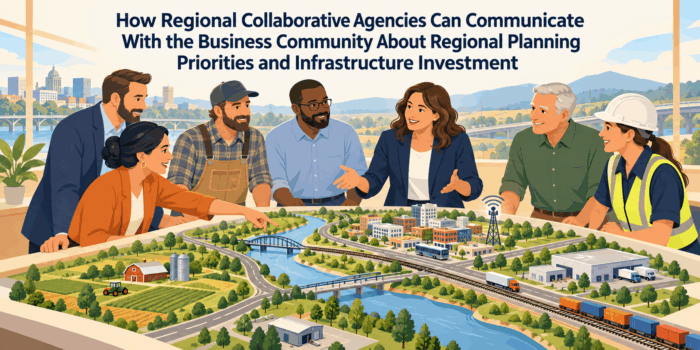
How Regional Collaborative Agencies Can Communicate With the Business Community About Regional Planning Priorities and Infrastructure Investment
The business community’s relationship with regional planning agencies is shaped by a fundamental asymmetry: businesses experience the regional planning decisions that affect their operational environment, their workforce access, their customer markets, and their competitive position, but they rarely participate in the regional planning processes that produce those decisions. The regional transportation plan that shapes freight corridor investment, the regional workforce development strategy that determines the skills pipeline for regional employers, the regional land use framework that governs where commercial and industrial development can locate, and the regional infrastructure program that determines the reliability of the utilities and transportation systems that businesses depend on, are all regional planning products with direct business relevance that most businesses have never engaged with in the planning process.
This disengagement is partly a product of how regional planning agencies have traditionally communicated with the business community. Regional planning public engagement programs are designed primarily for civic participation contexts, including community meetings held in public facilities at evening hours, planning documents written for technical audiences, and comment processes organized around regulatory requirements rather than around the business decision-making rhythms that determine when and how businesses engage with governance. A business leader who receives a notice for a regional long-range transportation plan public hearing is receiving an engagement invitation in a format and through a channel that may feel entirely disconnected from the business community’s professional context.
The opportunity is substantial. Regional planning agencies that successfully engage the business community develop a powerful constituency for regional planning investment that can advocate effectively for transportation funding, workforce development resources, and infrastructure investment through the business community’s existing political and policy channels. A regional chamber of commerce that understands the connection between regional transportation investment and regional economic competitiveness, and that advocates for regional transportation funding in state and federal legislative processes, is a more effective political advocate for regional transportation investment than the regional planning agency itself, because the business community’s advocacy does not carry the institutional self-interest that makes government agency advocacy less persuasive in legislative contexts.
This article examines how regional collaborative agencies can communicate with the business community in ways that connect regional planning priorities to the business interests that regional employers, developers, and business associations actually care about, that build genuine business community understanding of and engagement with regional planning processes, and that develop the business community advocacy relationships that make regional planning investments politically sustainable.
Connecting Regional Planning to Business Interests
 Effective business community communication about regional planning begins with a genuine understanding of what regional planning decisions actually mean for business operations, competitiveness, and location decisions. This understanding requires the regional agency to invest in the business perspective research that most planning agencies have not done systematically: interviews with regional employers about how transportation access affects their workforce recruitment and retention, with developers about how regional land use frameworks affect their project feasibility calculations, with logistics companies about how regional freight corridor investment affects their operational costs, and with small business owners about how regional infrastructure reliability affects their daily operations. Without this business perspective foundation, regional planning communication to the business community will inevitably talk past the business interests that determine whether businesses engage.
The business interests that regional planning most directly affects include workforce access, which determines whether businesses can recruit from the full regional labor pool or only from the subset reachable by existing transportation; freight and supply chain reliability, which determines the operational costs and delivery predictability that regional logistics infrastructure shapes; site availability and development feasibility, which determines whether businesses seeking to expand or locate in the region can find suitable sites at competitive costs in the regional land use framework; utility and infrastructure reliability, which determines the operational certainty that businesses depend on; and the regional talent pipeline, which determines whether the regional educational and workforce development system is producing the skills that regional employers need. Regional planning communication that explicitly connects planning decisions and investments to these specific business interests is communication that the business community finds relevant rather than abstractly civic.
Economic impact communication that translates regional planning investment decisions into the business environment terms that the business community uses to evaluate public investment, including employment impacts, wage effects, property value implications, and competitive positioning relative to peer regions, provides the business language for regional planning value that civic planning language does not. A regional transportation investment communicated in terms of its contribution to regional gross domestic product, its effect on the regional labor market access of major employers, and its competitive significance for regional freight movement, is an investment that business leaders can evaluate against the business case rather than only against a civic planning rationale.
From Fragmentation to Coordination: Communication Strategies for Councils of Governments, Metropolitan Planning Organizations, and Regional Planning Agencies
This article is part of our series on strategic communication for Councils of Governments, Metropolitan Planning Organizations, and Regional Planning Agencies. To learn more and to see the parent article, which links to other content just like this, click the button below.
Business Communication Channels and Formats
Meeting Businesses in Their Existing Networks
The most effective approach for reaching the business community with regional planning communication is to meet business leaders in their existing professional networks and communication contexts rather than inviting them to the planning agency’s own engagement formats. Regional chambers of commerce, industry associations, real estate development organizations, and business improvement districts are the organizations through which business leaders already communicate about policy issues affecting their industries and communities. Regional planning agencies that build relationships with these organizations, that provide them with accessible regional planning information tailored for business audiences, and that participate in their existing programs and events, reach business leaders through channels that carry the professional credibility of the business community’s own organizations.
Business association briefings that provide regional planning updates to chamber of commerce boards, real estate council meetings, logistics and transportation industry groups, and economic development organization leadership, in formats organized around the business implications of regional planning decisions rather than around the planning process categories that govern regional plan documents, deliver regional planning communication in the professional contexts where business decision-makers are already engaged with policy issues affecting their operations. A fifteen-minute regional transportation investment briefing at a chamber executive committee meeting, organized around the freight corridor investments that are most relevant to members’ logistics operations, delivers more business-relevant regional transportation communication than a regional public meeting attended primarily by planners and community activists.
Business-facing regional planning publications and digital communication, including economic impact analyses organized around the business community’s planning interests, project spotlights that explain the business environment implications of specific regional investments, and regular business briefings that provide regional planning updates in the formats and cadences that business audiences find useful, extend the reach of business community regional planning communication beyond the organizations and their events that in-person briefings serve. These materials should be distributed through business association newsletters, commercial real estate platforms, and the professional networks that business leaders already use to stay current on policy issues affecting their industries.
Business Case Communication
Regional planning agencies that communicate with the business community primarily through civic planning language, including terms like equity, sustainability, livability, and community resilience, are communicating in a register that many business leaders do not find immediately relevant to their operational concerns. This does not mean that equity and sustainability are not important values that the regional planning process should advance. It means that communicating those values in the terms that the business community actually uses to discuss public policy, including economic competitiveness, workforce development, infrastructure ROI, and regulatory certainty, requires the translation discipline that most regional agencies have not developed for business audiences.
Return on investment communication for regional planning investments, which presents the expected economic returns of specific regional infrastructure investments in the quantified terms that business audiences use to evaluate investment decisions, makes regional planning investment cases in the business language that business advocates can use in their own advocacy with legislators and funders. A regional transit investment whose expected returns include reduced employer transportation benefits costs, improved workforce recruitment reach, and reduced downtown parking demand that frees land for productive development, is a transit investment with a business case that the regional business community can advocate for in business terms rather than only in civic planning terms.
Regulatory certainty communication for the business community explains how regional planning frameworks provide the predictable development environment that businesses need for long-range facility planning and capital investment decisions. A regional land use framework that establishes clear, consistent development standards for commercial and industrial zones across multiple jurisdictions, reducing the regulatory uncertainty that businesses face when planning multi-site or multi-jurisdictional development, is a regional planning benefit that the business community can recognize as directly relevant to its investment planning needs. Communicating this regulatory certainty value is a regional planning business case dimension that most agencies have not developed systematically.
Engaging Real Estate and Development Communities
The real estate development community occupies a unique position in the regional planning landscape because it both responds to and shapes the regional planning environment. Developers whose projects are feasible within the regional land use framework will implement the regional development vision through their investment decisions. Developers whose projects are made infeasible by regional land use standards will advocate for regulatory changes. And the development community’s aggregate investment decisions, made within the regional planning framework, determine whether the regional transportation, housing, and economic development plans achieve their intended outcomes or fall short because the private investment they depend on does not materialize at the anticipated locations and densities.
Development community engagement in regional planning communication should address the specific regulatory dimensions of regional planning that most directly affect project feasibility: the land use designations that determine permitted development types and densities in specific areas, the transportation capacity requirements that determine what infrastructure improvements are required for development approval, the environmental review requirements that determine the cost and timeline of project approvals, and the affordable housing requirements that determine the financial feasibility of specific development types. Communication that engages the development community on these specific feasibility dimensions is communication that the development community finds directly relevant to its business decisions.
Proactive outreach to developers who are considering regional investments, providing them with early access to regional planning information, regional infrastructure investment timelines, and regional regulatory requirements that affect their specific development scenarios, positions the regional agency as a development facilitation resource rather than only as a regulatory body. A regional agency that helps a developer understand how a regional transit investment commitment affects the feasibility of a transit-oriented development project in a specific corridor, that provides the developer with the regional market data that informs the project’s financial modeling, and that facilitates the developer’s engagement with the multiple local jurisdictions whose approvals the project requires, is demonstrating the kind of regional planning service that the development community will recognize and value.
Workforce Development Communication for Employers
Regional workforce development planning, which assesses the regional labor market supply-and-demand dynamics, identifies the skills gaps that constrain regional employer growth, and coordinates the educational and training investments that address those gaps, is a regional planning function with direct relevance to every employer in the region. The manufacturer who cannot find sufficient workers with the specific technical skills their operations require, the healthcare system whose workforce pipeline is inadequate to meet its staffing needs, and the technology company whose talent recruitment is constrained by the regional education system’s output, are all experiencing the consequences of regional workforce conditions that regional workforce planning is designed to address.
Employer-facing workforce development communication that provides regional employers with regular reporting on regional labor market conditions, skills gap analyses, and workforce development program outcomes, gives employers the regional workforce context they need to plan their own talent strategies and to engage with the regional workforce development system as informed participants rather than as passive recipients of workforce development services whose relevance to their specific needs they cannot evaluate. Regional workforce reports that present labor market data in the operational terms that employers use, including specific occupational demand projections, wage rate trends for specific skill categories, and regional talent pipeline assessment by educational program and credential level, are workforce communication that the business community finds directly useful.
Employer engagement in regional workforce development planning, which solicits employer input on their specific skills needs, their evaluation of regional workforce development program effectiveness, and their willingness to participate in industry-education partnerships, produces a workforce development plan that reflects actual employer demand rather than workforce development planners’ assumptions about that demand. Communication that invites employer input in the formats and contexts that employers find accessible, including industry-specific roundtables, online employer surveys, and briefings at employer association meetings, generates the employer engagement that most regional workforce development planning has not achieved.
Infrastructure Reliability Communication for Business Audiences
The reliability of regional infrastructure, including transportation networks, utilities, and communications systems, is among the most directly experienced dimensions of regional investment quality for regional businesses, and it is a dimension whose connection to regional planning investment is rarely communicated to the business community in terms that connect infrastructure conditions to regional planning and investment decisions. A business that experiences significant losses because a regional freight corridor is repeatedly congested due to inadequate capacity, that suffers production disruptions because regional utility infrastructure is aging and failure-prone, or that loses employees because commute conditions on regional transportation corridors have deteriorated to the point of affecting recruitment, is experiencing the consequences of regional infrastructure investment decisions without understanding the regional planning dimension of those consequences.
Infrastructure condition reporting for business audiences that communicates regional infrastructure performance data in the operational terms that businesses use to evaluate infrastructure quality, including freight transit times on major corridors, utility reliability rates for commercial and industrial customers, and transportation system performance on the routes serving major employment centers, provides business audiences with the regional infrastructure picture in terms they find directly relevant. This reporting should be organized around the specific infrastructure dimensions that most affect regional business operations rather than around the asset management categories that infrastructure planners use to organize condition assessment data.
Infrastructure investment ROI communication that connects specific regional infrastructure investments to their expected business environment improvements, including congestion reduction on freight corridors, utility reliability improvements for industrial customers, and transportation access improvements for major employment centers, provides the business case evidence that business community advocates need to support regional infrastructure investment in legislative and funding processes. The business association that can cite specific congestion reduction projections and specific business cost implications for a regional freight corridor investment is a more effective legislative advocate for that investment than one that can only express general support for improved infrastructure.
How Business Community Communication Compares With Public Communication
Business community communication for regional planning agencies operates in a fundamentally different professional and organizational context than general public communication. The general public communication that most regional agencies have developed over years of federally required public participation practice is designed for civic engagement contexts, organized around regulatory requirements, and measured by public meeting attendance and comment volume. Business community communication must be organized around business decision-making rhythms, delivered through professional networks, and measured by the quality of business engagement in regional planning governance rather than by the metrics of civic participation programs.
The comparison with economic development organization communication reveals both the opportunity and the challenge. Economic development organizations that communicate with regional businesses daily, that understand the operational concerns and location decision factors that businesses prioritize, and that have built credible relationships with business leaders across the region, have developed the business communication infrastructure that regional planning agencies lack. Partnerships with economic development organizations, that leverage those organizations’ business relationships and professional credibility to deliver regional planning communication in business contexts, are among the most effective approaches available to regional planning agencies seeking to engage the business community without starting from scratch on business relationship development.
Communicating Regional Planning’s Impact on Commercial Real Estate
Commercial real estate markets in multi-county regions are shaped in fundamental ways by regional planning decisions that most commercial real estate professionals either do not track or understand only partially. Regional transportation investments that improve access to specific commercial corridors, regional land use frameworks that establish development intensity standards for commercial zones, regional infrastructure investment programs that determine the reliability of the utilities serving commercial properties, and regional economic development strategies that attract or retain the employer base that drives demand for commercial space, are all regional planning products with direct commercial real estate market implications that regional agencies rarely communicate to commercial real estate audiences.
Commercial real estate briefings that explain the regional planning dimensions of commercial market conditions to commercial real estate professionals, including the regional transportation investments that are improving access to specific commercial corridors, the regional land use framework changes that are expanding or constraining commercial development potential in specific areas, and the regional infrastructure investment timelines that affect the development feasibility of commercial sites, provide commercial real estate audiences with the regional planning context that improves the accuracy of their market analyses and site selection advice. A commercial real estate professional who understands that a specific corridor’s regional transportation investment timeline will bring transit service improvements within two years, versus another corridor where no regional transportation investment is committed, has market analysis information that their clients need for sound location decisions.
Opportunity site communication that identifies specific areas where regional planning investments are creating new commercial development potential, where regional land use framework changes are opening new commercial uses, or where regional infrastructure improvements are making previously marginal commercial sites more viable, gives the commercial real estate community the forward-looking regional planning information that private investment needs to align with regional planning visions. Regional agencies that communicate opportunity site information to commercial real estate professionals are extending the reach of regional planning investment from the public sector into the private investment decisions that will determine whether regional development visions are realized.
Regional planning regulatory education for commercial real estate professionals that explains the regional planning review and approval processes that commercial development projects must navigate, the specific regional requirements that affect commercial development feasibility in different parts of the planning area, and the regional technical assistance available to commercial developers navigating regional planning requirements, positions the regional agency as a facilitation resource for commercial development rather than only as a regulatory body whose requirements commercial developers must manage. This facilitation communication builds the development community’s understanding of and engagement with regional planning as a resource for development success rather than as an obstacle to be minimized.
Communicating With Industry-Specific Business Sectors
 Different industry sectors have different relationships with regional planning based on their specific operational dependencies on regional infrastructure, regional workforce development, and regional land use frameworks. The agricultural sector that depends on regional irrigation infrastructure, regional transportation access to markets, and regional land use policies that protect agricultural lands from development pressure, has regional planning concerns that differ entirely from those of the healthcare sector that depends on regional workforce development for clinical staff, regional transportation access for patients, and regional land use policies that support healthcare facility siting. Industry-specific regional planning communication that addresses the specific planning dimensions that most affect each sector’s operations is more effective than generic regional planning communication that attempts to speak to all business sectors simultaneously.
Healthcare sector communication that explains how regional workforce development planning is addressing healthcare staff shortages, how regional transportation planning is improving patient access to healthcare facilities, and how regional land use planning is affecting healthcare facility siting and expansion opportunities, provides healthcare executives and healthcare system planners with the specific regional planning context that is most relevant to their sector’s planning and investment decisions. The healthcare system that is planning a major facility expansion and that understands how regional transportation investment will affect patient access and staff recruitment over the next decade, is better positioned to make facility location decisions that align with regional planning opportunities than one that is making the same decisions without that regional context.
Agricultural sector communication that explains regional land use policies affecting agricultural land protection, regional water and irrigation infrastructure investment priorities, regional transportation access for agricultural goods movement, and regional workforce development for agricultural labor, provides agricultural landowners, farm operators, and agricultural industry organizations with the regional planning context that is most relevant to the long-term viability of regional agricultural operations. Agricultural sector engagement with regional planning is often limited by the perception that regional planning primarily serves urban and suburban development interests, and communication that specifically addresses regional planning’s agricultural sector implications can build the rural and agricultural engagement with regional planning that most planning agencies have not achieved.
Technology and innovation sector communication that connects regional planning priorities to the location factors that technology companies weigh in their regional expansion and talent retention decisions, including regional transportation access, regional housing cost trajectories, regional broadband infrastructure quality, and regional educational and research institution relationships, provides technology sector audiences with the regional planning information that is relevant to their location strategy and workforce planning decisions. Technology sector engagement with regional planning can produce significant advocacy benefits for regional transportation and infrastructure investment, because technology employers’ quality-of-life concerns for employee recruitment frequently align with regional transit investment and regional housing affordability planning priorities.
Building Business Advisory Structures for Regional Planning
The most effective form of ongoing business community engagement with regional planning is the formal business advisory structure that gives business community representatives a defined role in regional planning governance rather than a periodic consultation opportunity. Business advisory committees, economic development councils embedded in regional planning governance, and business liaison programs that create regular communication channels between regional agency leadership and business community representatives, provide the institutional infrastructure for sustained business community engagement that episodic outreach programs cannot sustain.
Business advisory committee design for regional planning agencies should balance the representational breadth that ensures all major business sector perspectives are included with the operational focus that keeps committee work relevant to specific regional planning decisions rather than general business advocacy. A business advisory committee that includes representatives from major employer sectors, commercial real estate, logistics and transportation, healthcare, and small business, and that is organized around specific regional planning committees whose work has the most direct business implications, is more likely to produce substantive business input to regional planning than one that meets periodically for general briefings without a specific governance connection.
Business advisory committee communication, including the regular briefing materials, the planning documents, and the investment analyses that committee members need to provide informed input on regional planning decisions, should be organized around the business perspectives of committee members rather than around the planning categories that agency staff use to structure their work. Business advisory committee members who receive planning materials organized around the planning topics their agency uses internally will find those materials less accessible and less relevant to their business perspective than members who receive materials organized around the business implications of planning decisions that their committee’s advisory role is specifically designed to address.
Reporting back to business advisory committees on how their input affected regional planning decisions, and on what the regional planning agency did in response to the concerns and recommendations that committee members raised, is the accountability communication that makes business advisory committee participation worthwhile rather than performative. A business advisory committee whose recommendations are acknowledged but never specifically addressed in subsequent planning decisions will eventually understand that its advisory role is nominal rather than genuine, and its engagement will diminish accordingly. The committee whose recommendations produce specific changes in planning approach, analysis methodology, or program design, demonstrated through specific follow-up communication, is a committee that will sustain its engagement because that engagement has demonstrated consequences.
Communicating Regional Planning’s Contribution to Business Resilience
The COVID-19 pandemic, climate-driven extreme weather events, and global supply chain disruptions have created a new business community awareness of the resilience dimensions of regional infrastructure and regional economic planning that most regional planning agencies have not yet fully incorporated into their business community communication programs. Businesses that experienced significant operational disruptions during these events, and that have subsequently invested in their own operational resilience, are businesses that are now receptive to regional planning communication that addresses the regional infrastructure resilience, regional supply chain diversity, and regional workforce resilience that their own operational resilience depends on.
Regional resilience communication for business audiences that explains how regional transportation infrastructure investment reduces the exposure of regional supply chains to single-point disruptions, how regional workforce development investment builds the labor market depth that businesses need to maintain operations during worker shortage events, and how regional land use planning reduces the concentration of business activity in areas of high natural disaster risk, provides the regional resilience framing that resonates with the post-pandemic business community’s elevated awareness of operational vulnerability. Businesses that understand the connection between regional planning investment and operational resilience are businesses that will advocate for regional planning investment as a business interest rather than treating it as a public good from which they benefit passively.
Business continuity planning partnerships between regional agencies and major regional employers, which connect regional emergency planning resources to employer business continuity planning processes, demonstrate the operational relevance of regional planning to business operations in the most practical terms available. A regional agency that provides major regional employers with access to regional emergency scenario planning data, regional evacuation route information, and regional emergency communication protocols relevant to their specific facilities and workforce, is demonstrating the connection between regional planning and business operations that abstract regional planning documents cannot convey. These partnerships build the institutional relationships that make future business community engagement with regional planning governance both more natural and more productive.
Communicating Regional Planning to Small Business Communities
Small businesses have a distinctive relationship with regional planning that differs significantly from that of large employers and commercial developers. While major employers and developers have staff resources dedicated to monitoring regional planning and engaging in regulatory processes, most small business owners lack the time, the staff resources, and the regulatory expertise to engage actively with regional planning processes that significantly affect their operating environments. The small business district that is affected by a regional transportation investment decision, the small manufacturer that depends on regional freight infrastructure quality, and the small retailer whose customer access depends on regional transit service, are all experiencing regional planning consequences without the institutional capacity to participate in the regional planning decisions that produced them.
Small business-specific regional planning communication that meets small business owners in the contexts they already engage with, including business improvement district meetings, small business development center programs, and local chamber of commerce events, and that explains regional planning implications in the operational terms that small business owners find directly relevant, reaches the small business community with regional planning information in ways that general regional planning outreach does not. A small manufacturer who learns at a business improvement district meeting that a regional freight corridor investment will reduce their inbound shipping costs by a specific percentage, or that a regional transportation authority park-and-ride expansion near their commercial district will increase customer access, has received regional planning communication in terms directly relevant to their bottom line.
Regulatory assistance for small businesses navigating regional planning requirements, including accessible plain-language guides to regional development review requirements, direct assistance for small business owners dealing with regional planning processes for the first time, and streamlined regional review procedures for smaller-scale development projects that do not warrant the full regional review burden designed for major developments, demonstrates the regional agency’s recognition that small businesses deserve regional planning service calibrated to their institutional capacity rather than to the capacity of major developers. Communicating the availability of this small business regulatory assistance, through the small business networks that small business owners actually use, is the regional planning service communication that most directly affects how small businesses experience regional planning as a resource or as an obstacle.
Small business impact assessments for major regional planning decisions that specifically analyze how those decisions affect the operational and financial conditions of small businesses in the affected areas, and that communicate those findings to small business communities through accessible channels before decisions are finalized, give small business owners the opportunity to engage with regional planning on the basis of their specific operational interests rather than only as members of a general public whose diverse concerns regional planning agencies address generically. A regional transportation construction project whose small business impact assessment finds that access restrictions will significantly reduce revenue for specific retail categories during the construction period, and whose communication includes specific mitigation measures for affected small businesses, is a project whose small business community communication reflects genuine recognition of the small business stake in regional planning decisions.
Tying It All Together
Regional planning agencies that communicate effectively with the business community build a constituency for regional planning investment that amplifies the agency’s own advocacy capacity in ways that no amount of internal communication investment can replicate. A regional business community that understands the connection between regional transportation investment and regional economic competitiveness, between regional workforce development and regional employer productivity, and between regional land use planning and regional development feasibility, is a business community that will advocate for regional planning investment through its own channels, its own political relationships, and its own organizational credibility in ways that make regional planning politically sustainable.
Building this business community understanding requires the communication investment of meeting businesses in their existing professional networks, translating regional planning priorities into business language, providing business-relevant regional data and analysis, and demonstrating through specific examples how regional planning decisions affect the business environment that regional employers, developers, and business associations operate within. That investment is more modest than its returns, because the business community’s advocacy capacity for regional planning investment is among the most valuable political resources that regional agencies can develop.
Strategic Communication Support for Business Community Engagement
 Developing the business association briefing programs, employer-facing workforce development reports, infrastructure reliability communication for business audiences, development community engagement systems, and business case communication materials that effective business community regional planning communication requires is work that most regional agency communication teams have not been staffed or resourced to accomplish alongside their civic planning communication and regulatory compliance responsibilities.
Stegmeier Consulting Group (SCG) works with regional collaborative agencies to develop business community communication programs that are built around the specific regional economy, the specific business community organizations and networks in each agency’s service area, and the specific regional planning priorities that most directly affect regional business operations. SCG’s engagement begins with business community stakeholder research that identifies the specific regional planning interests and communication preferences of the major employer, developer, and business association sectors in the service area, and that assesses how well current regional communication is reaching and engaging those sectors.
From that research, SCG develops the specific business communication products and engagement programs that address identified gaps, including business-facing regional planning briefing materials organized around specific industry and sector interests, infrastructure reliability reporting formatted for business audiences, regional workforce development reporting tailored to employer information needs, and economic impact communication frameworks that translate regional planning investment cases into the business language that business community advocates can use in their own advocacy. SCG also develops the business association partnership frameworks that give regional agencies access to business community networks without requiring the agencies to build those networks from scratch.
SCG works with regional agency staff to build the organizational practices that sustain business community communication as a continuous program rather than a periodic outreach exercise, including regular briefing schedules with major business associations, employer engagement protocols for workforce development planning cycles, developer outreach practices for major regional planning updates, and business advisory committee structures that give the regional business community ongoing voice in regional planning governance. The objective is a regional business community that understands regional planning as relevant to its interests and that advocates for regional planning investment through its own channels.
Future Trends in Business Community Communication
The regional business community’s engagement with regional planning is being reshaped by the growing recognition that regional planning decisions have material effects on business competitiveness, employee attraction and retention, and the long-term viability of regional business locations. The businesses that have suffered from regional infrastructure neglect, from regional housing cost increases that have made workforce recruitment difficult, and from regional transportation congestion that has increased their logistics costs, are businesses that have direct experience of the business consequences of regional planning quality that the broader business community can learn from.
Environmental, social, and governance considerations in business investment decision-making are also creating new business community interest in regional sustainability planning, regional climate resilience investment, and regional equity initiatives that connects business decision-making to regional planning dimensions that the traditional business community has not engaged with. Regional planning agencies that communicate the business case for sustainability and resilience investment in terms that connect to corporate ESG commitments and investor expectations, are finding new audiences in the business community for regional planning communication that would previously have been dismissed as civic rather than commercial.
Remote work patterns that have shifted where knowledge workers live relative to where they work are creating new regional economic geography dynamics that regional planning agencies must understand and communicate about in ways that engage the business community’s evolving location strategy. The regional planning agency that can communicate specifically about how remote work patterns are affecting regional commute patterns, regional housing demand, and regional commercial real estate conditions, and what regional planning investments and policies are most important for maintaining regional economic competitiveness in a hybrid work environment, is communicating about the business environment dimensions of regional planning that the post-pandemic business community most needs to understand.
Conclusion
Regional planning agencies that communicate effectively with the business community build the most durable form of political support for regional planning investment available: the advocacy of organizations and leaders whose endorsement of public investment carries the economic credibility and the political access that civic advocacy alone cannot provide. The regional transportation investment that is endorsed by the regional business community as an economic competitiveness priority, the regional workforce development initiative that is supported by major regional employers as essential to their operational sustainability, and the regional land use framework that is embraced by the development community as a foundation for investment certainty, are all regional planning products whose political sustainability is strengthened by the business community’s engagement in ways that civic support alone cannot match.
Building that business community engagement requires the communication investment of understanding what regional planning means for regional business operations, translating regional planning language into business language, and demonstrating through specific examples how regional planning decisions affect the business environment. That investment is both a communication practice and a planning quality improvement: regional agencies that genuinely engage the business community in regional planning produce plans that are more responsive to regional economic conditions and more aligned with the investment and location decisions that will determine whether regional planning visions are realized.
Stegmeier Consulting Group’s Strategic Approach to Communication Systems
Build business community communication around the specific regional planning interests of employers, developers, and business associations, translating planning priorities into business language and developing the advocacy relationships that make regional planning investments politically sustainable.
Regional planning agencies need communication that connects regional planning decisions to the operational, investment, and competitive interests of the business community. Stegmeier Consulting Group (SCG) helps agencies develop business communication programs tailored to their regional economy, employer networks, business associations, and planning priorities. SCG conducts stakeholder research to identify major business sectors, the planning issues that affect them, and gaps in current engagement, creating a clear basis for targeted communication and outreach.
Based on this research, SCG develops business association briefings, employer-focused planning reports, business case communication frameworks, and development community engagement systems. SCG also helps establish ongoing relationship structures, including regular business briefings, employer engagement protocols, and advisory groups that give businesses a continuing voice in regional planning. The objective is a business community that understands the value and implications of regional planning and can participate meaningfully in its future.
Use the form below to connect with our team and explore how strategic communication support can strengthen your agency’s business community communication program.