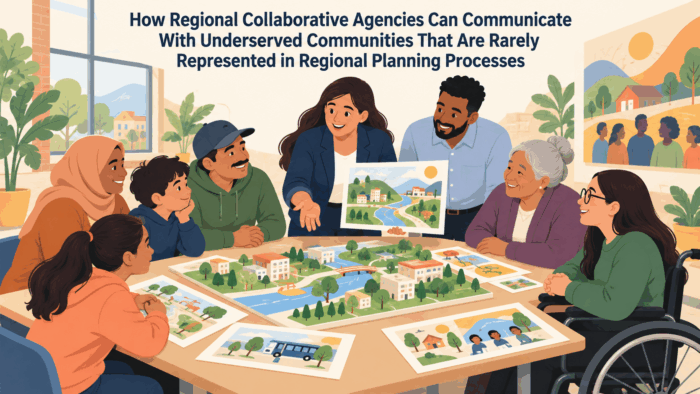
How Regional Collaborative Agencies Can Communicate With Underserved Communities That Are Rarely Represented in Regional Planning Processes
The communities that are least represented in regional planning processes are typically those whose transportation, environmental, housing, and economic conditions are most significantly shaped by regional planning decisions. The low-income neighborhood whose residents depend on transit but whose transportation needs have historically been underrepresented in regional transportation planning is a neighborhood whose absence from planning processes is both a democratic failure and a planning quality failure: a failure of governance because those residents have as much right to participate in the decisions that shape their community as residents with more political access, and a failure of planning quality because the transportation conditions of the most transit-dependent neighborhoods are precisely the conditions that regional transportation planning most needs to understand and serve.
The underrepresentation of specific communities in regional planning is not primarily a communication problem. It is a structural problem rooted in the design of planning processes around the participation norms of the communities that have historically engaged, in the location and timing of public engagement activities that are convenient for some populations and inaccessible for others, in the language and format of planning communication that serves literate English-speaking audiences and fails others, and in the historical experience of governance that many underserved communities have had, in which their participation produced no visible change in the planning decisions that followed. Communication improvements alone will not solve these structural barriers. But communication that is genuinely designed to reach underserved communities, that is delivered through trusted channels, and that is honest about what participation can and cannot influence, is the necessary starting point for the broader structural change that genuine representation requires.
The term underserved communities encompasses significant diversity that regional planning communication must engage specifically rather than treating as a monolithic category. Communities may be underrepresented in regional planning because of language barriers, because of geographic isolation from planning processes designed for urban and suburban participation, because of cultural distance from the civic participation norms that planning processes assume, because of historical distrust of government institutions, because of work schedules that make evening public meetings inaccessible, or because of documented prior experience in which participation produced no visible influence on planning outcomes. Each of these barriers requires a different communication response, and treating underserved community communication as a single program rather than as a set of community-specific engagement designs will reproduce rather than address the diversity of barriers that underserved communities face.
This article examines how regional collaborative agencies can communicate with and genuinely engage underserved communities that have historically been absent from regional planning processes, including how to identify and address the specific barriers that different underserved communities face, how to build the trusted community relationships that make engagement genuine rather than performative, and how to design the participation programs and the accountability feedback loops that give underserved communities reason to believe that their participation will actually influence regional planning outcomes.
Identifying Underserved Communities and Their Specific Barriers
 The first step toward genuine communication with underserved communities is honest identification of which communities are underrepresented in current planning processes and why. This identification requires going beyond demographic analysis, which can identify communities that are statistically underrepresented in planning participation relative to their share of the regional population, to the community research that reveals the specific barriers that different underserved communities face. A demographic analysis might identify that Spanish-speaking households are underrepresented in regional planning public meetings relative to their share of the regional population. Community research conducted with Spanish-speaking community members and the organizations that serve them will reveal whether the barrier is language access in meeting materials and meetings, transportation access to meeting locations, childcare availability during meetings, awareness that the meetings exist, distrust of the regional planning process, or some combination of factors that require different responses.
Barrier identification research should be conducted in partnership with community organizations that have established relationships with underserved communities rather than through standard survey methods that reach self-selected respondents who are already more engaged with government processes than the communities being studied. A community health organization that serves a low-income immigrant neighborhood has the community relationships and the cultural competency to conduct barrier identification research that produces accurate, community-validated findings rather than the research artifacts that arise when government agencies conduct their own research about communities whose institutions and norms they do not fully understand.
Geographic isolation as a participation barrier deserves specific attention in regional planning service areas that span urban cores and rural peripheries. The rural township at the edge of a regional planning area may be geographically and culturally distant from the urban center where most regional planning activities occur, and the residents of that township may face hour-long drives to regional meetings whose substance does not reflect their community’s specific planning conditions or priorities. Geographic isolation barrier research should map the distance and transportation requirements for participating in current regional planning activities for residents in different parts of the service area, and should identify the regional planning service area geography whose residents face the most significant geographic barriers to standard participation program formats.
Historical experience of governance as a participation barrier is among the most consequential and the least acknowledged factors in underserved community underrepresentation in regional planning. Communities that have experienced decades of planning decisions that overrode their preferences, that relocated incompatible land uses into their neighborhoods, that failed to invest in their transportation and infrastructure needs, and that consulted them without any visible influence on planning outcomes, have rational reasons for not investing their time and energy in regional planning processes that have not demonstrated they will respond to that investment differently than prior processes did. Acknowledging this history honestly in communication with these communities, and making specific commitments about how current processes will treat community input differently than past processes did, is a necessary starting point for engagement with communities whose distrust of planning processes is grounded in documented experience rather than in misunderstanding.
From Fragmentation to Coordination: Communication Strategies for Councils of Governments, Metropolitan Planning Organizations, and Regional Planning Agencies
This article is part of our series on strategic communication for Councils of Governments, Metropolitan Planning Organizations, and Regional Planning Agencies. To learn more and to see the parent article, which links to other content just like this, click the button below.
Building Trusted Community Relationships
Community Organization Partnerships
The most effective communication with underserved communities runs through the organizations that those communities already trust, that understand their cultural norms and communication preferences, and that have established relationships that give them both the access and the credibility to reach community members who would not engage directly with a regional planning agency. Community health centers that serve low-income neighborhoods, immigrant services organizations that work with non-English-speaking communities, faith communities whose congregations include residents from underserved neighborhoods, disability advocacy organizations that represent transportation-disadvantaged populations, and community development corporations that work in historically disinvested areas, are all organizations whose community trust is a planning engagement resource that regional agencies cannot replicate but can partner with.
Partnership-based communication requires genuine organizational investment rather than simple information-sharing agreements. A regional agency that asks community organizations to distribute its meeting notices has created a distribution partnership. A regional agency that works with community organizations to co-design participation activities that fit community members’ schedules and cultural contexts, that compensates those organizations for the engagement facilitation work they do, that provides them with the technical briefings and planning materials they need to accurately represent regional planning issues to their members, and that shares planning decision authority with communities that provide sustained planning engagement, has created the genuine partnership that underserved community communication requires. The difference between these two types of partnership is visible to the community organizations involved and to the community members they serve.
Community liaison programs that hire or contract community members from underserved communities as regional planning engagement liaisons, who work within their own communities to facilitate regional planning participation and who bring community perspectives back into the regional planning process, create the institutional bridge between the regional agency and underserved communities that external partnerships alone cannot sustain. A community liaison who lives in the neighborhood they are engaging, who speaks the language and shares the cultural background of the community members they are working with, and who has direct access to regional planning staff and information, is a more effective engagement communicator than any external outreach program that a regional agency can produce from the outside looking in.
Long-Term Relationship Investment
Genuine engagement with underserved communities requires sustained relationship investment that extends well beyond specific planning cycles and specific public participation campaigns. The community organization that is contacted only when a regional planning process requires public engagement, and that hears from the regional agency only at intervals of years, will not develop the institutional relationship depth that genuine community partnership requires. The community organization that is in regular contact with regional planning staff between planning cycles, that receives ongoing updates about regional planning developments affecting its community, that is consulted about program design before participation campaigns are launched, and that has direct access to regional planning leadership, has an institutional relationship with the regional agency that produces the trust on which genuine planning partnership depends.
Long-term relationship investment in underserved community engagement requires organizational commitment that most regional planning agencies have not sustained across planning cycles and staff transitions. The staff member who builds a strong relationship with a specific community organization is building an institutional relationship that belongs to the regional agency, not only to themselves, and the organizational systems that preserve that relationship through staff transitions, that document the specific partnership practices and the specific community organization relationships that have been most productive, and that invest in the relationship continuity that makes community trust an institutional asset rather than a personal one, are the organizational infrastructure that makes sustained underserved community engagement possible.
Designing Participation That Works for Underserved Communities
Participation programs that are designed around the schedules, the geographic access, the language abilities, the cultural communication norms, and the civic participation experience of underserved community members are participation programs that will produce genuine engagement rather than documenting the impossibility of reaching communities that the program design has made inaccessible. Designing participation for underserved communities requires starting with the question of what participation format, timing, location, and support would allow specific community members to participate meaningfully, and building the program around those answers rather than around the participation format that is most convenient for planning staff to administer.
Location flexibility that brings regional planning engagement into the communities that have historically been expected to travel to the planning agency, including holding planning meetings in community centers, faith communities, libraries, and other facilities that are already trusted and regularly attended by underserved community members, reduces the geographic and cultural barriers that meeting-in-a-government-building formats create for communities whose experience with government institutions is predominantly negative. A planning meeting held at a community health center where residents regularly come for services is a meeting that reaches community members in a trusted context that reduces the institutional distance between the community and the regional planning process.
Timing flexibility that schedules regional planning participation activities at the times when community members are actually available, including Saturday morning community meetings that serve working adults who cannot attend weekday evening meetings, mobile engagement activities that reach community members at farmers markets, transit stops, and community events where they are already present, and digital participation tools that allow community members to engage at any time and from any location, extends participation access to the community members whose schedules and geographic circumstances the standard evening public meeting format most systematically excludes.
Participation support services that remove the practical barriers to participation, including childcare provided at planning meetings, transportation assistance for community members who cannot reach meeting locations independently, interpretation services that allow community members to participate in their primary language, and food and refreshments that make attendance at planning events practically feasible for community members who work through typical meal times, demonstrate the agency’s genuine commitment to participation equity rather than its nominal commitment to open participation that is undermined by practical barriers that the agency has not invested in removing.
Communicating in the Languages of Underserved Communities
Language access in regional planning communication is a legal requirement for agencies that receive federal funding and a fundamental equity obligation that extends beyond legal compliance to the genuine accessibility of planning information for all community members whose lives regional planning decisions affect. The regional agency that satisfies language access requirements by providing translated meeting notices while conducting all planning discussions in English, that offers translated versions of planning documents that are not also simplified for the reading levels of translation target populations, or that provides interpretation services at public meetings without ensuring that those services are actually effective for the community members who need them, is meeting the letter of language access requirements while failing the spirit of language access as a genuine equity commitment.
High-quality translation and interpretation requires investment in the native speaker review and cultural adaptation that machine translation cannot provide and that bilingual staff without professional translation training cannot reliably deliver. A planning document that is translated by a bilingual staff member without professional translation training may be technically accurate but may use formal or institutional language that does not reflect the communication norms of the target language community. A public meeting with professional interpretation services that allow community members to speak in their primary language and to receive planning presentations in that language, and to have their contributions taken as seriously as contributions made in English, is a meeting that genuine language access requires but that most regional planning agencies have not invested in providing consistently.
Language access monitoring that assesses whether translated materials are actually reaching and being used by target language communities, whether interpretation services are effective for the community members who use them, and whether the quality of planning engagement from non-English-speaking community members is comparable to the quality of engagement from English-speaking participants, provides the quality assurance that genuine language access requires. A language access program that is assumed to be effective without measurement is a program that is optimizing for compliance documentation rather than for genuine communication equity.
Closing the Participation Feedback Loop for Underserved Communities
The participation feedback loop that shows underserved community members that their input actually influenced regional planning decisions is the most important and the most consistently absent element of underserved community engagement programs. Communities that have participated in regional planning processes and received no subsequent communication about how their input affected planning outcomes have participated in a process whose feedback loop is absent. For communities whose historical experience of government engagement is that their input is documented but not acted upon, this absent feedback loop confirms the distrust that prior experience has earned rather than building the trust that genuine engagement requires.
Specific, honest feedback communication that connects the input provided by specific underserved communities to specific changes in regional planning analysis, planning priorities, or plan commitments, demonstrates that participation produced genuine influence rather than documented consultation. This communication should be delivered through the community organizations and community channels that were used for the original outreach, not only through the planning agency’s standard communication channels, ensuring that community members who participated through community partner organizations receive the feedback about planning outcomes in the same trusted channels through which they were engaged.
When community input raises concerns or priorities that regional planning processes cannot fully address due to fiscal, technical, or political constraints, the feedback communication should honestly explain those constraints rather than simply noting that the input was received and considered. The underserved community that is told specifically why its transportation priority was not included in the near-term regional program, what the specific constraints were, and what the agency is committed to doing to address the priority in future cycles, has received honest feedback that respects the community’s investment in participation even when that investment did not produce the specific outcome the community sought. The community that receives no specific feedback, or feedback that acknowledges its input without explaining why it did or did not influence outcomes, receives the communication that confirms its distrust was warranted.
How Underserved Community Communication Compares With General Public Communication
 Communication with underserved communities is not simply general public communication delivered through additional channels or in additional languages. It requires fundamentally different communication design, different organizational investments, and different accountability standards than the general public communication that most regional agencies have built around the participation norms of communities that have historically engaged. General public communication can be designed for the medium-educated, English-literate, digitally connected, civically engaged resident who is the implicit default audience for most government communication. Underserved community communication must be designed specifically for the community members it is trying to reach, with the specific barriers, the specific communication preferences, and the specific cultural and institutional relationships of those communities at the center of its design rather than at the periphery.
The accountability standard for underserved community communication is also more demanding than for general public communication, because the democratic representation gap that underserved community underrepresentation creates is not simply a communication failure but a governance failure that planning agencies are responsible for addressing. Measuring the success of underserved community communication against the same output metrics that general public communication uses, counting meetings held and materials distributed, without measuring whether those efforts produced genuine engagement from underserved communities that influenced planning outcomes, is measuring the activities of outreach without the governance quality of representation.
Communicating Regional Planning’s Historical Relationship With Underserved Communities
The historical relationship between regional planning and many underserved communities is a relationship of harm as much as service. Regional transportation planning produced the highway projects that bisected and isolated urban neighborhoods of color in the mid-twentieth century. Regional land use planning legitimized exclusionary zoning that concentrated poverty and environmental burden in specific communities. Regional economic development planning directed investment toward areas with the most political access while systematically underinvesting in communities that lacked the political connections to attract regional resources. This history is documented, remembered by the communities that experienced it, and shapes how those communities receive current regional planning communication regardless of how much current planning has changed from its mid-century predecessor.
Acknowledging this history in regional planning communication with underserved communities is not simply a political or rhetorical gesture. It is the honest institutional communication that genuine trust building requires. A regional planning organization that communicates with communities of color or low-income communities without acknowledging the prior planning decisions that shaped their current conditions will be received as an institution that is either unaware of its own history or unwilling to acknowledge it, and neither reception supports the trust building that genuine engagement requires. Acknowledging prior planning harms, explaining what has changed in current planning processes and investment priorities, and committing to specific reparative investments and policy changes that address the legacy of prior planning decisions, is the historical accountability communication that positions the regional agency as a genuine partner for communities whose prior experience with planning was harm.
Reparative investment communication that specifically identifies and communicates about regional planning investments that are designed to address prior planning harms in specific communities, including the transit investments that connect historically isolated neighborhoods to regional employment opportunities, the green infrastructure investments that reduce the environmental burden concentrations that prior planning decisions created, and the affordable housing programs that address the displacement pressures that prior planning generated, connects current regional planning to the specific reparative purpose that provides the most compelling rationale for planning investment in historically underserved communities.
Community history recognition in regional planning communication that acknowledges the specific planning decisions that shaped specific communities’ current conditions, that names the specific planning processes and specific policy decisions that produced the harms that specific communities experience, is the most direct form of historical accountability communication available to regional planning organizations. A regional planning organization that can tell a specific community the history of the planning decisions that resulted in the highway through its neighborhood, the zoning that prevented the commercial development that would have provided local employment, or the transit disinvestment that limited residents’ access to regional job centers, and that connects that history to current planning commitments to address those legacies, is communicating with the historical specificity that genuine reparative partnership requires.
Indigenous and Tribal Community Communication
Indigenous and tribal communities represent a specific category of underserved community in regional planning that requires communication approaches distinct from those appropriate for other underserved populations, because tribal governments are sovereign governmental entities with their own planning authority and their own governmental relationships with federal agencies, state agencies, and local governments that differ fundamentally from those of non-governmental community organizations. Regional planning organizations that treat tribal governments as community stakeholders to be engaged in standard public participation processes are misunderstanding the governmental status of tribal governments and are failing to develop the government-to-government consultation relationships that federal law and federal planning regulations require.
Government-to-government consultation with tribal governments is a legal obligation for regional planning organizations that receive federal transportation, environmental, or housing funding, and its communication requirements are distinct from standard public participation. Tribal consultation requires early, meaningful engagement with tribal governments before planning decisions are made, respect for tribal governments’ rights to provide input through their own governance processes rather than through individual participation in public meetings, and genuine responsiveness to tribal government concerns rather than documentation that consultation occurred. Most regional planning organizations have not developed the government-to-government consultation practices and the communication protocols that genuine tribal consultation requires.
Cultural resource and traditional land communication for regional planning that involves the geographic areas of traditional tribal use requires specific collaboration with tribal governments whose knowledge of cultural resources, sacred sites, and traditional land use practices in the regional planning area is not captured by standard cultural resource surveys and should not be expected to be fully disclosed in public planning processes. Communication about regional plans and projects that affect areas of traditional tribal significance should begin with confidential tribal government consultation before public engagement, and should incorporate tribal government guidance about what aspects of cultural resource information can and cannot be shared in public planning processes.
Tribal economic development and regional economic coordination communication that engages tribal governments as regional economic development partners, connecting tribal economic development interests to regional planning priorities and regional infrastructure investment in ways that respect tribal sovereignty while building the regional economic coordination relationships that serve both tribal and non-tribal communities in the planning area, is the economic development communication dimension of regional-tribal planning relationships that most regional planning organizations have not developed as a systematic communication program.
Youth Engagement in Regional Planning
Young people are the population that will live longest with the consequences of current regional planning decisions and that has the most significant stake in the long-range planning commitments that regional planning organizations make on behalf of communities whose full population is not yet present. Yet young people are among the least represented in standard regional planning participation programs, which are organized around the civic participation norms of adult community members and which do not typically reach young people through the educational institutions, the digital platforms, and the social networks where young people actually spend their time and form their civic identities.
Youth participation in regional planning is valuable not only as an equity objective but as a planning quality investment, because young people’s transportation patterns, environmental concerns, housing preferences, and economic aspirations differ systematically from those of older adults in ways that should influence regional planning priorities rather than being excluded from the planning process by participation program designs that consistently fail to reach them. A regional transportation plan developed without genuine youth input will reflect the transportation preferences and the transportation experience of the adult working population that attends public meetings, and will underrepresent the transit, cycling, and pedestrian transportation that younger populations disproportionately use and prefer.
School-based regional planning engagement programs that bring regional planning issues into classroom curricula, that engage students in community condition assessment and planning proposal development, and that connect student work to formal regional planning processes that take student input seriously as a form of community participation, reach young people in the educational settings where they spend most of their time and where planning issues can be connected to the educational content that students are already engaging with. A regional planning organization that partners with school districts to integrate regional planning into social studies, environmental science, and civic education curricula is building the next generation of engaged regional planning participants while also improving the current generation of regional plans through the youth perspectives those programs contribute.
Digital youth engagement that reaches young people through the social media platforms, gaming environments, and digital civic spaces where they actually spend time, rather than through the email lists and government websites that adult civic participation programs rely on, extends regional planning communication reach into the digital spaces where young people are already present. Regional planning organizations that have developed social media communication strategies specifically designed for younger audiences, that use visually compelling formats, relatable scenarios, and interactive digital tools that resonate with younger participants’ communication preferences, are building the youth engagement that most planning agencies claim to want but few have invested in achieving.
Measuring and Reporting Underserved Community Engagement Quality
The quality of regional planning engagement with underserved communities cannot be adequately measured by the output metrics that most regional planning agencies use to evaluate their public participation programs. Meeting attendance counts, comment totals, and outreach activity logs describe what the agency did without revealing whether those activities produced the genuine engagement, the planning influence, and the trust building with underserved communities that genuine participation programs are supposed to achieve. Measuring the quality of underserved community engagement requires outcome measures that assess whether specific underserved communities actually participated, whether their participation was substantively comparable in quality to participation from more typically engaged communities, and whether their input demonstrably influenced planning outcomes.
Participation equity reporting that disaggregates participation data by the demographic characteristics of participants, presenting the participation rates of specific underserved communities relative to their share of the regional population and relative to the participation rates of more typically engaged communities, provides the equity accountability that output metrics alone cannot supply. A regional planning organization that knows that Spanish-speaking residents represent twenty percent of its service area population but three percent of its public meeting participants has specific evidence of a participation equity gap that it can then investigate for root causes and address with specific program changes. A regional planning organization that knows only that it held twenty public meetings and received three hundred comments has no evidence of whether those meetings and comments represented the full diversity of its service area.
Planning outcome equity analysis that assesses whether regional planning decisions reflect the priorities and concerns of underserved communities in proportion to their share of the regional population, or whether they primarily reflect the priorities of the more politically connected and more participation-active communities that attend public meetings and submit formal comments, provides the governance accountability measure that participation equity requires. This analysis is more demanding than participation equity reporting because it requires comparing the substance of planning decisions against the substance of underserved community input rather than only counting participation, but it is the measure that most directly addresses whether the democratic governance function of public participation is actually being served.
Communicating Regional Planning to Disability Communities
Disability communities represent a specific underserved population in regional planning whose transportation, housing, and environmental planning needs differ in important ways from the general population and whose underrepresentation produces planning decisions that systematically fail to meet those needs. The regional transportation plan developed without meaningful input from community members with mobility, visual, hearing, or cognitive disabilities will not produce the transit system, pedestrian network, and transportation technology that disability community members need for full regional mobility.
Disability-specific regional planning communication that provides information in accessible formats for different disability communities, including screen-reader-compatible digital content for blind community members, captioned video for Deaf community members, plain-language materials for community members with cognitive disabilities, and physically accessible meeting formats for community members with mobility disabilities, goes beyond ADA compliance to genuine communication equity for the full range of disability communities in the regional planning area.
Disability community advisory involvement in regional planning that engages disability advocacy organizations in reviewing regional plan documents, transportation project designs, and housing program designs for accessibility impacts before those decisions are finalized, produces more accessible plans and projects than those reviewed only by disability advocates after design decisions have been made. A regional transportation project that incorporates disability community feedback during design development is more likely to be genuinely accessible than one that is designed without disability community input and then modified to address accessibility issues discovered during or after construction.
Disability community emergency communication that specifically addresses the needs of disability community members who may be unable to access standard emergency notification channels, receive emergency information in standard formats, or respond to emergency situations through the same means as non-disabled community members, is a critical gap in most regional emergency planning communication programs. Regional planning organizations that work with disability advocacy organizations to develop disability-specific emergency communication protocols, test those protocols through engagement with disability community members, and integrate disability-specific communication into regional emergency response plans, are demonstrating the emergency communication equity that regional emergency planning governance requires.
Tying It All Together
Communicating with underserved communities that are rarely represented in regional planning processes is the most fundamental equity obligation that regional collaborative agencies carry, because it is the obligation that determines whether regional planning governance serves all communities in the planning area or primarily those with the most political access and the most compatible participation norms. The planning that produces better outcomes for underserved communities is not just more equitable planning. It is better planning, because it is planning that is informed by the conditions, the priorities, and the specific transportation, environmental, and economic needs of the communities whose underrepresentation has historically limited the quality and the legitimacy of regional planning decisions.
Building genuine communication and genuine engagement with underserved communities requires the organizational commitment to partnership-based outreach, community-centered participation design, high-quality language access, and honest participation feedback loops that most regional agencies have not fully sustained across planning cycles. That commitment is both a democratic obligation and a planning quality investment, and the agencies that make it consistently find that their plans are more responsive, their political coalitions more diverse, and their governance more legitimate than those that treat underserved community engagement as a compliance activity rather than as a governance imperative.
Strategic Communication Support for Underserved Community Engagement
 Developing the barrier identification research programs, community organization partnership frameworks, community-centered participation designs, language access quality systems, and participation feedback loop communication that genuine underserved community engagement requires is work that most regional collaborative agency communication teams have not been staffed, resourced, or trained to accomplish. The combination of community research expertise, cultural competency, language access quality assurance, and participatory program design that genuine underserved community communication demands makes external communication support a productive investment for agencies seeking to move beyond compliance-level outreach to genuine community governance.
Stegmeier Consulting Group (SCG) works with regional collaborative agencies to develop underserved community communication and engagement programs that are built around the specific underserved communities in each agency’s service area, the specific barriers those communities face to regional planning participation, and the specific community organization relationships that provide the trusted communication channels genuine engagement requires. SCG’s engagement begins with community barrier research that identifies the specific participation barriers facing different underserved communities in the service area, conducted through community organization partnerships that provide the cultural access and the community trust that government-led research cannot achieve independently.
From that research, SCG develops the community-specific participation program designs, the community organization partnership frameworks, the language access quality systems, and the participation feedback loop communication structures that address identified barriers and build genuine engagement rather than documenting outreach compliance. These programs are designed for the specific communities, the specific cultural contexts, and the specific planning governance structures of each agency’s service area, because underserved community engagement that is not grounded in the specific realities of specific communities will reproduce the generic outreach failures it is supposed to replace.
SCG also works with regional agency leadership and staff to build the organizational culture and the organizational systems that sustain underserved community engagement across planning cycles and staff transitions, including staff development in culturally responsive community engagement, organizational accountability structures that measure participation equity rather than only participation output, and community partnership documentation practices that preserve relationship history and engagement lessons through the staff transitions that every planning agency experiences.
Future Trends in Underserved Community Engagement
The federal equity and environmental justice requirements that are becoming more specific and more enforceable are creating new legal obligations for underserved community engagement that most regional planning agencies are not yet meeting. The environmental justice community engagement requirements embedded in federal infrastructure and climate investment programs, the equity planning requirements of state housing and transportation planning mandates, and the growing federal scrutiny of civil rights compliance in regional planning processes, are all creating a regulatory accountability framework for underserved community engagement that most agencies have not built their communication programs to meet.
Community power-building approaches to planning engagement, which go beyond consulting underserved communities about planning decisions to building the civic capacity and political power of those communities to influence regional planning governance on an ongoing basis, are the most advanced form of underserved community engagement practice and the form that is most consistent with the democratic governance obligations that regional planning agencies carry. Regional planning agencies that invest in community power-building alongside planning engagement are investing in the structural change that makes underserved community representation sustainable rather than dependent on agency outreach programs that can be reduced when budgets tighten.
Digital communication tools that extend the reach of underserved community engagement beyond the physical participation constraints of traditional meeting formats are creating new possibilities for participation access while also requiring new investments in digital equity that ensure those tools actually reach communities with lower rates of digital access and digital literacy. The planning agency that invests in digital participation tools without also investing in the digital equity infrastructure, including device access, connectivity, and digital literacy support for community members who lack those resources, is using digital tools to extend existing participation inequities rather than to reduce them.
Conclusion
Regional collaborative agencies that communicate with and genuinely engage underserved communities in regional planning processes are not simply meeting a democratic obligation, though they are doing that. They are producing better plans, more legitimate governance, and more politically sustainable regional planning programs than agencies that treat underserved community engagement as a compliance activity. The communities whose voices have been historically absent from regional planning processes have planning priorities, local knowledge, and governance perspectives that regional planning needs to serve its full mandate, and the communication investment that brings those voices into regional planning governance is simultaneously an equity investment and a planning quality investment whose returns extend well beyond the communities whose engagement it is designed to achieve.
The work of building genuine communication with underserved communities is sustained, relationship-dependent, and culturally specific in ways that cannot be accomplished through periodic outreach campaigns or through the translation of standard planning documents into additional languages. It requires the organizational commitment to community partnership, the investment in language access quality, the design of participation programs around the needs of the communities they are intended to engage, and the honest feedback loops that give underserved communities reason to believe that their participation in regional planning processes is worth their time and their trust.
Stegmeier Consulting Group’s Strategic Approach to Communication Systems
Build underserved community engagement around barrier-specific research, trusted community organization partnerships, community-centered participation design, and the honest feedback loops that demonstrate participation produces genuine planning influence.
Regional collaborative agencies need engagement programs that address the specific barriers underserved communities face, build genuine partnerships with community organizations, provide quality language access, and make participation accessible and meaningful. Stegmeier Consulting Group (SCG) helps agencies develop community engagement programs tailored to the communities, participation barriers, and trusted organizations within their service areas. SCG conducts community-based research through organizational partnerships to understand participation gaps and identify the approaches needed to make regional planning more accessible.
Based on this research, SCG develops community-specific participation strategies, language access systems, partnership frameworks, and feedback processes that show how community input influenced planning outcomes. SCG also supports staff development, participation equity measures, and relationship documentation that help sustain engagement across planning cycles and staff transitions. The objective is a regional planning process that meaningfully includes underserved communities and strengthens inclusive governance across the service area.
Use the form below to connect with our team and explore how strategic communication support can strengthen your agency’s underserved community engagement program.