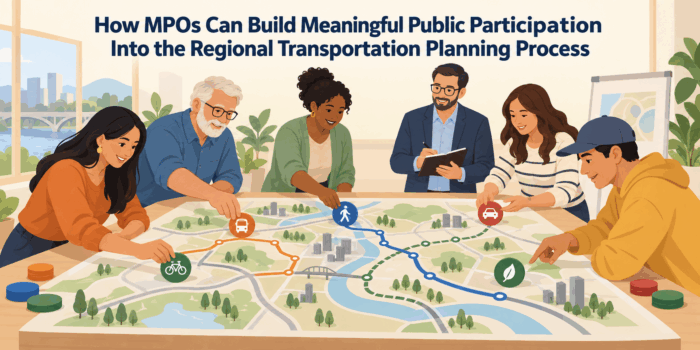
How MPOs Can Build Meaningful Public Participation Into the Regional Transportation Planning Process
The federal requirement for public participation in metropolitan transportation planning processes has produced, in most MPOs, public participation programs that satisfy the regulatory documentation requirements for participation while falling short of the substantive participation outcomes that those requirements are designed to produce. The public hearing that is noticed in the local newspaper, held at a time and location convenient for agency staff, attended by a small number of planning professionals and civic activists, and documented in a summary report that confirms public input was received, is a public participation process that is federally compliant and governance inadequate. It documents the existence of public engagement while producing neither the public understanding of regional transportation planning that genuine participation requires nor the community input that shapes planning decisions in ways that reflect the priorities of the communities the planning serves.
The gap between compliance-level and meaningful public participation is not primarily a question of legal requirement. Federal regulations require MPOs to provide reasonable opportunities for public comment, proactive public engagement, consideration of the needs of those traditionally underserved by transportation systems, and a documented public participation plan that describes how the agency will engage the public in transportation planning. These requirements, interpreted generously rather than minimally, provide the legal basis for participation programs far more robust than most MPOs have built. The gap is primarily a question of institutional commitment: the decision to treat public participation as a genuine input into planning decisions rather than as a regulatory obligation to be satisfied at minimum cost.
Meaningful public participation in regional transportation planning is valuable not only as a democratic governance practice but as a technical planning practice. Communities have knowledge about their transportation conditions, their mobility barriers, and their transportation priorities that no amount of technical modeling can replicate. A freight corridor study that does not engage the truck drivers, the warehouse workers, and the residential communities along the corridor, is a study that has access to technical data about the corridor without access to the operational and lived experience knowledge that makes the technical data intelligible and actionable. A long-range transportation planning process that does not engage the elderly riders, the low-income transit-dependent workers, and the families navigating school dropoff and pickup, is a process that produces a plan that reflects the transportation model rather than the transportation realities that the plan is supposed to address.
This article examines how MPOs can build meaningful public participation into the regional transportation planning process, including how to design participation programs that reach the full diversity of communities in the planning area rather than primarily the planning professionals and civic activists who attend public meetings on their own initiative, how to ensure that public input genuinely shapes planning decisions rather than being documented without substantive influence, and how to communicate back to participants about how their input affected the plans and decisions that their participation was meant to inform.
Designing Participation for the Public, Not for Planners
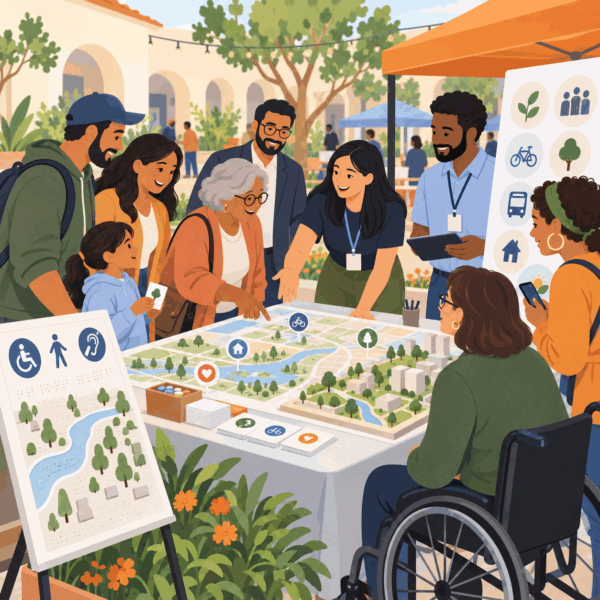 Most MPO public participation programs are designed by planners for planners, or at least with planners as the implicit default audience. The public meeting format, the technical presentation style, the comment period documentation, and the summary report communication, are all formats and approaches that professional planners find familiar and manageable. They are not formats and approaches that most members of the public find accessible, meaningful, or worth the effort of attending. The result is participation programs that are well-designed for the planning professionals and active civic community that attends them and poorly designed for the diverse general public whose transportation priorities the regional planning process is supposed to reflect.
Community-centered participation design begins with the question of how different community members prefer to engage with decisions that affect them, rather than with the question of what participation format is most convenient for MPO staff to administer. Communities that make collective decisions through faith community gatherings prefer to provide transportation input through the channels and in the contexts where they already gather rather than at separately scheduled MPO public meetings. Communities that communicate primarily through social media prefer to engage with transportation planning through digital tools that fit their existing information behaviors rather than through mailing list notices and website calendar listings. Agricultural communities that depend on rural transportation connections for market access prefer to engage with transportation planning through the agricultural extension and farm organization networks that they already trust rather than through regional planning forums that are geographically and culturally distant from their community contexts.
Participation format diversity that offers multiple ways to engage with regional transportation planning, including not only traditional public meetings but online comment tools, interactive mapping exercises, scenario preference surveys, video public hearing formats, and community representative interviews, extends participation reach to community members for whom the traditional public meeting format is a barrier rather than a natural engagement channel. The combination of format diversity and proactive outreach to underrepresented communities, through the organizations and channels that those communities trust, is the participation design approach that produces the community diversity in transportation planning input that meaningful participation requires.
From Fragmentation to Coordination: Communication Strategies for Councils of Governments, Metropolitan Planning Organizations, and Regional Planning Agencies
This article is part of our series on strategic communication for Councils of Governments, Metropolitan Planning Organizations, and Regional Planning Agencies. To learn more and to see the parent article, which links to other content just like this, click the button below.
Proactive Outreach to Underrepresented Communities
Identifying Gaps in Current Participation
Before designing participation outreach to underrepresented communities, MPOs need to honestly assess which communities are currently underrepresented in their participation programs and why. The assessment should compare the demographic composition of current participation, measured through participant surveys at public meetings and through the demographics of comment submitters, with the demographic composition of the planning area and of the transit-dependent and transportation-disadvantaged populations that the planning process is specifically required to engage. This comparison will typically reveal significant underrepresentation of low-income communities, communities of color, non-English-speaking communities, disability communities, and youth, all of which are precisely the communities that federal transportation planning requirements specifically call out as requiring proactive engagement.
Root cause analysis of participation gaps, which identifies why underrepresented communities are not engaging with current participation programs, is more useful for program improvement than demographic comparison alone. Communities may be absent from participation programs because they do not know the programs exist, because the programs are scheduled at times and located in places that are inaccessible to them, because the program formats and languages do not accommodate their communication preferences, because prior engagement experiences have left them with justified skepticism that their input will have any effect on planning decisions, or because the planning topics being addressed do not feel relevant to the transportation challenges they actually face. Each of these root causes requires a different outreach and program design response, and participation improvement programs that do not address the specific root causes of participation gaps will not close those gaps regardless of how many new outreach channels they add.
Partnership-Based Outreach
Partnership-based outreach that reaches underrepresented communities through the organizations they trust, rather than through MPO-produced communication that those communities have no prior relationship with, is the most effective approach to extending participation reach to communities that have not historically engaged with regional transportation planning. The community health center that serves a low-income neighborhood, the immigrant services organization that works with non-English-speaking communities, the disability advocacy organization that represents transportation-disadvantaged populations, and the environmental justice organization that advocates for communities overburdened by transportation infrastructure, are all organizations with established community relationships that MPOs do not have and cannot build quickly.
Partnership-based outreach requires genuine organizational partnerships rather than simple distribution agreements. An MPO that asks community organizations to distribute its participation notices has created a communication distribution partnership. An MPO that works with community organizations to co-design participation activities that fit community members’ schedules, preferences, and cultural contexts, that compensates community organizations for the outreach work they do, and that provides community organizations with the technical briefings they need to accurately represent regional transportation planning issues to their members, has created a genuine participation partnership that extends participation reach in ways that distribution agreements cannot.
Compensation for community participation is a specific outreach investment that addresses the participation barriers that are most concentrated among the communities that regional transportation planning most needs to engage. A low-income resident who must choose between attending an MPO public meeting and working an extra shift at their hourly job has a participation barrier that no amount of meeting accessibility improvement can overcome without childcare support, transportation assistance, and in some cases stipend support that makes participation financially feasible. MPOs that provide these participation supports are making the equity investment that genuine community participation diversity requires.
Ensuring Input Shapes Planning Decisions
The participation obligation that most MPOs most consistently fall short of is not the obligation to hold public meetings or to collect public comments. It is the obligation to demonstrate that the public input collected actually influenced the planning decisions that the participation process was designed to inform. The community that provides input on transportation priorities in a long-range planning process, and that receives no subsequent communication about how that input affected the plan’s investment priorities, has participated in a process whose feedback loop is absent. Without that feedback loop, the participation process is a community notification program disguised as a community input program, and communities that engage with it repeatedly without seeing evidence that their input matters will eventually stop engaging.
Participation-responsive planning communication, which documents specifically how public input affected planning analysis, planning decisions, and plan outcomes, is the feedback loop that makes public participation genuine rather than performative. This communication should be specific enough to allow participating communities to trace the connection between the input they provided and the planning decisions that followed. The community that provided input on the need for better transit connections to a regional employment center, and that subsequently sees a transit access improvement to that center included in the Transportation Improvement Program with an explicit notation that the project reflects community input received during the long-range planning process, has experienced a participation feedback loop that makes future participation feel worthwhile.
When public input raises concerns or priorities that the MPO is not able to incorporate into its planning decisions because of fiscal, technical, or political constraints, the participation feedback loop requires honest communication about why those concerns or priorities were not addressed in the plan, not simply the documentation that the input was received and considered. The community that provided input that did not affect the plan deserves to know why, not as an accountability demand but as the honest communication that genuine participation respect requires. Explaining the constraints that prevented a community’s input from being reflected in planning decisions, while committing to specific ways the community’s concerns will be tracked and considered in future planning cycles, is more respectful and more trust-building than the silence that most MPOs maintain when community input does not affect planning decisions.
Digital Participation Tools
Digital participation tools that allow community members to engage with regional transportation planning on their own schedule, through the devices and communication channels they already use, extend participation access to the significant share of the public that cannot or will not attend scheduled public meetings. Interactive scenario planning tools that allow participants to explore trade-offs among transportation investment options, priority mapping tools that allow participants to identify transportation challenges and priorities in their own neighborhoods, and online comment platforms that allow participants to respond to specific planning proposals at any time during the comment period, all provide participation access that traditional public meeting formats cannot offer.
Effective digital participation tools are designed around the transportation knowledge and digital comfort levels of the communities they are designed to reach rather than around the planning sophistication of the agency staff who build them. A scenario planning tool that requires participants to understand the difference between highway capacity expansion and transit-oriented development in order to make meaningful participation choices is a tool designed for planning professionals rather than for the general public. A scenario planning tool that asks participants to choose between futures described in terms of what their daily commute, their neighborhood walkability, and their access to destinations would look and feel like under different investment scenarios, is a tool that makes planning trade-offs accessible to participants without planning backgrounds.
Digital equity in participation tool design requires explicit investment in ensuring that online participation tools are accessible to community members without reliable internet access, without English reading proficiency, and without prior experience navigating government websites. This means designing tools for mobile-first access rather than desktop access, providing translated versions in the languages of the communities the agency serves, partnering with libraries and community centers to provide digital access for participants without home internet, and designing interfaces that are intuitive for participants with limited prior experience with online government tools. Digital participation tools that are technically sophisticated but digitally inequitable will extend participation reach to the communities that are already well-represented in traditional public meetings while leaving the underrepresented communities further behind.
Youth and Next-Generation Participation
Young people are both the generation that will live longest with the transportation infrastructure decisions being made today, and the population that is most consistently underrepresented in regional transportation planning participation programs. The college student without a car who depends on public transit, the teenager navigating unsafe routes to school on foot or by bike, and the young adult who is making decisions about where to live and work based partly on transportation access, all have transportation priorities and transportation knowledge that regional transportation planning needs but rarely solicits through participation programs designed for adult civic participation formats.
Youth-specific participation programs that engage young people through their schools, youth organizations, and digital communication channels, and that design participation formats appropriate for the communication styles and knowledge levels of younger participants, extend participation reach to a generation that has both unique transportation experience and unique stakes in long-range transportation decisions. A high school transportation planning project that involves students in identifying transportation challenges in their community and in developing transportation improvement proposals, communicated to the MPO as formal public input, is a participation program that serves both youth civic education and MPO participation diversity. A youth advisory committee that provides ongoing youth perspective on transportation planning decisions is a participation structure that maintains youth engagement across planning cycles rather than in isolated public meetings.
How Meaningful Participation Compares With Compliance Participation
The difference between meaningful public participation and compliance-level public participation is not primarily a question of how many meetings are held or how many comments are received. It is a question of whether the participation program is designed to generate community input that shapes planning decisions, or whether it is designed to document that community input was solicited. These two design objectives produce fundamentally different participation programs, and the communities that participate in both types of programs know the difference.
The comparison with community benefits agreement negotiation processes in economic development planning reveals a participation model in which community input has direct, binding influence on planning and development decisions rather than advisory influence that may or may not be reflected in final decisions. While the binding participation model is not directly applicable to the federal transportation planning process, it illustrates the participation quality standard that communities most affected by transportation decisions increasingly expect and that federal environmental justice guidance increasingly supports. MPOs that move toward this higher standard of participation, in which community input is treated as a co-planning contribution rather than a comment for the record, are building the participation legitimacy that regional transportation planning increasingly requires in politically diverse and equity-attentive metropolitan areas.
Communicating About the Public Participation Plan
The federally required Public Participation Plan that MPOs must develop and maintain is both a regulatory compliance document and a public communication commitment that the agency should make visible and accountable. Most MPOs treat their Public Participation Plan as an internal compliance document that is filed with the federal funding agency and updated as required, without communicating its contents to the public or making its implementation status accountable to the communities it is designed to serve. The Public Participation Plan that is visible to the public, that explains what the MPO has committed to doing to engage diverse communities in transportation planning, and that is reported against annually to demonstrate whether those commitments are being met, is a public accountability document rather than a federal compliance file.
Public Participation Plan communication that makes the plan’s commitments accessible to the communities it is designed to serve, including the specific outreach strategies the MPO commits to for different community types, the specific timelines for public comment periods on major planning decisions, the specific language access commitments the agency has made, and the specific feedback mechanisms through which the public can evaluate whether the participation plan is being implemented as committed, gives the public the information they need to hold the MPO accountable for its participation commitments rather than relying on federal oversight to enforce them.
Public Participation Plan update communication, which invites public input on how the plan should be revised to better serve communities that are currently underrepresented or inadequately engaged, treats the plan update process as itself a participation exercise rather than as an internal planning revision. The community organization that is consulted about whether the MPO’s current public participation strategies are reaching its members, and whose feedback leads to specific changes in how the MPO conducts outreach in that community, has experienced a participation plan update process that demonstrates the agency’s genuine commitment to participation improvement.
Equity in Public Participation
Meaningful public participation programs that reach the full diversity of communities in the planning area are participation programs that are designed with equity as a core design principle rather than as a supplementary consideration. Equity in public participation means not only reaching underrepresented communities but ensuring that the quality of participation experience is comparable across all communities, that the burden of participation falls equitably rather than primarily on the communities that already participate at lower rates, and that the connection between participation and planning decisions is equally visible for input from all communities rather than more responsive to input from more politically powerful communities.
Participation quality equity requires the MPO to provide equivalent participation support to all communities, including outreach resources, accessible meeting formats, language access, and participation support services such as childcare and transportation, regardless of whether those communities have historically participated actively in regional transportation planning. The community that has not participated because of prior neglect by the MPO deserves equivalent participation support to the community that has always been well-served by existing participation programs, and providing that equivalent support is an investment in closing the participation equity gap that prior neglect created.
Input responsiveness equity requires the MPO to demonstrate that input from historically underrepresented communities has the same influence on planning decisions as input from the communities that have historically been most engaged in regional transportation planning. If the transportation priorities of transit-dependent low-income communities consistently fail to be reflected in regional transportation investment while the transportation priorities of suburban car-owning communities are consistently reflected, the participation program has not achieved participation equity regardless of the diversity of the communities it has outreached to. Auditing the relationship between participation source and planning outcome, and publishing the results of that audit, is the participation equity accountability communication that most MPOs have not attempted.
Sustaining Participation Across Planning Cycles
 The most common participation failure in regional transportation planning is not the failure to engage communities in specific planning processes but the failure to sustain community relationships between planning cycles. Participation programs that are activated for specific plan updates and then go quiet during implementation periods produce communities that are engaged episodically in planning and disengaged from the implementation that makes planning consequential. Sustaining participation across planning cycles requires ongoing community communication and community relationship investment that continues between major planning events and that connects communities to the implementation progress of the plans their participation helped shape.
Continuous community advisory panels that represent diverse communities throughout the planning cycle, meeting regularly to review planning progress and provide ongoing input on transportation conditions and priorities, are a participation structure that maintains community engagement between major planning events. These panels should be compensated for their time, should include representatives from the communities that are most underrepresented in traditional participation programs, and should have genuine influence on planning and implementation decisions rather than serving as consultation forums that review completed staff work without substantive input opportunity.
Implementation milestone communication that notifies participating communities when specific transportation improvements they advocated for during planning processes move into implementation, groundbreaking, or completion, closes the participation loop in a way that reinforces the value of continued engagement. The community member who attended a long-range plan public meeting three years ago and who receives a notification that the transit improvement they advocated for has just broken ground has received the participation feedback that makes future participation worthwhile. Without these feedback communications, the connection between community participation and plan implementation is invisible to the participants who made it possible.
Communicating Participation Outcomes
Most MPOs produce participation summaries that document who participated, what they said, and how many comments were received, without documenting how participation shaped planning decisions. This documentation-without-accountability approach to participation reporting satisfies federal compliance requirements while failing the accountability standard that genuine participation requires. Participation outcome reporting that connects specific community input to specific planning decisions is more demanding to produce than comment count documentation, but it is the communication that makes participation genuine rather than ceremonial.
Annual participation outcome reports that assess how public participation affected planning decisions during the reporting period, identifying specific examples where community input led to changes in planning analysis, planning priorities, or plan content, and specific examples where community input raised concerns that could not be addressed in the current planning cycle and how those concerns will be carried forward, provide the participation accountability that most communities never receive. These reports should be accessible and community-facing, written for the participating communities rather than for the federal compliance record, and should be distributed through the same channels through which participation was solicited so that the communities that participated can see the results of their engagement.
Public participation program evaluation that assesses whether the participation program is achieving its stated goals, including specific goals for the diversity of participating communities, the quality of participation experience across different community types, and the influence of community input on planning decisions, provides the honest program accountability that most MPO participation programs lack. Participation programs that are evaluated only through output metrics, the number of meetings held, the number of comments received, and the number of languages in which materials were translated, without assessment of whether those outputs produced the participation outcomes of genuine community engagement and planning decision influence, are programs that will optimize for compliance metrics rather than for the governance quality that participation is supposed to produce.
Translating Technical Analysis Into Community-Relevant Information
The technical analyses that underlie regional transportation planning decisions, including travel demand modeling, safety analysis, environmental impact assessment, and transportation system performance monitoring, generate technical findings that are directly relevant to community interests but that are communicated primarily in formats and through channels that most community members cannot access or interpret. The travel demand model that projects how a regional transportation investment will affect traffic volumes, transit ridership, and vehicle miles traveled in specific parts of the region, contains community-relevant information about how the investment will affect daily life in those parts of the region that the technical outputs do not communicate accessibly.
Technical analysis translation that produces community-relevant summaries of the key findings from major planning analyses, organized around the questions that community members and local officials most care about rather than around the analytical methodology that produced the findings, is among the most important participation-enabling communication that MPOs can invest in. A travel demand model summary that tells community members in plain language what the model predicts will happen to traffic in their neighborhood under different investment scenarios, and why those predictions differ across scenarios, is more participation-enabling than a technical report that presents the same modeling results in the output formats that transportation engineers use to evaluate model validity.
Visualization tools that make technical analysis findings accessible to non-specialist audiences, including interactive maps that show how transportation investments will change travel conditions across the region, scenario comparison tools that allow community members to evaluate the transportation implications of different investment priorities, and before-and-after simulations that make predicted future transportation conditions concrete, extend the reach of technical analysis from the planning professional community to the general public whose transportation future the analysis is assessing. These visualization tools require investment in data visualization expertise and digital communication infrastructure that most MPOs have not prioritized as a technical analysis communication investment, but they produce participation quality improvements that no amount of additional public meeting time can substitute for.
Expert translation staffing, which includes staff with both technical transportation planning expertise and public communication skill in the participation program rather than treating technical staff and communication staff as separate specializations, is the organizational investment that makes consistent technical analysis translation possible. The transportation planner who can explain a travel demand model result in plain language to a community group is a more valuable participation program resource than the technical specialist who cannot communicate outside their professional community or the communicator who cannot accurately translate technical findings without technical expertise. Building these hybrid technical-communication competencies, through training and through participation program design that values communication skill alongside technical skill, is a staff development investment with direct participation quality returns.
Community Research and Transportation Planning
The most innovative regional transportation planning participation programs have moved beyond consulting communities about planning proposals to partnering with communities as co-researchers in the transportation planning process itself. Community-based participatory research approaches that train community members to conduct transportation condition assessments, to analyze transportation data for their neighborhoods, and to develop transportation improvement proposals based on their own research, produce planning knowledge that MPO technical staff research cannot replicate while building community research capacity and community investment in the planning process.
Community transportation condition assessments that engage residents in documenting the transportation conditions they experience, including pedestrian infrastructure quality, transit stop amenities, safety conditions for non-motorized travelers, and freight and industrial traffic impacts on residential neighborhoods, generate place-based knowledge that technical data sources do not fully capture. Residents who walk the same routes daily have observations about pavement conditions, crossing safety, lighting adequacy, and transit stop amenity that no amount of infrastructure inspection by agency staff can replicate from outside the community. Formalizing community observation as a recognized form of planning data, and using community assessment findings in transportation planning analysis alongside technical data sources, is both a participation practice and a planning quality improvement.
Community research partnership programs that provide training, data access, and technical support to community organizations conducting their own transportation research, and that create formal mechanisms for community research findings to enter the regional planning process, are the most advanced form of participation that any MPO has developed and the form that most directly challenges the planning profession’s traditional control over the technical knowledge that informs transportation decisions. An MPO that partners with a community organization to conduct a transportation needs assessment in an underserved neighborhood, that provides the technical support and data access the organization needs to conduct rigorous research, and that treats the organization’s research findings as planning evidence with the same weight as MPO staff research findings, is practicing genuine participatory planning rather than participatory consultation.
Building Long-Term Participation Capacity
The participation capacity that meaningful public participation in regional transportation planning requires is not built through any single planning process but through sustained investment in community relationships, staff development, and organizational systems that make genuine participation a continuous institutional practice rather than an episodic compliance response. MPOs that treat public participation as a capacity-building investment, accumulating community relationships, staff skills, and organizational processes that improve with each planning cycle, build a participation capability that is significantly more effective than programs that must be rebuilt from scratch with each new planning process.
Staff specialization in public participation and community engagement, including dedicated participation coordinators who develop deep expertise in community outreach, facilitation, and participation program design rather than managing participation alongside other communication and planning responsibilities, produces more effective participation programs than the generalist approach that most MPO communication teams use. A participation coordinator who has developed relationships with the community organizations that serve underrepresented populations in the planning area, who knows the communication channels and the cultural contexts of those communities, and who has refined their outreach and facilitation approaches through multiple planning cycles, is a participation resource whose effectiveness compounds over time.
Institutional participation learning that captures the specific outreach strategies, facilitation approaches, and community engagement tools that have been most effective in previous planning processes, and that applies those learnings to subsequent planning processes, builds the institutional memory that makes participation programs improve across planning cycles rather than repeating the same approaches regardless of their effectiveness. A participation program that conducts post-process evaluations, that documents what worked and what did not, and that incorporates those learnings into the design of the next participation program, is a program that learns from experience in ways that most MPO participation programs have not been designed to support.
Communication as Governance Infrastructure
The communication programs described in this article are not public relations functions that support the agency’s primary governance work. They are governance infrastructure in their own right, as essential to the effective exercise of the agency’s planning mandate as the technical analysis and regulatory compliance functions that receive most of the agency’s professional investment. An agency that plans well but communicates poorly produces plans and programs that are technically sound but governance inadequate, because the community understanding, the political support, and the intergovernmental relationships that plan implementation requires are built through communication rather than through planning analysis alone.
Communication investment in regional planning agencies has historically been treated as a support function rather than a core governance function, with communication staff allocated fewer resources, less organizational status, and less professional development investment than the technical planning staff whose work they are communicating. The governance consequences of this imbalance are visible in the participation quality, the public understanding, and the intergovernmental relationships of most regional planning agencies, which consistently fall short of what genuine governance accountability requires. Reorienting communication as core governance infrastructure, rather than as planning support, is the institutional investment that regional planning agencies most need to make.
The specific communication investments described in this article, whether for federal process accessibility, service equity accountability, or meaningful public participation, all represent this governance infrastructure orientation. They are not investments in how the agency presents itself to the public. They are investments in whether the agency’s governance actually serves the communities it is responsible to, whether the communities those governance functions affect can understand and evaluate what is being decided on their behalf, and whether the democratic potential of regional planning governance is fulfilled or merely procedurally satisfied.
Communicating Regional Agency Governance to a Broader Public
The public that funds regional planning agencies through taxes, fees, and federal program contributions has a legitimate interest in understanding how those agencies are governed and whether they are producing the public value that justifies the investment. Most regional planning agencies communicate about their programs and their plans without adequately communicating about their governance: how decisions are made, who participates in those decisions, what accountability mechanisms exist, and how the public can engage with governance at a level beyond public comment periods and public hearings. This governance transparency communication is the most foundational form of public accountability that regional agencies owe to the communities that fund them.
Agency governance communication that explains the board or commission structure, the member government representation, the federal oversight relationships, and the public participation mechanisms that exist at the governance level, provides the institutional context that makes specific program and planning communications comprehensible as expressions of a governance system rather than as isolated institutional decisions. A community member who understands how the regional planning agency’s governing board is constituted, how member governments are represented, and how they can influence governance decisions at the board level, is a community member who can engage with the agency as a democratic institution rather than as an administrative body whose decisions are outside the reach of public influence.
Tying It All Together
Building meaningful public participation into the regional transportation planning process is not a supplementary investment that MPOs make after their planning and compliance obligations are met. It is a core dimension of responsible regional transportation planning that makes the plans and programs the MPO produces more responsive to community needs, more politically legitimate, and more likely to generate the community understanding and support that long-range plan implementation requires. The participation program that is designed for compliance rather than for genuine community engagement is not simply missing a democratic obligation. It is producing planning decisions that are less informed, less accountable, and less effective than they would be if the communities whose transportation conditions the planning is addressing were genuine participants in the planning process.
The investment that meaningful public participation requires is substantial: the outreach to underrepresented communities, the participation format diversity, the community partnership development, the digital tool investment, the youth engagement programming, and above all, the feedback loop that demonstrates to participating communities that their input mattered to the planning decisions they were asked to inform. But this investment produces the community relationship, the planning knowledge, and the political legitimacy that regional transportation planning cannot achieve through technical modeling and federal compliance documentation alone.
Strategic Communication Support for Public Participation Programs
 Designing participation programs that reach the full diversity of communities in the planning area, that generate genuine community input, and that maintain the feedback loops that demonstrate participation’s influence on planning decisions, requires communication expertise and community relationship investment that most MPO communication and planning teams have not been resourced to develop fully. The combination of participation design expertise, community outreach capacity, multilingual communication capability, digital tool development, and participation evaluation that meaningful public participation requires makes external communication support a productive investment for MPOs seeking to build participation programs that serve both regulatory compliance and genuine democratic governance.
Stegmeier Consulting Group (SCG) works with metropolitan planning organizations to develop public participation programs that are built around the specific communities in each MPO’s planning area, the specific participation barriers those communities face, and the specific planning decisions that community input most needs to inform. This work begins with a participation equity audit that honestly assesses who is currently participating, who is not, and why, using both participant demographic data and community interview research that reveals the root causes of participation gaps from the perspectives of the communities that are underrepresented.
From that audit, SCG develops the specific participation program redesign strategies and new program elements that address the identified participation gaps, including partnership-based outreach frameworks that connect participation programs to the community organizations with established relationships in underrepresented communities, participation format diversity plans that expand beyond traditional public meetings to the digital tools, community gathering formats, and translated materials that reach the full range of community communication preferences, and youth participation programs that engage young people as transportation planning participants through their schools, youth organizations, and digital platforms.
SCG also works with MPO planning and communication staff to develop the participation feedback loop systems that make public input genuinely visible in planning decisions, including participation response documentation frameworks that connect specific community input to specific planning analysis and planning decisions, and public reporting systems that communicate to participating communities how their input affected plan outcomes, or honestly why it was not reflected in specific decisions due to constraints that the agency’s communication acknowledges openly. The objective is a public participation program that produces genuine community governance rather than compliance documentation, and that builds the community trust and planning knowledge that regional transportation planning requires to serve its communities well.
Future Trends in Public Participation
The public participation environment for regional transportation planning is evolving toward higher standards of genuine community engagement and away from compliance-oriented participation programs. Federal guidance on environmental justice and equity planning is creating clearer expectations that participation programs must reach and meaningfully engage underrepresented communities rather than simply documenting outreach efforts to those communities. Community advocacy organizations are increasingly sophisticated in their evaluation of participation quality, distinguishing between participation programs designed for genuine community governance and those designed for compliance documentation.
Digital participation tools are advancing rapidly in ways that extend participation access while also raising new equity challenges. Immersive scenario visualization tools that allow community members to experience simulated transportation futures rather than reading about them in planning documents, social media participation platforms that reach communities through their existing digital networks, and AI-assisted language translation tools that allow participation platforms to serve diverse language communities without separate translation workflows, are all capabilities that MPOs are beginning to adopt for transportation planning participation.
The movement toward genuine co-governance of regional transportation planning, in which community organizations are recognized as governance partners rather than stakeholder audiences, is the most significant long-term trend in transportation planning participation and the one whose communication implications most MPOs have not yet fully addressed. Co-governance requires communication systems that give community governance partners ongoing access to planning information, that report transparently on how community input affected planning decisions, and that maintain community engagement between planning cycles rather than activating it only for specific planning events.
Conclusion
Building meaningful public participation into the regional transportation planning process is the most important governance investment that metropolitan planning organizations can make. The participation programs that most MPOs currently operate, optimized for federal compliance documentation rather than for genuine community governance, produce planning decisions that are less representative, less legitimate, and less effective than those that genuine participation programs would produce.
The investment that meaningful participation requires, including partnership-based outreach to underrepresented communities, participation format diversity, technical analysis translation, and participation feedback loops, is an investment in the democratic foundation of regional transportation planning. MPOs that make this investment find that their planning processes are more politically legitimate, their plans are more responsive to community needs, and their implementation is more likely to generate the community support that long-range transportation investment requires.
The communities that participate in regional transportation planning are the communities that have the most direct stake in whether regional transportation investment serves their mobility needs, their economic access, and their quality of life. Designing participation programs that genuinely serve those communities, that treat their knowledge as a planning resource and their participation as a governance contribution, is the institutional commitment that makes regional transportation planning worthy of the public trust and the public investment it depends on.
Stegmeier Consulting Group’s Strategic Approach to Communication Systems
Build public participation programs around the communities most underrepresented in current engagement, participation formats that accommodate the full range of community communication preferences, and feedback loops that make community input visible in the planning decisions it was meant to inform.
Metropolitan planning organizations need public participation programs that reach the full diversity of communities in their planning areas, remove participation barriers, and make community input visibly connected to planning decisions. Stegmeier Consulting Group (SCG) helps MPOs develop participation programs tailored to their communities, barriers, and planning needs. SCG assesses who is participating, who is underrepresented, and why, examining outreach gaps, language access, participation formats, and feedback loops to identify priorities for improvement.
From that assessment, SCG develops practical strategies such as partnership-based outreach, diverse participation formats, youth engagement, translated materials, and systems that connect community input to planning analysis and decisions. SCG also supports staff with feedback and reporting systems that explain how input influenced outcomes and why certain recommendations could not be adopted. The objective is a public participation program that demonstrates meaningful community influence and strengthens the legitimacy and effectiveness of regional transportation planning.