
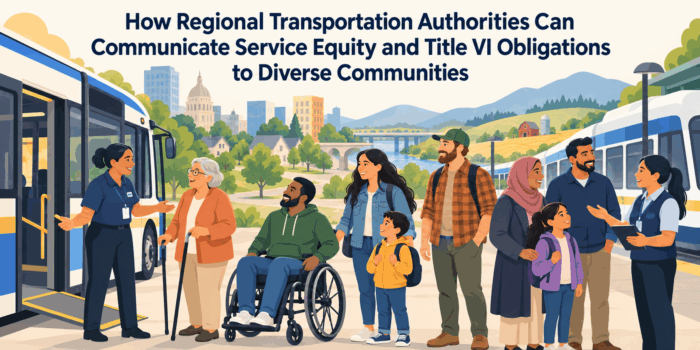
How Regional Transportation Authorities Can Communicate Service Equity and Title VI Obligations to Diverse Communities
The Title VI obligation that regional transportation authorities carry is not a bureaucratic compliance requirement that exists alongside service delivery. It is the foundational legal expression of the principle that public transportation serves everyone in the communities it operates within, not only the residents who have always ridden transit or the communities that have historically benefited most from transit investment. Title VI and the environmental justice framework built on it require transportation agencies to assess whether their services, their investments, and their fare and service change decisions distribute benefits and burdens equitably across their service populations, and to communicate those assessments honestly to the diverse communities that depend on their services.
The communication challenge of Title VI and service equity is not simply a matter of reaching diverse communities in their languages and through their preferred channels, though that is a necessary starting point. It is a matter of communicating honestly about whether the transit system’s services, investments, and decisions are serving communities equitably, and about what the agency is doing when its equity assessment reveals that they are not. Most regional transportation authority communication about Title VI is compliance-oriented communication that documents the existence of an equity analysis rather than communicating the findings of that analysis and the actions being taken in response to what it reveals. This compliance orientation produces communication that satisfies regulatory documentation requirements while failing to serve the communities whose equity interests Title VI is designed to protect.
The diversity of communities that regional transportation authorities serve creates specific communication challenges that equity communication must address: the non-English-speaking communities that depend on transit but that agency communications do not reach in their languages, the communities of color that have historically been underserved by transit investment and that approach agency equity communication with justified skepticism based on prior experience, the low-income communities whose mobility depends on affordable transit access and whose ability to evaluate fare change impacts requires the specific household-level cost analysis that most transit agencies do not provide, and the communities with significant disability populations whose transportation access depends on the paratransit and accessibility investments that are often the least visible dimension of transit system equity.
This article examines how regional transportation authorities can communicate service equity and Title VI obligations in ways that go beyond compliance documentation to provide the specific, honest, and community-responsive communication that genuine equity accountability requires, reaching diverse communities through the channels and in the terms they use, and demonstrating through specific program commitments and outcome reporting that equity is a genuine operational priority rather than a regulatory obligation.
Title VI Communication as Genuine Accountability
 The Title VI obligations of regional transportation authorities require agencies to conduct disparate impact and disproportionate burden analyses before making major service changes, fare changes, or major investment decisions that could significantly affect the distribution of transit service benefits and burdens across protected populations. These analyses are required to be made publicly available and to be considered in agency decision-making. What federal regulations do not specify is how the analysis findings should be communicated to the communities most affected by the decisions, and most agencies have interpreted this communication obligation narrowly, satisfying it through public notice of the analysis availability rather than through proactive communication of the analysis findings and their implications.
Genuine Title VI accountability communication treats the analysis findings as the most important element of the communication, not the documentation of the analysis’s existence. A fare change analysis that finds a disparate impact on minority communities and a disproportionate burden on low-income riders deserves public communication that specifically identifies the finding, explains what it means in practical terms for the affected communities, describes the mitigation measures the agency has developed in response to the finding, and explains how the agency will monitor whether those mitigation measures are effectively protecting the affected communities from the adverse impact. This communication serves the communities whose equity interests Title VI protects rather than primarily serving the agency’s regulatory compliance documentation.
The distinction between compliance documentation and genuine equity accountability communication is ultimately a question of institutional purpose. An agency that communicates Title VI analyses as compliance documents is using Title VI communication to satisfy a regulatory requirement. An agency that communicates Title VI findings as genuine accountability information is using Title VI communication to serve the communities that Title VI protects. These two purposes produce very different communication products, and the communities that are the subjects of equity analysis know the difference. The community that receives a notice that a Title VI analysis has been completed and is available for public review has received compliance communication. The community that receives a plain-language summary of what the analysis found about the equity implications of a proposed decision for their community, what the agency is doing to address any adverse findings, and how they can provide input on the agency’s proposed response, has received genuine accountability communication.
From Fragmentation to Coordination: Communication Strategies for Councils of Governments, Metropolitan Planning Organizations, and Regional Planning Agencies
This article is part of our series on strategic communication for Councils of Governments, Metropolitan Planning Organizations, and Regional Planning Agencies. To learn more and to see the parent article, which links to other content just like this, click the button below.
Reaching Diverse Communities in Their Languages and Through Their Channels
Language Access as an Equity Obligation
A transit agency that serves communities where significant shares of the population speak languages other than English but that communicates about service changes, fare adjustments, and equity analyses primarily or exclusively in English is not serving those communities equitably in its communication, regardless of what its Title VI analysis finds about the equity of its service distribution. Language access in transit communication is not simply a best practice. It is a legal requirement under Title VI for agencies that receive federal funding, and the adequacy of language access programs is specifically assessed in federal Title VI compliance reviews.
Language access communication programs should be designed around the actual languages of the communities the agency serves, determined through a language access needs assessment that identifies the languages spoken by transit-dependent populations in the service area rather than through assumptions about which languages are most prevalent. The agency that has determined through needs assessment that its service area includes significant populations speaking Spanish, Vietnamese, Somali, and Haitian Creole, and that designs its language access program around these specific languages, is meeting its language access obligations more completely than the agency that provides Spanish translation because Spanish is nationally common and leaves other language populations without accessible communication.
The quality of translated communications matters as much as their availability. Transit agency communications that are translated by machine translation without native speaker review, that use formal or institutional language that does not reflect the communication norms of the target community, or that preserve the bureaucratic structure of English-language documents without adapting for the reading levels and communication preferences of the target audience, may be technically translated while remaining practically inaccessible to the community members they are designed to serve. Language access programs that include native speaker review of translated materials, cultural competency assessment of communication style and framing, and community feedback on the accessibility of translated communications, produce language access that is genuine rather than performative.
Trusted Messenger Partnerships
The language access requirement is necessary but not sufficient for reaching communities that have historical reasons to distrust government transportation agencies. Communities of color that have experienced decades of transit disinvestment, freeway construction that divided their neighborhoods, and planning processes that consulted them after decisions were effectively made, may receive transit agency communications, even those in their language, with the skepticism that prior experience has earned. Reaching these communities effectively requires the trusted messenger partnerships that place transit equity communication within the community relationships that those communities trust rather than solely within the agency relationships they may not.
Community organization partnerships for transit equity communication provide access to community trust that no amount of agency-produced communication can replicate. A community health organization that includes transit service equity information in its health outreach, a faith community that discusses transit access as a community justice issue, and a community development organization that advocates for transit investment in underserved neighborhoods, are all trusted messengers that can extend transit equity communication into community contexts where agency-produced communication arrives with limited credibility. Building these partnerships requires the agency to invest in community relationships before specific equity communication needs arise, and to treat community partners as genuine governance partners in equity advocacy rather than as distribution channels for agency-produced materials.
Communicating Fare Changes and Their Equity Implications
Fare changes are the transit service decisions that most directly affect the households that depend most on public transportation, and they deserve the most specific and the most accessible equity communication that transit agencies can produce. A fare increase that is communicated through a general public notice that a proposed fare schedule has been posted to the agency’s website does not serve the low-income riders who will be most affected by the increase and who most need to understand its implications for their household transportation budgets. The equity communication that fare changes require must reach those riders specifically, in their languages, through the channels they use, with the specific household-level cost analysis that makes the impact of the fare change concrete rather than abstract.
Household cost impact analysis for fare changes should be communicated in terms that riders can relate to their own budgets: how much more a monthly pass will cost, how much more a daily round trip will cost for a typical commuter, how the new fare structure compares with the cost of driving for a typical trip, and what the cumulative annual cost increase is for a typical transit-dependent household. This level of specific, user-level cost analysis is more useful to the low-income riders most affected by fare changes than aggregate system revenue projections or average fare increase percentages, which are the metrics that most transit agency fare change communications lead with.
Low-income fare program communication should be integrated into every fare change communication rather than treated as a separate program notice that low-income riders are expected to seek out independently. A fare change notice that includes specific information about income-based fare discount programs, how to apply for them, what the income eligibility thresholds are, and how much the discounted fare will be, serves low-income riders as genuine partners in managing the affordability implications of fare changes rather than leaving them to discover income-based alternatives through separate outreach they may never receive.
Service Change Equity Communication
Service changes, including route modifications, frequency reductions, hours changes, and service eliminations, are the transit decisions that most directly affect whether specific communities have access to employment, healthcare, education, and other essential destinations. The equity communication that service changes require must connect the proposed changes to the specific mobility consequences for the specific communities affected, using the origin-destination analysis and accessibility data that can demonstrate how service changes affect the ability of affected riders to reach specific destinations.
Affected community notification for service changes should be specific enough that riders in affected communities understand whether their specific routes, their specific stops, and their specific trip patterns will be affected. A general notification that route modifications are proposed, directing riders to a route map on the agency’s website, is notification that serves riders who have the digital access, the language ability, and the transit planning knowledge to interpret a route map. Riders without those resources, who are disproportionately low-income and transit-dependent, need on-route notification through bus stop signage, direct rider notification through SMS or phone, and community meeting notification through the organizations that serve affected neighborhoods.
Community meeting communication for service changes in affected communities should be designed around the specific concerns and knowledge levels of affected riders rather than around the service planning analysis that the agency has conducted. Riders who attend a community meeting about a proposed service change want to understand whether they will still be able to get to work, to their medical appointments, to their children’s schools, and to the shopping that their household depends on. Meetings that lead with ridership data, service efficiency analysis, and system performance considerations without directly addressing these rider concern questions are meetings that do not serve the communities they are designed to engage.
Capital Investment Equity Communication
The equity dimensions of transit capital investment decisions, including which communities receive new transit infrastructure, which communities see their existing infrastructure maintained or upgraded, and which communities continue to wait for service quality improvements that other parts of the system have already received, are among the most consequential and the least adequately communicated equity dimensions of regional transportation authority operations. A capital program that consistently prioritizes service expansion in higher-income, lower-transit-dependency neighborhoods over state-of-good-repair investment in lower-income, higher-transit-dependency neighborhoods is a capital program with an equity problem that no amount of service equity communication can obscure if the investment data is visible.
Capital investment equity reporting that shows the geographic distribution of capital investment across the service area, compared with the geographic distribution of transit-dependent populations and transit service need, is the most direct form of capital investment equity communication available. An agency that can show specifically where its capital investments have gone over the past five years, compared with where transit-dependent populations are concentrated and where service quality gaps are most significant, is providing the evidence base that allows riders, community advocates, and elected officials to evaluate whether the agency’s capital investment priorities reflect an equity commitment or reflect the political geography of easier-to-serve communities.
How Title VI Communication Compares With Other Transit Authority Communication
Title VI and service equity communication is the transit authority communication that is most directly connected to the legal obligations that define what public transit means as a public service. Most transit authority communication is about operations: what the service is, when it runs, how to use it, what it costs. Title VI communication is about justice: whether the service is distributed fairly, whether the agency’s decisions reflect the equal worth of every community in its service area, and whether riders who lack political power and economic resources receive the same quality of service and the same quality of communication as those who have those advantages.
The comparison with public health equity communication reveals both the shared mission and the distinctive challenge of Title VI communication. Public health equity communication addresses the unequal distribution of health risks and health resources across communities with different social and economic characteristics, and it has developed communication approaches that connect structural equity analysis to community-level health advocacy in ways that transit equity communication has only partially adopted. The public health equity communication model, which treats community members as co-investigators of the equity conditions they experience rather than as recipients of agency-produced equity analysis, offers transit equity communication a participatory approach that most transit agencies have not developed.
Paratransit and ADA Accessibility Communication
Americans with Disabilities Act paratransit services, which provide door-to-door transportation for riders with disabilities who cannot use fixed-route transit services, are among the least visible and most essential components of regional transportation authority operations, and their communication deserves the specific, accessible investment that the communities that depend on them require. Paratransit riders are often isolated from the mainstream transit communication programs that serve fixed-route riders, receiving service-specific communication through separate channels that may have different quality standards than the agency’s general communication program. The communication equity standard that Title VI applies to service distribution should apply equally to the communication that paratransit riders receive about the services they depend on.
Paratransit eligibility communication that explains the application process, the eligibility criteria, the appeals process for denied applications, and the recertification requirements in terms that applicants without transportation planning backgrounds can understand, is a service access communication that directly determines whether eligible individuals can access the paratransit services they are entitled to under the ADA. Eligibility communication that is confusing, jargon-laden, or written primarily in English for a service population that includes many non-English-speaking disability community members is eligibility communication that creates access barriers to services that federal law requires agencies to provide equitably.
Paratransit service change communication that specifically reaches the current and prospective paratransit rider population, through the direct contact channels that the agency has for registered riders and through the disability community organizations and healthcare system partners that serve non-registered eligible individuals, provides the advance notice that riders who depend on paratransit for medical appointments, employment access, and essential errands need to make alternative arrangements when service conditions change. A paratransit service change that is communicated only through the agency’s general service change notification program, without specific outreach to the disability community organizations and healthcare partners that serve paratransit-eligible individuals, is a service change communication that systematically underserves the most transportation-vulnerable population in the agency’s service area.
Environmental Justice Communication for Specific Project Decisions
Environmental justice analysis is required for major transportation decisions including long-range plan adoption, TIP amendments, and major project decisions that could have significant impacts on minority and low-income communities. The communication of environmental justice analysis findings, and the communication of how those findings affected specific project and program decisions, is the environmental justice accountability communication that federal guidance increasingly expects and that communities with environmental justice concerns specifically need.
Project-level environmental justice communication that explains specifically what environmental justice analysis was conducted for a specific project, what the analysis found about the project’s distribution of benefits and burdens across low-income and minority communities, how those findings affected the project design or mitigation commitments, and what ongoing monitoring will track the project’s environmental justice outcomes, provides the project-level accountability that aggregate program-level environmental justice reporting cannot supply. The community that lives along a proposed transportation corridor and that wants to know whether the environmental justice analysis considered their specific community’s vulnerability to the project’s air quality, noise, and displacement impacts deserves project-specific environmental justice communication rather than references to the agency’s general environmental justice framework.
Environmental justice community engagement for specific project decisions, which goes beyond the standard public participation requirements to specifically engage the minority and low-income communities most affected by specific project decisions, is the participation investment that environmental justice analysis is supposed to complement rather than replace. An environmental justice analysis that documents community vulnerability without engaging the vulnerable communities themselves in identifying their concerns, evaluating the project’s impacts, and shaping the mitigation measures that will address those impacts, is an analysis that uses community data without community participation. Genuine environmental justice communication for specific projects includes the community engagement that makes affected communities partners in evaluating their own vulnerability and in shaping the project decisions that will affect them.
Long-Term Service Equity Monitoring and Reporting
Achieving service equity in regional transportation authority operations is a long-term goal that requires sustained monitoring and reporting rather than episodic equity analysis at the time of specific service or investment decisions. Service equity conditions change as demographics shift, as service modifications accumulate, and as capital investment changes the quality and coverage of transit service across the agency’s service area. An agency that conducts equity analysis only when required for specific decisions may miss the gradual equity drift that occurs as individual service decisions with individually minor equity implications accumulate into a system-level equity pattern that no single decision would have produced.
Annual service equity reports that assess the current distribution of transit service quality, service coverage, and service investment across the full range of community types in the service area, compared with the distribution of transit dependency and transit need, provide the ongoing equity monitoring that sustained service equity requires. These reports should be accessible to the public and to community advocacy organizations, should use plain-language interpretation of equity analysis findings rather than technical compliance language, and should honestly assess both where the agency is meeting its equity commitments and where it is falling short.
Equity trend analysis that tracks changes in service equity over time, identifying whether the agency’s service equity conditions are improving, stable, or deteriorating, provides the longitudinal accountability that point-in-time equity analysis cannot supply. An agency that can demonstrate through trend analysis that the equity gap between highest-service and lowest-service communities has narrowed over the past five years as a result of specific service equity investments, has evidence of genuine equity progress that point-in-time analysis alone cannot provide. An agency that discovers through trend analysis that its service equity conditions are deteriorating despite its stated equity commitments has the evidence it needs to reconsider its service planning priorities before the deterioration becomes entrenched.
Community Advocacy Partnership for Service Equity
Community advocacy organizations that monitor transit service equity, that engage the transit-dependent communities whose transportation conditions are most affected by transit service decisions, and that advocate for service equity through the political and regulatory channels available to them, are governance partners in service equity that most regional transportation authorities have not fully engaged as genuine collaborators. An agency that treats community equity advocates as external critics to be managed rather than as governance partners to be engaged, misses the community knowledge, the community relationships, and the community accountability that partnership with equity advocates provides.
Partnership communication with equity advocacy organizations, which provides those organizations with early access to service planning information, invites them to participate in equity analysis review before decisions are finalized, and creates ongoing dialogue channels that allow equity concerns to be raised and addressed before they become formal complaints or regulatory interventions, builds the governance partnership that sustainable service equity requires. An agency that learns about service equity concerns from community advocacy organizations before those concerns are raised in public hearings or filed as Title VI complaints, and that engages those concerns substantively in its service planning, is an agency that is using its equity advocacy partnerships as the governance resource they represent.
Communicating Transit Performance Equity
 Regional transportation authorities are increasingly required by federal performance management frameworks to track and report on transit system performance metrics including on-time performance, vehicle availability, and safety records. These performance metrics are typically reported as system-level averages that conceal the geographic and demographic variation in service quality that is among the most significant equity dimensions of transit system performance. A system that averages eighty percent on-time performance may have ninety percent on-time performance on its highest-ridership suburban commuter routes and sixty percent on-time performance on the bus routes that serve the densest concentrations of transit-dependent low-income riders. Communicating performance data at the route and community level rather than only at the system level is the performance equity communication that makes the geographic and demographic dimensions of service quality visible.
Route-level performance reporting that shows on-time performance, crowding rates, vehicle reliability, and service frequency for each route in the system, comparable across routes and accessible to community members rather than only to transit planning professionals, provides the service quality transparency that riders in every community deserve. A rider on a bus route that experiences chronic delays and overcrowding has a right to know how their route’s performance compares with other routes in the system, and to know whether the agency is investing in performance improvement for their route at a rate comparable to routes serving other communities. Route-level performance data that is publicly available and community-accessible is the performance equity transparency that makes service equity accountability possible.
Capital investment alignment with performance gaps communication that shows specifically where capital investment is being directed relative to where the most significant service quality deficiencies exist, demonstrates whether the agency’s capital planning reflects a genuine commitment to addressing performance equity or whether it reflects the investment patterns of a prior era when equity was not a capital programming consideration. An agency that can show that its capital investment over the past five years has been specifically concentrated in the routes and communities with the greatest performance deficiencies, and that service quality gaps have narrowed as a result, has evidence of genuine performance equity progress. An agency that shows capital investment concentrated in the highest-performing routes and communities while performance gaps persist in lower-income areas, has the evidence of a performance equity problem that community advocates and federal oversight agencies will eventually surface if the agency does not surface it first.
Rider experience research that directly solicits the assessment of riders in different communities about their experience of transit service quality, through surveys, focus groups, and community listening sessions, provides the qualitative performance equity data that system performance metrics cannot capture. The rider who experiences their bus route as unreliable, unsafe, and inadequately connected to their essential destinations has service quality information that on-time performance percentages and vehicle availability rates do not fully convey. Rider experience research that is stratified by community type, that reaches the most transit-dependent riders rather than only the most technically accessible survey respondents, and that presents its findings disaggregated by community in accessible public reports, is performance equity communication that serves the communities whose service experience most needs to be visible.
Interagency Equity Communication Coordination
Regional transportation authorities operate within a regional governance ecosystem that includes metropolitan planning organizations, local transit agencies, state transportation departments, and other regional service providers whose decisions collectively shape transportation equity conditions across the region. Communicating about service equity in isolation from the equity dimensions of regional transportation planning, land use planning, and housing policy that interact with transit service equity, is communication that addresses only one dimension of the transportation equity conditions that transit-dependent communities experience.
Interagency equity communication that connects regional transportation authority service equity findings to the transportation equity analyses and plans of the regional MPO, the local land use planning decisions that shape transit ridership demand patterns, and the housing and economic development policies that determine where transit-dependent populations can afford to live, provides the integrated equity picture that no single agency can supply independently. An authority that communicates how its service equity findings connect to the regional land use patterns that concentrate transit-dependent populations in areas with inadequate service, and that advocates for the land use planning changes that would reduce those concentrations or for the transit service improvements that would better serve them, is an agency that takes the systemic dimensions of service equity seriously rather than treating it as an internal program management question.
Joint equity reporting with the regional MPO and other transportation agencies that presents a unified regional transportation equity assessment, using shared equity metrics and shared geographic frameworks that allow riders and community advocates to evaluate transportation equity across modes and agencies rather than separately for each agency, is the regional equity transparency that addresses the systemic dimensions of transportation inequity that no single agency can address on its own. This joint reporting requires the interagency coordination and shared data infrastructure that most regional transportation agencies have not developed, but it produces the regional equity accountability picture that advocacy organizations and federal equity oversight increasingly expect.
Communicating With Disability Communities
Transit agencies serve disability community members across a wide spectrum of transportation needs and disability types, each with specific communication preferences and accessibility requirements that standard transit communication programs may not adequately address. Blind and low-vision riders who depend on audio transit information, Deaf and hard-of-hearing riders who depend on visual information displays, riders with cognitive disabilities who benefit from simplified and consistent wayfinding communication, and riders with mobility disabilities who need specific information about accessible vehicle types and stop accessibility, all have communication needs that the agency’s general public communication program must address specifically rather than treating accessibility as a single undifferentiated communication requirement.
Disability community consultation in transit communication design, which involves disability advocacy organizations and disability community members in the design and review of transit communication materials, wayfinding systems, and customer service protocols, produces communication that is more accessible in practice than communication designed without disability community input and tested only for technical compliance with accessibility standards. A wayfinding system that meets ADA signage standards but that disability community members find confusing or inadequate for their navigation needs is a system that is technically compliant but functionally inaccessible. Disability community consultation catches the functional accessibility gaps that technical compliance testing does not.
Emergency communication accessibility for disability community members is a specific and critical transit communication challenge that requires advance planning rather than emergency improvisation. An agency whose emergency communication plan does not include specific provisions for reaching blind riders through audio alerts, Deaf riders through visual alerts and real-time captioning, and mobility-impaired riders through specific evacuation assistance information, is an agency whose emergency communication will systematically underserve its most vulnerable riders at the moment when communication adequacy matters most. Pre-disaster disability community engagement that identifies specific emergency communication needs and that tests emergency communication systems for disability accessibility, is the preparedness communication investment that most transit agencies have not made but that disability community safety requires.
Communication as Governance Infrastructure
The communication programs described in this article are not public relations functions that support the agency’s primary governance work. They are governance infrastructure in their own right, as essential to the effective exercise of the agency’s planning mandate as the technical analysis and regulatory compliance functions that receive most of the agency’s professional investment. An agency that plans well but communicates poorly produces plans and programs that are technically sound but governance inadequate, because the community understanding, the political support, and the intergovernmental relationships that plan implementation requires are built through communication rather than through planning analysis alone.
Communication investment in regional planning agencies has historically been treated as a support function rather than a core governance function, with communication staff allocated fewer resources, less organizational status, and less professional development investment than the technical planning staff whose work they are communicating. The governance consequences of this imbalance are visible in the participation quality, the public understanding, and the intergovernmental relationships of most regional planning agencies, which consistently fall short of what genuine governance accountability requires. Reorienting communication as core governance infrastructure, rather than as planning support, is the institutional investment that regional planning agencies most need to make.
The specific communication investments described in this article, whether for federal process accessibility, service equity accountability, or meaningful public participation, all represent this governance infrastructure orientation. They are not investments in how the agency presents itself to the public. They are investments in whether the agency’s governance actually serves the communities it is responsible to, whether the communities those governance functions affect can understand and evaluate what is being decided on their behalf, and whether the democratic potential of regional planning governance is fulfilled or merely procedurally satisfied.
Communicating Regional Agency Governance to a Broader Public
The public that funds regional planning agencies through taxes, fees, and federal program contributions has a legitimate interest in understanding how those agencies are governed and whether they are producing the public value that justifies the investment. Most regional planning agencies communicate about their programs and their plans without adequately communicating about their governance: how decisions are made, who participates in those decisions, what accountability mechanisms exist, and how the public can engage with governance at a level beyond public comment periods and public hearings. This governance transparency communication is the most foundational form of public accountability that regional agencies owe to the communities that fund them.
Agency governance communication that explains the board or commission structure, the member government representation, the federal oversight relationships, and the public participation mechanisms that exist at the governance level, provides the institutional context that makes specific program and planning communications comprehensible as expressions of a governance system rather than as isolated institutional decisions. A community member who understands how the regional planning agency’s governing board is constituted, how member governments are represented, and how they can influence governance decisions at the board level, is a community member who can engage with the agency as a democratic institution rather than as an administrative body whose decisions are outside the reach of public influence.
Connecting Transit Equity to Regional Planning
Transit service equity does not exist in isolation from the broader regional planning context that shapes where jobs are located, where affordable housing is available, and where essential services are accessible to transit-dependent populations. A regional transportation authority that communicates about its service equity without connecting those communications to the regional land use and housing patterns that create transit dependency, or to the regional transportation planning processes that determine how transit investment is allocated, is communicating about service equity as a transit operations issue rather than as a regional governance issue.
The connection between transit service equity and regional land use planning is among the most consequential and least communicated dimensions of transit equity. Transit-dependent populations that are concentrated in areas with poor transit service are there partly because housing discrimination, exclusionary zoning, and market dynamics have pushed affordable housing away from the high-quality transit corridors where transit service is most abundant. Communicating honestly about these regional dynamics, and connecting transit service equity findings to the regional land use planning decisions that produce them, requires the interagency communication coordination that most transit agencies and regional planning bodies have not developed as a systematic practice.
Regional transit equity advocacy communication that positions the transit authority as an active participant in regional governance conversations about land use, housing, and economic development, demonstrates the institutional seriousness about transit equity that service-level communication alone cannot convey. A transit authority that advocates for the affordable housing siting and land use mix that would improve transit equity conditions, and that tracks and reports on the relationship between regional development patterns and transit service equity, treats transit equity as a regional governance responsibility rather than only as an internal service management challenge.
Tying It All Together
Service equity and Title VI communication for regional transportation authorities is not a regulatory compliance function that exists alongside the operational communication that tells riders when and how to use the transit system. It is the communication that determines whether the transit system is genuinely accountable to every community in its service area, or whether it is primarily accountable to the communities with the most political influence, the most transit planning engagement, and the least dependence on public transportation for essential mobility.
The transit authority that communicates service equity and Title VI obligations in ways that reach diverse communities genuinely, that presents equity analysis findings honestly rather than primarily as compliance documentation, that involves affected communities in equity-related decision-making as genuine governance partners, and that reports specifically on whether service, investment, and decision outcomes are equitable across its service population, is a transit authority that is fulfilling the public service mission that public investment in transit is designed to serve. That fulfillment is demonstrated not through the quality of the agency’s Title VI documentation but through the quality of the equity outcomes that the agency’s communication and governance produce for the communities that most depend on its services.
Strategic Communication Support for Service Equity Programs
 Developing the language access programs, trusted messenger partnerships, fare change equity analyses, service change community meeting designs, capital investment equity reporting frameworks, and Title VI compliance communication systems that genuine service equity communication requires is work that most regional transportation authority communication teams have not been fully staffed or resourced to accomplish. The combination of regulatory knowledge, community relationship investment, multilingual communication capacity, and equity analysis translation that genuine Title VI communication demands makes external communication support a productive investment for agencies seeking to build the community trust and governance accountability that service equity requires.
Stegmeier Consulting Group (SCG) works with regional transportation authorities to develop service equity communication programs that are built around the specific diversity of each agency’s service population, the specific equity challenges that each agency’s service distribution and investment history present, and the specific community relationships that genuine equity accountability requires. This work begins with an honest assessment of how current equity communication is reaching, or failing to reach, the diverse communities in the service area, including a language access audit that identifies gaps between the languages spoken by transit-dependent populations and the languages in which the agency currently communicates, and a community relationship assessment that identifies which communities have trusted relationships with the agency and which have not.
From that assessment, SCG develops the specific communication programs and community engagement strategies that address the identified gaps, including language access improvement programs that bring agency communications to the quality standard that genuine accessibility requires, trusted messenger partnership frameworks that connect equity communication to the community organizations whose relationships with affected communities are more credible than the agency’s own, fare change equity communication protocols that provide affected riders with the specific household-level impact analysis they need to evaluate fare changes and to access income-based fare programs, and service change community meeting designs that genuinely engage affected riders rather than managing the appearance of community engagement.
SCG also supports regional transportation authorities in building the internal organizational capacity that sustains equity communication over time, including staff training in equity communication principles and community engagement best practices, editorial guidelines that embed equity communication standards into every major service and investment decision communication, and performance measurement systems that track whether equity communication programs are reaching the communities they are designed to serve and whether the equity outcomes they are designed to produce are materializing in the agency’s service distribution data. The objective is equity communication that makes the agency’s Title VI obligations genuinely visible to the communities those obligations are designed to protect.
Future Trends in Service Equity Communication
Service equity and Title VI communication for regional transportation authorities is becoming more demanding and more consequential as federal oversight of civil rights compliance in public transportation intensifies. Federal agencies are expecting more specific equity analysis, more transparent communication of equity findings, and more substantive demonstration that equity analyses affect service and investment decisions rather than serving primarily as compliance documentation. Transportation authorities that have built genuine equity communication programs are better positioned to meet these evolving federal expectations than those that must develop equity communication capacity from scratch in response to federal compliance findings.
Real-time transit data and open data infrastructure are creating new opportunities for transit service equity transparency that periodic equity reports cannot provide. Agencies that publish route-level performance data, service coverage maps, and capital investment tracking in real-time, publicly accessible formats are providing the ongoing equity transparency that community advocates and federal oversight increasingly expect. These data platforms also enable independent analysis of service equity conditions by community organizations, journalists, and academic researchers, creating external accountability infrastructure that supplements the agency’s own equity reporting.
The climate resilience dimension of service equity is becoming an increasingly important communication priority as extreme heat events, flooding, and other climate impacts disproportionately affect the transit-dependent communities that are least able to manage transportation disruptions. Agencies that communicate specifically about the climate resilience investments they are making in transit infrastructure and service continuity for transit-dependent communities are connecting service equity to the climate justice concerns that urban communities with high transit dependency are increasingly raising.
Conclusion
Service equity and Title VI communication for regional transportation authorities is the communication that most directly determines whether public transit serves the public as a whole or primarily the communities with the most political influence and the highest transit visibility. The communication investment that genuine Title VI accountability requires, including language access programs, fare change equity analyses, service change community meeting designs, and long-term service equity monitoring reports, is an investment in the democratic purpose of public transit rather than in its regulatory compliance documentation.
Transit agencies that invest in genuine service equity communication find that their relationships with the most transit-dependent communities are more trusting, their service decisions are more politically legitimate, and their equity commitments are more credible because they are backed by specific communication accountability rather than by policy statements alone. The community that receives specific, honest, and responsive equity communication from its transit authority is a community that can hold the authority accountable for its equity commitments in ways that produce genuine service improvements.
Title VI is the legal expression of the principle that public transportation belongs to everyone it serves, not only to the communities with the most political power and the least transit dependency. Communication that makes this principle operationally real, reaching every community in the service area with the specific, honest, and community-responsive information that genuine service equity accountability requires, is the communication that fulfills the democratic purpose of public transit rather than merely documenting its regulatory compliance.
Stegmeier Consulting Group’s Strategic Approach to Communication Systems
Build service equity communication around genuine Title VI accountability, language access that reaches every transit-dependent community, and the sustained equity monitoring that demonstrates whether the agency’s equity commitments are producing equitable outcomes.
Regional transportation authorities need service equity communication that is specific, honest, and responsive to diverse communities. This includes providing information in appropriate languages, working through trusted messengers, clearly communicating the equity impacts of fare and service decisions, and reporting on whether service conditions are equitable across the service area. Stegmeier Consulting Group (SCG) helps authorities develop communication programs tailored to their communities and equity challenges. SCG assesses language access, community relationships, and existing communication gaps, then develops targeted strategies such as language access improvements, trusted messenger partnerships, fare change communication, community meeting frameworks, and accessible annual equity reports.
SCG also helps agencies build the internal capacity to sustain these efforts through staff training, editorial standards, and performance measurement. These systems help ensure equity communication is consistently integrated into major service and investment decisions and reaches the communities those efforts are intended to serve. The objective is to make Title VI and service equity accountability visible through meaningful community engagement and measurable outcomes, rather than compliance documentation alone.
Use the form below to connect with our team and explore how strategic communication support can strengthen your agency’s service equity communication program.