
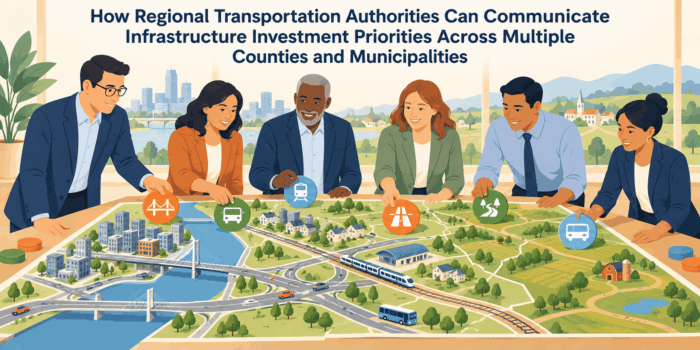
How Regional Transportation Authorities Can Communicate Infrastructure Investment Priorities Across Multiple Counties and Municipalities
Regional transportation authorities that serve multi-county service areas face a communication challenge that is simultaneously a governance challenge: how to explain investment allocation decisions that distribute limited capital resources across dozens of municipalities and multiple counties in ways that are perceived as fair, transparent, and driven by genuine regional need rather than by the political influence of specific member jurisdictions. Every infrastructure investment priority decision is a statement about whose transportation needs the authority regards as most urgent, and every community in the service area is paying attention to what those decisions say about its standing in the regional governance system.
The infrastructure investment communication challenge is compounded by the scale and duration of regional transportation capital programs. A multi-county transit authority that is managing a multi-billion-dollar capital improvement program over a decade-long implementation horizon is communicating about investment decisions whose consequences for specific communities will unfold over periods that outlast political cycles, planning staff tenure, and the attention spans of media and public audiences that typically focus on announcements and openings rather than on the decade of planning, programming, and construction that precedes them. The community that is told its infrastructure improvements are in the long-range program but not in the current capital plan has received information whose adequacy depends entirely on whether the community can trust that the long-range program commitment is genuine.
Multi-county infrastructure investment communication is further complicated by the diversity of the communities in a regional transportation authority’s service area. The older urban core with dense transit ridership, deteriorating infrastructure, and a history of deferred maintenance has different investment priorities and different communication needs than the growing suburban municipality seeking transit service expansion into new development areas, the rural county at the service area’s edge seeking intercommunity connections to regional employment centers, or the medium-sized city seeking infrastructure upgrades that will support transit-oriented development. Each of these community types brings to investment priority communication a different set of concerns, a different understanding of the regional authority’s mission, and a different basis for evaluating whether investment decisions are serving their community’s interests.
This article examines how regional transportation authorities can communicate infrastructure investment priorities in ways that give every jurisdiction in the service area a clear, honest, and specific explanation of where it stands in the capital program and why, that demonstrate the need-based and performance-based logic behind investment sequencing, and that build the multi-county political support that major infrastructure investment programs require to sustain their funding and implementation over the decade-long horizons that regional transportation capital programs span.
The State-of-Good-Repair Communication Foundation
 Before regional transportation authorities can communicate infrastructure investment priorities to diverse multi-county audiences, they need to establish the shared understanding of infrastructure condition that makes investment priorities comprehensible rather than arbitrary. A community that does not understand the difference between a transit station rated in a state of good repair and one with a critical condition rating, between a vehicle fleet with an average age well within its useful life and one operating beyond its replacement threshold, and between a rail corridor with adequate structural reserves and one with documented safety-critical deficiencies, cannot evaluate whether the authority’s investment priorities are driven by genuine need or by political considerations that state-of-good-repair framing is being used to justify.
Infrastructure condition reporting that publishes the actual condition assessments for every major asset in the authority’s inventory, using consistent rating systems that allow direct comparison across facilities, vehicles, and systems, and that are communicated in plain language that riders and local officials can interpret without engineering backgrounds, establishes the evidence base that investment priority communication draws on. When a capital program document says that a specific transit hub is receiving priority investment because it has received a critical condition rating, that rating means something specific and verifiable to an audience that has access to the full system condition assessment that produced it. When the same claim is made without the accessible condition data behind it, it is an assertion that communities are asked to accept on faith.
State-of-good-repair needs assessments that are published and communicated separately from capital program documents, and that quantify the full investment needed to bring all system assets to a state of good repair against the resources available for capital investment, provide the investment gap context that makes capital program sequencing decisions honest. Every multi-county regional transportation authority has more state-of-good-repair need than it has capital resources to address in any given program cycle. The communication of that gap, specifically and honestly, is the context that makes investment priority decisions comprehensible as the best available allocation of limited resources rather than as arbitrary choices among competing community interests.
From Fragmentation to Coordination: Communication Strategies for Councils of Governments, Metropolitan Planning Organizations, and Regional Planning Agencies
This article is part of our series on strategic communication for Councils of Governments, Metropolitan Planning Organizations, and Regional Planning Agencies. To learn more and to see the parent article, which links to other content just like this, click the button below.
Communicating Investment Criteria Across County Boundaries
The criteria that govern how regional transportation authorities prioritize infrastructure investments across their multi-county service areas are among the most important and least accessible elements of regional transportation capital program communication. Most regional transportation authorities have developed investment prioritization frameworks that incorporate a range of technical, equity, safety, and performance criteria, but those frameworks are typically documented in planning and program documents written for technical audiences rather than in the accessible communication formats that local governments and the public need to understand how investment decisions are made.
Plain-language investment criteria guides that explain each criterion in terms of what it measures, why it matters for regional transportation performance, how it is assessed for specific facilities and systems, and how it is weighted relative to other criteria in the investment prioritization process, give local governments and the public the information they need to understand why specific investments are prioritized and to evaluate whether their community’s highest-priority investment needs are being captured by the criteria framework. A municipality that understands that the authority’s safety criterion assesses not just the current condition of specific assets but the operational safety record of routes and facilities serving that municipality, is a municipality that can provide the local safety data and local safety experience that strengthens the safety case for its priority investment needs.
Equity criteria communication deserves particular emphasis in multi-county investment communication because equity considerations in capital investment allocation are both federally required and frequently misunderstood. A regional transportation authority that has incorporated environmental justice and Title VI equity criteria into its investment prioritization framework should communicate specifically about what those criteria measure, how they affect the prioritization of investments serving high-transit-dependency communities, and what the investment distribution looks like when the equity criteria are applied relative to what it would look like under purely technical criteria. This communication demonstrates that equity is a genuine operational priority rather than a policy statement, and it provides the communities with the most significant unmet investment needs with the evidence that equity criteria are serving their interests in the capital program.
County-by-County and Municipality-Level Communication
Individualized Investment Status Communication
The most important investment communication that a regional transportation authority can provide to each jurisdiction in its service area is the specific answer to the question that every local official in a multi-county authority is asking: where does my community’s infrastructure stand in the capital program, and when will we see the investment we need. This question deserves a specific answer, provided proactively to each jurisdiction rather than requiring local officials to interpret aggregate program documents to find their community’s position in the capital plan.
Community investment status summaries, produced for each county and major municipality in the service area and updated with each capital program cycle, that identify the specific infrastructure assets serving each community, the condition assessment for each of those assets, the capital program’s investment commitments for each asset, and the timeline for each committed investment, provide local officials with the jurisdiction-specific investment picture they need to communicate capital program progress to their constituents and to evaluate whether the regional authority’s investment priorities are serving their community’s needs. These summaries should be communicated directly to each jurisdiction’s elected officials and transportation staff rather than posted as reference documents that local officials are expected to find on their own.
Investment timeline honesty is among the most important dimensions of community investment status communication, because the gap between a long-range program commitment and near-term capital plan inclusion is where most community frustration with regional investment communication accumulates. A community that has been told for five consecutive program cycles that its infrastructure improvements are in the long-range program, without seeing those improvements advance toward capital plan inclusion, may reasonably conclude that the long-range commitment is not genuine. Investment timeline communication that honestly explains why specific improvements are sequenced the way they are, what conditions would advance them into the near-term capital plan, and what the realistic trajectory for their implementation is, is more credible and more relationship-preserving than repeated references to long-range program inclusion without specific advancement information.
Comparative Investment Distribution Communication
Multi-county regional transportation authority investment communication should include regular reporting on how capital investment is distributed across the service area, compared with the distribution of transit ridership, transit dependency, infrastructure condition needs, and equity considerations across member jurisdictions. This comparative reporting gives every jurisdiction in the service area the context to evaluate whether the capital program is serving the full service area equitably or whether it is concentrating investment in specific areas for reasons that may not reflect the full distribution of regional need.
Investment equity analysis that disaggregates capital investment distribution by community income level, transit dependency, existing infrastructure condition, and prior investment history, provides the equity accountability that multi-county investment communication requires. A regional transportation authority that can demonstrate through investment equity analysis that its capital program is directing resources toward the communities with the greatest infrastructure need and the highest transit dependency, in proportion to those needs, is an authority that has the equity evidence to support its investment priorities. An authority that discovers through equity analysis that its investment distribution does not reflect the distribution of need, has the internal accountability information that should drive capital program revision, and the public communication obligation to address the equity gap honestly.
Communicating About Major Capital Projects
Major capital projects, including new transit lines, major station reconstructions, fleet replacement programs, and significant infrastructure rehabilitation efforts, are the investment announcements that generate the most public attention and the most intense multi-county political engagement. The communication surrounding major capital project decisions, from the announcement of project alternatives through the environmental review process to funding authorization and construction commencement, shapes the multi-county political environment in which the authority operates for the duration of those projects and beyond.
Project announcement communication that is specific about what the project will accomplish, why it is being prioritized, how it was selected through the investment criteria process, and what communities will be directly served and indirectly affected, establishes the transparent accountability foundation for major project communication. The region that receives a major project announcement with specific, honest explanation of the selection rationale and the expected benefits is in a better position to evaluate the project than the region that receives an announcement without the criteria and analysis that produced it.
Community benefit communication for major capital projects should be specific about what service improvements, economic development potential, and quality-of-life enhancements each directly served community can expect from the project, and equally specific about what disruption, displacement, and construction impact those communities should prepare for. The community that receives an honest accounting of both the expected benefits and the expected costs of a major capital project in or near their neighborhood, including construction period impacts, is a community that is better prepared for the full reality of the project than one that receives only benefit communication.
Communities that do not receive direct service improvements from a major capital project but that bear some of its costs, through construction traffic, noise, air quality impacts, or the redirection of capital resources away from their own investment priorities, deserve communication that acknowledges their situation specifically. The jurisdiction that hosts a major maintenance facility but receives no direct service improvement from the line that facility serves, or the community that experiences construction impacts from a project that primarily serves another part of the region, has a legitimate claim on the authority’s communication attention that most major project communication programs do not adequately address.
Communicating About Federal and State Funding for Capital Programs
Regional transportation capital programs depend critically on federal and state funding sources whose availability, terms, and competitive requirements significantly shape what the authority can commit to in its capital program and when. Most multi-county service area jurisdictions have limited understanding of how federal and state transportation capital funding programs work, what the authority’s funding strategy is for its capital program, and how the success or failure of the authority’s federal and state funding applications affects the timing and scope of specific investments that local jurisdictions are counting on.
Capital funding strategy communication that explains the federal and state funding sources the authority is pursuing for its capital program, the competitive processes through which major federal capital grants are secured, the timeline for federal funding authorizations, and the implications of federal funding uncertainty for capital program commitments, gives local governments the funding context they need to advocate effectively for federal and state transportation funding and to understand why specific capital program commitments carry implementation contingencies that depend on funding applications that have not yet been awarded.
Federal grant application communication that informs local governments when the authority is pursuing major federal capital grants, what the grants would fund, when decisions are expected, and how local government support can strengthen the application, creates the multi-county advocacy infrastructure that makes regional transportation capital funding applications more competitive. A federal grant application that is supported by formal endorsements from every county and major municipality in the service area, and that includes local official letters of support that reflect genuine community understanding of the project’s regional significance, is more competitive than an application that lacks that intergovernmental endorsement.
How Investment Priority Communication Compares With Service Communication
Capital investment priority communication operates on a different temporal and political scale than the service communication that connects riders to current transit schedules, fare information, and service disruption updates. Service communication is immediate, specific, and operationally consequential for riders who depend on accurate information to navigate the transit system today. Investment communication is long-term, strategic, and politically consequential for communities whose infrastructure conditions and economic development prospects are shaped by investment decisions that will unfold over years and decades.
The comparison is useful because the two communication programs require different design principles, different communication channels, and different success metrics. Service communication is measured by whether riders receive accurate, timely information that helps them use the transit system successfully. Investment communication is measured by whether local governments, community leaders, and members of the public understand the capital program well enough to evaluate its equity and effectiveness, to engage meaningfully with investment priority decisions, and to provide the political support that multi-year capital programs require to maintain funding and implementation momentum. Both are essential, and both require sustained organizational investment that most regional transportation authorities have not made equally across the two communication domains.
Communicating System-Wide Investment Coherence
Capital investment decisions in multi-county regional transportation systems are not made in isolation from each other. The decision to prioritize vehicle fleet replacement over station rehabilitation in one program cycle reflects a judgment about the relative urgency of rolling stock reliability versus facility condition that affects every rider in the system, regardless of which county they board in. The decision to accelerate a specific extension project over a system-wide signal upgrade reflects a judgment about the relative value of service expansion versus system performance reliability that affects operational quality across the full service area. Communicating these system-wide coherence judgments, and the rationale behind them, is a capital program communication dimension that most multi-county authorities address inadequately.
System-wide investment coherence communication that explains how different capital program elements relate to each other, why specific investment sequences are more cost-effective than alternatives, and how the program as a whole is designed to improve system performance rather than simply to replace aging assets, gives local governments and the public the programmatic context that makes individual investment decisions comprehensible as part of a coherent strategy rather than as separate responses to separate pressures. The community that understands why its station rehabilitation has been sequenced after a system-wide track rehabilitation program, because the track work would have disrupted the newly rehabilitated station during its warranty period, has a very different understanding of the sequencing decision than the community that receives only the information that its station is in a later program phase.
Program phasing communication that explains the logic of capital investment sequencing in terms that non-technical audiences can evaluate, including the interdependencies between different program elements, the financial and operational constraints that shape phasing decisions, and the performance outcomes that the phasing sequence is designed to produce, is the system-wide coherence communication that most capital program communication programs omit in favor of project-by-project announcements that never add up to a comprehensible system-wide investment strategy for the communities receiving them.
Long-term capital program vision communication that shows how the current capital program fits into the authority’s long-term system development vision, including what the system will look like when current program commitments are fully implemented and what subsequent investment cycles will address, gives every jurisdiction in the service area the long-range context that makes near-term investment sequencing decisions comprehensible in terms of ultimate system outcomes rather than only in terms of immediate program priorities. A community that knows that its station is scheduled for rehabilitation in the current cycle and for service expansion in the subsequent cycle has a much clearer picture of its investment trajectory than one that knows only its current program position.
Communicating About Capital Program Governance
 Multi-county regional transportation authority capital programs are governed through board structures that typically include representatives from each member county, and the governance decisions that shape capital program priorities are made through these multi-county governing bodies rather than by agency staff. Most capital program communication focuses on the program outcomes and investment decisions without communicating about the governance process through which those decisions are made, leaving local governments and the public without the governance transparency that democratic accountability in multi-county investment decisions requires.
Board decision communication that explains what capital program decisions the governing board has made, how those decisions were reached including what analyses were presented and what member perspectives were expressed, and what the vote or consensus outcome was for significant investment priority decisions, provides the governance transparency that multi-county capital program accountability requires. The county representative who dissented from a board vote on a specific capital investment allocation deserves the transparency of having their dissent communicated publicly as part of the record, not only the announcement of the outcome that did not reflect their county’s preference.
Public engagement in capital program governance, including opportunities for community members to address the governing board on capital investment priorities, to provide input on the investment criteria and the weighting of different factors in the prioritization process, and to participate in the periodic capital program updates that reconsider long-range program commitments in light of changed conditions, gives the public a direct connection to the governance process that shapes investment decisions rather than only to the communication of decisions that have already been made. Capital program public engagement that is designed to inform governance decisions rather than to inform the public of governance decisions already made, is the democratic participation standard that multi-county investment governance should aspire to.
Capital program audit and oversight communication that publicizes the results of internal and external audits of capital program financial management, project delivery performance, and program governance, provides the independent accountability check that multi-county investment programs require. An authority that publishes its capital program audit results, that communicates the specific findings of those audits, and that reports on the corrective actions taken in response to audit recommendations, is demonstrating the financial accountability that public investment in regional transportation infrastructure requires.
Emergency and Resilience Investment Communication
Multi-county regional transportation authorities face specific investment communication challenges when natural disasters, extreme weather events, or infrastructure failures require emergency capital expenditures that displace planned capital program investments. The flooding event that destroys a transit maintenance facility, the earthquake that damages critical rail infrastructure, or the ice storm that accelerates vehicle fleet deterioration beyond programmed replacement schedules, all create investment communication challenges that planned capital program communication frameworks are not designed to address.
Emergency capital investment communication that explains specifically what damage has occurred, what the estimated cost of repair or replacement is, how the emergency expenditure will affect the planned capital program, and what the recovery timeline is for affected services, provides the multi-county service area with the specific information it needs to understand the investment implications of infrastructure emergencies. Emergency capital communication should reach every county in the service area simultaneously and should be specific about the program impacts for each county rather than communicating only aggregate system-wide impacts.
Infrastructure resilience investment communication that explains what the authority is investing in to reduce the vulnerability of its infrastructure to future emergency events, why specific resilience investments are prioritized over other capital needs, and what the expected reduction in emergency repair costs and service disruptions would be if resilience investments are made, provides the forward-looking investment communication that connects emergency response spending to long-term capital program planning. Communities that understand the connection between resilience investment and reduced emergency repair exposure are communities that can support resilience investment as a cost-effective capital program priority rather than as additional capital spending on top of an already-stretched program.
Communicating With Communities During Active Construction
The construction phase of major capital projects is when multi-county investment communication becomes most immediately consequential for the residents and businesses adjacent to construction sites, and when the quality of community-specific communication most directly affects the authority’s relationships with the communities it serves. Construction period disruptions, including access restrictions, noise, dust, traffic management impacts, and utility interruptions, are experienced by specific communities in specific ways that general project communication programs do not adequately address.
Community-specific construction impact communication that identifies the specific disruptions that active construction will create in each affected neighborhood, the timeline for each disruption phase, the mitigation measures the authority is implementing to minimize disruption impacts, and the direct contact information for community members to report construction concerns, provides the practical guidance that affected communities need to manage construction period impacts in their daily lives. This communication should be delivered through the neighborhood-level channels that reach residents most directly, including door-to-door notification for properties adjacent to construction sites, direct mail to businesses in construction impact zones, and coordination with neighborhood associations and community organizations that serve the affected areas.
Construction period community liaison programs that designate specific authority staff as direct points of contact for affected communities during active construction, that attend neighborhood meetings during the construction period to provide project updates and answer community questions, and that investigate specific community concerns about construction impacts with the same responsiveness applied to regulatory compliance issues, provide the human connection to the construction process that most affected communities find most valuable. The community that has a named, reachable authority contact who takes its construction period concerns seriously is a community with a very different experience of the regional transportation authority than one that can only submit concerns through a generic web form.
Communicating About Regional Transportation Network Interdependencies
Multi-county regional transportation systems are networks whose performance depends on the interdependencies between different service types, different infrastructure components, and different geographic service segments in ways that most riders and local officials do not understand. A rail corridor whose on-time performance depends on the condition of a specific bridge, the reliability of a specific signal system, and the performance of connecting bus service that feeds riders into the rail system, is a service whose investment priorities can only be communicated coherently in terms of the network interdependencies that determine where investment will produce the greatest system performance improvement.
Network interdependency communication that explains why specific infrastructure investments affect system performance across the full service area rather than only in the immediate vicinity of the investment, how the reliability of specific system components cascades into system-wide performance impacts, and why investment in unsexy infrastructure like signal systems and track geometry can produce greater system performance improvement than more visible investments in station renovation or vehicle acquisition, gives the multi-county service area the technical context that makes system-wide investment priorities comprehensible as a coherent performance improvement strategy rather than as technical staff preferences.
Bus-rail integration communication that explains how regional bus networks and rail networks are designed to function as integrated systems, how transfers between the two modes are supposed to work and how they actually work, and how investment in one mode affects the performance of the other, provides the service integration context that most riders experience but that regional transportation authority communication rarely addresses explicitly. A rider who understands that a bus route improvement in their neighborhood was designed specifically to improve access to a regional rail station, and that the rail station investment was designed to serve the bus network passengers who transfer there, has a systemic understanding of the regional transportation investment that makes both investments meaningful in terms of their collective service outcome.
Frequency and reliability investment communication that explains the service quality improvements that specific infrastructure investments will produce, in terms of the wait times, travel times, and schedule reliability that riders actually experience, connects capital investment to the service outcomes that riders care about more directly than the infrastructure condition metrics that most capital program communication leads with. A rider who is told that a signal system upgrade will reduce the frequency of train delays by a specific percentage, and that this reliability improvement means they can depend on a specific train to make a specific connection, has received capital investment communication in terms that are directly relevant to their daily transportation experience.
Communicating About Regional Program Integration
Regional planning agencies that operate multiple programs, including transportation planning, housing allocation, environmental planning, workforce development, and economic development coordination, are making decisions in each program area that are interdependent in ways that their siloed communication programs rarely reflect. The regional transportation investment that improves transit access to a regional employment center is connected to the regional workforce development strategy that is training workers for jobs at that employment center, to the regional housing allocation that is attempting to site affordable housing within transit reach of those jobs, and to the regional environmental planning that is managing the air quality implications of the transportation and development activity at the employment center. Communicating these program interdependencies, in terms that local governments and the public can use to evaluate regional planning coherence, is among the most demanding and the most valuable forms of regional-to-local connection communication.
Integrated regional planning communication that synthesizes the connections among regional transportation, housing, environmental, and economic development planning decisions, showing how the programs are designed to reinforce each other in advancing shared regional goals, is communication that demonstrates the added value of regional coordination over the sum of separate program efforts. The community that understands how a regional transit investment, a regional affordable housing allocation, and a regional economic development initiative are all designed to reinforce each other in a specific corridor, is a community that can evaluate regional planning coherence rather than evaluating each program in isolation from the others.
Program integration failure communication, which honestly acknowledges when regional programs are working at cross-purposes rather than reinforcing each other, when transportation investment is not coordinated with housing planning, or when economic development activity is outpacing the environmental and transportation infrastructure that sustainable development requires, is the program accountability communication that regional planning integrity demands. Regional agencies that acknowledge and address program integration failures demonstrate the institutional self-awareness and accountability that genuine regional planning governance requires.
Communicating About Regional Planning and Climate Change
Climate change is reshaping what regional planning means for the business community’s operational environment, its workforce conditions, and its infrastructure dependencies in ways that most regional planning agencies have only begun to communicate to business audiences. The extreme heat events that are increasing energy costs for commercial and industrial operations, the flooding events that are disrupting regional freight networks and damaging commercial properties, and the wildfire smoke that is affecting outdoor worker productivity and commercial outdoor operations, are all climate change manifestations that regional planning agencies are increasingly addressing in regional climate resilience planning but that most have not yet communicated specifically to business audiences in terms of the operational business consequences they represent.
Regional climate risk assessment communication for business audiences that maps the specific climate risks facing different parts of the regional business environment, including flood risk for commercial properties in low-lying areas, extreme heat risk for outdoor industries, wildfire smoke risk for agricultural operations and outdoor commercial activities, and sea level rise risk for port-dependent industries and coastal commercial areas, provides the geographically specific and operationally relevant climate risk information that regional businesses need to incorporate into their own resilience planning and location decisions.
Regional climate adaptation investment communication that explains what specific investments the regional planning program is making to reduce regional climate vulnerability, how those investments will improve the resilience of the business environment over the adaptation investment timeline, and what the cost of inaction would be for regional business conditions if climate adaptation investments are deferred, provides the forward-looking climate business case that connects regional climate adaptation planning to the business investment planning horizons of regional employers and commercial property owners.
Tying It All Together
Infrastructure investment priority communication across multiple counties and municipalities is not primarily a marketing challenge. It is a governance accountability challenge that requires regional transportation authorities to be as specific and as honest about the logic behind their investment sequencing, the equity dimensions of their investment distribution, and the constraints that prevent them from serving every community’s investment needs simultaneously, as the communities that depend on those investments have a right to expect. The authority that communicates investment priorities transparently, that provides every jurisdiction with specific information about its community’s position in the capital program, and that acknowledges honestly when investment timelines extend beyond what communities were told to expect, builds the multi-county trust that major infrastructure programs require to maintain political support over their full implementation horizon.
The authorities that build this trust through consistent, specific, and honest investment communication find that their capital programs are more politically sustainable, their federal funding applications are more competitively supported, and their relationships with member jurisdictions are more productive when difficult investment decisions must be made. Those that communicate investment priorities primarily through project announcements and long-range program references, without the community-specific detail and equity accountability that genuine investment transparency requires, build the multi-county skepticism that makes every subsequent capital program cycle more politically contested and every difficult investment decision more damaging to the authority’s regional relationships.
Strategic Communication Support for Investment Priority Programs
 Developing the state-of-good-repair reporting systems, investment criteria communication guides, community investment status summaries, equity distribution analyses, major project community communication programs, and federal funding strategy communication that effective multi-county investment communication requires is work that most regional transportation authority communication teams have not been resourced to accomplish alongside their service and operational communication responsibilities.
Stegmeier Consulting Group (SCG) works with regional transportation authorities to develop investment priority communication programs that are built around the specific capital program structure, multi-county political environment, and equity communication obligations of each authority’s context. SCG’s engagement on investment communication begins with an assessment of how current communication is reaching, or failing to reach, the full diversity of jurisdictions in the service area, including a review of whether each county and major municipality has access to the community-specific investment information it needs to evaluate the capital program’s service to its community and to participate effectively in capital program governance.
From that assessment, SCG develops the specific communication products and organizational systems that address identified gaps, including community investment status summary formats tailored to each major jurisdiction type in the service area, investment equity analysis frameworks that disaggregate capital investment distribution by the need and equity dimensions that federal requirements and regional equity commitments require, major project community communication programs that address both served and affected communities honestly, and federal and state funding strategy communication that creates the multi-county advocacy infrastructure that strengthens funding applications.
SCG also works with authority communication and planning staff to build the organizational systems that sustain investment communication quality across capital program cycles, including data management workflows that keep community investment status information current as capital program decisions evolve, equity analysis protocols that are applied consistently at each capital program update, and intergovernmental relationship communication practices that give every jurisdiction in the service area the advance access to investment program information that genuine governance partnership requires.
Future Trends in Infrastructure Investment Communication
Digital transparency tools that make capital program investment data available to jurisdictions and the public in real-time, interactive formats are raising the baseline expectation for investment communication transparency in multi-county service areas. Capital program dashboards that allow any county official or community member to see the current condition assessment, the capital program commitment, and the investment timeline for every major asset in their jurisdiction, updated in real time as capital program decisions are made, are beginning to appear in the most transparency-committed regional transportation authorities and establishing the standard that most authorities have not yet met.
Federal equity and climate resilience requirements are also evolving in ways that create new investment communication obligations. The infrastructure law requirements for equity analysis in transportation capital investment, the climate resilience assessment requirements for federally funded projects, and the environmental justice community engagement requirements for major investments, are all creating new investment communication obligations that require authorities to communicate about the equity and climate dimensions of their investment decisions with a specificity and accessibility that most current capital program communication does not provide.
Community investment tracking applications that allow residents to follow the progress of specific capital investments from program commitment through environmental review, funding authorization, design development, and construction, provide the longitudinal accountability for capital investment commitments that periodic program documents and occasional project announcements cannot sustain. These applications, combined with automated notifications when specific milestones are reached, create a continuous investment accountability relationship between the authority and the communities whose transportation infrastructure it is responsible for maintaining and improving.
Conclusion
Regional transportation authorities that communicate infrastructure investment priorities across multiple counties and municipalities with the community-specific transparency, equity accountability, and investment timeline honesty that multi-county governance requires, build the political support and institutional credibility that major infrastructure investment programs depend on. The authority whose every member jurisdiction knows specifically where its infrastructure stands, why investment decisions are sequenced as they are, and what the realistic timeline is for its highest-priority investment needs, is an authority that can maintain the multi-county coalition that long-term capital program implementation requires.
Capital investment shapes transportation access, economic development potential, and quality of life in every community that a regional transportation authority serves, for decades after the investment decisions are made. Communicating about those decisions with the transparency and accountability they deserve is among the most important governance communication investments that regional transportation authorities can make, and it is the communication that most directly determines whether multi-county infrastructure investment serves the region as a whole or primarily the communities with the most political access to capital program decisions.
Stegmeier Consulting Group’s Strategic Approach to Communication Systems
Build investment priority communication around community-specific transparency, need-based criteria explanation, equity distribution analysis, and the timeline honesty that maintains multi-county trust across the full implementation horizon of regional capital programs.
Regional transportation authorities need investment communication that gives every jurisdiction clear, current information about capital projects, investment criteria, equity distribution, and project timelines. Stegmeier Consulting Group (SCG) helps authorities develop communication programs tailored to their capital program structure, equity obligations, and multi-county governance environment. SCG assesses communication reach across the service area, identifying gaps in community-specific investment information, equity reporting, and timeline communication that may weaken intergovernmental relationships and accountability.
Based on this assessment, SCG develops investment status summaries, equity analysis frameworks, major project communication programs, and federal funding communication materials designed around the specific needs of each jurisdiction. SCG also supports data workflows, consistent equity analysis protocols, and intergovernmental communication practices that keep investment information current and accessible throughout capital program cycles. The objective is an investment communication program that makes each jurisdiction’s position in the capital program clear, transparent, and accountable.
Use the form below to connect with our team and explore how strategic communication support can strengthen your authority’s investment communication program.