
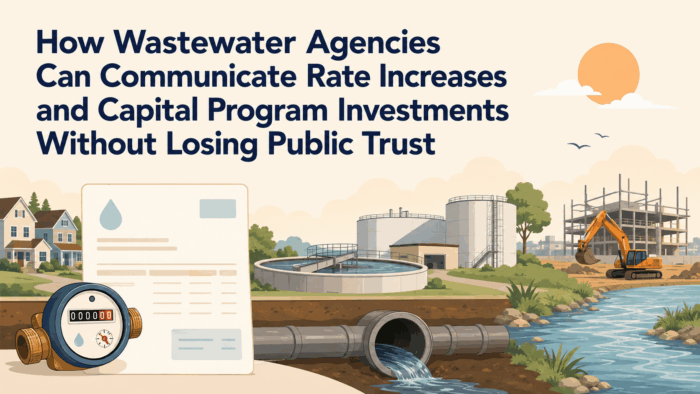
How Wastewater Agencies Can Communicate Rate Increases and Capital Program Investments Without Losing Public Trust
Wastewater rate increases occupy a particular position in the political economy of local public services. They fund infrastructure that no one sees, maintaining a service that no one thinks about until it fails, for a utility that most ratepayers regard as an obligation rather than a choice. The pipes, pump stations, and treatment processes that make daily wastewater management invisible are also the infrastructure that makes wastewater rate communication so difficult: the very success of wastewater systems at being unobtrusive deprives the agencies that operate them of the visible evidence of necessity that makes other infrastructure investment arguments self-evident.
Wastewater agencies that have built sustained communication programs about infrastructure condition, system performance, and capital investment priorities before filing a rate case are in a fundamentally different political position than those that communicate about rates for the first time in the rate announcement. The former agency is asking ratepayers to fund the next phase of a capital program they have been following. The latter is asking ratepayers to accept an increase for reasons they have never been given cause to evaluate. The difference in those communication environments is not primarily a matter of communication skill or message framing. It is a matter of the years of investment in public understanding that either exists or does not exist when the rate case arrives.
The political difficulty of wastewater rate increases is also shaped by a specific perception challenge that wastewater agencies share with no other utility type: the service they provide is one that most people associate strongly with unpleasantness, and the communication about their infrastructure must navigate that association without either ignoring it or dwelling on it in ways that undermine the agency’s authority and credibility. A water utility can communicate about the quality and reliability of a service that people actively enjoy. A wastewater utility must communicate about the critical importance of a service that people prefer not to think about at all. The communication strategy that works for one does not straightforwardly translate to the other.
This article examines how wastewater agencies can build the infrastructure investment narrative before a rate increase is proposed, explain the connection between aging systems and rate pressure honestly, communicate rate increase timelines and phase-in structures in ways that reduce ratepayer shock, manage the public comment process around rate proceedings, and maintain community relationships through a rate increase that will generate resistance regardless of how well it is communicated.
The Infrastructure Investment Narrative for Wastewater
 The infrastructure investment narrative for wastewater is harder to build than for most other utility types because the infrastructure itself provides no visible evidence of its condition or its necessity. A bridge that is visibly deteriorating builds its own narrative through the experience of the drivers who cross it daily. A water main break that floods a street creates an immediate, visible argument for water system investment. Wastewater infrastructure that is quietly deteriorating underground, that is producing subtle increases in overflow frequency and maintenance costs but no dramatic failures, requires deliberate communication investment to build public understanding of the conditions that rate increases are designed to address.
The narrative strategy that works best for wastewater infrastructure begins with the service outcome that ratepayers value: clean, functional communities where sewage is handled invisibly and waterways remain clean and accessible. From that outcome, the communication works backward to the infrastructure condition that produces it, explaining that the invisibility of wastewater management is the product of continuous maintenance and periodic capital replacement of aging infrastructure that has been functioning reliably precisely because it has been managed. The argument is that the current service reliability is the product of past investment, and that the rate increase being proposed is the investment required to maintain that reliability going forward.
Condition data is the factual foundation of the wastewater infrastructure narrative, and communicating it honestly is the most important single communication investment a wastewater agency can make before a rate case. The percentage of collection system that has passed its design life, the trend in overflow frequency as aging infrastructure becomes less reliable, the maintenance cost escalation that correlates with infrastructure age, and the capital reinvestment rate that asset management analysis indicates is required to maintain current service reliability, all provide the specific, verifiable evidence of investment necessity that a rate case requires to be credible. Agencies that communicate this data consistently and accessibly for years before a rate case create the informational environment in which the rate increase is received as a logical consequence of known conditions rather than as an arbitrary institutional demand.
From Pipelines to Public Trust: How Municipal Utilities Can Make Communication Central to Ratepayer Trust, Infrastructure Investment, and Long-Term Service Reliability
This article is part of our series on strategic communication for Public Utilities, Infrastructure Agencies, Municipal Utilities, and Public Works departments. To learn more and to see the parent article, which links to other content just like this, click the button below.
Communicating the Connection Between Aging Systems and Rate Pressure
The Deferred Investment Argument
The most compelling rate increase argument available to wastewater agencies is also the least frequently made: the specific, documented case that deferring the proposed capital investment will cost more in the long run than making it now. Infrastructure that is rehabilitated before it fails costs less to address than infrastructure that is replaced after it fails. Emergency repairs to failed collection mains are more expensive than planned rehabilitation of mains approaching end of life. Treatment plant components that are replaced on a planned schedule cost less than those that fail unexpectedly and require emergency procurement and installation. This economic argument for proactive investment is genuine, specific, and directly relevant to ratepayers’ financial stake in the rate decision.
Making this argument effectively requires historical data that most agencies have but rarely use in public communication: the actual cost comparison between planned maintenance and replacement on one hand, and emergency repair of failed assets on the other. An agency that can show that emergency main repairs in the previous five years cost an average of three times as much per linear foot as planned rehabilitation of comparable mains is making a specific, evidential argument for proactive investment that abstract statements about the importance of maintenance cannot replicate. This evidence-based deferred investment argument is available to most agencies through their own maintenance cost records, and agencies that use it in their rate case communication are making the most credible financial case available for the investment they are proposing.
Regulatory compliance drivers for wastewater capital investment deserve explicit communication in the rate case because they shape the agency’s choices in ways that ratepayers may not recognize. A treatment plant upgrade that is required by a more stringent permit limit is not primarily an agency choice about what infrastructure to build. It is a regulatory obligation whose consequences of non-compliance, including potential enforcement actions, additional penalties, and the eventual requirement to make the investment anyway under regulatory pressure, are more costly than compliance on the agency’s own schedule. Communicating the regulatory driver honestly, including what the regulation requires, why it has been set, and what the consequences of non-compliance would be, gives ratepayers the external accountability context that makes the investment rationale more compelling than an agency decision alone.
Phase-In Rate Communication
Rate increases that are large enough to fund significant capital programs often produce the most intense ratepayer resistance when they are communicated as a single large increase rather than as a phased series of smaller increases over time. The psychological and political impact of a twenty percent rate increase announced at once is substantially greater than five successive four percent increases that achieve the same total rate level over five years. Phase-in rate structures that spread the cost of capital investment over multiple rate adjustment cycles are both a rate design tool and a communication strategy, and the communication of those phase-in structures deserves as much deliberate attention as the rate design itself.
Phase-in communication should provide ratepayers with the full rate trajectory, not only the current adjustment. A ratepayer who is told that their rate will increase by four percent this year but is given no information about subsequent increases is being given incomplete information about the financial commitment they are being asked to make. A ratepayer who receives a clear, honest multi-year rate trajectory, showing the planned increases for each of the next five years alongside the capital investment each increase funds and the service reliability improvement it produces, is receiving the information they need to evaluate the full capital program rather than only its first installment. This multi-year transparency is more credible, even when the full trajectory is larger than any individual year’s increase might suggest, because it demonstrates institutional honesty about the full scope of the financial commitment.
Rate trajectory uncertainty communication is the honest companion to multi-year rate trajectory communication. Capital programs that extend over five or more years involve cost assumptions that will change as the program develops, and the rate trajectory that supports those programs will be affected by those changes. Communication that presents the multi-year rate trajectory as a fixed commitment rather than as a best-current projection, subject to revision as actual costs and regulatory requirements evolve, creates exactly the credibility problem that subsequent revisions produce. The communication discipline of distinguishing estimates from commitments, applied to rate trajectory communication, produces a more honest and ultimately more credible rate case than one that presents uncertain future rate levels as definite plans.
Managing the Public Comment Process
The public comment process around wastewater rate proceedings is a governance accountability mechanism that agencies often treat as a procedural obligation rather than as a genuine communication opportunity. A public hearing that is scheduled at a time and location that minimizes attendance, that provides no active mechanism for ratepayers to find out that the hearing is occurring, and that moves quickly through public testimony without any substantive agency engagement with the concerns raised, is meeting the procedural requirement for public participation while doing almost nothing to build the public understanding and institutional trust that effective rate case communication is meant to produce.
Proactive public hearing communication that actively encourages ratepayer participation, rather than passively satisfying the notice requirement, is the governance communication standard that wastewater agencies should apply. This means advertising the hearing through the full range of communication channels available to the agency, not only through the regulatory newspaper notice required by statute. It means scheduling the hearing at a time and location that is accessible to the working ratepayers who bear the most direct financial impact of the rate increase. It means providing a plain-language summary of the rate case rationale in advance of the hearing, so that ratepayers who attend can engage with specific issues rather than encountering the technical record for the first time in the hearing room.
Engagement with the substantive concerns raised in public comment is the accountability communication that distinguishes a hearing that functions as a genuine accountability mechanism from one that functions as a procedural formality. An agency that identifies the most common and most substantive concerns raised in public comment, addresses them specifically in the final rate decision communication, and explains how those concerns were considered in the rate structure that was approved, is demonstrating institutional accountability to public input that most agencies do not provide. That demonstration is more valuable for long-term ratepayer trust than any number of well-crafted rate announcement communications, because it shows that the public comment process is a genuine input into governance rather than a required formality that precedes a decision already made.
Maintaining Community Relationships Through a Rate Increase
A wastewater rate increase that is justified by genuine infrastructure necessity and communicated honestly will still generate resistance from ratepayers who are experiencing the cost as an unwelcome addition to household budgets that are already constrained. The communication challenge of maintaining community relationships through a rate increase is not to eliminate that resistance, which is both normal and legitimate, but to ensure that the resistance does not damage the long-term institutional trust that the agency needs to pursue the capital program the rate increase funds.
The communication that most effectively maintains community relationships through a rate increase is the communication that demonstrates the agency’s genuine regard for the ratepayer’s financial situation. This means actively promoting rate assistance programs for low-income ratepayers at the same time the rate increase is announced, not as a footnote to the main announcement but as a primary communication element that demonstrates the agency’s awareness that rate increases affect ratepayers differently and its commitment to ensuring that the most financially vulnerable ratepayers have access to programs that reduce their burden. It means communicating the affordability assistance programs in the languages and through the channels that reach the ratepayers who most need them. And it means making the enrollment process for those programs as simple and accessible as the program design allows.
Community engagement during the rate development process, before the rate case is filed, is the most valuable form of community relationship investment available to wastewater agencies preparing for a rate increase. Meetings with community groups, interviews with specific ratepayer communities, and forums that allow ratepayers to ask questions about infrastructure conditions and investment priorities before the rate proposal is finalized, demonstrate that the agency regards community input as a genuine input into its decision-making rather than as a political obstacle to be managed. The credibility that this early engagement produces is more durable than anything that post-announcement communication can achieve, because it is grounded in the experience of being asked rather than only being told.
Communicating Capital Program Performance After Rate Approval
The most important long-term communication investment that a wastewater agency can make following a rate increase approval is the consistent, honest, and accessible reporting of capital program performance. The rate case that approved the increase included specific capital program commitments: what infrastructure will be built, what it will cost, what schedule it will follow, and what service improvements it will produce. Ratepayers who supported or accepted the rate increase on the basis of those commitments have a reasonable expectation that the agency will report on whether those commitments are being met.
Annual capital program progress reports that track expenditure against approved budget, milestones completed against the approved schedule, and service reliability improvements observed in areas where capital work has been completed, provide the accountability reporting that rate increase commitments require. These reports should be written for the general ratepayer audience, not for the technical and regulatory audiences that receive the detailed program documentation, and should directly address the question of whether the agency is doing what it said it would do with the rate increase revenue. Agencies that provide this reporting consistently find that their subsequent rate cases are received with less resistance than those that remain silent on capital program performance between rate adjustments.
When capital programs experience cost overruns, schedule delays, or scope changes that affect the service improvement timeline, the communication obligation is to disclose those changes proactively with honest explanation of their causes and implications. An agency that raises rates to fund a specific capital program and then discovers that program costs have increased significantly has a communication obligation to disclose that fact and explain its causes and consequences, regardless of whether the cost increase fits within approved contingency budgets. The credibility standard that rate case communication has established for the agency applies to every subsequent communication about that rate case’s capital program, and selective disclosure of favorable outcomes while withholding unfavorable ones will eventually produce the credibility damage that honest disclosure of the unfavorable outcomes would have avoided.
How Wastewater Rate Communication Compares With Other Utility Rate Communication
Wastewater rate communication shares the fundamental challenge of all utility rate communication: asking captive ratepayers to accept higher costs for infrastructure investment whose benefits are often invisible, deferred, or diffuse. But wastewater rate communication faces specific additional challenges that distinguish it from rate communication for water, energy, or solid waste utilities. The service is the one that ratepayers most prefer not to think about, the infrastructure is the most completely invisible, and the failure consequences, sewage overflows and public health risks, are the most socially stigmatized.
These specific characteristics require wastewater rate communication to address the service’s invisibility more directly and more deliberately than rate communication for other utility types. A water utility can invite ratepayers to think about clean water they use and enjoy every day. A wastewater utility must invite ratepayers to think about infrastructure they never see and a service they rely on by not thinking about it. The communication challenge is to make that invisible, unconsidered service present and understood without either dwelling on its unpleasant dimensions or allowing it to remain as abstract and unconsidered as it is in daily experience.
Low-Income Ratepayer Communication During Wastewater Rate Cases
Low-income ratepayers bear a disproportionate share of wastewater rate increase costs relative to their household income, and the communication of rate assistance programs alongside rate increase announcements is an equity obligation as much as a communications strategy. A rate case communication that announces a rate increase without simultaneously communicating the assistance programs available to qualifying households is incomplete communication that serves the general ratepayer population while underserving the specific population most affected by the increase.
Rate assistance program communication for wastewater should be integrated into every element of the rate case communication, from the initial announcement through the public hearing process through the implementation notification. The income thresholds, application process, and benefit structure of any low-income rate assistance program should be communicated with the same prominence as the rate increase amount and effective date, and should be communicated through the channels and in the languages that reach low-income households most effectively. Agencies that bury rate assistance program information in footnotes to the main rate announcement, or that make it available only through the utility’s website, are communicating the assistance program as an afterthought rather than as a genuine commitment to equity in rate design.
Automatic enrollment mechanisms, where the wastewater agency enrolls qualifying households in rate assistance programs based on their enrollment in other income-qualified programs rather than requiring a separate application, reduce the participation barrier that application requirements create for the households with the most limited capacity to navigate multiple government program enrollment processes. Communication about automatic enrollment should explain clearly how the mechanism works, what data is being used to identify eligible households, and what the household needs to do if they believe they qualify but have not been automatically enrolled. The existence of automatic enrollment does not eliminate the need for outreach to qualifying households who are not enrolled in the other programs that trigger automatic eligibility.
Payment plan communication during rate increases should be proactive rather than reactive, reaching households that are at risk of falling behind before they accumulate arrears that complicate their relationship with the agency. An agency that identifies households with payment difficulty indicators, including late payments, partial payments, or contact with customer service about inability to pay, and that reaches out to those households before the rate increase takes effect to communicate the payment plan options and assistance programs available to them, is demonstrating the operational care for ratepayer financial circumstances that the agency’s public service mission requires.
Communicating Wastewater Rate Increases to Commercial and Industrial Customers
 Commercial and industrial customers who are wastewater ratepayers have information needs that differ from those of residential ratepayers in ways that require differentiated communication rather than a single rate case communication program. Large commercial and industrial users may have their rates set through specific rate schedules that are distinct from the residential rate, may have discharge permits that interact with their wastewater rate in ways that residential ratepayers do not experience, and may have established institutional relationships with the wastewater agency through permit negotiations and compliance activities that residential ratepayers do not.
Direct communication with major commercial and industrial accounts before a rate case is filed, providing them with early access to the rate proposal and an opportunity for direct engagement with agency financial and engineering staff about the proposal’s basis, demonstrates the customer relationship investment that large account management requires. These accounts are likely to participate formally in the rate proceedings, either through direct testimony or through membership in business associations that intervene in the proceeding, and an agency that engages them early and substantively is building a more productive relationship with their formal rate case participation than one that communicates with them only through the same general public notice that reaches residential ratepayers.
Small commercial accounts, which typically lack the staff resources to participate formally in rate proceedings but whose energy costs represent a significant share of their operating expenses, are often underserved by rate case communication programs that focus on residential ratepayers. The specific financial impact of a wastewater rate increase on a small restaurant, a laundromat, or a small manufacturing operation depends on the volume and characteristics of the wastewater they discharge, and the rate case communication that serves these accounts most effectively is communication that provides business-specific rate impact information rather than the average residential household impact figure that most rate case communications lead with.
The regulatory compliance dimension of commercial and industrial wastewater rates, where the rate structure reflects both the volume and the strength of the wastewater discharged, is a technical dimension of wastewater rate communication that most rate cases address inadequately in their public-facing communication. A commercial or industrial customer whose discharge characteristics make their rate impact different from the average residential impact deserves specific communication about how their rate is calculated, why the rate increase affects their specific billing differently from residential billing, and what options are available to them if they want to reduce their wastewater discharge strength or volume to reduce their rate exposure.
Wastewater Rate Communication and Infrastructure Accountability
The accountability communication that follows a wastewater rate increase is the communication that most directly determines whether the next rate case is received in a context of institutional trust or institutional skepticism. An agency that raises rates, executes the capital program it promised, and reports regularly and honestly on that execution is building the accountability record that makes subsequent rate cases more manageable. An agency that raises rates, executes a capital program that diverges from the commitments made in the rate case, and communicates inadequately about the divergence is building the accountability deficit that subsequent rate cases must overcome.
Project outcome communication should connect completed capital investments to the specific service or environmental improvements they were designed to produce, using monitoring data to demonstrate the connection rather than relying on the promise that the investment will eventually produce the anticipated outcomes. A collection system rehabilitation that was justified in the rate case by its expected reduction in overflow frequency deserves post-completion reporting that shows whether overflow frequency has changed in the rehabilitated area, and what factors may account for any difference between the expected and observed outcomes. This outcome accountability communication is the rate case accountability that most wastewater agencies do not provide and that most ratepayers would value if they understood that it was possible.
Cost performance accountability communication reports actual capital program costs against the budget that the rate case approved, with specific explanation of any significant variances. A program that comes in under budget deserves communication that explains the savings and how they will be used. A program that experiences cost overruns deserves equally specific communication about what drove the overruns and how the agency is managing the budget implications. Both types of cost performance communication demonstrate the financial accountability that rate cases require, and both are more credible than silence about cost performance that ratepayers may discover through regulatory filings or audit reports.
Governance Communication for Wastewater Rate Cases
Governing boards and utility commissions that approve wastewater rate increases carry both governance authority and public accountability for the rate decisions they make. Board members who vote to approve a rate increase without being able to articulate the capital investment rationale, the service improvement the investment will produce, or the financial management practices that ensure the investment will be executed as promised, are governance actors who are exercising authority without the institutional understanding that responsible authority requires.
Board education for wastewater rate cases should prepare board members to explain the rate case rationale in plain language to the constituents and media who will ask them about their vote. This means briefings that go beyond the technical and financial documentation of the rate case to address the questions that non-specialists will ask: What is wrong with the current infrastructure. Why can the problem not be deferred. What will this investment accomplish. Why is it worth this cost. How will we know if it is working. Board members who can answer these questions accurately and clearly in public settings are governance partners in the rate case communication rather than governance actors who must refer all public questions to staff.
Public board presentations on rate case rationale, which walk through the infrastructure conditions, capital program priorities, and financial analysis that underlie the rate proposal in terms accessible to community members who attend board meetings or watch recordings of them, are the most visible form of governance accountability communication available for wastewater rate cases. A board presentation that engages genuinely with the technical complexity of the rate case rationale, that acknowledges uncertainties and the agency’s plans for managing them, and that invites and responds substantively to questions from board members and the public, demonstrates the governance seriousness that significant capital investment decisions require.
Using Rate Case Communication to Build Long-Term Institutional Trust
Wastewater rate cases recur. The capital investment needs of a wastewater system do not resolve with a single rate adjustment; they evolve continuously as infrastructure ages, regulatory requirements change, and climate conditions place new demands on systems designed for different conditions. An agency that treats each rate case as a standalone communication event, building the rationale from scratch each time, is perpetually starting over in the task of building the public understanding that rate cases require. An agency that treats each rate case as a chapter in a continuing infrastructure accountability story, one that builds on the narrative established in prior rate cases and demonstrates follow-through on prior commitments, is accumulating the institutional trust that makes each successive rate case more credible.
The long-term communication investment that builds this accumulated trust includes the sustained infrastructure condition reporting that documents the aging of the system between rate cases, the capital program performance reporting that demonstrates follow-through on prior rate case commitments, the public engagement that treats ratepayers as ongoing partners in infrastructure governance rather than as periodic audiences for rate announcements, and the honest communication about challenges and setbacks that distinguishes an institution with integrity from one that communicates selectively about its successes. Each of these communication investments is most valuable not at the moment of a specific rate case but in the years between rate cases when the institutional credibility that rate cases depend on is either being built or being neglected.
Rate case follow-through communication is the single most powerful long-term trust-building investment that a wastewater agency can make. An agency that raises rates to fund a specific capital program and that reports consistently, specifically, and honestly on whether that program is being executed as promised, whether its costs are tracking against the approved budget, and whether its environmental and service reliability outcomes are materializing as projected, is building the accountability record that the next rate case will draw on. That record, accumulated over the full lifecycle of a capital investment, is the institutional credibility asset that makes the agency’s rate case communication credible rather than requiring credibility to be established anew each time a rate case is filed.
Multi-Jurisdictional Wastewater Rate Communication
Wastewater agencies that serve multiple municipalities or that participate in regional wastewater treatment arrangements face rate communication challenges that single-jurisdiction utilities do not. The ratepayer in a community that purchases wastewater treatment from a regional authority experiences rates that reflect the regional authority’s cost allocation as well as the local collection system costs, and the communication of rate changes that originate at the regional authority level requires coordination between the regional authority and the local utility that is often inadequate. A local utility that raises rates to pass through a regional authority rate increase without clearly explaining the regional authority component of the increase is presenting ratepayers with a local utility rate increase that is partly outside the local utility’s control.
Rate communication in multi-jurisdictional settings should explain the rate structure transparently, distinguishing between the components of the rate that reflect local utility costs and those that reflect regional treatment or conveyance costs. When a regional authority rate increase drives a local utility rate adjustment, the communication should explain the regional authority’s rate decision, the basis for it, and the governance process through which local elected officials can engage with regional authority rate decisions that affect their constituents. This transparency about the multi-jurisdictional nature of the rate demonstrates the institutional honesty that ratepayers deserve even when that honesty involves acknowledging that parts of their rate are set by entities beyond the local utility’s direct control.
Regional governance communication for wastewater authorities that set rates affecting multiple member jurisdictions is a specific accountability function that most regional authorities do not invest in adequately. Ratepayers in member communities who fund the regional authority through the rates they pay to their local utilities have a legitimate interest in understanding how the regional authority makes its budget and rate decisions, what governance mechanisms ensure that member jurisdictions have meaningful input into those decisions, and what accountability the regional authority provides to the ratepayers it ultimately serves. Proactive communication about regional authority governance that reaches member community ratepayers through local utility channels extends the accountability communication from the local utility relationship to the regional governance relationship that ultimately determines a significant component of the local utility rate.
Regulatory Framework Communication for Wastewater Ratepayers
Most wastewater ratepayers do not understand the regulatory framework that governs wastewater treatment, and this ignorance shapes how they receive rate case communication in ways that agencies rarely account for. A ratepayer who does not know that wastewater treatment is governed by Clean Water Act permits with specific effluent quality requirements, enforced by state and federal environmental agencies with authority to impose significant penalties for non-compliance, has no framework for understanding why treatment plant upgrades are not a matter of the utility’s discretion but a regulatory obligation whose consequences of non-compliance are more costly than the investment required to comply.
Regulatory driver communication should be a standard element of wastewater rate case rationale rather than a technical detail confined to the regulatory compliance documentation. When a specific capital investment is required by a permit condition, a regulatory compliance schedule, or an enforcement agreement, that regulatory driver should be communicated specifically and accessibly: what the regulation requires, which agency has set the requirement, what the regulatory basis for it is, and what the consequences of non-compliance would be for the utility and for the ratepayers it serves. This communication transforms the investment from an agency decision that ratepayers must take on faith into a regulatory obligation with external accountability that ratepayers can verify independently.
Consent decree and enforcement agreement communication is a specific regulatory driver communication challenge that most wastewater utilities face at some point and that most handle inadequately from a public communication standpoint. An enforcement agreement that requires a specific capital investment program to be completed on a defined schedule is both a governance accountability document and a rate case rationale document, and communicating about it honestly, including what regulatory violations or compliance concerns led to the enforcement agreement, demonstrates the institutional accountability that the enforcement process is designed to produce.
Future regulatory requirements communication, which prepares ratepayers for the regulatory drivers that will shape future rate cases before those rate cases are filed, is among the most proactive and most valuable long-term rate communication investments available to wastewater agencies. A utility that communicates about a pending permit renewal that is expected to include more stringent effluent quality standards, explaining what the new standards will require of the treatment plant and what capital investment that will entail, is building the regulatory context that will make the next rate case more comprehensible before it is filed.
Communicating Rate Increases in Economically Stressed Communities
Wastewater rate increases in communities with significant concentrations of low-income households, high unemployment, or economic stress from deindustrialization or other structural factors carry a communication burden that rate increases in more economically comfortable communities do not. The household for whom a fifteen-dollar monthly rate increase represents a meaningful share of disposable income is not an abstraction in the rate case filing. They are the ratepayer whose financial reality the rate case communication must acknowledge honestly if the agency’s equity commitments are to be credible.
Economic stress context communication does not mean abandoning the infrastructure necessity argument that justifies the rate increase. It means presenting that argument alongside honest acknowledgment of the financial reality that the rate increase creates for the households most constrained by it, and alongside the specific affordability measures the agency has designed to address that reality. An agency that communicates a rate increase in an economically stressed community without addressing the affordability dimension is communicating to the comfortable majority while ignoring the financially strained minority that bears the rate increase’s most significant burden.
Community-specific rate impact communication, which disaggregates the rate increase’s household impact by income level and housing tenure rather than presenting only the average household impact, gives community members a more accurate picture of how the rate increase will be distributed across the community’s economic diversity. The average monthly impact on a typical household may understate the impact on the community’s lowest-income households and overstate it for higher-income households. Communicating the distribution of impacts, alongside the assistance programs that address the impacts on the lowest-income tier, is the honest, equity-aware rate communication that economically diverse communities deserve.
Long-term affordability planning communication, which explains how the agency is designing its rate structure and assistance programs to remain affordable for low-income households over the full trajectory of the capital investment program, demonstrates the equity commitment that multi-year capital-driven rate increases require. A community that is being asked to accept a series of rate adjustments over five or ten years deserves not only information about the immediate rate change but assurance that the long-term rate trajectory has been designed with affordability at all income levels as a genuine program constraint rather than as an afterthought addressed through assistance programs that reach only a fraction of the eligible population.
Tying It All Together
Wastewater rate communication is among the most difficult forms of public utility communication because it must build understanding of and public support for investment in infrastructure that is successfully invisible, in a service that ratepayers prefer not to think about, funded through increases in a bill that most ratepayers regard as a cost without a visible service. The agencies that do this most effectively are not those with the most sophisticated communication programs or the most skilled communicators. They are the ones that have invested consistently over years in the specific, honest communication about infrastructure condition, capital investment priorities, and service performance that makes a rate increase comprehensible when it arrives.
The infrastructure narrative that makes wastewater rate cases governable is built one condition assessment report, one annual performance summary, one capital program update, and one community engagement meeting at a time. It is the cumulative product of sustained communication that treats ratepayers as partners in infrastructure governance rather than as audiences for institutional announcements. The agency that has built that relationship over years before filing a rate case finds that the rate case, however unwelcome, is received within a context of established trust that makes it manageable. The agency that has not built it finds that the rate case, however justified, arrives in a context of accumulated information deficit that makes it a fight.
Strategic Communication Support for Wastewater Rate Cases
 Developing the infrastructure narrative, the ratepayer engagement programs, the phase-in rate communication, and the capital program performance reporting that effective wastewater rate case communication requires is work that most wastewater agency communication teams cannot accomplish alongside their routine responsibilities. The sustained investment required, across years of condition assessment communication, capital program transparency, and public comment engagement, makes external communication expertise a productive investment for agencies seeking to improve the political environment in which their rate cases are received.
Stegmeier Consulting Group (SCG) works with wastewater agencies to develop rate case communication strategies that are grounded in the agency’s specific infrastructure conditions, capital program priorities, and community context. This includes developing the infrastructure investment narrative that builds public understanding before a rate case is filed, designing ratepayer engagement programs that demonstrate genuine accountability to community input, creating phase-in rate trajectory communications that provide full financial transparency, and building the capital program performance reporting systems that close the accountability loop on rate case commitments. The objective is a rate case communication program that treats public trust as the most valuable outcome of the rate proceeding rather than rate approval as its sole measure of success.
Future Trends in Wastewater Rate Communication
The wastewater rate communication environment is being shaped by rising expectations for financial transparency that digital tools are making increasingly feasible to meet. Interactive rate calculators that allow ratepayers to model the impact of proposed rate adjustments on their specific usage profile, capital program dashboards that track expenditure against approved budgets in real time, and digital infrastructure maps that show ratepayers the age and condition of the collection system components in their neighborhood, are all tools that are beginning to appear in the most transparency-committed wastewater programs. These tools do not replace the foundational communication work of building the infrastructure narrative and engaging ratepayers as genuine partners in capital investment governance, but they extend that work into digital environments where many ratepayers now encounter institutional information.
Climate change is creating new drivers for wastewater capital investment that require new communication approaches. Sea level rise and increased precipitation intensity are affecting the hydraulic design requirements for collection systems, the treatment capacity requirements for facilities that handle combined flows during storm events, and the resilience requirements for infrastructure in flood-prone areas. Communication that connects wastewater capital investment to climate resilience, explaining how infrastructure being built today is designed for the rainfall and sea level conditions expected over its design life rather than those of the past, positions wastewater investment as climate adaptation alongside its traditional role as infrastructure maintenance and regulatory compliance.
Conclusion
A wastewater rate increase that is communicated honestly, that is grounded in a sustained infrastructure investment narrative, that engages ratepayers as genuine participants in the governance of an essential public service, and that follows through on its capital program commitments with accountable performance reporting, does not eliminate opposition to higher costs. It earns the credibility to be heard when it explains why those costs are necessary, and it demonstrates through follow-through that the money collected has been used as promised.
The wastewater agencies that communicate rate increases most effectively are not those that have mastered the art of making rate increases politically acceptable. They are the ones that have invested consistently enough in ratepayer relationships, infrastructure transparency, and capital program accountability that when the rate increase arrives, it is received within a context of institutional trust that makes it a governable event rather than a political crisis. Building that context is the communication work that rate cases depend on, and it begins not when the rate case is filed but years before.
Stegmeier Consulting Group’s Strategic Approach to Communication Systems
Build wastewater rate case communication on the infrastructure investment narrative, honest phase-in transparency, and the capital program accountability that sustains public trust through the full rate cycle.
Wastewater agencies that communicate rate increases with sustained infrastructure investment context, genuine ratepayer engagement, and consistent capital program performance reporting build the institutional credibility that makes each successive rate case more manageable than the last. Stegmeier Consulting Group (SCG) helps agencies develop the infrastructure narrative programs, rate case communication strategies, community engagement frameworks, and capital accountability reporting systems that transform rate case communication from an adversarial political event into a transparent governance accountability process.
Use the form below to connect with our team and explore how strategic communication support can strengthen your agency’s rate case communication.