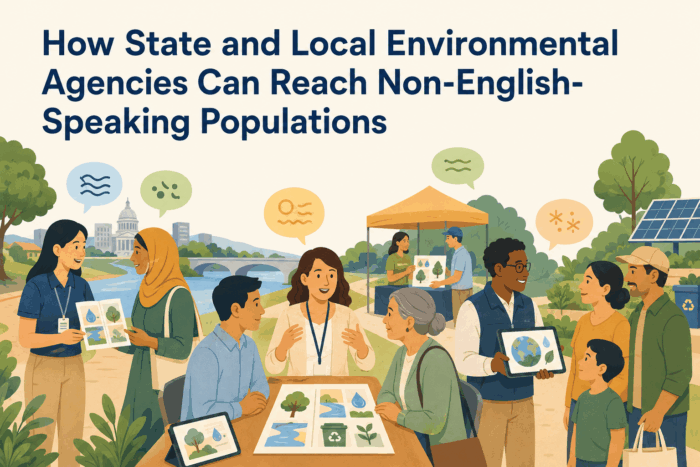
Multilingual Outreach in Environmental Compliance: How State and Local Environmental Agencies Can Reach Non-English-Speaking Populations
 Environmental compliance information is only useful when affected communities can understand it. State and local environmental agencies may publish accurate notices, permit information, enforcement updates, monitoring results, cleanup instructions, or public participation opportunities, yet still fail to reach residents who do not primarily use English. In those situations, the communication gap is not simply a translation issue. It can affect whether people understand environmental conditions, know what actions to take, recognize deadlines, participate in regulatory processes, or identify which agency can answer their questions.
Multilingual outreach is therefore part of effective environmental communication infrastructure. Agencies should consider language access at the beginning of a communication process rather than after English-language materials have already been finalized. Translation, interpretation, community distribution, digital access, and plain-language development should work together so that residents receive information that is both linguistically accessible and practically understandable.
The challenge is especially significant in environmental compliance because the underlying information may already be difficult to interpret in English. Terms related to permits, violations, remediation, sampling, emissions, discharge limits, enforcement, public comment, and regulatory authority can carry precise meanings that do not translate well through literal word substitution. If agencies begin with dense technical language, translation may reproduce the same barriers in another language.
A strong multilingual strategy should preserve regulatory accuracy while reducing unnecessary complexity. State and local environmental agencies need systems for identifying language needs, determining which information requires translation or interpretation, maintaining terminology consistency, coordinating with trusted community partners, and ensuring that multilingual audiences receive updates at the same stage of the process as English-speaking audiences. The goal is not to create separate regulatory messages for different communities. It is to provide equitable access to the same essential environmental information.
Treat Language Access as Part of Environmental Compliance Communication
Multilingual outreach should not be treated as a supplemental service that begins only when a community requests translation. State and local environmental agencies should incorporate language access into the planning of permits, enforcement actions, cleanup projects, monitoring programs, public meetings, and other compliance-related communication where affected populations may include residents with limited English proficiency.
This requires identifying communication needs before notices are released. Agencies should consider which populations may be affected, which languages are commonly used in the relevant area, what information is likely to require explanation, and which communication channels are most likely to reach those audiences. These decisions should be made early enough that multilingual materials can be released alongside the primary English-language communication whenever appropriate.
Language access also needs to extend beyond legally required notices. A translated public notice may satisfy one procedural function while leaving residents without understandable explanations of what the agency found, why the action matters, what happens next, or how to participate. Compliance communication should therefore distinguish between the formal notice and the broader information people need to navigate the process.
Embedding language access into the communication system reduces the risk that non-English-speaking residents receive important information later, in less detail, or only after community organizations intervene. It creates a more consistent standard for public access across environmental programs.
Identify Language Needs Before Choosing Outreach Tactics
Agencies cannot design effective multilingual outreach without understanding which language communities are actually affected. State and local environmental agencies should use available demographic information, local knowledge, prior engagement records, school and community data where appropriate, and input from local partners to identify likely language needs.
Geographic scale matters. A countywide language profile may not reflect the population living near a contaminated property, industrial facility, watershed, or project site. Agencies should examine the area most relevant to the environmental issue rather than rely solely on broad jurisdictional averages.
Language identification should also account for the fact that spoken-language needs may differ from written-language needs. Some communities may use a particular language conversationally but have varying levels of literacy in that language. Others may rely on interpreters, bilingual family members, or community organizations because formal written materials are difficult to use.
Understanding these distinctions helps agencies choose the right combination of translated documents, interpretation, verbal outreach, visual materials, community meetings, recorded information, or other tools. The outreach strategy should follow the actual communication need rather than beginning with a predetermined format.
Avoid Assuming That One Language Represents an Entire Community
Communities that appear linguistically similar may include several languages, dialects, or different levels of English proficiency. State and local environmental agencies should avoid treating a broad ethnic or geographic category as evidence that one translated version will reach everyone.
The same community may include long-term residents, recent immigrants, multilingual households, and people with different educational or literacy backgrounds. Communication planning should reflect this variation where it materially affects access.
A more precise understanding of language needs helps agencies avoid both under-translation and unnecessary translation. Resources can be directed toward the languages and formats that are most relevant to the people affected by the environmental issue.
Develop Plain English Before Translating Technical Information
Translation quality begins with the source material. Environmental agencies should not expect translators to solve communication problems created by highly technical, legalistic, or poorly organized English-language content. Before materials are translated, the agency should make the source language as clear and direct as possible.
Plain English does not require eliminating regulatory precision. Agencies can explain technical terms while retaining the formal language needed for permits, compliance findings, enforcement actions, or legal notices. A public-facing summary can identify what occurred, what requirement applies, what the agency is doing, and what residents need to know while linking to the complete technical or regulatory record.
Clear source material also reduces inconsistency across languages. If an English document uses several terms interchangeably for the same process, translators may reproduce or amplify that ambiguity. Consistent terminology, short sentences, clear headings, and defined concepts create a stronger foundation for accurate translation.
This step benefits every audience. Improving the source material makes environmental compliance information easier to understand in English while also improving the quality and reliability of multilingual versions.
Build a Consistent Multilingual Environmental Vocabulary
Environmental compliance communication contains specialized terminology that may not have a simple equivalent in every language. Words such as violation, exceedance, contamination, remediation, mitigation, discharge, permit condition, enforcement, exposure, and monitoring may require careful explanation rather than literal translation.
State and local environmental agencies should develop consistent terminology for frequently used environmental and regulatory concepts. Translation glossaries, approved terminology lists, and explanatory language can help agencies maintain consistency across notices, websites, meeting materials, fact sheets, and ongoing project updates.
Consistency is especially important for long-running matters. If different translators use different terms for the same cleanup activity, regulatory action, or environmental condition, residents may believe that the situation has changed when only the vocabulary has changed. Stable language allows communities to follow the issue over time.
Agencies should also recognize when explanation is more useful than a direct technical translation. A translated term may be linguistically correct but unfamiliar to the intended audience. Providing a brief plain-language explanation can make the regulatory meaning more accessible without changing the underlying technical concept.
Match Translation Depth to the Importance of the Information
Not every document associated with an environmental matter requires the same level of translation. Agencies may manage hundreds of pages of technical reports, laboratory data, permit attachments, correspondence, and administrative records. A multilingual communication strategy should prioritize the information residents need to understand the issue and participate effectively.
State and local environmental agencies should identify essential public-facing materials such as notices, executive summaries, protective guidance, public meeting information, comment instructions, project status updates, enforcement summaries, cleanup milestones, and contact information. These materials often have a stronger effect on practical access than translating every technical appendix.
Where a full technical document is not translated, the agency should provide a clear multilingual explanation of what the document contains, why it matters, and how residents can request assistance understanding it. Interpretation or language assistance may also help residents engage with technical information that is impractical to translate in full.
Prioritization should not become an excuse for providing only minimal information. The objective is to ensure that multilingual audiences receive the substantive information necessary to understand environmental conditions, agency action, and participation opportunities while using translation resources strategically.
Provide Interpretation Wherever Public Participation Depends on Spoken Communication
Written translation alone does not create meaningful language access when environmental engagement occurs through meetings, hearings, workshops, site tours, or direct conversations with agency staff. State and local environmental agencies should plan interpretation whenever spoken participation is an important part of the process.
Interpretation needs should be identified early enough that qualified interpreters can become familiar with the environmental terminology and meeting structure. Highly technical discussions are difficult to interpret accurately without preparation, particularly when agencies use acronyms, regulatory citations, or specialized scientific language without explanation.
Meeting design should also account for interpretation. Speakers may need to slow their pace, avoid overlapping discussion, explain acronyms, and allow additional time for questions and interpreted responses. Interpretation should be integrated into the meeting format rather than treated as an interruption to an English-language event.
Effective interpretation allows residents to do more than listen. They should be able to ask questions, provide comments, understand agency responses, and follow the same substantive discussion available to English-speaking participants.
How Environmental Protection Agencies Can Make Communication Central to Regulatory Effectiveness, Public Trust, and Community Health
This article is part of our series on strategic communication for Environmental Protection Agencies, Environmental Compliance Agencies, and state and local environmental departments. To learn more and to see the parent article, which links to other content just like this, click the button below.
Release Multilingual Information at the Same Time Whenever Practical
A common equity problem occurs when English-language information is published immediately while translated versions follow days or weeks later. During an active environmental issue, that delay can leave non-English-speaking residents dependent on secondhand summaries at the moment when public attention and decision-making are most active.
State and local environmental agencies should build translation time into communication schedules so essential multilingual materials can be released simultaneously with English versions whenever practical. This is particularly important for protective guidance, public meeting notices, comment deadlines, major monitoring findings, cleanup changes, and enforcement developments that require timely public understanding.
When simultaneous release is not possible, agencies should communicate what language assistance is available in the interim and when translated information will be provided. They should avoid leaving multilingual audiences uncertain about whether additional materials are forthcoming.
Timeliness is part of meaningful access. Information that becomes understandable only after a public meeting, comment deadline, or protective decision has passed does not provide the same opportunity to participate or respond.
Use Multiple Outreach Channels Instead of Relying on Translated Documents Alone
Translated materials are necessary, but they are not sufficient when affected residents do not regularly visit agency websites, monitor regulatory notices, or receive government information through formal channels. State and local environmental agencies should combine translation with a broader distribution strategy designed around where communities actually obtain information.
Depending on the issue, outreach may include direct mail, email, text alerts, local government channels, schools, libraries, community centers, neighborhood organizations, ethnic media, faith institutions, and other locally trusted networks. The appropriate combination should reflect the urgency, geography, and audience rather than rely on a single standard outreach method.
Agencies should also distinguish between distribution and explanation. A translated notice may inform residents that an action has occurred, while a community meeting, hotline, recorded message, or plain-language fact sheet may be needed to explain why the action matters and what residents can do next.
Using multiple channels reduces the likelihood that language access depends on residents already knowing how to find the agency. It also makes environmental compliance information more resilient when one communication channel has limited reach.
Work With Community Organizations Without Making Them Responsible for Agency Communication
Community-based organizations can help agencies understand language needs, identify trusted communication channels, and reach residents who may have limited contact with environmental regulators. State and local environmental agencies should build relationships with these organizations where appropriate while maintaining responsibility for official information.
Agencies can provide translated materials, current project summaries, meeting information, and clear contact pathways that community partners can share. Partners can also identify where agency terminology is confusing, where residents need additional explanation, and which outreach methods are likely to be effective.
The relationship should not shift the burden of technical interpretation onto community organizations. Agencies should remain available to explain regulatory findings, answer substantive questions, and correct outdated information. Community partners should not be expected to serve as unofficial translators for complex environmental conclusions unless they are formally prepared and supported for that role.
Maintaining this distinction protects both accuracy and trust. Community organizations extend reach and provide local insight, while the agency remains accountable for the content and meaning of environmental compliance communication.
Design Multilingual Public Meetings for Participation, Not Just Attendance
Providing interpretation at a public meeting does not automatically make the meeting accessible. State and local environmental agencies should consider how multilingual participants will receive information, ask questions, provide comments, and understand responses throughout the event.
Meeting materials should be available in relevant languages before or at the meeting whenever practical. Presenters should use clear language, avoid unnecessary acronyms, and pause appropriately for interpretation. Complex charts, maps, and technical findings should be explained visually and verbally so participants are not forced to rely on spoken translation alone.
Question-and-answer formats should also allow multilingual participants the same opportunity to engage as English-speaking attendees. Agencies may need interpreted question queues, translated comment forms, multilingual facilitators, or additional time so participation does not become compressed by the mechanics of interpretation.
The objective is substantive participation. A meeting is not meaningfully multilingual if residents can hear a translated presentation but cannot comfortably ask questions, respond to agency explanations, or understand how their input will be handled.
Explain Environmental Compliance Processes Before Asking Residents to Participate
Environmental agencies often invite public participation in processes that are unfamiliar to residents, including permit review, cleanup planning, enforcement settlements, public comment periods, hearings, and monitoring programs. Translating the notice does not necessarily explain how the process works.
State and local environmental agencies should provide multilingual explanations of what decision is being made, which agency has authority, what stage the process has reached, what input can influence, and what happens after the participation period closes. These explanations should accompany formal notices whenever the process itself is likely to create confusion.
This is especially important when public participation has defined limits. Residents should understand whether comments are being accepted on a permit condition, cleanup proposal, environmental document, enforcement action, or another specific matter. Agencies should avoid suggesting that every issue raised can be resolved through the current process.
Clear procedural explanation makes participation more equitable because residents do not need prior familiarity with environmental regulation to understand where their input fits. It also helps agencies receive more focused and useful public comments.
Translate the Decision Path, Not Just the Deadline
Deadlines are often the most visible part of public notices, but they do not explain the decision sequence. State and local environmental agencies should show what comes before and after the deadline so multilingual audiences can understand the significance of participating at that moment.
A simple explanation can identify when comments are accepted, who reviews them, what decision follows, whether another hearing or approval stage remains, and where the final outcome will be posted.
This context helps residents understand that public participation is part of a larger process rather than an isolated administrative requirement.
Coordinate Multilingual Communication Across Agencies When Responsibilities Overlap
 Environmental compliance matters may involve several agencies with different responsibilities. A state regulator may oversee cleanup, a local government may manage land use, a health agency may provide protective guidance, and a regional authority may oversee water or air quality. Multilingual audiences should not receive separate translated messages that leave them to determine how those responsibilities fit together.
Agencies should coordinate basic facts, terminology, contact information, and public guidance before distributing multilingual materials. If different agencies use different translations for the same technical concept or describe the same procedural status differently, confusion can increase rather than decrease.
Public-facing communication should make agency roles easy to navigate. Residents should know which institution handles monitoring, permitting, enforcement, public health guidance, cleanup, local implementation, or other relevant functions. Where possible, agencies should provide direct referrals rather than simply telling residents that a question belongs elsewhere.
Coordinated language access is especially important during incidents, enforcement matters, or controversial projects. Consistency across agencies helps multilingual communities receive one coherent explanation even when regulatory authority remains divided.
Use Visual Communication to Support, Not Replace, Translation
Maps, diagrams, icons, timelines, and other visual tools can make environmental information easier to understand across language differences. State and local environmental agencies should use visual communication strategically, particularly for geographic boundaries, process stages, exposure pathways, sampling locations, and project timelines.
Visual materials should not become substitutes for translated explanations. A map showing a cleanup area may still require text explaining what the boundary represents, whether every property within it is affected, and what actions are underway. Icons can support understanding but should not carry complex regulatory meaning on their own.
Agencies should also review visuals for cultural and practical clarity. Symbols that appear obvious to staff may not communicate the same meaning to every audience. Labels, legends, and explanatory text should remain accessible in the relevant languages.
When used carefully, visual communication reduces cognitive burden and supports comprehension. It is most effective when paired with clear multilingual text and opportunities for residents to ask questions.
Create Multilingual Contact Pathways for Questions and Follow-Up
Environmental communication often fails after the initial notice because residents do not have a practical way to ask questions in their preferred language. State and local environmental agencies should provide multilingual contact pathways that extend beyond translated documents and public meetings.
Depending on agency capacity and the importance of the issue, this may include bilingual staff, interpreter-supported phone lines, translated email instructions, language selection on online forms, scheduled call-back services, or clear directions for requesting language assistance. Residents should not have to navigate an English-only phone tree before reaching language support.
Agencies should also prepare staff to route questions appropriately. Environmental compliance matters can involve technical, legal, health, and procedural questions that require different expertise. A multilingual intake system should help residents reach the correct subject-matter staff without losing information during repeated referrals.
Follow-up access is essential because environmental issues evolve. Residents may have questions after new sampling results, project changes, enforcement developments, or cleanup milestones. Language access should remain available throughout the process rather than only at the first point of contact.
Keep Multilingual Materials Current as Environmental Conditions Change
Environmental compliance information can become outdated quickly. Sampling results change, cleanup plans are revised, permit decisions are issued, enforcement actions progress, and public meeting schedules shift. State and local environmental agencies should update multilingual materials whenever those changes materially affect what residents need to know.
Version control is particularly important when translated documents remain accessible online or circulate through community networks. Agencies should clearly date materials, identify the current version, and remove or label superseded guidance so outdated information does not continue to appear authoritative.
When an update changes protective guidance, regulatory status, or public participation opportunities, translated versions should receive the same priority as English-language updates. Delayed multilingual revisions can create unequal access at precisely the moment when information matters most.
Maintaining current materials demonstrates that language access is part of the ongoing environmental response. It also helps communities follow the issue over time without having to compare outdated translations against newer English-language documents.
Organize Multilingual Communication Around the Questions Residents Need Answered
Environmental compliance information is often organized according to agency programs, statutes, permit sections, or technical documents. Residents, however, are usually trying to answer more practical questions: What happened? Does this affect my household or neighborhood? What is the agency doing? Is there anything I need to do? Can I participate? Where can I get help in my language? State and local environmental agencies should organize public-facing multilingual communication around those questions while preserving access to the full regulatory record.
This approach is especially important when the environmental issue is complex. A permit modification, contamination investigation, enforcement action, or cleanup project may involve several documents and decision stages. If translated materials simply reproduce the structure of those documents, residents may still struggle to understand how the pieces connect.
Question-based communication can provide a clearer pathway through the process. Agencies can explain the current issue first, then identify the relevant technical or regulatory materials for people who want additional detail. This helps multilingual audiences understand the significance of the information without requiring them to become familiar with agency document systems.
The goal is not to simplify the issue to the point that regulatory meaning is lost. It is to make the communication sequence reflect the way residents actually approach environmental questions.
Explain Risk and Compliance Findings in Plain, Consistent Language Across Languages
Environmental compliance communication often requires agencies to explain risk, exceedances, violations, cleanup conditions, permit requirements, or monitoring results. These concepts can be difficult to communicate accurately even in English, and inconsistent translation can make them harder to understand.
State and local environmental agencies should establish a plain-language explanation for major findings before translating them. The agency should clarify what was measured or observed, what requirement or benchmark applies, what conclusion has been reached, and what action follows from that conclusion.
Translated versions should preserve these distinctions. A detected contaminant should not automatically become a violation, and a violation should not automatically be described as proof of a health effect. Agencies should work with qualified translators or interpreters who understand that environmental and regulatory terminology can carry specific meanings.
Consistency also matters across time. If the agency uses one term for remediation in an initial notice and another in later updates, residents may believe the underlying action has changed. Stable terminology helps communities follow the issue more confidently.
Use Community-Specific Outreach Without Creating Different Versions of the Facts
Different language communities may need different outreach methods, meeting formats, or explanatory tools, but the underlying environmental information should remain consistent. State and local environmental agencies should adapt communication delivery without creating separate factual narratives for different audiences.
One community may respond best to translated mailed notices and evening meetings, while another may rely more heavily on radio, community organizations, schools, or mobile messaging. These differences reflect access patterns, not differences in the regulatory record.
Agencies should maintain one authoritative factual foundation and ensure that translated materials, community presentations, and partner communications all draw from it. This helps prevent situations in which simplified outreach materials unintentionally omit a major limitation, uncertainty, or procedural detail that appears elsewhere.
Tailoring communication is most effective when it changes how information is delivered rather than what the agency claims. Residents should receive the same essential facts regardless of the language or channel through which they encounter them.
Build Feedback Loops With Multilingual Communities
Multilingual outreach should not be treated as one-way distribution. State and local environmental agencies need mechanisms for learning whether translated and interpreted information is actually understandable and whether residents still face barriers to participation.
Feedback may come through public meetings, multilingual hotlines, community partner discussions, comment forms, listening sessions, or repeated questions received by staff. Agencies should pay attention to patterns rather than assume that the existence of translated materials means the communication problem has been solved.
If residents repeatedly misunderstand the same concept, the issue may be the explanation rather than the translation. Similarly, low participation may reflect timing, meeting format, distrust, inaccessible technology, or unclear decision context rather than lack of interest.
Feedback loops allow agencies to adjust terminology, channels, meeting design, and explanatory materials while the environmental process is still active. This makes multilingual outreach more responsive and helps agencies improve future communication.
Use Repeated Questions as a Communication Diagnostic
Recurring questions can reveal where agency communication is not working. If residents repeatedly ask whether a permit has already been approved, whether contamination is still present, or whether comments will influence the decision, the existing materials may not be making the process sufficiently clear.
State and local environmental agencies should track these patterns across languages and outreach channels. The same misunderstanding appearing repeatedly can signal a structural problem in the communication framework.
Using questions diagnostically turns community interaction into useful communication intelligence. Agencies can revise materials based on what residents are actually struggling to understand rather than relying solely on internal assumptions about clarity.
Coordinate Multilingual Messaging With Public Health and Emergency Communication
Environmental compliance issues can intersect with public health or emergency response when contamination, releases, air quality conditions, unsafe water, or other hazards may require protective action. State and local environmental agencies should coordinate multilingual communication closely with the agencies responsible for health guidance or emergency instructions.
Residents should not receive different translated explanations of the same condition from environmental, health, and emergency agencies. Core facts, geographic descriptions, protective actions, and timing should be coordinated before release whenever possible.
The agencies should also preserve role clarity. Environmental regulators may explain the source, monitoring, compliance status, or cleanup response, while health officials explain exposure precautions or medical guidance. Emergency agencies may communicate evacuation, sheltering, or operational information. Multilingual materials should make those distinctions visible.
Coordination is especially important when conditions change quickly. A protective recommendation that has been revised in English but not yet updated in other languages can create a serious communication gap. Agencies should treat multilingual updates as part of the same response timeline.
Make Digital Environmental Information Multilingual by Design
Environmental agencies increasingly rely on websites, dashboards, online notices, permitting portals, and digital document repositories. If language access is added only through downloadable PDFs, multilingual users may still encounter an English-only system for navigation, updates, and participation.
State and local environmental agencies should consider multilingual access at the website and interface level. Key navigation, status summaries, contact instructions, meeting information, public comment pathways, and language assistance options should be easy to locate without requiring users to understand English first.
Digital design should also consider mobile use. Some residents may rely primarily on smartphones and may have difficulty navigating large technical PDFs or desktop-oriented portals. Short multilingual summaries, responsive layouts, clear links, and accessible forms can improve practical access.
Machine translation may support basic navigation in some contexts, but agencies should be cautious about relying on automated translation for high-stakes technical, legal, or protective information without review. Critical environmental communication requires sufficient quality control to preserve meaning.
Multilingual Communication With Regulated Entities Without Delegating the Agency’s Role
Facilities, utilities, developers, municipalities, and other regulated entities may communicate directly with multilingual communities affected by environmental compliance matters. Their outreach can help extend the reach of operational information, but agencies should not depend on regulated entities to explain regulatory conclusions on the government’s behalf.
State and local environmental agencies should identify which information can appropriately be communicated by the regulated party and which conclusions should come directly from the regulator. A facility may explain an operational shutdown, construction schedule, or corrective action, while the agency explains the compliance finding, enforcement status, or regulatory requirement.
Where both parties are communicating, terminology and basic facts should be aligned. Residents should not receive one translated explanation from the agency and a materially different one from the regulated entity without understanding why.
Maintaining this distinction protects public confidence. The regulated entity can describe what it is doing, while the agency remains clearly responsible for explaining what the environmental requirements mean and whether they have been satisfied.
Prepare Multilingual Communication for High-Conflict and High-Concern Environmental Matters
Language barriers can become more consequential when an environmental issue is controversial, rapidly evolving, or associated with potential health concerns. State and local environmental agencies should prepare multilingual communication systems before these situations become difficult to manage.
Preparation can include approved terminology, interpreter rosters, translated templates, community contact networks, multilingual media lists, public meeting procedures, rapid translation workflows, and clear internal review responsibilities. These tools help agencies move quickly without improvising critical language under pressure.
High-concern situations may also require more frequent communication. Communities should not receive one translated notice at the beginning of an issue and then rely on English-language updates as the situation evolves. Major changes in findings, protective actions, timelines, or enforcement status should be communicated consistently across relevant languages.
Prepared systems improve both speed and accuracy. They allow agencies to respond to urgent communication needs while maintaining the same standards of clarity, technical integrity, and accountability across languages.
Make Multilingual Follow-Up Part of the Entire Compliance Lifecycle
Language access should continue after the public meeting, comment deadline, initial enforcement announcement, or cleanup notice. Environmental compliance processes often extend for months or years, and multilingual communities need continued access to information as conditions and decisions change.
State and local environmental agencies should communicate major milestones such as permit decisions, responses to public comments, new monitoring results, remediation progress, enforcement outcomes, and changes in protective guidance in the languages used for earlier outreach.
The agency should also make the transition between stages understandable. If a matter moves from investigation to enforcement, from enforcement to cleanup, or from active remediation to long-term monitoring, multilingual communication should explain that shift and identify the new contact or decision process where applicable.
Continuity demonstrates that multilingual outreach is part of the agency’s communication system rather than a temporary accommodation. It allows residents to follow the environmental issue from initial notice through final resolution without losing access as the process becomes less publicly visible.
Build Multilingual Communication Into Program and Project Management
Multilingual outreach is most reliable when it is incorporated into the same planning systems that govern permits, enforcement actions, remediation projects, monitoring programs, public meetings, and compliance updates. State and local environmental agencies should identify language access needs, translation responsibilities, interpretation requirements, and outreach channels when communication milestones are established, not after English-language materials are complete.
Project and program teams should also identify which developments will trigger multilingual updates. A new monitoring result, revised permit condition, enforcement action, cleanup milestone, public hearing, protective recommendation, or change in project status may materially affect what residents need to know. Building those triggers into the communication workflow helps agencies avoid situations in which translated information lags behind the regulatory process.
Internal schedules should allow enough time for translation, review, accessibility checks, and distribution. High-quality multilingual communication becomes difficult when language access is treated as an emergency step immediately before publication. Planning for it early allows technical staff, communication teams, translators, interpreters, and community engagement personnel to work from the same current information.
Integrating multilingual outreach into project management also makes the work more predictable. Agencies can budget for language services, identify recurring needs, and maintain consistent standards across environmental programs rather than rebuilding the process for every individual matter.
Establish Clear Internal Responsibility for Language Access
Multilingual communication can become inconsistent when responsibility is divided informally among program staff, public information officers, contractors, community engagement teams, and individual bilingual employees. State and local environmental agencies should define who manages language access and how technical and regulatory accuracy will be maintained throughout the process.
Responsibilities may include identifying languages, preparing plain-language source materials, selecting qualified translators and interpreters, reviewing technical terminology, coordinating publication, maintaining translated webpages, and responding to multilingual inquiries. These functions can be distributed across teams, but ownership should remain clear.
Agencies should also establish who has authority to approve translated material. Translation review should consider both linguistic quality and substantive accuracy. A technically precise translation that is difficult for the intended audience to understand may still fail as public communication, while an accessible translation that changes the regulatory meaning creates a different risk.
Clear responsibility reduces dependence on individual initiative. Staff should not need to determine from scratch whether translation is needed, who can provide it, or how it will be reviewed every time an environmental issue arises.
Create Quality-Control Standards for High-Stakes Environmental Translation
Environmental compliance communication can involve information with legal, technical, health, or behavioral consequences. State and local environmental agencies should establish stronger quality-control standards for materials where mistranslation could materially affect public understanding or action.
Protective guidance, compliance findings, enforcement information, contamination explanations, cleanup requirements, public participation instructions, and major regulatory decisions should receive an appropriate level of professional review. Automated tools may assist workflow or preliminary translation, but high-stakes content should not depend on unreviewed machine output.
Quality control should also consider terminology across documents. Agencies should maintain approved translations for recurring regulatory and environmental concepts and update those resources when programs or requirements change. Translators should have access to relevant context rather than receiving isolated sentences or excerpts that are difficult to interpret accurately.
The objective is not linguistic perfection in every routine communication. It is a risk-based approach that applies stronger review where misunderstanding could affect health, participation, regulatory rights, or confidence in the agency’s environmental response.
Create a Review Path for Terms That Do Not Translate Cleanly
Some environmental concepts do not have a direct or familiar equivalent in every language. Literal translation may be technically correct while remaining confusing to community audiences.
Agencies should establish a process for identifying these terms and developing an approved plain-language explanation. Technical specialists, qualified language professionals, and community-facing staff can each contribute different perspectives to that review.
A stable explanation can then be reused across future materials, improving both consistency and understanding when the same regulatory concept appears repeatedly.
Maintain a Central Multilingual Content and Terminology Library
Agencies that repeatedly recreate translations waste resources and increase the likelihood of inconsistent language. State and local environmental agencies should maintain a centralized collection of approved multilingual content that staff can use across programs.
This resource can include terminology glossaries, standard language-assistance statements, public meeting instructions, comment-period explanations, agency role descriptions, common environmental concepts, interpreter guidance, and previously approved translations that remain current. Materials should be organized so staff can identify what is reusable and what requires project-specific revision.
The library should also include version information. Environmental requirements, program names, contact information, and public processes can change over time, and old translations should not continue circulating simply because they are convenient.
A maintained multilingual content system improves efficiency without turning communication into a template exercise. Staff gain a reliable starting point while retaining responsibility for adapting materials to the specific environmental issue and affected community.
Build Language Access Into Digital Content Governance
Multilingual websites and digital materials require ongoing management. Translating a project page once is insufficient if the English version continues to change while other language versions remain static. State and local environmental agencies should include multilingual content in their website governance and update processes.
Agencies should identify which digital pages require synchronized updates, who is responsible for maintaining them, and how users will be directed to the current language version. Important project status information, meeting dates, comment deadlines, protective guidance, and contact information should not become inconsistent across language pages.
Digital governance should also address documents that are replaced or archived. Superseded translated fact sheets and notices should be labeled or removed in the same way outdated English materials are managed. Residents should be able to identify which information is current regardless of the language they use.
This approach helps multilingual access remain durable. Instead of functioning as a collection of translated attachments, the agency’s digital environment becomes a communication system that can be maintained throughout the life of an environmental matter.
Prepare Staff to Work Effectively With Interpreters and Multilingual Audiences
Language access depends partly on the behavior of agency staff. Even qualified interpreters can struggle when speakers use long technical explanations, unexplained acronyms, overlapping conversations, or rapid exchanges. State and local environmental agencies should prepare staff to communicate in ways that support accurate interpretation.
Training can focus on speaking in manageable segments, defining technical terms, addressing participants rather than the interpreter, allowing sufficient response time, and avoiding colloquialisms that are difficult to translate. Staff should also understand the difference between professional interpretation and relying on community members or family members to convey complex environmental information.
Preparation is especially important for engineers, inspectors, toxicologists, attorneys, and other technical personnel who may participate in public meetings but communicate primarily with professional audiences in their everyday work. Clearer speaking practices benefit both multilingual and English-speaking participants.
Staff capability makes language access more consistent across programs. The quality of multilingual engagement should not depend solely on whether a particular employee has prior experience working through interpretation.
Establish Rapid Multilingual Communication Protocols for Environmental Incidents
Environmental incidents can require agencies to release information before a normal translation workflow can operate. Spills, releases, unsafe environmental conditions, fires, contamination discoveries, or other urgent events may require immediate protective communication to multilingual populations.
State and local environmental agencies should prepare rapid-response language protocols before emergencies occur. These can include pretranslated emergency phrases, language vendor arrangements, interpreter access, multilingual notification templates, review procedures, and clear responsibility for updating translated guidance as facts change.
Initial communication should prioritize information people need to act. Agencies can explain the affected area, immediate protective steps, what is known, what remains under investigation, and where updated information will appear. More detailed technical explanations can follow as the situation stabilizes.
Rapid communication protocols should also include correction procedures. Early information may change as investigation progresses, and multilingual audiences should receive revisions as quickly and visibly as English-speaking audiences. Speed matters, but continuity matters as well.
Measure Multilingual Outreach by Access, Understanding, and Participation
Agencies should evaluate multilingual outreach according to whether it improves access and understanding rather than simply counting translations or interpreted meetings. State and local environmental agencies need indicators that reveal whether language barriers remain embedded in their communication systems.
Useful patterns may include whether multilingual residents can locate current information, whether interpreted meetings generate substantive participation, whether translated comment instructions lead to participation, and whether the same procedural or technical misunderstandings recur across language groups. Requests for language assistance can also help agencies identify needs that demographic data may not have captured.
Agencies should be cautious about interpreting low use of translated materials as evidence that translation is unnecessary. Low utilization may result from poor distribution, difficult formatting, lack of awareness, or mistrust of the communication channel. Measurement should examine the entire access pathway rather than one output.
Evaluation allows agencies to improve translation priorities, community distribution, meeting design, digital navigation, and staffing over time. The purpose is to determine whether multilingual communication is functioning as part of environmental compliance infrastructure, not merely whether language services were technically offered.
Preserve Institutional Knowledge About Language Communities and Outreach Practices
Language access systems become fragile when knowledge exists primarily with individual employees or community partners. Staff turnover can cause agencies to lose information about effective outreach channels, terminology preferences, recurring access barriers, or previous commitments made to multilingual communities.
State and local environmental agencies should preserve relevant institutional knowledge in a form future project teams can use. This may include language-access profiles, community contact networks, lessons from prior environmental matters, approved terminology, meeting practices, and records of communication approaches that proved particularly effective or ineffective.
This information should guide future planning without turning communities into static profiles. Language patterns, community organizations, technology use, and preferred communication channels can change, so agencies should update their understanding rather than assume previous outreach strategies will remain appropriate indefinitely.
Institutionalizing these lessons helps agencies improve from one environmental matter to the next. Multilingual outreach becomes a durable organizational capability instead of a project-by-project accommodation.
Strategic Communication Support for Multilingual Environmental Compliance Outreach
Multilingual environmental communication requires agencies to coordinate regulatory accuracy, plain-language explanation, translation quality, interpretation, digital access, community outreach, and ongoing updates across the full compliance lifecycle. State and local environmental agencies may understand the technical and procedural requirements of a permit, enforcement action, cleanup, monitoring program, or public participation process while still lacking the internal capacity to translate that complexity into a consistent multilingual communication system. External strategic communication support can help agencies strengthen access without changing the underlying regulatory record or agency authority.
Stegmeier Consulting Group (SCG) can support state and local environmental agencies by developing multilingual communication strategies, plain-language source materials, translation and interpretation workflows, terminology frameworks, public meeting materials, community outreach plans, multilingual project webpages, FAQs, public participation explainers, partner communication tools, and update protocols for long-running environmental matters. SCG can also help agencies align communication across technical staff, public information teams, local governments, community organizations, interpreters, and other partners so that multilingual audiences receive the same essential facts, procedural context, and next steps as English-speaking audiences.
External support can be particularly useful when internal capacity is limited, several languages must be supported, technical terminology is difficult to translate consistently, or an objective outside perspective can identify where existing communication systems are creating barriers to access. SCG’s role remains focused on communication strategy, information organization, accessibility, stakeholder engagement, and public-facing systems. SCG does not make regulatory determinations, interpret legal requirements on behalf of the agency, conduct environmental analysis, determine compliance, issue permits, or make enforcement decisions.
Future Trends
Multilingual environmental communication will increasingly need to operate across digital, mobile, and community-based channels at the same time. Residents may encounter agency information through websites, text alerts, social platforms, translated PDFs, local media, community organizations, public meetings, and automated notification systems. State and local environmental agencies will need stronger governance to ensure that these channels remain synchronized as environmental conditions and regulatory decisions change.
Expectations for language access will also move beyond document translation. Communities will increasingly expect multilingual navigation through the entire environmental process, including project status, public comment opportunities, monitoring results, protective guidance, contact pathways, agency roles, and final decisions. Agencies that translate individual notices without translating the surrounding process may continue to create practical barriers even when formal language services are available.
Technology will likely expand the speed and scale of multilingual communication, including translation assistance, multilingual search, captioning, transcription, and digital interpretation tools. These capabilities can improve access, but high-stakes environmental content will continue to require professional review and agency oversight. Compliance findings, protective instructions, regulatory deadlines, and technical risk explanations cannot depend solely on automated language systems when errors could materially affect public understanding or participation.
Agencies will also need to treat multilingual communication data as part of organizational learning. Requests for interpretation, recurring questions, language-specific participation patterns, and outreach results can help agencies identify where access barriers persist. Used carefully, these insights can improve communication planning without reducing communities to demographic categories or assuming that one outreach method will work indefinitely.
Conclusion
Multilingual outreach in environmental compliance is not achieved simply by translating an English-language notice. State and local environmental agencies need communication systems that help residents understand what happened, what environmental requirement applies, what the agency is doing, how they can participate, and where they can ask questions in a language they can use.
Effective language access begins before translation. Agencies should develop clear source materials, identify relevant languages and communication needs, establish consistent terminology, provide interpretation, coordinate with community partners, and maintain multilingual information as conditions change. These practices preserve technical and regulatory accuracy while making the process easier to navigate.
The strongest systems also recognize that equal access may require different communication methods. Some residents may rely on written translation, while others may benefit more from interpretation, verbal outreach, visual information, mobile communication, or trusted community distribution channels. The underlying facts and regulatory standards should remain consistent even when the delivery method changes.
When multilingual communication is treated as part of environmental compliance infrastructure, agencies are better positioned to reduce procedural barriers, improve participation, and maintain public understanding throughout permits, enforcement actions, cleanups, monitoring programs, and other environmental processes. Language should not determine whether a resident can understand an environmental issue that affects their community.
Stegmeier Consulting Group’s Strategic Approach to Communication Systems
Build multilingual environmental communication systems that make regulatory information accessible, consistent, and usable across the full compliance process.
State and local environmental agencies need communication systems that help multilingual communities understand environmental findings, compliance requirements, agency actions, participation opportunities, and changing project conditions without depending on English proficiency to navigate the process. Stegmeier Consulting Group (SCG) helps agencies strengthen plain-language source content, multilingual outreach, translation and interpretation workflows, digital access, community engagement, and internal communication systems so that essential environmental information remains accurate and accessible across languages. Use the form below to connect with our team and explore how strategic communication support can strengthen multilingual environmental compliance communication and public access.