
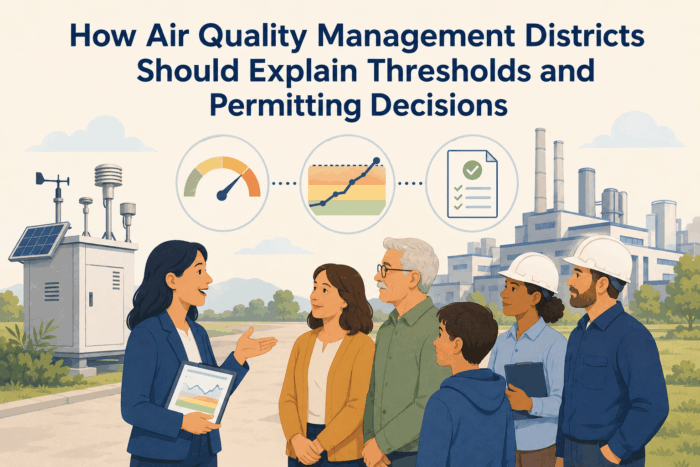
Air Quality Permit Communication: How Air Quality Management Districts Should Explain Thresholds and Permitting Decisions
Air quality permitting is technically precise, legally constrained, and often difficult for the public to interpret. Air quality management districts may evaluate emissions estimates, control technologies, health risk information, monitoring data, permit conditions, modeling results, regulatory thresholds, and facility operations before determining whether a permit can be issued or modified. To agency staff and regulated facilities, these elements are part of a familiar compliance framework. To residents living near a facility, however, the same decision may appear to answer a much broader question: whether the activity is safe, whether pollution will increase, or whether the agency believes existing air quality conditions are acceptable.
That difference in perspective creates one of the central communication challenges in air quality regulation. A permit decision usually addresses whether a proposed or existing source meets specific requirements under the applicable regulatory framework. It does not necessarily represent a broad judgment about every environmental, health, land-use, or community concern associated with the facility. When air quality management districts do not explain that distinction clearly, technically accurate permit language can be interpreted as a much larger endorsement than the agency actually made.
Thresholds create similar challenges. Emission limits, significance levels, health risk criteria, ambient standards, screening levels, and other numerical benchmarks may all appear in air quality materials, but they do not necessarily serve the same regulatory or analytical purpose. Public audiences may see a number below a threshold and interpret it as proof that no risk or impact exists. Conversely, they may see a threshold exceedance and assume that serious harm is certain. Neither conclusion may accurately reflect what the underlying standard means.
Effective air quality permit communication therefore requires more than simplifying technical terminology. Air quality management districts need to explain what is being permitted, which standards apply, what the agency evaluated, how thresholds function, what conditions the permit imposes, and what the decision does not resolve. The goal is not to make complex air quality regulation appear simple. It is to give residents, businesses, local governments, elected officials, and community organizations a reliable way to understand how the agency reached its decision and what that decision means in practice.
Explain What an Air Quality Permit Actually Authorizes
 Public confusion often begins with the word permit itself. Residents may interpret permit issuance as agency approval of an entire facility, project, or business operation. In practice, an air quality permit generally addresses specific emission sources, equipment, activities, operating conditions, or regulatory obligations within the district’s authority. The exact permitting framework varies by jurisdiction and source type, so districts should explain the scope of the permit rather than relying on the permit title to communicate it.
Public-facing materials should identify what equipment or activity is being permitted, whether the action involves a new source, modification, renewal, or another permit decision, and what air quality issues the district is evaluating. If the facility requires approvals from a city, county, state agency, federal agency, or another regulator, the district should make clear that its air quality permit does not substitute for those separate decisions.
This distinction is especially important when the public is concerned about whether a facility should exist in a particular location. Land-use compatibility, zoning, transportation, hazardous materials, water impacts, or broader development policy may be governed through separate processes. The air district should acknowledge those concerns while explaining the boundaries of its own authority so residents understand why some issues can affect the permit decision and others cannot.
Clear scope communication protects the credibility of the permitting process. When people understand precisely what the district is deciding, they are better able to interpret the technical analysis, participate in public review where available, and evaluate whether the final permit addresses the questions within the district’s jurisdiction.
How Environmental Protection Agencies Can Make Communication Central to Regulatory Effectiveness, Public Trust, and Community Health
This article is part of our series on strategic communication for Environmental Protection Agencies, Environmental Compliance Agencies, and state and local environmental departments. To learn more and to see the parent article, which links to other content just like this, click the button below.
Explain Regulatory Thresholds Before Presenting the Numbers
Air quality permitting frequently depends on numerical thresholds, but a number is meaningful only when the public understands what it measures and why it matters. District communication should explain the function of a threshold before asking residents to interpret an emissions rate, concentration, risk estimate, or modeling result against it.
A threshold may be used to determine whether additional analysis is required, whether a particular control standard applies, whether an emission increase triggers a regulatory requirement, or whether an estimated risk falls within an applicable decision framework. These are different functions. Public communication should avoid presenting all thresholds as though they are universal dividing lines between safe and unsafe conditions.
Districts should also identify the unit, averaging period, source, and regulatory context of important figures where those details are necessary for understanding. A short-term concentration should not be casually compared with a long-term value, and an emission rate should not be presented as though it directly represents what an individual resident will breathe. The technical record may contain all of these distinctions, but public-facing communication should surface the ones necessary to prevent predictable misunderstanding.
The strongest explanation connects the threshold to the decision. Rather than saying only that a source is “below the limit,” the district can explain what limit was applied, which question it addresses, and what regulatory consequence follows from the result. This helps the public understand how the number functions within the permitting process without implying more certainty than the analysis supports.
Avoid Translating “Below Threshold” Into “No Impact”
One of the most consequential communication errors in air quality permitting is converting a regulatory finding into an absolute statement. A modeled result or calculated emission level that falls below an applicable threshold does not automatically mean there is no emission, no exposure, no environmental effect, or no community concern.
Air quality management districts should preserve that distinction in plain-language materials. If the appropriate conclusion is that an estimated value does not exceed the regulatory threshold used for a particular determination, the public explanation should say that directly. Replacing the finding with “there is no risk” or “there will be no impact” can create expectations that the technical analysis does not support.
This precision is especially important in communities already experiencing multiple sources of air pollution. Residents may be concerned about existing conditions even when a proposed source does not independently cross a particular permitting threshold. Clear communication can distinguish the incremental permit finding from the broader air quality context without dismissing either one.
Separate Emissions From Exposure and Exposure From Health Risk
Public discussions about air quality often use emissions, pollution, exposure, and health risk as though they describe the same thing. They are related, but they represent different stages of analysis. Air quality management districts should explain these distinctions whenever the permit record relies on them.
Emissions describe pollutants released from a source. Exposure concerns the extent to which people may come into contact with those pollutants, which can depend on dispersion, distance, meteorology, operating patterns, duration, and other factors. Health risk analysis may then use additional assumptions and methods to estimate potential health consequences under a defined analytical framework. Not every permit decision requires the same type or level of analysis, so districts should explain which steps apply to the specific action.
This distinction helps prevent residents from interpreting an emissions estimate as though it were automatically an individual health prediction. It also prevents the opposite error of treating a low modeled risk estimate as evidence that no pollutant is emitted. Public communication should explain what each analysis measures and how those analyses relate without collapsing them into a single reassuring or alarming conclusion.
Districts should also be careful when communicating uncertainty. Modeling and risk assessment may rely on assumptions about source operations, meteorological conditions, receptor locations, exposure duration, or other factors. Where those assumptions materially affect interpretation, public-facing communication should identify them rather than presenting the resulting number as a direct measurement of an individual’s future experience.
Explain How Permit Conditions Turn Analysis Into Operational Requirements
A permit decision is not only a conclusion that a source satisfies applicable requirements at the time of review. It may also establish operating limits, equipment specifications, monitoring requirements, recordkeeping obligations, testing conditions, control requirements, or other restrictions that govern how the source can operate. Public communication should make these conditions visible because they are often the practical mechanism through which the regulatory analysis is implemented.
Air quality management districts should explain the most consequential permit conditions in terms that affected audiences can understand. If emissions assumptions depend on operating hours, fuel use, production limits, control equipment, maintenance requirements, or other constraints, the public should be able to see that the permit incorporates those limits rather than treating the analytical scenario as merely theoretical.
This communication should also distinguish enforceable permit conditions from voluntary commitments, project descriptions, or operational expectations that are not part of the permit. Blurring those categories can create confusion later if residents expect the district to enforce a statement that was never incorporated into the regulatory authorization.
By connecting permit conditions to the analysis that produced them, districts can show how technical findings translate into ongoing compliance responsibilities. The permit becomes easier to understand when the public can see not only why the district reached its decision, but also what the regulated source must continue doing to remain within the terms of that decision.
Clarify the Difference Between a Permit Decision and Broader Air Quality Conditions
Residents may evaluate a permit through the air quality they experience across an entire neighborhood or region. The permitting decision, however, may focus on one facility, source, modification, or set of emissions within a much larger airshed. Air quality management districts should acknowledge that difference directly.
A source may meet the applicable permitting requirements while the surrounding area still experiences significant air quality challenges. Existing emissions from transportation, industrial operations, wildfire smoke, regional pollution, other facilities, or additional sources may shape local conditions. Permit communication should not imply that compliance by one source resolves those broader concerns.
At the same time, broader community air quality problems should not automatically be attributed to the source under review without supporting evidence. Districts should distinguish what the permit analysis can establish about the specific source from what is known about wider air quality conditions. This protects both scientific accuracy and public credibility.
The most useful communication connects the two levels without confusing them. The district can explain how the individual permit fits within the broader regulatory system, what source-specific requirements apply, and which separate programs address regional or cumulative air quality concerns. Residents then have a clearer understanding of what the permit can accomplish and where other air quality responsibilities reside.
Explain How Control Requirements Affect the Permit Decision
Air quality permit decisions often depend not only on how much a source may emit, but also on what controls, technologies, operating practices, or performance standards apply. To technical staff, these requirements are part of the permitting framework. To public audiences, however, the relationship between a control requirement and the final permit decision may be difficult to see unless the district explains it directly.
Air quality management districts should describe the role of required controls in practical terms. If a source must install specific equipment, meet an emission standard, follow operating restrictions, conduct testing, or use defined work practices, public-facing materials should explain how those requirements affect the district’s evaluation. This helps residents understand that the permit is based on an operating scenario constrained by enforceable conditions rather than an unrestricted assumption about facility activity.
The district should also distinguish between required controls and additional measures that may be proposed voluntarily or through another process. Not every technology discussed publicly necessarily becomes an enforceable permit condition, and not every regulatory control requirement originates from the same rule or standard. Clear communication prevents audiences from assuming that all mitigation or operational commitments carry the same legal weight.
Where control technology is central to a controversial decision, agencies should explain what the control is designed to reduce and what limitations remain. A control device may substantially reduce a pollutant without eliminating it completely. Presenting the technology as either ineffective or as a complete solution can distort the actual regulatory finding.
Distinguish Modeled Results From Monitored Air Quality Conditions
Air quality permit materials may rely on dispersion modeling, emissions calculations, monitoring data, or a combination of analytical methods. These forms of evidence answer different questions, and public audiences may interpret them incorrectly if the district presents them without sufficient context.
Modeled results estimate how emissions may disperse or contribute to concentrations under defined assumptions and scenarios. Monitoring, by contrast, measures conditions at a specific location and time. A model may help evaluate a proposed source before it begins operating, while monitoring may reflect the combined influence of many existing sources and regional conditions. Neither should be presented as though it automatically substitutes for the other.
Air quality management districts should explain why a particular method was used and what question it addresses. If the permit decision relies primarily on modeled impacts, the public should understand that the result is an analytical estimate rather than a direct future measurement. If monitoring information is relevant, the district should clarify whether it represents neighborhood conditions, background concentrations, source-specific information, or another purpose.
These distinctions become especially important when residents compare modeled permit results with air quality they experience in their community. A modeled source contribution and a monitored ambient condition may both be valid but describe different aspects of the air quality picture. Clear communication helps audiences understand why the values may differ without assuming that one contradicts the other.
Explain Health Risk Results Without Reducing Them to a Single Reassuring Number
Health risk information can become the focal point of public concern during an air quality permitting decision, particularly when a facility is near homes, schools, workplaces, or other sensitive locations. Risk estimates may be technically complex and may depend on assumptions about emission rates, toxicity, exposure duration, receptor location, operating patterns, and other analytical inputs.
Air quality management districts should explain what the risk estimate represents before presenting the numerical result. Public-facing communication should identify whether the analysis concerns cancer risk, noncancer effects, acute exposure, chronic exposure, or another applicable measure. These categories should not be blended into a single general statement about whether a facility is “safe.”
The district should also explain how the estimate relates to the applicable decision criteria. If a modeled risk falls below a permitting threshold, the communication should state that finding precisely rather than implying that no health risk exists. If additional controls or permit conditions are required because of the result, those consequences should be visible in the explanation.
Risk communication should preserve uncertainty where it matters. Agencies can explain that risk assessment is an analytical tool designed to evaluate potential exposure under defined assumptions. This provides residents with a more accurate understanding than either minimizing the result or presenting the estimate as a prediction of an individual person’s health outcome.
Explain Background Air Quality and Source-Specific Contributions Separately
Residents may reasonably ask why a new or modified source is allowed to operate in an area that already experiences poor air quality. This question can become difficult to answer when the permitting analysis focuses on the incremental contribution of one source while the community experiences the combined effects of many sources.
Air quality management districts should distinguish background or existing air quality from the source-specific contribution being evaluated. The district can explain that an individual permit analysis may determine how much a particular source adds under the applicable regulatory framework, while broader programs address regional attainment, cumulative pollution, transportation emissions, existing industrial sources, or other air quality conditions.
This distinction should not be communicated as though existing pollution makes additional emissions irrelevant. Residents may see even a relatively small incremental contribution as significant within an already burdened area. The agency should acknowledge the broader context while explaining what the current permit decision can and cannot address.
Clear separation between background conditions and source-specific findings helps prevent two opposite errors. It avoids suggesting that one facility is responsible for all existing pollution, and it avoids implying that broader air quality problems disappear because the individual source meets its permitting requirements.
Explain Incremental Contribution Without Minimizing Community Concern
Technical permitting language may describe an individual source contribution as small relative to regional conditions or existing background concentrations. While that comparison can be analytically relevant, public communication should avoid using relative size as a reason to dismiss concern.
A community may be focused on the cumulative experience of living near multiple sources rather than the percentage attributable to the current permit applicant. The district can explain the incremental result accurately while recognizing that residents are viewing the decision within a broader environmental context.
This approach allows the agency to remain precise about the permit analysis without treating community concern as a misunderstanding. The permit finding and the broader community perspective can both be acknowledged without being presented as equivalent regulatory conclusions.
Clarify When a Permit Decision Depends on Operating Assumptions
Air quality analyses often depend on assumptions about how a facility will operate. Production levels, operating hours, fuel type, equipment capacity, material throughput, control efficiency, maintenance practices, or other variables may influence estimated emissions and modeled impacts. Public audiences may not recognize how important these assumptions are to the permit decision.
Air quality management districts should explain which assumptions are material and whether they become enforceable permit conditions. If the analysis assumes a maximum number of operating hours or a specific production limit, residents should be able to see whether the permit restricts the source accordingly. Otherwise, the public may reasonably question why the facility could not simply operate beyond the conditions used in the analysis.
The district should also distinguish between maximum permitted operation and expected routine operation. A permit may evaluate a conservative or maximum scenario that does not represent typical daily activity. Conversely, an applicant may describe expected operations that are lower than the enforceable permit limits. Public communication should clarify which values govern regulatory compliance.
Making operating assumptions visible helps connect technical analysis to real-world accountability. The public can better understand the permit when the district shows not only how emissions were calculated, but also what operational boundaries keep the source within the conditions evaluated during permitting.
Explain Permit Modifications and Renewals Without Treating Them as New Decisions From Scratch
Air quality permits may be modified, renewed, reissued, or otherwise updated over time. Public audiences may interpret any permit action as a complete reconsideration of the entire facility, even when the district is reviewing only specific changes or continuing previously authorized operations under an established framework.
Air quality management districts should explain the scope of each permit action. If a modification concerns new equipment, a change in throughput, revised controls, or another limited operational change, communication should identify what is being reconsidered and what remains governed by existing permit conditions. If a renewal involves a broader review, that scope should be explained accordingly.
This distinction is particularly important when residents raise longstanding concerns during a limited permit modification. The district should acknowledge those concerns while clarifying whether the current action provides authority to revisit them. Where another regulatory process is more appropriate, communication should direct participants toward that pathway when possible.
A clear explanation of permit history also helps audiences understand how the facility’s authorization has evolved. Showing which conditions are new, which remain unchanged, and what triggered the current review can make a technically complex permit action much easier to follow.
Make Public Participation Specific to the Permit Decision
When an air quality permit includes a public notice or comment opportunity, participants need guidance about what information can meaningfully connect to the decision. Simply announcing that comments are welcome may produce frustration if residents later learn that many of their concerns fall outside the district’s permitting authority.
Air quality management districts should explain the scope of participation in plain language. Depending on the proceeding, relevant input may address emissions calculations, modeling assumptions, permit conditions, control requirements, health risk analysis, operating limits, technical information, or other issues within the district’s jurisdiction. The exact guidance should reflect the specific permit process rather than rely on a generic comment template.
The agency should also make clear that public comment is not necessarily a vote on whether the facility should operate. Residents can strongly oppose a project while the district remains legally required to evaluate the application under specific air quality standards. Explaining that framework before comments are submitted helps participants understand how the agency will evaluate the record.
Participation communication should remain respectful of concerns that extend beyond the permit. If residents raise land-use, traffic, odor, noise, hazardous materials, or broader environmental justice issues outside the immediate permitting decision, the district should clarify its authority without suggesting those concerns are inherently unimportant. Clear jurisdictional communication helps maintain trust even when the agency cannot resolve every issue raised.
Organize Permit Communication Around the Questions Communities Are Actually Asking
Air quality permit materials are often organized around regulatory requirements, technical analyses, and internal review sequences. Public audiences, however, usually approach a permit decision through a different set of questions. Residents may want to know what will change at the facility, whether emissions will increase, whether nearby neighborhoods could be affected, what controls will be required, how compliance will be checked, and what happens if the source exceeds its permit conditions. Air quality management districts should design public-facing communication around these practical questions while preserving access to the formal technical record.
This does not mean replacing the regulatory structure with a simplified narrative. It means creating an accessible entry point into the same decision. A public summary can explain the facility change, identify the pollutants or operational issues most relevant to the permit, describe the applicable thresholds or standards, and connect those findings to specific permit conditions. Readers who need greater detail can then move directly into the supporting analysis.
Question-based communication is particularly valuable for controversial permits because it allows the district to address predictable areas of confusion before they become the dominant public narrative. If residents are likely to misunderstand whether a permit allows unlimited operation, whether a risk estimate represents an individual diagnosis, or whether the district controls land-use approval, those distinctions should be addressed proactively rather than left for public meetings or media inquiries.
The strongest communication structure therefore begins with community decision questions and links each one back to the regulatory basis for the answer. This helps the district remain technically precise while making the permit easier to navigate for people who do not routinely work with air quality regulation.
Show How Thresholds Lead to Specific Regulatory Consequences
 Thresholds become more understandable when districts explain what happens because a threshold is met, exceeded, or not triggered. Public materials often present the number itself but do not explain the regulatory consequence associated with the result. This can leave residents focused on whether a value sounds high or low rather than on how the threshold functions in the permit decision.
Air quality management districts should connect each material threshold to the step it controls. Depending on the applicable framework, a threshold may determine whether additional modeling is required, whether a control requirement applies, whether health risk review is necessary, whether an emission increase is considered significant for a particular regulatory purpose, or whether another permitting requirement is triggered. These distinctions should be explained in direct language.
This approach also helps when several thresholds appear in the same permit record. Residents may encounter different numbers for emissions, ambient concentrations, health risk, or other regulatory criteria and assume they are competing measures of the same issue. A public-facing explanation should identify why each threshold exists and what decision it informs.
By focusing on consequence rather than only comparison, districts can reduce the tendency to interpret thresholds as universal safety lines. The public can instead see them as tools within a defined regulatory system, each connected to a specific analytical or permitting requirement.
Explain When Different Thresholds Answer Different Questions
A single source may be evaluated against multiple thresholds that serve different purposes. One value may concern total emissions, another may relate to modeled concentrations, and another may be used in a health risk assessment. Without explanation, audiences may assume that the most stringent or most alarming-looking number should control every part of the decision.
Air quality management districts should explain that different thresholds can coexist because they address different regulatory questions. The public should understand what each threshold measures, what period or scenario it represents, and what consequence follows from the comparison.
This distinction is especially important when one threshold is not exceeded while another triggers additional requirements. That result is not necessarily contradictory. It may simply reflect the fact that the permitting framework evaluates the source through several independent analytical lenses.
Make Permit Conditions Easy to Trace Back to the Analysis
Permit conditions are often where the district’s technical analysis becomes enforceable, but that connection can be difficult for the public to see. Conditions may appear in detailed permit language without explaining why a particular operating limit, monitoring requirement, control device, testing frequency, or recordkeeping obligation was included.
Air quality management districts should make the relationship between key findings and key permit conditions visible. If the emissions analysis assumes a production limit, the public should be able to see whether the permit incorporates that limit. If a control device is necessary to meet an applicable requirement, the communication should identify that connection. If testing or monitoring is required to verify performance, that role should also be clear.
This traceability is particularly important when residents question whether the analysis reflects actual future operation. Public concern often increases when technical documents assume certain operating conditions but the permit appears difficult to interpret. Showing that the permit converts material assumptions into enforceable boundaries helps demonstrate how the regulatory analysis will be carried into day-to-day operation.
The district should also distinguish conditions that are central to the permitting determination from routine administrative provisions. Public summaries do not need to reproduce every permit clause. They should focus on the conditions that materially explain how emissions, risk, controls, and ongoing compliance will be managed.
Explain Compliance Verification Before Residents Ask How the Permit Will Be Enforced
A permit decision can appear incomplete to the public if the district explains what the facility is allowed to do but not how compliance will be verified afterward. Residents may reasonably question whether operating limits, control requirements, or monitoring conditions have practical meaning if they do not understand how the district checks them.
Air quality management districts should explain the compliance mechanisms associated with significant permit conditions. Depending on the source and applicable requirements, these may include inspections, source testing, continuous or periodic monitoring, recordkeeping, reporting, equipment checks, emissions calculations, or other verification methods. Public-facing communication should describe these tools accurately without implying that every source is monitored continuously if that is not the case.
The district should also explain what information comes from the facility and what the agency independently verifies. Self-reported data can be an important part of regulatory compliance, but audiences may misunderstand its role if the agency does not explain how reporting, inspections, testing, and enforcement interact. Clear communication can show how the compliance system uses several forms of evidence rather than relying on a single source of information.
Explaining verification at the time of permitting also strengthens later enforcement communication. Residents already understand what the source was required to do and how the district expected to evaluate compliance, making subsequent notices, violations, or corrective actions easier to interpret.
Communicate Permit Denials, Additional Requirements, and Conditional Approvals With the Same Precision as Approvals
Public communication often focuses most heavily on permit approvals, but air quality management districts should apply the same clarity to decisions that impose additional requirements, delay approval, require modifications, or deny an application. These outcomes can also be misunderstood when the district communicates only the procedural result without explaining the regulatory basis.
If an application cannot proceed as submitted, the public should understand what aspect of the applicable framework created the problem. The issue may involve emissions, incomplete information, control requirements, modeling, health risk, operating assumptions, or another permit criterion. The district should explain the basis accurately without speculating about how the applicant may respond unless that information is part of the record.
Conditional or revised approvals require similar care. If the district allows a source to proceed only after equipment changes, tighter operating limits, additional monitoring, or another modification, those conditions should be visible. Otherwise, audiences may interpret the final approval as though the original proposal was accepted unchanged.
Consistent communication across different outcomes reinforces the idea that permit decisions follow defined standards rather than a presumption in favor of either approval or denial. The district’s role is easier to understand when the public can see how the same regulatory framework produces different results depending on the facts and requirements of each application.
Correct Misunderstandings Without Treating Policy Disagreement as Technical Error
Controversial air quality permits often generate claims that are partly factual, partly interpretive, and partly rooted in broader policy disagreement. A resident may accurately describe existing pollution while drawing a conclusion about the permit that the regulatory analysis does not support. An applicant may accurately cite compliance with one threshold while implying that the finding resolves every community air quality concern. District communication should separate these different layers rather than categorizing all disagreement as misinformation.
Air quality management districts should correct verifiable factual errors when the record supports doing so. If a public statement misidentifies the equipment being permitted, the applicable threshold, the projected emissions, or the scope of the district’s authority, the agency can provide the correct information and direct audiences to the supporting record. Corrections should remain factual and avoid characterizing the motives of the person or organization that made the claim.
Policy disagreement requires a different response. Residents may believe that applicable standards are not sufficiently protective, that additional sources should not be allowed in an already burdened community, or that land-use decisions should account for broader environmental conditions. These positions may extend beyond the current permit criteria but are not therefore factual errors. The district should explain the boundaries of the permit decision without suggesting that disagreement with the governing framework reflects misunderstanding.
Maintaining that distinction protects the agency’s credibility. The district remains authoritative about what the permit record says while recognizing that communities can understand the technical findings and still disagree about the broader policy environment in which the permit is being considered.
Prepare Technical Staff to Explain Permit Findings Consistently in Public Settings
Air quality engineers, permit specialists, inspectors, toxicologists, and other technical staff may be asked to explain complex findings during hearings, workshops, community meetings, media interviews, or individual inquiries. Their expertise is essential, but highly technical answers can create new confusion when terminology, assumptions, or procedural boundaries are not translated consistently.
Air quality management districts should prepare staff with a shared explanation of the permit decision, key thresholds, significant assumptions, enforceable conditions, unresolved issues, and jurisdictional limits. This preparation should not prevent technical staff from providing detailed answers. It should ensure that different specialists use consistent language when describing the same core finding.
Staff should also be prepared to distinguish between what the analysis concludes and what remains uncertain. Phrases such as “no impact,” “completely safe,” or “nothing will change” should be avoided when the technical record supports a narrower conclusion. Similarly, staff should not introduce new interpretations during a public meeting that are inconsistent with the permit documents.
A consistent oral explanation is especially important because public audiences often remember what agency representatives say more readily than what appears in lengthy technical documents. Preparing staff to translate findings accurately helps ensure that public meetings reinforce the permit record rather than create a parallel and potentially inconsistent explanation of it.
Integrate Permit Communication Into the Review Timeline
Air quality permit communication is most effective when it is planned alongside technical review rather than added after the analysis is complete. Air quality management districts should identify the major communication needs associated with a permit application early enough to prepare public summaries, staff guidance, meeting materials, translated content, and digital information before public attention intensifies.
Planning should also identify the points at which public-facing information may need to change. Revised emissions estimates, updated modeling, new health risk analysis, equipment modifications, changed operating assumptions, or additional permit conditions can materially affect how the decision should be explained. When communication is linked to those milestones, districts are less likely to leave outdated summaries online while the technical record evolves.
Internal review responsibilities should be defined as well. Technical, legal, permitting, enforcement, communications, and community engagement staff may all contribute to the public explanation, but each should understand who is responsible for confirming facts, approving regulatory language, updating materials, and responding when new information becomes available.
This integrated approach protects both accuracy and pacing. Public communication becomes part of permit administration rather than a last-minute translation exercise, making it easier for districts to explain complex decisions consistently from application review through final action.
Create a Single Authoritative Public Source for Each Significant Permit Action
Permit information can become difficult to follow when documents are distributed across application portals, public notice pages, technical databases, hearing calendars, staff reports, and archived files. Residents may find several versions of the same permit action without knowing which information is current. Air quality management districts should create a central public-facing source for significant or high-interest permit decisions.
That source should clearly identify the facility, permit action, current status, major documents, comment or hearing opportunities where applicable, and the most recent agency explanation. Draft and final materials should be labeled distinctly, and superseded documents should remain available where appropriate without appearing to represent the current decision.
The page should also connect plain-language information directly to the technical record. A resident reading a summary of health risk, emissions, or operating limits should be able to find the analysis supporting that explanation without searching through unrelated files. This layered structure preserves transparency while helping users enter the record at an appropriate level of detail.
Maintaining one authoritative source also supports media relations, elected-official communication, and staff consistency. When questions arise, the district can direct audiences to the same current information rather than relying on separate explanations that may diverge over time.
Establish Version Control for Permit Assumptions, Analysis, and Public Materials
Air quality permit applications may change during review. Applicants can revise equipment, production assumptions, control technologies, operating schedules, emission calculations, or other elements in response to agency questions or technical findings. If public materials do not track those changes carefully, audiences may compare information from different stages and conclude that the district’s analysis is inconsistent.
Air quality management districts should maintain clear version control across both technical and public-facing materials. When a material assumption changes, the district should identify which analysis was updated and whether the change affected permit conditions, modeled results, health risk findings, or another part of the decision.
Public communication should focus on consequential revisions rather than overwhelm audiences with every administrative edit. A change in an equipment identifier may have little public significance, while a revised production limit or emissions estimate may materially affect how the permit should be understood. The communication system should distinguish between those levels of change.
Version control is especially important for controversial permits because older numbers can continue circulating through public comments, media stories, presentations, or community materials. A clearly dated and updated agency explanation gives audiences a reliable basis for understanding which information currently governs the permit review.
Coordinate Permit Communication With Compliance and Enforcement Staff
Permitting and enforcement are closely connected in practice, but public communication often treats them as separate worlds. A permit establishes operating requirements, while inspections, testing, reporting, monitoring, and enforcement determine whether those requirements are being followed. Air quality management districts should connect these functions in their communication systems.
Compliance staff should understand the public commitments associated with significant permit conditions so that later explanations remain consistent with what was communicated during review. If a district emphasizes a production limit, monitoring requirement, or control device as central to the permit decision, staff should be prepared to explain how compliance with that condition will be evaluated after issuance.
Permit staff should likewise understand how enforceability works in practice. Public summaries should not describe a condition as continuously verified if the district actually relies on periodic reporting or inspections. Aligning permitting and enforcement communication helps prevent the agency from overstating the level of oversight associated with a particular requirement.
This coordination also strengthens future incident communication. If a source later violates a permit condition, the district can explain the issue in relation to the original requirement, the verification method, and the corrective or enforcement response. The public sees a continuous regulatory system rather than an isolated violation disconnected from the permit decision.
Preserve the Difference Between Permit Conditions and Compliance Results
A permit condition describes what a source is required to do. A compliance result describes whether the district has information indicating that the source met that requirement during a particular period or event. These concepts should not be blended in public communication.
Issuing a permit with stringent conditions does not establish that future compliance is guaranteed. Conversely, identifying one violation does not necessarily mean every aspect of the permit or facility operation is noncompliant. Air quality management districts should preserve these distinctions so audiences understand what the agency has authorized and what later oversight has established.
Clear separation also makes enforcement communication more precise. Residents can follow the progression from requirement to monitoring or inspection to finding and, where necessary, corrective action or enforcement.
Prepare for Community Questions About Cumulative Burden and Environmental Justice
Air quality permit decisions can attract heightened concern in communities already experiencing multiple pollution sources, industrial activity, transportation emissions, or longstanding environmental burdens. Even when the permit analysis is source-specific, residents may evaluate the decision within that broader context. Air quality management districts should prepare for those questions rather than treating them as unexpected departures from the technical review.
Communication should distinguish what the current permitting framework evaluates from broader cumulative or community conditions. If the applicable process includes specific cumulative, community risk, or environmental justice considerations, the district should explain how those requirements apply. If certain broader concerns are addressed through separate programs or authorities, that distinction should also be clear.
The district should avoid using jurisdictional limits as a reason to dismiss community experience. Residents may accurately describe broader pollution burdens even when those conditions do not determine the permit under review. A credible explanation can acknowledge the context while remaining precise about the standards the district is required to apply.
This approach helps prevent two communication failures: implying that the permit resolves cumulative air quality concerns, or implying that those concerns are irrelevant because they extend beyond the immediate permit criteria. Districts strengthen trust when they can explain both the source-specific decision and the larger regulatory context without confusing them.
Measure Whether Permit Communication Is Improving Public Understanding
Air quality management districts should evaluate communication based on whether audiences can understand the permit decision, not simply on whether notices, webpages, fact sheets, or presentations were produced. Communication outputs are necessary, but they do not demonstrate that people can interpret thresholds, operating limits, risk estimates, or the scope of the district’s authority.
Useful indicators may include recurring public questions, repeated misconceptions about the same threshold, confusion between permit approval and land-use authorization, difficulty locating supporting documents, or persistent misunderstanding of how compliance will be verified. These patterns can reveal where technically accurate communication is still failing to provide enough context.
Districts can also examine whether public comments become more specific after plain-language materials are introduced, whether residents can identify which issues fall within the permit decision, and whether staff spend less time correcting avoidable procedural misunderstandings. These measures should be interpreted cautiously because participation volume alone does not indicate communication quality.
The purpose of measurement is continuous improvement. If audiences repeatedly struggle with the same concepts across multiple permit actions, the district can improve templates, staff training, website structure, meeting formats, threshold explanations, and public guidance rather than treating every misunderstanding as unique to one project.
Build Repeatable Permit Communication Infrastructure Across the District
Air quality management districts review many permit applications over time, and each action may involve different sources, pollutants, technical analyses, and community contexts. Even so, districts should not rebuild the communication process from the beginning for every permit. Repeatable infrastructure can provide consistency while allowing technical content to remain permit-specific.
Reusable tools may include permit summary templates, threshold explanation frameworks, document navigation standards, staff briefing formats, public meeting guidance, translation protocols, version-control practices, decision-summary structures, and compliance follow-up communication. These tools should establish a common approach without forcing every permit into identical language.
Institutional knowledge should also capture lessons from high-interest or difficult permit actions. If one project reveals recurring confusion about modeling, health risk, jurisdiction, operating assumptions, or permit conditions, those lessons can inform future communication before the same misunderstandings reappear.
A repeatable system makes the district more resilient to staff turnover, workload surges, and controversial applications. The objective is not standardized messaging for its own sake. It is a durable communication structure that helps the district explain technically different permit decisions with the same level of clarity, precision, and accountability.
Strategic Communication Support for Air Quality Permitting
 Air quality management districts often have strong internal expertise in permitting, engineering, emissions analysis, toxicology, inspections, monitoring, and regulatory compliance, but translating that work for public audiences requires additional communication capacity. Permit decisions can involve complex thresholds, multiple analytical methods, technically dense applications, sensitive health questions, and community concerns that extend beyond the district’s immediate authority. External strategic communication support can help districts organize that information around the questions residents, regulated facilities, elected officials, local governments, and community organizations are actually trying to answer.
Stegmeier Consulting Group (SCG) can support air quality management districts by developing plain-language permit summaries, threshold and health-risk explainers, public participation materials, project webpages, meeting presentations, staff talking points, multilingual outreach frameworks, permit decision summaries, document navigation systems, and communication plans for high-interest applications. SCG can also help districts align technical, permitting, compliance, and public-facing information so that key assumptions, operating limits, permit conditions, and agency responsibilities are explained consistently across communication channels.
External support can be particularly useful when internal staff capacity is limited, a permit attracts sustained public scrutiny, or an objective outside perspective can identify explanations that make sense internally but remain difficult for nontechnical audiences to interpret. SCG’s role remains focused on communication strategy, information organization, stakeholder engagement, and public-facing content. SCG does not calculate emissions, conduct dispersion modeling or health risk assessments, determine regulatory thresholds, issue permits, establish permit conditions, provide legal determinations, or make compliance and enforcement decisions on behalf of the district.
Future Trends
Air quality permit communication will increasingly need to operate in an environment where communities expect faster access to technical information and greater visibility into how regulatory decisions are made. Digital permit portals, searchable records, interactive mapping, emissions databases, monitoring platforms, and online public participation can make information more accessible, but they can also expose audiences to large quantities of technical data without enough context to interpret it correctly.
Districts are likely to face growing expectations to connect source-specific permit decisions with broader community air quality information. Residents may want to see how a proposed source relates to monitored conditions, nearby facilities, regional pollution patterns, health risk information, and ongoing community air monitoring. Meeting that expectation will require careful communication that connects different forms of information without implying that they answer the same regulatory question.
There will also be greater demand for traceability. Public audiences will increasingly expect to see how an emissions estimate connects to a threshold, how that threshold affects the permit decision, how the resulting analysis becomes an enforceable condition, and how the district later verifies compliance. Districts that make these relationships visible can provide a more understandable regulatory narrative without reducing the technical rigor of the permitting process.
Technology may assist with document navigation, data organization, translation, and public access, but it will not replace the need for professional judgment. Air quality management districts will still need to decide which distinctions must be preserved, when uncertainty requires explanation, how regulatory findings should be translated, and how to address community concerns that extend beyond the permit without overstating the district’s authority.
Conclusion
Air quality permit communication is difficult because a technically narrow regulatory decision can carry much broader meaning for the people who live near a facility or follow local air quality conditions. Residents may interpret permit approval as a determination that a facility is completely safe, while regulated entities may focus primarily on whether individual numerical criteria have been satisfied. Air quality management districts need communication that accurately explains what the permit actually determines and what it does not.
That begins with the fundamentals. Audiences need to understand what activity or equipment is being permitted, which regulatory thresholds apply, how emissions differ from exposure and health risk, what analytical assumptions were used, and how permit conditions translate those findings into enforceable operating requirements. These distinctions should remain visible throughout public participation and final decision communication.
The strongest communication also connects permitting with ongoing compliance. Residents should be able to understand how important permit conditions will be verified, what happens if those conditions are not met, and how source-specific findings relate to broader air quality concerns. Districts should acknowledge cumulative and community concerns without attributing conditions to an individual source when the evidence does not support that conclusion or implying that one permit decision can resolve a larger regional problem.
When communication is integrated into the permit process from initial review through compliance oversight, air quality management districts can make technically complex decisions more understandable without weakening regulatory precision. Clear explanations of thresholds, assumptions, conditions, authority, and follow-up help the public evaluate what the district actually decided and provide a stronger foundation for trust even when disagreement about the outcome remains.
Stegmeier Consulting Group’s Strategic Approach to Communication Systems
Connect technical air quality findings to permitting decisions in language the public can follow without losing regulatory precision.
Air quality management districts need communication systems that help communities understand what a permit authorizes, how thresholds and health risk findings are used, which operating conditions become enforceable, and how compliance will be verified after approval. Stegmeier Consulting Group (SCG) helps districts organize complex permitting information, develop audience-specific explanations, strengthen staff and public-facing messaging, improve digital access, and build communication frameworks that connect technical analysis with understandable regulatory decisions.
Use the form below to connect with our team and explore how strategic communication support can strengthen air quality permit communication and public understanding.