
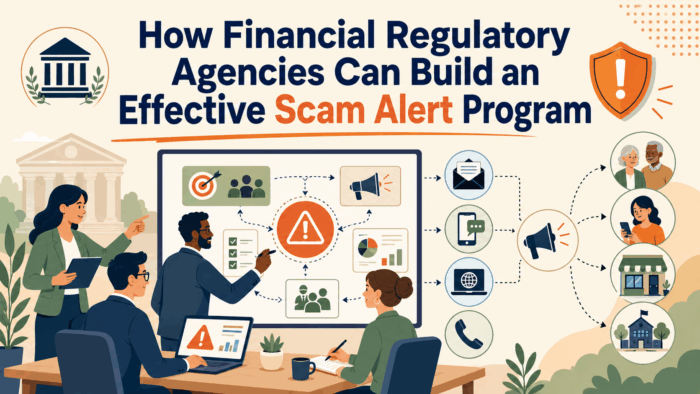
How Financial Regulatory Agencies Can Build an Effective Scam Alert Program
A financial regulatory agency that issues a scam alert once or twice a year when a particularly visible fraud scheme comes to its attention has a scam notification function. An agency that has built a systematic scam alert program, with established monitoring processes to identify emerging threats, a clear internal workflow for drafting and approving alerts, a template library that supports rapid production, a partner network for extending distribution reach, and a measurement framework for evaluating whether alerts are protecting consumers, has a scam alert program. The difference between the two is the difference between reactive communication and protective communication, and it is reflected directly in how many consumers receive timely, accurate warning information before they are harmed.
Building an effective scam alert program is an institutional investment, not a communications project. It requires policy decisions about the threshold for issuing an alert, operational decisions about the monitoring and workflow processes that produce alerts consistently, technical decisions about the platforms and channels through which alerts are distributed, relationship decisions about the partner organizations that extend alert reach, and measurement decisions about the indicators that determine whether the program is working. Each of these decisions shapes the program’s effectiveness in ways that no amount of attention to individual alert quality can fully compensate for.
This article addresses how financial regulatory agencies can move from occasional scam warnings to a consistent, systematic scam alert program. It covers how to establish monitoring processes that identify emerging threats before they reach peak harm, how to design the approval workflow that allows alerts to be issued quickly without sacrificing accuracy, how to develop the template library that supports rapid, high-quality alert production, how to build and maintain the distribution channels and partner networks that extend alert reach, how to time alerts for maximum protective impact, how to update alerts as schemes evolve, and how to measure whether the program is achieving its consumer protection goals.
Establishing Threat Monitoring Processes
 An effective scam alert program requires a systematic process for identifying emerging financial fraud threats before they reach the scale at which consumer harm is widespread. Threat monitoring for a financial regulatory agency draws on multiple information sources, each of which reveals different aspects of the fraud landscape.
Internal Data Sources
Consumer complaint data is the most immediate and most direct indicator of emerging fraud activity. Complaint staff who interact with consumers daily have first-hand access to the types of fraud that consumers are encountering and reporting. A pattern of similar complaints about the same type of scheme, even if each individual complaint seems isolated, is a signal that a scheme may be scaling that warrants alert consideration. Agencies should have a standing process for complaint staff to flag patterns that may warrant an alert, with a clear path for those flags to reach the communication and enforcement staff who can assess whether an alert is warranted.
Licensing and registration applications for entities and individuals that match the profiles of known fraud schemes are another internal data source for threat monitoring. An unusually high volume of applications from entities with similar names, similar principals, or similar claimed business models in a short period may indicate that a particular scheme is organizing for rapid expansion. Suspicious application patterns should be flagged for fraud review and should be considered as an input to alert decisions.
Enforcement cases and investigations generate specific intelligence about fraud schemes that may warrant alert communication. An active investigation may provide enough specific information about a scheme’s operation, targets, and tactics to support a public alert even before enforcement action is ready, if the threat to consumers is sufficiently immediate and specific. The decision to issue an alert based on investigative intelligence requires careful consideration of whether the alert would compromise the investigation or put targets on notice in ways that allow them to evade enforcement.
External Data Sources
Law enforcement referrals and tips from federal partners, other state regulators, and local law enforcement provide intelligence about fraud schemes that may not yet have appeared in the agency’s own complaint data. A scheme that has been generating significant harm in another state is likely to expand, and early warning from another state’s regulatory partner gives the agency an opportunity to alert consumers before the scheme reaches significant scale in its own jurisdiction.
Consumer advocacy organizations and legal aid providers that work directly with fraud victims are an important external intelligence source because they often see fraud cases before those cases result in regulatory complaints. A legal aid organization that has assisted several clients with the same type of financial fraud should have a channel through which they can alert the regulatory agency to the emerging pattern. Establishing and maintaining those referral relationships is an ongoing part of threat monitoring that pays dividends in earlier and more complete fraud intelligence.
Industry self-regulatory organizations, financial institution compliance departments, and licensed financial professional networks are often early identifiers of fraud schemes that target their customers or their professional community. A bank that has seen an unusual pattern of wire transfer fraud related to a specific type of investment solicitation, a real estate professional organization that has seen a pattern of mortgage modification fraud targeting its members’ clients, or an insurance agent association that has identified a new type of contractor solicitation scheme targeting their policyholders, all have intelligence that supports the agency’s monitoring and early alert capacity.
Protecting the Public Interest: Communication Strategies for Financial Regulation, Insurance, and Consumer Protection Agencies
This article is part of our series on strategic communication for Financial Regulatory Agencies, State Insurance Departments, and Consumer Protection Agencies. To learn more and to see the parent article, which links to other content just like this, click the button below.
Designing the Alert Approval Workflow
The alert approval workflow is among the most consequential design decisions in building a scam alert program, because it determines how quickly alerts can be issued from the moment a threat is identified. An approval workflow that requires multiple layers of review, legal sign-off, executive approval, and public affairs coordination for every alert will produce alerts that are accurate and carefully considered but that frequently arrive after the peak period of consumer harm has passed. An approval workflow that is too streamlined may produce alerts that are issued without sufficient accuracy verification, creating credibility problems when alerts must be corrected.
The appropriate workflow design depends on the urgency and scale of the alert and the specific agency context. Many agencies find that a tiered workflow, with different approval requirements for different alert types based on urgency and sensitivity, provides the right balance between speed and quality control. A routine scam alert about a well-documented, non-novel fraud scheme that is based on established intelligence may require only one or two approval levels. An alert about a novel, high-profile scheme that may generate significant media attention, or an alert that requires coordination with law enforcement or other agencies, may warrant more extensive review before issuance.
Pre-authorization of template-based alerts, in which agency leadership approves the template and the circumstances under which it can be issued without additional individual approval, is one of the most effective mechanisms for enabling rapid alert issuance. If the agency head has pre-approved that alerts using the investment fraud template can be issued by the communications director without individual case-by-case approval when specific criteria are met, the alert can be issued within hours of a threat being identified without the delay of executive approval.
Legal review of alert content is important for ensuring accuracy and avoiding defamation risk, but it need not delay every alert if it is incorporated into the template development process rather than the individual alert issuance process. Templates that have been reviewed and approved by legal counsel for accuracy and legal compliance can be issued with the template-specific legal clearance rather than requiring individual legal review of each alert that uses the template. Alert content that deviates significantly from the approved template, or that makes specific allegations about identified individuals or entities, should receive individual legal review before issuance.
Developing the Alert Template Library
A template library is the production infrastructure of a scam alert program. Well-designed templates allow staff to produce high-quality alerts quickly by filling in scheme-specific details within a tested structural framework. They ensure that every alert includes the essential elements that make it genuinely protective. And they reduce the cognitive burden on staff who are producing alerts under time pressure by eliminating the need to make structural decisions for each alert from scratch.
The template library should cover the scam types that are most common in the jurisdiction, that generate the most consumer harm, and that the agency is most likely to need to alert about on short notice. Common categories for financial regulatory agency alert templates include investment fraud alerts, consumer lending fraud alerts, insurance fraud alerts, debt collection fraud alerts, money transmission fraud alerts, and cybercrime and identity theft alerts with financial components. Each category may have multiple template variants for different specific schemes within the category.
Each template should include: a clear, specific headline that describes the scheme in terms consumers recognize; a brief description of how the scheme operates from the consumer’s perspective; a list of specific warning signs that indicate a consumer may have been approached by the scheme; clear recommended consumer actions, including what to do if already in contact with the scammer and where to report the scheme; contact information for the agency’s consumer assistance line; and a distribution list or distribution protocol that specifies which channels the alert should be sent through and which partner organizations should receive it.
Template maintenance requires regular review to ensure that templates remain current with evolving fraud tactics, updated legal and regulatory provisions, and current contact information and distribution protocols. An out-of-date template that references a discontinued phone number or a superseded legal provision is worse than no template, because it may lead consumers to act on inaccurate information. Assigning responsibility for annual template review to a specific staff member or team, with a defined schedule for reviewing and updating each template, is the minimum maintenance discipline an effective template library requires.
Building and Maintaining Distribution Channels
A scam alert that is posted only on the agency’s website reaches the consumers who are actively monitoring the agency’s website, which is a small fraction of the full population the alert is designed to protect. An effective distribution strategy for a scam alert program extends beyond the agency’s own channels to reach consumers through the channels they actually use for financial information and through the organizations that have trusted relationships with the populations most likely to be targeted by specific schemes.
Direct consumer alert distribution channels include the agency’s email newsletter, social media accounts, text alert system if one exists, and any other channels through which the agency maintains a direct subscription relationship with consumers. These channels should be maintained year-round, with regular non-alert content that gives consumers a reason to stay subscribed, so that the subscriber base is as large as possible when an urgent alert needs to be distributed.
Partner organization distribution channels extend the agency’s alert reach to populations that the agency’s own channels do not effectively reach. Senior centers and organizations serving older adults reach a population that is disproportionately targeted by financial fraud. Legal aid organizations and credit counseling agencies reach consumers who are already in financial difficulty and who may be more vulnerable to predatory financial schemes. Community development financial institutions and financial education programs reach communities that are often targeted by predatory lenders and investment fraudsters. Building and maintaining relationships with these organizations, providing them with alert materials in formats they can use, and keeping their contact information current is the ongoing work of partner network management.
Media distribution is a critical force multiplier for scam alert reach. A scam alert that is reported by local television news, picked up by local newspapers, or shared by community news websites reaches a dramatically larger audience than one distributed only through the agency’s own channels and partner networks. Maintaining relationships with financial journalists and consumer protection reporters, providing timely and accurate information when media contacts follow up on alert announcements, and making alert spokespersons available for interviews when a scheme warrants significant media attention are all components of the media distribution strategy that extends alert reach.
Alert Timing for Maximum Protective Impact
The timing of a scam alert relative to the peak of scheme activity significantly determines its protective impact. An alert issued when a scheme is just beginning to scale reaches consumers before most of them have been approached and gives the full at-risk population time to receive and act on the warning before the scheme peaks. An alert issued after the scheme has reached its peak, when most of the consumers who were going to fall victim have already done so, reaches consumers after the peak protective opportunity has passed.
Early alert issuance requires accepting some degree of uncertainty about the scheme’s full scope, methods, and targets. An alert that could theoretically be improved with additional intelligence may protect more consumers if issued promptly with the information available than if delayed until a more complete picture has developed. The timing decision should weigh the cost of a less complete alert against the cost of a delayed alert, recognizing that delay has a concrete cost measured in consumers who are harmed during the delay period.
Seasonal and event-driven alert timing should be a standing element of the alert calendar. Tax season consistently generates IRS impersonation scams and tax fraud schemes. Medicare open enrollment generates Medicare fraud. Holiday seasons generate gift card scams and charitable fraud. The predictability of these seasonal patterns means that alerts can be drafted in advance and issued at the beginning of the relevant season rather than in response to the schemes after they have already appeared. Pre-season alerts that reach consumers before the seasonal scheme peaks are more protective than reactive alerts issued after the schemes are already well underway.
Updating Alerts as Schemes Evolve
Financial fraud schemes are not static. They adapt their tactics, their contact methods, their cover stories, and their target populations in response to consumer awareness, law enforcement activity, and the specific opportunities presented by current events. An alert that accurately describes a scheme as it operated when the alert was issued may become inaccurate or incomplete as the scheme evolves, and consumers who consult the alert later in the scheme’s lifecycle may receive outdated information that does not reflect current scheme tactics.
Alert update protocols should specify the circumstances under which an issued alert will be updated, who is responsible for monitoring for developments that warrant an update, what the update process looks like, and how the update will be distributed. Updates should be distributed through the same channels as the original alert, with clear notation that the alert has been updated and identification of what has changed. An update distributed only to consumers who actively check the agency’s website for updates will not reach the consumers who received the original alert through other channels and who may not know that an update is available.
Alert closure communication, issued when a scheme has been substantially disrupted by enforcement action or has ceased to be actively targeting consumers, closes the communication cycle for consumers who have been following the alert. Alert closure should explain why the alert is being closed, confirm that the scheme is no longer an active threat, and note any enforcement actions that resulted from the scheme’s activity. Consumers who followed the alert through its lifecycle and who receive a closure communication experience the full arc of the alert program’s protective function.
Measuring Alert Program Effectiveness
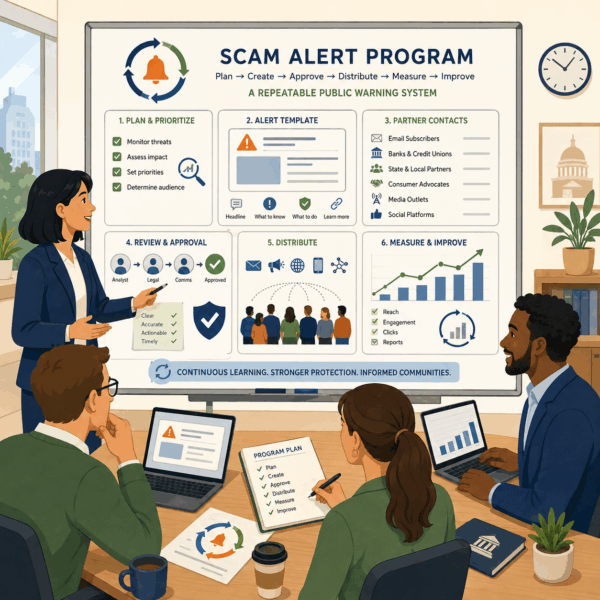 A scam alert program that is not measured is a program that cannot demonstrate its value, cannot identify its weaknesses, and cannot improve systematically over time. Measurement of scam alert program effectiveness requires indicators at multiple levels: process indicators that track whether the program is functioning as designed, output indicators that track the volume and timeliness of alert production, reach indicators that track how many consumers receive alerts through which channels, and impact indicators that track whether alerts are changing consumer behavior in ways that reduce fraud victimization.
Process indicators for a scam alert program include: average time from threat identification to alert issuance, proportion of alerts issued within target timeframe, template use rate relative to ad hoc alert drafting, and partner network activation completeness for each alert. These indicators reveal whether the program is operating with the speed and consistency that effective consumer protection requires.
Reach indicators include: total subscriber count for direct alert distribution channels, partner organization distribution confirmation rates, media pickup rates for alerts, and social media engagement metrics for alert posts. These indicators reveal how many consumers are receiving alerts through which channels and which channels are most effective for different alert types and target populations.
Impact indicators are the most important and the most difficult to measure. Consumer awareness surveys that ask whether respondents received an alert and whether it changed their behavior regarding a specific scheme type provide the most direct evidence of protective impact. Complaint volume changes following alert issuance, particularly for the specific scheme type described in the alert, provide indirect evidence of behavioral impact. Post-enforcement outcome analysis, comparing the volume of consumer harm from a specific scheme to schemes of similar scale and duration that were not the subject of alerts, provides the counterfactual comparison that most directly estimates the alert’s protective effect.
Alert Program Governance and Sustainability
Effective scam alert programs are governed by clear policies that define the threshold for issuing an alert, the content standards every alert must meet, the distribution protocols that determine which channels are used for which alert types, and the review processes that keep templates and issued alerts current. These policies are not bureaucratic constraints. They are the infrastructure that allows the program to operate consistently and effectively regardless of which specific staff are managing any given alert.
Program sustainability requires that every major function has documented procedures and trained backup staff. Alert programs that depend entirely on the knowledge and relationships of one or two individuals are programs that are one staff departure away from significant capacity loss. Documenting the program processes, maintaining current records of partner contacts and distribution protocols, and cross-training multiple staff members on each element of the program are investments in resilience that small agencies often underestimate until a key staff member leaves. Annual budget justification for the scam alert program requires demonstrating what the program accomplishes. A program that can present specific data on alerts issued, consumers reached, reports generated, and enforcement actions supported is a program that can defend its resource requirements.
Alert Language and Accessibility Standards
The language in which scam alerts are written determines how broadly they are understood and how effectively they motivate protective consumer action. Alerts written in plain language at an accessible reading level protect more consumers than those written in regulatory terminology that only financially sophisticated readers can comprehend. Plain language standards for scam alert communication should be explicit program policy rather than left to the discretion of individual alert writers.
Specific plain language practices that improve scam alert accessibility include using active sentences that clearly identify who is doing what, avoiding jargon without plain-language alternatives, using concrete examples rather than abstract descriptions of fraud characteristics, leading each alert with the most important consumer action rather than with background context, and presenting warning signs and recommended actions in a format that consumers can scan quickly. Multilingual alert production is an equity obligation for agencies that serve communities where significant populations are not fluent in English. A scam alert that reaches only English-speaking consumers does not protect non-English-speaking consumers from the same threats, and those consumers are often specifically targeted by fraud operators who know that warning communications rarely reach them in accessible form.
Coordinating With Federal and Multistate Alert Efforts
Many fraud schemes that state financial regulatory agencies encounter are national or multistate in scope, operated by actors who move between jurisdictions and who may already be the subject of alert efforts elsewhere. Coordinating with federal agencies and with other states on alert communication about these national schemes produces more authoritative and more comprehensive warnings than any single state can produce independently.
The Federal Trade Commission, the Consumer Financial Protection Bureau, and relevant federal law enforcement agencies maintain national fraud alert programs and intelligence-sharing networks that state regulatory agencies can participate in and contribute to. Multistate coordination among state agencies facing the same fraud threats can produce joint alerts that carry the authority of multiple regulators and reach consumers across a broader geographic area. Regional regulatory coordination groups and national associations that facilitate peer communication among state agencies are the organizational structures through which this multistate coordination most commonly occurs.
Enforcement actions that result from schemes that were the subject of prior alerts should be communicated in a way that explicitly connects the enforcement outcome back to the original alert. This demonstrates to consumers who reported the scheme that their reports contributed to a regulatory response, provides closure for consumers who were targeted, and communicates to potential fraud operators that the agency’s alert program is backed by enforcement authority that acts on the threats it identifies. This enforcement communication also provides natural content for the program’s annual accountability reporting, connecting specific alert investments to specific regulatory outcomes.
Communicating Alert Program Results to Stakeholders
The value of a scam alert program is not self-evident to the legislators, agency heads, and public stakeholders who allocate the resources that sustain it. Communicating program results in terms that make that value clear requires translating program activity measures into terms that non-specialist stakeholders can understand and evaluate. The number of alerts issued, consumers reached, and reports generated are the raw data of program activity. Their significance becomes clear only when connected to the consumer protection outcomes they produced.
Annual program reports that present the year’s alert activity alongside the consumer protection outcomes associated with that activity give legislators and oversight bodies the information they need to evaluate the program’s effectiveness and to make informed resource allocation decisions. These reports should be written for a non-specialist audience, using plain language and concrete examples rather than technical regulatory metrics, and should be proactively distributed to relevant legislative committees and other stakeholders who have an interest in consumer financial protection outcomes. Public-facing communication about the alert program’s results also builds community awareness that the agency is actively monitoring the fraud landscape and taking protective action.
Strategic Communication Support for Financial and Insurance Regulators
 An effective scam alert program requires more than publishing warnings when a fraudulent scheme becomes visible. Consumers benefit most when agencies have a structured system for identifying emerging threats, determining which audiences may be affected, developing clear alerts, and distributing those warnings quickly through trusted channels. A planned approach allows agencies to move from reactive announcements to an ongoing consumer protection function that can respond as scams change and new risks emerge.
Successful scam alert programs combine monitoring, audience targeting, rapid message development, reusable communication templates, partner coordination, multi-channel distribution, and continuous evaluation. Different scams affect different populations, and a warning that reaches consumers after a fraudulent offer has already spread may have limited preventive value. Effective alerts therefore need to communicate what is happening, who may be affected, what warning signs to recognize, what consumers should do, and where they can verify information or report suspected fraud.
Developing this type of communication system requires specialized expertise in consumer communication, risk messaging, workflow design, audience segmentation, partner engagement, channel strategy, and communication evaluation. Many financial and insurance regulators choose to partner with external communication specialists such as Stegmeier Consulting Group (SCG) because these capabilities complement the agency’s regulatory and consumer protection expertise while providing the strategic communication capacity needed to turn emerging fraud information into timely, actionable warnings that reach consumers before harm occurs.
Working alongside financial and insurance regulatory agencies, SCG develops scam alert systems that support rapid and coordinated consumer communication. Support may include designing scam monitoring and escalation workflows, developing reusable alert templates, establishing criteria for prioritizing warnings, building partner distribution networks, developing multi-channel alert strategies, creating consumer action and reporting guidance, and implementing measurement frameworks that assess alert reach, engagement, and effectiveness.
Because fraudulent schemes evolve quickly, scam alert programs must be designed for continuous adaptation. SCG helps agencies establish repeatable review processes, governance practices, partner activation procedures, and performance measurement frameworks that allow alert content and distribution strategies to improve as new scams emerge and agencies learn more about how consumers respond to warnings. This creates an institutional capability that remains useful beyond any individual scam or campaign.
The objective is to create a communication environment in which consumers receive credible, timely, and actionable warnings before fraudulent activity causes preventable harm. By strengthening scam alert systems, financial and insurance regulators can extend consumer protection beyond enforcement and investigation, using communication as an upstream tool for reducing exposure, improving public awareness, and helping consumers make safer decisions.
Future Trends in Financial Fraud and Alert Programs
The financial fraud landscape is evolving rapidly, and scam alert programs must evolve with it. Artificial intelligence tools that enable fraud operators to produce more convincing impersonation communications, more personalized phishing messages, and more realistic fraudulent websites are changing the detection and warning challenges that alert programs face. Alerts that warn consumers about AI-enabled fraud must address the specific capabilities of these tools and explain why the warning signs that consumers learned to recognize for earlier forms of fraud may not apply to AI-generated fraud communications.
The speed with which financial fraud can now scale through digital channels has reduced the window in which a timely alert can prevent significant harm. Alert programs that were designed for fraud schemes that spread over weeks or months may not be fast enough to protect consumers from schemes that can reach millions of targets within hours through social media and messaging platforms. Building the institutional capacity for very rapid alert issuance, including pre-authorized template-based alerts and automated threat detection systems, is an investment that the increasing speed of fraud scaling makes increasingly urgent.
Conclusion
A strong scam alert program is ultimately measured by the harm it helps prevent, not simply by the number of alerts an agency publishes. Consumers are most likely to benefit when warnings arrive early enough to influence their decisions, explain the specific threat clearly, and provide practical steps they can take to protect themselves. That requires an institutional system capable of turning emerging information into reliable public guidance quickly and consistently.
Building that system also creates lasting value beyond individual alerts. Monitoring processes, established workflows, reusable templates, trusted partner networks, and performance measurement give agencies the infrastructure to respond to future scams with greater speed and precision. Over time, that accumulated communication capacity allows consumer protection agencies to move from reacting to fraud after it occurs toward preventing more consumers from becoming victims in the first place.
Stegmeier Consulting Group’s Strategic Approach to Communication Systems
Align your scam alert program with the systematic, preventive consumer protection your mission requires.
Financial regulatory agencies need scam alert programs that move from reactive occasional warnings to systematic consumer protection, with monitoring processes that identify threats early, workflows that enable rapid alert issuance, template libraries that support high-quality production at scale, partner networks that extend reach, and measurement systems that demonstrate impact. SCG helps agencies build the infrastructure for alert programs that protect consumers before harm occurs.
Use the form below to connect with our team and explore how a systematic scam alert program can strengthen your agency’s consumer protection capacity and demonstrate the proactive regulatory effectiveness your constituents and stakeholders expect.