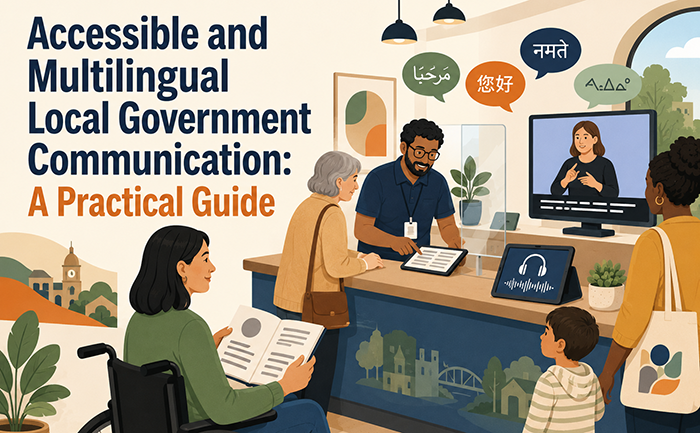
Accessible and Multilingual Local Government Communication: A Practical Guide
The obligation to communicate is not fulfilled by producing information. It is fulfilled by producing information that the people who need it can actually access, read, understand, and use. That distinction matters enormously for local governments in small and rural communities, where the populations served often include residents with disabilities who need alternative formats, residents with limited English proficiency who need information in languages other than English, residents with limited literacy who need plain language rather than technical prose, residents with limited internet access who need physical formats, and residents with visual or hearing impairments who need communication designed with their needs in mind.
Many small local governments produce technically accurate communication that fails a significant portion of the population because it does not account for the diversity of ways in which residents receive, process, and act on information. A website that cannot be read by a screen reader excludes residents with visual impairments. A public meeting that provides no accommodation for residents with hearing loss excludes a group that is disproportionately large in older rural communities. A notice published only in English in a community where a significant share of residents speak another language as their primary language excludes those residents from information they have a right to receive. A document formatted in small type on a low-contrast background excludes residents with certain vision conditions. Each of these failures is a communication failure that has nothing to do with the quality of the information itself.
This article provides practical guidance on accessible and multilingual communication for small local governments. It covers plain language as the foundation of all accessible communication, accessible document and website design, accommodations for residents with disabilities at public meetings and in other government settings, multilingual communication priorities and approaches, accessible digital communication practices, and the organizational habits that make accessibility a standing practice rather than an occasional accommodation. The goal is communication that serves the full range of residents in the community rather than only those whose communication needs happen to match the default practices of the agency.
This article addresses practical steps that small governments can take with limited budgets and without specialized accessibility expertise. It does not advocate for an immediate comprehensive overhaul of all agency communications. It advocates for a deliberate, staged approach in which the most impactful accessibility improvements are made first, and in which accessibility considerations become embedded in the standard communication workflow rather than added as afterthoughts when individual residents request accommodation.
Plain Language as the Foundation of Accessible Communication
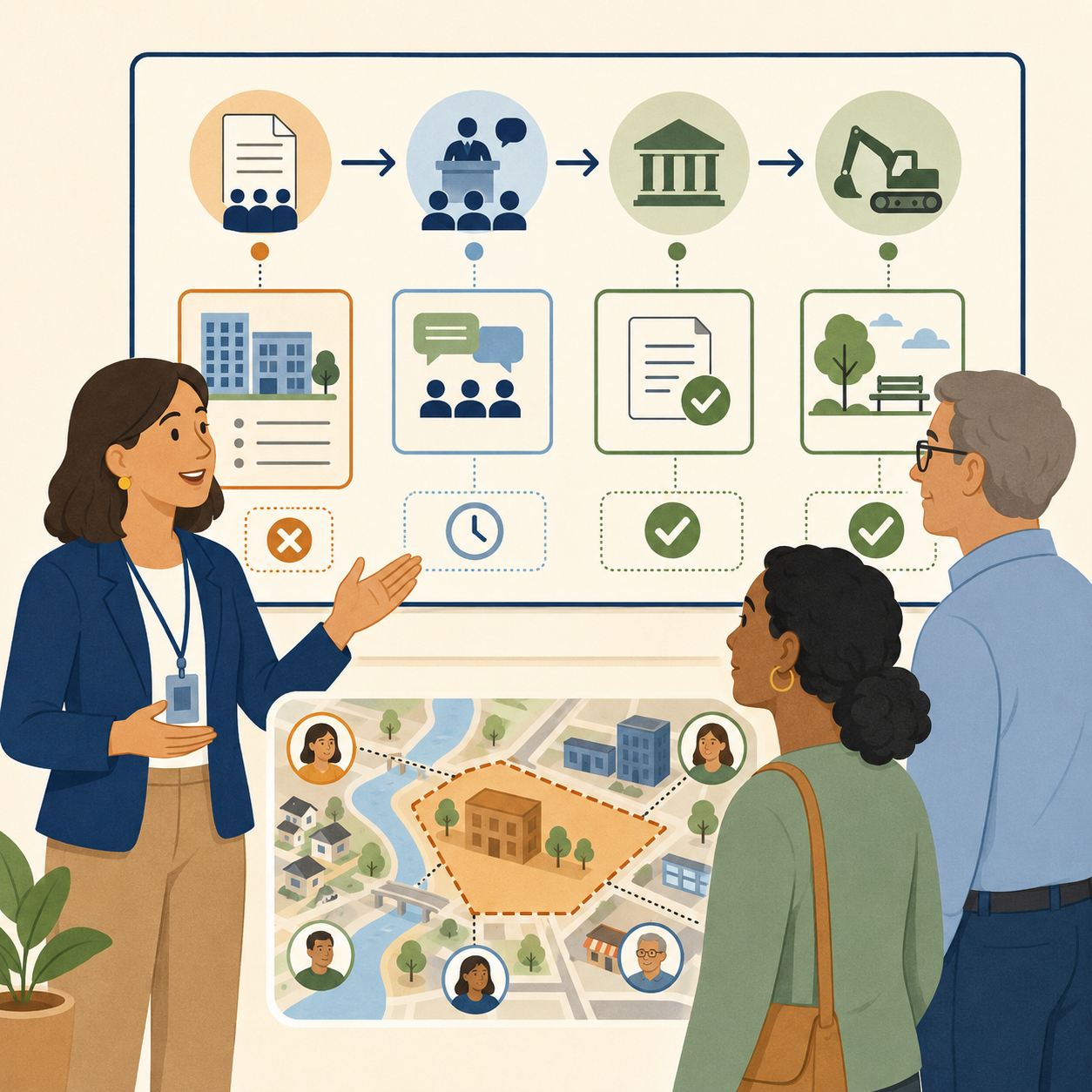 Plain language is the most broadly impactful accessibility practice available to any local government, because it improves communication for virtually every audience simultaneously. Content written in plain language is easier for residents with lower literacy levels to understand. It is easier for residents reading in a second language to comprehend. It is easier for residents with cognitive disabilities to process. It is easier for busy residents who are reading quickly to extract the essential information. And it is easier for residents with any level of background knowledge to engage with without requiring specialized expertise.
Plain language does not mean dumbing down complex information. It means presenting accurate, complete information in the clearest possible form: direct sentence structure, common vocabulary, active voice, concrete examples, and organization that puts the most important information first rather than building to it through context-setting preambles. A plain language boil water advisory tells residents exactly what to do in the first sentence and then explains why. A plain language budget summary tells residents what it costs to provide their services and how that compares to last year before explaining the technical factors that drove any changes.
Specific Plain Language Practices
Several specific plain language practices are particularly important for local government communication. Using the active voice, in which the actor and the action are clearly connected, makes it easier for readers to understand who is doing what and who is responsible for what outcome. Passive voice constructions that obscure the actor are common in government writing and consistently reduce reader comprehension.
Using common words rather than technical or bureaucratic vocabulary reduces the reading burden for all audiences. When technical terms are necessary because there is no plain equivalent, defining them clearly on first use allows even readers who are encountering the term for the first time to proceed with understanding. A boil water advisory that uses the term coliform bacteria should immediately explain what that means in terms of the health concern it represents, rather than assuming that residents know the term.
Breaking complex information into short, clearly organized sections with descriptive headings allows readers to navigate directly to the information most relevant to their situation rather than reading through all content to find what they need. A resident who wants to know whether the boil water advisory applies to their address should not have to read through the technical cause of the advisory, the repair timeline, and the all-clear process to reach the geographic description of the affected area.
Reading level testing of significant communications, using tools that are freely available online, helps staff identify language that is more complex than necessary and revise it toward greater accessibility. A reading level target of sixth to eighth grade for most public-facing communications is commonly recommended for government documents, though the appropriate target may vary depending on the specific audience and the complexity of the subject matter.
Engaged & Connected: Communication Strategies for Small Towns, Villages, Townships, and Rural Communities
This article is part of our series on strategic communication for Small Towns, Villages, Townships, and Rural Local Governments. To learn more and to see the parent article, which links to other content just like this, click the button below.
Accessible Document Design
Document design choices affect whether residents with visual impairments, reading difficulties, or cognitive disabilities can access the information in the document. These choices are made during document production and, once established as standing practices, require no additional effort per document.
Font choice and size significantly affect readability. Sans-serif fonts such as Arial, Helvetica, or Calibri are generally more readable on screens than serif fonts, particularly at smaller sizes. A minimum body text size of twelve points for printed documents and fourteen points for digital documents intended for online reading gives residents with mild vision limitations a better chance of reading without zooming or printing assistance. Larger text in the fourteen to sixteen point range is appropriate for notices intended for older adults who may have age-related vision changes.
Color contrast between text and background affects readability for residents with certain vision conditions and for anyone reading in less-than-ideal lighting conditions. Black or very dark text on a white or very light background provides the highest contrast and is the most accessible choice for most documents. Color combinations that are problematic for colorblind readers, such as red and green, should be avoided for any information coding where color is the primary differentiator. When color is used to convey meaning, a secondary indicator such as a label or a pattern should always accompany it so that the information is accessible to residents who cannot distinguish the colors used.
Document structure, including the use of headings, lists, and clearly defined sections, makes documents easier to navigate for all readers but is especially important for documents that will be accessed using screen readers by residents with visual impairments. Screen readers navigate documents by heading structure, and a document that uses bold text rather than properly formatted headings will not be navigable by screen reader. Government documents produced using standard word processing software should use the software’s built-in heading styles rather than applying bold and font size changes manually, and PDF documents derived from those source files should preserve the heading structure.
Alternative text for images, known as alt text, is a text description embedded in a document or web page that is read by screen readers when they encounter an image. Every image, chart, diagram, map, or other visual element in a government document or website should have an alt text description that conveys the information the visual element is intended to communicate. An image with no alt text is invisible to a screen reader and excludes residents with visual impairments from whatever information it was intended to provide.
Accessible Public Meeting Practices
Public meetings are a fundamental element of local democratic governance, and residents with disabilities have the same right to participate in them as any other community member. Making public meetings physically and communicatively accessible is both a legal obligation for many government entities and a democratic responsibility for all of them. For small local governments, meeting accessibility does not require expensive technology or specialized infrastructure. It requires deliberate attention to the barriers that residents with different disabilities face and practical steps to remove those barriers.
Physical Accessibility
The meeting location should be physically accessible to residents who use wheelchairs, walkers, or other mobility aids. This means a building entrance without steps that cannot be avoided, an accessible path from parking to the meeting room, seating that can accommodate a wheelchair user at the same level as other participants rather than in a designated overflow area, and accessible restrooms in the same building. For agencies that regularly use a meeting location that is not fully physically accessible, identifying and using an accessible alternative is a communication and governance obligation, not a preference.
Lighting in the meeting room affects participation by residents with low vision and by residents who rely on lip-reading or sign language interpretation to follow spoken communication. Adequate, even lighting that illuminates both the speaker and the audience, rather than spotlight-style lighting that creates glare and shadow, allows residents with visual and hearing-related disabilities to participate more fully in the meeting.
Communication Accessibility at Meetings
Hearing accessibility at public meetings affects a substantial share of the older adult population and others with hearing loss. A hearing loop or induction loop system installed in the meeting room allows residents who use hearing aids with a telecoil setting to receive amplified audio directly in their hearing aids without feedback interference. These systems are available at a wide range of price points and are among the most impactful accessibility investments a small government can make for regular public meetings.
For meetings where residents who are deaf or have significant hearing loss will attend, sign language interpretation or real-time captioning should be provided. When a resident requests this accommodation in advance, the agency should arrange it. For agencies that want to proactively provide captioning without waiting for individual requests, automated captioning tools are available at low cost and can be displayed on a screen visible to meeting attendees.
For residents with visual impairments who want to follow along with written meeting materials, large print or audio versions of agendas and supporting documents should be available on request, with adequate lead time for production. Digitally accessible PDF or Word versions of meeting materials, posted to the agency’s website in advance of the meeting, also allow residents with visual impairments to access them using their own assistive technology.
Multilingual Communication Priorities and Approaches
Multilingual communication serves residents whose primary language is not English and who may have limited English proficiency that makes standard English-language government communication inaccessible. The obligation to communicate in languages other than English is both a legal requirement in some contexts and a service equity obligation in all contexts. A community that includes a significant share of residents who are more comfortable in a language other than English cannot claim to be communicating effectively with those residents through English-only channels.
Identifying Language Needs
The starting point for multilingual communication planning is understanding which languages are represented in the community at a level that warrants dedicated communication. A community with a significant Spanish-speaking population has different language needs from one with a significant Vietnamese-speaking or Arabic-speaking population. Census data, school enrollment language data, and information from community organizations that serve language-specific populations can all help identify the languages that represent the most significant communication gaps in the community.
The threshold for providing communication in a specific language should reflect the proportion of the population that would benefit and the significance of the communication being translated. Emergency communications, including boil water advisories, emergency alerts, and public safety notices, should be translated into every language spoken by a meaningful share of the community because the stakes of failing to communicate are highest for those notices. Routine meeting notices and general information may be translated on a lower frequency if resources for translation are limited.
Translation Quality and Resources
Machine translation tools have improved significantly in recent years and are increasingly capable of producing working translations of common government documents. However, machine translation remains unreliable for technical, legal, or complex documents, for languages with less common character sets, and for local idioms and references that automated tools may not handle correctly. Official government communications, particularly those with health, safety, or legal implications, should be reviewed by a human who speaks the target language fluently before distribution.
Professional translation services are available through a range of providers at varying price points. For small governments with limited budgets, building translation resources through community partnerships, bilingual volunteer programs, or shared service agreements with county agencies or neighboring jurisdictions may be more practical than maintaining an ongoing professional translation contract. State language access resources, including translation banks and interpretation services available to local governments, are available in many jurisdictions and should be investigated before assuming that professional translation is beyond the agency’s means.
For communities where a specific language need is both significant and ongoing, a relationship with a trusted bilingual community member or organization that can review translation quality and provide cultural context for government communication is more valuable than relying on translation services alone. Cultural context matters in government communication: a technically accurate translation that is culturally misaligned with the target community may still fail to communicate effectively.
Accessible Digital Communication
 Government websites, digital documents, and online communication platforms create specific accessibility challenges that differ from those of physical documents and in-person settings. Accessible digital communication requires attention to the technical standards that determine whether digital content can be accessed by residents using assistive technologies, as well as the design and content choices described in the document design section above.
Website accessibility standards, published as Web Content Accessibility Guidelines, provide a technical framework for making web content accessible to people with a range of disabilities. Meeting these standards at the minimum level covers the most significant accessibility barriers, including providing text alternatives for non-text content, ensuring that all content is keyboard-navigable without requiring a mouse, providing sufficient color contrast, and ensuring that content can be understood without relying on color alone. Many government website platforms include accessibility features as standard components, and agencies that use these platforms can achieve basic accessibility compliance by configuring and using the platform correctly rather than requiring specialized technical development.
Videos and audio content posted to government websites should include captions for residents with hearing impairments and transcripts for residents who cannot access video content at all. Automatically generated captions from video platforms are a starting point but are often inaccurate, particularly for technical vocabulary or for speakers with accents. Reviewing and correcting auto-generated captions before posting is a basic quality control step that significantly improves accessibility for residents who depend on captions to access video content.
Online forms and public comment portals should be tested with screen readers and keyboard-only navigation to confirm that residents with visual impairments and motor disabilities can complete them without encountering barriers. A public comment form that cannot be submitted using keyboard navigation alone excludes residents who cannot use a mouse. A form with unlabeled fields that a screen reader cannot identify excludes residents who are blind. These barriers are avoidable with basic accessible design practices that do not require specialized expertise.
Building Accessibility Into Communication Workflows
Accessibility is most effective when it is built into the standard communication workflow rather than added as an afterthought when an individual resident requests accommodation. A workflow that includes a plain language review step for every significant public document will produce more consistently accessible content than one that reserves plain language review for documents flagged as serving a specific audience. A website management practice that includes alt text for every image will produce a more accessible site than one that adds alt text only when a specific resident reports a problem.
Staff training on accessibility basics, covering plain language writing, accessible document formatting, alt text for images, and the most common meeting accommodation requests, gives every staff member who produces or publishes official communication the knowledge to make accessible choices as a routine practice. This training does not need to be extensive. A two-hour session covering the most impactful accessible practices is sufficient to significantly raise the accessibility baseline for most small agencies.
An accessibility review of the agency’s most frequently accessed communications, including the website home page and key information pages, the most commonly distributed notice templates, and the meeting materials format, identifies the most significant existing barriers and prioritizes the improvements with the highest potential impact. This review does not need to be a comprehensive audit. It needs to identify the changes that will make the biggest difference for the most residents and that can be implemented within the agency’s current resources.
Accessibility for Older Adults in Rural Communities
Older adults represent a disproportionately large share of many rural communities, and they present a distinct communication accessibility profile. Age-related vision changes affect a significant portion of adults over sixty-five, making small type and low-contrast designs particularly challenging. Age-related hearing loss affects an even larger share of older adults and significantly affects their ability to participate in public meetings and to receive audio-based emergency notifications. Lower rates of digital adoption among older cohorts mean that digital-only communications may miss a substantial portion of this population.
Communication designed for older adult accessibility benefits residents across the age spectrum. Larger type that is easily readable without reading glasses is easier for everyone to read quickly. Clear heading structure that makes navigation easy benefits every reader. Meeting facilities that are physically accessible and that provide hearing accommodation serve every community member who may face those challenges at any age.
Direct outreach to older adults who may not access official communication through standard channels is one of the most important equity investments a small local government can make. Senior centers, meal delivery programs, and volunteer visitor programs all provide pathways to reach older adults who are isolated from both digital and community information networks. A partnership with a senior services organization that can provide printed summaries of significant local government decisions to the residents it serves is a communication investment that no digital channel can replicate.
Communication Accessibility for Residents With Cognitive Disabilities
Residents with intellectual disabilities, traumatic brain injuries, learning disabilities, and other cognitive conditions that affect information processing have specific communication access needs that are often overlooked in government communication planning. These residents may find complex sentence structures difficult to parse, may struggle with abstract or technical vocabulary, and may benefit from visual supports such as pictures or diagrams alongside text.
Easy-read communication, a format developed specifically for accessibility by people with intellectual disabilities, uses short sentences, simple vocabulary, and supporting images to convey information in a form that is accessible to readers with cognitive disabilities. Producing easy-read summaries of the most significant communications, such as budget summaries, service change announcements, and emergency preparedness information, is a practical step that serves a population that standard government communication consistently fails.
Beyond specific format adaptations, the general plain language practices described throughout this article have significant accessibility benefits for residents with cognitive disabilities. Short sentences reduce processing demand. Common vocabulary reduces the need for readers to decode unfamiliar terms. Clear organization that puts the most important information first reduces the cognitive load of searching through content for relevant details. Staff members who interact directly with residents should be trained to communicate respectfully and effectively with residents who may process information differently or who may need more time to respond.
Sustaining Accessible Communication Practices Over Time
Accessibility improvements that are made in response to an individual request or a specific project are valuable in the moment but do not produce systemic change. Sustaining accessible communication practices over time requires embedding them in standard processes so that each new staff member, each new communication produced, and each new technology adopted reflects the accessibility standards the agency has established.
A standing accessibility checklist, applied to all significant communications before they are published or distributed, is among the most practical tools for sustaining accessible practices. The checklist should cover the specific accessible practice standards the agency has established: plain language review, appropriate reading level, accessible document formatting, alt text for images, color contrast compliance, captioning for video content, and any language-specific translation requirements. A checklist applied consistently is more reliable than relying on individual staff members to remember every accessibility standard without a prompt.
Periodic accessibility audits of the most frequently accessed communications and digital channels identify where standards have drifted, where new content has not met the established standards, and where original accessibility investments need to be refreshed as technology and content evolve. An annual audit that covers the website home page and key content pages, the most frequently distributed notice templates, and the meeting materials format prevents the gradual erosion of accessibility standards that tends to occur without deliberate maintenance.
Leadership modeling of accessible communication practices signals to all staff that accessibility is a professional standard rather than a marginal concern. An administrator who uses plain language, ensures that meeting materials are accessible before distributing them, and treats accommodation requests from residents as a normal part of service delivery is establishing the organizational culture that makes accessibility sustainable over time.
Strategic Communication Support for Small and Rural Governments
 Providing accessible and multilingual communication requires more than translating a document or meeting minimum accessibility requirements. Effective public communication ensures that residents with different languages, abilities, literacy levels, and communication needs can find, understand, and use important government information. Building this level of accessibility requires communication systems that incorporate inclusive practices into everyday operations rather than treating accessibility as a special accommodation.
Successful accessible communication systems are built through plain-language writing, multilingual communication planning, accessible document design, website accessibility, inclusive public engagement, staff training, and ongoing evaluation. Every community has unique communication needs, and local governments benefit from understanding which languages, formats, and accessibility accommodations will have the greatest impact. Integrating these considerations into routine communication workflows helps agencies improve information access while strengthening equity and public trust.
Developing this type of communication system requires specialized expertise in plain-language communication, accessibility standards, multilingual communication strategy, content governance, workflow development, and communication evaluation. Many small and rural governments choose to partner with external communication specialists such as Stegmeier Consulting Group (SCG) because these capabilities complement the organization’s operational expertise while providing the strategic communication knowledge needed to build sustainable communication systems that improve accessibility, expand language access, and better serve every resident.
Working alongside small and rural governments, SCG develops communication strategies that embed accessibility and language access into everyday communication practices. Support may include conducting plain-language reviews, developing accessible document and presentation standards, creating multilingual communication plans, assessing website accessibility, establishing meeting accommodation processes, integrating accessibility into communication workflows, and implementing governance practices that support continuous improvement across all communication channels.
As community demographics, accessibility standards, and communication technologies continue to evolve, communication systems must evolve alongside them. SCG helps agencies establish repeatable communication processes, governance practices, and performance measurement frameworks that enable accessible and multilingual communication to remain consistent, inclusive, and sustainable while supporting equitable communication across departments and services.
The objective is to create a communication environment in which every resident can access, understand, and act on important government information regardless of language, disability, or communication preference. By strengthening accessible and multilingual communication systems, small and rural governments are better positioned to improve equity, expand public participation, and build stronger relationships with the communities they serve.
Future Trends in Accessible Government Communication
The standards and expectations for accessible government communication are evolving in ways that will affect small local governments in the coming years. Several trends are worth monitoring for agencies building accessible communication practices.
Legal and regulatory expectations for digital accessibility are growing, with federal and state guidance increasingly specifying accessibility requirements for government websites and digital communications. Small governments that build accessibility into their digital presence now will be ahead of requirements that are likely to become more explicitly mandated over time, while those that defer accessibility improvements may face compliance demands with less preparation time.
Artificial intelligence tools for translation, captioning, and accessibility checking are becoming more capable and more affordable. Automated captioning that is reviewed and corrected by a human is becoming a practical standard for government video content. AI-assisted translation that is reviewed by a bilingual community member is becoming a more viable approach for communities with limited translation budgets. These tools do not replace the need for human review and cultural competence, but they significantly reduce the cost and effort of achieving a reasonable baseline of multilingual and accessible communication.
Community expectations for inclusive government communication are also growing, driven by advocacy from disability rights organizations, language justice advocates, and equity-focused governance practitioners. Small governments that proactively address accessibility and language access, rather than waiting to be pushed, will be better positioned as community standards continue to evolve and as residents with communication access needs become more vocal in their expectations of local government.
Conclusion
Accessible and multilingual communication is not a specialized function for agencies that serve large or particularly diverse populations. It is a basic communication obligation for any local government that is committed to serving all of the residents in its community rather than only those whose communication needs happen to match the agency’s default practices. The specific steps required vary by community demographics and by the specific barriers residents face, but the principle is universal: communication fulfills its purpose only when it reaches and is understood by every resident who needs it.
The practical accessibility and multilingual communication improvements described in this article are achievable for any small local government that is willing to make them a standing priority. Plain language, accessible document formatting, meeting accommodations, translation of the highest-stakes communications, and accessible digital design are all within the capacity of agencies that build them into their workflows rather than treating them as special projects. Each improvement makes the agency’s communication more equitable and more effective, which is the purpose of communication in the service of democratic local governance.
Stegmeier Consulting Group’s Strategic Approach to Communication Systems
Align your agency’s communication with the full diversity of residents you are committed to serving.
Small and rural governments need communication systems that serve every resident, including those with disabilities, those with limited English proficiency, those with limited literacy, and those whose communication needs are not met by standard digital or print formats. Building that communication requires plain language, accessible document design, meeting accommodations, multilingual communication for the most significant notices, and the workflow habits that make accessibility a standing practice.
SCG helps public agencies develop accessible and multilingual communication systems that serve the full range of community members. Whether your agency needs to address a specific access gap or build a comprehensive approach to equitable communication, SCG can help you develop the practice that fulfills your obligation to every resident equally.
Use the form below to connect with our team and explore how accessible and multilingual communication practices can help your agency serve every resident with the clarity, respect, and equity that effective local governance requires.