How Local Governments Can Keep Website, Email, Social Media, and Print Updates Consistent
There is a moment that most small government staff members have experienced at least once. A resident calls, mentions something they saw on the agency’s Facebook page, and the information they describe is different from what appears on the website. Or a neighbor tells someone at a community event that the road project is finished, which contradicts the construction notice still posted at the site. Or a council member receives a complaint from a constituent who received a printed newsletter saying one thing about the meeting date and then found a different date on the agency’s homepage. In each of these situations, the agency has not failed to communicate. It has communicated, and the result is worse than silence because it has now given people conflicting signals about what is true.
Channel inconsistency is one of the most common and most damaging communication problems in local government, and it is not caused by carelessness. It is caused by the structural reality of managing multiple communication channels with limited staff and no coordinating system. When the person who updates the website is different from the person who runs the social media accounts, and both are different from the person who prepares the mailing, and no one has established a protocol for making sure all three are working from the same current information, inconsistency is the predictable outcome. It happens not because anyone wants it to but because the systems that would prevent it have never been put in place.
The stakes are higher than they might initially appear. When residents encounter inconsistent information across official channels, they face a choice that no government wants to put them in: which version do they believe? Some will call the office to clarify. Others will make decisions based on the version they saw first or the one that is most convenient for them to act on. Others will share the wrong version with neighbors, who share it further. The agency may eventually correct the error, but the correction has to travel the same distance as the original misinformation and often does not catch up completely. Meanwhile, the broader effect on credibility is cumulative. Residents who see inconsistent official information once may be patient. Residents who see it repeatedly learn not to trust official channels, which defeats the purpose of having them.
This article explains how local governments can build the coordination systems that prevent channel inconsistency. It covers how to designate an authoritative source of truth, how to build channel-specific protocols that ensure updates flow in the right direction, how to manage corrections when inconsistencies occur, and how to maintain alignment across channels even during staff transitions and high-volume periods. The goal is not to create an elaborate editorial process. The goal is to create simple, reliable habits that prevent the most common forms of channel drift before they occur.
One clarifying point before proceeding: this article is not primarily about having a unified brand voice or using the same tone across every channel. Those are worthy goals but secondary to the more fundamental problem of factual consistency. A social media post that is chattier in tone than the website is not a problem. A social media post that says the meeting is on Tuesday when the website says Wednesday is a serious problem. This article addresses factual consistency first, because that is the foundation without which channel strategy of any kind fails to serve residents.
Why Channel Inconsistency Happens in Small Governments
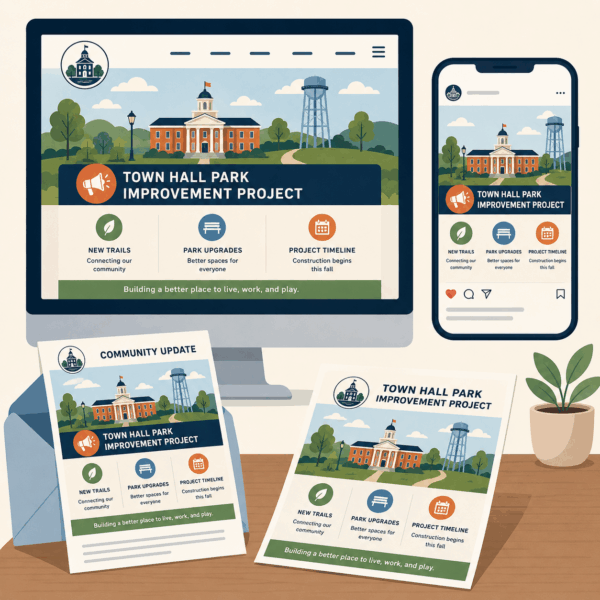 To solve channel inconsistency, it helps to understand the mechanics of how it develops. In most small governments, the communication channels in use today were added one at a time over a period of years, not designed together as an integrated system. The website came first, typically managed by a vendor or a tech-savvy staff member. The Facebook page came later when someone suggested the agency needed a social media presence. The email newsletter was added when a new administrator wanted a way to reach residents directly. The printed insert was started during a utility rate increase when the agency wanted to reach households that were not online.
Each channel was added with good intentions and at a time when it felt like the right tool for the moment. But each was also added without a formal protocol for how it would relate to the other channels, who would be responsible for keeping it current, and what would happen to ensure that a change communicated on one channel was also reflected on all the others. The result is a collection of channels that operate semi-independently, each managed by whoever has time and access, each carrying information that may or may not match what the others say.
Staff specialization compounds the problem. In a small government, the person who manages the website may be the administrator or a clerk who is comfortable with the content management system. The person who posts to Facebook may be a younger staff member who took on the role informally because of familiarity with social media. The person who prepares the quarterly newsletter may be a department head who writes well. The person who manages the utility bill insert may be the finance office. These individuals may rarely interact directly about communication, and none of them may have a standing process for checking what the others have published before posting their own update.
The timing problem is another structural contributor to inconsistency. Channels have different publishing cadences. The website can be updated continuously. The social media account may be updated daily or weekly depending on staff availability. The email newsletter may go out monthly. The printed insert may go out quarterly. Information that is accurate when it appears on the website in January may be significantly outdated by the time the quarterly newsletter carries it in April. If the newsletter is written from notes rather than from a current check of the website, it may contain information that has already been updated or superseded.
Finally, emergency and urgent updates are a frequent source of inconsistency because they happen quickly and under pressure. When a road closes unexpectedly, the first notice may go out through the fastest available channel. Other channels may be updated later when time permits, or they may not be updated at all if the person managing them did not know the update was needed. The resident who checks the website a day after the closure notice went out on Facebook finds no information about the closure and draws their own conclusions about what is happening.
Engaged & Connected: Communication Strategies for Small Towns, Villages, Townships, and Rural Communities
This article is part of our series on strategic communication for Small Towns, Villages, Townships, and Rural Local Governments. To learn more and to see the parent article, which links to other content just like this, click the button below.
The Source of Truth: Designating One Authoritative Location
The most important structural decision in managing multi-channel communication is designating one location as the official source of truth. The source of truth is the channel that carries the most complete, most current, and most authoritative version of any piece of information the agency publishes. Every other channel either points to the source of truth, carries a condensed version that accurately summarizes it, or both. No other channel is expected to carry independently maintained information that is not derived from and consistent with the source of truth.
For almost all small local governments, the source of truth should be the official website. The website is the only channel the agency controls completely and permanently. Social media platforms can change their policies, limit reach, or disappear. Email platforms require subscriptions and active list management. Printed materials become outdated the moment they are distributed. The website, if properly maintained, can carry the official current version of every significant piece of information the agency needs to communicate, with a clear date, a clear status, and a clear indication when it has been updated.
Designating the website as the source of truth requires a corresponding commitment to keeping it current. A source of truth that is not maintained is not a source of truth. It is a misleading document that residents will learn to distrust. The commitment to maintaining the website as the source of truth means that every significant communication the agency makes should appear on the website first or simultaneously with other channels, that outdated information is removed or archived on a defined schedule, and that updates to information already published always appear on the website before they appear on any other channel.
The source of truth principle also means that every other channel should reference the website explicitly when carrying abbreviated or summary information. A social media post that summarizes a road closure notice should include a link to the full notice on the website. An email alert that mentions a meeting rescheduling should direct recipients to the agency’s website for the updated schedule. A printed utility bill insert that describes a rate increase should note that full information is available at the agency’s website. This practice serves residents who want more detail, but it also serves the agency by establishing the website as the authoritative location that residents learn to go to when they want the definitive version of any information.
For agencies that maintain both an official website and a social media presence, a common point of confusion is whether Facebook or a similar platform can serve as the source of truth. It cannot, for several reasons. The agency does not control the platform, its algorithms, its policies, or its continued existence. Posts on social media can be modified, hidden, or removed by the platform without the agency’s consent. Not all residents use social media, and treating it as the authoritative source excludes those who do not. Social media is a distribution channel, not a records system. It should amplify and summarize information that originates on the official website, not originate information that the website then follows.
A useful way to think about the source of truth is to consider what a resident should do when they encounter conflicting information. If two channels say different things, which one should they trust? The answer to that question should be unambiguous, built into the agency’s communication practices, and communicated explicitly to residents over time. An agency that consistently directs residents to its website for official information, and that consistently keeps its website accurate and current, trains residents over time to go there first rather than comparing multiple channels and trying to determine which one is correct.
Source of truth discipline also simplifies the work of community partners who help distribute official information. A food pantry that receives a family asking about a water advisory, a library that fields questions about a road closure, a school district that shares utility outage information with families, all of these partners need to know where to send people for the official version. A clearly designated source of truth that is consistently maintained gives partners a reliable referral point that reduces the risk that they will inadvertently share outdated or inaccurate information on the agency’s behalf.
Building a Channel Update Protocol
A channel update protocol is a simple written process that specifies how information flows from the source of truth to every other channel the agency maintains. It answers two questions: when something needs to be communicated, which channels need to be updated, and in what order? The protocol does not need to be long or complicated. It needs to be specific enough that any staff member with communication responsibilities can follow it without guidance.
Mapping Each Channel’s Role and Update Trigger
The first step in building a channel update protocol is defining the role of each channel the agency uses. The role definition should specify what kind of information belongs on that channel, how current the information on that channel should be, and what the expected response time is for updating that channel after information changes.
A website role definition might specify that the website carries the full official text of all significant communications, is updated within a defined period after any significant development, and serves as the primary reference point for all other channels. A social media role definition might specify that the social media account carries brief summaries of significant developments with links to the website for full detail, is updated within a defined period after a website update, and is used for community-facing announcements rather than for technical or legal notices. An email newsletter role definition might specify that the newsletter summarizes significant developments from the past month, is sent monthly, and is assembled from content already published on the website rather than from independent sources.
These role definitions matter because they establish expectations that prevent accidental inconsistency. If the social media role definition says the account carries brief summaries with links to the website, a staff member who is tempted to post a detailed explanation of a complex policy change on social media instead of on the website first will have a clear guideline telling them to reverse that order. If the newsletter role definition says it is assembled from website content, the person preparing the newsletter will know to pull information from the website rather than from notes or memory.
Establishing an Update Sequence
The update sequence specifies the order in which channels are updated after a piece of information changes. The sequence should always start with the source of truth. After the website has been updated, other channels can be updated in whatever order the agency finds most efficient, as long as no channel is updated before the website is current.
For routine updates, the sequence might be: update the website first, then post to social media with a link to the updated page, then include the update in the next scheduled email newsletter if it is significant enough. For urgent updates such as emergency alerts, the sequence might be adjusted to allow simultaneous updates to the website and to a text alert platform, with social media following immediately after. The key is that no channel carries information that the website does not carry or that contradicts what the website says.
The update sequence should also specify what happens to previously published information when it changes. If a meeting is rescheduled, the old meeting date should be removed from or clearly superseded on every channel where it appeared, not just on the channel that carries the correction. If a road project completion date changes, every channel that announced the original date should be updated to reflect the revised one. Allowing outdated information to persist on some channels while other channels carry the update is a form of inconsistency that the protocol should explicitly prevent.
Assigning Channel Stewardship
Each channel in the protocol should have a named steward: the person responsible for updating that channel when updates are needed and for ensuring that the channel reflects current information at all times. The steward is not necessarily the person who originates every piece of content, but they are the person accountable for making sure the channel stays current. For the website, the steward is typically the administrator, clerk, or whoever has primary publishing access. For social media, the steward may be a different staff member. For the newsletter, the steward is the person who compiles and distributes each issue.
Channel stewards should be identified by name in the protocol, not just by role, and the protocol should also identify a backup steward for each channel. When the primary steward is unavailable, the backup steward is responsible for ensuring that urgent updates are made without delay. Backup stewardship is particularly important for the website and for any emergency alert platforms, because those channels may need to be updated outside of normal business hours.
Keeping Print and Physical Channels Consistent With Digital Channels
Print and physical channels present a particular consistency challenge because they cannot be updated after distribution. A printed newsletter distributed in January carries information that was accurate at the time of printing but that may be outdated by February. A posted notice at the town hall bulletin board may remain posted long after the event or deadline it describes has passed. A utility bill insert from the previous quarter may describe a service or program that has since changed. The immutability of print and physical materials requires a different approach to consistency management than digital channels.
The most important practice for managing print and physical channel consistency is date-stamping. Every printed piece should carry the date it was prepared and the statement that current information is available at the agency’s website or a specific contact number. This does not prevent the information from becoming outdated, but it gives readers a clear indication that the information they are reading reflects a particular point in time and that they should verify current details before making decisions based on it.
A second practice is to keep printed communication focused on information that is unlikely to change. A printed newsletter is an appropriate channel for summarizing decisions that have already been made, completed projects, and stable service information. It is a poor channel for communicating pending decisions, project schedules that may slip, or any information that is likely to be revised before the next printing. Reserving print channels for stable information reduces the risk that printed material will contradict more current digital updates.
Physical notice postings at bulletin boards, utility offices, and public facilities should be part of the update protocol. When a posted notice becomes outdated, it should be replaced or removed. If a road closure that was announced on a posted notice has ended, the closure notice should come down when the road reopens, not remain posted for weeks while other channels carry the all-clear. Designating someone responsible for maintaining the accuracy of physical postings and establishing a standard schedule for reviewing posted materials prevents the accumulation of outdated physical notices that undermine the agency’s credibility with residents who rely on them.
Utility bill inserts are a specialized form of print communication that reaches every household on the utility billing list. Because they cannot be updated after mailing, they should carry only information that is confirmed and unlikely to change during the period between the billing cycle and the next one. An insert announcing a confirmed meeting date or a finalized rate change is appropriate. An insert announcing a meeting date that might be subject to rescheduling is a risk that may require a correction notice later. The utility billing cycle is a reliable and relatively low-cost communication channel, but its value depends on the reliability of the information it carries.
Managing Corrections When Inconsistencies Occur
 Even with a strong protocol in place, channel inconsistencies will occasionally occur. A staff member will update one channel and forget another. An urgent update will go out before the source of truth is revised. A printed piece will become outdated when circumstances change faster than anticipated. The question is not whether these situations will happen but how the agency will handle them when they do.
Identifying Inconsistencies Quickly
The earlier an inconsistency is identified, the less damage it does. Agencies that check their own channels regularly are more likely to catch discrepancies before residents notice them. A simple weekly review of the agency’s website, social media accounts, and any other active digital channels takes only a few minutes and can identify outdated or contradicted information before it circulates widely. This review should be part of the communication coordinator’s standing responsibilities rather than something that happens only in response to a complaint.
Resident contacts are also an important source of inconsistency detection. When a resident calls to ask which version of a meeting date is correct, or reports that the website says one thing and the newsletter says another, that contact is providing the agency with valuable quality control information. The protocol should specify how staff should handle those contacts: who receives the report, who investigates and corrects the discrepancy, and whether the resident who identified the inconsistency receives a follow-up confirmation that it has been resolved.
Issuing Corrections Promptly and Clearly
When an inconsistency is identified and a correction is needed, the correction should go out promptly and to every channel where the incorrect information appeared. A correction that appears only on social media when the incorrect information appeared on the website, the newsletter, and a posted notice does not fully correct the record. The correction needs to travel the same channels as the error.
The correction should be specific about what was incorrect and what the accurate information is, without excessive explanation of how the error occurred. Residents need the right information. They do not need a detailed account of the internal process that produced the wrong information, and too much explanation can come across as defensive rather than accountable. A clear, factual correction that gives residents the accurate version and acknowledges the original was incorrect is sufficient.
For significant errors, particularly those involving meeting dates, deadlines, or emergency information, the correction should be prominent rather than buried in a general update. A social media correction should be a new standalone post, not a comment on the original post that many residents may not see. A website correction should appear in the same location as the original, not only in an archive or a news section that requires navigation to find.
Maintaining Consistency During Staff Transitions
One of the most predictable moments for channel inconsistency is during staff transitions. When the person who managed the website leaves and a replacement has not yet been identified, the website may go unupdated while social media continues. When a new administrator comes aboard, they may not initially know what all of the agency’s communication channels are, who has access to them, or what the current update status of each channel is. The gap between outgoing and incoming staff is a gap during which the protocol is most likely to break down.
Preventing inconsistency during transitions requires communication-specific offboarding and onboarding processes. The departing staff member should document the current status of every channel they managed: what was most recently published, what is scheduled to go out, what is pending, and what access credentials the successor will need. The incoming staff member should receive that documentation before taking over, not after discovering a gap on their own.
The transition period is also a good time to audit the agency’s channels and identify any that have not been updated recently. A channel that has been dormant for several months may be carrying outdated information that contradicts what appears on active channels. The transition audit should confirm the current state of every channel and flag any that need immediate attention. This audit does not need to be elaborate. A simple checklist of all channels with the date of the most recent update on each is enough to identify problems quickly.
New staff members who take on communication responsibilities should be given access to the channel update protocol as part of their onboarding. They should understand which channel is the source of truth, what the update sequence is, what their specific responsibilities are, and who to contact if they are unsure how to handle a communication situation. Without that orientation, new staff are likely to develop their own informal habits that may or may not align with the protocol established by their predecessors.
Consistency During High-Volume and High-Stakes Communication Periods
Certain periods generate more communication than usual: budget season, major capital projects, controversial decisions, election periods if applicable, and emergency events. These are also the periods when channel inconsistency is most likely to occur, because multiple staff members may be generating and publishing information simultaneously, updates may be coming faster than the normal update protocol can accommodate, and the pressure to communicate quickly may lead to shortcuts that bypass source-of-truth discipline.
High-volume periods require heightened coordination, not reduced protocol. Before a major budget presentation, the agency should confirm that all channels carry consistent information about the meeting date, time, location, and materials available. During an emergency, the agency should designate a single person responsible for ensuring that all channels are updated simultaneously and consistently rather than allowing each channel steward to update independently. After a controversial decision, the agency should conduct a rapid channel audit to confirm that all channels are carrying the same version of what was decided.
Communication coordinators should brief all channel stewards before known high-volume periods, confirming the update sequence, identifying any special procedures for the period, and establishing a check-in schedule to catch inconsistencies before they become public. That briefing does not need to be formal. A brief email or a five-minute conversation is often sufficient to align the people who are managing different channels so that their work reinforces rather than contradicts each other.
For emergency communication specifically, the protocol should designate one person as the sole publisher of official updates during the active emergency period rather than allowing multiple staff members to post to different channels independently. Multiple simultaneous publishers increase the risk that channels will carry slightly different versions of evolving information. A single designated publisher who updates all channels in the correct sequence, or who coordinates closely with the stewards of each channel, is far less likely to produce inconsistency under pressure.
The consistency challenge during high-volume periods is compounded when communication responsibilities are distributed across staff who may not be in close contact during busy operational periods. A public works crew managing an active infrastructure emergency, an administrator managing elected official communication and media inquiries, and a clerk managing office operations and resident calls may each be generating communication independently without a real-time mechanism for checking that what each is saying matches what the others are saying. Building brief check-in moments into the communication protocol for high-volume periods, even as short as a five-minute conversation or a quick group message confirming what has been published and what is pending, can prevent the accumulation of inconsistencies that become apparent only after the fact.
After a high-volume period ends, a channel audit should be part of the wrap-up process. The audit should confirm that every piece of time-sensitive information published during the period has been updated, archived, or removed as appropriate, and that every channel carries consistent information about the current state of the situation. A road project that wrapped up over a busy summer should not still have a project completion date from three months ago on the website while the social media account has been carrying a completion notice since August. The post-period audit is what catches those residual inconsistencies before the next high-volume period begins.
Training Staff on Multi-Channel Consistency
The channel update protocol is only as effective as the staff members who follow it. A well-written protocol that no one has read will not prevent inconsistency. Training staff on the protocol, the reasons behind it, and the consequences of not following it is as important as writing the protocol itself.
Training for multi-channel consistency does not require a formal course. It requires that every staff member with communication responsibilities has read the protocol, understands their specific role in it, knows what the source of truth is and why it is the source of truth, and knows what to do when they are uncertain whether something they are about to publish is consistent with what other channels say. That orientation can be delivered in a brief meeting, in a written onboarding document, or in a one-on-one conversation with the communication coordinator.
Periodic reinforcement matters as well. Staff members who were trained on the protocol two years ago may not remember all of its details, particularly if they have not had reason to consult it recently. Including a brief communication consistency check in the annual review of the communication plan, or circulating a one-page summary of the update protocol at the start of each year, reinforces the habits that prevent channel drift over time.
Supervisors and administrators can reinforce consistency norms through their own behavior. When a supervisor asks a staff member who is about to post to social media whether the website has been updated first, that question communicates the importance of source-of-truth discipline more effectively than any written protocol. When an administrator includes channel consistency in the feedback given during performance conversations with staff who have communication responsibilities, it signals that consistency is a professional expectation, not a nice-to-have.
Another dimension of training that is often overlooked is helping staff understand how to handle real-time questions from residents when they are unsure whether the information they have is consistent with what official channels say. A staff member who is asked about a road project timeline while working at a community event should know that if they are not certain whether the information they have is current, the right answer is to direct the resident to the website rather than sharing potentially outdated information from memory. Training staff to use the source of truth as their own reference before sharing information externally is a simple but powerful consistency practice.
Training should also address how staff handle information they encounter on unofficial channels. Residents sometimes share local news on neighborhood Facebook groups, community apps, or informal networks that may be inaccurate or outdated. Staff who are part of those communities in a personal capacity should understand that responding to misinformation in unofficial channels is generally not their role as individual community members, but that significant misinformation should be reported to the communication coordinator so the agency can decide whether an official clarification is warranted. That clarity prevents staff from either ignoring important misinformation or attempting to address it through personal accounts in ways that may create confusion about what is official.
Using Technology to Reduce the Risk of Inconsistency
Several tools and platform features can reduce the risk of channel inconsistency for small governments that are willing to invest a small amount of time in setup. These tools do not replace the protocol, but they can make following the protocol easier and reduce the manual coordination burden on staff.
Social media scheduling tools allow staff to draft and schedule posts in advance rather than posting in real time. For routine updates that are connected to content already published on the website, scheduling a social media post at the same time the website is updated ensures that both channels go live simultaneously. This eliminates the lag between a website update and the corresponding social media post that is one of the most common sources of temporary inconsistency.
Email newsletter platforms that allow content to be built from website RSS feeds or embedded links can reduce the risk of newsletter inconsistency by pulling information directly from the website rather than from staff notes. If the newsletter content is assembled from published website content, the newsletter is less likely to carry information that contradicts the website.
Website platforms that allow dated alerts to expire automatically can help with one category of print and physical channel inconsistency by removing time-sensitive notices from the website when they are no longer current. A meeting notice that automatically expires the day after the meeting prevents a resident who finds the notice later from being misled about an upcoming event that has already occurred.
None of these tools eliminates the need for human judgment and oversight. Staff still need to review scheduled posts before they go live, check that newsletter content is accurate and current, and confirm that website alerts are expiring at the right time. The tools reduce the manual workload of consistency management but do not replace the protocol or the habits that make it work.
One additional consistency risk that small governments should explicitly address in their protocols is the communication that happens before a formal decision is made. Elected officials sometimes discuss agenda items publicly before a vote, staff members sometimes share their expectations about an upcoming decision with residents who ask, and department heads sometimes announce project timelines that are subject to change depending on budget approval or contractor availability. When that pre-decision communication does not match the outcome that is eventually communicated officially, residents experience a form of channel inconsistency that is harder to address because it is not technically an error in the published record. Establishing norms about what staff should and should not communicate about pending decisions, and ensuring those norms are understood by elected officials as well, reduces the risk of this more subtle form of inconsistency.
The correction process should also include a brief internal review of what caused the inconsistency in the first place. Not in a punitive way, but in a process improvement way. If the same type of inconsistency recurs, such as social media being updated before the website or print materials carrying information that was later revised, the protocol should be adjusted to address the specific failure pattern. Over time, this iterative approach to protocol development produces a coordination system that becomes progressively more reliable because it is built from real experience rather than theoretical best practices alone.
Resident-Facing Communication About Where to Find Official Information
A frequently overlooked dimension of multi-channel consistency is helping residents understand which channels are official and which are not. In many small communities, residents encounter local government information through a mix of official channels, unofficial community groups, neighbor networks, and local social media conversations. Not all of that information is accurate, and residents may not always know which sources to prioritize. An agency that actively tells residents where to find official information is more likely to build the habit of source-of-truth checking among residents themselves.
The most effective way to communicate which channels are official is to include that information on every channel the agency uses. The website should clearly identify itself as the agency’s official information source. The email newsletter should include a brief standing line noting that residents can find current information on the website. Social media profiles should include the website address in their description and should consistently link to the website in posts about significant matters. Printed materials should direct residents to the website and to a phone number for questions.
When an agency launches a new channel or discontinues an old one, that change should be communicated explicitly. If the agency is moving from a general Facebook page to a neighborhood notification platform, residents who were following the Facebook page need to know that official updates will now come from a different source. If an old website address is being replaced, the old address should redirect to the new one for a reasonable transition period, and the change should be communicated through every active channel. Residents who discover that the information source they have been relying on is no longer being maintained feel a version of the trust erosion that comes from encountering inconsistent information: they had a habit, the agency changed something without warning them, and now they are uncertain where to look.
Regular, brief reminders about official channels can be embedded in routine communication rather than requiring standalone announcements. A line at the bottom of a monthly email saying that all current information is available at the agency’s website, or a standing social media post every few months encouraging residents to bookmark the official site, reinforces the source-of-truth habit without requiring significant additional communication effort. These reminders are especially valuable after a period when misinformation has circulated, because they give the agency a natural opportunity to redirect residents to the official source without having to address the misinformation directly.
Strategic Communication Support for Small and Rural Governments
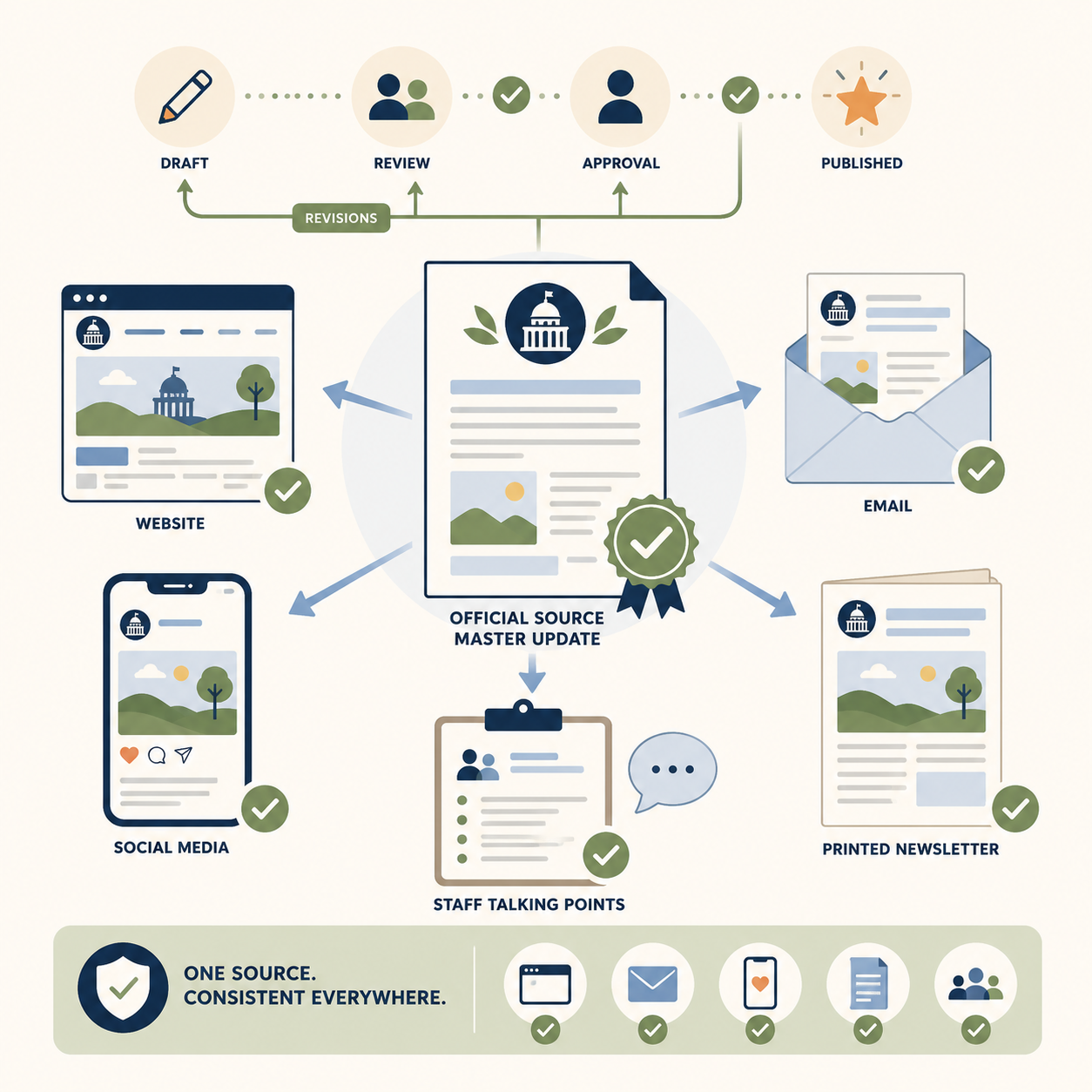 Keeping multiple communication channels consistent is a coordination problem, and coordination problems are solved with systems, not with effort alone. Small governments that try to maintain channel consistency through individual vigilance, without a designated source of truth, without a channel update protocol, and without named channel stewards, will find that the effort required is unsustainable and that inconsistencies accumulate despite everyone’s best intentions. The structural solution is not complicated, but it requires deliberate decisions and documentation that many small agencies have not yet made.
Outside support can be valuable in helping agencies build those systems efficiently. Identifying the right source of truth for the specific agency’s context, designing a channel update protocol that matches the agency’s staffing structure, and establishing stewardship assignments that are realistic given existing workloads are all decisions that benefit from a structured process and outside perspective.
Stegmeier Consulting Group (SCG) helps small and rural governments build communication systems that are coordinated, reliable, and sustainable within existing capacity. That work includes source-of-truth designation, channel protocol development, stewardship assignment, consistency training for staff, and audit tools that help agencies catch and correct channel drift before it becomes a credibility problem. Whether your agency is starting from an informal system or trying to formalize coordination that has been working inconsistently, SCG can help you design a structure that produces consistent resident communication across every channel your agency uses.
Future Trends in Multi-Channel Communication Consistency
The challenge of maintaining channel consistency will grow in the coming years as the number of channels available to local governments continues to expand. Platforms that did not exist a decade ago are now significant sources of local information, and new ones emerge regularly. Small governments that adopt new channels without adjusting their coordination protocols will find that each new channel is another potential source of inconsistency rather than an additional communication asset.
One trend that may help small governments manage this complexity is the consolidation of communication management into unified dashboards. Several platforms designed for local government communication allow staff to draft content once and distribute it to multiple channels simultaneously, with channel-specific formatting applied automatically. These tools significantly reduce the manual coordination required to keep channels synchronized, and they are becoming more affordable and accessible for agencies with limited budgets.
Another trend is the increasing expectation of real-time consistency. When a decision is made at a public meeting that is being streamed live, some residents will look for the agency’s official update immediately after the meeting ends. Agencies that cannot update their channels within hours of a significant development are increasingly perceived as slow and opaque, even if their communication the following day is excellent. Building the systems and workflows that allow rapid post-meeting updates will become a more prominent expectation as digital communication norms continue to evolve.
Accessibility requirements for digital content are also likely to shape how consistency is managed across channels. As expectations grow for accessible web content, alt text on images, captions on videos, and readable document formats, agencies that are managing multiple channels will need to ensure that accessibility practices are applied consistently, not just on the primary website but on social media posts, email newsletters, and digital documents distributed through every channel. Building accessibility into the channel update protocol from the beginning is more efficient than retrofitting it later.
Conclusion
Keeping website, email, social media, and print updates consistent is not an ambitious goal. It is a basic one, and it is achievable for any small government that is willing to make a few structural decisions and document them. Designating a source of truth, building a channel update protocol, assigning stewardship for each channel, and establishing a practice of reviewing channels for consistency are the foundational steps. None of them require new staff, new technology, or significant additional time beyond what the agency is already spending on communication.
The payoff is significant. Residents who receive consistent information from every official channel learn to trust official channels. They stop calling the office to ask which version is correct. They stop relying on informal networks for information that should be coming from the agency. They become more receptive to the communications the agency sends because those communications have proven reliable over time. That kind of trust is built incrementally through consistent practice and lost rapidly through inconsistency. The channel update protocol is the tool that makes consistent practice possible at scale.
Small governments that invest in multi-channel coordination are investing in the credibility that underlies everything else they do. A budget presentation delivered to a public that trusts official communication lands differently than the same presentation delivered to a public that has learned to question whether what the agency says is accurate. That credibility is built one consistent update at a time, and the systems described in this article are how small governments build it sustainably.
Stegmeier Consulting Group’s Strategic Approach to Communication Systems
Align your agency’s messaging, channels, and community outreach.
Small and rural governments need communication systems that produce consistent, trustworthy information across every channel residents use to stay informed. Building that consistency requires more than good intentions. It requires a designated source of truth, a clear protocol for how information flows from that source to every other channel, named stewards for each channel, and the habits that sustain coordination even during busy periods and staff transitions.
SCG helps public agencies design and implement multi-channel communication systems that are coordinated, credible, and sustainable within the real constraints of small-government operations. Whether your agency needs to establish coordination from scratch or to strengthen a system that is producing inconsistencies despite everyone’s best efforts, SCG can help you build the structure that keeps every channel aligned with what residents need to know.
Use the form below to connect with our team and explore how a coordinated multi-channel communication system can help your agency build the kind of consistent public trust that only comes from communicating reliably across every channel, every time.