
How to Maintain Local Government Communications During Staff Turnover
Staff turnover is one of the most predictable disruptions a small local government will face, and yet it is the disruption that most consistently catches communication systems unprepared. When the clerk who has managed the website for six years gives three weeks’ notice, or when the administrator who ran the emergency alert platform leaves unexpectedly, or when the only staff member who knows the newsletter platform’s login credentials takes a leave of absence, the communication infrastructure that residents depend on becomes fragile in ways that were not anticipated and are not easy to solve quickly.
The problem is not unique to small governments, but small governments experience it more acutely because communication responsibilities in a small agency are typically concentrated in one or two individuals rather than distributed across a team. A city communications department can absorb the departure of one staff member because others on the team understand the systems and can cover the work. A township office where a single clerk has been the de facto communications person for a decade cannot absorb that departure gracefully without preparation, because the institutional knowledge, the platform access, and the established habits all walk out the door with her.
What makes staff turnover a communication risk, specifically, is not the loss of the person’s writing skill or judgment, though those may also matter. It is the loss of the accumulated operational knowledge that keeps communication systems running: the passwords, the contact lists, the template locations, the understanding of which channel gets updated first, the relationships with local media contacts, the awareness of what commitments have been made about future updates, and the familiarity with the informal exceptions and special cases that do not appear in any written document.
This article addresses how small governments can protect their communication systems from the disruption of staff turnover. It covers the documentation practices that preserve institutional knowledge, the platform management policies that prevent access from being held by individuals rather than by the agency, the transition practices that ensure communication continuity during departures, and the onboarding practices that bring new staff into communication responsibilities effectively. The goal is not to make communication systems departure-proof, because no system fully achieves that. The goal is to reduce the fragility that makes every departure a potential communication crisis.
Importantly, this article also addresses proactive steps that agencies can take during ordinary operations, not just at the moment of departure. The practices that protect communication during staff turnover are the same practices that improve communication quality and consistency during normal operations. Agencies that build communication documentation habits, manage platform access deliberately, and maintain shared systems rather than individual systems will find that turnover, when it comes, is disruptive but manageable rather than potentially catastrophic.
The Communication Risks Created by Staff Turnover
 Understanding the specific risks that staff turnover creates for local government communication helps agencies prioritize which protections to build first. Not all of the risks are equally serious, and not all of them manifest in the same way. Some create immediate, visible problems. Others create slow, quiet deterioration that may not become apparent until the agency faces a high-stakes communication need months after a departure.
The most immediate risk is loss of access. When a departing staff member was the only person who could log into the website, the social media accounts, the email newsletter platform, or the emergency alert system, those channels become inaccessible until the agency can recover the accounts or establish new credentials. That recovery process takes time that may not be available during an emergency, and it often involves contacting platform vendors, verifying organizational identity, and navigating account recovery workflows that were not designed for speed.
A closely related risk is the loss of credentials that were never formally documented. Many small government communication accounts were set up years ago using personal email addresses, personal phone numbers, or passwords stored only in a browser on one staff member’s computer. When that staff member leaves, the credentials leave with them. The agency may not know which email address the account is registered under, may not have access to the phone number that receives verification codes, and may face a recovery process that is genuinely uncertain in outcome.
A second category of risk is the loss of contact relationships. Local government communication depends on relationships as much as on systems. The connection with the local newspaper editor who calls back when the agency needs coverage. The relationship with the county emergency management coordinator whose contact is essential for multi-jurisdictional alerts. The connection with the utility authority’s public information staff who coordinate on service disruption notices. These relationships exist in the departing staff member’s phone and memory, not in any shared contact management system. When they leave, those relationships may need to be rebuilt from scratch.
A third risk is the loss of contextual knowledge about ongoing communication commitments. Departing staff members often carry in their heads an awareness of what has been promised. A road project update that was committed to residents by a specific date. A follow-up communication that residents were told to expect after a controversial decision. A correction that was being prepared when the departure occurred. Without documentation of these commitments, the incoming staff member may not know they exist, and residents who were expecting follow-up may conclude that the agency does not follow through on what it says.
Finally, there is the risk of channel drift during the transition period. When no one is actively managing communication channels, they begin to diverge. The website may go unupdated. Social media posts may stop. The email newsletter may miss its scheduled date. Each of these gaps creates its own small erosion of resident trust, and the cumulative effect of several weeks or months of reduced communication during a transition can be significant for an agency that was previously communicating reliably.
Engaged & Connected: Communication Strategies for Small Towns, Villages, Townships, and Rural Communities
This article is part of our series on strategic communication for Small Towns, Villages, Townships, and Rural Local Governments. To learn more and to see the parent article, which links to other content just like this, click the button below.
Agency Ownership of Communication Accounts and Platforms
The most fundamental protection against communication disruption during staff turnover is ensuring that every communication platform the agency uses is registered to and controlled by the agency, not by an individual employee. This principle sounds obvious, but in practice it is violated frequently in small governments where accounts were set up casually and the importance of agency ownership was not considered at the time.
Auditing Current Account Ownership
Before any other protective measures can be put in place, the agency needs to know what it actually has. An account audit is a straightforward inventory of every communication platform the agency uses, the email address or username under which each account is registered, whether that email address is an agency-controlled address or a personal address, and who currently holds login credentials. The audit should also note whether two-factor authentication is enabled and, if so, whether the verification method is agency-controlled or personal.
The audit will frequently reveal problems that need to be corrected. Accounts registered to personal email addresses of current or former staff. Platforms whose only authorized user is a staff member whose last day is approaching. Accounts where no one currently employed knows the password. Social media profiles that were created by a board member using their personal account and that are technically tied to that individual’s profile rather than to the agency. Each of these represents a potential loss of access that should be corrected before the departure occurs rather than discovered after.
The audit should be documented and stored in a location accessible to more than one authorized person. A shared drive, a secure password management system, or a physical document in a secured location can all serve this purpose. The documentation should include not just the current credentials but also notes on which accounts require two-factor authentication and what the recovery options are for each platform if the primary credentials are lost.
Converting to Agency-Controlled Credentials
Wherever possible, communication platform accounts should be registered to an agency email address rather than a personal one. An agency email address in the form of info@townshipname.gov or communications@villageofname.org is controlled by the agency, can be accessed by authorized staff regardless of who originally set it up, and does not expire or become inaccessible when a staff member departs. Personal email addresses, even professional ones using a staff member’s name, are controlled by the individual and cannot be accessed by the agency after that individual leaves.
For platforms that currently use personal email addresses, the conversion to an agency address should be done before the relevant staff member departs, while that person can still assist with the account transfer process. Converting an account after a departure is significantly more difficult because most platforms require access to the registered email or phone number to authorize changes. The departing staff member who assists with converting their accounts before leaving is providing a genuine and important service to the agency, and framing the request that way during the offboarding conversation is likely to produce cooperation.
Phone-based two-factor authentication presents a specific challenge. Many platforms send verification codes by text message to a registered phone number, and if that number is the personal cell phone of a departing staff member, the agency loses access to that verification method. Where possible, two-factor authentication should use an agency-controlled method such as an authenticator app installed on an agency device, an email-based verification code sent to an agency email address, or a registered phone number associated with an agency-owned device. When transitioning existing accounts, updating the two-factor authentication method should be part of the conversion process.
Building a Communication Operations Document
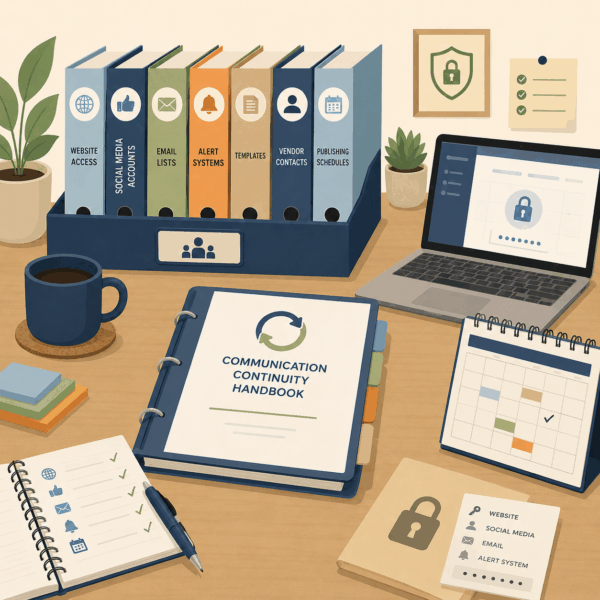
The communication operations document is the institutional memory of how communication works in the agency. It is not a communication plan, which describes what the agency will communicate and when. It is the operational guide to how the agency’s communication systems function: what the platforms are, how to access them, what the standing processes are, what commitments are currently open, and where all of the materials the agency uses for communication are stored. A good communication operations document allows an incoming staff member to take over communication responsibilities with a clear understanding of what they are taking over.
What the Document Should Cover
The communication operations document should begin with a complete list of all communication channels and platforms the agency uses. For each channel, it should include the platform name, the URL or access point, the username or email address the account is registered under, the password or a reference to where the password is stored, any two-factor authentication method in use and how to access it, and the name of the current primary steward and backup steward.
The document should include the content calendar for the current year, noting what has been published, what is scheduled, and what is pending. It should include contact lists for external partners, local media, elected officials, and any other contacts that communication staff use regularly. It should include links to or locations of template libraries, editorial guidelines, brand materials, and any standing instructions about what the agency does or does not publish on each channel.
It should also include a section on open commitments: updates that have been promised to residents but not yet delivered, correction notices that were being prepared, responses to resident inquiries that are pending. These commitments are easy to lose in a transition and can quietly damage the agency’s credibility when they go unfulfilled. Documenting them explicitly ensures that whoever takes over communication responsibilities can see what residents are expecting.
Keeping the Document Current
A communication operations document that is created once and never updated will be partially or significantly outdated at the moment it is most needed. Platform passwords change. Staff assignments shift. Contact information evolves. The template library grows. New channels are added. The document must be maintained to remain useful.
The most practical approach is to build document maintenance into existing processes rather than treating it as a separate task. When a new platform account is created, the document is updated. When a contact changes, the document is updated. When a template is revised, the location of the updated template is noted. When the communication coordinator role changes hands, the document update is part of the transition. This incremental maintenance approach keeps the document current without requiring significant time on any single occasion.
The document should be stored in a location that is accessible to more than one authorized person and that does not depend on any single staff member for access. If the communication operations document is stored only on the departing staff member’s desktop, it is no more available to the incoming staff member than the information that was only in the departing staff member’s head. The document should live on a shared agency drive or server, in a cloud-based system with multiple authorized users, or in a physical format stored in a location known to key staff.
Transition Practices That Protect Communication Continuity
 Knowing what to do when a staff departure is announced is essential to limiting the communication disruption that follows. The transition period, from the announcement of the departure to the point when a successor is fully operational, is the highest-risk window for communication failures. A structured transition protocol that begins as soon as a departure is known can significantly reduce that risk.
Knowledge Transfer Before Departure
The most valuable communication continuity practice during a staff transition is a structured knowledge transfer while the departing staff member is still available. The departing staff member should be asked to walk through each communication platform with their successor or with the person who will cover their responsibilities in the interim, demonstrating the login process, showing where templates and materials are stored, explaining the standing processes for routine communications, and flagging any pending commitments or unusual situations the incoming person should be aware of.
This knowledge transfer should be documented. The departing staff member should not simply describe what they know verbally and expect the incoming person to remember all of it. Notes, screenshots, updated process guides, and additions to the communication operations document should result from these sessions. The departing staff member’s institutional knowledge is most accessible during this window, and extracting as much of it as possible into shared documentation is the agency’s best opportunity to preserve it.
When departures are planned and the timeline allows, the departing staff member and their successor or interim should work together on actual communication tasks before the departure. The departing person sends the next meeting notice while the incoming person watches and asks questions. The incoming person drafts the next road closure notice while the departing person reviews and provides feedback. This parallel process builds practical familiarity with the communication systems in a way that documentation alone cannot achieve.
Establishing Interim Coverage
Not all departures come with enough notice for a full knowledge transfer or a successor to be identified and onboarded before the departure date. In those cases, the agency needs an interim coverage plan that keeps communication running at a baseline level while recruitment proceeds. The interim plan should identify which communication tasks are critical enough to maintain during the transition period, who will handle each of those tasks, and what minimum the agency needs to maintain to avoid breaking commitments or leaving residents without essential information.
Emergency alert capability is the most critical communication function to maintain and should be the first priority in any interim coverage plan. If the departing staff member was the primary emergency publisher, another staff member must have or immediately obtain the access and training needed to send alerts before the departure occurs. An agency that cannot send an emergency alert during a transition period has created a genuine public safety risk that no other communication concern outweighs.
Website update capability is the second priority. Residents who cannot find current information on the official website during a transition period may experience significantly more confusion and concern than the transition itself would normally produce. Identifying a staff member who can make basic website updates, and ensuring they have the necessary access, should be done before the departing staff member’s last day regardless of how short the notice period is.
Routine communications such as meeting notices and newsletters can tolerate more disruption during a transition than emergency and website updates, but they should not be neglected entirely. A brief explanation to residents that the agency is managing a staff transition and that some routine communications may be delayed, posted to the website and social media, sets expectations and reduces the risk that residents interpret the communication gap as indifference.
Onboarding New Staff Into Communication Responsibilities
The onboarding process for a new staff member who will have communication responsibilities should include explicit, structured orientation to those responsibilities alongside everything else the onboarding covers. Communication orientation is frequently omitted or treated as an afterthought in local government onboarding, particularly when the hiring process has been focused primarily on operational qualifications. The result is a new staff member who can process permits or manage utility billing but who does not know what the agency’s social media accounts are called, where to find the emergency alert template, or what the protocol is for updating the website after a board meeting.
Communication onboarding should cover the full communication operations document, the channel update protocol, the template library, the content calendar, the open commitments inherited from the transition, and any standing expectations or preferences that the administrator or elected board has established. It should also include hands-on access to every platform the new staff member will be responsible for, confirmed before the onboarding is considered complete rather than left to the new staff member to figure out on their own.
For new staff members who have not previously worked in local government communication, it is also useful to explain the specific communication norms and expectations that distinguish public-sector communication from other contexts they may have experienced. The importance of accuracy over speed. The need to verify information before publishing it. The distinction between official agency positions and the views of individual elected officials. The sensitivity around certain categories of information including personnel matters, legal proceedings, and pending decisions. These norms are often assumed to be understood but are more reliably absorbed when they are named explicitly during onboarding.
A staged onboarding for communication responsibilities is often more effective than a complete handover on the first day. The new staff member might begin by updating a routine channel while a more experienced colleague reviews the update before it is published. Over several weeks, they take on progressively more independent responsibility as their familiarity with the platforms and protocols increases. By the end of the onboarding period, they should be capable of managing all communication responsibilities independently, with a clear understanding of who to consult when situations arise that fall outside the established protocols.
Preventing Communication Systems From Becoming One-Person Operations
The deepest protection against communication disruption during staff turnover is structural: building communication systems that are genuinely shared rather than effectively controlled by a single person. Many small governments have communication systems that appear shared in name but are in practice dependent on one person’s knowledge, access, or initiative. The clerk who is nominally the communication coordinator but who has never fully documented the systems they manage. The administrator who is theoretically the emergency publisher but who has never actually tested that access. The staff member who maintains the social media account but who is the only person who knows the login.
Building genuinely shared communication systems requires deliberate attention to redundancy. Every critical communication function should have at least two staff members who can perform it independently. Every platform should have at least two authorized users with full access. Every template and process guide should be stored in a shared location. Every contact list should be accessible from any authorized device. Building this redundancy takes time and modest effort during ordinary operations, but it converts communication from a fragile individual capability into a resilient organizational one.
Periodic communication drills can help identify gaps in the shared system before they become problems. Once or twice a year, the agency might ask the designated backup emergency publisher to actually log in and walk through the alert sending process, confirming that their access is current and their familiarity with the steps is sufficient. Or the communication coordinator might ask a backup website steward to make a routine update, confirming that the backup can do it without assistance. These brief exercises take only a few minutes but reveal problems that would otherwise surface only during an actual emergency or an actual staff departure.
Communication systems should also be designed to run on shared infrastructure rather than on individual devices. If platform logins are saved only in one person’s browser, or if the template library is stored only on one person’s computer, the system is functionally individual even if it is theoretically shared. Shared password management tools, cloud-based document storage, and agency-controlled device management are the infrastructure investments that make shared communication systems genuinely accessible to more than one person.
Password Management and Access Security During Transitions
Credential management during staff transitions is both a communication continuity concern and a security concern. When a staff member departs, the agency needs to ensure that the departing individual no longer has access to official communication channels, while simultaneously ensuring that the successor or interim does have that access. Those two requirements must be addressed simultaneously rather than sequentially, because a gap during which no authorized person can access critical platforms is as problematic as a gap in which an unauthorized person retains access.
The most practical approach to credential management during transitions is the use of an organizational password management system. These tools allow the agency to store credentials for all communication platforms in a centralized, encrypted location that can be accessed by multiple authorized users. When a staff member departs, their individual access to the password management system can be revoked while other authorized users retain full access. When a new staff member joins, they can be granted access to the system and immediately have the credentials they need to operate every platform they are responsible for.
For agencies that have not yet adopted a password management system, the transition period is a useful occasion to begin the process. Even a simple approach, such as storing credentials in a spreadsheet protected by an agency-controlled password and stored on a shared agency server, is significantly better than the default situation where each staff member stores credentials only on their personal devices or in their personal email accounts. The goal is not a perfect security solution but a solution that keeps credentials within the organization’s control rather than tied to individuals.
After a departure, all passwords associated with the departing staff member’s access should be changed. This is not a reflection on the individual’s trustworthiness. It is a standard security practice that protects the agency regardless of the circumstances of the departure. The change should happen promptly, ideally on or before the staff member’s last day, and should be coordinated to ensure that the successor or interim has new credentials before the old ones are revoked. Password changes should be documented in the communication operations document so the record of current credentials is always accurate.
Social media accounts present a particular challenge because they are tied to personal profiles in ways that website and email newsletter platforms are not. If a Facebook page was administered by an individual using their personal Facebook account, that individual retains administrative access even after leaving the agency unless the access is explicitly revoked. The account audit should identify any social media accounts where administrative access is held by individuals rather than by an agency-controlled account, and those access permissions should be restructured before a departure occurs. Adding a second administrator under an agency-controlled account, and then removing the departing staff member’s access, is the standard approach for transferring social media administrative control.
Communicating With Residents During a Transition
Most staff transitions in small governments are managed internally, and there is no expectation that the agency will publicly announce every personnel change. But there are transition situations where some form of resident communication is appropriate, and getting that communication right is as important as managing the transition itself.
When a long-tenured staff member who had significant public-facing communication responsibilities departs, and when the agency is entering a period where routine communications may be temporarily reduced or delayed, a brief notice to residents is appropriate. The notice should be honest about what residents can expect, such as that the agency is managing a staff transition and that some routine communications may take additional time, while also reassuring residents that critical services including emergency communication will continue without interruption. The notice should include a contact for residents with urgent questions and a reference to the website as the current source of accurate information.
Transitions that coincide with significant local events, such as a major road project, a budget hearing cycle, or a pending public decision, require more active communication management. When the person who was managing communication about an ongoing situation departs, there is a risk that residents who were following the situation through regular updates will experience a gap they interpret as the agency abandoning the transparency it had been practicing. In those situations, maintaining update continuity, even if the updates are briefer or less frequent during the transition than they were before, is more important than normal. A brief update that says the agency is in a staff transition but remains committed to keeping residents informed about the project or decision preserves the communication relationship even when the full normal frequency is not achievable.
Volunteer and Part-Time Staff Roles in Communication Continuity
Many small governments rely on part-time staff, volunteers, or contracted support to perform functions that full-time employees cannot cover alone. Communication responsibilities are sometimes included in this arrangement, particularly for tasks like social media management, website updates, or newsletter preparation. Part-time and volunteer contributors to communication can provide valuable capacity, but their involvement creates additional continuity challenges that should be addressed explicitly in the communication operations framework.
Part-time staff and volunteers typically have limited availability, may have less access to the internal information systems the agency uses, and may not participate in the internal briefings and coordination processes that keep full-time staff aligned. When a part-time communication contributor departs, the transition challenges described in this article apply with equal force, and sometimes with less notice. A volunteer who stops showing up or a part-time staff member whose hours are reduced may not generate a formal offboarding process, yet the platform access and institutional knowledge they held may be just as important as that of a departing full-time employee.
Agencies that use part-time or volunteer communication support should apply the same platform ownership, credential management, and documentation practices to those contributors as they apply to full-time staff. Part-time contributors should be given access to official, agency-controlled accounts rather than personal accounts. Their contributions should be to shared template libraries and documented processes rather than to individual systems they manage independently. And their departure, even if informal, should trigger the same account review and credential update process as a full-time departure.
The onboarding process for part-time and volunteer communication contributors should also include explicit orientation to the communication operations document and channel protocols. A volunteer who is given access to the agency’s social media accounts without understanding the source-of-truth principle or the update sequence may post something that contradicts what the website says, not out of any bad intent but out of lack of context. Brief, clear orientation that covers what the contributor is and is not authorized to publish, how updates should be coordinated with full-time staff, and who to contact with questions is a modest investment that significantly reduces the risk of channel inconsistency from part-time or volunteer involvement.
Documentation as an Ongoing Practice, Not a One-Time Project
The communication operations document and the associated practices described in this article are only useful if they are maintained as living systems rather than created once and forgotten. Many agencies that have undertaken communication documentation projects have produced excellent initial documents that were accurate and comprehensive at the time of creation but that gradually drifted out of alignment with actual practice as months and years passed without being updated.
Building documentation maintenance into existing processes is the most sustainable approach. When the communication coordinator sends out a monthly email newsletter, one of the steps in the newsletter process should be confirming that the communication operations document reflects any changes that have occurred since the last update. When a new platform account is created or an old one is discontinued, the document is updated the same day. When a contact changes, the contact list is updated immediately. These incremental updates take only a few minutes each and collectively keep the document current without requiring any large dedicated documentation effort.
Annual reviews of the communication operations document should be scheduled and treated as a standing commitment rather than an optional exercise. The annual review is an opportunity to confirm that the information in the document is still accurate, to add documentation for any processes that have changed, to identify any platforms or practices that are no longer current but have not yet been removed from the record, and to confirm that all platform access is appropriately shared and that credential information is up to date. The review should be assigned to a specific person with a specific due date rather than left as a general aspiration.
The communication operations document is ultimately the agency’s institutional memory for how communication works. It is what makes it possible for a new staff member to take over communication responsibilities without starting from scratch, for a backup publisher to send an emergency alert at midnight without calling anyone for help, and for an auditor or elected official to understand how the agency’s communication systems function. Maintaining that document faithfully is one of the most practical things a small government communication program can do to build resilience over time.
Building a Communication Resilience Culture in Small Government
The practices described throughout this article, taken together, represent more than a set of technical procedures for managing staff transitions. They represent a shift in how the agency thinks about communication: from something that happens because specific individuals make it happen, to something that the organization itself is capable of sustaining regardless of who is present on any given day. That shift is as much cultural as it is structural, and it requires ongoing reinforcement from agency leadership to take hold.
Communication resilience culture in a small government means that staff at every level understand that communication systems are shared organizational infrastructure, not individual capabilities. It means that protecting platform access, maintaining documentation, cross-training colleagues, and following established protocols are understood as professional responsibilities rather than optional extras. It means that administrators and elected officials model these norms by treating communication continuity as a genuine operational priority rather than a theoretical concern that rarely comes up in practice.
Building that culture takes time and consistent reinforcement. Annual communication plan reviews that explicitly address resilience. Onboarding processes that treat communication orientation as seriously as operational orientation. Recognition when staff members maintain documentation, complete cross-training, or manage transitions gracefully. These practices signal that the agency takes communication resilience seriously, and that signal matters for staff who are deciding how much attention to give to documentation and cross-training that may not feel immediately urgent.
Ultimately, the measure of communication resilience is simple: when a key person leaves, does the agency’s communication to residents continue at a level that maintains trust and meets resident needs? If the answer is yes, the systems are working. If the answer is no, the gap is an opportunity to build the structures that will produce a yes next time. Every small government will have the opportunity to make that measurement. The agencies that invest in resilience before the test comes are the ones that serve their residents well regardless of what the test brings.
Strategic Communication Support for Small and Rural Governments
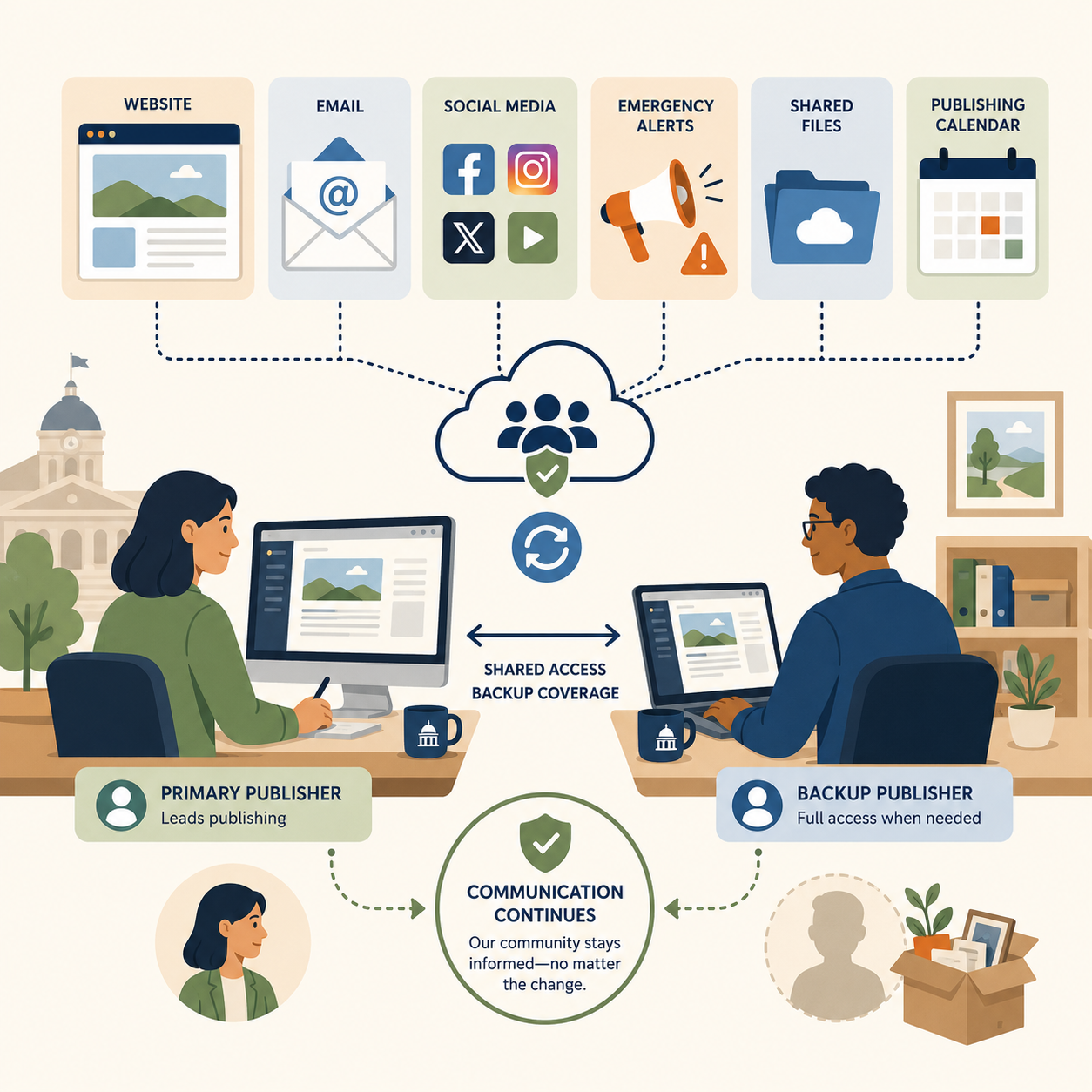 Protecting communication during staff turnover is fundamentally a systems design problem. Agencies that design their communication systems for resilience, with documented processes, shared access, maintained records of open commitments, and structured transition practices, are able to absorb departures without losing communication continuity. Agencies that rely on individual knowledge and informal practices will experience disruption every time a key person leaves, regardless of how capable that person was or how smooth the departure seemed.
Building resilient communication systems during ordinary operations is the most effective preparation for the disruptions that staff turnover inevitably brings. The documentation, the shared access, the transition protocols, and the onboarding structures that protect communication during departures also improve communication quality and consistency during normal operations. The investment pays dividends continuously, not only in moments of transition.
Stegmeier Consulting Group (SCG) helps small and rural governments build communication systems that are resilient, well-documented, and capable of surviving the staff changes that every agency eventually experiences. That work includes communication operations documentation, platform account audits, access management planning, transition protocol development, and onboarding design for communication responsibilities. Whether your agency is facing a near-term departure and needs immediate support or is building proactively for future resilience, SCG can help you design and implement the systems that protect communication continuity over the long term.
Future Trends in Communication Continuity for Small Governments
The challenge of maintaining communication continuity during staff turnover is likely to intensify in the coming years as the number and complexity of communication platforms used by local governments increases. An agency that in 2010 might have managed only a website and a printed newsletter now may be managing a website, a resident notification platform, a Facebook page, a NextDoor presence, an email newsletter, and a digital signage system. Each additional platform is an additional set of credentials, an additional update protocol, and an additional potential point of failure during a staff transition.
Cloud-based communication management tools are likely to play an increasingly important role in managing this complexity. Platforms that centralize multiple communication channels under a single organizational account, rather than requiring separate logins and processes for each, reduce the number of access points that need to be managed and transferred during transitions. As these integrated platforms become more accessible and affordable for small governments, the communication continuity challenge may become more manageable even as the number of channels continues to grow.
The increased availability of documentation and process management tools is also relevant. Platforms that allow agencies to create and share process guides, store access credentials securely, and maintain shared contact lists in an organizational rather than individual format are reducing the barrier to building the communication operations documentation that resilient systems require. Small governments that have historically lacked both the tools and the time to maintain comprehensive communication documentation may find that newer, more intuitive tools make the documentation habit more sustainable.
Finally, shared services arrangements between neighboring local governments may offer a path toward greater communication continuity for very small agencies where even a partially shared communication system represents a significant improvement. Two small townships that share a communication coordinator, maintain a joint template library and contact list, and cross-train each other’s staff on emergency alert procedures each have greater resilience than either could achieve independently. These arrangements require intergovernmental agreement and coordination, but they are a practical direction for agencies whose individual capacity is too limited to build full resilience on their own.
Conclusion
Staff turnover will happen in every local government, and it will always create some disruption. The goal is not to eliminate that disruption but to ensure that it does not extend to the communication systems that residents depend on for information about services, decisions, and emergencies. The practices described in this article, taken together, convert communication from a fragile individual capability into a resilient organizational one that can absorb departures without losing continuity.
The transition from individual to organizational communication capability does not happen overnight, and it does not require a large investment of resources. It requires deliberate attention over time to the documentation, access management, and shared practices that keep communication systems running regardless of who is present on any given day. Agencies that make that investment during ordinary operations will find that staff transitions, while still disruptive in other ways, no longer represent the communication risk they once did.
Residents do not know or care whether a staff departure is what caused a gap in communication. They experience the gap and draw conclusions about the agency based on it. Protecting communication continuity through staff transitions is therefore not just an operational matter. It is a fundamental component of the resident trust that good local government communication builds and maintains over time.
Stegmeier Consulting Group’s Strategic Approach to Communication Systems
Align your agency’s communication systems for long-term resilience.
Small and rural governments need communication systems that can survive the staff changes every agency eventually experiences. Building that resilience requires more than individual commitment. It requires shared documentation, agency-controlled access, structured transition protocols, and onboarding practices that bring new staff into communication responsibilities with the context and tools they need to succeed.
SCG helps public agencies design communication systems that are built for organizational durability rather than individual dependence. Whether your agency is managing a near-term departure or building proactively for a more resilient future, SCG can help you identify the gaps in your current system, build the documentation and structures that fill those gaps, and implement the practices that protect communication continuity through every transition your agency will face.
Use the form below to connect with our team and explore how a resilient communication system can help your agency maintain consistent, trustworthy resident communication regardless of the staff changes that come with any dynamic organization.