
Communication Templates Every Small Town, Village, and Township Needs
Every time a small local government needs to communicate something, it starts from zero. The road is about to close and someone has to figure out what to say. The board is meeting next Tuesday and someone has to write the notice. The utility bill is going up and someone has to find words that will not immediately generate thirty phone calls. Each of these tasks takes time, produces inconsistent results depending on who happens to handle it, and creates room for errors that a template would have prevented. What is missing is not communication ability. What is missing is the reusable foundation that makes communication efficient, consistent, and complete.
Templates solve this problem. Not by writing for staff, but by giving staff a pre-built framework that handles the structural decisions in advance: what information belongs in this kind of message, in what order, and through which channels. A good template is less like a script and more like a form with blanks. It removes the cognitive burden of deciding what a road closure notice needs to contain, leaving only the task of filling in the specific details for the specific situation. That distinction matters enormously in a small government where the person sending the notice is also managing permits, answering phones, and preparing for the next board meeting.
Templates also serve an equity and consistency function that is easy to overlook. When each communication is written from scratch by whoever happens to have time, the quality and completeness of what residents receive varies significantly depending on which staff member wrote it, how much time they had, how comfortable they are with writing, and how much they knew about what information residents actually need. Templates level that variation. A thorough road closure notice produced from a good template by a public works supervisor who is not a writer is more useful to residents than an unstructured message produced ad hoc by a professional communicator who was not sure what to include.
This article identifies seventeen communication templates that serve the most common and recurring communication needs in small towns, villages, and townships. For each template, it explains what information the template should contain, why each element matters, and how the template should be adapted for different channels. The goal is not to be prescriptive about exact wording but to give agencies a clear blueprint for the information architecture of each message type so that templates can be built to fit the agency’s voice and context.
Agencies do not need to build all seventeen templates at once. A practical approach is to start with the five or six types that arise most frequently or that have caused the most problems in the past, build and test those, and add the remaining templates over time. The most important thing is to start, because even one good template for the message type that causes the most difficulty represents a significant improvement over the current approach.
Road Closure and Construction Notice
 The road closure notice is the template most small governments need most often, and it is the one most likely to be sent out incomplete. A notice that says road work will begin on County Road 14 without specifying which segment, which dates, how long the closure will last, whether local access is maintained, where the detour routes, or who to call with questions is technically a notice but practically useless to the residents who depend on that road every day.
A complete road closure template should prompt for the specific road name and location identifiers such as cross streets, mile markers, or distance from a named landmark. It should include the start date, expected end date, and hours of restriction if the work is not continuous. It should explain whether the road will be fully closed or whether traffic will be restricted or alternated in some way. It should identify any detour route in terms residents recognize. It should state whether residents who live on the affected road will have access to their driveways and how. It should explain whether emergency vehicles will have access. It should give a contact number for questions and a location where updates will be posted.
For situations involving contractors, the template should clarify who is responsible for the work and give residents a way to know whether they are speaking to someone who can actually answer their question. A notice that attributes work only to the agency may generate calls that belong to a contractor. A notice that identifies the contractor may shift some of those calls appropriately. The template should include a field for contractor information with a note to include it when available and relevant.
The road closure template should have versions for different channels. The website version can carry full detail. The social media version should be short, name the road and dates prominently, and link to the full notice. The printed version for utility bills or posted notices should be self-contained and not assume internet access. A text alert version should name the road and dates only and point to the website for more.
Engaged & Connected: Communication Strategies for Small Towns, Villages, Townships, and Rural Communities
This article is part of our series on strategic communication for Small Towns, Villages, Townships, and Rural Local Governments. To learn more and to see the parent article, which links to other content just like this, click the button below.
Utility Outage and Disruption Notice
Utility notices carry higher stakes than road closure notices because disruptions to water, sewer, or similar services affect households directly and can create safety concerns. A water outage that lasts more than a few hours is not merely an inconvenience. It affects cooking, hygiene, and for some residents, medical needs. A notice about a utility outage must be fast and accurate, and it must answer the questions residents will immediately ask.
The utility outage template should identify the type of utility affected, the specific geographic area of the disruption, the estimated start and end time, the reason for the outage if it is known, and what residents should expect from the outage itself. For a water outage, should residents expect reduced pressure or no pressure? For a sewer issue, are residents experiencing backups? For a power-related issue, are any city facilities unavailable? The template should include a field for any resident action required, such as boiling water before drinking, conserving water during reduced pressure, or avoiding using toilets during a sewer backup.
The template should also address what is being done to resolve the issue and when the next update will be provided. Residents who have no water and no timeline are more likely to call the office repeatedly than residents who know the crew is on site and an update will come by noon. Setting an update expectation in the first notice is a simple communication practice that significantly reduces inbound call volume during active disruptions.
An all-clear version of the utility outage template is equally important. The all-clear should confirm that service has been restored, should specify whether any residual effects exist such as discoloration or low pressure that may persist temporarily, and should explain whether any follow-up action is needed from residents such as running cold water before drinking or reporting remaining issues to a specific contact.
Public Meeting Announcement
The meeting announcement is one of the most routine communications a small government produces and one of the most commonly done poorly. A notice that satisfies legal posting requirements does not necessarily serve residents who might want to attend a meeting but cannot decipher a formal agenda or find the location and access information they need.
The meeting announcement template should include the date, time, and location of the meeting, with enough detail for a first-time attendee to find the right room in the right building. It should note whether the meeting will include a hybrid or virtual attendance option and provide the link or call-in number if applicable. It should list the major items on the agenda in plain language, not just by their formal file or project numbers. It should note whether any item on the agenda involves a decision that will be made at this meeting, as opposed to a discussion or presentation. It should explain how residents can participate if there is a public comment period and what the process for doing so is.
For meetings that include contentious or high-interest items, the template should include an optional field for a brief plain-language explanation of the item that gives residents enough context to understand why it matters before they arrive. This is not an editorial comment on the item. It is a factual summary that helps residents decide whether they want to attend and what questions they might want to ask.
The meeting announcement should also include the agency’s contact information for residents who have questions before the meeting and a reference to where residents can find the full agenda and supporting materials.
Meeting Recap or Summary
Meeting minutes are legal records and should remain formal, comprehensive, and precise. Meeting recaps are a different document. They are a communication tool designed to help residents who did not attend a meeting understand what happened, what was decided, and what will happen next. Both documents can coexist, and in most small governments the recap significantly expands the community’s actual access to information about governance.
The meeting recap template should include the date and basic identity of the meeting. It should provide a brief summary of each significant item discussed, including the nature of the discussion without recording individual statements unless they are directly material to understanding the outcome. It should clearly identify each vote taken, what was voted on, and the outcome. It should note items that were tabled or postponed and what the next step is. It should explain what follow-up actions will result from decisions made and who is responsible for each.
The recap template should include a field for resident impact, which is the most important element for residents who did not attend. For each major item, the recap should briefly explain what the decision or discussion means for residents’ daily experience, their properties, their services, or their taxes. This is the element that most traditional minutes omit and that most residents are most interested in.
The recap should end with a note about the next regular meeting, any special meetings scheduled, and where residents can find the full official minutes and related documents when they are available.
Ordinance or Policy Change Explanation
When a local government adopts a new ordinance, amends an existing one, or changes a policy that affects what residents and businesses can do, those residents and businesses need more than the official document. They need a plain-language explanation that tells them specifically what has changed, who is affected, what they need to do differently, when the change takes effect, and where to go with questions.
The ordinance or policy change template should begin with the most important fact: what is changing. Not the ordinance number, not the resolution title, not the legal recitation of authority. What is actually different now from what it was before. The template should then explain who is affected in plain terms: all residents, all property owners, commercial properties only, agricultural properties only, properties within a specific zoning district. It should give the effective date and explain whether there is a transition period or phase-in.
The template should include a section on what action, if any, is required from affected residents. If compliance requires registering something, updating a permit, modifying a structure, or adjusting a practice, the template should explain that clearly and give a deadline if one exists. It should also explain what the consequences of noncompliance are and how enforcement will work.
The template should include a contact for questions, a reference to where the full ordinance text is available, and a note about whether any public assistance or guidance sessions are planned to help affected parties understand and comply with the change.
Budget Summary and Resident-Facing Budget Overview
The annual budget is one of the most important governance communications a local government produces and one of the most frequently produced in a format that is completely inaccessible to most residents. A spreadsheet organized by fund and account number, even a correct and complete one, tells residents almost nothing about what they care about: what services will be funded, what is changing from the previous year, how taxes or rates are affected, and what tradeoffs the governing board made in setting the budget.
The budget summary template should translate financial decisions into service language. Instead of reporting that the general fund is increasing by a specific percentage, it should explain what that change means: whether it reflects a new program, more staff, reduced services, deferred maintenance, a one-time expense, or a change in revenue. The template should identify any proposed tax or rate changes and explain in concrete terms what the typical household impact will be.
The template should explain what the top spending priorities are in the coming year and why. It should identify any significant changes from the prior year’s budget, including programs or services being added, reduced, or eliminated. It should explain where the revenue comes from in broad terms that residents understand: property taxes, utility revenues, state-shared funds, grants, reserves.
The budget summary template should be timed to accompany budget hearings so that residents who attend can use it to orient themselves within the more technical discussions. It should also be posted publicly in a format that any resident can access without needing to download a multi-tab spreadsheet.
Rate or Fee Increase Announcement
Utility rate increases, fee changes, permit cost adjustments, and assessment increases are among the most sensitive communications a local government makes, and they are among the communications most likely to generate negative resident reactions when handled poorly. A notice that simply announces a new amount without any context will almost always produce more frustration than necessary, because residents cannot evaluate a number they do not understand.
The rate or fee increase template should identify what is changing and by how much, expressed both as a percentage and as a dollar amount where practical. It should explain what the charge funds and why that service costs what it does. It should identify the specific factors driving the increase: inflation in materials or labor, infrastructure investment, regulatory compliance, contractual obligation, or other concrete reasons. It should explain what alternatives were considered and why the increase was the outcome selected.
The template should give the effective date and, if a phased increase is being implemented, the schedule of changes. It should note any exemptions or assistance programs available to eligible residents. It should explain where residents can ask questions or learn more, and where they can find the formal resolution or documentation if they want to review the underlying decision.
The template should avoid language that minimizes the impact on residents or implies that the cost is small when for some households it is not. Honest communication about a real cost, accompanied by a clear explanation of the reason, is more likely to be accepted than dismissive framing that residents perceive as out of touch with their financial circumstances.
Capital Project Update
Capital projects, including road reconstruction, water main replacement, sewer upgrades, facility renovations, and park improvements, often span months or years and generate sustained resident interest and concern. Residents want to know why the project is happening, how long it will take, what the impacts on their routines will be, how much it will cost and how it is being paid for, and what the outcome will look like. A single announcement at the start of the project is rarely enough to address those needs throughout a construction timeline that stretches across multiple seasons.
The capital project update template should be designed for both the initial project announcement and for ongoing progress updates. The initial template should explain the project need, the scope, the schedule, the funding source, the contractor if selected, the likely community impacts, and how residents can stay informed. It should be specific about the anticipated start and end dates and about what portions of the project may cause disruption.
The progress update version of the template should explain what phase the project is currently in, what has been completed since the last update, what is expected to happen in the coming period, any changes to the schedule or scope, any additional impacts residents should anticipate, and when the next update will be provided. The progress update should be honest about delays when they occur rather than allowing residents to draw their own conclusions from a project that appears to have stalled.
A project completion template should explain what was accomplished, how the final cost compared to the original estimate, when restoration work such as seeding, paving, or landscaping will be complete, any residual conditions residents may notice, and how to report any concerns or damage related to the project.
Emergency Alert
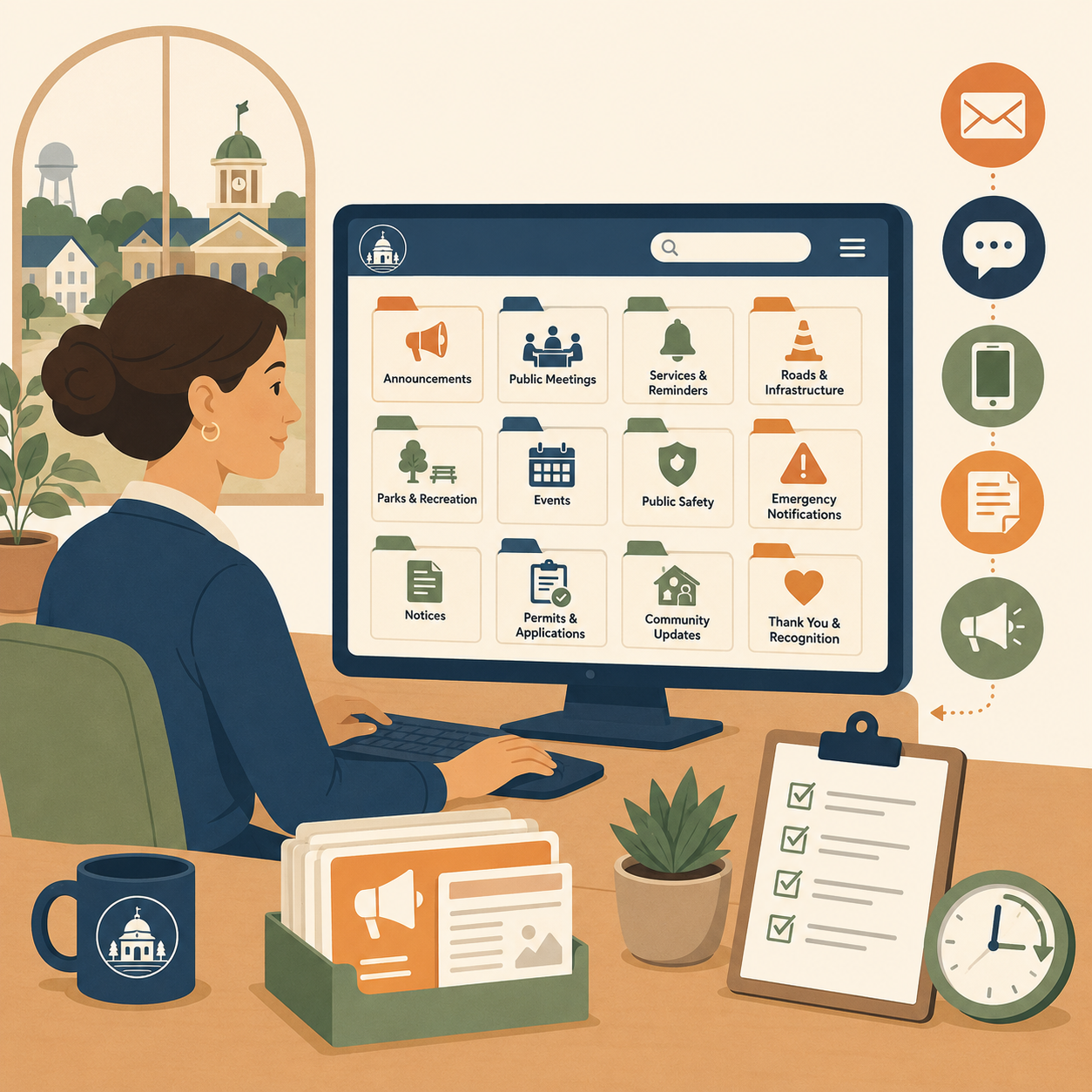 The emergency alert template is the most time-sensitive template a small government will use and the one most likely to be composed under pressure by someone who does not normally write public notices. For that reason, the template should be especially simple and clear, requiring only the specific details to be filled in rather than any structural decision-making.
The emergency alert template should have a clear headline field that names the type of emergency and the affected area. It should have fields for what is happening, what residents in the affected area should do right now, what residents should avoid, and where to get more information. It should include a field for the next expected update time. It should be short enough to function as a text alert but complete enough to answer the most urgent questions residents will have when they receive it.
The template should include a companion field for additional detail that can be posted to the website and social media while the short version goes out by text. That companion version can explain what is known about the cause, what the agency is doing, and what the anticipated timeline is. The two-version approach allows the agency to meet the speed requirement of emergency communication without sacrificing the completeness that some residents will need.
Every small government should have emergency alert templates drafted and stored before an emergency occurs. The worst time to compose an emergency alert template is when the emergency is happening. Even a basic template that covers the three most likely emergency scenarios for the agency, including a utility outage, a road hazard, and a weather event, is far better than no template at all.
Service Change or Reduction Notice
When a local government reduces service hours, eliminates a program, changes how a service is delivered, or otherwise alters what residents have come to expect, the communication must address not just what is changing but why. Residents who receive only the fact of the change without the reasoning behind it are left to speculate, and the explanation they construct on their own is rarely more favorable than the actual one.
The service change template should explain the service being changed, the nature of the change, the effective date, and the reason. For service reductions driven by budget constraints, the template should be honest about the financial context without being either alarmist or dismissive. For service changes driven by operational decisions, the template should explain the intended benefit or improvement, even if the short-term experience involves disruption. For service changes driven by external factors such as contractual changes, regulatory requirements, or partner decisions, the template should explain those factors without blaming external parties in ways that undermine resident confidence.
The template should explain what alternatives exist, if any, for residents who relied heavily on the service being changed. It should provide a contact for questions and a reference to any formal documents, meeting agendas, or board resolutions related to the decision.
Boil Water or Contamination Advisory
The boil water advisory is a specific and high-stakes notice that requires precision, clarity, and speed. Residents need accurate guidance about whether their water is safe to use for drinking, cooking, preparing infant formula, brushing teeth, or making ice. They need to know which households or service areas are affected, how long the advisory is expected to last, and what exactly they should do.
The boil water advisory template should name the affected area as specifically as possible, because advisories that cover a broad geographic description when only a small subset of residents is affected generate unnecessary alarm. The template should explain what precautions residents should take, covering drinking water, cooking, ice, and personal hygiene. It should note any uses for which the water remains safe, such as flushing toilets or watering lawns. It should explain the situation that triggered the advisory without using technical language that confuses rather than informs.
The template should specify when the advisory will be lifted, or if that cannot be determined, when the next update on its status will be provided. It should explain the testing process that will determine when the advisory can be lifted. It should provide a contact for residents who have questions or who report symptoms that may be related to water exposure.
An advisory-lifted template is equally important and is often overlooked. When the boil water advisory is lifted, residents who were following the precautions need to know clearly that it is safe to return to normal use. The lifting notice should also explain any final steps residents should take, such as running cold water from taps for a specified period before resuming normal use.
Office Closure or Hours Change Notice
When a local government office closes for a holiday, an unexpected event, or a planned operational change, residents who planned to conduct business in person need to know in advance. A closure notice that appears only after the resident has already made the trip is a failure of basic consideration. Office closure notices should appear in advance and on every channel where residents are likely to see them.
The office closure template should state which office is affected, when the closure begins and ends, the reason for the closure when appropriate, and whether any services will be available through alternative channels during the closure. It should specify the date when normal operations will resume. For extended closures or significant service interruptions, the template should include alternatives for residents with urgent needs, such as a phone number, email address, or online system that remains available.
For planned holiday closures, the template should be published at least a week in advance on the website and one to two days before the closure on social media and other high-visibility channels. For unexpected closures, the notice should go out as soon as the closure is decided, even if full details are not yet available, with a follow-up update once the situation is clearer.
Agencies that experience planned extended closures, such as during building renovations, emergency repairs, or major operational transitions, should communicate the closure plan in stages rather than with a single advance notice. A first notice well ahead of time, a reminder notice one week before the closure begins, and a notice on the last day before the closure takes effect give residents multiple opportunities to plan ahead and to complete any time-sensitive business before services become unavailable.
The office closure template should also address the question of urgent needs. Even when a building is closed, some residents may have emergency situations that cannot wait until the closure ends. The template should include a field for specifying how residents with truly urgent needs can reach someone, whether that is a phone number, an on-call contact, or a referral to another agency with jurisdiction over the matter. Making that pathway clear in advance reduces the anxiety of residents who are uncertain whether help is available during a closure period.
Request for Public Comment or Community Input
When a local government is seeking resident input on a proposed project, policy, or plan, the communication about that opportunity should give residents enough information to participate meaningfully. A generic invitation to provide feedback on an unnamed proposal to be discussed at an unspecified meeting is not sufficient to generate informed public engagement.
The public comment or community input template should explain what the agency is considering or planning, why resident input is being sought at this stage, what kinds of questions or concerns the agency is specifically interested in hearing about, and how input will be used. It should specify the input period dates, the methods available for submitting input, any formal hearing or meeting that is part of the process, and where supporting documents can be found.
The template should also explain what will happen with the input received. If there will be a public summary of themes, residents should know that. If the input will be presented to the board at a specific meeting, that meeting date should be included. If the input will inform but not determine the final decision, the template should say that clearly so residents do not feel misled when the final decision does not match the most common input received.
A follow-up template for closing out the input period is equally important. After the comment period closes and the agency has analyzed the input, a brief summary of what was heard and how it influenced the final decision or recommendation gives residents confidence that their participation was taken seriously.
Correction or Clarification Notice
Every local government will eventually publish information that contains an error, that becomes outdated by subsequent events, or that was misunderstood by a significant number of residents. How the agency handles those situations tells residents a great deal about its honesty and its respect for their time. A correction notice that is clear, prompt, and non-defensive is one of the most trust-building communications an agency can issue.
The correction notice template should identify the original communication being corrected, state clearly what was incorrect or misleading, provide the accurate information, and briefly acknowledge the error without excessive self-flagellation or defensiveness. The tone should be matter-of-fact and focused on giving residents the right information, not on managing the agency’s image.
The template should include fields for noting where the original incorrect information appeared so that the correction can be posted in the same places. If the original was a social media post, a reply or updated post in the same location helps ensure that residents who saw the original information also see the correction. If the original was a mailed notice, the correction may need to be distributed through channels that reach the same audience.
A frequently underused tool in local government communication is the proactive clarification notice. This is not a correction of a specific error but a response to widespread misunderstanding of accurate information. If a road closure notice was accurate but many residents mistakenly believed it also affected a neighboring road, a clarification notice can address that misunderstanding directly without implying that the original notice was wrong. Distinguishing between corrections, which address actual errors, and clarifications, which address misunderstandings of accurate information, helps maintain the agency’s credibility while still serving residents who need the right information.
Agencies should also have a process for deciding when a rumor or misunderstanding warrants a formal clarification notice versus when it is best addressed by updating the original posting and responding to individual inquiries. Not every piece of misinformation circulating in the community requires a formal agency response. The threshold for a formal clarification should be proportional to the number of residents affected by the misunderstanding, the seriousness of the consequences if they act on incorrect information, and whether the misunderstanding is spreading rather than resolving itself.
Seasonal or Recurring Service Reminder
Many local government services operate on seasonal or cyclical schedules that residents need to anticipate and prepare for. Brush and leaf pickup, road weight restrictions, burn bans, swimming area openings and closings, winter road maintenance protocols, seasonal park hours, and similar recurring services generate predictable communication needs that can be handled with reusable templates updated annually.
The seasonal service reminder template should explain the service, its schedule, any resident action required to prepare or take advantage of the service, and any rules or restrictions that apply. For services that involve resident preparation such as leaf collection, the template should specify how material should be presented for pickup. For services that involve restrictions such as burn bans or weight limits, the template should explain the specific restriction, the reason for it, the dates it applies, and the consequences of noncompliance.
The seasonal reminder template is particularly well-suited to the content calendar approach described in the communication planning context. Each year’s version requires only updating the specific dates, any changes from the previous year, and the contact information. The rest of the template carries forward, significantly reducing the time required to produce a complete and accurate communication.
Partner and Stakeholder Update
Small governments work with a range of external partners: county agencies, utility authorities, school districts, local nonprofits, library boards, volunteer fire departments, emergency management offices, and community organizations that serve the same residents. Keeping those partners informed about local government decisions, projects, and service changes helps ensure that residents get consistent information from every source they trust.
The partner update template should be simple and direct. It should summarize what is happening, who is affected, what action is needed from the partner, and where the partner can find additional information or official materials to share with their own constituents. It should specify whether the partner is being asked to distribute the information actively or simply to be aware of it in case their clients or members ask questions.
The partner update should include a contact name and information for partners who have questions, and it should be timed to reach partners before or simultaneously with the public announcement so that partners are not placed in the awkward position of being asked about something they have not yet heard from the agency.
Partner updates are particularly valuable during budget season, when local governments are making decisions about services that partner organizations help residents access. A library that serves as a distribution point for utility assistance applications, a nonprofit that helps residents navigate building permits, or a senior center that connects residents to local programs all benefit from early notice about changes that will affect what they tell their clients. Including partners in budget-season communication as early as the public hearing process helps those partners prepare accurate information and avoids the situation where residents receive conflicting guidance from the agency and the partners they trust.
The relationship between a small local government and its community partners is built through consistent, respectful communication over time. Agencies that treat partners as genuine extensions of their communication capacity, by providing materials early, acknowledging partner contributions, and keeping partner contacts current and active, will find that partners are more willing and able to support official communication during the moments when it matters most.
Project Need or Study Announcement
Before a capital project is funded, designed, or built, local governments often need to communicate about the problem being studied, the options under consideration, or the need that has been identified. This kind of early-stage communication is frequently neglected, with agencies waiting until a decision is made before informing residents. That approach generates frustration because residents feel that significant decisions were made without their knowledge or input.
The project need or study announcement template should explain what problem or need the agency has identified, what the general range of potential solutions looks like, what stage the process is currently in, when decisions are expected, and how residents will have an opportunity to learn more or provide input. The template should be honest about uncertainty. At the early stage of a study, the agency may not know what the solution will be, and the communication should reflect that honestly rather than implying a direction that has not been determined.
This template type is especially important for projects that are likely to be controversial, expensive, or significantly disruptive. Early communication that acknowledges the need, explains the process, and invites engagement before decisions are made is far more effective at building community understanding than communication that arrives simultaneously with a completed plan that residents have no opportunity to influence.
Emergency Preparedness and Seasonal Hazard Notice
Local governments in small and rural areas are often the primary source of emergency preparedness information for residents who may not be monitoring county or state emergency management channels. Advance communication about severe weather season, flooding risk, winter driving conditions, drought restrictions, wildfire preparedness, and similar seasonal hazards serves residents who need to make household decisions about supplies, evacuation readiness, and property protection.
The emergency preparedness template should explain the specific hazard relevant to the season or geography, what residents should do to prepare, what the agency will do if the hazard materializes, how residents will receive official alerts, and where to find more information. It should include practical, specific guidance rather than general advice that residents cannot act on.
The seasonal preparedness template can be built once and updated annually with current resource information, any changes in the agency’s emergency plans, and specific forecasts or conditions relevant to the coming season. Like the seasonal service reminder, it carries forward efficiently from year to year with modest updates.
Contact Information and Services Directory Update
Resident-facing contact information is among the most practically important information a local government maintains and among the most frequently outdated. Phone numbers change. Staff members leave. Websites migrate. Email addresses are updated. A resident who calls a disconnected number or sends an email to an account that no one monitors has been failed by a simple maintenance gap.
The contact information update template should identify what is changing, when the change takes effect, and what the correct information is. For significant changes such as a new main phone number or a new website address, the template should be distributed through multiple channels and posted prominently on the current website until residents have had reasonable time to update their records. For minor changes such as a staff email address or a department extension, a website update may be sufficient.
The template should include a clear presentation of all current contact information for the agency, not just the item being updated, so that residents receiving the notice can use it as a reference for everything they might need. A simple, cleanly formatted directory of agency contacts embedded in the update is often more useful to residents than a notice that refers only to the single item being changed.
Strategic Communication Support for Small and Rural Governments
 Developing a library of communication templates is one of the most practical ways for small and rural governments to improve communication consistency without significantly increasing staff workload. Well-designed templates reduce the time required to prepare recurring announcements while helping ensure residents receive complete, accurate, and easy-to-understand information during routine operations and unexpected situations alike. The greatest value comes from treating templates as part of a broader communication system rather than as standalone documents.
Successful communication template libraries are built through audience-focused content design, plain-language writing, standardized messaging, defined communication workflows, and ongoing evaluation. Different types of announcements require different information, but residents consistently expect communication that answers their most important questions quickly and clearly. Templates help staff meet these expectations while reducing the likelihood that essential information will be overlooked during time-sensitive situations.
Developing this type of communication system requires specialized expertise in plain-language communication, content strategy, message design, communication governance, workflow development, and communication evaluation. Many small and rural governments choose to partner with external communication specialists such as Stegmeier Consulting Group (SCG) because these capabilities complement the organization’s operational expertise while providing the strategic communication knowledge needed to build template libraries that improve consistency, strengthen resident understanding, and support long-term communication effectiveness.
Working alongside small and rural governments, SCG develops communication template libraries that integrate with broader communication planning efforts. Support may include identifying the highest-priority communication scenarios, developing standardized templates for recurring announcements, establishing plain-language writing standards, defining staff roles and approval workflows, integrating templates into annual communication calendars, and implementing governance practices that keep communication resources accurate, current, and easy for staff to use.
As community needs, communication channels, and organizational priorities continue to evolve, template libraries should evolve as well. SCG helps agencies establish repeatable communication processes, governance practices, and performance measurement frameworks that enable communication templates to remain effective while supporting continuous improvement across departments and communication channels.
The objective is to create a communication environment in which staff can communicate quickly, consistently, and clearly while residents receive the information they need to make informed decisions. By strengthening communication systems through well-designed templates and supporting governance, small and rural governments are better positioned to improve operational efficiency, build public trust, and deliver more reliable communication throughout the year.
Future Trends in Local Government Communication Templates
The role of templates in local government communication is evolving as the channels and tools available to small agencies become more sophisticated and more accessible. Several trends are likely to shape how templates are built and used in the coming years.
One trend is the integration of templates directly into communication platforms. Rather than storing templates as documents that staff copy and modify before publishing, some local government communication platforms now allow templates to be built into the publishing workflow itself. A staff member who logs in to send a road closure notice is presented with a form that mirrors the template structure, with fields for each required element and automatic formatting for different channels. This integration reduces the steps between a draft and a published notice, reduces the likelihood that a staff member will skip a required element, and eliminates the need for manual reformatting for different platforms.
Another trend is the use of plain language tools and AI-assisted drafting to improve template quality and reduce the time required to fill them in. These tools are not yet reliable enough to replace human judgment, especially for sensitive communications, but they can be useful for standardizing language, suggesting simpler alternatives to technical terms, and checking that a completed notice addresses the required information elements.
Accessible and multilingual template development is also becoming a more visible expectation. Agencies that serve communities with significant Spanish-speaking, Vietnamese-speaking, or other non-English-speaking populations are increasingly expected to have templates that have been professionally translated, not just machine-translated, for the most important message types. Building translated versions of the highest-priority templates, such as the emergency alert and the boil water advisory, into the standard template library is a practical and high-impact step that small agencies can take without a large investment.
Finally, resident expectation for visual communication is shaping how templates are designed. Maps attached to road closure notices, photographs of the affected area on project updates, and diagrams showing the scope of a utility outage all improve resident comprehension in ways that text alone cannot achieve. Templates that include optional fields for visual attachments, with guidance on what kind of image is most useful for each message type, help staff think about the visual dimension of communication rather than defaulting to text only.
Conclusion
Templates do not replace the judgment, knowledge, and communication skill that local government staff bring to their work. They support those qualities by handling the structural decisions in advance, ensuring that every communication of a given type contains the information residents need, and reducing the time required to produce a complete and accurate notice. For small governments where communication is a secondary responsibility distributed across staff members who are primarily doing other things, templates are not a nice-to-have. They are an essential piece of communication infrastructure.
The seventeen templates described in this article cover the full range of recurring communication needs in small towns, villages, and townships. Built well, stored accessibly, and used consistently, they can transform a local government’s communication from reactive and inconsistent to proactive, complete, and credible. The investment required to build them is modest. The improvement in resident experience and agency efficiency is significant.
Small governments that build a template library will find that communication becomes less stressful, less time-consuming, and more consistent over time. Staff members who are asked to handle a notice type they have never handled before will find a template that tells them what is needed. Residents who receive notices will find that the information they need is where they expect it to be. The governing board will find that public communication reflects the decisions made at the board table accurately and clearly. All of those outcomes are achievable with templates, and none of them require resources that small governments do not already have.
Stegmeier Consulting Group’s Strategic Approach to Communication Systems
Align your agency’s messaging, responsibilities, and community outreach.
Small and rural governments need communication tools that are practical, reusable, and sustainable within the real capacity of their staff. A template library is one of the most impactful investments a small agency can make in its ability to communicate consistently, completely, and credibly with the residents it serves. Building that library requires understanding what residents need from each type of message, designing templates that prompt for that information reliably, and embedding those templates into the communication workflow so they are actually used.
SCG helps small and rural governments build communication systems that include template development alongside channel strategy, role assignment, and content calendar planning. That integrated approach produces a communication structure that functions as a whole rather than as a set of disconnected tools. Whether your agency needs to start from scratch or to formalize and improve an existing approach to communication, SCG can help you build the foundation that makes consistent, resident-centered communication achievable.
Use the form below to connect with our team and explore how a practical template library and broader communication strategy can help your agency communicate more effectively with the residents who depend on it.