
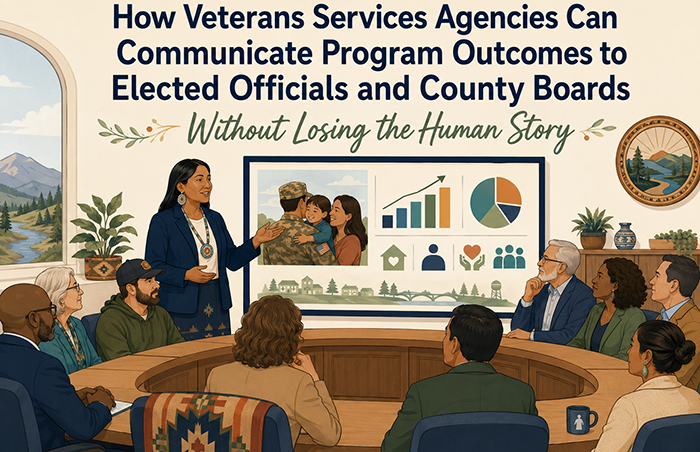
How Veterans Services Agencies Can Communicate Program Outcomes to Elected Officials and County Boards Without Losing the Human Story
Annual reports and program summaries for oversight audiences occupy a paradoxical position in the communication ecosystem of veterans services agencies. They are required, they are read by people with significant influence over the agency’s resources and authority, and they consistently fail to communicate what the agency most needs those readers to understand: not just what the agency did, but what the agency’s work meant. An annual report that presents claim volume statistics, processing time metrics, and budget utilization figures tells an oversight audience what happened in the agency without telling them why it mattered. It accounts for activity without conveying impact. It satisfies the formal requirements of public accountability without producing the understanding that makes oversight audiences genuine advocates for the agency’s work and the veteran population it serves.
Elected officials and county board members who receive agency program summaries are not, for the most part, benefits specialists. They did not spend their careers in veterans services. They may have a general awareness that the agency helps veterans navigate a complex federal system, but they are unlikely to have a specific and vivid understanding of what that help means in the lives of the veterans who receive it, or of what the absence of that help would mean for veterans who are not being reached. Without that specific and vivid understanding, their engagement with the agency’s budget request, staffing needs, and program expansion proposals is likely to be shallow: they will approve what seems reasonable and question what seems excessive, without the deep investment in the agency’s mission that turns an oversight body into an advocacy body.
The communication strategy this article advocates is not about manipulating oversight audiences with emotional appeals that substitute for rigorous program performance data. It is about presenting rigorous program performance data in a way that is anchored in human reality rather than abstracted into statistics that convey scale without conveying significance. A county board member who understands that the agency’s 847 disability compensation claims filed last year represents 847 individual veterans who now have access to financial resources that are changing their families’ economic stability, that 32 of those veterans were on the verge of abandoning their claims when the CVSO intervened and helped them through the process, and that one of those veterans is someone the board member knows from their community, is a board member who is not just informed about the agency’s work but invested in it. That investment is what produces the sustained support, the resource allocation, and the public advocacy that the agency needs from its oversight relationship.
This article provides a comprehensive framework for structuring public accountability communication for veterans services agencies that serves both the quantitative outcome accountability function that oversight bodies require and the human story function that produces genuine engagement and advocacy investment. It covers the analytical foundation of meaningful outcome metrics that go beyond activity counts, the narrative integration framework that connects quantitative data to individual veteran stories without losing the rigor of the data, the communication design for annual reports and program summaries that presents both dimensions effectively, the presentation practices that make oral reporting to oversight bodies engaging and memorable, the specific communication needs of different oversight audiences, and the ongoing communication relationship with elected officials that sustains advocacy investment beyond the annual report cycle.
The communication work described in this article is also, importantly, an equity communication function. When agencies report to their oversight bodies on who their programs are reaching and who they are not reaching, they are creating the accountability structure that drives equity investment. Oversight audiences that hear only aggregate outcome numbers without demographic and geographic breakdowns are not equipped to ask the equity questions that might otherwise drive communication investment in underserved populations. The integration of equity reporting into the outcome communication framework is not only good communication practice. It is good governance practice, creating the oversight accountability that makes sustained equity investment organizationally sustainable.
Building the Quantitative Foundation for Meaningful Outcome Reporting
 Effective public accountability communication for veterans services agencies begins with outcome metrics that are meaningful rather than merely measurable. The distinction is important because most agencies track data that is easy to measure, including numbers of contacts, numbers of claims filed, numbers of applications processed, and processing time averages, without necessarily tracking the data that most directly reflects the impact of their work on veterans’ lives. These activity metrics are not without value, but they describe what the agency did rather than what resulted from what the agency did, and the distinction between activity and outcome is the distinction between an agency that accounts for its effort and an agency that demonstrates its impact.
The most important outcome metric for a veterans services agency is the financial impact of its services on the veterans it has assisted, measured as the aggregate annual benefit dollars secured for veterans through the agency’s claims assistance and benefits navigation work. This metric, sometimes called the return on investment calculation, connects the agency’s activity directly to the financial wellbeing of the veteran community in a way that elected officials and county board members can immediately understand and appreciate. An agency that can credibly report that its work resulted in veterans receiving twenty-seven million dollars in federal disability compensation, GI Bill benefits, and other program payments that flow into the local economy is communicating its financial significance in terms that any elected official can relate to economic development and community investment in ways that claim-count statistics cannot match.
Secondary outcome metrics that add depth to the primary financial impact measure include the number of veterans newly enrolled in VA healthcare, which represents improved healthcare access for veterans who may otherwise have gone without; the number of veterans who accessed mental health services for the first time through agency referrals, which represents a crisis prevention and wellbeing impact that may not be fully captured in financial metrics; the number of veterans who avoided housing instability or homelessness through agency assistance; and the number of veterans from underserved populations, including women veterans, veterans of color, and rural veterans, who accessed benefits through the agency’s targeted outreach efforts. Each of these secondary metrics adds a dimension of impact that the primary financial metric does not capture and that enriches the overall picture of what the agency’s work produces.
Process metrics, including the average time from initial contact to first benefit access, the rate at which claims filed by the agency’s CVSO clients are approved relative to national or state averages, and the proportion of veterans who successfully complete their benefit access process relative to those who initiate it, provide evidence of the quality and effectiveness of the agency’s service delivery that adds important context to outcome metrics. An agency whose claim approval rate significantly exceeds the national average is demonstrating that its preparation and documentation work adds value to the claims process, and this demonstration is persuasive to oversight audiences who want to know whether the agency is using its resources effectively rather than simply showing activity volume.
Geographic and Demographic Outcome Disaggregation
Aggregate outcome metrics tell oversight audiences what the agency accomplished overall but do not tell them whether the agency is serving the full veteran population equitably or whether specific communities and demographic groups are being underserved. Geographic and demographic disaggregation of outcome data, presenting outcomes by county, by service era, by gender, by race and ethnicity, and by program category, provides the granular picture that equity accountability requires and that increasingly sophisticated oversight audiences expect.
County-level outcome reporting is particularly valuable for county board oversight because it allows board members to see what the agency’s work is producing in their specific geographic area and whether their constituent veterans are being served at rates comparable to veterans in other areas. A county board member who can see that veterans in their county filed disability compensation claims at significantly lower rates than veterans in the neighboring county, and who hears the agency’s explanation of what communication and access barriers are producing that difference and what the agency is doing to close it, is an engaged oversight partner who understands the equity challenge and has a specific, locally relevant stake in its resolution.
Demographic disaggregation of outcomes enables the equity reporting function that is increasingly required by the policy environment and increasingly expected by oversight audiences who are attending to equity in public service delivery. Presenting outcome metrics by gender, race, ethnicity, and veteran population category alongside the agency’s analysis of gaps and the communication responses designed to address them demonstrates the organizational sophistication and equity commitment that builds oversight confidence in the agency’s leadership and management. Oversight audiences that hear only aggregate outcomes without demographic analysis are not equipped to assess the equity of the agency’s service delivery, and providing the demographic analysis proactively rather than waiting to be asked demonstrates accountability that builds rather than undermines oversight trust.
Serving Those Who Served: Communication Strategies for Veterans Agencies
This article is part of our series on strategic communication for Veterans Services Agencies, County Veterans Services Offices, State Departments of Veterans Affairs, and community-based veteran support organizations. To learn more and to see the parent article, which links to other content just like this, click the button below.
The Narrative Integration Framework
Quantitative outcome data provides the evidence of what the agency accomplished. Human stories provide the understanding of what that accomplishment meant. Neither dimension alone produces the accountability communication that serves the full range of oversight audience needs. Quantitative data without human stories is credible but not memorable, rigorous but not compelling, complete in its accounting for activity but incomplete in its communication of significance. Human stories without quantitative data are emotionally resonant but not analytically grounded, compelling in their individual specificity but unable to demonstrate scale, representative quality, or equitable reach. The integration of quantitative data and human stories in a coherent communication framework is the design challenge that effective public accountability communication must solve.
The narrative integration framework that is most effective for veterans services annual reports and program summaries treats individual veteran stories as entry points into the quantitative data rather than as supplements to it. Each story is introduced with the human specificity that makes it memorable and meaningful: a name if the veteran has consented to be named, or a first name and brief characterization if they have not; the veteran’s service background in the briefest possible terms that establish their veteran identity; the specific situation they were in when they first contacted the agency; and the specific outcome they achieved through the agency’s assistance. From this human entry point, the report or summary expands to the quantitative context that situates the individual story within the agency’s broader impact: this veteran is one of 847 veterans who filed disability compensation claims through the agency last year, claims that collectively resulted in veterans receiving over twelve million dollars in annual compensation that flows into the county economy.
The transition from individual story to aggregate data is the critical architectural element of the narrative integration framework, and it must be handled with care to produce the intended effect of grounding the data in human reality without losing the rigor of the data. The transition should be explicit and direct rather than oblique, using connecting language that specifically links the individual case to the aggregate and that tells the reader why the individual case is a meaningful representation of the broader pattern. The transition is not a device for making the data more engaging. It is an expression of the genuine relationship between the individual’s experience and the population-level impact that the data describes.
The selection of individual stories for inclusion in accountability communication requires ethical standards and practical criteria. Ethically, veterans whose stories are used in public accountability communication must have provided informed consent for the specific use of their story in that specific context, including understanding that the communication will be presented to elected officials and potentially made part of the public record. The consent process should be transparent about how the story will be presented, who will see it, and what identifying information will and will not be included. Veterans who provide consent should have the opportunity to review the story as it will be presented before it is finalized, and should have the right to withdraw consent at any point before the communication is distributed.
Practically, stories should be selected to represent the diversity of the veteran population the agency serves, including veterans from different service eras, demographic backgrounds, and geographic areas, rather than defaulting to the most dramatic or most familiar types of veteran story. An accountability communication that exclusively features combat veterans whose stories emphasize military heroism and battlefield injury is not accurately representing the full range of the agency’s work or the full diversity of the veteran population it serves. Stories that represent women veterans, veterans of color, Guard and Reserve veterans, rural veterans, and veterans accessing programs beyond disability compensation, provide a more complete and more accurate picture of the agency’s mission and its implementation.
The Composite Story Approach
When individual veteran consent is not available or when the level of personal detail required to make a story compelling would create privacy risks even without identifying information, the composite story approach provides a narrative alternative that combines characteristics from multiple similar cases into a single illustrative story that is accurate in its representation of the type of case and the type of outcome without being the account of any specific individual. A composite story that describes the experience of a typical Guard and Reserve veteran navigating PACT Act eligibility for the first time, drawing on the actual patterns observed across many such veterans, is both ethically protective of individual privacy and representative of the real population of veterans in that category.
Composite stories should be labeled clearly as composites that represent the experience of many veterans rather than any specific individual. This transparency is important for both ethical and credibility reasons: oversight audiences who discover that a story presented as a specific individual is actually a composite may feel misled in ways that damage their trust in the agency’s communication integrity more broadly. Labeling composites accurately and explaining why composite stories are being used, typically because the number of individual veterans in the represented category is small enough that even anonymized stories could identify specific individuals, maintains the communication integrity that is essential for sustained oversight trust.
Annual Report Structure and Design
 The structure and design of a veterans services agency annual report for oversight audiences should serve the dual purpose of satisfying formal accountability requirements and producing genuine engagement with the agency’s work. These two purposes are not inherently in conflict, but they are in tension when the default structure for agency annual reports, which is determined by formal reporting requirements, is not optimized for engaging narrative communication. Agencies that design their annual reports exclusively to satisfy formal accountability requirements will produce documents that are complete but not compelling. Agencies that design reports that satisfy formal requirements while also incorporating narrative integration and human story elements that produce genuine engagement will produce documents that fulfill both purposes.
The opening section of an annual report for elected officials and county board members should immediately establish the human significance of what follows. A brief, specific, and emotionally grounded account of what the agency’s work meant to veterans in the past year, presented in the form of a single compelling story or a brief narrative panorama of the year’s work, sets the tone for the entire document and prepares the reader to engage with the data sections that follow with the human context already established. An opening that begins with statistics and program descriptions, without first establishing the human stakes, is an opening that loses the reader’s emotional engagement before the substantive content begins.
The data sections of the annual report should present outcome metrics with the geographic and demographic disaggregation described in the previous section, organized around the impact dimensions most relevant to the oversight audience. For a county board, the most relevant impact dimensions are likely to be the financial impact on veterans and the local economy, the geographic distribution of services across the county, and the equity of service delivery across the county’s veteran population. Each data section should be accompanied by brief narrative context that explains what the numbers mean, why they matter, and what trends they represent, rather than presenting numbers alone and expecting the reader to interpret them without guidance.
An equity section that presents the agency’s demographic and geographic gap analysis alongside the communication responses designed to close those gaps is an increasingly important element of annual reports for oversight audiences that are attending to equity in public service delivery. This section should present gap data honestly, naming the populations and areas where the agency is not reaching veterans at rates commensurate with their eligible population, and should present the agency’s gap-closing communication strategy specifically and credibly. The equity section demonstrates organizational accountability for equity that builds oversight confidence and that establishes the basis for equity-related resource requests in the budget section of the report.
A forward-looking section that identifies the communication and program priorities for the coming year, grounded in the gap analysis and outcome data from the past year, provides the oversight audience with a basis for evaluating the agency’s strategic planning and for providing guidance or support for specific priorities. This section should be specific enough to convey genuine planning depth without being so operational that it is beyond the scope of what an oversight audience can meaningfully engage with. The most effective forward-looking sections identify two or three specific priorities with clear rationales grounded in past year data, specific planned actions, and specific projected outcomes that will be reported in the following year’s accountability communication.
Visual Design for Accountability Communication
The visual design of annual reports and program summaries for oversight audiences affects both their accessibility and their effectiveness in communicating the quantitative and narrative content they contain. Accountability communications that are visually dense, with small text, complex tables, and minimal white space, are less accessible and less engaging than those that use visual design to organize and present information in ways that support efficient reading and quick orientation to key content.
Data visualization, the presentation of quantitative data in chart, graph, and infographic formats rather than exclusively in tabular formats, significantly improves the accessibility of outcome data for oversight audiences who are not accustomed to reading and interpreting dense statistical tables. A bar chart showing county-level claim volume disaggregated by program type is more immediately intelligible to a county board member than a table with the same data, because the visual format communicates patterns and comparisons instantaneously rather than requiring the reader to extract those patterns from numerical data through mental comparison. Effective data visualization for oversight audiences is simple and direct, prioritizing the clarity of the key finding over the completeness of the underlying data.
Photography and visual storytelling in accountability communications can carry the human story function with particular power when the images are authentic and specific rather than generic stock photography that could represent any agency or any veteran population. Photographs of the agency’s actual staff, actual CVSO offices, and actual community outreach activities convey the reality of the agency’s work in ways that generic imagery cannot, and photographs of veterans who have consented to be photographed in connection with their stories add the human presence to the accountability communication that data alone cannot provide. Photo captions should carry narrative content that extends the story function of the images rather than simply labeling what is depicted.
Oral Reporting to Oversight Bodies
The oral presentation of program outcomes to county boards, legislative committees, and other elected oversight bodies is a communication format that is distinct from written annual reports in its immediacy, its interactivity, and its potential for genuine relationship building between the agency and its elected overseers. Oral reporting that is organized as a reading of the written annual report, without the adaptations that make oral communication effective, misses the specific opportunities that the direct communication context provides and produces a communication experience that is less engaging and less productive than either a well-designed written report or a genuinely interactive oral presentation.
Effective oral reporting to oversight bodies uses the annual report data as a foundation but is not structured as a recitation of that data. Instead, it uses selected data points as anchors for brief, specific, and memorable narrative illustrations that make the data meaningful to an audience that is listening rather than reading. An oral presentation that tells a thirty-second story about a specific veteran’s experience before presenting the relevant aggregate data produces a connection between the individual and the population that a purely numerical presentation cannot achieve and that an oral format is uniquely positioned to exploit.
Interactive elements in oral presentations to oversight bodies, including brief Q-and-A opportunities, specific invitations for board members to share what they are hearing from veterans in their districts, and direct questions about the board’s priorities for the coming year that the agency might address through its communication and program strategy, convert the oral presentation from a one-directional report into a genuine dialogue that builds the agency-oversight relationship while also providing valuable community intelligence that the agency can use in its communication planning.
The verbal framing of data during oral presentations should be specific about what the numbers represent rather than presenting them as abstract statistics. A board member who hears ‘847 claims’ does not necessarily connect that number to 847 individual veterans whose financial situations were improved by the agency’s work. A board member who hears ‘847 veterans, each of whom came to our office with a specific need and left with a specific plan for accessing benefits they had earned,’ is receiving the human context that makes the number meaningful. This contextual framing does not add time to the presentation if it is built into the script rather than added as a supplement to it.
Managing Difficult Data in Oversight Communication
Oversight communication that presents only positive outcomes and elides gaps, failures, and areas for improvement is not honest accountability communication and will not be received as such by oversight audiences with any sophistication. County board members and elected officials who encounter accountability communications that present uniformly positive pictures without acknowledging challenges are likely to be skeptical of the entire communication rather than simply of the specific claims that seem too positive to be credible. Honest acknowledgment of gaps and challenges, presented alongside specific plans for addressing them, produces more sustained oversight confidence than communications that appear to be advocacy for the agency rather than accountability to the public.
The framing of difficult data in accountability communication is important: the same facts can be communicated in ways that are honest about challenges while also conveying confidence in the agency’s capacity to address them. A presentation that says ‘Our analysis shows that we are not reaching women veterans in our county at rates commensurate with their estimated eligible population, and this is a gap we have identified as a priority for targeted communication investment in the coming year, with specific planned activities and measurable targets,’ is honest about a challenge, demonstrates analytical awareness, and communicates a specific plan for improvement that asks for oversight support rather than simply reporting a failure without a response.
Building an Ongoing Communication Relationship With Elected Officials
The annual report is the most formal and most comprehensive communication between veterans services agencies and their elected oversight bodies, but it is not the most effective communication for building the sustained understanding and advocacy investment that produces the most valuable oversight relationship. Elected officials who hear from the agency only once a year, in a formal reporting context that is organized around accountability rather than relationship building, develop a thinner relationship with the agency’s work and its veteran community than officials who receive periodic brief communications about the agency’s work throughout the year and who are engaged as genuine partners in the agency’s mission rather than only as its formal overseers.
Periodic brief updates to elected officials, shorter and less formal than the annual report but consistent and substantive, maintain awareness of the agency’s work between annual reporting cycles and provide the context in which the annual report is received as a continuation of a familiar story rather than as an annual data delivery. A brief monthly email to county board members that highlights one veteran story and one program statistic, totaling no more than two hundred words and requiring no more than two minutes to read, keeps the agency’s work present in the official’s awareness and builds the gradual accumulation of understanding that makes the annual report’s comprehensive data more meaningful and more persuasive.
Invitations to specific agency events and community activities provide elected officials with direct exposure to the agency’s work that is qualitatively different from any written or oral report. A county board member who attends a veterans resource expo, who sees the agency’s staff working with veterans across multiple agencies to make substantive service connections, and who has a brief conversation with a veteran whose disability claim the CVSO assisted, has developed a direct understanding of the agency’s work that informs their engagement with the agency’s program reports and resource requests in ways that no communication can fully substitute for. Creating opportunities for this direct exposure, and making attendance easy and meaningful for elected officials whose schedules are demanding, is a relationship investment that produces returns that are visible in the quality and depth of the oversight body’s engagement with the agency’s work.
Strategic Communication Support for Veterans Services Agencies
 Public accountability communication requires more than producing annual reports or presenting performance updates to governing bodies. Effective accountability communication helps elected officials, county boards, and other oversight partners understand how agency resources are being used, the outcomes being achieved for veterans, and the opportunities that exist to strengthen services. When communication is clear, evidence-based, and focused on meaningful results, it builds confidence in the agency’s mission while supporting informed decision-making.
Successful public accountability communication is built through performance reporting, audience-focused message development, data visualization, narrative storytelling, presentation planning, and ongoing evaluation. Oversight audiences need more than operational data. They need communication that explains why program outcomes matter, how investments improve veteran wellbeing, and where future opportunities exist. Presenting information in a structured, accessible, and engaging format helps agencies strengthen transparency while fostering stronger relationships with the officials responsible for governance and funding decisions.
Developing this type of communication system requires specialized expertise in communication strategy, performance reporting, executive messaging, data presentation, content design, and communication evaluation. Many veterans services agencies choose to partner with external communication specialists such as Stegmeier Consulting Group (SCG) because these capabilities complement the agency’s expertise in veterans programs while providing the strategic communication knowledge needed to develop accountability systems that strengthen transparency, improve stakeholder understanding, and build long-term confidence in the agency’s work.
Working alongside veterans services agencies, SCG develops communication strategies that improve how agencies report performance to oversight audiences. Support may include developing annual reports and executive summaries, designing presentation frameworks for county boards and elected officials, translating complex performance data into clear communication, creating visual reporting standards, establishing messaging that connects program outcomes to community impact, and implementing measurement systems that continuously improve accountability communication over time.
As reporting requirements, community expectations, and agency priorities continue to evolve, accountability communication must remain accurate, relevant, and responsive. SCG helps agencies establish repeatable communication processes, governance practices, and performance measurement frameworks that enable public reporting to remain consistent across reporting cycles while strengthening relationships with oversight partners and supporting long-term organizational credibility.
The objective is to create a communication environment in which oversight bodies clearly understand the agency’s impact, recognize the value of its programs, and have confidence in its stewardship of public resources. By strengthening public accountability communication systems, agencies are better positioned to build trust, support informed decision-making, and demonstrate the measurable value of the services they provide to veterans.
Future Trends in Public Accountability Communication
The public accountability environment for government agencies is evolving in ways that will increase both the complexity and the importance of effective outcome communication for veterans services agencies. The growing emphasis on equity in government service delivery is producing new expectations for demographic and geographic disaggregation of outcome data that will require agencies to develop more sophisticated data systems and more nuanced reporting frameworks than have historically been expected. Oversight bodies that are increasingly attentive to equity in public service will expect not only aggregate outcome data but evidence that programs are reaching all segments of the eligible population equitably, and agencies that have built the data infrastructure and analytical capability for this reporting will be better positioned to meet these expectations than those that have not.
Digital accountability communication is becoming increasingly important as government agencies develop online reporting platforms that make program outcome data publicly accessible beyond the formal oversight context. Veterans services agencies that publish their outcome data, including demographic and geographic disaggregation, on accessible public dashboards or websites are making their accountability communication available to a much broader audience than the formal oversight body, including veterans themselves, community organizations, journalists, and researchers whose engagement with the data can produce both public understanding of the agency’s work and external accountability for the equity of its service delivery.
The integration of storytelling with data in public accountability communication is a trend that is growing across the public sector as agencies recognize that data without narrative does not produce public understanding and that narrative without data does not produce public accountability. The balanced integration of both dimensions, which this article has described as the narrative integration framework, is becoming the recognized standard for effective public sector accountability communication, and agencies that develop this capability will be both better positioned to meet emerging expectations and better able to build the genuine public investment in their mission that makes their work sustainable over time.
Conclusion
The veterans services agency that reports to its oversight body with both rigorous outcome data and the human stories that make that data meaningful is doing more than fulfilling an accountability obligation. It is building the understanding, the relationship, and the advocacy investment that sustains the agency’s capacity to serve veterans over time. It is showing elected officials not just what the agency accomplished but what that accomplishment meant, and it is asking them to be partners in continuing and expanding work whose significance they now genuinely understand. That understanding, built through communication that never loses sight of the human story behind every statistic, is the foundation of the oversight relationship that every veterans services agency needs to do its work well.
SCG’s Strategic Approach to Communication Systems
Stegmeier Consulting Group’s public accountability communication work with veterans services agencies is grounded in the belief that the most effective accountability communication is also the most honest, and that honesty includes both the rigor of accurate outcome data and the fullness of human stories that make the data meaningful. An agency that can do both, that can walk an oversight audience through the numbers and then walk them through the veteran whose life those numbers represent, is an agency that is building the kind of oversight relationship that produces sustained advocacy rather than periodic scrutiny. SCG helps agencies develop the analytical frameworks, the narrative integration skills, and the communication design capabilities that make this kind of accountability communication possible and sustainable.
Use the form below to connect with our team and explore how strategic public accountability communication can help your agency strengthen transparency, improve stakeholder understanding, and demonstrate the impact of its services for veterans.