
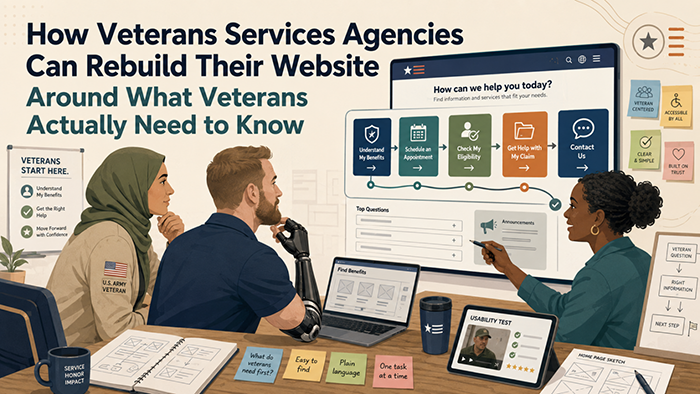
How Veterans Services Agencies Can Rebuild Their Website Around What Veterans Actually Need to Know
The website of a veterans services agency is, for a growing proportion of the veterans it serves, the first and most frequent point of contact with that agency. Veterans who are beginning to explore what benefits might be available to them, who have a specific question about a program they have heard about, who want to check on the status of a service, or who need to find a phone number or an address to continue a process they have already begun, turn to the agency’s website as the primary information resource. The quality of the website experience they encounter determines whether they get the information they need, conclude that the information is unavailable or inaccessible, or leave the site frustrated without having found what they came for.
Most veterans services agency websites are organized around the agency’s internal structure rather than around the veteran’s information-seeking experience. The navigation reflects the agency’s program categories and administrative divisions. The content is written in the language of program descriptions and eligibility criteria rather than in the language of veteran questions. The contact information is presented in institutional hierarchy rather than in terms of what specific questions each contact can answer. And the site’s overall architecture is designed to tell veterans about the agency rather than to help veterans accomplish the specific tasks they came to the site to do. This organizational logic serves the agency’s self-presentation needs but fails the veteran’s information-seeking needs in ways that have direct and measurable consequences for benefit access.
Rebuilding a veterans services website around what veterans actually need to know is not primarily a visual redesign project. It does not require a new content management system, a significant budget for web development, or a professional design agency. It requires a fundamental reconception of the organizing logic of the site, shifting from agency-internal structure to veteran-question logic. This reconception is an analytical and communication design challenge before it is a technical challenge, and the analytical and communication work of understanding what veterans are trying to accomplish on the site, what questions they are asking, and what information they need to accomplish those tasks, is the foundational investment from which all other website improvement work follows.
This article provides a step-by-step framework for undertaking this website reorganization, covering the analytical work of understanding current user behavior and information needs, the structural redesign of site navigation around veteran question logic, the content design of individual pages to serve the veteran’s specific information-seeking purpose, the contact accessibility design that makes it easy for veterans to reach the right person at the agency, and the search engine optimization strategy that ensures veterans who are searching for benefit information online are finding the agency’s resources rather than less authoritative or less accurate sources. The framework is designed for agencies at any level of current website sophistication and is intended to be implementable with modest technical resources.
The practical stakes of website quality for veteran access are higher than many agencies recognize. Veterans who cannot find information on an agency website do not typically persevere until they find it through another channel. They conclude that the information is either not available or not for them, and they disengage. Veterans who encounter confusing navigation, jargon-heavy content, and buried contact information at the agency’s digital front door receive a communication about the agency’s relationship to their needs that is often more influential than any specific program information the site contains. A website that communicates through its architecture that the agency was designed to serve organizational needs rather than veteran needs produces an initial impression that works against every specific outreach effort the agency makes to build trust and connection with the veteran community.
Understanding How Veterans Currently Use the Agency Website
 Before redesigning a veterans services website, agencies must understand how veterans are currently using the existing site. This understanding is the empirical foundation for all subsequent redesign decisions, and without it, redesign will reflect the agency’s assumptions about what veterans need from the site rather than evidence about what veterans are actually trying to accomplish and where the current site is failing to help them do it. Website analytics tools, which are available at no cost through platforms like Google Analytics, provide a significant amount of actionable data about current site usage that most agencies are not systematically analyzing.
The most immediately useful analytics data for website redesign purposes includes the pages that veterans visit most frequently, the pages where veterans spend the least time before leaving the site, the navigation paths that veterans take through the site from their entry point to the pages they are trying to reach, the search terms that veterans are entering into the site’s internal search function, and the proportion of site visits that occur on mobile devices. Each of these data types reveals something specific about how veterans are experiencing the current site and where the current experience is failing them.
High-traffic pages tell the agency what information veterans are most frequently seeking when they visit the site. If the most visited pages are consistently those covering disability compensation eligibility and healthcare enrollment, those are the topics around which the site’s navigation and content quality should be most rigorously optimized. Low-dwell-time pages, where veterans arrive and leave almost immediately, indicate pages where the content is either not what the veteran expected when they navigated there or is not accessible enough to engage with productively. These pages deserve specific attention in the content redesign process.
Navigation path analysis reveals whether veterans are finding the information they need through the navigation paths the site provides or whether they are taking circuitous routes that suggest navigation confusion. A veteran who visits the site’s homepage, clicks through three menu levels to reach the disability compensation page, and then navigates back to the homepage and tries a different path to reach the same page, has demonstrated that the current navigation structure is not mapping onto their mental model of how the site should be organized. This behavioral evidence is more reliable than attitudinal survey data about what veterans find confusing, because it reflects actual navigation decisions rather than retrospective self-reports.
Search terms from the site’s internal search function are particularly valuable data because they reveal what veterans are looking for when they cannot find it through the navigation structure. Search terms like ‘Guard and Reserve eligibility,’ ‘property tax exemption apply,’ ‘VA healthcare enrollment difference,’ and ‘disability claim status’ are veterans telling the agency exactly what information they need and where the navigation structure has failed to get them there. These search terms should be treated as a prioritized content and navigation improvement agenda: each recurring search term identifies either a content gap that should be filled or a navigation failure that should be corrected.
User Research Methods for Website Redesign
Website analytics provide behavioral evidence about current site usage, but they do not explain the motivations, the mental models, or the specific unmet needs that produce the behavioral patterns the data reveals. User research methods, including structured usability testing, one-on-one interviews with veterans about their website experience, and card sorting exercises that reveal how veterans categorize benefit information, provide the motivational and conceptual evidence that behavioral data alone cannot supply.
Usability testing for a veterans services website can be conducted with a small number of representative veteran participants at modest cost and produces evidence that is directly actionable for navigation and content redesign. In a usability test, a veteran participant is given a specific task to accomplish on the website, such as finding out whether they qualify for property tax exemption or locating the phone number for the CVSO office in their county, and their process of attempting the task is observed and recorded. The points at which they hesitate, take wrong turns, express confusion, or give up without completing the task reveal the specific navigation and content failures that are preventing task completion for the broader veteran population.
Card sorting exercises, in which participants sort a set of benefit topics and program names into categories that make intuitive sense to them, reveal how veterans conceptually organize the information landscape they encounter on a veterans services website. When the categories that veterans create in a card sort exercise are compared to the categories currently used in the site’s navigation structure, the gaps between veteran mental models and agency organizational logic become visible in a directly actionable way. Navigation categories that make sense to the agency but that veterans consistently place in different conceptual categories than the site suggests are candidates for reorganization in the redesign.
One-on-one interviews with veterans about their experiences using the agency’s website, including both successful and unsuccessful attempts to find information, provide the richest qualitative evidence about the website experience. Veterans who describe their navigation experience in their own words reveal the specific points of confusion, the specific assumptions that were violated by the site’s behavior, and the specific information needs that the site failed to address, in language that is directly useful for content redesign. These interviews should include veterans from the full range of demographic groups the agency serves, with specific attention to veterans who are less digitally confident or who access the internet primarily through mobile devices, because these groups are most likely to face accessibility barriers that optimized desktop users would not encounter.
Serving Those Who Served: Communication Strategies for Veterans Agencies
This article is part of our series on strategic communication for Veterans Services Agencies, County Veterans Services Offices, State Departments of Veterans Affairs, and community-based veteran support organizations. To learn more and to see the parent article, which links to other content just like this, click the button below.
Redesigning Navigation Architecture Around Veteran Question Logic
The most fundamental change in a veteran-centered website redesign is the reorganization of the site’s navigation architecture from agency-internal structure to veteran-question logic. This reorganization requires setting aside the agency’s organizational chart and program categories as organizing principles and replacing them with the questions and tasks that veterans are actually bringing to the site. The new architecture should make it possible for a veteran who is asking a specific question, whether that question is ‘Do I qualify for VA healthcare?’ or ‘How do I appeal a disability rating decision?’ or ‘What state benefits are available to me beyond federal programs?’, to navigate directly to the content that answers that question without requiring specialized knowledge of how the agency is organized.
The first step in redesigning navigation architecture is developing a comprehensive inventory of the questions that veterans are asking when they visit the site. This inventory draws on the analytics data, the usability research, and the inquiry patterns from CVSO intake data described in earlier sections of this article, and it should be comprehensive enough to represent the full range of questions that the site needs to answer. The inventory will typically reveal that veterans’ questions cluster around a small number of core themes, including eligibility assessment, benefit description, application process, claims status, and contact and appointment access, and these themes should be the primary organizing categories of the redesigned navigation structure.
Eligibility-centered navigation is particularly important for veterans services websites because eligibility assessment is the first and most critical question veterans must answer before any other information about a program is useful to them. A navigation structure that presents program eligibility information prominently and accessibly, and that provides eligibility assessment tools that allow veterans to determine whether a program is likely relevant to them before they invest time in reading detailed program descriptions or navigating application processes, serves the veteran’s information-seeking sequence far more effectively than a structure that buries eligibility information within comprehensive program descriptions.
Question-based navigation labels, which describe what the navigation item helps the veteran accomplish rather than what program or organizational unit it represents, significantly improve navigation effectiveness for veterans who do not know the agency’s internal organization. A navigation label like ‘Find out if you qualify’ is more effective than a label like ‘Eligibility Criteria’ for a veteran who is trying to assess their eligibility, because it maps directly onto the task the veteran is trying to accomplish rather than onto the agency’s categorization of the same information. Similarly, ‘Get help with your claim’ is more effective than ‘Claims Assistance,’ and ‘Understand your rating decision’ is more effective than ‘Rating Appeal Information,’ because the question-framed labels meet the veteran at their specific task rather than at the agency’s program description.
Mobile-First Design Requirements
A growing proportion of veterans, and a particularly high proportion of younger veterans and veterans accessing information in contexts away from home, access websites on mobile devices rather than on desktop computers. A website that is designed for desktop viewing and adapted for mobile as an afterthought produces a mobile experience that is significantly inferior to the desktop experience, with text that is too small to read without zooming, navigation elements that are difficult to tap on a touchscreen, and content layouts that break down on small screens. Veterans who access the agency’s website on mobile devices and encounter these barriers receive a communication that the agency’s digital infrastructure was not designed with their access needs in mind.
Mobile-first design reverses the traditional design sequence, beginning with the constraints and capabilities of the mobile experience and building the desktop experience as an enhancement of the mobile foundation rather than as the primary design target. Mobile-first design for a veterans services website requires that navigation be accessible through mobile-friendly menus rather than desktop hover states, that text be large enough to read without zooming on a standard smartphone screen, that contact information including phone numbers be click-to-call rather than requiring manual dialing, that forms be optimized for touchscreen input, and that the most critical information is accessible without excessive scrolling or tapping through multiple menu levels.
Performance optimization for mobile access is particularly important for veterans in areas with limited bandwidth, including rural veterans and veterans accessing the site on mobile data connections rather than WiFi. Pages that load slowly on low-bandwidth connections drive users away before they have accessed any content, and the performance optimization required to serve low-bandwidth users well, including image compression, minimal use of heavy scripts, and efficient page architecture, benefits all users while specifically serving those with the most constrained access conditions.
Content Design for Veteran Information Needs
The content of individual pages on a veterans services website must be designed as answers to the specific questions that veterans are asking when they navigate to those pages, rather than as comprehensive descriptions of the programs those pages address. This distinction in content design philosophy produces fundamentally different documents: a program description documents what a program is and how it works, organized around the program’s administrative logic; a veteran question answer tells a veteran what they specifically need to know to accomplish the specific task they came to the page to accomplish, organized around the veteran’s task logic.
The most effective content design framework for veteran-centered website pages begins with the question the page is designed to answer, states the answer to that question directly and clearly in the first paragraph, provides the supporting detail necessary to substantiate and contextualize the answer in subsequent paragraphs, and concludes with a clear call to action that tells the veteran what to do next if the page content is relevant to their situation. This framework produces pages that serve veterans who read quickly and scan for key information, veterans who read comprehensively before acting, and veterans who arrive at the page from a search engine and need to quickly determine whether the page content answers their specific question.
Plain language principles, described in detail in the plain-language benefit guides article earlier in this series, apply with equal force to website content. Every principle that makes a printed benefit guide more accessible applies to web content: active voice, concrete and specific language, short sentences and paragraphs, question-based headers that tell readers what each section answers, and explicit definition of technical terms at first use. Web content has additional constraints, including the tendency of web readers to scan rather than read linearly, that make these principles even more important than they are in print, because web content that requires sustained reading to extract key information is content that will not be read by the majority of its intended audience.
Eligibility pages, which are among the most visited and most critical pages on any veterans services website, require specific content design attention. An eligibility page that presents eligibility criteria in the regulatory language in which they were written produces reader confusion that sends veterans away without having determined whether they qualify. An eligibility page that presents the same criteria in plain-language questions that veterans can answer about themselves, organized to allow rapid self-assessment, produces the understanding that the page exists to create. The difference is not in the technical content of the page but in how that content is translated for the reader’s comprehension process.
FAQ Pages as Navigation Infrastructure
Frequently asked questions pages serve a dual function in a veteran-centered website: they answer the specific questions that veterans are most commonly asking, and they provide a navigation infrastructure that helps veterans who do not know where to find information on the site discover the answers to their questions through the medium of the question itself. A veteran who scans a well-organized FAQ page and finds a question that matches their own will navigate to the answer before they would have navigated to the same information through the topic-based navigation structure, because the question medium is more recognizable to them than the topic category medium.
FAQ pages for veterans services websites should be organized around the actual questions that veterans ask, using the actual language veterans use to ask them, rather than around the questions the agency thinks veterans should be asking or the questions that allow the agency to present its programs most favorably. The analytics data, the intake inquiry patterns, and the usability research described earlier provide the evidence base for determining which questions should appear on the FAQ page and how those questions should be worded. FAQ pages that are populated by agency staff imagining what questions veterans might ask, without reference to evidence about what questions veterans actually ask, will consistently miss the most important questions.
FAQ answer quality is as important as FAQ question selection. An FAQ page that presents questions veterans actually ask but that provides answers in the institutional language that produces comprehension failures on program description pages has not improved the veteran’s information-seeking experience. FAQ answers should be the shortest, clearest, most specific answers possible to the question asked, using plain language throughout, and should include specific next steps and contact information for veterans whose situation requires more specific assistance than the FAQ answer can provide.
Contact Accessibility Design
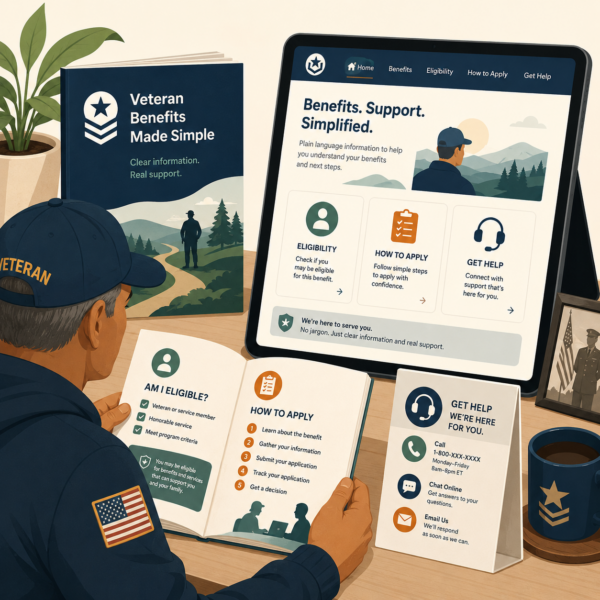 Contact accessibility, the ease with which veterans can reach the right person at the agency for the specific question or need they have, is one of the most functionally important and most commonly inadequate dimensions of veterans services website design. Veterans who have navigated to information that suggests they need to contact the agency, or who have a question that the website content does not fully address, need to be able to identify the right contact quickly and initiate contact through a mechanism that is accessible to them. Contact pages and contact mechanisms that are generic, that require veterans to navigate through additional layers to identify the specific contact relevant to their need, or that present contact information in formats that are not functional on mobile devices, are barriers that prevent benefit access for veterans who are one contact away from the help they need.
Contact page design should present contacts organized by the veteran’s need rather than by the agency’s organizational structure. A veteran who needs help with a disability compensation claim does not need to navigate the agency’s organizational chart to find the right contact. They need to see clearly that if they have a disability compensation question, they should contact a specific person or phone line with a specific function. A veteran who needs information about a specific state benefit program needs to see clearly where to direct that inquiry, with a specific contact rather than a general agency number that requires additional navigation to reach the right person.
Click-to-call phone numbers on mobile-optimized contact pages eliminate the transcription barrier that prevents many mobile users from calling the agency. When a phone number is displayed on a mobile screen as a tap-to-dial link rather than as plain text that must be manually entered, the barrier to initiating a call is reduced to a single tap, which significantly increases the probability that a veteran who has arrived at the contact page with the intention of calling will actually make the call rather than abandoning the attempt because of the friction of manual dialing.
Live chat functionality, increasingly available through low-cost or no-cost platforms, provides a contact mechanism that is particularly valuable for veterans who are not comfortable making phone calls, who have hearing-related disabilities that make phone calls difficult, or who prefer the written medium for initial benefit inquiries. A live chat function staffed during business hours provides a real-time human response to veteran questions in a medium that is accessible across a wide range of communication preferences, and it produces contact with the agency for veterans who would not have initiated a phone call or an email.
Response time commitments for email and online inquiry forms, displayed prominently on contact pages and upheld consistently, set clear expectations for veterans who submit inquiries and provide a standard against which agency responsiveness can be assessed. A contact page that promises responses to email inquiries within two business days and that consistently delivers on that promise is communicating through the contact experience that the agency is responsive and reliable. A contact page without response time commitments, or one that states commitments that are not consistently met, communicates the opposite.
Accessibility for Veterans With Disabilities
Many veterans who are the primary audience for veterans services websites have service-connected disabilities that affect how they interact with digital content. Veterans with visual impairments who use screen readers, veterans with traumatic brain injuries that affect reading and concentration, veterans with fine motor disabilities that make precise mouse or touchscreen interaction difficult, and veterans with cognitive disabilities that affect navigation and information processing, all have specific accessibility needs that website design must address to ensure equitable digital access.
The Web Content Accessibility Guidelines, known as WCAG, provide the international standard for web accessibility that government websites are increasingly required to meet. WCAG compliance requires that website content be perceivable through multiple sensory channels, that interactive elements be operable through keyboard navigation as well as mouse and touchscreen, that content be understandable without specialized technical knowledge, and that the website be robust enough to function with assistive technologies including screen readers. Achieving WCAG compliance requires specific technical design decisions and specific content practices that are beyond the scope of this article to detail fully but that should be a baseline requirement for any agency website serving a veteran population with significant rates of service-connected disabilities.
Font size, color contrast, and content layout are the most immediately visible dimensions of web accessibility for veterans with visual impairments or reading difficulties. Body text that is too small to read without zooming, color combinations with insufficient contrast between text and background, and dense text layouts without adequate white space and visual breaks, create reading barriers for veterans with these characteristics. Content design standards that specify minimum font sizes, minimum contrast ratios, and maximum content density provide the baseline accessibility requirements that prevent the most common visual accessibility failures.
Search Engine Optimization for Veteran-Relevant Queries
Search engine optimization, the practice of designing website content to appear prominently in search engine results for relevant queries, is a critical component of veteran-centered website design because it determines whether veterans who are searching online for information about veterans benefits find the agency’s resources or find less authoritative and potentially less accurate resources instead. Veterans who are beginning their benefit information search on Google or another search engine are starting their information-seeking journey at a point where the quality of available resources is highly variable, and an agency whose website ranks poorly for relevant queries is ceding the first contact with these veterans to resources that may not serve them as well.
Keyword research for veterans services SEO should be grounded in the same evidence base that drives all other veteran-centered website design decisions: the search terms that veterans are using when they are looking for benefit information. Keyword research tools can reveal the specific phrases that veterans are entering into search engines when they are looking for information about VA healthcare, disability compensation, property tax exemptions, GI Bill benefits, and other program categories. The most valuable keywords for a county or state veterans services agency are typically those that are specific enough to identify veteran benefit information seekers and local enough to direct those searchers to resources relevant to their specific geographic context.
Content quality and relevance are the most important determinants of search engine ranking for veterans benefit queries, because search engines are increasingly sophisticated at assessing whether a page’s content genuinely answers the questions that searchers are asking. Pages that provide accurate, comprehensive, well-organized answers to specific veteran questions in clear language will rank better for relevant queries than pages that use keyword-heavy language without substantive content quality. The plain-language content design described in the previous section is therefore not only a veteran usability investment but an SEO investment, because the characteristics that make content accessible to veteran readers are substantially aligned with the characteristics that search engines reward with higher rankings.
Local SEO is particularly important for county and state veterans services agencies whose primary audience is geographically defined. Veterans who are searching for veterans services in their specific county or state should find the relevant county or state agency prominently in their search results, and achieving this requires that the agency’s website include clear geographic identifiers in its content, that the agency’s Google Business Profile is complete and accurate, and that the agency’s website includes county and state-specific content that signals geographic relevance to search engines for location-specific queries.
Link building, the accumulation of links from other websites to the agency’s website, is a secondary but significant component of SEO that is particularly accessible for veterans services agencies through their existing partner network. When VSO posts, healthcare provider partners, community organizations, and local media include links to the agency’s website in their own web content, those links signal to search engines that the agency’s website is a credible and relevant resource for veterans in the community. Building this link network through partner relationships is a natural extension of the VSO partnership and community partner engagement work described in earlier articles in this series.
Website Analytics as Continuous Improvement Infrastructure
A veteran-centered website is not a one-time design achievement but an ongoing improvement project that requires continuous monitoring of how veterans are using the site and regular adjustments based on what the analytics reveal. The analytics infrastructure described at the beginning of this article is not only a baseline assessment tool but a continuous performance monitoring system that should be reviewed regularly and used to inform content and navigation improvements on an ongoing basis.
Monthly analytics reviews, covering the site’s traffic patterns, navigation behavior, search term data, and conversion metrics for key actions like contact form submissions and phone number clicks, provide a regular performance picture that identifies emerging issues before they become persistent problems and confirms whether specific improvement interventions are having their intended effect. The staff member responsible for website management should be conducting these reviews and translating their findings into specific improvement actions on a regular schedule rather than reviewing analytics only when a concern prompts a specific investigation.
A/B testing, in which two versions of a specific page element such as a navigation label, a call to action phrase, or a content layout are shown to different portions of site visitors simultaneously and their performance is compared, provides direct evidence about which of two approaches better serves the veteran audience for that specific element. A/B testing requires technical implementation that is beyond the capacity of some agencies, but many website platforms include basic A/B testing functionality that does not require custom development. Where available, A/B testing converts website improvement decisions from educated guesses into evidence-based choices.
Content Maintenance and Accuracy Infrastructure
A veteran-centered website that was accurate when launched and is inaccurate six months later is a website that is actively harming the veterans it was designed to serve, because veterans who receive inaccurate information about program eligibility, benefit amounts, or application processes make decisions based on that information in ways that have real consequences for their access and their expectations. The plain-language benefit guides article described the accuracy maintenance challenge for printed materials. The same challenge applies to website content with additional urgency because websites are often perceived as more current than printed materials, increasing the risk that outdated web content will be taken as current by veterans who access it.
Content ownership, in which specific staff members are assigned responsibility for the accuracy of specific sections of the website, is the foundational organizational mechanism for content accuracy maintenance. When every page on the website has a designated owner who is responsible for reviewing that page whenever relevant programs or policies change and for updating the content to reflect those changes, the accuracy maintenance function is distributed across the staff with the relevant subject matter expertise rather than concentrated in a web manager who may not have deep knowledge of specific program details.
A content review calendar that schedules regular accuracy reviews for all website content, aligned with the legislative and regulatory cycles that most predictably produce program changes, provides a systematic backstop for accuracy maintenance that catches changes that might otherwise be missed in continuous monitoring. For federal VA programs, the annual October compensation rate adjustments should trigger a review of all compensation-related web content. For state programs, legislative session cycles should trigger reviews of state benefit content. Supplementing these scheduled reviews with a reporting mechanism that alerts content owners when they learn of relevant program changes, regardless of the review schedule, ensures that urgent changes are addressed promptly.
Strategic Communication Support for Veterans Services Agencies
 Creating a veterans services website that truly supports veterans requires more than updating page layouts or adding new content. An effective website is built around the questions veterans are trying to answer, the tasks they are trying to complete, and the decisions they need to make. When information is organized from the veteran’s perspective rather than the agency’s internal structure, websites become more intuitive, reduce confusion, and help more veterans successfully access the benefits and services available to them.
Successful veterans services websites are built through user research, information architecture, plain-language content, accessibility, usability testing, and continuous evaluation. Veterans visit agency websites with different backgrounds, service histories, eligibility questions, and levels of familiarity with available programs. Meeting these diverse needs requires communication systems that organize information around veteran goals, simplify complex processes, and make it easier for users to find accurate answers without unnecessary frustration.
Developing this type of communication system requires specialized expertise in user research, content strategy, information architecture, plain-language communication, accessibility, usability, and communication evaluation. Many veterans services agencies choose to partner with external communication specialists such as Stegmeier Consulting Group (SCG) because these capabilities complement the agency’s expertise in veterans programs while providing the strategic communication knowledge needed to design websites that improve information access, support self-service, and strengthen the overall veteran experience.
Working alongside veterans services agencies, SCG develops website communication strategies that prioritize veteran needs at every stage of the user journey. Support may include conducting user research, reorganizing website navigation around veteran questions and tasks, developing plain-language content standards, improving accessibility and usability, designing content governance processes that keep information accurate and current, and implementing measurement systems that evaluate how effectively the website helps veterans find information and complete key actions.
As veterans’ expectations, digital technologies, and agency services continue to evolve, websites must evolve alongside them. SCG helps agencies establish repeatable content management processes, governance practices, and performance measurement frameworks that enable veterans services websites to remain accurate, accessible, and responsive while continuously improving the user experience across programs and communication channels.
The objective is to create a website that helps veterans quickly find the information they need, understand the benefits and services available to them, and confidently take the next steps toward accessing those resources. By strengthening website communication systems, agencies are better positioned to improve information access, reduce barriers to service, and connect more veterans with the benefits they have earned.
Future Trends in Veterans Services Website Design
The veterans services website is evolving from a static information resource into a dynamic, personalized digital service point that can provide veterans with tailored information and interactive tools based on their specific circumstances. Several emerging developments deserve attention from agencies planning their digital communication investments.
Personalized eligibility screening tools, which allow veterans to enter basic information about their service history, discharge character, and current circumstances and receive a customized summary of the programs they are likely eligible for, represent one of the most significant access improvements available through digital technology for veterans services websites. These tools convert the generic information landscape of a program description website into a personalized relevance assessment that tells each veteran specifically what is available to them rather than requiring them to assess relevance from general descriptions. Agencies developing or considering these tools should ensure that they are accurate, that they do not substitute for individualized CVSO consultation on complex eligibility questions, and that they are accessible to veterans with limited digital literacy.
Chatbot and virtual assistant technologies are being deployed on government websites with increasing sophistication, and veterans services applications are among the most promising use cases. A well-designed chatbot that can answer common veteran questions accurately, navigate veterans to relevant sections of the site, and escalate to live chat or phone contact when a question exceeds the chatbot’s accurate response capacity, can extend the site’s service hours and reduce the burden on CVSO staff for routine information requests. The key qualification is accuracy: a chatbot that provides inaccurate benefit information is more harmful than no chatbot, and the investment in content quality and accuracy monitoring required to deploy a trustworthy chatbot is significant.
The integration of case management functionality into veteran-facing website experiences, allowing veterans to check the status of their claims and applications, update their contact information, and communicate with CVSO staff through a secure digital portal, represents a significant expansion of what the agency’s digital presence can accomplish. These integrations are technically more demanding than static content improvements, but they address some of the most persistent frustrations in veterans’ benefit access experiences, including the difficulty of getting status updates on pending applications. Agencies considering case management integration should assess the technical and organizational requirements carefully and should pilot with a limited scope before full deployment.
Conclusion
The veteran who arrives at a veterans services agency website with a specific question and leaves without an answer has not been served by that website regardless of how much content it contains or how professional its visual design appears. The question is the unit of value in veteran-centered website design, and the website’s effectiveness is measured in the proportion of veterans who arrive with specific questions and leave with specific answers, rather than in page views or visit durations that measure activity without assessing whether the activity produced the information access it was intended to produce.
Rebuilding a veterans services website around what veterans actually need to know is an act of organizational alignment: aligning the agency’s digital presence with the agency’s mission of serving veterans rather than with the organizational logic that produced the current site structure. It requires sustained analytical attention, content design skill, and organizational commitment, and it produces returns that are visible in improved veteran information access, increased contact initiation, and ultimately in improved benefit utilization among veterans who found on the website what they needed to take the next step.
SCG’s Strategic Approach to Communication Systems
Stegmeier Consulting Group’s website communication work with veterans services agencies reflects the same foundational commitment to veteran-centered design that guides all of SCG’s communication work. A website that is designed for the agency’s organizational convenience serves the agency. A website that is designed for the veteran’s information needs serves veterans. The analytical, content design, and technical work required to build the second kind of website rather than the first is exactly the kind of communication investment that SCG helps agencies make, producing digital access infrastructure that compounds in value over time as more veterans find what they need and are connected to the services they have earned.
Use the form below to connect with our team and explore how strategic website communication can help your agency improve the veteran user experience, simplify access to information, and connect more veterans with available benefits and services.