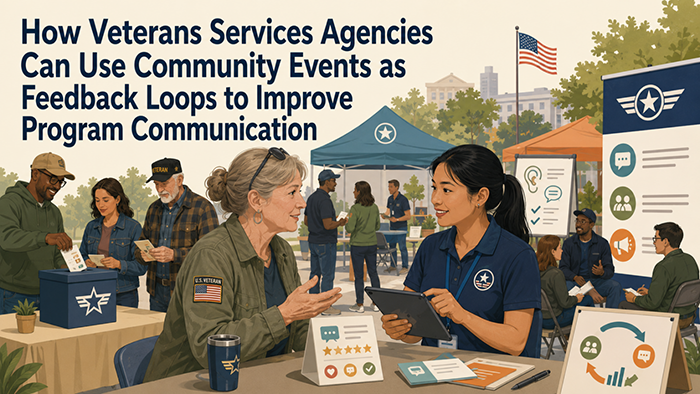
How Veterans Services Agencies Can Use Community Events as Feedback Loops to Improve Program Communication
Community events in the veterans services context are most commonly thought of as outreach tools: mechanisms for delivering information about available programs to veterans who have not yet received it. This framing is accurate as far as it goes, but it captures only one direction of the communication that is possible when agencies and veterans occupy the same physical space with a shared purpose of connecting veterans to services. The direction the framing misses, the flow of information from veterans to agencies rather than from agencies to veterans, is where some of the most valuable communication available to veterans services agencies originates.
When a veteran at a resource fair tells an agency representative that they had no idea that property tax exemptions existed and wishes someone had told them years ago, that is information about a communication gap. When a veteran at a community event asks a CVSO representative why the agency’s website makes it so difficult to find out whether they qualify for healthcare, that is information about a usability failure. When a navigator volunteer at a veterans expo notices that every veteran they approach has the same initial question about whether Guard and Reserve members qualify for VA benefits, that is information about a persistent awareness gap that the agency’s current outreach is not closing. All of this information is available in the interactions that happen at community events, and almost none of it is systematically collected, analyzed, or used to improve the agency’s communication strategy.
The missed opportunity is significant. Veterans services agencies invest considerable resources in developing their program communications, from website content and printed guides to outreach presentations and social media content. They do so primarily based on their own expertise about what veterans need to know, without systematic evidence about what veterans actually do and do not know, what aspects of program communication are confusing or inaccessible, and what specific barriers are preventing eligible veterans from accessing the programs the communications describe. Community events represent one of the most accessible and most richly informative sources of exactly this evidence, and treating those events exclusively as delivery vehicles for outgoing communication is a significant waste of the feedback opportunity they present.
This article provides a comprehensive framework for redesigning community events to function as feedback loops that produce actionable intelligence about the gaps in agency communication, as well as outreach vehicles that deliver program information. It covers the specific mechanisms for building feedback collection into event design, the analytical frameworks for converting raw event feedback into specific communication improvement actions, the organizational processes for ensuring that feedback from events actually reaches the people responsible for communication design, the connection between event feedback and broader community voice integration, and the measurement approaches that demonstrate whether feedback-driven communication improvements are producing access outcomes. The goal is an agency communication system that improves continuously based on evidence from the community it serves rather than remaining static based on the best judgment of people who are not in the community’s position.
The shift this article advocates is not from outreach to feedback collection. It is from outreach alone to outreach and feedback collection simultaneously, recognizing that the community event context makes both possible and that doing both produces better communication outcomes than doing only one. Agencies that make this shift build a communication improvement system that becomes more effective over time as successive rounds of feedback inform successive rounds of communication improvement, and they build a more authentic relationship with the veteran community by demonstrating through their responsiveness that veteran voice genuinely influences agency communication rather than being listened to ceremonially without consequence.
Understanding What Community Events Reveal About Communication Gaps
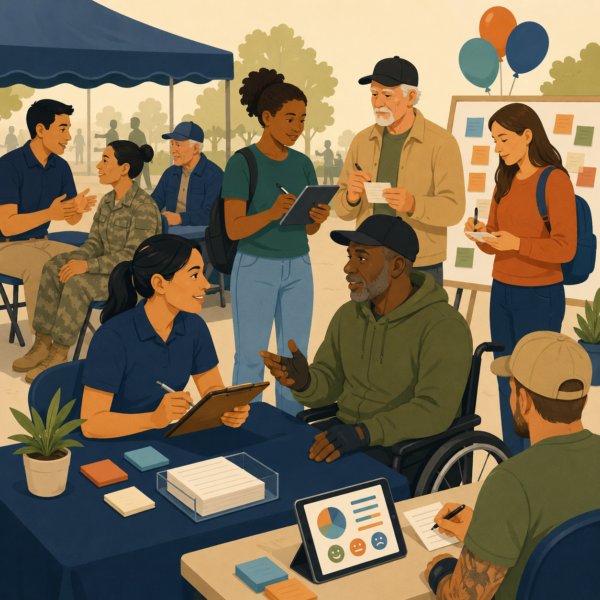 Every interaction between a veteran and an agency representative at a community event contains information about the communication environment that surrounds that interaction. The veteran who asks the same question that hundreds of veterans have asked before, the veteran who did not know a program existed despite the agency’s outreach about it, the veteran who misunderstood an eligibility requirement in a specific and predictable way, and the veteran who had to be turned away because they expected something the event was not designed to provide, are all providing evidence about the communication gaps that produce these outcomes. What distinguishes agencies that use events as feedback loops from agencies that do not is not the presence or absence of this evidence but the existence of systems for collecting, analyzing, and acting on it.
The specific communication gaps that community event interactions most reliably reveal fall into several recurring categories. Awareness gaps are revealed when veterans consistently report not knowing about programs that the agency believes it has communicated about. These gaps indicate that the agency’s communication is either not reaching the specific veteran population, not reaching veterans through the channels they actually use, or not registering as salient when it does reach them. Comprehension gaps are revealed when veterans consistently misunderstand specific eligibility requirements, program terms, or application processes in the same ways. These gaps indicate that the agency’s communication about specific topics is clear to the people who wrote it but not to the people who need to act on it. Expectation gaps are revealed when veterans arrive at events with expectations that do not match what the event or the programs can deliver. These gaps indicate that pre-event communication has not accurately conveyed what the event offers or that program communications have not accurately conveyed what the programs provide.
Navigation gaps are revealed when veterans consistently have difficulty finding specific services or programs within the event space or within the agency’s broader service landscape. These gaps indicate that the organizational structure of agency communications and services does not map onto the questions veterans are asking, requiring them to do additional interpretive work to connect their needs with the resources that address them. Trust gaps are revealed when veterans express skepticism about program information, when they have been told by others that the programs don’t really work or don’t really serve people like them, or when their prior experiences with the agency have produced a wariness that affects how they receive current communications. These gaps indicate that the agency’s communication is being filtered through community-level distrust that specific, honest communication strategies need to address.
Identifying these gap categories within the qualitative information produced by community event interactions requires analytical attention that is more demanding than simply noting that veterans asked a lot of questions. It requires pattern recognition across multiple interactions, the identification of recurring themes and questions that indicate systemic communication failures rather than individual information deficits, and the translation of those themes and questions into specific communication improvement actions. The analytical process is what converts raw event feedback into actionable communication intelligence, and building organizational capacity for this analysis is the core investment required to treat community events as genuine feedback loops.
The Information Richness of Event Conversations
Direct conversations between veterans and agency representatives at community events are among the richest sources of communication intelligence available to veterans services agencies, and they are also among the most consistently underutilized. The richness of these conversations derives from their spontaneity and specificity: veterans at events are not completing surveys or responding to pre-determined questions. They are expressing, in their own words and in real time, the specific needs, confusions, misconceptions, and communication experiences that are most salient to them in the moment of seeking help. This spontaneous specificity produces information that survey instruments, designed by people who already know what questions to ask, consistently miss.
Agency representatives who are attending community events with an awareness of the feedback potential of their conversations are better positioned to capture useful intelligence from those conversations than representatives who are focused exclusively on the service delivery function. This does not require representatives to conduct research interviews or to shift from their service role to a research role during event interactions. It requires a simple additional awareness: when a veteran expresses surprise that a program exists, notes the down. When a veteran uses a specific phrase to describe what they thought eligibility required and that phrase reveals a specific misconception, note it. When a veteran describes having looked for information somewhere specific and not found it, note where they looked. These observations, recorded briefly during or immediately after event interactions, are the raw material of communication intelligence that can improve the agency’s communication for every veteran who follows.
The specific observations most valuable for communication improvement include the specific words and phrases veterans use to describe their needs and their confusion, because these words and phrases reveal how veterans are thinking about the topic and what language would be most accessible in communications designed to address that thinking. A veteran who describes their situation as ‘I have some medical stuff from my time in the military’ is communicating in a way that is very different from the agency’s language about ‘service-connected conditions’ and ‘disability compensation,’ and understanding the gap between the veteran’s language and the agency’s language is the first step toward closing it.
Observer Notes as Feedback Data
Navigator volunteers and event coordinators who are moving through the event space and observing multiple interactions simultaneously have access to patterns that individual agency representatives, who are focused on their own table interactions, cannot see as clearly. An observer who notices that veterans are consistently bypassing a specific agency’s table without stopping, that veterans are clustering around a specific area of the event and waiting in extended queues while other areas are underutilized, or that veterans are consistently asking the central information station the same question that should be answerable from the event signage, is observing navigation and communication failures that the layout and signage decisions of the event produced.
Systematic observer notes, collected by event coordinators and navigator volunteers and reviewed after the event as part of the feedback analysis process, provide a different kind of communication intelligence from the conversational feedback that agency representatives collect. Observer notes reveal behavioral patterns that indicate communication system failures, including failures of wayfinding, failures of expectation setting, and failures of organizational intelligibility, that direct conversation feedback may not capture because veterans who encounter these failures often do not identify them as failures. They simply experience confusion, or they skip the resource that would have helped them because the navigation system did not get them there.
Observation instruments, brief structured forms that observers complete during or immediately after the event to record specific types of observations, increase the reliability and comparability of observer notes across multiple observers and multiple events. An observation instrument might ask observers to record the three most common questions they observed veterans asking at the central information station, the zones or agencies where wait times were longest, the zones where foot traffic was lowest relative to the services available, and any specific moments where veterans expressed frustration or confusion that the observer could identify as related to a specific communication or navigation failure. These structured observations, collected consistently across events, build a dataset that reveals patterns over time that single-event observations might attribute to idiosyncratic factors.
Serving Those Who Served: Communication Strategies for Veterans Agencies
This article is part of our series on strategic communication for Veterans Services Agencies, County Veterans Services Offices, State Departments of Veterans Affairs, and community-based veteran support organizations. To learn more and to see the parent article, which links to other content just like this, click the button below.
Building Feedback Collection Into Event Design
Feedback collection does not happen automatically at community events. It requires specific design decisions that create the conditions for systematic information gathering, specific tools that make collection practical without burdening event staff, and specific organizational roles that are responsible for feedback collection as a defined function rather than an informal byproduct of event participation. Events that treat feedback collection as a design priority rather than an afterthought produce substantially richer and more actionable feedback than events that rely on the incidental recollections of exhausted event staff at post-event debriefs.
The most fundamental design decision for feedback collection is the designation of at least one event participant whose primary role is feedback collection rather than service delivery. This person, who might be a dedicated event researcher, a communications staff member from the organizing agency, or a trained volunteer, moves through the event conducting brief structured observations, collecting post-interaction notes from agency representatives, and in some cases conducting brief impromptu conversations with veterans about their event experience. Their presence as a dedicated feedback collector rather than a service provider allows them to maintain the observational attention and the note-taking practice that service providers cannot maintain while also serving veterans.
Brief interaction logs for agency representatives reduce the burden of feedback collection on staff who are primarily focused on service delivery while still capturing the most important information from each interaction. An interaction log that asks representatives to record, for each substantive veteran interaction, the veteran’s primary stated need, any specific confusion or misconception they expressed, and any feedback about the agency’s communication or programs they volunteered, requires two to three minutes per interaction to complete and produces a dataset of specific, categorized feedback that can be analyzed after the event.
Exit surveys for attending veterans, brief enough to be completed in two to three minutes as veterans leave the event, provide systematic feedback about the veteran experience that observation and representative notes cannot fully capture. Exit survey questions should be specific and behaviorally focused rather than abstract and attitudinal. Questions like ‘Did you find the service or information you came for?’ ‘Was there something you were looking for that you did not find?’ ‘How easy was it to find the agencies relevant to your needs?’ and ‘Is there anything about the event that was confusing?’ produce specific, actionable information. General satisfaction rating questions produce aggregate data that is less useful for specific communication improvement.
The Post-Event Debrief as Structured Feedback Analysis
The post-event debrief is the analytical moment at which the raw feedback collected during the event is converted into specific communication improvement actions. Most post-event debriefs are logistics reviews that assess what went well and what went poorly in terms of event operations without systematically analyzing the communication intelligence the event produced. An access-oriented post-event debrief treats communication feedback as the primary subject of analysis and logistics feedback as secondary, and it produces specific, assigned communication improvement actions as its primary output.
The post-event debrief should be attended by representatives from the organizing agency’s communications function, not only by event logistics staff. The specific communication gaps identified through interaction logs, observer notes, and exit surveys are relevant to the communications function rather than the logistics function, and the communication improvement actions they suggest should be owned by the communications team rather than by the event planning team. If the debrief produces an observation that veterans consistently did not know that the agency’s website has a resources section specifically for Guard and Reserve members, the action item from that observation belongs to the communications team, not to the event logistics team.
The debrief should produce a documented list of specific communication improvement actions, each assigned to a responsible staff member with a deadline for implementation and a follow-up date for assessing whether the improvement has been made. This documentation converts the debrief from a conversation into a process, and the process is what ensures that the feedback from the event actually results in communication improvements rather than in productive conversation that does not change anything. The list of action items should be reviewed at the next pre-event meeting to assess whether prior event feedback has been addressed, creating a continuous improvement cycle that makes each successive event an opportunity to test whether previous communication improvements have had the intended effect.
Converting Event Feedback Into Communication Improvements
 The translation from raw event feedback to specific communication improvements requires analytical skill and organizational clarity about who is responsible for making specific types of improvements. Not all feedback translates equally directly into communication improvement actions, and the analytical work of distinguishing between feedback that reveals specific correctable communication failures and feedback that reveals systemic or policy issues beyond the agency’s communication function is an important component of the feedback analysis process.
Feedback that reveals awareness gaps, specifically that veterans were not aware of programs the agency believed it was communicating about, points toward channel and reach failures in the current communication strategy. The appropriate communication improvement action is not necessarily to produce more communication about the program but to identify why the existing communication is not reaching the veterans who encountered the program for the first time at the event. Are those veterans outside the channels the agency currently uses? Are they in the channels but not registering the program as relevant to them because the communication does not connect the program to their specific situation? Are they receiving communication about the program but at a point in their awareness or information-seeking journey when it is not actionable for them? Each of these diagnoses points to a different communication improvement action.
Feedback that reveals comprehension gaps, specifically that veterans consistently misunderstand specific program terms or eligibility requirements in the same ways, points toward clarity failures in the specific communication content about those programs. The appropriate improvement action is to revise the specific communication, whether a web page, a brochure, a talking point, or an eligibility summary, to address the specific misconception that feedback has identified. The revision should be informed by the language veterans used to express their misunderstanding, which often reveals the specific interpretive pathway through which the current communication produces the misconception, and should be tested with representative veteran readers before deployment to verify that it resolves the comprehension gap rather than introducing a new one.
Feedback that reveals navigation gaps, specifically that veterans consistently have difficulty connecting their needs with the programs that address them, points toward organizational structure failures in how the agency presents its services. The appropriate improvement action may be a reorganization of how services are categorized and described on the agency’s website, a revision of the wayfinding structure of community event layouts, or the development of need-based navigation tools that allow veterans to identify relevant programs based on their situation rather than based on program categories that require specialized knowledge to interpret. These organizational improvements are more demanding than content revisions and may require collaboration across multiple agency functions, but they address a class of communication failure that content improvements alone cannot resolve.
Closing the Loop With the Veteran Community
A feedback loop is not complete unless the feedback produced actually results in changes that are visible to the community that provided the feedback. Veterans who provide feedback about agency communications at community events and who subsequently observe no change in the communications they found confusing or inaccessible will conclude, reasonably, that their feedback was not taken seriously. This conclusion will reduce the quality and quantity of feedback they provide in the future and will damage the trust relationship between the community and the agency that the feedback solicitation process was intended to build.
Closing the loop with the veteran community requires that agencies communicate specifically about the communication improvements they have made in response to community feedback, including where that feedback originated. This communication can take many forms: an announcement at a subsequent community event noting that a website revision was made in response to feedback from the previous event; a social media post describing a change to program description language that veterans at a recent event said was confusing; a newsletter item explaining that the agency has added a Guard and Reserve eligibility section to its outreach materials because multiple veterans at community events indicated they did not know that Guard and Reserve members might qualify.
This closing-the-loop communication performs several functions simultaneously. It demonstrates to the veteran community that their feedback is taken seriously and results in concrete changes, which increases the likelihood of productive feedback in future interactions. It demonstrates to agency staff that the feedback collection and analysis work they are doing has visible consequences for communication quality, which sustains motivation for that work over time. And it demonstrates to agency leadership and partner organizations that the community events are functioning as genuine feedback loops rather than one-directional outreach activities, which supports continued investment in the event communication infrastructure.
Integrating Event Feedback Into the Broader Communication Improvement System
Community event feedback is most valuable when it is integrated into a broader communication improvement system that includes multiple feedback channels, a consistent analytical framework, and organizational processes for translating feedback into action across the full range of agency communication functions. Events are a rich but episodic source of feedback. They provide intensive windows of community voice that are limited to the populations that attend the event, the topics that come up in event interactions, and the specific feedback collection mechanisms that are active during the event. A comprehensive communication improvement system uses event feedback as one input among several, including analysis of inquiry patterns from CVSO intake data, website analytics that reveal navigation failures, social media engagement data that reveals what content resonates, and periodic community surveys that capture voice from populations not present at events.
The integration of event feedback with these other data sources produces a more complete and more accurate picture of communication gaps than any single source can provide alone. Inquiry pattern analysis from CVSO intake data reveals the questions veterans are asking when they contact the agency through formal channels, which often reflects different populations and different communication experiences than the questions asked by veterans at community events. Website analytics reveal where veterans are abandoning navigation pathways on the agency’s digital properties, which often corresponds to exactly the navigation gaps that community event observers identify in the physical event space. The convergence of these evidence streams around specific communication gaps is more reliable evidence that an actual gap exists and that correcting it will produce meaningful improvement than any single data source can provide.
The organizational home of the communication improvement function determines how effectively event feedback is integrated with other data sources and translated into action. Agencies that have a dedicated communications function with responsibility for both producing communications and improving them based on evidence are better positioned to perform this integration than agencies where communication production is distributed across program functions without a coordinating communication intelligence role. The investment in a communications function with explicit feedback analysis and improvement responsibilities is an organizational commitment to treating communication quality as a strategic priority rather than an operational byproduct.
Using Feedback to Prioritize Communication Investments
Not all communication gaps are equally consequential, and not all communication improvements require equal investment to produce. Event feedback, combined with other data sources, can be used to prioritize communication investments by identifying the gaps that are producing the largest access impacts and that are most directly addressable through specific communication interventions. This prioritization is essential in agencies with limited communication resources, which includes the vast majority of veterans services agencies, because without prioritization the communication improvement agenda becomes a backlog of low-priority revisions that competes with high-priority needs for the same limited staff capacity.
The prioritization framework should consider two dimensions: the magnitude of the gap’s access impact, measured in the number of veterans whose benefit access is affected by the communication failure, and the tractability of the improvement, measured in the degree to which a specific communication change can be expected to close the gap. High-impact, high-tractability gaps should be addressed first. High-impact, low-tractability gaps should be disaggregated into components to identify the tractable portions. Low-impact gaps can be addressed when resources permit without delaying the high-impact improvements.
The magnitude estimation for specific gaps requires connecting the frequency with which the gap appears in event feedback to an estimate of how broadly the gap is distributed in the veteran population beyond those who attend events. A gap that appears frequently in event feedback and that is corroborated by CVSO intake inquiry patterns is likely a broad population-level gap worth prioritizing. A gap that appears in event feedback but not in other data sources may be more specific to the population attending events and may warrant lower priority than gaps that appear across multiple data sources.
Building a Culture of Communication Feedback
The organizational practices described throughout this article, feedback collection at events, structured post-event debriefs, integration with other data sources, prioritized communication improvement actions, and loop-closing communication with the community, are all components of a communication feedback culture that does not develop spontaneously and is not sustained without deliberate organizational investment. Agencies that build this culture produce communication systems that improve continuously over time. Agencies that treat feedback as an episodic special project rather than a routine operational function will see improvement cycles that are disconnected, sporadic, and ultimately less effective than the continuous improvement that a genuine feedback culture produces.
Leadership commitment is the most important determinant of whether a communication feedback culture takes root in a veterans services agency. When agency leadership treats community event feedback as important information that should be reviewed at leadership meetings, that should inform program and communication decisions, and that should be explicitly cited when communication changes are made, the message to staff is clear: this feedback matters and collecting it is worth the effort. When leadership does not engage with feedback data, the same message is communicated in reverse.
Staff recognition for feedback collection and analysis contributions sustains engagement with the feedback function beyond the initial period of enthusiasm that often accompanies the launch of a new organizational practice. Agency representatives who take time to complete interaction logs at events, navigators who submit detailed observer notes, and communications staff who analyze feedback data and produce improvement recommendations should receive explicit acknowledgment of the value of that work, whether through formal recognition programs, performance evaluation criteria that include feedback function contributions, or simply through leadership communications that cite specific feedback-driven improvements and credit the staff who contributed the evidence for them.
Partner agency engagement in the feedback culture extends the feedback loop beyond the organizing agency’s own staff to include the full range of organizations participating in community events. Partner agencies that are briefed on the feedback purpose of event interactions, that receive templates for interaction logs, and that are asked to contribute their observations to the post-event debrief, are co-investigators in the communication intelligence process rather than passive event participants. Their observations and interactions produce feedback about the communication environment that is often more specific to their particular program area than anything the organizing agency’s own staff can observe, and integrating that feedback into the analysis produces a more comprehensive picture of communication gaps across the full resource landscape the event represents.
Strategic Communication Support for Veterans Services Agencies
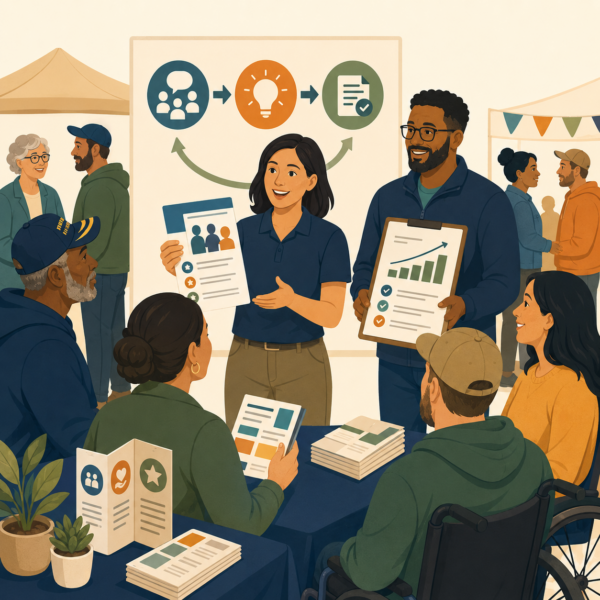 Community events provide valuable opportunities to engage veterans, but their greatest long-term value comes from the information agencies gain through those interactions. Every conversation, question, recurring concern, and unmet need has the potential to improve future communication. When agencies systematically collect and apply this feedback, community events become more than outreach activities. They become an ongoing source of insight that strengthens communication strategies across programs and services.
Successful communication feedback systems are built on structured data collection, consistent documentation, thoughtful analysis, cross-functional collaboration, and continuous evaluation. Veterans often reveal communication barriers that surveys and website analytics cannot capture, including misconceptions about benefits, gaps in service awareness, confusing processes, and emerging community needs. Capturing these insights requires communication systems that transform individual conversations into organizational knowledge that can guide future outreach and service improvements.
Developing this type of communication system requires specialized expertise in communication research, audience analysis, feedback design, process development, organizational governance, and communication evaluation. Many veterans services agencies choose to partner with external communication specialists such as Stegmeier Consulting Group (SCG) because these capabilities complement the agency’s expertise in veterans services while providing the strategic communication knowledge needed to build sustainable feedback systems that continuously improve communication effectiveness rather than relying on isolated observations.
Working alongside veterans services agencies, SCG develops communication feedback systems that turn community engagement into actionable intelligence. Support may include designing standardized feedback collection tools, developing frameworks for identifying communication trends and recurring barriers, creating processes for sharing insights across departments, establishing workflows that translate findings into communication improvements, implementing mechanisms for reporting changes back to veterans and community partners, and developing measurement systems that evaluate how feedback contributes to stronger communication outcomes over time.
As veteran needs, communication channels, and community expectations continue to evolve, agencies benefit from communication systems that learn and improve continuously. SCG helps agencies establish repeatable feedback processes, governance practices, and performance measurement frameworks that enable every community event to strengthen future communication while creating a culture of continuous learning and improvement across the organization.
The objective is to create a communication environment in which every community interaction contributes to better outreach, clearer messaging, and more responsive services for veterans. By transforming community events into continuous communication feedback loops, agencies are better positioned to improve engagement, address emerging needs, and strengthen veteran access to the benefits and services they have earned.
Future Trends in Veteran Community Feedback
The technology available for community feedback collection is evolving in ways that make real-time and post-event feedback collection more accessible and more systematic than traditional paper-based approaches. Mobile survey tools that can be accessed via QR code at event exits produce immediate digital feedback that requires no data entry to analyze. Natural language processing tools that can identify themes and patterns across large volumes of open-text feedback reduce the analytical burden of qualitative feedback data. Social listening tools that monitor veteran community conversations on social media and other digital platforms extend the feedback reach beyond event attendees to the broader veteran community that is discussing programs, agencies, and service access experiences continuously.
As these tools mature and become more accessible to agencies with limited technology resources, the technical barriers to systematic feedback collection will continue to decline. The organizational and cultural barriers, the commitment to treating feedback as important intelligence rather than administrative byproduct, will remain the primary determinants of whether agencies build genuine feedback cultures. The technology enables more efficient feedback collection. The organizational commitment to acting on that feedback is what converts collection into improvement.
The growing emphasis on community-centered service design in public sector contexts, in which the people served by a program are involved in the design and continuous improvement of that program rather than being passive recipients of services designed by experts, aligns directly with the feedback loop approach this article advocates. Veterans services agencies that build genuine communication feedback loops are practicing community-centered communication design, and their investment in that practice positions them well as the expectation for community-centered public service increasingly becomes the standard against which agency performance is assessed.
Conclusion
Community events contain more information than they deliver. Every interaction in which a veteran reveals what they did not know, what they misunderstood, or what they could not find is an invitation to improve the communication system that produced those gaps. Accepting that invitation requires treating events as bidirectional communication exchanges rather than outreach delivery mechanisms, building the collection and analysis infrastructure that converts that information into actionable intelligence, and maintaining the organizational commitment to act on that intelligence in ways that are visible to the community whose feedback made the improvement possible.
The veterans services agency that builds this feedback culture produces communication that gets better with every event it conducts, that is informed by the actual experience of actual veterans rather than by the best guesses of agency staff, and that demonstrates through its continuous improvement that veteran voice is not just welcomed but genuinely consequential. That demonstration is itself a significant communication achievement, one that builds the trust and engagement that every other agency communication depends on to be effective.
SCG’s Strategic Approach to Communication Systems
Stegmeier Consulting Group’s communication systems work is grounded in the conviction that effective communication is produced through evidence and iteration rather than through one-time expertise and indefinite deployment. The feedback loop that community events can provide is one of the most accessible sources of evidence about communication quality from the perspective of the people the communication is designed to serve, and agencies that build this feedback into their operational DNA produce communication systems that are structurally oriented toward continuous improvement. SCG helps agencies build the specific tools, processes, and organizational practices that make this orientation operational rather than aspirational.
Use the form below to connect with our team and explore how strategic communication feedback systems can help your agency turn community events into lasting improvements in veteran outreach, engagement, and service delivery.