
How Veterans Services Agencies Can Build Suicide Prevention Messaging That Reaches Veterans Who Distrust Clinical Language
Language is not a neutral delivery mechanism that carries meaning unchanged from sender to receiver. Every word arrives at its destination carrying the accumulated weight of all the contexts in which the receiver has previously encountered it, and for a substantial portion of the veteran population, the language of clinical mental health carries a weight that is not only heavy but actively repellent. Words like trauma, depression, suicidal ideation, mental health crisis, and psychiatric intervention do not arrive in a vacuum when a veteran hears them from a government agency or a clinical professional. They arrive carrying the accumulated associations of military culture, in which psychological vulnerability has historically been coded as professional liability, personal weakness, and a failure of the discipline that defines a servicemember’s identity.
The consequence of this dynamic for suicide prevention communication is not simply that some messaging falls on deaf ears. It is that some messaging actively triggers the identity rejection that closes the door to any further communication about mental health support. A veteran who hears a prevention message framed in clinical terminology does not simply set the information aside. They receive a signal, before any substantive content is absorbed, that the message comes from a world that does not understand them, and that the help being offered is help for people who are willing to accept an identity they have spent years rejecting. The signal is often subtle, embedded in word choices and framing rather than in explicit statements, but it is received with clarity by people whose cultural training has made them adept at recognizing the difference between communication that respects their identity and communication that requires them to abandon it.
This is the central challenge that veterans services agencies face when they attempt to build suicide prevention messaging that actually reaches the veterans most at risk. The veterans who are hardest to reach through prevention communication are frequently the same veterans who are carrying the greatest psychological burden. They are the veterans who have most thoroughly internalized the cultural prohibition against acknowledging need, who have the strongest aversion to the clinical mental health framework, and who are consequently the least likely to engage with prevention messaging that relies on that framework. The irony is that the population most in need of effective prevention communication is the population least served by the communication approaches most commonly used.
Veterans services agencies that are serious about their prevention mission must therefore confront a design challenge that goes well beyond choosing better words or softer tones. The challenge is to build a communication framework that operates within the veteran’s existing value system rather than asking the veteran to adopt a new one, that uses the veteran’s own cultural commitments as the foundation for a different kind of conversation about struggle and support, and that embeds crisis resources so deeply in the ordinary fabric of veteran community communication that encountering them does not require identifying oneself as someone in crisis. This article provides that framework, drawing on the principles of effective prevention communication, the specific dynamics of veteran culture, and the practical strategies that agencies have found effective in reaching veterans who would otherwise remain beyond the reach of their prevention efforts.
The stakes of getting this communication right could not be higher. Veteran suicide rates have remained persistently elevated relative to the general population despite decades of prevention investment. The gap between available resources and veteran utilization of those resources is not primarily a resource problem. It is a communication problem, one that is solvable with the right analytical framework and the right organizational commitment to implementing it. What follows is a detailed examination of both the problem and the solution.
Understanding the Roots of Clinical Language Distrust in the Veteran Population
 Before any communication strategy can be designed to work around or through clinical language distrust, the sources of that distrust must be understood with genuine specificity. It is insufficient to observe that veterans distrust clinical mental health language and move on to communication workarounds. The distrust has specific cultural, institutional, and experiential roots, and those roots shape the particular forms the distrust takes, the specific messages that trigger it, and the specific alternative frameworks that can work where clinical framing cannot.
The foundational source of clinical language distrust in the veteran population is the value framework that military service instills and that veterans carry into civilian life as a core element of their professional and personal identity. The military institution is organized around values that have survival utility in combat and operational utility in institutional settings: stoicism, self-reliance, competence under pressure, mission focus, and the subordination of individual comfort to unit effectiveness. These are not superficial cultural preferences. They are deeply internalized behavioral commitments that shape how veterans perceive themselves and how they interpret every situation that tests their self-concept. When a veteran encounters a message organized around the acknowledgment of psychological vulnerability, the message is not simply surprising or uncomfortable. It is dissonant with the self-concept the veteran has built across years of service, and that dissonance activates a rejection response that operates at a level beneath conscious deliberation.
Clinical mental health language amplifies this dissonance in specific ways. The vocabulary of mental health diagnoses, treatment plans, and therapeutic interventions is organized around a framework that positions the individual as a patient whose symptoms require professional management. This framework is not inherently problematic for populations whose cultural context makes patient identity comfortable or acceptable. For veterans whose cultural context has valorized exactly the opposite, the self-sufficient capable operator who manages adversity through discipline and competence rather than through professional support, the patient framework is not simply foreign. It is the conceptual antithesis of the identity they have built.
Beyond the cultural dimension, many veterans have had specific institutional experiences that give their distrust of clinical mental health language a concrete and personal dimension. Veterans who sought mental health support during service and experienced professional consequences, or who know fellow veterans for whom this was true, carry a lesson learned at significant personal cost: that acknowledging psychological need within the military institutional context has predictable negative outcomes. That lesson does not automatically update when the veteran leaves service. The association between psychological disclosure and professional consequence persists as a conditioned behavioral pattern long after the institutional environment that produced it has changed, and it shapes how veterans interpret any communication that invites mental health disclosure.
The VA system itself has contributed to clinical language distrust through the accumulated experiences of veterans who have engaged with VA mental health services over the years. Long wait times for appointments, clinical encounters that felt impersonal or formulaic, the bureaucratic complexity of navigating VA mental health pathways, and specific incidents that became part of the shared narrative of veteran experience with VA mental health services have all built a reservoir of institutional skepticism that shapes how veterans receive prevention communication from VA-affiliated sources. This skepticism is not irrational, and communication that fails to acknowledge it, that positions the VA mental health system as straightforwardly beneficial without engaging with the veterans’ actual experience of it, loses credibility in the same moment that it asserts it.
How Stigma Operates as a Communication Barrier
Stigma in the context of veteran mental health is not primarily a function of individual attitudes, though individual attitudes matter. It is a community-level phenomenon, embedded in the shared norms, language patterns, and behavioral expectations of the veteran community. Understanding how stigma functions as a communication barrier requires understanding it at this community level rather than as an individual psychological trait that some veterans have and others do not.
Community-level stigma around mental health in veteran populations operates through several specific mechanisms. The first is the norm of stoic self-presentation, which discourages veterans from expressing psychological difficulty in any community context where their performance and capability are being assessed, explicitly or implicitly. This norm is most powerful in male veteran communities and in veterans from service eras when the norm was most strongly enforced, but it exists across the veteran population in various forms and intensities. Communication that does not account for this norm, that asks veterans to publicly acknowledge psychological difficulty in contexts where the norm makes such acknowledgment costly, will consistently underperform regardless of how well the substantive content is designed.
The second mechanism is the circulation of negative information about mental health help-seeking through veteran peer networks. Stories about veterans who sought mental health support and experienced professional consequences, lost relationships, or found that the support they sought was unhelpful or actively harmful circulate through veteran communities with particular intensity and persistence. The peer network is among the most trusted information sources in the veteran community, and negative information transmitted through it is significantly more influential than positive information transmitted through institutional channels. Prevention communication strategies that do not engage with this peer network dynamic, that do not deliberately introduce positive counter-narratives through the same trusted peer channels that circulate negative ones, will consistently lose the information competition to the negative peer network content.
The third mechanism is the self-exclusionary logic that many veterans apply to prevention resources. A veteran who sees a poster for a mental health crisis line may simultaneously recognize that it is a potentially valuable resource and conclude that it is not for them, that it is for people who are in a different and more serious situation than their own, or who have a different and less capable relationship to adversity. This self-exclusion does not require the veteran to explicitly reject the resource. It simply requires them to not include themselves in the category of person the resource is for, a cognitive move that happens effortlessly when the resource is framed in ways that do not include them.
The Specific Messages That Trigger Identity Rejection
Among the communication approaches that most reliably trigger identity rejection in veterans who distrust clinical language, several are particularly consequential and deserve specific attention in prevention communication design. The first is any message that explicitly frames help-seeking as a response to weakness or inability to cope. Even messages that intend to reduce stigma by normalizing struggle can inadvertently reinforce the framing of weakness framing if they position psychological distress as something that overwhelms a person rather than as something that a capable person encounters and responds to strategically.
The second trigger is the implicit equation of seeking mental health support with giving up on self-management. Veterans who have developed extensive personal strategies for managing psychological difficulty, including physical activity, social connection, purposeful work, and the cultural practices of veteran community life, do not experience themselves as people who have failed to cope. They experience themselves as people who have successfully managed significant adversity through their own resources. A prevention message that implies they should seek professional support instead of the strategies they have been using is not persuasive. It is insulting.
The third trigger is institutional language that positions the VA or any government agency as the authority on the veteran’s psychological experience. Veterans who have had the experience of being assessed, classified, and rated by government systems bring significant skepticism to any communication that positions those systems as capable of understanding their inner experience. Prevention messaging that asks veterans to trust institutional assessments of their psychological state without establishing the credibility of the institutional source through specific, honest engagement with veterans’ actual experience of those institutions will not break through the skepticism that this trigger activates.
Serving Those Who Served: Communication Strategies for Veterans Agencies
This article is part of our series on strategic communication for Veterans Services Agencies, County Veterans Services Offices, State Departments of Veterans Affairs, and community-based veteran support organizations. To learn more and to see the parent article, which links to other content just like this, click the button below.
Communication Principles That Work With Cultural Resistance
The central design principle for prevention communication that reaches veterans who distrust clinical language is to work within the veteran’s existing value system rather than asking the veteran to adopt a new one. This principle is more demanding than it sounds, because it requires genuine understanding of the value system rather than a surface-level use of military vocabulary to dress up communication that remains fundamentally organized around clinical frameworks. Veterans are adept at detecting the difference between communication that is authentically grounded in their cultural framework and communication that has been militarized in language while remaining clinical in logic. The surface-level approach is more likely to backfire by appearing manipulative than to succeed by appearing resonant.
Working within the veteran’s value system means identifying the specific values that are already commitments for the target population and demonstrating honestly how seeking support fits within those values rather than contradicting them. The value of personal courage, for example, is not abstract for most veterans. It is a lived commitment that they have exercised in contexts where courage had concrete operational consequences. A prevention communication that makes the honest case that acknowledging psychological struggle and reaching out for support requires the same quality of personal courage that military culture already valorizes is not repackaging weakness as strength. It is making an accurate observation about what the act of help-seeking actually involves, one that veterans who have internalized the value of personal courage can recognize as true.
Similarly, the values of loyalty and duty that are central to most military value systems apply directly to the veteran’s relationships outside of service. The veteran who is struggling psychologically and who does not seek support is not only placing themselves at risk. They are placing at risk their ability to be present, functional, and fully themselves for the family members, community connections, and fellow veterans who depend on their presence. Framing the decision to seek support as an act of loyalty and duty to those relationships is not a manipulation. It is an honest account of what is at stake in the decision that does not require the veteran to adopt any identity they have rejected.
The third communication principle that is particularly powerful for this population is the principle of tactical realism. Veterans are trained to make clear-eyed assessments of situations, to acknowledge threats and obstacles honestly rather than denying them, and to call for available resources when a situation exceeds what individual capability can manage. Prevention communication that applies this framework to psychological difficulty, that says in effect this is a real and serious situation, there are specific resources available that are relevant to this situation, and knowing those resources and how to use them is the operationally correct response, is communicating in a frame that veterans can recognize as consistent with the operational logic they already apply to other challenges.
Framing Strength, Not Vulnerability
The strength-based reframe for prevention communication goes beyond replacing clinical language with military language. It requires a fundamental restructuring of the narrative that prevention messaging tells about what psychological struggle is and what responding to it means. In the clinical framework, psychological struggle is a condition that impairs functioning and that requires professional intervention to restore the individual to baseline. In the strength-based framework appropriate for veteran prevention communication, psychological struggle is a predictable consequence of extraordinary service in extraordinary circumstances, one that is encountered by capable people and that capable people respond to by deploying the same resource awareness and action orientation that characterized their effective military performance.
This reframe is not a softening of the clinical reality. Veterans who are in genuine psychological distress are not helped by communication that minimizes the seriousness of their situation. The reframe is a change in the narrative about what the appropriate response to that situation is and what that response means about the person who chooses it. The veteran who reaches out for support is not demonstrating that they have been defeated by their experience. They are demonstrating that they have the situational awareness to recognize a situation that warrants a specific response, and the operational discipline to take that response rather than waiting for the situation to deteriorate further.
Prevention communication that consistently and authentically delivers this reframe, across multiple channels and multiple messages over time, builds an alternative narrative in the veteran community that competes with the stoicism-as-strength narrative that currently dominates. The goal is not to eliminate the value of stoic endurance, which is a genuine military virtue with genuine utility in many contexts. The goal is to distinguish between the contexts where stoic endurance is appropriate and the contexts where it is contraindicated, and to make the case that psychological struggle is a context where operational resource-deployment, not stoic endurance, is the appropriate veteran response.
Using Military Values as the Communicative Foundation
The specific military values that provide the most robust foundation for prevention communication vary by service branch, service era, and individual veteran background, and effective prevention communication must be calibrated to the specific value framework of the veteran population being addressed. The Army’s seven core values, the Navy and Marine Corps’ honor, courage, and commitment, the Air Force’s integrity, service, and excellence, and the Coast Guard’s honor, respect, and devotion to duty are all specific formulations that carry meaning for veterans who internalized them during service and who continue to identify with them in civilian life.
Prevention communication that engages these specific value frameworks, rather than speaking in generic terms about military values, demonstrates a level of cultural specificity that builds credibility before any substantive content is delivered. A message designed for an Army veteran audience that explicitly references the value of personal courage and connects it to the act of seeking support when needed is communicating within a specific cultural framework that the veteran recognizes as their own. A message that speaks generically about veterans being strong is not making this specific cultural connection and does not carry the same weight.
The value of selfless service, present in the Army framework and in various forms across all service branch value systems, is particularly powerful as a prevention communication foundation. Selfless service is the commitment to the mission and to the unit above personal comfort or personal benefit. A veteran who is struggling psychologically and who does not seek support is not practicing selfless service. They are allowing a personal situation to deteriorate in ways that will eventually affect their capacity to serve the people around them, to be present for their family, to contribute to their community, and to show up fully for fellow veterans who depend on their friendship and support. Framing the decision to seek support as an act of selfless service rather than self-indulgence is an honest and powerful communication move that uses the veteran’s own deepest values to reframe a decision that the stigma narrative has framed as weakness.
Peer Voice as the Most Credible Messenger for Prevention Communication
No communication principle in the veterans prevention messaging space is more consistently supported by both research and practitioner experience than the principle of peer credibility. The research on effective communication across populations with high institutional distrust consistently identifies message source credibility as among the strongest predictors of message reception and behavioral response. For veterans who distrust clinical language and institutional communications, the most credible messenger for prevention communication is not a clinical professional, not a government agency spokesperson, and not a celebrity advocate who has not shared their service experience. It is a veteran who has been through something recognizably similar to what the audience is experiencing and who found a way through it.
Peer credibility in the veteran community is built on a foundation that is specific to that community’s culture. The veteran who hears from another veteran about psychological struggle, about the decision to seek support, and about what life looks like on the other side of that decision, is receiving information from someone who has demonstrated the same qualities the listening veteran values. The peer has served. They understand the culture from the inside. They cannot be dismissed as someone who is speaking from outside the experience they are describing. Their credibility is not built on credentials or institutional authority. It is built on lived experience, and in a community where lived experience in specific contexts is the primary basis for credibility, this is the most powerful credential available.
Veterans services agencies that build peer voice programs for prevention communication are not simply adding a human-interest element to their messaging. They are deploying the most effective communication asset available for reaching the population most resistant to institutional and clinical communication. A video testimonial from a veteran who speaks in their own language about the moment they realized they needed support, the resistance they felt, the decision they made, and what their life looks like now, is doing communication work that no institutional message can replicate. The production values can be modest. The language can be imperfect. What matters is authenticity, and authenticity is the one communication quality that peer voice possesses absolutely and that institutional communication can never fully simulate.
Why Peer Credibility Exceeds Institutional Credibility for This Population
The specific mechanisms through which peer credibility exceeds institutional credibility in veteran prevention communication deserve close examination, because understanding these mechanisms allows agencies to design peer voice programs that maximize their effectiveness rather than simply deploying peer voice without attention to the factors that make it work.
The first mechanism is identity congruence. A veteran who receives a prevention message from another veteran who has navigated similar experiences is receiving that message from someone whose identity is congruent with their own in the ways that matter most for the message’s credibility. The peer has served. They have experienced the specific pressures, the specific culture, and the specific challenges of military life. They have carried the specific social expectations that make acknowledging psychological struggle feel threatening. When this peer says that seeking support was the right decision, the listener cannot dismiss the claim on the grounds that the speaker does not understand the cost of making it, because the speaker’s identity makes clear that they understood that cost completely and made the decision anyway.
The second mechanism is the demonstration of survivability. Veterans who are struggling psychologically are often operating with an implicit assumption that the struggle will continue indefinitely, that there is no pathway through it that does not require either stoic endurance or the kind of clinical engagement that feels incompatible with their identity. A peer who is visibly on the other side of a comparable struggle is demonstrating something that no institutional communication can demonstrate as effectively: that there is an other side, that it is reachable, and that the path to it did not require abandoning the identity that makes the veteran who they are.
The third mechanism is the normalization effect. A veteran who hears peer testimony about psychological struggle from a peer they respect is receiving evidence that the struggle they are experiencing is not unique to them, that it does not mark them as fundamentally different from the veterans they admire, and that the decision to seek support is not an exceptional act of weakness but a normal response to real circumstances that capable people in their community have navigated. This normalization operates at the community level when peer testimony is delivered in group settings or through channels that reach multiple veterans simultaneously, and it builds over time as more peer voices join the prevention communication ecosystem.
Developing and Sustaining Peer Messengers
The development of an effective peer voice program for prevention communication is not accomplished by simply identifying veterans who are willing to share their stories and deploying them without further preparation or support. Peer messengers who are asked to share experiences of psychological struggle and help-seeking in public contexts are taking on a significant emotional and social responsibility, and agencies that do not support them adequately through that responsibility will see their peer voice programs produce burnout, withdrawal, and ultimately the loss of the asset they were investing in.
Preparation for peer messengers should include structured narrative training that helps them identify the elements of their story most relevant to the prevention message, organize those elements in a sequence that is coherent and compelling for their audience, and deliver their narrative with the kind of reflective distance that allows for authentic communication without retraumatization. The peer does not need to disclose every detail of their psychological history to be an effective messenger. They need to share enough that the audience can recognize the authenticity of the experience and draw the relevant connection to their own situation.
Support structures for peer messengers should include regular opportunities for debriefing after public communication events, connections with clinical supervisors or peer support specialists who can help them process the emotional impact of repeated public disclosure, and clear boundaries about what they are and are not expected to share in any given context. These support structures are not bureaucratic formalities. They are the infrastructure that makes sustained peer voice participation possible without the burnout that would eventually remove the peer from both their communication role and their broader wellbeing.
The formats through which peer voice is delivered to veteran audiences should be selected based on careful analysis of where the target population is most receptive and most likely to encounter the message. Video testimonials distributed through social media reach veterans who consume information in digital formats. In-person testimony at VSO post meetings reaches veterans who are present in community spaces. Panel discussions at outreach events create interactive peer voice environments where veterans can engage directly with peers rather than receiving testimony passively. A comprehensive peer voice program uses multiple formats across multiple channels to maximize reach and to accommodate the diversity of information consumption patterns within the target population.
Designing Prevention Messaging That Lives in Ordinary Space
 One of the most consequential structural failures in veteran suicide prevention communication is the confinement of that communication to crisis-specific contexts. When prevention messaging appears only on hotline posters in clinical waiting rooms, in materials explicitly labeled as suicide prevention resources, and in outreach events specifically organized around mental health topics, it is sending a powerful implicit message alongside its explicit content: the message that this topic belongs only in crisis spaces, and that engaging with it requires identifying oneself as someone whose situation has already reached that level of urgency.
This confinement is a barrier in two specific ways. First, it excludes from the prevention communication ecosystem the large population of veterans who are experiencing the cumulative deterioration of wellbeing that often precedes acute crisis but who do not yet identify as being in crisis. These veterans would benefit from prevention messaging that reaches them where they are, before their situation has escalated to the threshold that crisis-specific resources are designed to address. Second, it reinforces the implicit norm that mental health topics are appropriate only in specific designated spaces, which strengthens rather than reduces the stigma barrier that prevents veterans from engaging with support resources.
Effective prevention communication for the population that distrust clinical language must be embedded in the broader ecology of veteran community communication, present across every channel the agency controls and every context where veterans gather, without requiring a crisis-specific trigger for its appearance. This means that the Veterans Crisis Line number appears not only in mental health contexts but in every newsletter, every event communication, every social media post, and every business card the agency produces. It means that brief, normalized references to the availability of support appear alongside content about benefits, employment, and community events. And it means that the language used to frame these references is drawn from the veteran’s own cultural vocabulary rather than from clinical terminology.
The cumulative effect of this embedded communication approach is an information environment in which crisis resources are encountered repeatedly in ordinary contexts, which reduces the psychological distance between where a veteran typically is and where the resources are located. A veteran who has encountered the Veterans Crisis Line number twelve times in non-crisis contexts over the course of a year has a fundamentally different relationship to that number in a moment of acute need than a veteran who has only ever seen it in crisis-specific materials. The first veteran knows the number as part of the ordinary fabric of the veteran services environment. The second veteran must cross the psychological barrier of identifying a moment as a crisis before they can access the resource.
Integrating Crisis Line Information Into All Veteran Communication
The tactical practice of including Veterans Crisis Line contact information in all veteran-facing communications, regardless of the primary topic of the communication, is simple, low-cost, and cumulatively powerful in ways that are often underestimated by agencies that treat crisis line communication as a specialized activity rather than a universal communication standard. The rationale for universal inclusion is straightforward: the veteran who needs the resource in a moment of acute distress is most likely to use it if they already know it exists, if they have encountered it in contexts that are not associated with crisis or clinical intervention, and if its presence in their memory does not require a specific search in a moment when searching may be the last thing they are capable of doing.
Implementation of universal inclusion is equally straightforward. The Veterans Crisis Line contact information, presented with brief non-clinical framing such as ‘If you or a veteran you know is having a hard time, call 988 and press 1,’ occupies a single line in any communication format and adds no meaningful burden to the production of any document, email, social media post, or event material. The investment is negligible. The cumulative communication value, measured across the full population of veterans who encounter the information repeatedly over time, is substantial.
Agencies that implement universal inclusion should also ensure that the framing of the crisis line information is consistent with the non-clinical communication principles described throughout this article. A framing that requires a veteran to self-identify as being in a mental health crisis before they feel entitled to call is a less effective framing than one that positions the line as available to anyone who is struggling, regardless of whether they would describe their situation as a crisis. The words chosen to frame the crisis line reference in every communication are a communication decision that deserves the same deliberate attention given to any other prevention communication design choice.
Building Prevention Into VSO Post Culture
VSO posts represent one of the most powerful community-level venues for embedded prevention communication precisely because they are spaces where veterans gather for reasons that have nothing to do with mental health services. The social character of VSO post gatherings, the camaraderie, the shared history, the informal conversation over drinks or food, creates an environment in which conversations about how members are doing are natural and expected rather than clinical and interventional. A VSO post whose commander has made member wellbeing a regular and explicit concern of the post culture, who asks at meetings how everyone is doing and means it, and who has created an environment where the answer to that question can be honest, has built a prevention communication infrastructure that operates continuously without requiring any formal prevention programming.
Veterans services agencies that invest in building relationships with VSO post commanders, equipping them with the language and the permission to have direct conversations about member wellbeing, and connecting them to specific resources they can refer struggling members to, are building prevention communication into the most trusted community infrastructure available. The investment required is modest: regular briefings, accessible resource materials, and the cultivation of genuine relationships between agency staff and post leadership. The return on that investment, measured in veterans who receive a concerned question from a trusted peer before their situation escalates to crisis, is difficult to quantify but clearly significant.
Language Guidelines for Veteran-Centered Prevention Messaging
The translation of prevention communication principles into specific language choices is where the abstract commitment to culturally resonant communication becomes concrete and testable. Language guidelines for veteran-centered prevention messaging must be specific enough to be operational across diverse communication contexts and formats, while remaining flexible enough to accommodate the genuine variety of veteran audiences and communication situations that agencies encounter.
The foundational guideline is to use concrete, experiential language in place of diagnostic or clinical terminology wherever possible. The experiences that prevention communication is trying to name are real and recognizable, and naming them in the terms of lived experience is more effective than naming them in the terms of clinical classification. Instead of depression, language that describes the experience serves better: feeling numb, not caring about things that used to matter, going through the motions without feeling present in your own life. Instead of suicidal ideation, language that describes the thought without the clinical label reaches further: thinking that others would be better off without you, feeling like there is no way out, wondering what the point is. These descriptions are not softer or less honest than clinical language. They are more precise in the specific sense that matters for communication: they describe the experience in terms the listener can recognize from the inside.
The second guideline is to avoid language that positions help-seeking as an admission of deficit or inability. Phrases like getting help for your problems, admitting that you need support, and acknowledging that you cannot handle it alone all frame the act of reaching out in terms that confirm the stigma narrative. The alternatives are not euphemisms but genuine reframings: connecting with someone who has been through it, knowing your resources, making the call. Each of these alternatives describes the same act in terms that are neutral or positive within the veteran’s cultural framework, that do not require the veteran to accept a deficit identity before they can take the action being encouraged.
The third guideline is to be specific about what is available without overpromising or using clinical descriptions that create resistance before the resource is encountered. A description of the Veterans Crisis Line as staffed by veterans and veteran family members who understand military life and are available around the clock is accurate, specific, and framed in terms that are relevant to the veteran audience. A description of the line as providing mental health crisis counseling services is equally accurate but triggers the clinical framework that creates resistance. The first description invites. The second screens.
The fourth guideline is to use first-person or community-voice framing wherever possible, in the form of peer testimonials, representative scenarios, and language that positions the communication as coming from within the veteran community rather than from an external institutional perspective. When prevention communication language begins from a position within the veteran experience rather than from a position of external observation and recommendation, it carries a different kind of authority, one grounded in shared experience rather than professional expertise, and that authority is more effective with the target population than any credential-based authority could be.
Working With Community Partners to Extend Prevention Communication Reach
Veterans services agencies that limit their prevention communication to their own channels and their own staff interactions are reaching only the veterans who are already in some relationship with the formal veterans services system. The veterans most at risk of suicide are frequently the veterans least connected to formal services, and reaching them requires building partnerships with the community organizations, healthcare providers, faith communities, and social networks through which veterans who have disengaged from formal services can still be reached through trusted human relationships.
VSO posts have already been discussed as a community communication partner for embedded prevention messaging. Beyond VSO posts, healthcare providers who serve veteran patients represent one of the highest-leverage partnership opportunities in the prevention communication ecosystem. A primary care physician, emergency physician, or specialty provider who has an ongoing relationship with a veteran patient has the kind of established trust that government agencies spend years trying to build. When that provider is equipped with simple, accurate information about available prevention resources and with the communication skills to raise the subject of veteran wellbeing in a natural and non-clinical way within the medical encounter, they become a prevention communication asset that extends far beyond anything the agency could achieve through its own direct outreach.
Faith communities, particularly those with significant veteran membership, offer prevention communication opportunities that operate within a framework of spiritual meaning and pastoral relationship that has specific credibility and resonance for veterans who maintain religious faith as part of their post-service identity. The pastoral relationship is one in which conversations about struggle, meaning, and the desire for things to be different are culturally legitimate and expected, and in which the faith leader’s concern for the wellbeing of community members is understood as part of their role rather than as an institutional communication function. Equipping faith leaders with accurate information about prevention resources and with the communication language appropriate for raising these concerns in a pastoral context, and building formal referral relationships between faith communities and veterans services agencies, converts the faith community into a prevention communication partner that reaches veterans through a channel with unique cultural credibility.
Employers in industries and regions with high concentrations of veteran employees represent another partnership category. Human resources professionals and direct supervisors who have regular contact with veteran employees are positioned to notice changes in behavior, mood, and engagement that might indicate a veteran is struggling, and they are positioned to initiate the kind of direct, caring conversation that QPR training enables. Veterans services agencies that build relationships with major veteran-employing organizations in their communities and that provide QPR training and resource information to HR and management staff are building prevention infrastructure in the workplace setting where many veterans spend the majority of their waking hours.
Training Community Partners for Prevention Communication
Equipping community partners to deliver prevention communication effectively requires more than providing them with a list of available resources and a brochure to hand out. It requires building the communication skills and the cultural knowledge that allow partners to raise the subject of veteran wellbeing authentically, to have a direct conversation about what they are observing, and to make a specific and facilitated connection to available support rather than a general referral that places the full navigation burden on the veteran.
Training for community partners should include the basic framework of what effective prevention communication looks like in their specific context, the specific resources available in the community and how to connect veterans to them, the cultural considerations that shape how veterans receive communications about mental health and help-seeking, and the practical communication skills for raising the subject of wellbeing with a veteran in a way that is direct without being clinical, concerned without being alarming, and specific without being intrusive. This training does not need to be lengthy or technically demanding. A two-hour session that covers these elements, supplemented by accessible reference materials for partners to consult when specific situations arise, provides the foundation for effective partner prevention communication.
Sustaining partner engagement over time requires ongoing relationship management rather than a single training investment. Partners who receive annual updates, who are included in prevention communication campaigns, and who have a specific agency contact they can call when they are uncertain how to handle a particular situation are more likely to maintain their prevention communication function over time than partners who received training years ago and have not been contacted since. The agency’s investment in partner relationship management is an investment in the sustained reach of its prevention communication beyond its own direct channels.
Evaluating Prevention Communication Effectiveness
Prevention communication for veteran suicide is inherently difficult to evaluate because the primary outcome of effective prevention, the crises that do not occur, is not directly observable. This evaluation challenge does not mean that agencies should forgo systematic assessment of their prevention communication. It means they should invest in proxy measures that provide meaningful evidence of communication impact and that can inform strategic decision-making about where to invest prevention communication resources.
Awareness measures, including community surveys that assess veteran knowledge of available resources and openness to using them, provide a foundational level of evidence about communication reach and penetration. A community where 60 percent of veterans can correctly identify the Veterans Crisis Line and describe it as a resource for veterans who are struggling, compared to a community where only 30 percent have this awareness, is a community where prevention communication has produced a measurable change in the information environment. This change is a necessary precondition for utilization, and tracking it over time allows agencies to assess whether their communication investments are producing the ambient awareness that enables resource use.
Behavioral measures, including help-seeking rates, peer support program enrollment, Veterans Crisis Line call volume from the community, and provider referral rates, provide more direct evidence of communication impact at the behavioral level. These measures require data collection infrastructure and data sharing agreements that not all agencies have in place, but they represent the most meaningful evidence of whether prevention communication is producing the outcomes it is designed to produce. Agencies should invest in building the data infrastructure that makes these behavioral measures accessible rather than relying exclusively on awareness measures that capture only the first stage of the impact pathway.
Qualitative measures, including focus groups and interviews with veterans about their experience of the prevention communication environment in the community, provide rich contextual evidence that quantitative measures alone cannot capture. Veterans who can describe what messages they have encountered, how those messages landed, what would make them more likely to seek support, and what their peers think about available resources, are providing strategic intelligence that is directly actionable for communication design. Agencies that build regular qualitative feedback processes into their prevention communication strategy are investing in the learning infrastructure that makes iterative improvement possible.
Strategic Communication Support for Veterans Services Agencies
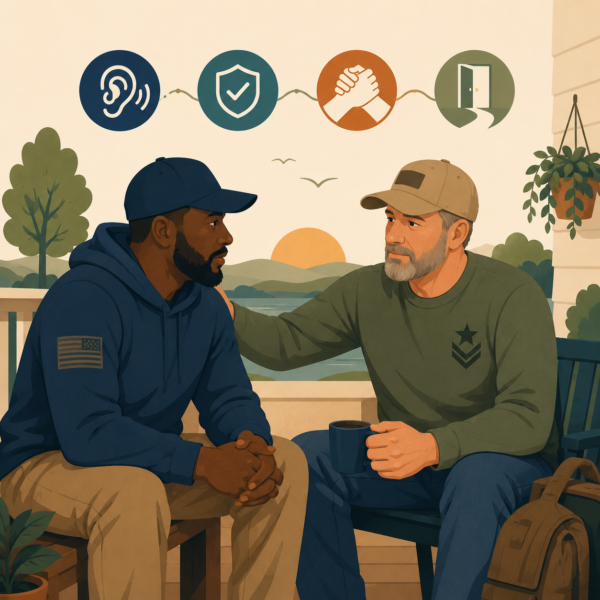 Organizations that consistently reach veterans who distrust clinical language rarely rely on periodic awareness campaigns alone. Instead, they build prevention communication into the routine operations of the agency, treating it as a long-term organizational capability that evolves alongside the communities they serve. Maintaining that capability requires continuous learning from evaluation data, ongoing support for peer voice initiatives, active relationships with trusted community organizations, and communication practices that adapt as veteran perspectives and needs change over time.
Sustaining this level of communication maturity also requires organizational commitment. Prevention communication is most effective when agencies dedicate staff time to communication planning, invest in peer voice program development, regularly evaluate communication outcomes, and reinforce the importance of prevention messaging through leadership, policies, and day-to-day operations. Without these elements working together, even well-designed communication strategies can lose momentum, partner relationships can weaken, and community trust can gradually decline.
For many veterans services agencies, building and maintaining this type of communication infrastructure requires capabilities that extend beyond traditional program administration. Agencies often choose to partner with external communication specialists such as Stegmeier Consulting Group (SCG) because developing sustainable communication systems requires specialized expertise in communication strategy, audience research, message design, partner engagement, and performance evaluation that complements the agency’s expertise in behavioral health and veterans services.
Rather than focusing solely on individual campaigns or communication materials, SCG works alongside veterans services agencies to strengthen the entire prevention communication ecosystem. Support may include developing language guidelines that resonate with veteran audiences, designing peer voice programs, preparing community partners to reinforce prevention messages, embedding communication practices throughout agency operations, and creating evaluation frameworks that measure communication effectiveness and support continuous improvement.
As these capabilities become integrated into everyday operations, prevention communication becomes more consistent, more trusted, and easier to sustain over time. SCG helps agencies establish communication standards, governance practices, and repeatable implementation processes that allow prevention messaging to remain effective even as staff, programs, and community needs evolve.
The goal is to create a prevention communication system that veterans recognize as authentic, relevant, and worthy of their trust. When communication becomes an enduring organizational capability instead of a series of isolated initiatives, agencies are better positioned to encourage help-seeking, strengthen community partnerships, and support better long-term outcomes for veterans and their families.
Future Trends in Veterans Suicide Prevention Communication
The landscape of veteran suicide prevention communication is evolving in response to research advances, technological change, demographic shifts in the veteran population, and a growing body of evidence about what communication approaches produce meaningful behavioral outcomes for resistant populations. Several trends deserve sustained attention from agencies planning prevention communication strategies over the coming years.
Digital and social media platforms are becoming the primary information environment for younger veteran cohorts, and prevention communication strategies that are not designed for these platforms are systematically missing the fastest-growing segment of the veteran population. Social media prevention communication requires specific design considerations that are different from print or broadcast communication, including the visual and narrative formats that perform well in social media environments, the algorithmic dynamics that determine what content is seen by which audiences, and the community norms of specific platforms that shape how health and wellbeing content is received. Agencies that develop genuine social media prevention communication capacity, rather than simply posting institutional content in social media formats, will reach younger veterans in the environments where they spend significant daily time.
Research on the neurobiological and psychological mechanisms of stigma reduction is producing increasingly specific guidance about which communication approaches produce durable attitude change versus which produce temporary information updates that do not affect behavior. Agencies that stay current with this research and design prevention communication based on the mechanisms most likely to produce durable behavioral change rather than momentary awareness will be more effective over time. The field of health communication is advancing rapidly in its ability to specify the conditions under which messaging produces the outcomes it is designed to produce, and veteran prevention communication should benefit from these advances.
The demographic diversification of the veteran population, including the growing proportions of women veterans, veterans of color, and veterans from non-combat occupational specialties, is creating prevention communication needs that are not fully addressed by communication frameworks designed for the dominant cultural profile of earlier veteran cohorts. Women veterans, in particular, face a prevention communication environment that has historically been calibrated for male veterans and that often fails to speak to the specific experiences, cultural frameworks, and barriers to help-seeking that characterize women’s experiences of military service and its aftermath. Agencies that invest in developing prevention communication specifically designed for the demographic segments of the veteran population that are most underserved by current communication approaches will be both more equitable and more effective as the veteran population continues to diversify.
Conclusion
The veteran who is carrying the weight of a psychological struggle that is quietly becoming unbearable, who has not sought support because the language of available resources signals that those resources are not for people like them, and who has no reason to believe that reaching out would be worth the personal cost the cultural narrative assigns to it, is not beyond reach. They are beyond the reach of prevention communication that has not been designed for them. They are within reach of prevention communication that speaks their language, honors their values, uses their peers as its primary messengers, and is woven so thoroughly into the ordinary fabric of their community life that crisis resources feel familiar and accessible rather than foreign and alarming.
Designing that communication is not simple, and sustaining it requires organizational commitment that goes beyond any single program or campaign. But the design principles are clear, the evidence base is substantial, and the stakes are high enough to justify the investment. Veterans who served this country deserve a prevention communication environment that meets them where they are and reaches them before the crisis rather than after. Building that environment is among the most important communication investments a veterans services agency can make.
SCG’s Strategic Approach to Communication Systems
Stegmeier Consulting Group’s work with veterans services agencies on prevention communication reflects the core principle that guides all of SCG’s communication work with public agencies: effective communication is designed for the specific audience it is trying to reach, grounded in genuine understanding of that audience’s values, concerns, and information environment, and measured against behavioral outcomes rather than communication activity. For prevention communication specifically, this means building systems that produce the ambient awareness, the reduced stigma, and the normalized help-seeking culture that make a difference in veteran lives rather than systems that produce the appearance of prevention communication activity without the underlying impact.
SCG brings a structured, research-informed approach to every dimension of prevention communication system development, from initial audience analysis and communication principle development through message design, peer voice infrastructure, community partner training frameworks, embedded communication protocols, and evaluation system design. Agencies that partner with SCG on prevention communication strategy build communication systems that work for veterans rather than communication programs that work for the agency’s reporting requirements. The investment produces prevention communication that veterans encounter, recognize as relevant, and are more likely to act on when they need to, which is the only outcome measure that matters.
The practical work of building prevention communication infrastructure is demanding, and no agency can accomplish it alone or all at once. SCG’s approach is to identify the highest-leverage communication investments available to an agency given its resources, its veteran population profile, and its current communication capacity, and to build the strategy from those highest-leverage points outward. The result is a prevention communication system that produces meaningful impact from the beginning while building the comprehensive infrastructure that produces maximum impact over time.
Use the form below to connect with our team and explore how strategic prevention communication can help your agency strengthen veteran engagement, encourage earlier help-seeking, and build a more effective suicide prevention communication system.