
How Veterans Services Agencies Can Explain the Difference Between VA Healthcare Enrollment and VA Disability Compensation
Among the most consequential and most persistent points of confusion in the veterans services landscape is the confusion between VA healthcare enrollment and VA disability compensation. These are two distinct systems: distinct in purpose, distinct in eligibility requirements, distinct in what they provide, distinct in how they are accessed, and distinct in the organizations within the VA that administer them. Yet they are routinely confused with each other by veterans across service eras, educational backgrounds, geographic regions, and levels of prior VA experience. Veterans who confuse them make real decisions based on the confusion, and those decisions have real consequences for their access to significant financial and health benefits.
The forms this confusion takes in the real world are numerous and varied, and each form produces different harm. Some veterans believe that applying for VA healthcare enrollment is the same as filing for disability compensation, and having done one, they assume they have done both. These veterans are receiving healthcare but foregoing the monthly compensation that a disability rating would provide. Other veterans believe that a disability rating is required to enroll in VA healthcare, and having been told they do not qualify for a disability rating or having never filed for one, they have never sought healthcare enrollment, forgoing access to a comprehensive health system that many of them are eligible for at little or no cost. Still others believe that VA healthcare is exclusively for veterans who were physically injured in combat, and having served in support roles or in peacetime periods, they have excluded themselves from consideration for a program they may well qualify for.
Each of these misconceptions is specific enough to be addressed directly with accurate information, and each of them represents a population of veterans whose access to significant benefits is being blocked by a communication failure rather than by an eligibility failure. The VA system did not deny these veterans benefits. Communication about the system failed to accurately convey what the system offers and who qualifies. That failure is correctable, and correcting it through strategic communication is one of the most high-value investments a veterans services agency can make in expanding veteran access to the benefits they have earned.
This article provides a comprehensive framework for how veterans services agencies can design, deliver, and sustain communication that clearly distinguishes VA healthcare enrollment from VA disability compensation across every channel and every interaction through which veterans engage with the agency. It addresses the specific mechanisms through which the confusion persists and is reinforced, the principles that govern effective distinction-making communication, the specific messages and formats that produce accurate understanding, the staff training required for consistent delivery, the digital and print communication design that makes the distinction visually and structurally clear, the unique communication needs of specific veteran populations for whom the confusion takes specific forms, and the organizational measurement approaches that assess whether the communication investment is producing the access improvements it is designed to produce.
The stakes of getting this communication right are significant. VA disability compensation provides monthly financial support that, at meaningful rating levels, can substantially improve the economic stability of veterans with service-connected conditions. VA healthcare provides access to a comprehensive health system that represents the primary healthcare resource for many veterans who lack affordable alternatives. Veterans who miss either of these systems because of a communication failure are experiencing concrete and consequential harm. The investment in communication that prevents that harm is an investment in the actual wellbeing of the people the agency exists to serve.
Understanding the Two Systems in Their Own Terms
 Before any communication about the distinction between VA healthcare enrollment and VA disability compensation can be effective, the communicator must have an accurate and thorough understanding of each system in its own terms. Incomplete or imprecise understanding of either system produces communication that is either too simplified to be accurate or too complex to be accessible. The goal is a deep enough understanding of each system to be able to describe it accurately in plain terms, address common misconceptions directly, and explain the relationship between the systems without conflating them.
VA healthcare enrollment is the mechanism through which eligible veterans gain access to the VA health care system. Once enrolled, veterans can receive medical care at VA medical centers and community-based outpatient clinics, through telehealth platforms, and through community care providers authorized by the VA when VA facilities cannot provide the needed care conveniently. The system offers primary care, specialty care, mental health services including both inpatient and outpatient options, preventive care, prescription medications, dental care in limited circumstances, and a range of other services. What is available to any individual veteran depends on their priority group, the specific facilities serving their area, and their eligibility for specific program components.
The most important fact about VA healthcare enrollment for communication purposes is that it does not require a service-connected disability rating. Veterans who have served on active duty and been discharged under conditions other than dishonorable are generally eligible to enroll in VA healthcare, subject to priority group assignment based on factors including disability rating, income, and specific service characteristics. Veterans without any service-connected disability can enroll and receive care. Veterans with service-connected disabilities receive priority enrollment and enhanced benefits within the healthcare system based on those disabilities. The two pathways to enrollment, through service-connected disability status and through service history without disability rating, are both real and both significant, and communication that presents service-connected disability as a requirement for healthcare enrollment is communicating an inaccuracy that prevents otherwise eligible veterans from enrolling.
VA disability compensation is a fundamentally different program with a fundamentally different purpose. It is a monthly financial benefit paid to veterans whose health conditions are recognized by the VA as service-connected, meaning that the conditions were caused by, occurred during, or were aggravated by military service. The compensation amount is determined by a disability rating, expressed as a percentage from zero to one hundred in ten-percentage-point increments, that reflects the aggregate severity of all service-connected conditions. Higher ratings produce higher monthly compensation amounts, with additional amounts available for veterans with dependents and for veterans at the highest rating levels. The disability rating also affects a veteran’s priority group for VA healthcare, their eligibility for specific VA programs, and in some cases their access to other federal and state benefits.
The service connection determination is the eligibility element that makes disability compensation fundamentally distinct from healthcare enrollment. Healthcare enrollment requires service history. Disability compensation requires both service history and a VA determination that specific health conditions are related to that service. The VA makes this determination through the disability claims process, which involves reviewing the veteran’s service records and medical history, potentially requiring a Compensation and Pension examination, and issuing a rating decision that either grants or denies service connection for each claimed condition and assigns a rating percentage to each granted condition. This process is separate from the healthcare enrollment process, takes substantially longer, and produces a different kind of outcome: not access to healthcare services but a monthly cash benefit.
The Priority Group System and Its Role in the Confusion
The VA healthcare priority group system is a significant contributor to the confusion between healthcare enrollment and disability compensation because it creates a real relationship between disability rating and healthcare benefits that can be misinterpreted as a dependency between the two systems. Veterans with higher disability ratings receive better priority group placement in the healthcare system, which means lower or no copayments, more comprehensive coverage, and in some circumstances priority access to scarce healthcare resources. This real relationship between disability rating and healthcare benefits quality leads some veterans to conclude incorrectly that a disability rating is required to access any VA healthcare at all.
Communication about the priority group system must convey two things simultaneously: that disability rating affects the level of healthcare benefits a veteran receives within the VA system, and that the absence of a disability rating does not preclude healthcare enrollment. Veterans with no disability rating can enroll in the VA healthcare system and receive meaningful healthcare benefits, though they may be in a lower priority group than veterans with disability ratings and may pay copayments for care of conditions that are not service-connected. The priority group distinction is real and matters for what healthcare costs a veteran and what access priority they have, but it is not an eligibility distinction that excludes unrated veterans from the system.
Explaining the priority group system in plain language requires specific attention to the common misreadings of the system that the confusion generates. A veteran who is told that they are in priority group seven or eight because they have no service-connected disability may interpret this information as meaning that they are in a low-priority category that does not receive meaningful benefits. Accurate communication clarifies that all priority groups have access to the VA healthcare system and that the priority group designation affects copayments and access priority rather than enrollment eligibility. A priority group seven veteran who understands that they are enrolled in VA healthcare and can access VA medical care with standard copayments for non-service-connected conditions is in a fundamentally better position than a priority group seven veteran who understood their group placement to mean that the VA has determined they are not really eligible for meaningful benefits.
Serving Those Who Served: Communication Strategies for Veterans Agencies
This article is part of our series on strategic communication for Veterans Services Agencies, County Veterans Services Offices, State Departments of Veterans Affairs, and community-based veteran support organizations. To learn more and to see the parent article, which links to other content just like this, click the button below.
The Interaction Between the Two Systems
VA healthcare enrollment and VA disability compensation are distinct systems, but they interact with each other in specific ways that veterans benefit from understanding, and that communication must convey accurately without allowing the interaction to be misread as evidence that the systems are the same thing. The relationship between the systems is one of interaction rather than identity, and maintaining that conceptual distinction while explaining the specific interactions is a communication challenge that requires deliberate attention to framing.
The most significant interaction between the two systems is that disability compensation rating affects healthcare enrollment priority and copayment structure. Veterans with service-connected disability ratings of 50 percent or higher receive priority group 1 or 2 placement in the healthcare system, which means no copayments for any VA care and enhanced access to VA healthcare resources. Veterans with lower ratings receive priority placement based on their specific rating level and service-connected conditions. Veterans without service-connected ratings are placed in priority groups 7 or 8 based primarily on income criteria and pay copayments for care of non-service-connected conditions. Communicating this interaction accurately means explaining that the disability rating enhances healthcare benefits for veterans who have one, not that healthcare enrollment depends on having one.
A second interaction involves the application process: applying for disability compensation often initiates a process that results in enhanced healthcare enrollment benefits for veterans who are already enrolled, or in enrollment for veterans who were not previously enrolled, because the disability rating that results from a successful claim improves the veteran’s priority group. Veterans who have applied for disability compensation should understand that the outcome of that process may affect their healthcare situation even if they did not apply for healthcare specifically. Communicating this interaction proactively, rather than leaving veterans to discover it after the fact, ensures that veterans approach both processes with accurate expectations about how they relate.
The third interaction involves specific healthcare services that are available to veterans with service-connected conditions within the healthcare system at no cost, regardless of priority group. Veterans enrolled in VA healthcare receive care for their service-connected conditions without copayments even if they are in a lower priority group for other care. This interaction is valuable for veterans with service-connected conditions who are uncertain about whether to enroll in VA healthcare because they are concerned about costs, and communicating it clearly removes a specific financial concern that may be preventing enrollment decisions.
Why the Confusion Persists Across the Veteran Population
Understanding why the confusion between VA healthcare enrollment and VA disability compensation is so persistent despite decades of efforts to communicate about the VA benefits system, requires looking beyond the content of specific communications to the structural and contextual factors that create and maintain the confusion. The persistence of the confusion is not simply a function of inadequate communication effort. It reflects specific structural features of the VA system, specific characteristics of the information environment in which veterans receive information about VA benefits, and specific cognitive patterns in how people process complex systems information.
The structural features of the VA system that contribute to the confusion begin with the fact that both programs are administered by the same broad organization, the Department of Veterans Affairs, and that the two programs’ points of contact are often co-located or closely affiliated in ways that make their distinctness less visible. A veteran who visits a VA medical center for healthcare may be directed by the same staff member to a benefits counselor who handles disability compensation questions, creating the impression that the two are part of a single integrated system that operates differently depending on the veteran’s situation rather than two distinct programs with distinct eligibility and access pathways. This co-location is operationally efficient but communicatively confusing without explicit messaging that maintains the distinction.
The information environment in which veterans receive information about VA benefits is a second major contributor to the confusion’s persistence. Veterans form their understanding of VA benefits primarily through peer networks rather than through formal agency communications. Information transmitted through peer networks is accurate about individual experiences but often incomplete or inaccurate as a general account of program eligibility and structure. A veteran who hears from a fellow veteran that ‘the VA provides healthcare and disability payments’ has received information that is accurate but that does not convey the distinctness of the two systems, their different eligibility requirements, or the fact that accessing one does not automatically confer access to the other. The peer network is the most trusted information source in the veteran community, and the information it transmits is often the information that shapes veteran understanding most deeply, regardless of the accuracy of that information at the level of detail that matters for benefit access decisions.
The cognitive dimension of the confusion’s persistence involves the way people naturally process information about complex systems they have not previously encountered. When encountering an unfamiliar institutional system, people tend to assimilate new information to the frameworks they already have, creating coherent mental models that may not be accurate but that allow them to navigate the system with the feeling of understanding. A veteran who encounters information about both VA healthcare and VA disability compensation simultaneously tends to integrate them into a single mental model of ‘VA benefits’ rather than maintaining them as conceptually distinct programs with distinct eligibility and access pathways. This integration is cognitively natural and organizationally rational from the veteran’s perspective, but it produces a mental model that will generate specific errors in specific benefit access situations.
The Specific Forms the Confusion Takes
The confusion between VA healthcare enrollment and VA disability compensation takes several specific forms that are worth identifying individually because each form requires a specifically tailored communication response. Treating all manifestations of the confusion as a single undifferentiated problem produces generic communications that are relevant to none of the specific forms and effective for reaching none of the specific veteran populations that each form affects.
The first specific form is the assumption-of-identity confusion, in which veterans believe that the two programs are fundamentally the same thing described in different terms. Veterans who hold this belief may have applied for one and assumed they have applied for both, or may be avoiding one because they had a bad experience with the other. Communication for this population needs to establish the fundamental distinctness of the two programs before providing any specific information about either, because specific information about programs the veteran has mentally merged will be processed as additional information about a single merged program rather than as information about two separate programs.
The second specific form is the prerequisite confusion, in which veterans believe that one program requires the other as a condition of eligibility. The most common version is the belief that a disability rating is required for healthcare enrollment. The less common but also significant version is the belief that healthcare enrollment is required before filing for disability compensation. Both versions are incorrect, and both versions produce specific access barriers. Veterans who believe disability rating is required for healthcare enrollment delay or forgo enrollment decisions they could make immediately. Veterans who believe healthcare enrollment is required before filing disability compensation delay claims filing while they pursue an enrollment process they believe must precede it.
The third specific form is the substitution confusion, in which veterans believe that receiving benefits from one program substitutes for the need to access the other. This form is most common among veterans who receive VA healthcare and who conclude that the VA has therefore addressed their service-connected conditions, not understanding that the disability compensation system provides financial recognition of service-connected conditions separately from the medical care that treats them. Veterans in this situation are often unaware that they may be entitled to monthly financial compensation for conditions the VA is already treating, and communicating about this specific form of the confusion requires framing that does not imply the veteran has been negligent in not understanding it.
Designing Communication That Makes the Distinction Clear
Effective communication about the distinction between VA healthcare enrollment and VA disability compensation requires more than accurate information presented in accessible language. It requires a communication design that makes the distinctness of the two programs structurally visible to the reader before the content of each program is engaged, that addresses the specific forms of confusion most prevalent in the veteran audience being served, and that is delivered proactively rather than reactively so that veterans encounter accurate information before they have formed inaccurate beliefs that subsequent communication must then overcome.
The communication design principle that is most important for this purpose is the distinction-first principle: before any specific information about either program is communicated, the communication should establish clearly and explicitly that the two programs are distinct, that they serve different purposes, that they have different eligibility requirements, and that accessing one does not automatically grant access to or require access to the other. This distinction-first framing provides the conceptual architecture within which all subsequent specific information about each program can be accurately received. Without this architecture, specific information about one program may be incorrectly applied to the other by readers who have not yet established the programs’ distinctness in their mental models.
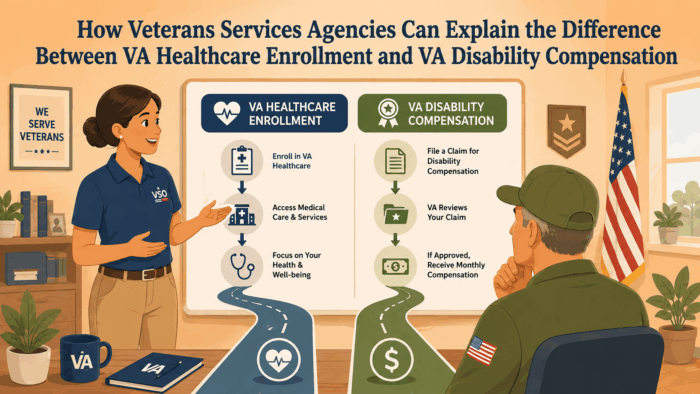
The side-by-side comparison format is the most effective structural implementation of the distinction-first principle. A comparison that presents the two programs in parallel columns or panels, organized around the same set of questions answered for each program, makes the distinction between the programs structurally visible rather than requiring the reader to infer distinctness from prose descriptions of each program that appear in separate sections of the document. The parallel structure signals that the reader is looking at two things rather than two descriptions of one thing, and the visual separation reinforces the conceptual separation that the comparison is designed to establish.
The comparison should be organized around the questions that most directly address the forms of confusion that are most prevalent in the intended audience. The questions that most effectively clarify the distinction include: what does this program provide, who is eligible, how do you apply, how long does the process take, what does approval look like and what does it give you, and what does this program not provide? The ‘what it does not provide’ question is particularly important for this comparison because a significant portion of the confusion involves veterans attributing to one program something that is actually provided by the other, and explicit statements of what each program does not provide directly address this source of confusion.
Addressing the Most Common Specific Misconceptions
Beyond the general distinction-first communication design, effective communication about the VA healthcare versus disability compensation distinction must directly address the specific misconceptions that produce the most consequential access barriers. These misconceptions are identifiable from the patterns of inquiry at CVSO offices and from research on veteran knowledge of VA benefits, and addressing them explicitly rather than hoping that general clarity will prevent them is consistently more effective.
The misconception that requires the most direct and explicit communication is the belief that disability rating is required for VA healthcare enrollment. This misconception is so consequential, blocking potentially eligible veterans from a comprehensive healthcare system, and so persistent despite decades of communication about VA benefits, that it deserves not just a mention but a prominent, explicit, and repeated communication that directly states the accurate information: you do not need a service-connected disability rating to enroll in VA healthcare. If you served on active duty and were discharged under other than dishonorable conditions, you may be eligible to enroll in VA healthcare right now, regardless of whether you have ever filed a disability claim or received a rating. This statement, delivered prominently and repeatedly in appropriate contexts, is the most direct available communication intervention for the most consequential form of the VA healthcare enrollment access barrier.
The misconception that applying for VA healthcare initiates a disability claim requires equally direct communication because it affects access in two distinct ways. Veterans who believe this may seek healthcare enrollment expecting to receive disability compensation that will never come, and veterans who feel unprepared to file a disability claim may avoid healthcare enrollment specifically to avoid initiating what they think will be a claims process. The direct communication is clear and simple: applying for VA healthcare and filing for VA disability compensation are two separate processes that you can pursue independently in any order. Applying for healthcare does not file a disability claim. Filing a disability claim does not enroll you in healthcare. You can do one, both, or neither independently, and starting one does not require or commit you to the other.
The misconception that disability compensation is limited to combat injuries is particularly prevalent among veterans from service eras and occupational specialties where combat exposure was limited, and among veterans whose service-connected conditions developed after service rather than being the direct result of identifiable in-service injuries. The direct communication for this misconception names the range of conditions that can be service-connected: conditions caused by occupational exposures during service, hearing loss from equipment noise, respiratory conditions from burn pit exposure, musculoskeletal conditions from the physical demands of service, mental health conditions caused or aggravated by service experiences, and conditions that developed after service as secondary effects of service-connected conditions. Naming this range concretely, rather than describing it in abstract terms, gives veterans from diverse service backgrounds the information they need to assess their own potential eligibility.
The Written Side-by-Side Comparison Tool
The written side-by-side comparison of VA healthcare enrollment and VA disability compensation is one of the most universally useful communication tools for agencies that want to address the confusion between these programs across the full range of their veteran-facing communications. When well designed, it functions simultaneously as a myth-busting tool, an orientation document for veterans approaching the VA system for the first time, a reference resource for veterans who have partial knowledge and want to fill in the gaps, and a communication asset that can be adapted for use across multiple formats and channels.
The comparison should be organized around a consistent set of question rows that apply equally to both programs, allowing the reader to directly compare the programs’ answers to the same questions. The question rows that produce the most useful comparisons include: what is this, what does it provide, who is eligible, how do you apply, how long does the process take, what does approval mean in concrete terms, how do the two programs relate to each other, and what does this program not do. Each of these rows should be completed for each program in plain language that prioritizes the veteran’s informational needs over administrative completeness.
The visual design of the comparison should use clear visual differentiation between the two programs, different color treatments or column headers that are visually distinct enough that the separation between the programs is apparent even to readers who are scanning rather than reading closely. Headers that clearly name each program should appear at the top of each column or panel, and the same headers should remain visible as the reader moves through the comparison so that context is maintained throughout. The design should be clean enough that the content does not compete with the structure for the reader’s attention, but distinctive enough that the structure itself conveys the fundamental message: these are two different things.
The comparison document should be available in both a brief version suitable for quick reference and distribution at outreach events, and a more detailed version that provides more complete information for veterans who want to go deeper. The brief version, covering the most essential distinctions in a format that can be read in five minutes, serves the initial orientation function. The detailed version, covering the same distinctions with more complete information about eligibility nuances, application processes, and program interactions, serves the research function for veterans who are ready to engage more deeply with one or both programs. Both versions should point to each other and to additional resources, creating a linked communication ecosystem rather than standalone documents that provide all their information in isolation.
Delivering the Distinction Through Every Contact Point
 The most carefully designed communication materials for distinguishing VA healthcare enrollment from VA disability compensation produce no benefit for veterans who never encounter them. Ensuring that accurate information about the distinction between these two programs reaches veterans across the full range of contexts in which they engage with veterans services agencies requires deliberately building the distinction into every contact point the agency has with veterans, rather than confining the distinction-making communication to dedicated materials that veterans must specifically seek out.
The intake appointment is the most important single contact point for delivering the distinction, because it is often the first substantive interaction a veteran has with veterans services and because the mental model that veterans form during the intake appointment shapes how they receive all subsequent information about VA benefits. A CVSO representative who establishes the distinction between VA healthcare enrollment and VA disability compensation clearly and explicitly during the intake conversation, before any program-specific information is introduced, is providing the conceptual architecture that allows all subsequent program-specific communication to be accurately received. This requires no additional time in the intake appointment. It requires a brief, specific framing statement: ‘Before we get into the specifics of what you are here for, I want to make sure we’re clear on the difference between two things the VA offers, because they are often confused. VA healthcare enrollment and VA disability compensation are two separate programs with different purposes, different eligibility requirements, and different application processes. Applying for one does not mean you have applied for the other, and you may be eligible for both independently.’
Community outreach events, including veterans resource fairs, VSO post meetings, and community information sessions, are contact points where the distinction can be delivered to veterans who have not yet engaged with the formal veterans services system and who are most likely to be operating with incomplete or inaccurate initial mental models about VA benefits. A brief, organized presentation at a community event that establishes the distinction between VA healthcare enrollment and VA disability compensation before discussing either program in detail provides the foundational orientation that allows subsequent specific information about each program to be accurately received.
The agency’s website and digital communication channels should reflect the distinction in their navigational architecture as well as in their content. Website navigation that clearly separates VA healthcare information from VA disability compensation information, with explicit labeling that makes the distinction structurally visible before any content is engaged, is more effective than navigation that groups both under a general ‘VA benefits’ category that requires the reader to infer distinctness from within a unified section. The distinction-first principle applies to digital communication design as directly as it applies to print communication design.
Printed materials including brochures, fliers, and one-pagers that are distributed at outreach events and at CVSO offices should routinely include a brief statement of the distinction between VA healthcare enrollment and VA disability compensation, either as a dedicated section or as a prominent callout that appears in materials discussing either program. Even a single sentence that says ‘VA healthcare enrollment and VA disability compensation are two separate programs. Enrolling in one does not enroll you in the other’ is a communication intervention that reaches veterans who receive the material without requiring them to engage with detailed program information first.
Staff Training and Communication Consistency
The quality of communication about the distinction between VA healthcare enrollment and VA disability compensation in direct veteran interactions depends on the knowledge and communication skill of the staff members conducting those interactions. Even the best-designed printed materials and digital communications can be undermined by staff interactions that introduce inconsistencies, reinforce misconceptions through imprecise language, or fail to proactively address the confusion before it leads veterans to incorrect assumptions. Consistent, accurate staff communication requires training that goes beyond basic factual knowledge to encompass the specific communication techniques that are most effective for addressing the specific forms of confusion that veterans bring to their interactions.
Staff training for this communication challenge must begin with the foundational knowledge that all staff who interact with veterans should possess about both programs. This includes the eligibility requirements for each program in their accurate form, the application process for each program and the distinct channels through which each is accessed, the nature of the benefit each program provides, the priority group system and how it relates to disability rating without creating a dependency between rating and enrollment, and the specific circumstances where the two programs interact and how those interactions work. Staff who have gaps in this foundational knowledge will communicate inaccurately in ways they may not recognize, because they do not know what they do not know.
Beyond foundational knowledge, training should address the specific communication techniques that are most effective for proactively addressing the distinction in veteran interactions. These techniques include the framing statement that establishes the distinction before program-specific information is introduced, the direct responses to the most common misconceptions that allow staff to address those misconceptions when they arise without lengthy explanation, the language choices that most clearly and simply convey the distinctness of the two programs, and the follow-up questions that allow staff to verify that a veteran has understood the distinction accurately before proceeding with more detailed program-specific guidance.
Role-playing exercises that simulate the specific scenarios in which the confusion most commonly arises are more effective for developing staff communication skills than didactic presentation of the relevant information. A staff member who has practiced the framing statement in a simulated intake conversation is more likely to use it in an actual intake conversation than a staff member who read about it in a training document. Simulated scenarios should include the most common misconception presentations so that staff have direct practice responding to them before encountering them in actual veteran interactions.
Consistency in staff communication across all staff members who interact with veterans is as important as the accuracy of any individual staff member’s communication. Veterans who receive different information about the distinction between VA healthcare enrollment and VA disability compensation from different staff members in the same office are more confused after their multiple interactions than they would have been after a single accurate interaction. Regular calibration conversations among staff that identify and address communication inconsistencies, combined with clear organizational standards for how specific topics are communicated, reduce the inter-staff variation that produces this compounding confusion.
Communicating With Specific Veteran Populations
The confusion between VA healthcare enrollment and VA disability compensation takes different specific forms in different veteran populations, and agencies that serve diverse veteran communities need to develop communication approaches that are calibrated to the specific forms of confusion most prevalent in each population segment they serve. Generic communication that addresses the most common forms of confusion without accounting for population-specific variations will be effective for some veterans and less effective for others, producing inequitable outcomes in communication reach across the diversity of the veteran community.
Veterans transitioning out of active duty in the near term represent a population that is at maximum openness to accurate initial information about VA benefits and at maximum risk for forming inaccurate initial mental models if that accurate information is not provided at transition. Communication at transition should establish the distinction between VA healthcare enrollment and VA disability compensation as a clear and explicit foundation of the veteran’s initial understanding of the VA benefits landscape, before any program-specific information is introduced. Transition assistance programs that dedicate explicit attention to establishing this distinction from the beginning are producing veterans who approach the VA system with accurate foundational mental models rather than veterans who must unlearn inaccurate models before they can benefit from accurate program-specific communication.
Older veterans from the Vietnam era and earlier are a population in which specific historical experiences with the VA system and with the relationship between military service and government benefits shape the forms of confusion in ways that require specific communication sensitivity. Veterans from this era who had poor experiences with the VA system may have formed inaccurate beliefs about the VA’s willingness to provide healthcare to veterans without service-connected disabilities, based on historical practices that may have been less inclusive than current eligibility rules. Communication for this population must acknowledge the historical context while accurately conveying current eligibility rules, and must do so in ways that give the veteran reason to believe that the current situation genuinely differs from what they may have experienced in the past.
Women veterans are a population for whom the VA healthcare versus disability compensation confusion has specific dimensions related to the historical experience of women in the military and in the VA system. Women veterans are statistically less likely to have been reached by accurate VA benefits information at transition and are less likely to identify themselves as veterans in community contexts where veterans services information is distributed. Communication strategies for women veterans must extend beyond standard veterans services channels to reach women veterans in the spaces where they are present, and must include specific acknowledgment of women’s health services available through VA healthcare enrollment, since awareness of these services is itself a driver of enrollment decisions for women veterans.
Rural veterans present communication challenges related both to geographic access to accurate information and to specific features of rural veteran culture that affect how VA benefits information is received. Rural veterans are often less connected to CVSO offices and VA healthcare facilities than their urban counterparts, and their information about VA benefits is more likely to come primarily through peer networks and secondhand accounts that may include significant inaccuracies. Communication strategies for rural veterans must extend into the community channels through which rural veterans receive information, including local media, community organizations, agricultural extension services in farming communities, and faith communities with significant veteran membership.
Addressing Specific Interaction Concerns
A specific communication challenge that arises frequently in conversations about VA healthcare enrollment and VA disability compensation involves veterans who are concerned that pursuing one program will negatively affect their access to or benefits from the other. These concerns are generally not well founded for most program interactions, but they are real concerns that prevent real benefit access decisions, and dismissing them without engaging with them substantively is less effective than addressing them with the specific accurate information that resolves them.
The concern that applying for disability compensation will somehow affect existing VA healthcare enrollment is among the most common and most unfounded of these interaction concerns. A disability compensation claim and its outcome, whether approval or denial, does not affect a veteran’s enrollment in VA healthcare. An approved claim that results in a disability rating may improve the veteran’s priority group and enhance their healthcare benefits, but it does not create any risk to their existing enrollment. A denied claim has no effect on healthcare enrollment. Veterans who are hesitant to file disability claims because they fear losing their existing healthcare access are operating under a misconception that direct and specific communication can correct.
The concern that enrolling in VA healthcare will create records that could harm a disability claim, particularly for mental health conditions, is a more complex concern that intersects with the clearance and firearms concerns addressed in a separate article in this series. For the specific purpose of addressing the healthcare enrollment versus disability compensation distinction, the relevant communication is that healthcare enrollment creates medical records that can be used as evidence in a disability claim, which is generally a benefit to the claim rather than a harm. Medical records of treatment for a condition are evidence that the condition exists and is being treated, which is relevant and often helpful evidence in a disability compensation claim. Veterans who are avoiding healthcare enrollment because they fear the medical records it creates will harm their claims are making decisions that are likely to harm rather than help their claims.
The concern that the financial benefits of disability compensation will affect eligibility for VA healthcare, or vice versa, reflects the understandable confusion of someone trying to navigate multiple government benefit programs without a clear picture of how they relate. The accurate and reassuring answer is that VA disability compensation income is excluded from the income calculations used to determine VA healthcare priority groups for veterans who are already entitled to compensation. Compensation income does not push a veteran into a lower priority group. Veterans who are receiving both programs simultaneously are in a stable benefit arrangement that does not require them to choose between the programs or to manage their income in ways that protect their healthcare access.
Measuring Communication Effectiveness
Veterans services agencies that invest in communication designed to reduce the confusion between VA healthcare enrollment and VA disability compensation should also invest in measuring whether that communication is producing the intended outcomes. Without measurement, agencies are assuming their communication is effective rather than knowing it, and assumptions about communication effectiveness are frequently wrong in ways that measurement would reveal and that evidence-based adjustment could correct.
The most direct measurement approach for this specific communication challenge is veteran knowledge assessment: surveying veterans who have recently interacted with the agency to determine whether they can accurately distinguish the two programs and accurately identify their own eligibility for each. A simple assessment instrument that asks veterans to describe in their own words the difference between VA healthcare enrollment and VA disability compensation, and to indicate whether they believe they are currently accessing each program, provides direct evidence of whether communication is producing accurate understanding. Comparing results across veterans who received specific distinction-making communication with veterans who did not provide direct evidence of whether the communication intervention is working.
Behavioral measures, including rates of VA healthcare enrollment among veterans who interact with the agency, rates of disability compensation claim filing, and rates of veterans who are accessing both programs among those who are eligible for both, provide complementary evidence of whether communication-driven understanding is translating into access behavior. An agency whose distinction-making communication is consistently producing accurate understanding but not producing corresponding increases in access behavior may be missing a process barrier between understanding and action that additional communication or process support could address.
Staff communication auditing, through observation of intake appointments and outreach presentations to assess whether the distinction is being delivered consistently and accurately across all staff who interact with veterans, provides evidence about whether the communication system is functioning as designed at the point of delivery. Even the best-designed system produces no outcomes if the delivery is inconsistent, and regular auditing that identifies and addresses delivery gaps is an essential quality maintenance function for any communication system that depends on human delivery.
Tracking the specific misconceptions that veterans present in intake conversations and benefits counseling sessions over time provides a dynamic measure of where the communication system is failing to reach veterans with accurate information. If the prerequisite misconception, the belief that disability rating is required for healthcare enrollment, remains prevalent among veterans presenting for intake appointments despite agency communication designed to correct it, the agency has evidence that the communication designed to address this specific misconception is not reaching veterans before their intake appointment and should be delivered through additional or earlier channels.
Strategic Communication Support for Veterans Services Agencies
 Confusion between VA healthcare enrollment and VA disability compensation is rarely the result of a single unclear brochure, website page, or staff conversation. More often, it reflects a communication system that does not consistently reinforce the distinction across every point where veterans seek information. Addressing that challenge requires more than updating individual communication materials. It requires a coordinated communication strategy that is reflected in outreach, intake conversations, digital content, printed resources, staff training, and ongoing evaluation so veterans receive the same clear message regardless of how or where they interact with the agency.
When agencies evaluate their communication systems, they often find that confusion is reinforced through a series of small but consistent inconsistencies. Explanations may differ between staff members, outreach materials may assume veterans already understand the distinction, websites may separate related information without providing sufficient context, and communication channels may not consistently explain that eligibility for one program is independent of eligibility for the other. Over time, these communication gaps can discourage veterans from pursuing benefits they may be eligible to receive.
Designing a communication system that eliminates this confusion requires specialized expertise in audience research, communication strategy, message development, staff training, and performance measurement. Many veterans services agencies choose to partner with external communication specialists such as Stegmeier Consulting Group (SCG) because these capabilities complement the agency’s expertise in veterans’ programs and services while providing dedicated communication knowledge needed to build consistent, long-term communication systems across every channel and veteran interaction.
SCG partners with veterans services agencies to develop communication systems that address foundational benefit confusion at its source rather than responding to misunderstandings after they occur. Support may include assessing how and where confusion develops within the veteran population, designing communication frameworks and educational materials, strengthening staff training, improving message consistency across digital and in-person communication channels, and establishing measurement practices that evaluate whether communication efforts are improving veteran understanding and increasing benefit access.
SCG also helps agencies strengthen the broader communication environment in which veterans learn about VA benefits. By developing communication standards, repeatable workflows, governance practices, and coordinated messaging across outreach materials, websites, presentations, and frontline staff interactions, SCG helps agencies build communication systems that remain effective as policies evolve and veteran information needs change.
The goal is to create a communication environment in which veterans consistently understand the distinct purposes of VA healthcare enrollment and VA disability compensation, regardless of where they seek information or whom they speak with. When that distinction becomes embedded throughout an agency’s communication system rather than isolated within individual resources, veterans are better equipped to make informed decisions and access the full range of benefits available to them.
Future Trends in VA Benefits Communication Integration
The landscape of VA benefits communication is evolving in ways that will both complicate and potentially simplify the challenge of distinguishing VA healthcare enrollment from VA disability compensation for veterans who encounter the two programs simultaneously. Several trends deserve specific attention from agencies planning their long-term communication strategies for this distinction.
The VA’s ongoing digital transformation is creating new digital touchpoints through which veterans encounter information about VA benefits, and the design of those touchpoints has direct consequences for whether the distinction between VA healthcare enrollment and VA disability compensation is made clear or obscured by the digital experience. VA.gov and related digital platforms are increasingly the first point of contact for many veterans seeking information about VA benefits, and the navigational architecture and content design of those platforms either reinforces or undermines the distinction. Veterans services agencies that engage with the design of veteran-facing digital experiences, whether through advocacy for better VA digital communication or through development of complementary digital resources that fill gaps in the VA’s own digital communication, are contributing to the digital information environment that shapes veteran understanding.
The integration of AI-assisted benefits navigation tools is an emerging trend with significant implications for how veterans understand the relationship between VA healthcare enrollment and VA disability compensation. AI tools that are designed to help veterans identify their benefit eligibility and navigate benefit applications have the potential to either reinforce accurate understanding of the distinction between the two programs or to compress that distinction in ways that introduce new forms of confusion. Agencies evaluating or developing AI-assisted benefits navigation tools should assess how those tools represent the relationship between VA healthcare enrollment and VA disability compensation and should ensure that the distinction is maintained clearly in any AI-mediated communication about VA benefits.
The evolving regulatory landscape of VA benefits, including ongoing PACT Act implementation that is expanding disability compensation eligibility, creates new populations of veterans whose updated eligibility for disability compensation may also affect their healthcare priority group in ways that require new communication about how the two systems interact. As PACT Act presumptive conditions continue to be recognized and as new veterans file disability claims based on those conditions, the communication environment for VA benefits will need to evolve to address the specific interactions between expanded disability eligibility and healthcare benefits that these new claimants will encounter. Agencies that have built the communication infrastructure for explaining the distinction between VA healthcare enrollment and VA disability compensation accurately and consistently will be well positioned to extend that infrastructure to accommodate the specific communication needs that the PACT Act’s continuing implementation creates.
Conclusion
Two programs. Two separate applications. Two different kinds of benefits. Two different eligibility frameworks. Two different purposes. The distinction between VA healthcare enrollment and VA disability compensation is not technically complex, and accurately describing it does not require specialized expertise. What it requires is the commitment to make the distinction the foundational frame of every communication interaction veterans services agencies have with veterans about VA benefits, rather than something that is clarified only after the confusion has already formed and the access decisions that flow from that confusion have already been made.
Veterans who access only one of these programs when they are eligible for both, because communication about the distinction between them never reached them in a form they could act on, are veterans whose needs are being partially but not fully met. Getting communication right about this distinction is not a technical communication exercise. It is a direct investment in the wellbeing of veterans who have earned both programs and who deserve communication that makes both accessible to them.
SCG’s Strategic Approach to Communication Systems
Stegmeier Consulting Group’s communication systems work with veterans services agencies is built on the recognition that foundational communication failures, the kind that block access to significant benefits by leaving veterans with inaccurate mental models of the systems that serve them, require systemic responses rather than symptomatic fixes. The VA healthcare enrollment versus disability compensation confusion is a paradigmatic foundational communication failure, one that persists not because it is conceptually difficult but because the communication systems that should correct it have not been built with sufficient intentionality and comprehensiveness to reach veterans before the confusion forms.
SCG helps agencies build those communication systems comprehensively, from the intake appointment framing protocols that establish the distinction at first contact through the outreach materials that deliver it in community settings, the digital content that presents it to veterans who seek information online, the staff training that ensures consistent delivery across every human interaction, and the measurement infrastructure that tracks whether the investment is producing the access improvements it is designed to produce. The standard of success for this work is simple: veterans who interact with the agency understand the distinction between VA healthcare enrollment and VA disability compensation, and that understanding enables them to make informed decisions about accessing both programs they may be eligible for. That is the communication outcome that serves veterans, and it is the outcome that SCG’s communication systems work is built to produce.
Use the form below to connect with our team and explore how strategic communication systems can help your agency improve veterans’ understanding of VA healthcare enrollment and disability compensation while expanding access to the benefits they have earned.