
Plain-Language Benefit Guides: How Veterans Services Agencies Can Translate Federal Program Descriptions Into Veteran-Usable Content
Federal benefit programs are written in the language of regulatory precision, and for good reason. The legal architecture of programs like VA disability compensation, GI Bill education benefits, and veterans pension has been built over decades through legislation, rulemaking, court decisions, and administrative guidance, each layer adding specificity that reduces interpretive ambiguity in adversarial contexts and ensures consistent application across millions of claimants. The Code of Federal Regulations does not care whether the person reading it finds it accessible. Its job is to be accurate, defensible, and consistent, and within those constraints it performs admirably.
The veteran trying to understand whether their service-connected respiratory condition qualifies them for a disability rating, or whether their discharge characterization affects their GI Bill eligibility, or what the difference is between a fully developed claim and a standard claim, is not operating in the context for which regulatory language was designed. They are operating in the context of a personal decision with real financial and health consequences, often made under conditions of stress, time pressure, and incomplete prior knowledge of the systems they are navigating. In this context, regulatory precision is not helpful. It is a barrier, and the distance between the regulatory description of a benefit and the veteran’s ability to understand and access that benefit is a distance measured in claims not filed, deadlines missed, and support not received.
Veterans services agencies exist, in significant part, to close this distance. At their best, they serve as translation layers between the world of federal benefit administration and the world of veterans’ lived experience. They take what the law says and render it into terms that veterans can understand, assess for relevance to their own situations, and act on. The quality of this translation work is one of the most direct determinants of how many veterans actually access the benefits they have earned, and it is a quality that varies enormously across agencies, offices, and individual staff members depending on whether those agencies have invested deliberately in developing plain-language communication capacity.
This article provides a comprehensive framework for developing plain-language benefit guides that function as genuine translation tools rather than reformatted versions of the regulatory language they purport to simplify. It addresses the specific ways in which standard program descriptions fail veterans, the principles that distinguish genuinely accessible communication from communication that merely appears accessible, the organizational process for developing content that works for its intended audience, the challenge of translating specific VA and state benefit programs, the maintenance and distribution infrastructure that makes quality content durable, and the measurement approaches that determine whether the guides being produced are actually improving veteran understanding and access. The goal throughout is not communication that looks plain but communication that is plain in the specific sense that matters: veterans who read it are better positioned to access the benefits they are entitled to than they were before they read it.
Plain-language benefit guides are not a communications project adjacent to the core work of veterans services agencies. They are, in a fundamental sense, the infrastructure through which agencies fulfill their translation mission. An agency that cannot communicate what it offers in terms veterans can understand and use has not completed the service it was created to provide, regardless of how sophisticated its benefits expertise, how capable its staff, or how well-funded its operations. The translation function is the mission-completing function, and investing in it seriously is the most direct available path to closing the gap between benefit availability and benefit access that defines the effectiveness of the veterans services system as a whole.
Why Standard Program Descriptions Fail Veterans
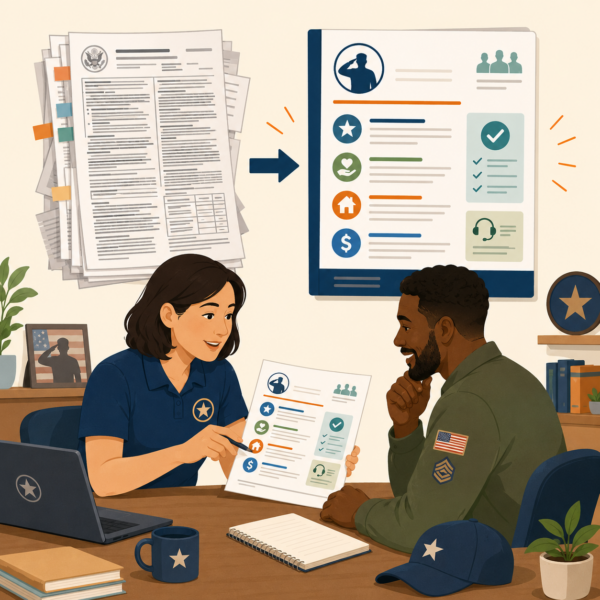 The failure of standard federal benefit program descriptions to serve the veterans who need them is not a failure of intent or a failure of effort by the agencies that produce those descriptions. It is a structural failure rooted in the fact that regulatory and administrative documents are designed for a different purpose and a different audience than the veterans who ultimately need the information they contain. Understanding the specific mechanisms of this failure is the prerequisite for designing communication that succeeds where standard descriptions fail, and it is the starting point for any serious investment in plain-language guide development.
The most fundamental mechanism of failure is organizational logic mismatch. Federal benefit program descriptions are organized around administrative structures that reflect the internal logic of how programs are designed, regulated, and administered. VA disability compensation materials are typically organized around rating schedules, compensation tables, eligibility criteria defined by regulatory category, and procedural requirements in the sequence that makes sense for the administrative process. This organization serves people who need to navigate the administrative system efficiently, including benefits attorneys, accredited claims agents, and VA adjudicators. It does not serve veterans who are approaching the system for the first time and who need to know, before anything else, whether the system is relevant to their situation and what engaging with it will involve.
The second mechanism of failure is language complexity that operates at multiple levels simultaneously. Federal program descriptions use technical terminology that requires specialized knowledge to interpret accurately, sentence structures that are complex enough to lose the main clause between qualifying phrases, passive voice constructions that obscure who does what, and nominalized verb constructions that compress action into abstract nouns in ways that make process requirements opaque. Each of these language features is individually manageable for a reader who is trained to deal with regulatory text. In combination, and particularly for readers who are encountering the material under conditions of stress and unfamiliarity, they produce comprehension failures that are not apparent to the writer of the material because the writer already knows what the material means.
The third mechanism of failure is the assumption of a generic audience that does not actually exist in the veteran population. The veteran population is diverse in every dimension that affects how people receive and process information: educational background, prior experience with federal benefit systems, health status, cognitive load from service-connected conditions including traumatic brain injury and PTSD, digital literacy, primary language, service era, branch, and occupational specialty. A benefit guide written for a generic veteran addresses no actual veteran effectively, because no actual veteran is generic. The communication that is clearest and most accessible for a twenty-six-year-old post-9/11 veteran with a college degree and extensive prior digital interaction with VA systems is not the same communication that is clearest and most accessible for a seventy-two-year-old Vietnam-era veteran with a high school education and no prior VA benefits experience.
The fourth mechanism of failure is the absence of navigational structure that allows readers to quickly identify whether a document is relevant to their specific situation without reading the entire thing. Standard program descriptions typically begin with the program’s purpose, legal authority, and eligibility criteria in the order that makes administrative sense, but this order requires readers to engage with material that may not be relevant to them before they can determine whether anything in the document applies to their situation. Veterans who are busy, fatigued, skeptical, or simply under-resourced for sustained reading engagement will disengage before reaching the content that is relevant to them, not because they are not motivated to find the information but because the document’s structure requires more sustained engagement than their circumstances allow.
The Administrative Structure Problem in Detail
The administrative structure problem in benefit guide design deserves extended examination because it is the most pervasive source of failure and the most resistant to simple fixes. Many agencies that have made genuine efforts to improve the accessibility of their benefit communications have done so by improving the language within an administrative structure that remains unchanged, producing documents that are written in simpler sentences but that are still organized in ways that serve administrative logic rather than veteran information needs. These documents are more readable than their predecessors but not more useful, because readability without navigability does not solve the orientation problem that prevents veterans from finding the content that is relevant to their situation.
Administrative structure organizing logic typically proceeds from the general to the specific within each program: program overview, legal authority, eligibility criteria, benefit amounts, application process, adjudication procedure, appeal rights. This sequence is internally coherent and provides a complete picture of each program. It does not, however, correspond to the sequence in which a veteran approaching the system from outside it needs information. The veteran’s information sequence is: is this relevant to me, what would I get, how do I get it, what can go wrong. These four questions do not map onto the administrative structure in a simple or consistent way.
The reorganization required to serve the veteran’s information sequence is not a cosmetic revision of existing administrative structure. It is a fundamental reconception of the document’s organizing logic. A benefit guide organized around the veteran’s questions begins with the relevance question, providing accessible eligibility information in terms that allow veterans to quickly self-assess whether the program is likely to apply to them. It then addresses the value question, describing what the program provides in concrete and specific terms. It then addresses the process question, describing the application and adjudication process in the sequence of steps the veteran will take rather than the administrative sequence in which those steps are processed. And it addresses the complication question, identifying the most common reasons applications are delayed or denied and the options available when things go wrong.
Each of these four sections requires drawing on content from multiple locations in the standard administrative structure and synthesizing it into a coherent answer to the question the veteran is asking. This synthesis work is the intellectual core of plain-language guide development, and it is the work that most agencies do not invest in because it requires more time, more expertise, and more collaborative development than simply reformatting existing administrative documents in simpler language.
The Language Problem in Detail
The language problem in benefit guide communication goes deeper than vocabulary complexity, though vocabulary complexity is a real and significant issue. Veterans who encounter words like nexus, adjudication, fully developed claim, individual unemployability, combined rating, and special monthly compensation for the first time are encountering technical terms with precise meanings that are not apparent from the ordinary sense of the words. Each of these terms requires either a definition or a replacement with non-technical language that conveys the same functional meaning. But the vocabulary problem is the most visible layer of a language problem that operates at the level of sentence structure, document structure, and implicit assumptions about reader knowledge.
Sentence structure in regulatory and administrative writing typically involves long sentences with multiple subordinate clauses, conditional constructions, and qualified claims. A sentence like ‘A veteran who has been determined by the Veterans Benefits Administration to have a service-connected disability rated at thirty percent or higher, or who has been found to have a service-connected disability that is the proximate cause of their inability to maintain substantially gainful employment, may be entitled to compensation under the individual unemployability provision, subject to the income limitations described in section 4.16 of title 38, Code of Federal Regulations’ is grammatically correct and legally precise, but it requires the reader to hold multiple conditional relationships in working memory while parsing the main clause, and it situates the main point of relevance to the reader at the end rather than the beginning of the sentence.
The plain-language alternative does not sacrifice accuracy for accessibility. It restructures the information in a way that serves the reader’s comprehension process: ‘If your service-connected disability prevents you from holding a full-time job, you may qualify for additional monthly compensation called Individual Unemployability, or IU. Your disability must be rated at least 60 percent for a single condition, or at least 70 percent combined if you have multiple conditions, with one rated at least 40 percent. Income limits apply.’ This version conveys the same eligibility information in a form that the reader can engage with at the pace of their own comprehension rather than at the pace the regulatory sentence structure imposes.
The implicit knowledge assumption is perhaps the most insidious language problem because it is invisible to writers who possess the assumed knowledge. A benefit guide that discusses applying for benefits at the ‘regional office’ assumes that the reader knows what a regional office is and how to find the one relevant to their location. A guide that discusses submitting a claim with ‘buddy statements’ assumes the reader knows what a buddy statement is and why it matters. A guide that recommends getting a ‘nexus letter’ assumes the reader knows what nexus means in the VA claims context and who can write a letter establishing it. Each of these assumptions represents a point at which the guide stops being a translation tool and becomes another document that presupposes the specialized knowledge it is supposed to provide.
Serving Those Who Served: Communication Strategies for Veterans Agencies
This article is part of our series on strategic communication for Veterans Services Agencies, County Veterans Services Offices, State Departments of Veterans Affairs, and community-based veteran support organizations. To learn more and to see the parent article, which links to other content just like this, click the button below.
The Framework for Veteran-Centered Content Design
Veteran-centered content design is a design philosophy before it is a set of writing techniques. It begins with a genuine commitment to organizing information around the veteran’s experience and needs rather than around the program’s administrative structure or the agency’s communication convenience. This commitment has real organizational costs: it requires more research, more collaborative development, more testing, and more time than simply reformatting existing documents in simpler language. Agencies that are serious about closing the gap between benefit availability and benefit access will make these investments. Agencies that are not serious will produce documents that appear to be plain-language guides without functioning as them.
The foundational principle of veteran-centered content design is to begin every guide development process with genuine knowledge of what veterans actually need to know, in what sequence they need to know it, and what specific questions they are asking that current communications do not answer. This knowledge cannot be generated by benefit experts working in isolation, because benefit experts already know what veterans need to know and have lost the ability to perceive the gaps from the outside. It must be generated through direct research with veterans, with CVSO staff who answer veteran questions every day, and with the inquiry and intake records that any active veterans services office accumulates over time.
The second foundational principle is to design for the whole range of the intended audience rather than for the most capable subset of that range. A benefit guide that is accessible to a veteran with advanced literacy skills, strong prior knowledge of VA systems, and ample time and attention to devote to reading is not necessarily accessible to a veteran with average literacy skills, no prior VA experience, and fifteen minutes between work obligations and childcare responsibilities. Designing for the whole range means designing for the lower end of literacy, knowledge, and reading time that characterizes a meaningful proportion of the intended audience, because the veterans at that lower end are as entitled to the information as the veterans at the upper end and are considerably more likely to be left behind by guides that are not designed with them in mind.
The third foundational principle is to treat testing as a non-optional component of development rather than a quality control afterthought. Plain-language content that has not been tested with actual members of the intended audience has not been validated. What seems clear to a skilled writer and accurate to a subject matter expert may still be confusing to a veteran who is encountering the content for the first time. The only way to know whether content is actually accessible is to put it in front of the people it is designed for and observe directly whether it produces accurate understanding, and then to revise based on what that observation reveals.
Starting With Questions, Not Answers
The most operationally powerful reorientation available in plain-language benefit guide design is the shift from organizing around the answers programs provide to organizing around the questions veterans ask. This shift sounds simple but is profoundly demanding in practice, because it requires writers and subject matter experts to set aside their specialized knowledge and approach the content with genuine openness about what a person without that knowledge needs to know first, second, and third.
Research on how veterans approach benefit information seeking, whether conducted through structured inquiry analysis, focus groups, or simply systematic observation of intake appointment conversations, consistently reveals a similar question sequence regardless of the specific benefit program. Veterans want to know, in order: whether the program is likely to be relevant to their situation, what they would actually receive if they qualify, what the process of applying involves and how long it takes, and what happens if something goes wrong. This four-question sequence is the organizing architecture for a veteran-centered benefit guide, and it should drive both the macro-structure of the document and the sequencing of information within each section.
The relevance question is typically the most under-served by standard program descriptions, which tend to present eligibility criteria in the regulatory language in which they were written rather than in the experiential terms that allow veterans to self-assess quickly. A relevance section organized around the question ‘Is this program for someone like me?’ needs to describe eligibility in terms of service history, discharge character, health status, and personal circumstances rather than in terms of regulatory categories and statutory definitions. The veteran who served in Vietnam, who has been diagnosed with Parkinson’s disease, and who has never filed a VA claim should be able to read the relevance section of a VA disability compensation guide and quickly understand that their situation is likely covered by Agent Orange presumptive service connection provisions, without needing to navigate regulatory terminology to reach that understanding.
The value question requires communication that is concrete rather than abstract, specific rather than general, and honest about variation rather than reliant on averages that may not apply to any individual veteran’s situation. A veteran who wants to know what VA disability compensation would mean for their monthly income needs a communication that provides specific dollar ranges based on rating levels rather than a reference to the VA compensation tables that requires them to perform their own lookup and calculation. A veteran who wants to know what VA healthcare enrollment means for their access to mental health services needs a communication that describes specific services that are typically available rather than a reference to the VA’s standard medical benefits package.
The process question requires a step-by-step description organized around what the veteran does, not what the agency does. Standard program descriptions typically describe the administrative process in terms of what happens to an application after it is submitted, because that is the process from the agency’s perspective. The veteran’s experience of the process is different: they gather documents, they fill out forms, they submit evidence, they attend examinations, they wait, they receive decisions, they respond to decisions. A process description organized around the veteran’s actions in their natural sequence is more useful than a description of the administrative machinery that processes their actions, even if both are technically accurate accounts of the same process.
Organizing Around Veteran Life Experience
A second structural principle for veteran-centered guide design is to organize information around the veteran’s lived experience of military service and its aftermath rather than around the program’s administrative categories. Veterans do not experience their service and their post-service lives in terms of the eligibility categories that federal benefit programs use to classify them. They experience their service as a sequence of specific assignments, deployments, occupational roles, and events, and they experience its aftermath in terms of specific conditions, challenges, and needs. Benefit guides that begin with the veteran’s experience and work toward the relevant programs, rather than beginning with program descriptions and expecting veterans to identify their own relevance, are more useful tools for navigating a complex system.
A guide organized around the service era, for example, acknowledges that Vietnam-era veterans, Cold War-era veterans, Gulf War-era veterans, and post-9/11 veterans have distinct benefit profiles that reflect distinct service experiences, distinct exposure histories, and distinct legislative histories of VA benefit recognition. A Vietnam-era veteran navigating the Agent Orange presumptive conditions landscape is in a fundamentally different situation from a post-9/11 veteran navigating the PACT Act burn pit provisions, even though both are accessing VA disability compensation. A guide that organizes its content around these distinct service era experiences, rather than around a single generic description of VA disability compensation that applies to all of them technically but feels relevant to none of them specifically, is a more useful tool for the actual veterans it is serving.
Life circumstance organization is another effective alternative to program-category organization. A benefit guide organized around common veteran life situations, such as just separated from service, living with a service-connected disability, supporting a veteran family member, or returning to education, allows veterans to navigate directly to content that is relevant to their current circumstances without needing to read through material that is not relevant to them. This kind of navigational organization requires more careful content architecture than a simple program-by-program structure, but it produces a guide that veterans can use efficiently rather than a comprehensive reference that requires more time and attention to navigate than most veterans have available.
Within each life experience section, the guide can introduce the specific programs that are most relevant to that situation, explain their relevance in terms specific to the veteran’s circumstances, describe what each program provides and how to access it, and address the most common complications and questions. This architecture produces guides that feel like they were written for the reader rather than about a program, and that quality, the sense that the guide was written for someone like me, is the most powerful driver of the reading engagement and information retention that ultimately determines whether the guide produces the access improvements it is designed to produce.
Translating Specific VA Programs Into Veteran-Usable Content
The translation of specific VA benefit programs into plain-language content requires program-by-program analysis of what veterans most need to understand, what the most common misconceptions and confusion points are, and what specific language choices and structural decisions will make the content most accessible to the range of veterans who need it. This section examines the translation challenges for three of the most important VA benefit programs and the specific communication approaches that address those challenges most effectively.
VA disability compensation represents one of the most important and most persistently misunderstood benefits in the federal system. The basic concept is accessible enough when stated plainly: if a health condition was caused by, happened during, or was made worse by military service, the VA can provide monthly financial compensation based on the severity of the condition. The complexity lies in the layers below this basic concept, including how service connection is established, how the rating system works, how multiple conditions are combined into an overall rating, what the rating means for monthly payment amounts, and what options exist when the initial decision is wrong.
VA healthcare enrollment is consistently confused with VA disability compensation, and any plain-language guide to either program should address the confusion between them explicitly rather than assuming that readers will not make the mistake. The two programs are distinct in eligibility, application process, benefit type, and purpose, and the confusion between them is among the most consequential communication failures in the veterans services landscape because it leads veterans to believe they have accessed benefits they have not accessed and to forgo benefits they are eligible for because they believe they have already received them.
GI Bill education benefits represent a category of programs that is particularly complex to translate into plain language because the various chapters of the GI Bill have different eligibility requirements, different benefit structures, and different interactions with other programs in ways that can be confusing even for specialists. The translation challenge is to make this complexity navigable without either oversimplifying to the point of inaccuracy or reproducing the complexity in a different format. The key insight for plain-language GI Bill communication is that most veterans need guidance on which chapter applies to their situation before they can usefully engage with the specific benefit details of any chapter, and that providing clear eligibility navigation upfront reduces the complexity burden for the rest of the document.
Translating VA Disability Compensation
A plain-language translation of VA disability compensation begins by establishing the service connection concept in human terms before introducing any regulatory framework. Service connection is the legal recognition that a health condition is related to military service in one of three ways: the condition was caused by an event, injury, or illness that occurred during service; the condition existed before service and was aggravated by service; or the condition is a secondary consequence of a condition that is already service-connected. Plain language for each of these three pathways is essential because veterans whose situations fit one pathway may not recognize themselves in a description that emphasizes a different pathway.
The rating system is the most technically complex element of VA disability compensation and the one that generates the most confusion among veterans who receive rating decisions. The combined ratings formula, which uses a whole-person calculation rather than simple addition, consistently produces results that seem mathematically counterintuitive to veterans who expect their individual condition ratings to add up directly to their combined rating. A plain-language explanation of this formula, with specific numeric examples that walk through how two, three, or four conditions combine to produce a combined rating, is one of the most valuable communication investments a guide can make, because it prevents the confusion and distrust that result when veterans receive a combined rating that appears to be wrong.
Specific monthly compensation amounts, organized by rating level and including the additional amounts available for veterans with dependents and for veterans at specific rating levels, give veterans the concrete financial information they need to assess the significance of their rating rather than requiring them to navigate the VA compensation tables independently. While these amounts change annually with cost-of-living adjustments, providing the current year’s amounts with a note that they are updated annually and a reference for checking current rates gives veterans the specific financial picture they need while maintaining honesty about the need for ongoing verification.
The most common reasons VA disability claims are delayed or denied deserve explicit communication in any plain-language guide to disability compensation. Veterans who understand that claims are often delayed because of missing records, that service connection is often denied because the nexus between a current condition and service events has not been clearly documented, and that rating decisions are sometimes too low because the Compensation and Pension exam did not fully capture the severity of the condition, are better positioned to anticipate and address these issues during the claims process rather than encountering them as surprises in a denial letter.
Translating GI Bill Education Benefits
The GI Bill translation challenge begins with the eligibility navigation problem: veterans who are trying to understand their education benefits need to know which chapter of the GI Bill applies to them before they can usefully engage with the specific benefit details. A plain-language guide that leads with a simple decision tree, organized around service dates, discharge character, and prior benefit use, allows veterans to identify their most likely applicable benefit chapter quickly and then engage with a focused description of that chapter’s benefits rather than reading through a comprehensive comparison of all chapters.
For veterans who are likely eligible for the Post-9/11 GI Bill, which covers the majority of veterans who served after September 10, 2001, the plain-language description should focus on the three core benefits the program provides: tuition and fees paid directly to the educational institution up to the in-state public school rate, a monthly housing allowance based on the cost of living near the school, and a stipend for books and supplies. These three benefits, described in concrete dollar terms with examples relevant to the veteran’s likely educational situation, give veterans the specific information they need to understand what Post-9/11 GI Bill benefits would mean for their individual educational plans.
The transferability provision, which allows eligible veterans to transfer Post-9/11 GI Bill benefits to a spouse or dependent child, is among the most valuable and most underused provisions of the program, primarily because many veterans do not know it exists or do not understand the requirements for using it. A plain-language guide that explains transferability clearly, including the requirement that the transfer be completed while the veteran is still on active duty and the specific steps required to process a transfer request, ensures that eligible veterans can access this provision before they separate from service when the opportunity to use it closes.
The interaction between GI Bill benefits and other programs, including VA vocational rehabilitation for veterans with service-connected disabilities that create employment barriers, the Yellow Ribbon Program that supplements GI Bill tuition coverage at higher-cost private and out-of-state institutions, and state-level education supplement programs, is an area where plain-language guidance is particularly valuable because the existence and interaction of these supplemental programs is often unknown to veterans who are planning their education. A guide that helps veterans understand which supplemental programs may be available to them and how those programs interact with their GI Bill benefits gives them a complete picture of their educational financial resources rather than an incomplete one that leaves significant available support unaccessed.
Translating State-Level Benefit Programs
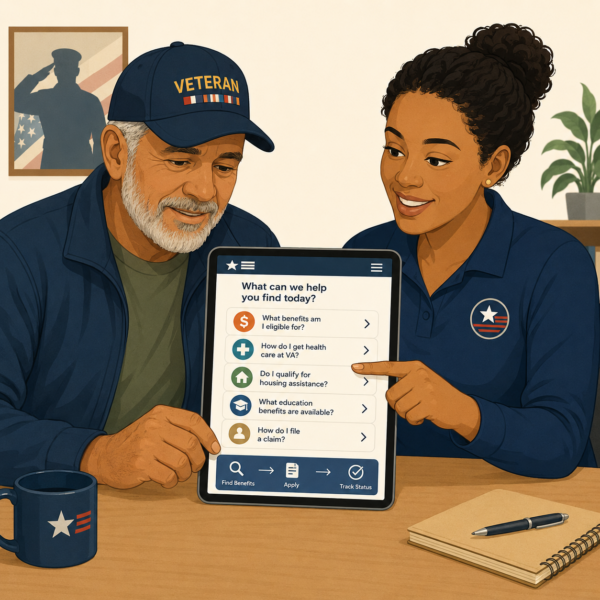 State-level veteran benefit programs present a distinct translation challenge from federal programs, and the challenge is compounded by the fact that state programs vary by jurisdiction in ways that make any generalized communication potentially misleading and require state-specific content development for any guide that is intended to be accurate and actionable for veterans in a specific state. Despite this complexity, the translation imperative for state benefits is if anything more urgent than for federal programs, because state benefits are even less known to veterans than federal programs and the gap between availability and awareness is correspondingly larger.
The foundation of effective state benefit translation is a comprehensive program inventory that goes beyond listing program names and administering agencies to documenting the specific details veterans need to access each program: eligibility requirements in plain language, current benefit amounts or values, application process and required documentation, administering agency contact information, and any interactions with federal programs that might affect a veteran’s decision to apply. This inventory must be developed through direct engagement with each administering agency to verify current accuracy, because relying on previously published information introduces the risk of communicating outdated details that lead veterans toward incorrect expectations.
Property tax exemptions represent one of the most financially significant state benefits available to veterans in most states and one of the most consistently underutilized, primarily because veterans who have not specifically sought information about state benefits do not know it exists. A plain-language communication about property tax exemptions should tell veterans specifically who qualifies, using language tied to the disability rating thresholds and property ownership requirements that apply in the specific state, what the exemption is worth in concrete dollar terms based on the state’s assessment and tax rate framework, how to apply and to which agency, and how the exemption interacts with any federal benefit programs they are receiving.
Education benefits for veteran dependents represent a category of state programs where the primary audience for communication is often not the veteran themselves but their family members, particularly children who may qualify for tuition assistance at state universities. Communication strategies for these programs need to reach the family members who are the actual decision-makers for dependent education planning, through channels including high schools, community colleges, and higher education institutions in addition to veterans services channels, because the veteran may be deceased, incapacitated, or simply uninvolved in the dependent’s educational planning in ways that make veteran-centric outreach insufficient.
Communicating State and Federal Program Interactions
One of the most consistent communication barriers to state benefit access is veteran uncertainty about whether claiming a state benefit will affect their federal benefits. Veterans who have achieved a stable financial arrangement through disability compensation and healthcare enrollment are understandably cautious about anything that might disrupt that arrangement, and the absence of clear communication about the relationship between state and federal benefits leaves many veterans choosing not to apply for state benefits they are entitled to because they cannot assess the risk of doing so.
For the vast majority of state veteran benefits, the honest and accurate answer is that federal benefits are not affected. Property tax exemptions do not affect disability compensation. State education benefits do not affect GI Bill eligibility. State veterans home placement does not affect disability compensation, though it may interact with pension in specific circumstances. Hunting and fishing license fee waivers do not affect any federal benefit. Employment preference in state hiring does not affect any federal benefit. Communicating these specific non-interactions directly and explicitly removes a barrier that is based entirely on uncertainty rather than on any actual policy interaction.
For the limited cases where state benefits do interact with federal programs, communication should be equally specific. Veterans pension, which is income-based, does interact with certain state income-based programs and with the cost of care in some state veterans homes in ways that require individual assessment. Veterans who are considering state programs that involve housing subsidies or care payments should be directed to a benefits counselor who can assess the specific interaction for their situation rather than being given either a blanket reassurance that no interaction exists or a vague caution that interactions might occur without specifying what they are.
A state-by-state interaction summary, covering the specific programs in the state and their specific relationship to federal benefits, is one of the most useful and most underproduced communication tools in the state benefits space. Veterans who can read a clear statement that their state’s property tax exemption does not affect their VA disability compensation, that their state’s education benefit for dependents does not affect their Post-9/11 GI Bill benefits, and that the specific circumstances under which the state veterans home affects pension are limited to specific income-based calculation scenarios, have the specific information they need to make informed decisions about state benefit applications rather than uninformed decisions based on unresolved uncertainty.
The Plain-Language Development Process
Developing plain-language benefit guides that genuinely work for their intended audience requires a development process that is substantially different from the process of producing standard institutional communications. The difference is not primarily in the skill of the writers involved, though skilled plain-language writers are essential. It is in the architecture of the development process itself, which must integrate multiple forms of expertise and multiple forms of audience knowledge in ways that standard communications production processes do not require.
The development process begins with audience research that goes beyond demographic description to genuine understanding of what the intended audience knows, what they do not know, what they think they know that may be incorrect, and what questions they are most urgently asking. This research should use multiple methods because different methods reveal different dimensions of the audience’s information needs. Structured interviews with veterans at various stages of the benefits process reveal the questions that veterans articulate when given the opportunity to do so. Analysis of inquiry logs from CVSO offices and VA call centers reveals the questions that veterans ask when they contact services. Review of web search patterns reveals the questions veterans are asking independently online. Observation of intake appointment interactions reveals the questions that arise in real-time decision-making contexts. Each of these data sources contributes distinct evidence to a multi-dimensional picture of what veterans need to know.
Subject matter expert engagement is the second phase of the development process, and it should be organized specifically around the audience research findings rather than around the expert’s existing knowledge structure. Subject matter experts who are asked ‘what do veterans need to know about disability compensation?’ tend to produce comprehensive taxonomies of program content that reflect their expert knowledge of the program. Subject matter experts who are asked ‘the audience research shows that veterans consistently confuse the combined ratings formula with simple addition, and that they don’t know what a nexus letter is or who can write one, what are the most accurate ways to address these specific misconceptions?’ produce targeted content that addresses the specific gaps the audience research identified. The second approach produces more useful content with less production effort.
The writing phase of the development process should separate the writing function from the subject matter expertise function, because these two forms of expertise rarely exist in the same person at a high level simultaneously. The plain-language writer’s job is to produce prose that is organized around the audience’s questions, written at the appropriate reading level, and structured in ways that support efficient reading and accurate comprehension. The subject matter expert’s job is to review that prose for accuracy and to flag any points where the plain-language translation has compromised the accuracy or completeness of the information. The collaboration between these two functions produces content that is both accessible and accurate, a combination that either function alone rarely achieves.
Testing and Refining Plain-Language Content
Content testing is the phase of the plain-language development process that most agencies skip, either because they do not have established testing protocols or because the time and resource investment required feels disproportionate to the benefit. Skipping testing is a false economy. Plain-language content that has not been tested with actual members of the intended audience is content that has been produced according to the best judgment of people who are not representative of the intended audience, and that judgment, however expert and well-intentioned, is systematically wrong about specific things in ways that testing reveals and revision addresses. The only way to know whether content is actually accessible is to observe actual members of the intended audience engaging with it.
The most informative testing method for plain-language benefit guide content is a structured comprehension session in which a veteran reads a section of the draft guide and then is asked specific questions about what they understood the content to mean. The veteran’s answers reveal not only whether they understood the content correctly but where in the text their understanding diverged from the intended meaning, which provides actionable guidance for revision. When multiple veterans answer a specific comprehension question incorrectly in the same way, the error pattern points directly to the specific passage or term that is producing the misunderstanding.
Task-based testing, in which veterans are asked to use the draft guide to answer specific questions that are relevant to their own situations, reveals whether the guide’s organizational structure and navigational features support the use cases it is designed to serve. A veteran who is asked to find out whether they are eligible for VA healthcare and who cannot locate the relevant information in the draft guide within a reasonable time period has revealed a navigational failure that organizational revisions can address. A veteran who locates the relevant section but misinterprets its eligibility criteria has revealed a content comprehension failure that language revision can address.
Iterative revision based on testing results is the phase of the development process that converts testing from an evaluation exercise into a genuine improvement tool. Initial testing typically reveals multiple comprehension and navigational failures that require revision. A second round of testing after revision verifies whether specific failures have been corrected and may reveal new issues that emerged from the revision process. The iteration continues until the content demonstrably performs at the comprehension and navigational standard the guide is intended to meet. Agencies that treat one round of testing as sufficient will consistently produce guides that are better than their untested predecessors but not as good as they could be with additional iteration.
Maintaining Plain-Language Content Over Time
A plain-language benefit guide that is accurate when published and inaccurate six months later is not a benefit guide. It is misinformation in a legible format, and it can cause genuine harm to veterans who rely on it to make decisions about their benefits. Federal and state benefit programs change. Eligibility rules are updated by legislation and regulation. Payment rates are adjusted annually. Application processes are modified as agencies improve their administrative systems. Any plain-language benefit guide that is not regularly reviewed for accuracy becomes a liability over time rather than an asset, providing veterans with information that is no longer correct and potentially leading them to make decisions based on obsolete content.
The maintenance challenge is significant enough that some agencies avoid developing comprehensive plain-language guides on the grounds that they will not be able to maintain them. This is a mistake in the opposite direction from treating maintenance as an afterthought. The solution is not to forgo plain-language guides but to design them in ways that make maintenance sustainable. Modular content organization, in which distinct sections covering distinct programs or eligibility criteria can be updated independently without requiring a comprehensive revision of the entire document, dramatically reduces the maintenance burden. A guide whose benefit amount information is separated from its eligibility information, for example, can be updated for the annual compensation rate adjustment by revising only the benefits section rather than the entire document.
A maintenance calendar tied to the regulatory and legislative cycles that most predictably produce program changes provides a systematic baseline for accuracy review. For federal VA programs, the annual budget process and the October cost-of-living adjustments to compensation rates are predictable triggers for benefit amount updates. New legislation, regulatory changes, and VA policy updates require monitoring and responsive review rather than scheduled calendar review, and designating a staff member responsible for monitoring these developments and triggering content reviews when they occur is an organizational investment in accuracy maintenance that the alternative approach, discovering that content is outdated when a veteran encounters the discrepancy, is considerably more expensive.
Distribution partner maintenance is an often-overlooked dimension of plain-language guide accuracy over time. CVSO staff, VSO post contacts, healthcare provider partners, and community organizations that have received printed or digital copies of plain-language guides and that distribute or reference those guides in their own communications with veterans will continue using outdated versions of the guides unless they receive updates when revisions are made. Building a distribution registry that records who has received copies of each guide and maintaining active communication with those partners about updates is the organizational practice that prevents the situation in which accurate new versions of guides exist while outdated old versions continue circulating through the partner distribution network.
Distributing Plain-Language Guides Effectively
The most carefully developed plain-language benefit guide produces no value if it does not reach the veterans who need it, and the veterans who most need it are often the veterans who are least likely to find it through standard agency distribution channels. Veterans who are already engaged with veterans services agencies, who attend benefits events, and who actively seek information about available programs are relatively well served by conventional distribution approaches. Veterans who have not connected with veterans services, veterans in rural and geographically isolated communities, veterans from underserved populations with limited prior experience with federal benefit programs, and veterans who have disengaged from formal services after negative prior experiences are the veterans whose access gaps plain-language guides are most urgently needed to close, and they are the veterans for whom conventional agency distribution channels are least effective.
Reaching these veterans requires distribution strategies that extend through partner networks into the community spaces where veterans are present without actively seeking benefits information. Healthcare providers who serve significant veteran patient populations can make plain-language benefit guides available in their waiting areas and can reference them in clinical conversations with veteran patients. Community libraries in veteran-dense areas can maintain current copies of plain-language guides alongside other community resource materials. VSO posts whose members include veterans who are not connected to formal veterans services can distribute guides to members and make them available at post gatherings. Faith communities with significant veteran membership can distribute guides through their existing communication channels with members.
Digital distribution through agency websites, social media, and email communication should be designed for accessibility as well as availability. A plain-language guide that is available on the agency website but is buried in a navigation structure that requires knowing where to look is not effectively distributed to veterans who do not already know what they are looking for. A guide that is prominently featured on the agency’s homepage, that is accessible through multiple navigation pathways reflecting different veteran entry points, and that is available for download without requiring registration or login, is effectively distributed to veterans who visit the agency’s website with any degree of regularity.
Multilingual distribution is an important dimension of effective reach for agencies serving veteran communities with significant non-English-speaking populations. Veterans who served from immigrant communities, veterans who immigrated after service, and family members of veterans who are navigating benefit systems on behalf of veterans who cannot do so themselves, may need benefit information in languages other than English. Identifying the languages most needed in the agency’s service area and developing plain-language guides in those languages, or at minimum developing accessible summaries in those languages that direct non-English speakers to additional assistance resources, extends the reach of plain-language communication to veterans who would otherwise be excluded from it by language barrier.
Strategic Communication Support for Veterans Services Agencies
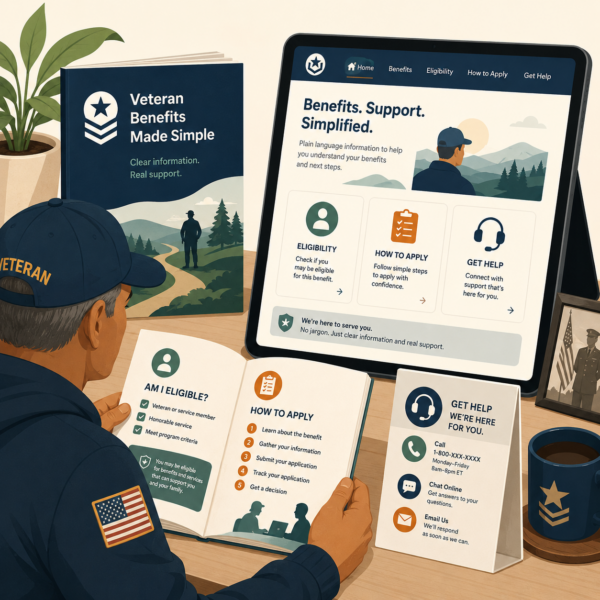 Developing plain-language benefit guides that help veterans understand and access available services requires sustained investment in audience research, content development, usability testing, accessibility, and ongoing content maintenance. Many veterans services agencies have not yet been able to make that investment at the scale needed to support every audience they serve. As a result, agencies may provide accurate and comprehensive benefit information that remains difficult for veterans to understand, navigate, or apply to their own circumstances. Plain-language communication is not separate from the mission of veterans services agencies. It is a critical part of ensuring that veterans can successfully access the benefits they have earned.
A structured assessment of an agency’s benefit communication often reveals a consistent set of challenges. Benefit information may rely on technical terminology, legal language, or administrative processes that are familiar to agency staff but difficult for veterans to interpret. Guides may be organized around agency programs instead of the questions veterans are trying to answer, while limited user testing can leave agencies without meaningful insight into where confusion occurs. Content maintenance processes may also be inconsistent, increasing the risk that guidance becomes outdated as policies, eligibility requirements, or application procedures change.
Addressing these communication challenges requires strategic planning, audience research, plain-language writing expertise, user testing, and long-term content governance. Many agencies recognize opportunities to strengthen benefit communications but have communication teams that are already focused on constituent services, program administration, policy updates, and day-to-day operations. As a result, agencies often partner with external communication specialists such as Stegmeier Consulting Group (SCG) to gain specialized public sector communication expertise, additional capacity, and an objective perspective while allowing internal staff to remain focused on delivering programs and supporting veterans.
SCG helps veterans services agencies develop plain-language benefit communication systems that make complex information easier for veterans to understand and use with confidence. Support may include conducting audience research, identifying communication barriers, developing plain-language benefit guides, facilitating collaborative content development, testing materials with representative veteran audiences, and establishing maintenance processes that help keep communication accurate as policies and programs evolve.
Beyond developing individual guides, SCG can also help agencies build communication frameworks that support consistent plain-language standards across programs, publications, and digital channels. By establishing repeatable content development processes, governance practices, and ongoing review procedures, SCG helps agencies create communication systems that remain accurate, accessible, and sustainable over time while improving veterans’ ability to find, understand, and act on benefit information.
The goal is to build a plain-language communication system that enables veterans to understand available benefits, navigate application processes with greater confidence, and make informed decisions using information that is clear, accurate, and maintained as programs continue to evolve.
Future Trends in Veteran-Centered Benefit Communication
The field of plain-language communication for public benefits is evolving rapidly, driven by technological advances, changes in how people seek and process information, and a growing recognition across the public sector that communication quality is a direct determinant of program access and equity. Several trends deserve sustained attention from agencies developing long-term plain-language communication strategies.
Personalized digital benefit navigation tools represent the most transformative emerging development in veteran benefit communication. A digital tool that asks a veteran a series of accessible questions about their service history, discharge character, current conditions, prior benefit engagement, and personal circumstances, and that generates a customized summary of the programs most likely to be relevant to their specific situation along with specific guidance about how to access each, is a more powerful access tool than any static plain-language guide. The personalization function converts the relevance question from something a veteran must resolve through reading and self-assessment into something the tool resolves on the veteran’s behalf based on the veteran’s own inputs. Agencies developing digital communication strategies should be investing in this direction, beginning with simpler eligibility screening tools and building toward more sophisticated personalized navigation systems as their digital capacity grows.
Artificial intelligence tools for plain-language content development are emerging as potentially significant productivity accelerators for agencies that face the challenge of producing and maintaining large volumes of accurate plain-language content with limited staff capacity. AI tools can assist with initial drafts, with identification of complex passages that require simplification, and with consistency checking across large document sets. They cannot replace the subject matter expertise required to verify accuracy, the audience research required to understand what veterans need to know, or the human judgment required to make the nuanced decisions about emphasis and framing that determine whether content genuinely serves its audience. Agencies that use AI tools as productivity accelerators within a rigorous human-led development and review process may find them valuable. Agencies that use them as substitutes for the intellectual work of genuine plain-language development will produce content that is fluent and inaccurate in ways that are difficult to detect without the expertise to check it.
Plain-language content standards are becoming more formally embedded in public sector communication policy across multiple levels of government, with federal agencies increasingly required to meet specific plain-language standards and many state governments adopting explicit plain-language requirements for public communications. Veterans services agencies that are not already aligned with these emerging standards face both a compliance risk and a quality gap. Building plain-language principles into standard operating procedures for all communication development, rather than treating plain-language guides as special projects to be undertaken periodically, positions agencies for compliance and quality simultaneously. The agencies that make this operational commitment will be better positioned to serve veterans well as both the standards and the veteran population’s communication expectations continue to evolve.
Conclusion
The distance between a federal benefit program and the veteran who needs it is almost never a legal distance. Most eligible veterans are not denied benefits because the law does not cover them. They are unable to access benefits because the communication environment that should connect them to the programs they qualify for was not designed around their needs, their language, or their experience of navigating a complex system under conditions that make sustained reading and specialized knowledge extremely demanding. Plain-language benefit guides, developed with genuine rigor and tested with actual veterans, are the most direct available remedy for this structural communication failure.
The work of translation, from regulatory language to veteran-usable content, is not glamorous and it is not simple. It requires the intellectual investment of genuine audience research, the skill of experienced plain-language writers working in collaboration with subject matter experts, the organizational discipline of systematic testing and iterative revision, and the operational commitment of ongoing maintenance and broad distribution. But it is consequential in ways that go beyond any individual case or any individual guide. An agency that has built a genuine plain-language communication infrastructure has built the foundation for equitable access to the programs it administers. That is the mission, and it begins with a commitment to communication that serves the reader rather than the program.
SCG’s Strategic Approach to Communication Systems
Stegmeier Consulting Group’s plain-language benefit guide development process reflects the core principle that guides all of SCG’s communication work: effective communication is measured by the outcomes it produces for the people it is designed to serve, not by the effort that went into producing it or the institutional approval it receives on publication. For veterans services agencies, that means measuring plain-language guides not by their reading ease scores or their compliance with style guides, and not by whether benefits experts find them comprehensive, but by whether veterans who read them are demonstrably better positioned to access the benefits they have earned.
SCG’s development process for plain-language benefit guides begins with rigorous audience research that identifies what veterans know, what they do not know, and what misconceptions they are operating under. It proceeds through structured development that integrates subject matter expertise and plain-language writing skills in a collaborative process designed to produce content that is both accurate and genuinely accessible. It includes testing with representative veteran audiences that identifies remaining comprehension and navigational failures and drives iterative revision. And it results in a maintenance plan and distribution strategy that ensures the guide’s quality is sustained over time and its reach extends to the veterans who most need it.
Agencies that work with SCG on plain-language benefit communication find that the investment produces returns across multiple dimensions: improved veteran access to programs, reduced intake burden on CVSO staff who spend less time providing remedial explanation of content that veterans did not understand from written materials, stronger trust relationships with the veteran community that result from the experience of being communicated with clearly and respectfully, and more equitable distribution of program benefits across the full veteran population the agency serves. These are the outcomes that veterans services agencies were created to produce, and plain-language communication infrastructure is among the most direct available investments in producing them.
Use the form below to connect with our team and explore how strategic plain-language communication can help your agency improve veterans’ understanding of benefits and expand access to the programs and services they have earned.