
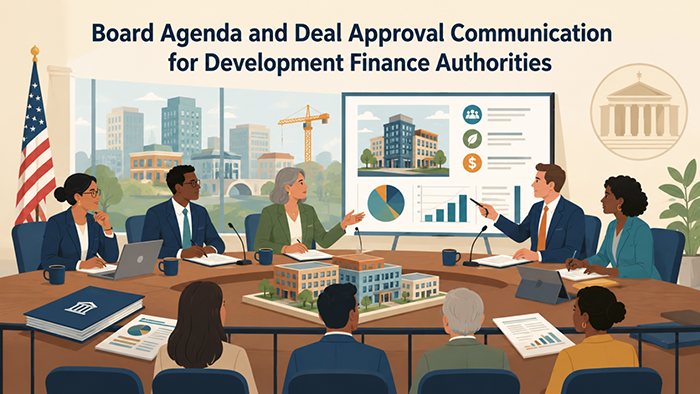
Board Agenda and Deal Approval Communication for Development Finance Authorities: What Elected Officials and Residents Need to Understand Before the Vote
The period before a development finance authority board approves a financing deal is among the most consequential and most poorly managed communication moments in public finance. Everything that determines whether the approval process builds or erodes public trust happens in the days and weeks before the vote: what information decision-makers receive, how it is framed, how much time they have to review it, what the public understands about the deal, and whether the explanation of the transaction is clear enough to support informed judgment or opaque enough to invite suspicion.
Development finance authorities regularly approve complex transactions involving tax increment financing, conduit bonds, tax credit allocation, revolving loan fund deployments, equity investments, loan guarantees, and other instruments that serve important economic development purposes but that are genuinely difficult to explain to non-specialist audiences. The legal documents that govern these transactions are precise and comprehensive. The staff presentations that accompany board meetings are often technically detailed. What is almost universally missing is a short, clear, plain-language explanation of what is being approved, what the financing tool actually does, what the public benefit is, what commitments are attached, and what happens if those commitments are not met.
That gap is not a minor procedural shortcoming. It is a transparency and trust problem with real consequences. Elected officials who cannot understand a deal well enough to explain it to constituents tend to either rubber-stamp staff recommendations without genuine deliberation or oppose deals on precautionary grounds that could have been addressed with clearer communication. Community members who encounter complex financing approvals without adequate explanation tend to assume the worst, particularly in jurisdictions where prior economic development decisions have generated controversy. A development finance authority that consistently fails to communicate clearly before the vote is building a credibility deficit that will eventually affect its ability to operate effectively.
Why Legal Documents and Staff Presentations Are Not Enough
 Development finance authorities produce extensive documentation for financing approvals. A typical deal package may include a staff report, a resolution, a loan agreement or financing agreement, an underwriting analysis, a project description, legal counsel memoranda, and in some cases environmental review documents. This documentation serves important purposes: it creates a legal record, satisfies due diligence requirements, and provides the technical foundation for staff recommendations. What it does not do, for most of the people who need to understand the transaction, is clearly explain what is happening and why.
A resolution approving a development finance authority loan or bond issuance is written in the language of legal authorization. It identifies the parties, the instrument, the amounts, and the authorization being granted. It does not explain what the project does, why the financing structure was chosen, what public benefit is expected, or what will happen if the developer does not meet the job creation or other commitments attached to the financing. A board member reading only the resolution can say they voted yes or no, but they may not be able to explain the substance of what they voted on.
Staff presentations fill some of this gap, but they have limitations. They are typically delivered verbally at the board meeting, which means they are not available in advance for board members to review, are not accessible to community members who were not present, and do not create a written record that can be referenced later. They are often prepared by staff who are deeply familiar with the transaction and may not fully account for the information gaps of board members who are encountering the deal for the first time. And they are frequently compressed by the agenda demands of a busy board meeting into a presentation that covers the highlights without the context needed for genuine understanding.
What Elected Officials Actually Need Before They Vote
An elected official serving on a development finance authority board, or a city council or county board that must approve an authority action, needs a specific and relatively contained set of information to fulfill their oversight responsibility responsibly. They need to understand what is being approved: the nature of the financing instrument, the amount, the borrower or recipient, and the project. They need to understand what the authority is committing to: what the agency’s financial exposure is, what security the deal carries, and what the authority can do if things go wrong. They need to understand what the public benefit is: what specific outcomes the financing is designed to produce, how those outcomes will be measured, and what commitments the borrower or recipient has made to deliver them. And they need to understand what the downside looks like: what scenarios would result in loss to the authority or to the public, how likely those scenarios are, and what mitigation is in place.
None of this requires the elected official to read the full legal documentation. It requires a plain-language briefing document, produced by staff and available in advance of the meeting, that addresses these questions directly and concisely. That document is not a substitute for the full legal record. It is a decision-support tool that allows board members to engage in genuine deliberation rather than simply ratifying a staff recommendation they do not fully understand.
Growing Places: Communication Strategies for Economic Development and Public Finance Agencies
This article is part of our series on strategic communication for Economic Development organizations, including state and local economic development agencies, regional partnerships, and business attraction initiatives. To learn more and to see the parent article, which links to other content just like this, click the button below.
Plain-Language Deal Summaries as a Standard Practice
The most practical and highest-impact communication improvement most development finance authorities can make is to produce a plain-language deal summary for every significant financing action that comes before the board. This summary should be a standard document, produced as part of the deal preparation process, and provided to board members in advance of the meeting rather than as a supplement to the staff presentation at the meeting itself.
A plain-language deal summary for a development finance authority financing action should cover, at minimum: what is being proposed and why, who the borrower or recipient is and what they are proposing to do, what financing tool is being used and how it works at a high level, what the expected public benefit is and how it will be measured, what the authority’s financial exposure is and what security or recourse exists, what commitments the borrower or recipient is making and what happens if those commitments are not met, and what the staff recommendation is and the key reasons for it.
This document should be written for a reader who is a thoughtful, engaged public official without specialized finance expertise. It should avoid jargon where possible and define technical terms when they must be used. It should be organized so that the most important information is accessible at the beginning, with more detailed supporting information available in subsequent sections for board members who want to go deeper. It should be short enough to be read in full, typically no more than three to five pages for a standard transaction, while containing enough substance to support genuine deliberation.
The Advance Briefing as a Board Governance Tool
The timing of deal communication matters as much as its content. Board members who receive a deal summary the morning of the board meeting, or who encounter key deal information for the first time in the staff presentation, are not in a position to engage in genuine deliberation. They can ask questions, but they may not know what questions to ask because they have not had time to identify their own information gaps. They can vote, but their vote reflects time pressure and deference to staff as much as genuine judgment about the merits of the transaction.
An advance briefing process, in which board members receive the plain-language deal summary at least a week before the vote and have an opportunity to ask questions and receive written responses before the meeting, changes the quality of the board approval process significantly. Board members arrive at the meeting with a working understanding of the transaction, having had time to form their own views, identify their concerns, and in some cases consult with constituents or advisors. The board meeting then becomes a venue for genuine deliberation rather than a performance of oversight that does not actually involve substantive engagement with the transaction.
Advance briefings also help staff prepare for the board meeting more effectively, because the questions board members raise in advance identify the aspects of the transaction that need more explanation and give staff the opportunity to develop clearer answers before the meeting rather than improvising responses under time pressure. The entire approval process tends to be smoother, more substantive, and more credible when board members are genuinely prepared.
Public-Facing Communication Before Significant Financing Votes
 Development finance authority financing decisions that involve significant public resources, high-profile projects, community controversy, or substantial public benefit commitments deserve public communication that goes beyond the legal notice requirements. A financing approval that appears on a board agenda as a technical resolution, accompanied by documentation that is accessible only to people with finance expertise, is not transparent in any meaningful sense even if it is technically public.
Meaningful transparency before a significant financing vote requires communication that community members can actually understand. That means a plain-language public summary of the transaction, available before the meeting, that explains what is being considered, what the expected public benefit is, what the authority is and is not committing to, and how community members can participate in the process. It means a public hearing or comment opportunity that is designed to elicit genuine community input rather than to satisfy a procedural requirement. And it means follow-up communication after the vote that explains what was approved and why.
Development finance authorities sometimes resist this level of public communication out of concern that it will generate opposition to transactions that would otherwise pass without controversy. This is a short-term calculation that tends to produce long-term damage. A transaction that generates opposition because it was not explained clearly enough is not well-served by better communication; it is a transaction that deserved the scrutiny it received. A transaction that is genuinely in the public interest can withstand clear explanation, and in most cases is better served by it. The authorities that consistently explain their financing decisions clearly before the vote tend to face less organized opposition over time, because the community understands what they are doing and has developed a basis for trusting that the authority exercises its powers responsibly.
Briefing Documents for Elected Officials Outside the Authority
Many development finance authority financing decisions require approval or notification from elected officials who are not members of the authority board. A city council may need to approve a development agreement. A county commission may need to ratify a tax increment financing plan. A state legislative committee may review an authority action. In each of these cases, the elected officials involved are typically encountering the transaction from a different vantage point than the authority board, with less background on the authority’s programs and processes and more immediate political accountability to constituents who may have questions about what their government is approving.
Briefing documents for elected officials outside the authority should be tailored to their specific role and information needs. A city council member voting on a development agreement needs to understand what the authority has approved, what the city is being asked to approve or accept, how the two approvals fit together, what the city’s obligations and exposure are, and what the expected benefit to city residents is. That is a different document than the plain-language deal summary prepared for the authority board, even though both are plain-language explanations of the same transaction.
The authority should not assume that elected officials outside the authority will ask for or find their way to the documentation they need. The authority should proactively prepare and deliver the briefing materials, offer to answer questions, and follow up to ensure that the officials have the information they need before they are asked to act. This proactive approach builds relationships with partner jurisdictions and elected bodies while reducing the risk that misunderstanding about the authority’s role or the transaction’s details will create unnecessary political complications.
Communicating Commitments and Accountability Mechanisms
Development finance authority financing deals typically include commitments from borrowers or recipients regarding job creation, wage levels, project timelines, community benefit provisions, environmental performance, or other outcomes that justify the public benefit rationale for the financing. These commitments are usually specified in the legal documentation of the transaction. They are rarely communicated clearly in the board approval materials, and they are rarely the subject of explicit public communication about how the authority intends to monitor and enforce them.
The accountability gap around commitments is one of the most significant communication failures in development finance. When a community is told that a financing deal will create a specific number of jobs at specific wage levels, and the authority does not have a clear and public process for tracking and reporting on whether those commitments are being met, the community has no way to assess whether the public benefit it was promised is materializing. When job numbers fall short or commitments go unfulfilled, and the community learns about it through news coverage rather than authority reporting, the damage to trust can be severe and lasting.
Board approval communication should include an explicit statement of what commitments the borrower or recipient is making, how the authority will monitor compliance, what reporting the borrower or recipient is required to provide, and what recourse the authority has if commitments are not met. This information should be part of the plain-language deal summary rather than buried in the loan agreement or financing documents that most board members and community members will not read in full. It should also be the foundation for the post-approval reporting that keeps the community informed about whether the financing is producing the outcomes it was designed to support.
Framing Financing Decisions as Transparency and Trust Issues
The communication quality of a development finance authority’s board approval process is ultimately a measure of how seriously the authority takes its public accountability obligations. An authority that treats the legal documentation as sufficient public disclosure, that relies on technical staff presentations to convey the substance of complex transactions, and that does not invest in plain-language explanation for board members and the public is operating with a narrow conception of transparency that does not serve the public interest.
Transparency in development finance is not only about making documents available. It is about creating the conditions for genuine informed oversight by board members and genuine informed engagement by community members. That requires communication that is accessible, timely, specific, and honest about both the expected benefits and the real risks of each transaction. It requires a process in which board members have enough time and information to deliberate meaningfully before they vote. And it requires public communication that gives community members the information they need to form views about whether the authority is using its financing powers in ways that serve the public interest.
Authorities that invest in this level of communication build a reservoir of public trust that makes the approval of even complex or controversial transactions more manageable. When a community has confidence that an authority explains its decisions clearly and follows through on commitments, it is more likely to extend good faith in situations where the public benefit rationale is less immediately obvious. Conversely, authorities that have a history of opaque approval processes and unmet commitments find that even straightforward transactions attract suspicion and opposition.
Agenda Materials as Communication Infrastructure
The board agenda and its accompanying materials are the primary communication infrastructure for development finance authority decision-making. They are the documents that board members rely on to prepare for the meeting, that journalists and community advocates use to understand what the authority is considering, and that create the official record of what was before the board when it made its decision. Treating these materials as purely administrative documents rather than as communication tools is a significant missed opportunity.
Agenda materials for development finance authority financing actions should be organized around the information needs of the people who will use them, not around the internal workflow of the staff that prepare them. A well-organized agenda package for a financing action should lead with the plain-language deal summary, followed by the staff recommendation and its key rationale, followed by the more detailed supporting documentation for board members who want to review the technical basis for the recommendation. The legal documentation should be included as a reference document, clearly labeled as such, rather than presented as the primary explanation of the transaction.
The format and presentation of agenda materials also matters. Materials that are dense, poorly organized, or formatted in ways that make them difficult to navigate online or in print are barriers to the informed deliberation they are supposed to support. Authorities that invest in clear, well-organized, and accessible agenda materials signal to board members and the public that they take the oversight process seriously and that they want it to function well.
Strategic Communication Support
 Board agenda and deal approval communication is one of the areas where the gap between current practice and better practice is wide and the investment required to close it is relatively modest. Most development finance authorities could significantly improve the quality of their board approval communication by adding a plain-language deal summary to every significant financing action, establishing an advance briefing process that gives board members time to review materials before the meeting, and developing standard templates for the public-facing communication that accompanies high-profile or controversial transactions.
Stegmeier Consulting Group (SCG) works with development finance authorities to build board approval communication systems that support genuine oversight and informed public engagement. That work includes plain-language deal summary template development, board briefing process design, public-facing communication strategy for significant financing decisions, commitment and accountability communication frameworks, advance briefing process implementation, and the communication governance infrastructure that maintains the quality of approval communication across a large volume of transactions.
The goal of this work is not to make complex financing decisions seem simpler than they are. It is to make them understandable enough that the people responsible for approving them, overseeing them, and living with their consequences can form informed views about whether they serve the public interest. That is what transparency in development finance actually requires, and it is a standard that most authorities can meet with the right communication approach.
Future Trends in Development Finance Approval Communication
Public expectations for transparency in government financing decisions are rising, driven by a broader environment of increased scrutiny of how public institutions manage resources that affect community outcomes. Development finance authorities, which operate with significant discretion in deploying public financing tools for economic development purposes, are increasingly subject to this scrutiny. Authorities that build strong, clear, and proactive approval communication now are positioning themselves well for an environment in which the demand for transparency is likely to continue growing.
Digital tools are changing the accessibility of public agency decision-making in ways that create new communication opportunities and new communication risks. Board meeting agendas and materials that are posted online and searchable are more accessible to journalists, advocates, and community members than materials that were previously available only to people who attended meetings in person or submitted public records requests. That accessibility is generally beneficial for transparency, but it also means that unclear, jargon-heavy, or incomplete deal materials are more likely to be encountered by people who will not understand them and may interpret them unfavorably.
The range and complexity of development finance tools is also expanding. New financing instruments for clean energy, affordable housing, broadband, healthcare, and workforce infrastructure are creating new categories of transactions that board members, elected officials, and community members are encountering for the first time. Each new instrument brings a new explanation challenge. Authorities that have invested in the communication infrastructure and discipline to explain complex financing tools clearly will be better positioned to deploy new tools effectively than those that have not.
Conclusion
The period before a development finance authority board approves a financing deal is when public trust in the authority is either built or eroded. Decision-makers who understand what they are approving make better decisions and can explain them more confidently. Community members who understand what the authority is doing and why are more likely to extend good faith even when they have questions or concerns. The communication investment required to create those conditions is modest relative to the transactions it supports and to the trust it protects.
Development finance authorities that treat board approval communication as a transparency obligation rather than a procedural requirement are building the kind of institutional credibility that makes their long-term effectiveness possible. They are also fulfilling the actual promise of development finance: that public financing tools will be deployed transparently, accountably, and in ways that genuinely serve the communities that give the authority its mandate.
SCG’s Strategic Approach to Communication Systems
Align your agency’s messaging, processes, and public engagement strategies.
Development finance authorities need board approval communication systems that give elected officials and community members what they actually need before the vote: plain-language deal summaries, advance briefing processes that support genuine deliberation, clear public-facing communication about significant financing decisions, and explicit accountability frameworks that explain how commitments will be monitored and enforced. These are not supplements to the legal and technical documentation of financing transactions. They are the communication infrastructure that makes the approval process genuinely transparent.
SCG helps development finance authorities build the communication systems that make board approval processes more informative, more credible, and more consistent with the transparency obligations that public financing authority carries. Whether your authority is developing standard deal summary templates, redesigning the advance briefing process, building public communication strategy for high-profile transactions, or creating the accountability communication frameworks that keep the community informed after the vote, SCG can help you communicate with clarity, consistency, and genuine public accountability.
Use the form below to connect with our team and explore how a strategic communication system can help your authority make every financing approval a demonstration of transparent and accountable public finance.