
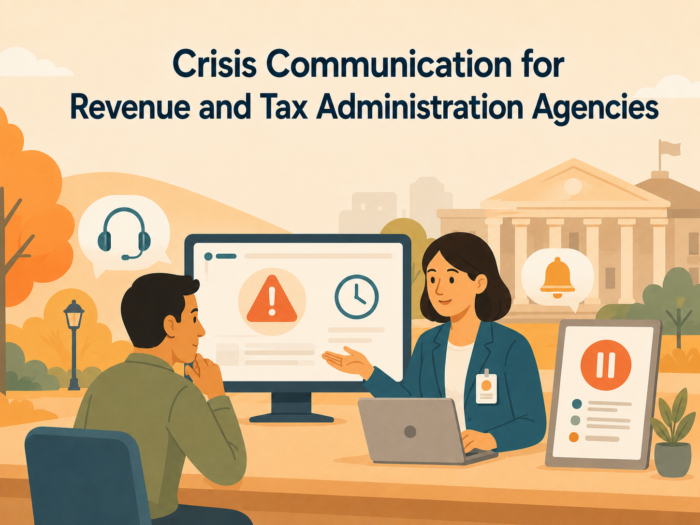
System Outages and Filing Delays: Crisis Communication for Revenue and Tax Administration Agencies
There is a specific moment that every revenue and tax administration agency eventually faces, regardless of how well its systems are built or how carefully its processes are designed. The online filing portal goes down during the final hours before a deadline. A printing vendor error delays a batch of property tax bills by weeks. A software update introduces a bug that causes a subset of returns to be processed incorrectly. A high-volume influx of filings overwhelms processing capacity and creates delays that stretch from days into weeks. In each of these situations, a large number of taxpayers are simultaneously affected by the same problem at the same time, and the agency’s response in the hours and days that follow will be remembered far longer than the technical glitch that caused the disruption in the first place.
High-volume issue response communication is a distinct discipline within tax administration communication, different in important ways from the routine, individualized communication that makes up the bulk of an agency’s taxpayer interactions. A balance due notice addresses one taxpayer’s specific situation. A system outage affects thousands or potentially hundreds of thousands of taxpayers simultaneously, all of whom are looking for the same information at the same time, often through the same channels, creating a communication challenge that is fundamentally about scale, speed, and consistency rather than personalization.
The agencies that navigate these situations most effectively are not necessarily the ones that experience fewer technical problems. Systems fail, vendors make errors, and volume occasionally exceeds capacity at every agency eventually, regardless of how much has been invested in infrastructure and planning. What distinguishes agencies that maintain taxpayer trust through these episodes from those that see trust erode significantly is the quality, speed, and consistency of the communication they provide while the problem is being identified, addressed, and resolved.
This article examines how revenue and tax administration agencies can build a high-volume issue response communication framework that determines what to say, when to update, and how to preserve taxpayer trust during system outages, filing delays, and other large-scale disruptions. It addresses the structural decisions an agency needs to make before a crisis occurs, the content and timing principles that govern effective communication during an active incident, and the recovery communication that determines whether taxpayers leave the experience with confidence in the agency or lasting skepticism about its reliability.
Why High-Volume Issues Require a Different Communication Approach
 Standard tax communication, including notices, website content, and call center scripts, is designed around individualized interactions, where each taxpayer’s situation is addressed specifically and the communication can be tailored to their particular circumstances. High-volume issue communication operates under fundamentally different constraints. The agency typically does not yet have complete information about the scope or cause of the problem when the first wave of taxpayer concern begins, the volume of affected taxpayers means that individualized response is not feasible as the primary communication channel, and the urgency of the situation, often involving an approaching deadline that taxpayers cannot meet because of the very problem the agency is trying to communicate about, compresses the timeline for response to hours rather than the days or weeks that might be acceptable for routine communication planning.
This combination of incomplete information, mass audience, and time pressure creates a genuine communication dilemma. Waiting until the agency has complete, confirmed information about the cause and scope of a problem before communicating anything risks leaving taxpayers without guidance during the period when they most need it, potentially leading thousands of people to take incorrect action, such as attempting repeated unsuccessful filing attempts that compound a system load problem, or giving up on filing altogether and missing a deadline they could have met if they had different information. Communicating too early, before the agency has any confirmed understanding of what is happening, risks providing inaccurate information that the agency will need to correct later, which can itself become a trust problem if taxpayers feel they were given wrong information during a critical moment.
The resolution to this dilemma is not to wait for complete certainty before communicating, but to communicate early with appropriately calibrated confidence, clearly distinguishing between what is confirmed and what is still being investigated, and to commit to a regular update cadence that taxpayers can rely on even when each individual update does not yet contain a full resolution. This approach treats communication itself as part of the incident response, not as a separate function that waits for the technical response to be complete before beginning.
The Psychological Experience of Taxpayers During a System-Wide Disruption
Understanding the psychological experience of a taxpayer affected by a system outage or filing delay helps explain why communication quality matters so significantly during these episodes. A taxpayer who cannot access the filing portal in the final hours before a deadline experiences a specific and acute form of anxiety, compounded by uncertainty about whether the problem is on their end or the agency’s, whether the deadline will be extended, whether they will face a penalty for circumstances outside their control, and whether anyone at the agency is even aware of the problem they are experiencing.
This anxiety is not primarily about the technical glitch itself. It is about the uncertainty surrounding the technical glitch. A taxpayer who knows clearly that the agency is aware of the outage, is working on it, has extended the deadline or will not penalize taxpayers affected by the outage, and will provide updates at specific intervals, experiences a fundamentally different and far less distressing situation than one who is left to wonder whether the problem is unique to them, whether anyone is addressing it, and whether they will be held responsible for a failure that was not their fault. The communication itself, separate from the technical resolution, directly addresses and can substantially reduce this anxiety.
Clearer Taxpayer Communication: Strategies for State and Local Assessors, Treasurers, Revenue Departments, and Finance Offices
This article is part of our series on strategic communication for State and Local Assessors, Treasurers, Revenue Departments, and Finance Offices. Clear, timely, and accessible taxpayer communication helps government agencies improve compliance, reduce confusion, strengthen public trust, and enhance the citizen experience. To learn more and to see the parent article, which links to additional resources and best practices for taxpayer outreach and engagement, click the button below.
Effective high-volume issue communication is not improvised in the moment. It is built on a framework that the agency develops and rehearses
Pre-Crisis Planning for High-Volume Issue Communication
before any specific incident occurs, so that when an actual outage or delay happens, the communication team is executing a known plan rather than designing a response strategy from scratch under the worst possible time pressure.
This pre-crisis framework should identify the most likely categories of high-volume disruption an agency might face, based on its specific systems and processes, such as filing portal outages during peak deadline periods, mass mailing errors or delays affecting notices or bills, processing system errors that affect a batch of returns or accounts, and external vendor failures that disrupt a specific service the agency depends on. For each category, the framework should establish a draft communication template that can be rapidly customized with the specific details of the actual incident, rather than requiring the communication team to draft an entirely new structure and tone from scratch in the early hours of a live incident.
The framework should also establish clear internal protocols for how quickly communication should begin once an incident is identified, who has the authority to approve and release the initial communication without requiring a lengthy internal approval chain that delays the agency’s public acknowledgment of a problem taxpayers may already be experiencing, and what channels will be used to distribute updates, including the agency’s website, social media, email lists, and direct coordination with media outlets for incidents significant enough to warrant broader public attention.
Establishing this framework in advance also requires identifying the decision authority for significant policy questions that often arise during high-volume incidents, such as whether to extend a filing deadline, whether to waive penalties for taxpayers affected by the disruption, and how broadly that relief should apply. Agencies that have pre-established protocols for how these decisions will be made and communicated, even if the specific decision in any given incident must still be made based on the actual circumstances, can move much faster than agencies that must build both the decision-making process and the substantive decision simultaneously during a live crisis.
Rehearsing the Response Through Tabletop Exercises
Some agencies have found significant value in conducting periodic tabletop exercises, where the communication, technical, and policy teams walk through a simulated high-volume incident scenario and practice the coordination and decision-making the actual framework calls for, without the pressure of a live incident affecting real taxpayers. These exercises frequently reveal gaps in the framework, such as unclear decision authority, communication channels that are not actually ready to be activated quickly, or assumptions about available information that may not hold true in an actual incident. Identifying and correcting these gaps through a low-stakes rehearsal is considerably more valuable than discovering them for the first time during an actual high-pressure incident affecting thousands of taxpayers.
The First Communication: Speed, Honesty, and Appropriate Calibration
 The first public communication an agency issues after identifying a high-volume issue sets the tone for everything that follows, and it should be released as quickly as the agency can confirm that a real, system-wide problem exists, even if the agency does not yet have complete information about the cause or the resolution timeline. The goal of this first communication is not to provide a complete explanation but to acknowledge the problem, confirm that the agency is aware of it and actively working on it, and provide whatever immediate guidance is available about what affected taxpayers should do in the interim.
This first communication should avoid both overconfidence and excessive vagueness. A communication that says the issue has been resolved when the agency has not yet confirmed that resolution risks a credibility problem if the issue recurs or was not actually fully resolved. A communication that says we are aware some users may be experiencing issues without confirming that a genuine system-wide problem exists, when the agency already has clear evidence that it does, can feel evasive to taxpayers who are experiencing a very real and significant problem and want the agency to acknowledge it directly rather than hedging.
The most effective first communications use direct, specific language about what is known: we have identified an issue affecting [the specific system or process], we are working to resolve it, and we will provide an update by [a specific time]. This kind of communication does not require the agency to know the root cause or the full resolution timeline. It requires the agency to be willing to say clearly that a problem exists, that it is being actively addressed, and that the affected population will receive further information by a specific, near-term point, which is itself a meaningful commitment that reduces taxpayer anxiety even before the underlying problem is fixed.
Addressing the Deadline Question Immediately
When a high-volume system issue occurs close to a filing or payment deadline, the single most pressing question on the mind of every affected taxpayer is whether the deadline will be extended or whether penalties will be waived for those who cannot complete their required action because of the outage. Agencies should prioritize answering this specific question as early as possible, even before all other aspects of the incident are fully understood, because this is the piece of information that most directly determines whether an affected taxpayer experiences acute anxiety or relative calm while the technical issue is being resolved.
Where an agency has the authority to extend a deadline or waive penalties in response to a system outage, and determines that doing so is the appropriate response, communicating that decision clearly and as early as possible should be a top priority, even if other aspects of the incident response are still being finalized. Where the agency has not yet decided whether to extend a deadline or is still evaluating that decision, the initial communication should at minimum acknowledge that this question is under active consideration and commit to providing an answer by a specific time, rather than leaving taxpayers with no indication of when they will know whether their compliance obligation has changed.
Maintaining a Reliable Update Cadence
Once an agency has issued its initial acknowledgment of a high-volume issue, maintaining a predictable, reliable cadence of follow-up updates is essential to preserving taxpayer trust throughout the duration of the incident. Taxpayers who do not receive updates as promised, or who must actively search for information because the agency is not proactively pushing updates through clear channels, experience a renewed sense of uncertainty each time they check for new information and find none, which compounds the negative experience of the original disruption.
The update cadence an agency commits to should be realistic and should be honored consistently, since a missed update is itself a trust-eroding event, separate from whatever the underlying technical issue is. If an agency commits to providing an update every two hours during an active outage, that commitment should be met even if the update simply states that the issue remains under investigation and the resolution timeline has not changed, rather than allowing the promised update window to pass silently because there is no new substantive information to share. A predictable cadence that consistently delivers, even when the content of an individual update is minimal, builds more trust than an irregular cadence that occasionally delivers more substantive updates but breaks its own stated commitments along the way.
Each update should clearly indicate what has changed since the previous update, what remains unresolved, and when the next update will be provided, maintaining the same direct, specific communication style established in the initial acknowledgment. Updates that simply repeat the same language as the prior update without indicating whether any progress has been made can feel dismissive to taxpayers who are anxiously awaiting genuine new information, even if the underlying situation genuinely has not changed significantly between updates.
Channel Strategy During an Active Incident
High-volume issue updates should be distributed simultaneously across every channel a taxpayer might reasonably check for information, including a prominent banner or alert on the agency’s website homepage and on the specific portal or page affected by the issue, social media posts on the agency’s official accounts, an email alert to any taxpayers who have opted into electronic communication, and direct coordination with the call center to ensure that representatives have the same current information that is being published publicly, preventing the frustrating scenario where a taxpayer reads one update on the website and then receives different or outdated information from a phone representative who has not yet been briefed on the latest development.
Coordinating this multi-channel distribution requires a clear internal process that ensures every channel receives the same update simultaneously, rather than a sequential process where the website is updated first and the call center script catches up sometime later, creating exactly the kind of cross-channel inconsistency that undermines confidence in the reliability of the agency’s communication during a moment when consistency matters most.
Communicating Root Cause and Resolution
Once an issue has been resolved, agencies should provide a clear closing communication that confirms the resolution, explains in appropriately accessible terms what caused the problem if that information is available and appropriate to share publicly, and provides specific guidance for any affected taxpayers who need to take a follow-up action, such as confirming that a delayed filing was ultimately received and processed correctly, or that a deadline extension applies to their specific situation.
The level of technical detail appropriate for root cause communication varies depending on the nature of the incident and the audience, but a general explanation that helps taxpayers understand why the problem occurred, without requiring deep technical expertise to follow, tends to be more reassuring than either an overly technical explanation that most taxpayers cannot evaluate, or no explanation at all, which can leave taxpayers wondering whether the underlying problem might recur without warning. A communication that explains a high volume of simultaneous filers near the deadline exceeded the processing capacity of a specific system component, and that the agency has implemented additional capacity to prevent a recurrence, gives taxpayers a reasonable, comprehensible understanding of what happened and some assurance about future reliability.
Resolution communication should also explicitly address any compliance relief that applies, restating clearly which taxpayers are covered by a deadline extension or penalty waiver, what if anything they need to do to claim that relief, and how to confirm that their specific account has been correctly flagged as eligible for the relief if the relief is not applied automatically. Leaving this confirmation ambiguous after the technical issue has been resolved can generate a substantial volume of follow-up calls from taxpayers who are uncertain whether they personally are covered by the relief the agency has announced.
Communicating About Filing and Processing Delays That Are Not Sudden Outages
Not every high-volume disruption takes the form of a sudden system outage. Some of the most consequential communication challenges involve gradual delays, such as a printing vendor that falls behind schedule and causes property tax bills to be mailed weeks later than usual, or a processing backlog that develops over time and results in refunds or correspondence taking significantly longer than the standard timeline taxpayers have come to expect. These situations require a somewhat different communication approach than a sudden outage, because there may not be a single clear moment when the problem becomes obvious, and the affected population may become aware of the delay gradually and individually, through their own experience of not receiving an expected document or refund, rather than experiencing a single shared moment of disruption.
For gradual delays, proactive communication that gets ahead of the individual taxpayer’s growing concern is particularly valuable. An agency that recognizes a developing delay and communicates about it before a significant volume of affected taxpayers begin independently calling to ask where their bill or refund is demonstrates a level of attentiveness that a reactive communication, issued only after call volume has already spiked, does not convey. A proactive communication that says property tax bills for this cycle are experiencing a delay of approximately two weeks due to a printing vendor issue, and bills are now expected to arrive by a specific date, addresses the concern before it becomes a crisis of confidence for the individual taxpayers who would otherwise be left wondering why their bill has not arrived.
Delay communication should include a specific revised timeline rather than a vague statement that the matter is being addressed, since taxpayers experiencing a delay need concrete information to plan around, such as whether to expect a bill or refund within days or whether the delay is significant enough to require an alternative action, such as confirming a balance directly with the agency rather than waiting for a mailed bill that will determine their payment deadline.
Strategic Communication Support for Revenue and Tax Administration Agencies
 High-volume issue response communication is a discipline that most agencies engage with only occasionally, since by definition these significant disruptions are not routine daily occurrences, which means that the muscle memory and refined practice that comes from frequent repetition does not develop naturally the way it might for more routine communication functions. This makes deliberate advance planning, rather than reliance on improvisation during an actual crisis, especially important for this category of communication.
A structured assessment of an agency’s high-volume issue response readiness typically identifies a consistent set of gaps: no pre-established communication framework or templates for likely disruption categories, unclear internal decision authority for time-sensitive policy questions such as deadline extensions, no established update cadence commitment practice, inconsistent coordination across channels during active incidents, and no structured process for closing communication once an incident is resolved that confirms relief eligibility and explains the resolution to affected taxpayers.
Stegmeier Consulting Group (SCG) helps revenue and tax administration agencies build high-volume issue response communication frameworks that preserve taxpayer trust during system outages, filing delays, and other large-scale disruptions. That support may include pre-crisis communication framework and template development, tabletop exercise facilitation, update cadence and channel coordination protocol design, deadline relief communication strategy, and resolution and closing communication frameworks.
The goal of this work is an agency that, when the inevitable significant disruption occurs, responds with speed, honesty, and consistency that taxpayers experience as evidence of a well-managed agency rather than as confirmation of an unreliable one. The technical problem that caused the disruption will be remembered far less than how the agency communicated while addressing it.
Future Trends in High-Volume Issue Response Communication
The practice of high-volume issue response communication for revenue and tax administration agencies is evolving as agencies adopt new monitoring and communication technology and as public expectations for rapid, transparent crisis communication continue to rise, shaped significantly by the standards set in commercial customer service contexts.
Automated system monitoring that can detect a developing high-volume issue, such as a spike in failed transaction attempts or processing errors, before the volume of affected taxpayers becomes large enough to generate significant independent awareness, allows agencies to begin their communication response earlier in the lifecycle of an incident, potentially before the issue has affected as many taxpayers as it eventually would if left undetected for a longer period.
Real-time status pages, similar to those many commercial technology companies maintain, that provide a continuously updated, centralized source of information about current system status and known issues, are becoming a more common expectation among taxpayers who are accustomed to this kind of transparency from other digital services they use. Agencies that build and maintain this kind of dedicated status resource give taxpayers and preparers a reliable, predictable place to check for current information without having to search across multiple channels or wait for a periodic update to be pushed out.
Increased use of text and push notification alerts for taxpayers who have opted into this kind of communication allows agencies to reach affected populations more immediately than email or website updates alone, particularly valuable during a fast-moving incident where minutes matter and where a taxpayer may not be actively checking the agency’s website or email at the moment an update is released.
Finally, growing institutional learning practices, where agencies conduct formal after-action reviews following significant incidents, not only of the technical response but specifically of the communication response, comparing the actual communication timeline and content against the agency’s pre-established framework and identifying specific improvements for the next iteration of that framework, are becoming a more established best practice. Agencies that treat each significant incident as a learning opportunity for refining their communication framework, rather than simply moving on once the immediate crisis is resolved, build progressively more effective crisis communication capability over time.
Conclusion
System outages, filing delays, and other high-volume disruptions are not avoidable in the long run, regardless of how much an agency invests in infrastructure and process design. What is avoidable, with deliberate advance planning, is a communication failure that compounds the technical problem and converts a temporary disruption into a lasting erosion of taxpayer trust. The agencies that navigate these episodes most successfully are the ones that have already decided, before any specific incident occurs, how they will communicate: how quickly, through which channels, with what level of honesty about uncertainty, and with what commitment to a reliable update cadence.
Taxpayers generally understand that systems sometimes fail and that government agencies, like any organization, occasionally experience disruptions beyond their immediate control. What taxpayers remember, and what shapes their lasting impression of the agency’s competence and trustworthiness, is whether the agency communicated honestly, promptly, and consistently while the problem was being addressed. That memory persists long after the specific technical glitch has been forgotten, making the communication response, not the technical response alone, the determining factor in whether a high-volume disruption becomes a moment that strengthens or weakens the public’s confidence in the agency.
SCG’s Strategic Approach to Communication Systems
Align your agency’s messaging, processes, and public engagement strategies.
Revenue and tax administration agencies need high-volume issue response communication frameworks that are built and rehearsed before a crisis occurs, not improvised during one. That means pre-established communication templates for likely disruption categories, clear internal decision authority for time-sensitive questions like deadline relief, a reliable and consistently honored update cadence, coordinated multi-channel distribution that prevents conflicting information across the website, social media, email, and call center, and structured resolution communication that confirms relief eligibility and explains what happened once the issue is resolved.
SCG helps revenue and tax administration agencies build high-volume issue response communication systems that preserve taxpayer trust through system outages, filing delays, and other large-scale disruptions. Whether your agency needs a pre-crisis communication framework, tabletop exercise facilitation, update cadence and channel coordination design, deadline relief communication strategy, or resolution communication frameworks, SCG can help you build a system that turns inevitable disruptions into moments of demonstrated reliability rather than lasting trust erosion.
Use the form below to connect with our team and explore how strategic high-volume issue response communication can help your agency respond to disruptions with the speed, honesty, and consistency that preserves taxpayer confidence.