
How Townships and Special Districts Can Explain Their Services to Residents
Most people move through their daily lives interacting with the products of local government without knowing which government provided them. The road is maintained. The water flows. The park is mowed. The stormwater drain carries runoff away from the yard. If any of those things stop working, the resident has a complaint, but they often cannot identify with confidence which agency to call. Is it the township? The county? The municipality they thought they lived in but might actually be a township? The water authority that bills them separately? The district that never sent them anything but whose name appeared on a line item of their property tax bill?
This confusion is not a failure of resident attention. It is the predictable result of a genuinely complex system of overlapping, limited-purpose, and variously structured local governments that was built over many generations to serve specific needs in specific ways, without much consideration for how comprehensible the whole would be to the people living inside it. In many parts of the country, a single parcel of land falls within the jurisdictional boundaries of a township, a municipality, a county, a school district, a fire district, a park district, a library district, and a water or sewer authority simultaneously. Each of these entities has a governing board, levies taxes or charges fees, and provides specific services. Most residents are aware of only a fraction of this structure at any given time.
Townships and special districts bear a particular communication burden in this environment. Unlike municipalities, which residents generally understand as the basic unit of local self-governance, townships and special districts serve more limited, more technical, or more geographically complex functions that require explanation before residents can understand them. A township that provides road maintenance and drainage services to an unincorporated area may be invisible to many of its residents until a road needs repair and they are not sure who to call. A stormwater district that manages detention basins and outfall structures may be entirely unknown to the property owners who contribute to its budget through a line item on their tax bill.
This article addresses how townships and special districts can communicate effectively about who they are, what they do, how they are funded, and how residents can interact with them. It covers the specific communication challenges of limited-purpose governments, the most important information residents need to understand their local service providers, the channels and formats most effective for this kind of foundational communication, and the relationship between good service explanation and the broader goal of resident trust. The goal is not to make local government structure comprehensible in the abstract but to give residents enough practical understanding to know when they are being served well, when they need to reach out, and why their tax dollar or fee is doing what it does.
Why Service Explanation Is a Communication Priority
 Explaining services to residents may not feel as urgent as communicating about a road closure, a budget change, or an emergency. Nothing is going wrong. There is no immediate action required. The temptation for a township or special district communication plan to focus entirely on event-driven communication and treat service explanation as a background task is understandable. But service explanation is foundational to everything else the agency communicates, because residents who do not understand what the agency does cannot make sense of anything else it says.
A resident who does not know that the township is responsible for maintaining the road in front of their house will call the county when the road needs repair, receive a referral to the township, and be frustrated by the runaround. A resident who does not know that the water district and the municipality are separate entities may call the municipal office to report a water main break and assume that the lack of an immediate response means the municipality does not care about their problem. A resident who does not understand what a fire protection district is may question why they pay a separate levy for fire service when their property tax already goes to the county.
In each of these situations, the communication failure is not about a specific event. It is about baseline knowledge that residents lack and that the agency has not made a priority to provide. When that baseline knowledge is absent, every event-driven communication requires the agency to work harder to establish context before it can convey the information residents need. A road project update that begins by explaining which entity is responsible for the road, how that project was funded, and who approved it is doing the service explanation work that should have been done before the project began.
Service explanation also has a direct relationship with budget support and political sustainability. Elected boards and governing bodies of townships and special districts operate in a political environment where residents vote, pay taxes, and form opinions about whether the agency is worth what it costs. Residents who do not know what the agency does are in the worst possible position to evaluate whether they are getting value for their money. They may vote against levies, support consolidation proposals, or simply express generalized dissatisfaction with local government that is really a response to not understanding what local government is doing for them. Clear service explanation gives residents the information they need to form accurate opinions, which is the prerequisite for any meaningful public support.
Engaged & Connected: Communication Strategies for Small Towns, Villages, Townships, and Rural Communities
This article is part of our series on strategic communication for Small Towns, Villages, Townships, and Rural Local Governments. To learn more and to see the parent article, which links to other content just like this, click the button below.
Understanding What Residents Do and Do Not Know
Effective service communication for townships and special districts begins with an honest assessment of what residents currently know and do not know about the agency. This assessment is not complicated, but it is frequently skipped in favor of assuming that residents know what the agency knows, which almost always produces communication that does not reach residents where they are.
The baseline for most residents in a township or special district service area is relatively low. They know they pay taxes or fees. They may know the name of the entity from the property tax bill, utility bill, or a sign on a piece of public infrastructure. They may have called the agency once or twice with a specific question and received an answer. They may have attended a public meeting when something affected them directly. Beyond that, most residents have limited understanding of the agency’s jurisdiction, the scope of its services, how it is governed, how its budget works, or how it relates to other local government entities that also serve the area.
Within that general low baseline, there are significant variations. Long-time residents who have lived in the area for decades may have accumulated considerably more knowledge through experience than newer residents. Residents who have been directly affected by an agency decision or service disruption may have learned a great deal about the agency’s processes through that experience. Residents who work in related fields such as construction, real estate, or public administration may have professional knowledge of the agency that far exceeds what their neighbors know. Any service communication plan should acknowledge this variation and design communication that serves the lower end of the knowledge range without being condescending to the more knowledgeable end.
A useful diagnostic exercise for any township or special district is to list the ten questions that staff receive most frequently from residents who are calling for the first time. Those questions are a reliable map of what residents find confusing or unclear about the agency. Common questions often include who is responsible for a specific road or facility, how to report a problem, how the tax or fee is calculated, why a service works the way it does, who governs the agency and how to contact them, and what residents should do in various specific situations. The questions that appear most frequently point to the communication gaps that service explanation should address first.
The Core Information Residents Need
Every township and special district, regardless of its specific function, should communicate a core set of foundational information to residents. This information does not change frequently, but it is the essential context without which other communication cannot be fully understood. Communicating it clearly and making it easy to find is a prerequisite for effective resident relationships.
What the Agency Does and Does Not Do
The first and most fundamental communication is a clear, plain-language description of what the agency does. Not in the formal statutory language of its enabling legislation, but in the practical terms of what residents can expect the agency to provide, maintain, or administer. A township road district that maintains gravel roads within its boundaries and does not maintain county roads, state routes, or private drives should say exactly that in plain language. A park district that maintains specific parks and does not have jurisdiction over city parks or county forest preserves should explain that distinction.
Equally important is communicating what the agency does not do. Many resident calls and complaints result from residents asking the agency to address something outside its jurisdiction. These calls waste staff time, frustrate residents who expected help and did not receive it, and sometimes damage the agency’s reputation unfairly because the resident experiences the referral as the agency refusing to help rather than as the agency being honest about its scope. A service description that clearly identifies what the agency handles and what other agencies handle reduces the volume of misdirected contacts and the frustration that accompanies them.
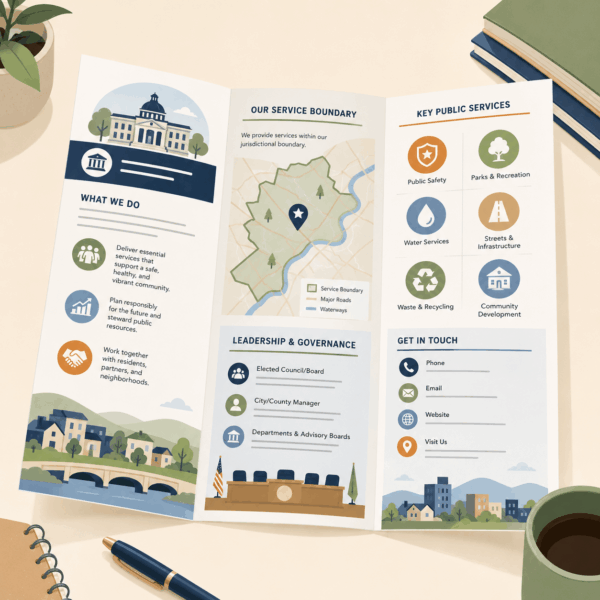
The service description should also identify the geographic area the agency serves. Township and district boundaries are not always intuitive, and properties along boundary lines may generate genuine uncertainty about which agency is responsible. A map showing the agency’s service area is one of the most useful communication tools a limited-purpose government can provide, both on the website and in any printed materials that describe its services. The map should be clear enough for a resident to determine whether their property is inside or outside the service area without requiring them to call the office.
How the Agency Is Governed
Residents who want to participate in decisions or hold the agency accountable need to understand how it is governed. A township governed by an elected board of trustees is different from a special district governed by an appointed board, which is different from a water authority governed by a joint powers agreement between member municipalities. Each governance structure has different election cycles, different public meeting schedules, different processes for public input, and different accountability mechanisms. Residents who do not understand the governance structure cannot effectively exercise their rights within it.
The governance explanation should identify who the governing body members are, how they are selected, how long their terms are, when and where meetings are held, and how residents can attend or participate. It should explain how residents can contact individual board members or elected officials with questions or concerns. For agencies with appointed rather than elected boards, it should explain who makes the appointments and how the appointment process works, so residents understand what avenues exist for influence.
Meeting information is particularly important and should be kept current. An agency whose website shows last year’s meeting schedule, or whose meeting location information has changed without update, is effectively preventing resident participation even if it is technically holding open meetings. Current, accurate meeting information prominently displayed on the website and in other routine communications is one of the most basic transparency practices an agency can implement.
How the Agency Is Funded
Residents who pay taxes or fees to a township or special district deserve to understand what they are paying and why. The funding explanation does not need to be a detailed budget presentation. It should be a clear, plain-language description of where the agency’s revenue comes from, how the amounts are determined, and what the money is used for.
For property tax-funded agencies, the explanation should include how the levy is calculated, what the typical household cost is, how residents can find their specific obligation, and what process governs changes to the levy. For fee-funded agencies such as water and sewer districts, the explanation should describe what the fee covers, how billing cycles work, and how rate changes are determined. For agencies that use multiple funding sources including grants, intergovernmental transfers, or special assessments, the explanation should describe each source in terms residents can understand.
The funding explanation should be connected to the service description so that residents understand the relationship between what they pay and what they receive. An explanation of what a road district levy covers, connected to a description of the road maintenance work the district performs, gives residents a complete picture rather than leaving them to wonder whether the money they contribute is being used for something they can see and value.
How to Access Services and Report Problems
One of the most practically important things a township or special district can communicate is how residents can get help, report a problem, or request a service. This information should be as simple and direct as possible: a phone number, an email address, a web form, or a physical address, with clear indication of which method is appropriate for which type of contact. Emergency contacts should be distinguished from routine contacts. After-hours contacts should be provided where relevant.
The problem reporting process should explain what happens after a report is made. How does the agency confirm receipt? Who investigates the report? What is the typical timeline for a response or resolution? What should residents do if they do not hear back within a reasonable time? Residents who report a problem and never hear anything are often left assuming the report was ignored, even when the agency is actively working on it. A process description that sets clear expectations about the reporting and response cycle reduces that frustration and builds confidence that the agency is responsive.
Explaining Jurisdictional Complexity Without Overwhelming Residents
One of the most challenging communication tasks for townships and special districts is explaining how they relate to the other local governments that also serve the same area. Getting this right requires a balance between giving residents enough information to navigate confidently and overwhelming them with more governmental complexity than they need or want to understand.
The most useful approach is to organize jurisdictional explanation around resident questions rather than around the governmental structure itself. Residents typically want to know one of three things: who is responsible for a specific service or facility, who to call when something goes wrong, and who to hold accountable for a decision they care about. A well-organized jurisdictional guide that answers those questions by service type is more useful than a structural diagram showing all of the governmental entities and their overlapping boundaries.
A contact referral directory, organized by service type rather than by agency name, is one of the most practical service communication tools a limited-purpose government can provide. It tells residents who handles road maintenance, who handles water and sewer service, who handles police and fire protection, who handles parks, who handles schools, who handles zoning and building permits, and who handles waste collection. For services the agency does not provide, the directory provides the name and contact information of the agency that does. This kind of directory reduces misdirected contacts, helps residents solve problems more efficiently, and positions the township or special district as a helpful community resource rather than a confusing bureaucratic entity.
Explaining jurisdictional complexity should also address the question of overlapping taxes and fees directly. Many residents who receive multiple property tax bills or who pay a utility fee in addition to a general property tax do not understand why they are paying to multiple entities. A brief explanation of why multiple governmental layers exist, what each one does, and why the services they provide cannot simply be consolidated into one government body, gives residents the context they need to evaluate whether the system makes sense rather than simply being frustrated by it. This explanation does not need to defend the existing structure as perfect. It needs to help residents understand it accurately.
Channels and Formats That Work for Service Explanation
Service explanation communication is fundamentally different in character from event-driven communication. Road closure notices and budget alerts are time-sensitive and action-oriented. Service explanation is durable, reference-oriented, and designed to be found when residents need it rather than consumed immediately when it arrives. The channel and format choices that work best for event-driven communication are not always the best choices for service explanation.
The Website as a Service Information Hub
The agency website is the primary and most important channel for service explanation. Unlike social media posts or email newsletters, the website is always available, can be organized in a way that matches how residents look for information, and can carry the full depth of information that service explanation requires without length constraints. A well-organized service explanation section of the website serves residents whether they arrive because they received a tax bill with the agency’s name on it, because a neighbor referred them, because they searched online for information about a specific problem, or because they noticed an agency vehicle working in the neighborhood and wondered who it belonged to.
The website’s service information should be organized by what residents are trying to accomplish or understand, not by the agency’s internal organizational structure. A section called Services should lead with the question What do we do?, followed by plain-language descriptions of each service, geographic scope, and access information. A section on governance should answer Who makes decisions and how can I participate? A section on funding should answer What am I paying and why? A frequently asked questions section organized around the questions staff actually receive most often is one of the most efficient investments in resident-facing service communication a small agency can make.
Proactive Distribution Through Welcome Materials
New residents moving into a township or special district service area may know almost nothing about the agency. A one-time outreach effort at the point of new residency, when residents are actively trying to understand their new community, is one of the most effective opportunities for service explanation. Welcome materials distributed through utility billing lists, property transfer records, or partnerships with real estate professionals can introduce the agency to residents who have not yet had occasion to seek it out.
Welcome materials should be brief, visually clear, and focused on the most essential information: what the agency does, what it does not do, the service area, how to access services, how to report problems, how to attend meetings, and where to find more information. They should include a clear reference to the website for detailed information. A single well-designed page that covers these basics is more effective than a comprehensive booklet that most residents will not read in full.
Regular Communications That Reinforce Service Awareness
Service explanation is most effective when it is woven into the agency’s regular communications rather than treated as a one-time event. A monthly newsletter or email that focuses primarily on current projects and decisions can include a brief standing section that reminds readers of a specific service the agency provides, how to access it, or a recent example of the service in action. A project completion notice can include a brief explanation of how the project was funded and who made the decision to approve it. A budget update can include a reminder of what the agency’s revenue pays for.
These standing elements do not require the agency to produce entirely new content for each communication. They require the agency to take information it already has and connect it to the service explanation framework the agency wants residents to internalize. Over time, consistent reinforcement of basic service information creates the accumulated understanding that helps residents navigate the governmental landscape more confidently.
Explaining Service Changes and Service Boundaries
 Two communication situations that require particularly careful service explanation are service changes and service boundary issues. Both situations test whether residents understand the agency’s role clearly enough to interpret a change or limitation accurately rather than experiencing it as an arbitrary or unexplained action.
Service changes, including adding or discontinuing a service, changing how a service is delivered, contracting it to a third party, or entering a shared service agreement with another agency, require explanation that connects the change to the agency’s mission and to the financial or operational factors that drove it. A township that contracts a private vendor to handle brush pickup needs to explain not just that the service is being contracted but what that means for residents: how to request pickup, what the vendor’s contact information is, what the service standards are, and how the township will continue to oversee quality. A district that discontinues a service needs to explain why, what alternatives residents have, and whether another agency has assumed responsibility.
Service boundary situations arise when residents request or expect service that falls outside the agency’s jurisdiction. A resident whose road abuts a township boundary and whose property is actually served by the county may call the township when the road needs repair. A property owner just outside a fire district’s boundaries who calls the district may be told they are not within the service area. These situations are difficult to handle gracefully, because the resident has a genuine need that the agency genuinely cannot meet. Service explanation communication that prepares residents for the existence of boundaries, and that provides clear referral information for services outside the agency’s scope, is the most respectful and practical way to manage these situations before they arise as individual conflicts.
Building Trust Through Consistent Service Communication Over Time
One of the less visible but most important outcomes of sustained service explanation communication is the gradual accumulation of resident trust in the agency as a reliable information source. This trust does not develop from a single well-produced document or a clever social media campaign. It develops from the consistent experience of finding accurate, useful information about the agency wherever residents look for it, over a period of months and years.
Residents who look up the agency’s website when they receive a tax bill with its name on it and find a clear, well-organized explanation of what the agency does form a different first impression than residents who find a website with outdated staff information, a broken link, and a mission statement written in the kind of bureaucratic language that communicates nothing meaningful. That first impression shapes how residents engage with everything the agency communicates subsequently. An agency that makes a strong first impression through clear service explanation has a significant advantage when it later needs residents to pay attention to a budget hearing, support a levy, or respond to an emergency notice.
Sustaining that trust requires consistency. Service explanation materials must be kept current. When services change, the website description should change. When the board composition changes, the governance section should be updated. When a fee changes, the funding explanation should reflect it. Residents who find inaccurate information on an agency’s website draw one of two conclusions: either the agency is not paying attention to its own communication, or it is not being transparent about something. Neither conclusion serves the agency’s relationship with its residents.
Small but meaningful gestures of service communication also contribute to trust over time. A sign at a road project that identifies the township or district as the responsible party and provides a contact number. A message on the back of a fee bill that briefly explains what the fee covers. A note in the annual tax statement that tells residents what each government entity receiving a portion of their payment does. Each of these small touches reinforces that the agency knows residents have questions and is making an effort to answer them proactively, which is the foundation of a communication relationship that residents value and trust.
Communicating About Service Quality and Performance
Most townships and special districts communicate primarily about what they do but rarely about how well they are doing it. Service quality communication, meaning information about whether the agency is meeting the standards it has set for itself, is an underused form of service explanation that builds credibility and accountability in ways that descriptive service information alone cannot.
Performance communication does not require a sophisticated metrics system or a formal annual report, though both can be useful. Even basic, honest information about service delivery resonates with residents who want to know that their tax dollars are producing results. A brief note in a quarterly communication indicating how many road miles were graded during the quarter, how many service requests were received and resolved, or how the agency’s response time compared to the standard it aims for gives residents tangible evidence of service delivery rather than abstract assurances.
When service quality falls below expectations, proactive communication about that shortfall and the steps being taken to address it is more trust-building than silence. A district that is behind on its road maintenance schedule because of unexpected equipment failure or staffing challenges, and that communicates that situation honestly along with the plan to catch up, is demonstrating the kind of transparency that residents appreciate. Silence about service shortfalls, or communication that implies everything is on track when it is not, may protect the agency’s image in the short term but damages its credibility when residents notice the gap between what was said and what was experienced.
Service quality communication is particularly important for agencies that are managing resident dissatisfaction about a specific service issue. A township road district that is receiving complaints about the condition of a specific road should communicate clearly about what has been inspected, what the findings show, what the plan is for addressing the condition, and when residents can expect to see improvement. That communication does not have to promise a quick fix if a quick fix is not realistic. It has to demonstrate that the agency is aware of the issue, is taking it seriously, and is communicating honestly about what it can and cannot do. That kind of honest, specific service communication is what turns dissatisfied residents into residents who feel heard rather than ignored.
Explaining the Relationship Between Services and Taxes or Fees
For many residents, the most immediate and emotionally significant encounter with a township or special district is receiving a tax bill or fee statement that includes the agency’s name alongside an amount they owe. That encounter should be the agency’s best opportunity to make a clear connection between what the resident is paying and what they receive in return. Too often, it is a missed opportunity because the tax bill or fee statement provides no such explanation, and the agency provides no supplementary communication that fills the gap.
The connection between payment and service should be made as direct and concrete as possible. A water district that charges a monthly service fee should be able to explain in plain language what that fee pays for: the treatment facility that ensures water quality, the distribution system that delivers water to homes and businesses, the staff who operate the system and respond to emergencies, and the reserve that funds major system repairs. When residents can see exactly what their payment buys, the payment feels reasonable rather than arbitrary.
For agencies funded through property taxes, the relationship between the levy and specific services is often less direct, because the tax is collected by a different entity and distributed to multiple recipients. But that does not relieve the agency of the responsibility to explain the connection. An annual communication that tells residents approximately how much of their total property tax bill goes to the township or district, and what that money is used for in concrete service terms, is a straightforward form of transparency that most residents appreciate and that very few limited-purpose governments provide.
Explaining costs also means being honest about the factors that drive those costs. Material prices, labor costs, regulatory requirements, aging infrastructure, and changing demand are all legitimate drivers of cost changes that residents can understand if they are explained plainly. An agency that raises its levy or fee and explains the specific cost drivers behind the increase is in a much stronger position with residents than one that simply announces the new amount. Residents who understand why the cost has changed are more likely to accept it as justified than residents who experience an unexplained increase and draw their own conclusions about the agency’s priorities.
Addressing Common Misconceptions About Township and District Services
Every township and special district accumulates, over time, a set of common misconceptions that residents hold about the agency’s role, responsibilities, or jurisdiction. Some of these misconceptions are benign misunderstandings that occasionally produce misdirected phone calls. Others are more consequential, shaping how residents vote on levies, what they expect of the governing board, or what they tell their neighbors about the agency. Proactively addressing common misconceptions through regular communication is one of the most practically useful forms of service explanation.
Identifying the misconceptions that are most worth addressing is relatively straightforward. The same diagnostic that reveals what residents do not know, by cataloging the most frequently asked questions and most common complaints, also reveals the most persistent misconceptions. A road district that regularly receives calls about a state highway running through its territory because residents assume the district is responsible for all roads in the area has identified a misconception worth correcting explicitly. A stormwater district that regularly encounters residents who believe their fee covers household flood insurance rather than watershed management infrastructure has identified a misconception with significant financial implications.
Addressing misconceptions should be direct but not condescending. The goal is not to correct residents for being wrong but to provide accurate information they did not have. A brief standing item in a regular communication that addresses one common misconception per issue, framed as answering a question residents frequently ask, is a format that accomplishes this without making residents feel lectured. Over time, this kind of persistent, patient communication erodes the stock of widespread misconceptions and replaces it with increasingly accurate resident understanding of what the agency does and why.
Partnering With Other Agencies to Explain a Complex Service Landscape
No township or special district operates in isolation. The governmental landscape that residents navigate includes multiple overlapping agencies, and explaining any one agency’s services well almost always requires acknowledging the others. An agency that pretends to be the only local government its residents encounter is not giving residents an accurate picture, and residents who later discover the complexity of the actual landscape may feel that the agency was misleading them by omission.
The most effective approach to explaining a complex service landscape is collaborative rather than unilateral. When a township, a county highway department, and a state transportation agency all have road maintenance responsibilities in the same area, coordinating with those partners to produce a shared resident guide that explains who does what is more useful than any single agency explaining its own role without reference to the others. That kind of intergovernmental communication cooperation is relatively rare, but it is achievable and has significant impact on resident understanding.
Even without formal intergovernmental cooperation, a township or special district can substantially improve resident understanding by incorporating referral information into its own service communication. A township road district that maintains a current, accurate list of county and state highway contacts and provides that list to residents who call about roads outside the district’s jurisdiction is doing collaborative service explanation through its own channels. A water district that can tell residents which sewer authority serves the area and how to contact it is reducing the runaround that residents experience when they contact the wrong agency.
Building and maintaining a local government contact directory is a modest investment in resident service that yields consistent returns. Staff who spend time on the phone redirecting misdirected contacts would rather have a quick answer than an awkward referral. Residents who receive a prompt referral to the right agency are more satisfied than residents who are told the agency cannot help them without any guidance about who can. And the directory serves as a standing reminder to the agency itself that it operates within a larger governmental context and that good service includes helping residents navigate that context effectively.
Intergovernmental communication cooperation can also extend to sharing communication infrastructure. Two neighboring townships that share a newsletter mailing list, a social media channel, or a joint website for service information can each reach a broader audience than either could alone. A special district that participates in a county-level community newsletter or information system can use that platform to explain its services to residents who might never seek out the district’s own communication channels. These cooperative arrangements require some coordination and trust between agencies, but they produce communication outcomes that no individual agency can achieve alone.
Evaluating Whether Service Communication Is Working
It is possible to produce a significant volume of service explanation communication and still not achieve the resident understanding that communication was designed to create. The measure of effective service explanation is not the communication produced. It is the resident understanding that results. Agencies that evaluate their service explanation communication only by what they have put out rather than by what residents have taken in may be investing significant effort in communication that is not reaching its intended audience or not being understood by those it reaches.
Simple indicators of whether service communication is working include the volume and type of misdirected contacts the agency receives. If residents are still regularly calling about services outside the agency’s jurisdiction, the jurisdictional explanation communication is not reaching them or not being retained. If residents who call with service requests frequently do not know the basic reporting process despite it being explained on the website, the website may not be accessible enough or the explanation may not be clear enough. If residents regularly express surprise about how the agency is governed or funded at public meetings, the governance and funding explanation communication is not achieving its purpose.
Resident surveys are a more systematic way to assess service communication effectiveness, though they require more effort than monitoring contact volume. A brief annual survey asking residents what they know about the agency’s services, governance, and funding can reveal gaps that staff observations alone might not catch. Survey questions should be practical and specific rather than general. Asking whether residents know which entity is responsible for maintaining a specific type of road, or whether they know how to report a problem to the agency, produces more actionable information than asking generally whether residents feel informed about local government.
The results of these evaluations should inform communication plan updates. If the evaluation reveals that residents still do not understand the jurisdictional boundary despite the agency having published a service area map, the agency may need to find a different format, a different channel, or a more prominent placement for that information. If the evaluation reveals that residents who moved to the area in the last two years are significantly less informed than long-term residents, the agency may need to strengthen its welcome communication for new residents. Evaluation is not an end in itself. It is a tool for making communication more effective over time.
Making Service Explanation Accessible to All Residents
Effective service explanation reaches all residents, not only those who read English fluently, have reliable internet access, or are comfortable navigating government websites. Townships and special districts that serve geographically and demographically diverse communities need to think deliberately about whether their service communication is reaching the residents who need it most.
Language access is one of the most significant barriers to effective service communication in communities where a substantial share of residents are more comfortable in a language other than English. A water district that explains its billing process only in English is not fully communicating with the significant portion of its ratepayers who read primarily in Spanish, Vietnamese, Arabic, or another language. Professional translation of the most important service explanation materials, including the service overview, the contact directory, the problem reporting process, and the funding explanation, is a practical investment that directly expands the reach of communication that is already being produced.
Literacy level is a second access barrier that service explanation communication should address. Reading level testing of service explanation materials will frequently reveal that the average reading level is significantly higher than the level at which many residents are most comfortable. Simplifying the reading level of plain-language materials is not the same as oversimplifying the content. It means using shorter sentences, more common words, and more direct sentence structures while retaining the full substance of the explanation. Many online readability tools are available that assess reading level and flag sentence structures that can be simplified.
Physical accessibility of service information is a third consideration. Residents who do not have reliable internet access, who have visual impairments that make standard website navigation difficult, or who prefer to receive information in a format they can hold and share need service explanation that does not depend entirely on digital channels. Printed materials distributed through libraries, post offices, community centers, and other trusted physical locations in the service area can reach residents who are not online while reinforcing the same foundational service explanation that the website carries. A single well-designed, annually updated printed service guide is a modest investment for a small agency that can significantly expand the reach of its service communication to residents who would otherwise not receive it.
Strategic Communication Support for Small and Rural Governments
 Service explanation is communication infrastructure that supports everything else a township or special district does. Agencies that invest in clear, accessible, consistently maintained service explanation will spend less time managing confusion, less time redirecting misdirected contacts, and less time responding to questions that good foundational communication would have answered in advance. They will also build the kind of baseline resident understanding that makes every subsequent communication more effective, because residents who already understand what the agency does can focus on the specific information a new communication is conveying rather than first trying to figure out who is talking to them and why.
Building service explanation communication from scratch or significantly improving it requires assessing what residents currently know and what they need to know, designing the information architecture of the website service section and other reference materials, developing plain-language descriptions of services, governance, and funding, and establishing the standing practices that keep service information woven into regular communications. Outside support can accelerate all of these steps and produce materials that are more likely to be genuinely useful to residents than materials assembled without reference to how residents actually navigate and understand local governmental services.
Stegmeier Consulting Group (SCG) works with townships, special districts, and other limited-purpose governments to build service explanation communication systems that reduce confusion, improve resident relationships, and support the public understanding on which accountable and responsive local government depends. That work includes website content design, welcome material development, service description writing, governance and funding explanation, and the integration of service explanation into regular communication practices. For agencies that have never formally addressed how they explain themselves to residents, that work can produce significant improvements in a relatively short time.
Future Trends in Service Explanation for Limited-Purpose Governments
The challenge of explaining limited-purpose government services to residents is likely to become more rather than less complex in the coming years. The continued growth of special district governance as a mechanism for funding and delivering specific services means that more residents will find themselves within the boundaries of more districts, each of which needs to explain its role. The consolidation of some governmental functions and the fragmentation of others means that the map of service responsibility will continue to change in ways that outpace resident understanding. And the growing diversity of communities served by local governments means that service explanation materials need to reach residents across more languages, more communication preferences, and more levels of prior governmental experience than ever before.
Digital tools are improving the ability of small governments to create and maintain clear, accessible service explanation materials. Interactive service maps that allow residents to enter an address and see which governmental entities serve that property are one example. Dynamic frequently asked questions sections that are updated based on the questions staff actually receive are another. Video explanations of how services work, how tax bills are calculated, and how residents can participate in governance are becoming more accessible to produce and more widely watched by residents who prefer video to text. Small governments that explore these tools will find that some are achievable with modest resources and have significant impact on resident understanding.
The expectation that local government communication will be mobile-friendly, visually clear, and designed for audiences with varying levels of literacy and language access is also growing. Service explanation materials that were designed for print or for a desktop computer audience may not serve residents who access information primarily through a smartphone, who read at a lower literacy level, or who are more comfortable in a language other than English. Agencies that build accessibility and plain language into their service explanation materials from the beginning will find that those materials serve a broader share of their resident population more effectively than materials that were designed for a narrower audience.
Conclusion
Townships and special districts exist to perform specific, essential functions that residents depend on even when they do not fully understand the agency providing those functions. The communication challenge is to make that understanding accessible, practical, and durable enough that residents can navigate local government services confidently, participate in agency decisions meaningfully, and form accurate opinions about whether they are being served well.
Service explanation is not the most dramatic form of local government communication, but it may be the most foundational. Every other communication the agency makes, from road project updates to budget hearings to emergency alerts, makes more sense to residents who already understand what the agency does and why it exists. Building that foundation is a communication investment that pays returns across every subsequent communication the agency produces.
The agencies that communicate their services clearly are the agencies that their residents understand, trust, and support. That understanding and trust are built through consistent, accessible, plain-language communication that meets residents where they are rather than expecting them to navigate complexity on their own. For townships and special districts operating in a genuinely complex governmental landscape, taking responsibility for helping residents understand that landscape is not just a communication best practice. It is a core obligation of public service.
Stegmeier Consulting Group’s Strategic Approach to Communication Systems
Align your agency’s service communication, governance transparency, and resident outreach.
Townships and special districts need communication systems that help residents understand what they do, how they are governed, and how to engage with them, before a problem arises and before residents have a reason to feel confused or frustrated. Building that foundational communication requires deliberate design of the information residents need, the channels through which it reaches them, and the habits that keep it current and accessible over time.
SCG helps limited-purpose local governments develop service explanation communication that is clear, practical, and designed for the residents who need it most. Whether your agency needs to build its service communication from the ground up or to strengthen an existing system that is not reaching residents effectively, SCG can help you design and implement a communication approach that builds resident understanding, reduces misdirected contacts, and supports the kind of informed public engagement that makes local government work better for everyone.
Use the form below to connect with our team and explore how clear, accessible service communication can strengthen your agency’s relationship with the residents and communities it serves.