
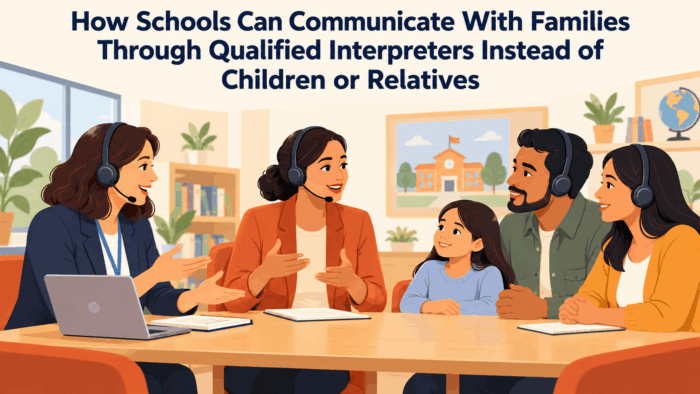
How Schools Can Communicate With Families Through Qualified Interpreters Instead of Children or Relatives
In schools across the country, a familiar scene plays out every day. A parent who speaks limited English arrives at the front office with a question, and the staff member, unsure how to communicate, looks around for help. A student is called from class to interpret. Or a teacher calling home to discuss a concern, asks the student to translate a note for their parents, or asks an older sibling to interpret during a conference. Sometimes a relative or family friend accompanies the parent and is asked to interpret a meeting about grades, discipline, special education, or health. These arrangements often feel practical in the moment. They are fast, they seem to work, and they avoid the perceived hassle of arranging professional interpretation. But they carry serious risks for accuracy, privacy, and student well-being, and they fall short of the legal obligations schools have to communicate meaningfully with families who have limited English proficiency.
Federal civil rights law requires schools to communicate with parents with limited English proficiency in a language they can understand about any program, service, or activity that is communicated to English-speaking parents. Federal guidance has made clear that schools should provide language assistance through appropriate, competent staff or professional interpreters, and that schools should not rely on students, siblings, friends, or untrained staff to interpret for parents. When children interpret, they are placed in an inappropriate role that can distort communication, burden them emotionally, and alter family dynamics. When untrained relatives or friends interpret, accuracy and confidentiality cannot be assured. Even well-meaning bilingual staff who are not trained as interpreters may omit, add, or change information without realizing it, particularly in technical conversations.
Despite these obligations and risks, informal interpretation remains common because qualified interpretation is often harder to access than it should be. Staff may not know that telephone or video interpretation is available, may not know how to request it, may believe it takes too long, or may worry about the cost. Families may offer to bring a child or relative because they assume no other option exists, or because they are accustomed to relying on their children to navigate institutions in English. Breaking this pattern requires more than a policy prohibiting informal interpreters. It requires making qualified interpretation so easy, fast, and routine that staff choose it naturally, and helping families understand that professional interpretation is available to them at no cost as a right, not a favor.
This article examines how schools can communicate with families through qualified interpreters instead of children or relatives. It looks at why informal interpretation is harmful, what qualified interpretation means, and how to make professional interpretation easy for staff to access in every setting, from the front office to the classroom to the special education meeting. It covers how to communicate with families about their right to free interpretation, how to work effectively with interpreters during conversations, how to handle urgent and unplanned situations, and how to build interpreter capacity across languages. It also addresses training, policies, and measurement. The goal is a school culture in which qualified interpretation is the routine choice in every conversation with families who need it.
Why Informal Interpretation Causes Harm
 Informal interpretation by children, relatives, friends, or untrained staff may appear to solve an immediate communication problem, but it creates several kinds of harm that are not always visible in the moment. Information may be lost or changed. Sensitive matters may be shared with people who should not hear them. Children may carry burdens that are inappropriate for their age. Families may receive a distorted understanding of decisions that affect their child. Schools may believe they have communicated effectively when they have not. Understanding these harms in concrete terms helps staff appreciate why qualified interpretation matters and why the convenience of informal interpretation is a false economy. The time saved by grabbing a nearby student is often lost many times over when misunderstandings lead to repeated calls, missed deadlines, disputes, and lost trust, and the costs fall most heavily on the families and students least able to absorb them.
The Burden on Children
When children are asked to interpret for their parents, they are placed in a role that reverses the normal relationship between parent and child. A student asked to interpret a conversation about their own grades, attendance, or behavior faces an obvious conflict of interest and may soften, omit, or change information to avoid consequences. Even when children try to interpret faithfully, they often lack the vocabulary to convey technical terms accurately, especially in conversations about special education, health, discipline, or academic programs. A child may not know how to translate terms like evaluation, accommodation, suspension, credit recovery, or individualized education program, and may substitute simpler words that change the meaning.
Children may also be exposed to information that is inappropriate for them to hear or carry, such as details of a sibling’s health condition, a parent’s financial situation, or a serious disciplinary incident involving another family member. Interpreting difficult conversations can cause stress, anxiety, and a sense of responsibility for adult problems. Students pulled from class to interpret also lose instructional time. Research and the experiences of families and educators consistently describe the emotional toll of language brokering on children, even when families depend on it in other settings. Schools have the ability and the obligation to relieve children of this burden in school matters.
Relieving children of this role also changes the message the school sends to the student. When a school arranges a professional interpreter rather than calling a student out of class, it signals that the student’s job at school is to learn, and that the adults will handle adult communication. For many students who interpret constantly for their families in other settings, such as at medical offices, banks, and government agencies, school can become one place where they are allowed simply to be students. Teachers and counselors who understand the pressures of language brokering can also be more attentive to signs that a student is carrying heavy responsibilities at home and can offer support where appropriate.
Accuracy and Completeness
Interpretation is a skill that requires more than bilingualism. Qualified interpreters are trained to convey meaning completely and accurately, without adding, omitting, or changing information, and to maintain the tone and register of the original speaker. Untrained interpreters, including bilingual relatives and staff, frequently summarize rather than interpret, leave out details they consider unimportant, add their own explanations or opinions, or misunderstand technical terms. In casual conversation these errors may be minor, but in conversations about a student’s education, health, safety, or legal rights, they can have serious consequences.
Families who receive incomplete or inaccurate information may make decisions based on misunderstandings, such as agreeing to a placement they do not fully understand, missing a deadline they did not know about, or failing to follow medical instructions. Schools may then believe that families agreed to decisions or understood information when they did not. When disagreements arise later, it may be impossible to know what was actually communicated. Qualified interpretation protects both families and schools by ensuring that what was said is what was heard.
Consider a meeting in which a teacher explains that a student is at risk of failing a course and must attend tutoring and complete missing work by a specific date. An untrained interpreter might convey only that the student needs to work harder, omitting the deadline, the tutoring schedule, and the consequences. The family leaves believing the situation is minor. Weeks later, when the student fails the course, the family is shocked and the school is frustrated, each believing the other failed to act. A qualified interpreter would have conveyed every detail, and the family would have had the chance to respond. Multiplied across thousands of conversations, the cumulative effect of incomplete interpretation on student outcomes and family trust is substantial.
Privacy and Family Dynamics
Conversations between schools and families often involve private information: a student’s disability, health, grades, behavior, family circumstances, or immigration-related concerns. When a relative, friend, or community member interprets, that information is shared with someone who may not be bound by confidentiality and who may have their own relationship with the family or community. Families may be reluctant to share important information in front of such interpreters, or may feel pressured into decisions. In small communities, information shared through informal interpreters may spread in ways the family did not intend.
Informal interpreters may also have their own perspectives and interests. A relative may hold views about the child’s needs, discipline, or education that influence how they interpret. In situations involving family conflict or concerns about safety, using a family member as an interpreter can be not only inappropriate but dangerous. Professional interpreters are bound by codes of ethics that require confidentiality, impartiality, and accuracy, which protects the family’s privacy and ensures that communication reflects what the parties actually said.
Schools should be especially alert to situations in which informal interpretation could put a student or family member at risk, such as conversations about suspected abuse, domestic conflict, or concerns raised by the student about someone in the home. In these situations, using a family member as an interpreter could compromise safety or discourage disclosure. Staff should be trained to recognize these situations and to use professional interpreters every time, without exception, even when it requires a short delay to arrange.
Learning Together: Communication Strategies for K-12 School Districts and Public Education Agencies
This article is part of our series on strategic communication for K-12 School Districts and Public Education Agencies. To learn more and to see the parent article, which links to other content just like this, click the button below.
What Qualified Interpretation Means
Qualified interpretation goes beyond the ability to speak two languages. It involves demonstrated proficiency in both languages, training in interpreting techniques, knowledge of relevant terminology, and adherence to ethical standards. Schools should understand what makes an interpreter qualified so they can select appropriate interpreters for different situations and ensure that families receive accurate and complete communication. Clear definitions also help schools explain to staff and families why informal interpreters are not an adequate substitute. When staff understand that interpreting is a professional skill, much like teaching or nursing, they are more likely to see the value of qualified interpreters and less likely to assume that any bilingual person will do.
Skills and Ethics of Qualified Interpreters
Qualified interpreters demonstrate proficiency in both English and the target language, including the ability to understand and convey complex and technical content. They are trained in modes of interpretation, such as consecutive interpretation, in which the interpreter speaks after the speaker pauses, and simultaneous interpretation, in which the interpreter speaks while the speaker is talking. They understand and follow professional ethics, including accuracy, completeness, confidentiality, impartiality, and transparency, which means informing all parties if they need clarification or if an error occurs. They know when to ask for repetition or clarification rather than guessing.
In educational settings, qualified interpreters also need familiarity with school terminology and processes. An interpreter who understands what an individualized education program is, how grading works, or what a suspension hearing involves can interpret more accurately than one encountering these concepts for the first time. Many districts provide interpreters with glossaries of education terms and orientation to school processes. For specialized settings, such as special education meetings or health conversations, districts may require interpreters with specific training or experience.
Districts can verify qualifications in several ways, such as requiring vendors to document interpreter training and assessment, using language proficiency assessments for staff interpreters, and observing interpreters periodically in practice. When districts work with community interpreters for less common languages, they can provide orientation to school processes, confidentiality expectations, and education terminology to strengthen quality. Investing in interpreter quality is particularly important for languages spoken by newly arrived communities, where professional interpreters may be scarce and families may be especially dependent on accurate communication.
Sign language interpretation deserves specific attention. Families who are deaf or hard of hearing may use American Sign Language or another signed language, and they are entitled to qualified sign language interpreters for school communication. Sign language interpreters require distinct training and certification, and they are often in short supply, so districts should establish relationships with interpreter agencies in advance and use video remote interpreting when in-person interpreters are unavailable. As with spoken languages, hearing children of deaf parents should not be asked to interpret school conversations, even though they may be fluent signers.
Bilingual Staff Versus Trained Interpreters
Many schools employ bilingual staff, such as office managers, paraprofessionals, and family liaisons, who are invaluable for building relationships and communicating directly with families in their language. Direct communication by a bilingual staff member speaking with a family in their shared language is different from interpretation, in which a third person conveys communication between two parties. Bilingual staff communicating directly can be highly effective. However, when bilingual staff are asked to interpret between an English-speaking staff member and a family, they need interpreting skills and should be assessed and trained for that role.
Districts should distinguish between these roles in their policies. Bilingual staff who are asked to interpret should have their language proficiency assessed, receive interpreter training, and be compensated or recognized appropriately. For high-stakes conversations, districts may require professional interpreters even when bilingual staff are available. Clear role definitions protect bilingual staff from being overburdened and ensure that families receive appropriate interpretation.
Recognizing the contributions of bilingual staff also helps with retention. Bilingual office staff and paraprofessionals often become the informal language access system of a school, fielding calls, translating notes, and interpreting in meetings on top of their regular duties. Without recognition, training, or relief, they may burn out or leave. Formalizing their roles, providing training, offering stipends or pay differentials, and supplementing their work with contracted services allows districts to value these essential employees while ensuring that interpretation quality is consistent.
Districts can also create pathways for bilingual students and community members to become qualified interpreters, for example through high school interpreting courses, partnerships with community colleges, and support for certification. These pathways expand the pool of qualified interpreters over time, create career opportunities for bilingual young people, and help districts meet growing demand in the languages their families speak.
Making Qualified Interpretation Easy to Access
The single most important factor in replacing informal interpretation with qualified interpretation is ease of access. If staff can connect with a qualified interpreter in a minute or two by phone or video, they will use it. If they must submit a request days in advance, search for contact information, or worry about cost approval, they will turn to whoever is nearby. Districts must design interpretation access around the realities of school life, where many conversations happen unexpectedly, at the front desk, in the hallway, during dismissal, or on the phone. Access must therefore be designed for the unplanned moment as well as the scheduled meeting, so that a staff member who encounters a family unexpectedly can connect with an interpreter as easily as they would pick up the phone to call a colleague.
On-Demand Telephone and Video Interpretation
Contracts with telephone and video interpretation services give staff immediate access to interpreters in many languages, often within seconds. Every school phone, front desk, nurse’s office, counseling office, and classroom should have clear instructions for accessing these services, including the phone number, access code, and steps for adding the interpreter to a call. Video interpretation, using tablets or computers, is particularly helpful for in-person conversations and for sign language interpretation. Districts should ensure that devices and instructions are readily available and that staff have practiced using them.
Cost concerns often discourage use of on-demand services. Districts can address this by budgeting centrally for interpretation, so that individual schools or staff do not need to approve each call, and by communicating clearly that staff should use interpretation whenever needed. Tracking usage helps districts plan budgets and identify schools where usage is unexpectedly low, which may indicate continued reliance on informal interpreters.
Districts should also test the experience from the staff perspective. If accessing a telephone interpreter requires navigating a confusing phone menu, entering a long access code, and waiting several minutes, staff may give up and call a student instead. Simplifying access, for example by programming a speed dial button on every school phone or placing a laminated card with the number and code next to every phone, removes friction. Brief hands-on practice during staff meetings, in which staff actually place a call to the interpretation service, builds confidence and makes staff far more likely to use the service when a real need arises.
Scheduling In-Person Interpreters
For planned meetings, such as conferences, special education meetings, discipline hearings, and family events, in-person interpreters are often preferable, particularly for long or complex conversations. Districts should have a simple, centralized process for requesting interpreters, with clear timelines and confirmation. Families’ language preferences should be recorded in the student information system so that interpreters can be arranged automatically when meetings are scheduled, rather than requiring families to request interpretation each time.
For high-volume events, such as parent-teacher conferences, schools can schedule interpreters in advance for the most common languages and arrange telephone or video interpretation for others. Coordinating conference schedules so that families who need interpretation are grouped during interpreter availability can improve efficiency without reducing access.
Interpreters for planned meetings should receive key documents and the agenda in advance, along with any glossary of terms likely to arise. A brief pre-meeting conversation between the facilitator and the interpreter allows the interpreter to ask about terminology and context, which improves accuracy. For long meetings, such as special education meetings that may last two hours, districts should plan for interpreter breaks or a second interpreter, since interpretation is mentally demanding and accuracy declines with fatigue.
Quick-Reference Tools for Staff
Staff need simple tools at their fingertips. A one-page quick-reference guide posted at every front desk and in every classroom can explain how to identify a family’s language, how to access telephone or video interpretation, how to request an in-person interpreter, and why students should not interpret. Language identification cards, which display a phrase such as point to your language in many languages, help staff identify the language a family speaks when it is not already known. Building interpretation steps into meeting scheduling systems and phone procedures makes the right choice the easy choice.
Some districts also add a field to meeting scheduling forms that automatically prompts staff to confirm whether interpretation is needed and in which language, drawing on recorded family preferences. Others place interpretation instructions directly in the family contact screen of the student information system, so that staff calling a family see the family’s language and the steps for adding an interpreter before they dial. These small design choices embed qualified interpretation into everyday routines rather than relying on staff to remember.
Quick-reference tools should be available in every setting where families might appear, including the nurse’s office, the counseling center, the cafeteria during lunch events, the gym during athletic events, and buses or transportation offices. Coaches, club advisors, bus drivers, and cafeteria managers interact with families regularly and may be among the most likely to rely on students as interpreters, because they are often outside the office environment where interpretation procedures are most familiar. Including these staff in training and providing them with portable reference cards or a phone number they can call from any device ensures that qualified interpretation is available wherever families and staff meet, not only at the front desk.
Communicating With Families About Their Right to Interpretation
 Many families do not know that schools provide free interpretation, or they assume that bringing a child or relative is expected. Some families feel uncomfortable asking for an interpreter, worry that it will inconvenience the school, or fear that requesting language assistance might reflect poorly on them. Clear, welcoming communication about the right to free interpretation helps families request it confidently and reduces reliance on informal interpreters. Families should also understand that interpretation is available for every kind of interaction, from a quick question at the front desk to a formal meeting, so that they do not limit their requests to situations they consider important enough.
Schools can reinforce this message visually by posting multilingual signs in front offices and meeting rooms stating that free interpretation is available and inviting families to ask. Seeing their own language displayed on a welcoming sign tells families immediately that the school expects and welcomes them, and it gives families who are hesitant to ask a clear, low-pressure prompt. Some schools also include a short multilingual line in automated phone greetings, explaining how to reach an interpreter, so that families calling the school are connected to language assistance from the very first moment of contact.
Informing Families Proactively
Schools should inform families about free interpretation at enrollment, in welcome materials, on websites, in newsletters, and in every invitation to a meeting or conference. Messages should be written in families’ languages and should state clearly that interpretation is free, that the school will arrange it, and that families do not need to bring their own interpreter. A brief statement such as we will provide an interpreter at no cost; please do not bring a child to interpret, delivered warmly, helps set expectations.
Front office staff and teachers should also offer interpretation proactively rather than waiting for families to ask. When a family arrives with a child ready to interpret, staff can thank the family and explain that the school has an interpreter available so the child can return to class, presenting the interpreter as a service the school is happy to provide.
The tone of these conversations matters. Families who have relied on their children for years may feel embarrassed or worry that they have done something wrong. Staff should avoid any suggestion of criticism and instead emphasize that the school wants to make sure the family receives complete information and that the student can stay focused on learning. Over time, as families experience the benefits of professional interpretation, many come to prefer it and begin requesting it on their own.
Respecting Family Preferences
Some families may prefer to have a trusted relative present for support, and that preference can be respected while still providing a qualified interpreter. The relative can participate as a support person while the professional interpreter handles interpretation. In rare situations where a family insists on using their own adult interpreter for a routine matter, staff should explain the benefits of professional interpretation, document the family’s choice, and consider having a qualified interpreter present to monitor accuracy, particularly for important conversations. Minors should not be used to interpret substantive matters even if the family requests it.
Schools should also be prepared for situations in which families decline interpretation because they believe their English is sufficient, even when staff observe that the family is struggling to understand. In these situations, staff can offer interpretation gently and repeatedly, explain that many families find it helpful for detailed conversations, and provide written summaries in the family’s language afterward. Respecting family autonomy while ensuring genuine understanding requires sensitivity and judgment, and staff benefit from guidance and examples.
Finally, schools should remember that a family’s language needs may change over time and may differ by topic. A parent who handles routine questions comfortably in English may still prefer an interpreter for a special education meeting, a discussion of a health concern, or any conversation involving legal rights. Offering interpretation for each significant conversation, rather than assuming that a family’s earlier choice applies forever, ensures that families always have access to the level of support they need, and it reinforces the message that requesting an interpreter is normal and welcome in every situation.
Working Effectively With Interpreters
Providing a qualified interpreter is essential, but staff also need skills to communicate effectively through an interpreter. Interpreted conversations take longer and require different habits than conversations in a shared language. Staff who know how to work with interpreters help ensure that families receive complete and accurate information and that conversations feel natural and respectful. Many staff have never worked with an interpreter before, and without guidance they may feel awkward, speak too quickly, or address the interpreter rather than the family. A small amount of preparation and practice makes a significant difference in the quality of interpreted conversations.
Practical Techniques
Staff should speak directly to the family, not to the interpreter, using first person, as in what questions do you have, rather than ask her what questions she has. They should speak in short segments, pausing to allow interpretation, and avoid jargon, idioms, and acronyms. They should allow extra time for interpreted meetings and check for understanding by asking families to share their questions or summarize key points. Before important meetings, staff can brief interpreters on the purpose and key terms and share documents in advance.
Staff should also be attentive to cultural communication differences. Interpreters can sometimes help clarify cultural context if asked, but their primary role is to interpret accurately, not to advocate or explain on behalf of either party. Debriefing with interpreters after difficult meetings can help staff improve their practice.
Seating arrangements also matter in face-to-face meetings. The interpreter is often best positioned beside or slightly behind the family member so that staff naturally look at and speak to the family rather than the interpreter. In video or telephone interpretation, staff should introduce the interpreter, explain the process to the family, and confirm that everyone can hear clearly before beginning. At the end of the conversation, staff can ask whether the family has any remaining questions and confirm next steps, giving families a final opportunity to clarify anything that was unclear. These practices make interpreted conversations feel more natural and respectful, and they help families feel like full participants rather than observers.
Staff should also be prepared for moments when interpretation reveals a misunderstanding. A family may respond in a way that suggests they did not understand a point, or the interpreter may ask for clarification of a term. These moments are opportunities, not interruptions. Staff can rephrase, use examples, or provide visual aids, such as a calendar showing a deadline or a diagram of the school day, to make information clearer. Written follow-up in the family’s language after the conversation reinforces key points and gives families something to refer to later.
Building Capacity, Policies, and Measurement
Sustaining qualified interpretation across a district requires adequate capacity in the languages families speak, clear policies, ongoing training, and measurement. These elements work together to ensure that qualified interpretation is consistently available and used. Without all four, progress tends to stall: capacity without policy leads to inconsistent use, policy without training leads to confusion, and neither can be improved without measurement that shows where gaps remain.
Capacity and Policy
Districts should assess interpretation needs by language and school, combining staff interpreters for common languages with contracted services for others. Policies should prohibit the use of students as interpreters for substantive matters, define when professional interpreters are required, set standards for interpreter qualifications, and explain how staff should request interpretation. Policies should be communicated to all staff and included in onboarding.
Policies should also address emergencies and unplanned situations, recognizing that in a genuine emergency, such as a medical crisis or safety threat, staff may need to communicate immediately using whatever means are available. In these rare cases, staff should use the quickest available qualified option, such as an on-demand telephone interpreter, and should follow up with a qualified interpreter as soon as possible to confirm that the family understood what happened and what comes next. Clear guidance on emergencies prevents staff from treating every situation as an exception that justifies informal interpretation.
Training and Measurement
All staff who interact with families should receive training on why qualified interpretation matters, how to access it, and how to work with interpreters. Districts should track interpretation usage, response times, family satisfaction, and reports of informal interpretation, and should review data by school to identify where additional support is needed.
Some districts conduct brief surveys of families who used interpretation, asking whether they felt understood, whether the interpreter was professional, and whether they would request interpretation again. Others ask staff periodically whether they have used students or relatives to interpret and why, treating the answers as information about barriers rather than as grounds for blame. These insights help districts improve access, address gaps in particular languages, and celebrate schools that have made qualified interpretation routine.
Leaders should share measurement results with principals and staff, highlight progress, and address persistent gaps directly. When data shows that a particular school rarely uses interpretation despite serving many multilingual families, leaders can explore the reasons, provide additional training or tools, and set clear expectations. Over time, consistent attention from leadership signals that qualified interpretation is a district priority rather than an optional best practice.
How School Interpretation Practices Compare With Other Agency Types
Hospitals and courts offer instructive models for schools. In health care, research linking the use of untrained interpreters to medical errors has led many hospitals to make professional interpretation available around the clock, to train clinicians in working with interpreters, and to prohibit the use of minors as interpreters except in emergencies. Courts require certified or qualified interpreters for legal proceedings and recognize that interpretation errors can affect fundamental rights. Both settings have shown that when professional interpretation is easy to access and expected, staff use it routinely, and the practice of relying on children or relatives declines sharply.
Schools differ from hospitals and courts in the frequency, variety, and informality of their interactions with families. A family may interact with a school dozens of times a year, through brief phone calls, hallway conversations, conferences, and formal meetings, often with little warning. This makes on-demand access and staff habits especially important. Schools also have a unique relationship with children, who are present daily and readily available as informal interpreters, which makes clear policies and a strong culture of qualified interpretation all the more necessary to protect students from inappropriate roles. Schools also have the advantage of predictable patterns, such as conference seasons, enrollment periods, and recurring meetings, which allow them to plan interpretation capacity in advance in ways that hospitals and courts responding to unpredictable demand cannot always do.
Tying It All Together
Interpreted family communication is not a side function. It determines whether families with limited English proficiency receive accurate, complete, and private communication about matters that profoundly affect their children, and whether children are protected from adult responsibilities that do not belong to them.
Effective schools recognize the harms of informal interpretation, including the burden on children, the risks to accuracy and completeness, and the threats to privacy and family dynamics. They define what qualified interpretation means and distinguish between bilingual staff communicating directly and trained interpreters.
They make qualified interpretation easy to access through on-demand telephone and video services, centralized scheduling of in-person interpreters, automatic arrangement based on recorded language preferences, and quick-reference tools at every point of contact.
They communicate proactively with families about their right to free interpretation, welcome families warmly when they arrive with a child prepared to interpret, and respect family preferences for support persons while still providing qualified interpreters.
They train staff to work effectively with interpreters, speaking directly to families, pausing for interpretation, and avoiding jargon. They build interpreter capacity across languages, adopt clear policies, and measure usage and family experience.
Taken together, these practices make qualified interpretation the routine choice in every conversation, protecting families, students, and schools alike. The shift is as much cultural as procedural. It requires every staff member to see qualified interpretation not as an inconvenience but as a basic part of respectful, effective communication with every family the school serves.
Strategic Communication Support for Qualified Interpretation
 Families who communicate with schools in languages other than English need reliable access to qualified interpreters when discussing enrollment, academic progress, special education, health services, and other important matters. Although staff may turn to bilingual colleagues, relatives, or students when language barriers arise, these informal arrangements can compromise accuracy, confidentiality, and meaningful family participation. Replacing them with dependable interpretation practices requires more than adopting a policy; staff need clear procedures, accessible resources, and confidence in using the available services. Because these changes span multiple departments and daily school operations, districts often partner with Strategic Communication Support (SCG) to establish practical systems that make qualified interpretation easier to access and use consistently. SCG helps districts turn language access expectations into clear procedures that staff can follow and families can understand.
SCG supports districts in examining when informal interpretation occurs, which situations create the greatest challenges, and what prevents staff from using qualified services. This review can inform straightforward procedures for requesting interpreters, arranging appointments, accessing telephone or video interpretation, and determining when interpretation is needed for meetings or urgent communication. Quick-reference guides and clearly assigned responsibilities help staff respond without unnecessary delays or uncertainty, making qualified interpretation a routine part of service delivery rather than an exception.
Family communication is another important part of the transition. Parents and caregivers need to know that interpretation is available, how to request it, and whether they will be charged for the service. SCG helps districts develop multilingual notices and staff guidance that explain these options in accessible language. Training can also prepare employees to work effectively with interpreters, address families directly during interpreted conversations, protect confidentiality, and avoid relying on children or other unqualified individuals to convey important information.
During enrollment periods, parent-teacher conferences, special education meetings, and other high-demand periods, inconsistent procedures can become particularly difficult to manage. SCG helps districts coordinate interpretation workflows across schools and departments, clarify vendor and technology arrangements, and prepare for predictable increases in demand. These measures can help districts maintain access when scheduling pressures rise and support more consistent communication with multilingual families.
SCG also helps districts assess whether qualified interpretation is being used effectively and whether families can participate fully in school interactions. Service utilization records, family feedback, staff observations, and recurring access problems can reveal where additional training, resources, or procedural changes are needed. By reviewing these findings across schools and refining implementation over time, districts can strengthen accountability, reduce reliance on informal interpretation, and make language access a more dependable part of family engagement.
Future Trends
Video remote interpretation is becoming more widely available and affordable, making it easier for schools to provide face-to-face interpretation in many languages, including sign language, without waiting for an in-person interpreter.
Artificial intelligence interpretation tools are emerging, offering real-time spoken translation. While these tools may help with simple exchanges, their accuracy for complex and sensitive conversations remains limited, and districts will need clear guidance on when human interpreters are required. Families will also need to understand when they are speaking with an automated tool and how to request a human interpreter, and districts will need to consider privacy implications when sensitive conversations are processed by technology.
More districts are investing in staff interpreter programs that assess, train, and compensate bilingual employees for interpretation, building internal capacity and career pathways.
Federal and state attention to language access in schools remains strong, and districts can expect continued scrutiny of practices such as using students as interpreters.
Finally, families are increasingly aware of their right to interpretation and more likely to expect it, which will reinforce the shift toward qualified interpretation as standard practice. Districts that have already built strong systems will find it easy to meet these expectations, while districts that continue to rely on informal interpretation will face growing pressure from families, advocates, and oversight agencies.
Conclusion
Asking a child or relative to interpret may seem like a quick solution, but it compromises accuracy, privacy, and student well-being, and it falls short of schools’ obligations to families. Qualified interpretation protects everyone involved. It ensures that families receive the full message, that children remain in their proper role, and that schools can be confident their communication has been understood.
Schools that make qualified interpretation easy to access, communicate with families about their rights, train staff to work with interpreters, build capacity, and measure results can make professional interpretation the routine choice.
When every family can communicate with their school through a qualified interpreter, families are fully informed, children are free to be children, and partnership becomes possible across every language. That outcome is well within reach for any school willing to make qualified interpretation as easy and routine as picking up the phone.
Stegmeier Consulting Group’s Strategic Approach to Communication Systems
Make qualified interpretation the routine choice in every family conversation.
Stegmeier Consulting Group helps school districts replace informal interpretation with qualified interpretation that families and staff can rely on. We begin by assessing current practices, identifying where children, relatives, and untrained staff are still being used as interpreters, and understanding the barriers that drive those choices.
Our team works alongside language access staff, school leaders, and family engagement teams to design simple access processes, develop clear policies, create quick-reference tools and family-facing messages, and train staff to work effectively with interpreters.
We treat interpretation as part of a broader multilingual communication system, aligning it with language data, translation practices, and family engagement. We help districts measure usage and family experience so that improvements are sustained.
Use the form below to connect with our team and explore how strategic language access communication can help your district make qualified interpretation the standard in every conversation with families, protect students from interpreting for their own families, and build trust across language communities.