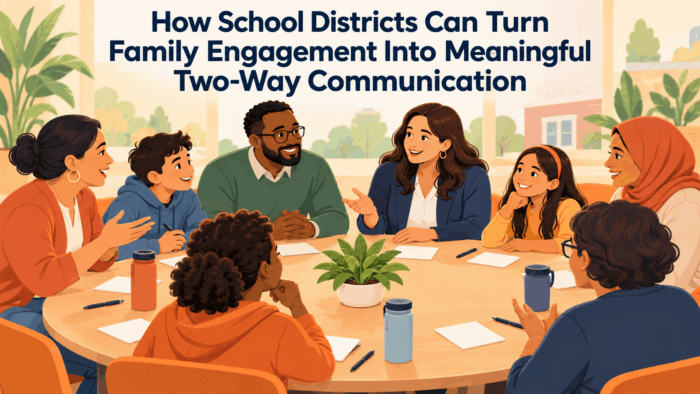
How School Districts Can Turn Family Engagement Into Meaningful Two-Way Communication
Most school districts describe family engagement as a priority. They host events, send newsletters, run parent advisory committees, and survey families every year. Yet many families still report that they do not feel heard. They receive a steady stream of information from schools, but they rarely feel that their own knowledge, concerns, and ideas shape what happens. Communication flows outward from the district far more easily than it flows back in.
This imbalance is understandable. School systems are built to deliver information efficiently to large numbers of people. Announcements, alerts, and newsletters scale easily. Listening does not. Genuine two-way communication requires time, relationships, translation, follow-up, and a willingness to change course based on what families say. Those requirements can feel at odds with the pace and pressure of running schools.
But the research and experience behind family engagement are consistent: students benefit when families and schools work as partners. Partnership depends on communication that runs in both directions. Families hold essential knowledge about their children, their communities, and the barriers that affect learning. When schools tap into that knowledge, they make better decisions, design more effective programs, and earn the trust that helps them through difficult moments.
This article examines how school districts can turn family engagement into meaningful two-way communication. It covers the difference between informing and engaging, building listening systems at the classroom, school, and district levels, designing family input processes that are inclusive, closing the feedback loop so families see the results of their input, preparing staff for two-way communication, and measuring whether engagement is actually changing relationships and decisions. The goal is engagement that families experience as real partnership rather than polite consultation.
The Difference Between Informing and Engaging
 Many activities labeled family engagement are actually family information. Newsletters, robocalls, website updates, and event announcements inform families about what the school is doing. These are necessary, but they are one-directional. Engagement begins when families have real opportunities to share their perspectives and when those perspectives influence decisions.
Distinguishing between informing and engaging helps districts see where their efforts are concentrated and where gaps exist. Most districts find that the vast majority of their family communication is informational, and that the opportunities for families to be heard are limited, infrequent, or reach only a small group of already involved parents.
A Spectrum of Family Communication
It can be useful to think of family communication along a spectrum. At one end is informing, where the district shares information with families. Next is consulting, where the district asks for family input on a defined question. Further along is involving, where families participate in shaping options and plans. At the far end is partnering, where families share in decision making and leadership.
Not every decision belongs at the partnering end of the spectrum, and informing will always be essential. But districts that engage meaningfully make deliberate choices about where each issue belongs on the spectrum and communicate honestly with families about how much influence their input will have.
Why Token Engagement Backfires
Engagement that asks for input but does not use it can be worse than no engagement at all. Families who participate in a survey, attend a listening session, or serve on a committee and then see no evidence that their input mattered often conclude that the district is not sincere. They become less willing to participate the next time, and they may share that skepticism with others.
Token engagement often happens unintentionally. Input is gathered after a decision has effectively been made, or the results are never reported back, or the input is summarized so broadly that families cannot recognize their own concerns in it. Avoiding these patterns requires planning engagement before decisions are made and committing to report back on what was heard and what changed.
Building Two-Way Communication at the Classroom Level
For most families, the most important communication relationship is with their child’s teacher. Two-way communication at the classroom level shapes how families experience the entire school system. When teachers and families exchange information regularly and respectfully, students benefit directly.
Starting the Year With Listening
Many teachers begin the year by sending families information about classroom rules, schedules, and expectations. Fewer begin by asking families to share information about their children. A simple start-of-year conversation or questionnaire asking families about their child’s strengths, interests, challenges, and hopes for the year signals that the teacher values the family’s knowledge. It also provides insights that help the teacher connect with the student.
These conversations work best when families can respond in their preferred language and format. A short phone call, a brief in-person meeting, a text message exchange, or a paper questionnaire can all work. The key is that the teacher actually uses what families share.
Regular, Positive Contact
Families often hear from teachers only when something is wrong. This pattern makes families anxious when the school calls and reluctant to engage. Regular positive contact, such as a quick message sharing something a student did well, builds a foundation of trust that makes difficult conversations easier when they are needed.
Schools can support positive contact by setting expectations, such as reaching every family with a positive message in the first month, and by providing tools that make it quick and easy, including translation support.
Reimagining Conferences
Traditional parent-teacher conferences are often brief, teacher-led, and focused on grades. More engaging models, such as student-led conferences or academic partnership meetings where teachers and families set goals together, create genuine dialogue. Conferences should include time for families to share their observations and questions, and teachers should be prepared to listen as much as they report.
Schools can also make conferences more accessible by offering flexible scheduling, virtual and phone options, and interpretation booked in advance. Sending families a short set of questions to consider before the conference helps them arrive prepared to contribute, and a brief follow-up note summarizing agreed goals keeps the partnership going after the meeting ends.
Creating Listening Systems at the School Level
Beyond individual classrooms, schools need systems for hearing from families collectively. School leaders make decisions about schedules, programs, discipline approaches, events, and resources that affect all families. Two-way communication at the school level allows families to influence those decisions and helps leaders understand the school community.
Principal Listening Sessions
Regular listening sessions with the principal, held at times and places convenient for families, give families direct access to school leadership. Sessions work best when they are structured around open questions, such as “What is working well for your family this year?” and “What would make school better for your child?”, rather than presentations. Interpretation, childcare, and food increase participation.
Rotating sessions across different times, locations, and formats, including virtual options, helps reach families who cannot attend a single standard meeting.
Principals should end each session by summarizing what they heard and explaining when and how they will follow up. Posting a brief summary afterward, in the languages families speak, allows families who could not attend to see what was discussed and add their own perspective.
School Site Councils and Advisory Groups
Many schools have formal family advisory structures, such as site councils or parent advisory committees. These groups can be powerful vehicles for two-way communication, but they often draw a narrow slice of the school community. Schools can broaden participation by actively recruiting families from underrepresented groups, offering training on how the group works, holding meetings at accessible times, and providing interpretation.
Advisory groups should have clear roles and real responsibilities. Members should know which decisions they influence and how their recommendations will be used.
Rotating membership, term limits, and alternate members help prevent advisory groups from becoming closed circles. Schools can also ask advisory members to gather input from other families before meetings, which turns the group into a bridge to the wider community rather than a small set of individual voices.
Informal Channels for Feedback
Not every family will attend a meeting or join a committee. Informal channels, such as brief surveys, suggestion boxes, comment cards at events, and two-way text messaging, allow families to share feedback on their own terms. These channels are most effective when schools respond visibly to what they hear, for example by posting a “You said, we did” summary.
Designing District-Level Engagement That Includes Every Community
District-level decisions, such as budget priorities, boundary changes, strategic plans, school calendars, and new programs, affect families across the district. Engagement on these decisions often draws families who are already connected and comfortable speaking in public forums. Designing district engagement to include every community requires deliberate effort.
Planning Engagement Before Decisions Are Made
Effective district engagement begins early, when options are still open and family input can genuinely shape outcomes. Engagement plans should identify the decision, the timeline, the questions families will be asked, how input will be gathered, how it will be used, and how results will be reported. Sharing this plan publicly at the outset helps families understand the process and builds credibility.
An engagement plan should also state plainly which aspects of the decision are open to family influence and which are fixed by law, budget, or prior commitments. That clarity prevents families from investing effort in questions that are already settled and directs their energy to the choices where their input can make a real difference.
Using Multiple Methods
No single engagement method reaches everyone. Surveys reach many families quickly but provide limited depth. Community meetings allow dialogue but draw those who can attend. Focus groups provide depth but reach few. Combining methods, including surveys in multiple languages and formats, meetings in community settings, small group conversations hosted by partners, and online input tools, produces a fuller picture.
Districts should pay particular attention to reaching families who are often underrepresented, such as families with limited English proficiency, families experiencing poverty, families of students with disabilities, and families in neighborhoods with historically low participation.
Making Public Meetings More Inclusive
Public meetings and board comment periods can be intimidating for many families. Districts can make them more inclusive by offering interpretation, providing materials in advance and in multiple languages, holding meetings in community settings, using small group discussion formats, and allowing input in writing or through recorded messages. Clear explanations of how comments will be used help families understand why their participation matters.
Making Two-Way Communication Work Across Languages and Cultures
Two-way communication is only two-way if both sides can understand each other. For families who speak languages other than English, many engagement opportunities are effectively one-way: they can receive translated information, but they have few practical ways to respond, ask questions, or share ideas in their own language. Cultural differences in expectations about schools, authority, and family roles can add further distance.
Districts that serve multilingual communities must design engagement with these realities in mind from the start, rather than adding translation at the end.
Interpretation That Supports Dialogue
Interpretation at meetings should support genuine participation, not just listening. Simultaneous interpretation equipment, language-specific small group discussions led by bilingual facilitators, and the option to submit comments in any language all allow multilingual families to contribute fully. Meeting agendas should allow extra time when consecutive interpretation is used, so that families are not cut off.
For individual communication, two-way messaging with translation and readily available phone interpretation make it possible for families to initiate conversations with teachers and staff, not only respond to them. Families should be told clearly that they can contact the school in their own language and that interpretation is free.
Schools can reinforce this message by including a short multilingual statement on every communication explaining how to request interpretation, and by making sure office staff know how to connect a caller to an interpreter immediately rather than asking them to call back later.
Understanding Cultural Expectations
Families from different backgrounds may hold different expectations about how to engage with schools. In some cultures, questioning teachers is considered disrespectful, and families may defer to educators even when they have concerns. In others, families expect to be closely involved in daily decisions. Some families may be cautious about engaging with any public institution because of past experiences.
Staff who understand these expectations can invite participation in ways that feel comfortable. Explicitly telling families that the school wants to hear their questions and concerns, and that raising them is welcome, can make a significant difference for families who might otherwise stay silent.
Language-Specific Engagement Opportunities
Some districts host engagement sessions conducted entirely in a particular language, facilitated by staff or partners who share the community’s language and culture. These sessions often produce richer conversation than interpreted meetings, because families can speak freely without the pauses and filters that interpretation introduces. Findings from language-specific sessions should be integrated into broader engagement results so that these voices carry equal weight.
Treating Concerns and Complaints as Two-Way Communication
Family concerns and complaints are one of the most direct forms of two-way communication schools receive, yet they are often handled as problems to be contained rather than information to be learned from. How a school responds when a family raises a concern shapes whether that family, and others who hear about the experience, will speak up in the future.
Making It Clear How to Raise a Concern
Many families do not know how to raise a concern or who to contact. Clear, simple guidance, explaining that families can start with the teacher, then the principal, then the district, along with contact information and expected response times, gives families confidence that their concerns will be heard. This guidance should be available in multiple languages and formats and repeated throughout the year, not only in a handbook families rarely read.
Responding Promptly and Respectfully
Families who raise concerns should receive a timely acknowledgment, even if a full response takes longer. Staff should listen fully, ask clarifying questions, and avoid defensiveness. When the concern involves a mistake by the school, a sincere acknowledgment goes a long way. When the school cannot do what the family asks, a clear explanation of why, and of any alternatives, helps preserve the relationship.
Following up after a concern is resolved, to confirm that the family is satisfied or to share what changed, demonstrates that the school takes concerns seriously.
Learning From Patterns
Individual concerns often reflect broader issues. Districts that track concerns by topic and school can identify patterns, such as recurring transportation issues, communication gaps, or concerns about particular practices, and address root causes. Sharing what the district has learned from family concerns, and what it has changed as a result, shows families that speaking up makes a difference beyond their own situation.
Engaging Families Who Are Often Underrepresented
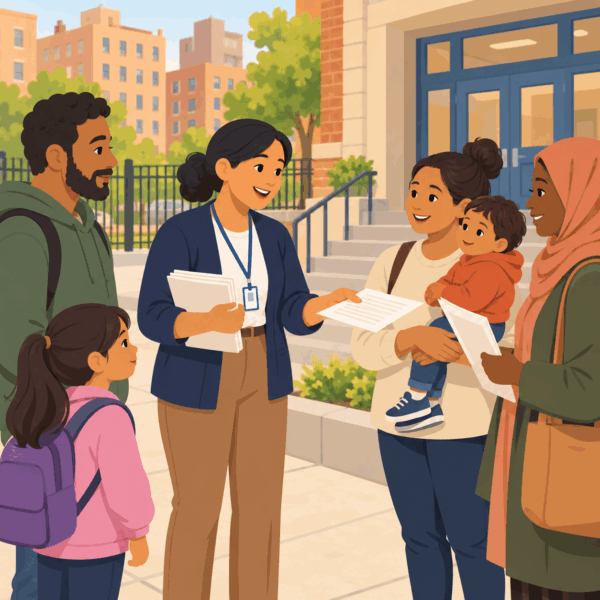 In nearly every district, a relatively small group of families participates in most engagement activities. These families are valuable partners, but their perspectives do not represent the full community. Families who are often underrepresented include families with limited English proficiency, families working nonstandard hours, families of students with disabilities, families experiencing housing instability, fathers and male caregivers, and families of older students.
Going Where Families Are
Rather than expecting underrepresented families to come to school-based meetings, districts can bring engagement to them. Conversations at community events, apartment complexes, places of worship, workplaces, and neighborhood gatherings reach families who rarely attend school functions. Partnering with community organizations that already serve these families makes outreach more effective and more trusted.
Removing Practical Barriers
Practical barriers keep many families from participating. Meeting times that conflict with work shifts, lack of childcare, transportation challenges, and the cost of time all matter. Offering multiple times, virtual options, childcare, meals, and transportation support removes these barriers. Some districts compensate families for participating in intensive engagement such as focus groups or design teams, recognizing the value of their time and expertise.
Inviting Personally
A personal invitation from a teacher, liaison, or another parent is far more effective than a general announcement. Families who have never participated often assume engagement opportunities are meant for others. A direct invitation that explains why their perspective matters can change that assumption. Districts can ask staff and family leaders to personally invite a set number of families who have not participated before.
Follow-up matters as much as the invitation itself. Families who attend for the first time should be thanked personally, told how their input will be used, and invited back. A positive first experience is often what turns an occasional participant into a long-term partner.
Using Digital Tools for Dialogue, Not Just Distribution
Most school communication technology is designed to distribute information efficiently. Newsletters, alerts, and announcements move from the school to families. Many of the same platforms, however, include features that support dialogue, such as two-way messaging, polls, comment functions, and feedback forms. Districts can make better use of these features to build two-way communication into everyday practice.
Quick Pulse Checks
Short, frequent pulse surveys, sometimes as simple as a single question sent by text, allow families to share feedback without the burden of a long survey. A school might ask after an event how useful it was, or ask families midyear how well they feel informed about their child’s progress. Quick pulse checks show families that the school is interested in their views throughout the year, not only once annually.
Online Input With Visible Responses
Online input tools for district decisions can broaden participation, particularly when they allow families to see what others have said and how the district is responding. Transparency about the input received builds trust that the process is genuine. These tools should be accessible on mobile devices, available in multiple languages, and complemented by offline options.
Guarding Against Digital Exclusion
Digital engagement tools reach families who are comfortable online and leave out those who are not. Districts should always pair digital engagement with offline methods and should compare who participates through each channel to ensure that digital tools are broadening rather than narrowing the range of voices heard.
Printed versions of online surveys, phone-based input lines, and partner-hosted input sessions give families without reliable internet access an equal opportunity to be heard. When results from all channels are combined and reported together, no group’s perspective is lost simply because of the format it arrived in.
Developing Family Leadership and Co-Design
At the partnering end of the engagement spectrum, families take on leadership roles and help design solutions. Family leadership programs, co-design teams, and parent ambassador initiatives give families meaningful influence and build their capacity to advocate for their children and communities.
Family Leadership Development
Leadership development programs teach families how the school system works, how decisions are made, and how to participate effectively in advisory groups and public processes. Graduates often become connectors who help other families engage. Programs should be designed to reach families from diverse backgrounds and should be offered in multiple languages.
Successful programs pair learning with real opportunities to lead, such as joining an advisory group, helping plan a school event, or presenting family perspectives to school leaders, so that participants can put their new knowledge to use right away.
Co-Designing Programs and Communication
When districts design new programs, policies, or communication tools, involving families in the design process produces solutions that better fit family needs. Co-design teams that include families, staff, and sometimes students can work through problems together, test ideas, and refine solutions before they are rolled out. Families who help design a program also become credible messengers for it.
Co-design requires clear expectations about the team’s authority, the time commitment involved, and how recommendations will be used. When those expectations are honored, co-design builds deep trust and ownership.
Parent Ambassadors and Peer Connectors
Parent ambassador programs recruit and train family members to welcome new families, share information, and gather feedback within their own networks. Ambassadors often reach families the school cannot, particularly in communities with strong informal networks. Ambassadors should receive training, regular communication from the school, and recognition for their contributions.
Many districts also provide stipends to ambassadors, recognizing the time they contribute. Ambassadors should have a clear point of contact at the school and a simple way to pass along questions and concerns they hear, so that the feedback they gather reaches people who can respond.
Closing the Feedback Loop
Closing the feedback loop is the step most often missing from family engagement, and it is the step that most strongly determines whether families will engage again. Families need to know what was heard, what was decided, and why. When input did not change a decision, families deserve an honest explanation.
Reporting What Was Heard
After gathering input, districts and schools should share a summary of what families said. Summaries should be specific enough that families can recognize their own contributions and should reflect the range of perspectives, including disagreements. They should be available in the languages families speak and shared through the same channels used to invite input.
Explaining Decisions and Tradeoffs
When decisions are made, communication should explain how family input influenced the outcome. If input led to changes, those changes should be highlighted. If input could not be accommodated, the reasons, such as legal requirements, budget constraints, or competing priorities, should be explained clearly and respectfully. Families can accept decisions they disagree with more readily when they understand the reasoning.
Making Follow-Through Visible
Follow-through should continue after decisions are made. Updates on implementation, such as progress on a new program families requested or changes to a policy families raised concerns about, show that engagement led to action. Simple tools like a public “You said, we did” page or regular updates in newsletters make follow-through visible over time.
Follow-through updates should be specific. Rather than stating that the district is working on family concerns, an update might explain that the after-school pickup process was changed at three schools in response to family feedback, describe what changed, and invite families to share whether the change is working. Specific updates make engagement feel real.
Engaging Families Through Difficult Decisions and Change
The true test of two-way communication comes during difficult decisions. School closures and consolidations, boundary changes, budget reductions, schedule changes, and responses to community controversies all generate strong feelings. Districts sometimes limit engagement during these moments out of concern that it will intensify conflict. In practice, limiting engagement usually deepens mistrust and makes the eventual decision harder to implement.
Engaging Early and Honestly
When difficult decisions are on the horizon, families deserve to know early. Sharing the problem the district is trying to solve, the constraints it faces, and the options under consideration before choices are finalized allows families to contribute ideas and understand tradeoffs. Honesty about constraints, such as declining enrollment or budget gaps, helps families engage with the real problem rather than reacting to a decision they did not see coming.
Early engagement also allows districts to learn about impacts they may not have anticipated, such as effects on particular neighborhoods, transportation challenges, or consequences for students with specific needs.
Structuring Conversations to Reduce Conflict
Large public meetings on contentious topics can quickly become adversarial, with the loudest voices dominating. Structured formats, such as small group discussions with trained facilitators, scenario exercises that ask families to weigh tradeoffs, and listening sessions organized by school or community, create space for more productive dialogue. These formats help districts hear a fuller range of perspectives and help families hear one another.
Providing clear, accessible background information before and during these conversations ensures that families can participate on an informed basis.
Supporting Families Through Implementation
Engagement does not end when a difficult decision is made. Families affected by a closure, boundary change, or program change need ongoing communication about what happens next, how transitions will be supported, and who to contact with questions. Involving affected families in planning the transition, for example by inviting them to help design welcome activities at a receiving school, can turn a painful decision into a shared effort to support students.
Aligning Engagement Across Classroom, School, and District
Families experience the school system as a whole, not as separate levels. When a teacher invites family input, a principal hosts listening sessions, and the district runs a strategic planning survey, families may receive overlapping requests with little explanation of how they connect. Misaligned engagement can lead to fatigue and confusion, while aligned engagement reinforces a consistent message that family voices matter at every level.
Coordinating Engagement Calendars
A shared engagement calendar that shows when schools and the district plan surveys, listening sessions, and advisory meetings helps avoid overload. Districts can schedule major surveys at times that do not compete with school-level requests and can coordinate questions so that school and district surveys complement rather than duplicate one another.
Connecting Input Across Levels
Input gathered at one level often has implications for others. Concerns raised in a principal’s listening session may point to a district policy issue. District survey results may reveal school-specific patterns. Establishing ways to share engagement findings across levels, such as regular summaries shared with principals and district leaders, ensures that family voices reach the people who can act on them.
When families see that a concern raised at their school led to action at the district level, they gain confidence that engagement is worthwhile at every level of the system.
Preparing Staff for Two-Way Communication
Two-way communication depends on staff who are prepared and supported to listen. Teachers, administrators, office staff, and district leaders all play roles. Many have received little training in family engagement, and some may feel uncertain or defensive when families raise concerns.
Building Skills and Mindsets
Professional learning on family engagement should cover practical skills, such as active listening, asking open questions, responding to concerns without defensiveness, and working with interpreters. It should also address mindsets, including the belief that all families care about their children’s education and have valuable knowledge to contribute, even when their involvement looks different from traditional expectations.
Role-playing realistic scenarios, such as a family raising a concern about how their child was treated, helps staff practice responses that keep dialogue open.
Providing Tools and Time
Staff need tools that make two-way communication practical, including messaging platforms with translation, templates for common communications, and access to interpretation. They also need time. When two-way communication is treated as an add-on to an already full workload, it rarely happens consistently. Schools can build time for family communication into schedules and recognize staff who model strong engagement.
Some schools set aside a short block each week specifically for family outreach, while others use part of professional collaboration time to plan family communication together. Even modest protected time signals that two-way communication is part of the job rather than something staff must squeeze in after everything else is done.
Supporting Staff Through Difficult Conversations
Two-way communication sometimes brings criticism. Staff need support from leaders when families raise difficult concerns, and they need clear guidance on when to escalate issues. Leaders should model openness to feedback and treat family concerns as information that can improve the school rather than as threats.
Clear protocols for when to involve an administrator, how to document concerns, and how to follow up protect both staff and families. When staff know they will be supported, they are more willing to invite honest feedback rather than avoiding conversations that might become uncomfortable.
Measuring Engagement That Matters
Many districts measure family engagement by attendance at events or survey response rates. These measures capture participation but not the quality of relationships or the influence of family input. Measuring engagement that matters requires looking at whether families feel heard, whether communication runs in both directions, and whether family input shapes decisions.
Indicators of Two-Way Communication
Useful indicators include the share of families who report that the school listens to their concerns, the share who say they know how to raise a concern and get a response, the frequency of two-way contact between teachers and families, the diversity of families participating in advisory groups and engagement activities, and documented examples of family input influencing decisions.
Survey questions should be designed carefully to capture these dimensions and should be analyzed by school, language, and student group to identify gaps.
Districts can also review samples of school communication to assess the balance between informational and dialogue-based messages, giving a concrete picture of whether communication practices are actually shifting toward two-way exchange.
Learning From Families Directly
Focus groups and conversations with families, particularly those who are less engaged, reveal why families do or do not participate and what would make engagement more meaningful to them. These conversations should be conducted by people families trust, in settings where families feel comfortable, and in the languages families speak. Findings should be shared back with families and used to improve engagement practices.
Over time, combining survey indicators with these qualitative insights allows districts to tell a clear story about how family relationships are changing and where further investment is needed. That story is valuable for boards, staff, and families alike.
How Family Engagement Communication Compares With Other Agency Types
Many public agencies conduct public engagement. Transportation agencies seek input on projects. Planning departments engage communities on land use. Health departments gather community input on priorities. These agencies have developed engagement methods, such as structured public participation frameworks, that school districts can adapt.
What distinguishes school family engagement is the ongoing, personal nature of the relationship. Most public engagement happens around discrete projects. Family engagement is continuous, occurring daily between teachers and families and throughout the year at the school and district levels. This makes relationships, rather than individual engagement events, the foundation of two-way communication.
Schools also engage with a population that has a direct, personal stake in outcomes. Families are not simply members of the public. They are partners in the education of their own children. That partnership creates both higher expectations and greater opportunities for meaningful dialogue.
Family engagement also operates across multiple levels at once, from individual classrooms to schools to the district. Few agencies must coordinate engagement at so many levels simultaneously, which makes alignment and consistency particularly important.
Finally, research linking family engagement to student outcomes gives schools a strong evidence base for investing in two-way communication. Engagement is not only a matter of good governance. It is a strategy for improving learning.
Tying It All Together
Two-way family communication is not a side function. It is the foundation of partnership between families and schools, and partnership is one of the most powerful supports for student success. When communication flows only outward, districts miss the knowledge, insight, and trust that families can offer.
Districts that engage meaningfully distinguish between informing and engaging, and they are honest with families about how much influence their input will have. They avoid token engagement by planning engagement before decisions are made and committing to report back.
At the classroom level, they encourage teachers to begin with listening, maintain regular positive contact, and use conferences as genuine dialogue. At the school level, they create listening systems through principal sessions, inclusive advisory groups, and informal feedback channels.
At the district level, they design engagement that reaches every community, using multiple methods and making public meetings more accessible. They close the feedback loop by reporting what was heard, explaining decisions, and making follow-through visible.
They prepare and support staff with skills, tools, and time for two-way communication, and they back staff through difficult conversations. And they measure engagement by whether families feel heard and whether family input shapes decisions.
Taken together, these practices turn family engagement from a calendar of events into a living partnership. That partnership strengthens trust, improves decisions, and supports every student’s learning.
Strategic Communication Support for Two-Way Family Communication
 Meaningful family engagement depends on more than providing opportunities for parents and caregivers to share their opinions. Districts need processes that make listening accessible, encourage honest participation, and demonstrate how community input influences decisions. Establishing these processes involves coordination among school leaders, communication teams, family engagement staff, and district administrators. Because designing inclusive engagement and translating feedback into organizational action can exceed the capacity of existing teams, districts often work with Strategic Communication Support (SCG) to strengthen their approach to community dialogue. SCG helps districts create engagement practices that connect family perspectives with decision-making and build greater confidence in the process.
SCG supports districts in evaluating how families currently participate in conversations with schools and district leadership. This may involve reviewing surveys, public meetings, listening sessions, and other feedback channels to identify barriers to participation and opportunities for more meaningful exchange. For major initiatives, SCG helps develop engagement plans that define the purpose of consultation, identify affected audiences, select appropriate participation methods, and establish how findings will inform the decision-making process.
Inclusive engagement also requires deliberate attention to whose perspectives are represented. Meeting schedules, language access, accessibility needs, and the format of participation can influence which families feel able to contribute. SCG helps districts design listening sessions, focus groups, and other engagement activities that accommodate different circumstances and encourage a broader range of voices. Facilitation approaches can also help participants discuss sensitive concerns constructively while ensuring that feedback is documented accurately.
Collecting input is only one part of effective two-way communication. Families need to understand what district leaders heard, how their concerns were considered, and which actions may follow. SCG helps districts establish feedback processes that communicate key themes, explain decisions, and distinguish between recommendations that can be adopted and those that cannot be accommodated. Clear follow-through demonstrates that participation has a purpose, even when the final decision does not reflect every preference expressed.
During strategic planning, budget discussions, school boundary reviews, consolidation proposals, or leadership transitions, these practices become especially important. SCG helps districts prepare engagement strategies suited to the sensitivity and complexity of each situation, while supporting staff in communicating with consistency and care. By reviewing participation patterns, the quality of feedback, and the effectiveness of follow-up communication, districts can continue improving their engagement practices and build stronger relationships with families over time.
Future Trends
Two-way messaging platforms with built-in translation are making it easier for teachers and families to communicate directly across languages. As these tools become standard, expectations for responsive, ongoing dialogue between teachers and families will rise.
Districts are increasingly using digital engagement platforms that allow families to share input, see what others have said, and follow how decisions evolve. These tools can broaden participation, but they must be paired with in-person and offline options to remain inclusive.
There is growing interest in family leadership development, with districts training families to serve as advocates, ambassadors, and co-designers of programs. Expect more districts to treat families as partners in shaping solutions rather than only as sources of feedback.
Districts are also connecting family engagement more closely with efforts to address chronic absenteeism and student well-being, recognizing that strong family relationships are central to both.
Finally, accountability for engagement is increasing. Families, boards, and communities expect districts to show not only that they asked for input but that they used it. Districts that document and report on how engagement shapes decisions will be better positioned to sustain trust.
Conclusion
Family engagement reaches its potential when communication runs in both directions. Informing families is necessary, but listening to them, learning from them, and acting on what they share is what turns engagement into partnership.
Districts that build listening systems at every level, design inclusive engagement, close the feedback loop, prepare staff, and measure what matters can transform their relationships with families. The work requires time and commitment, but the returns in trust, better decisions, and student success are substantial.
When families know that their voices are heard and valued, they become true partners in the work of educating every child. That partnership, built conversation by conversation, is one of the most durable assets a school district can have.
Stegmeier Consulting Group’s Strategic Approach to Communication Systems
Build family engagement that listens as well as it informs.
Stegmeier Consulting Group helps school districts move from one-way information to meaningful two-way communication with families. We begin by assessing how families currently experience communication and engagement, where they feel heard, and where they do not.
Our team works with district leaders, communication offices, family engagement staff, and schools to design listening systems at the classroom, school, and district levels. We plan and facilitate inclusive engagement on major decisions, develop processes for closing the feedback loop, and create professional learning that prepares staff for two-way communication.
We treat family engagement as a communication system that can be designed, measured, and improved. That includes building indicators that capture whether families feel heard and whether their input shapes decisions, and helping districts report back to families in ways that build lasting trust.
Use the form below to connect with our team and explore how strategic family engagement communication can help your district move from one-way announcements to genuine two-way partnership, listen to families as well as it informs them, and act on what it hears.