
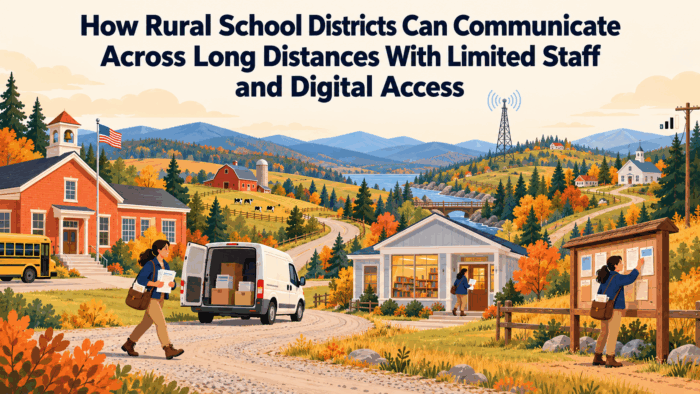
How Rural School Districts Can Communicate Across Long Distances With Limited Staff and Digital Access
Rural school districts serve a substantial share of the nation’s students, and they do so under conditions that make communication uniquely challenging. A rural district may cover hundreds of square miles, with families living far from schools and from each other. Bus routes may take more than an hour each way. Broadband internet may be unavailable, unreliable, or unaffordable in parts of the district, and cell coverage may be spotty in valleys, mountains, or remote areas. The district office may consist of a handful of people, with the superintendent also serving as principal, curriculum director, or transportation coordinator, and there may be no dedicated communication staff at all. Teachers may cover multiple grades or subjects. Local news outlets may have closed or reduced coverage. In some rural areas, families include agricultural workers, migrant families, Indigenous communities, or recent immigrants, each with distinct communication needs and languages. At the same time, rural communities often have deep relationships, strong local institutions, and a close connection between schools and community identity that can be powerful assets for communication.
Many communication strategies designed for larger, more connected districts do not fit rural realities. Advice to rely on websites, apps, email newsletters, and online forms assumes that families have reliable internet access. Recommendations to hire communication specialists, launch sophisticated campaigns, or produce frequent video content assume staff capacity that rural districts may not have. Expectations that families will attend evening meetings at a central location may ignore long distances, work schedules on farms and in shift jobs, and the cost of fuel. When rural districts try to adopt strategies that do not fit their context, communication can become inconsistent, overwhelming for staff, and ineffective for families.
Effective rural district communication starts from the strengths and constraints of rural communities. It uses channels that work with limited connectivity, such as text messages, phone calls, local radio, printed materials, and trusted community gathering places. It builds on the personal relationships that are often stronger in small communities, where staff may know families personally. It concentrates limited staff time on the communication that matters most, using simple systems, templates, and shared resources to reduce the burden. It partners with community institutions, such as churches, libraries, extension offices, local businesses, tribal governments, and regional education agencies, to extend reach. And it recognizes that rural schools are often the heart of their communities, making communication about schools a matter of community identity as well as information.
This article examines how rural school districts can communicate across long distances with limited staff and digital access. It looks at the distinctive conditions of rural communication, how to choose channels that work where connectivity is limited, and how to build simple, sustainable communication systems with small staffs. It covers how to use relationships and community institutions as communication assets, how to reach families who are geographically isolated or who speak languages other than English, how to communicate during emergencies and weather events that are common in rural areas, and how to engage communities in decisions when meetings are hard to attend. It also addresses partnerships with regional agencies, communicating about connectivity and technology, and measuring whether communication is reaching every family. The goal is practical, relationship-centered communication that works for rural families and the staff who serve them.
The Distinctive Conditions of Rural Communication
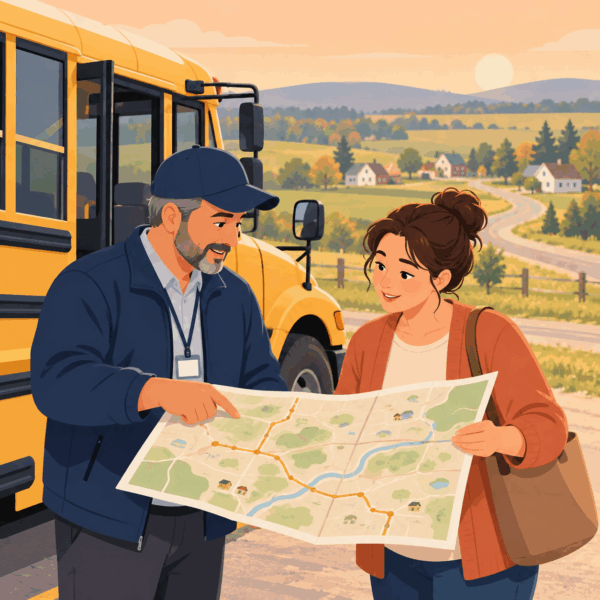 Rural districts vary widely, from agricultural communities on the plains to mountain towns, tribal lands, coastal fishing villages, and areas with growing recreation economies. But many share conditions that shape communication: long distances, limited connectivity, small staffs, close-knit communities, and limited local media. Understanding these conditions helps rural leaders design communication that fits their context rather than importing approaches that assume urban or suburban conditions.
Rural communities also have communication strengths that larger districts may envy. Families and staff often know each other personally, local institutions are deeply trusted, and community events bring people together regularly. News can travel quickly through these networks, and a personal call from a principal may carry more weight than any formal message. Effective rural communication builds on these strengths rather than viewing rural conditions only as obstacles.
Distance and Time
Distance affects nearly every aspect of rural communication. Families may live many miles from school, making it difficult to attend meetings, pick up materials, or stop by the office with questions. Students may spend long hours on buses, and families may have limited time for school activities after long commutes to work. Staff who conduct home visits may spend much of the day driving. Distance also affects emergency communication, since families may be far from school when weather or other emergencies require early dismissal or closure, and they need information early enough to arrange transportation or child care.
Communication strategies in rural districts must therefore minimize the need for families to travel and maximize the information families can receive where they are. Phone calls, text messages, and printed materials sent home with students or mailed often work better than events that require attendance. When events are necessary, holding them at times and places that reduce travel, such as combining them with existing community gatherings or offering them at multiple locations, increases participation.
Distance also shapes how quickly news travels. In some rural communities, word of mouth spreads information remarkably fast through dense personal networks, while in others, isolated families may not hear news for days. Understanding these patterns helps districts choose the right mix of channels.
Seasonal rhythms matter as well. In agricultural communities, planting and harvest seasons may leave families with little time for school events, and some students may help with family work. In communities dependent on tourism, fishing, or energy industries, work schedules may shift dramatically by season. Scheduling family conferences, meetings, and major communications with these rhythms in mind shows respect for family realities and increases participation. Asking families when they are most and least available, rather than assuming a standard calendar works for everyone, helps districts plan communication that fits community life.
Limited Connectivity
Many rural areas still lack reliable, affordable broadband internet, and some areas have limited cell service. Even where service exists, families may rely on prepaid phones with limited data, share a single device, or have connections too slow for video. This means that communication relying on websites, apps, email, or video may not reach many families, or may reach them unreliably. Online forms for enrollment, meal applications, or permission slips may be impossible for some families to complete.
Rural districts should not assume digital access. Instead, they should learn which families have reliable access to which channels and design communication accordingly. Text messages, which require only basic cell service and work on any phone, are often the most reliable digital channel. Voice calls reach families with landlines. Printed materials remain essential. When digital tools are used, they should be designed to work on low bandwidth and basic devices, and paper alternatives should always be available.
Districts can learn about family connectivity through simple surveys at enrollment, asking families which channels they use and whether they have reliable internet at home. Teachers and bus drivers often know which families are hard to reach and can help identify gaps. This information should be updated regularly, since connectivity can change when families move, change phone plans, or gain access through new broadband projects. With accurate information, districts can match each family to the channels that actually reach them, rather than sending every message through every channel and hoping for the best.
Small Staffs and Many Roles
In many rural districts, the superintendent, principal, office manager, and a few teachers handle all communication in addition to their other responsibilities. There may be no communication director, no translator, and no web manager. Communication tasks compete with instruction, budgets, transportation, compliance, and daily operations. Under these conditions, communication can become reactive and inconsistent, handled only when something urgent arises.
Effective rural communication systems are therefore simple and sustainable. They focus on a small number of reliable channels, use templates and shared calendars to reduce effort, and draw on regional and community partners for support. They prioritize the communication that matters most to families, such as safety, schedules, student progress, and major decisions, rather than trying to do everything.
Leaders in small districts should also recognize that communication is part of their leadership role, not an extra task. When superintendents and principals set aside even a small amount of time each week for planned communication, such as drafting a weekly update or making a few personal calls, the cumulative effect on family trust and understanding can be substantial. Consistency matters more than volume; families come to rely on a short message that arrives every week far more than on occasional long newsletters.
Learning Together: Communication Strategies for K-12 School Districts and Public Education Agencies
This article is part of our series on strategic communication for K-12 School Districts and Public Education Agencies. To learn more and to see the parent article, which links to other content just like this, click the button below.
Choosing Channels That Work Where Connectivity Is Limited
Channel choice is perhaps the most important decision in rural communication. The goal is to reach every family reliably, which often means using a combination of low-tech and digital channels and understanding which families depend on which.
No single channel will reach every family in most rural districts. The most reliable approach is to identify a small set of core channels that together reach nearly everyone, use them consistently, and teach families what to expect from each. For example, a district might commit to sending all urgent information by text and voice call, all weekly updates in a printed newsletter sent home on Fridays, and all major announcements through local radio as well. Consistency helps families know where to look.
Text, Voice, and Print
Text messaging is often the most effective channel in rural districts because it works on basic phones with minimal connectivity and is read quickly. Districts can use text for reminders, schedule changes, closures, and short updates, keeping messages brief and avoiding links that require data. Automated voice calls reach families with landlines and those who prefer spoken messages. Printed newsletters sent home with students, mailed, or posted in community locations reach families without digital access and provide information families can keep and refer to.
Combining channels for important messages ensures redundancy. A closure announcement might go out by text, voice call, local radio, and social media at the same time, so that families receive it through whichever channel they use. Districts should survey families periodically about their preferred channels and update contact information regularly.
Messages should be written for the channel. Text messages should be short, include the essential information in the first line, and avoid abbreviations that might confuse families. Voice messages should be clear, slow, and repeated if important. Printed materials should use large, readable fonts, plain language, and clear headings, since they may be read by grandparents, older siblings, or other caregivers as well as parents. Including a phone number on every printed piece gives families a way to ask questions without needing internet access.
Districts should also be thoughtful about the frequency of messages. In small communities where families receive many messages from school, church, work, and community groups, too many texts can lead families to ignore them. Reserving text messages for timely, important information and using printed newsletters or social media for general updates helps keep the text channel effective for the messages that matter most.
Local Radio, Newspapers, and Community Boards
Local radio stations remain important information sources in many rural areas, especially for weather and emergency announcements. Building relationships with local stations, providing them with timely information, and arranging regular school segments can extend reach. Local and regional newspapers, where they still exist, can publish school news and notices. Community bulletin boards at post offices, grocery stores, feed stores, gas stations, churches, and libraries are effective places to post printed information where families naturally gather.
Local radio can do more than announce closures. Some rural districts have regular segments where superintendents or principals share school news, explain upcoming events, or answer listener questions. Students may produce radio spots highlighting school achievements. Radio is particularly valuable for reaching families during commutes, at work in fields or shops, and in homes without internet. Stations serving Spanish-speaking or Indigenous communities can be important partners for reaching multilingual families.
Social media can also play a role where connectivity allows, since many rural families use social media on their phones even when they lack home internet. Community social media groups are often active in rural areas and may be where families share and discuss school news. Districts can post accurate information on their own pages and, where appropriate, share it in community groups through staff or parent volunteers, helping ensure that discussions are grounded in facts. However, social media should never be the only channel for important information.
Building Simple, Sustainable Systems With Small Staffs
Rural districts cannot rely on large communication teams, so they need systems that make good communication achievable with limited time. Simple, repeatable processes, templates, and shared tools can help small staffs communicate consistently without becoming overwhelmed.
The key is to design communication around the capacity the district actually has. A plan that requires daily social media posts, a weekly video, and a monthly magazine will quickly collapse in a district where the superintendent also drives a bus route. A plan built around a weekly text update, a monthly printed newsletter, reliable emergency templates, and regular personal calls is far more likely to be sustained, and sustained communication builds trust more effectively than ambitious plans that fade after a few months.
A Communication Calendar and Templates
A simple annual communication calendar that lists recurring messages, such as back-to-school information, enrollment reminders, meal application deadlines, conference schedules, testing dates, weather procedures, and graduation, allows staff to plan ahead rather than scrambling. Templates for common messages, such as closure announcements, event reminders, and newsletters, reduce drafting time. Pre-written messages for weather closures and emergencies, prepared before the season begins, allow the superintendent to send alerts quickly from a phone.
Assigning clear responsibility for each type of message, even if the same person handles many, prevents tasks from falling through the cracks. A short weekly or monthly routine, such as reviewing upcoming messages every Monday, helps busy staff stay on track.
Templates are especially valuable for messages that must be sent quickly or at difficult times, such as early in the morning during winter storms. A superintendent who has a pre-written closure message ready to send from a phone can notify families within minutes of making a decision, giving families more time to arrange child care or transportation. Templates for bus delays, road closures, power outages, and early dismissals should be reviewed each year and stored where multiple staff can access them, so that communication continues even if the superintendent is unavailable.
Small districts can also simplify by choosing one primary messaging platform that sends text, voice, and email from a single interface, so that staff do not need to log into multiple systems. Many regional agencies offer shared platforms or negotiated pricing that make these tools affordable for small districts. Training several staff members to use the platform ensures that messages can go out when the primary communicator is away.
Sharing the Work
Communication work can be shared among staff, students, and volunteers. Teachers can contribute short updates for newsletters. Students in journalism, media, or leadership classes can help produce newsletters, social media posts, and photos of school events, gaining valuable skills in the process. Parent volunteers can help distribute materials and spread information through their networks. Regional education service agencies may offer communication support, templates, translation, or shared staff.
Sharing the work requires a little coordination. A simple shared document or calendar where staff can see what is planned, who is responsible, and when items are due keeps everyone aligned. A brief style guide, explaining how the district names programs, writes dates and times, and describes key policies, helps volunteers and students produce consistent content. The superintendent or principal should still review important messages before they go out, but delegating drafting and distribution can free leaders to focus on decisions and relationships.
Rural districts can also share work with neighboring districts. Districts facing similar issues, such as weather closures, meal applications, or state testing schedules, can share templates and translated materials, reducing duplicated effort. Informal networks of rural superintendents and communication staff, whether through regional agencies or professional associations, provide a way to exchange ideas and resources and to learn from districts that have solved similar problems.
Using Relationships and Community Institutions as Assets
 One of the greatest strengths of rural communities is the density of personal relationships. Teachers may know families personally, bus drivers may see families every day, and school staff may attend the same churches and community events as families. These relationships can be powerful communication channels when used intentionally.
Rural relationships often extend across generations. Staff may have taught the parents of current students, and families may have attended the same school for decades. This history can create deep trust, but it can also mean that newcomers, such as families who recently moved to the area for work, feel like outsiders. Intentionally welcoming new families and ensuring they are connected to official communication helps them become part of the school community rather than depending on informal networks they have not yet joined.
Small districts can also formalize the informal by creating simple phone trees or family contact networks, in which volunteer parents in each area of the district agree to pass along important information to neighbors who may not receive official messages. While phone trees should never replace official channels, they can be especially useful in remote areas, during emergencies when other systems fail, and for families who rely on personal contact. Volunteers should receive accurate information directly from the school and know whom to contact with questions, so that the network spreads facts rather than rumors.
Personal Contact
In rural districts, personal phone calls and conversations are often the most trusted form of communication. A call from a teacher or principal can resolve concerns, share important information, and build trust more effectively than any newsletter. Bus drivers can share information with families at stops. Staff who see families at community events can answer questions informally.
Relationships can be strengthened intentionally. Teachers can make a positive phone call to every family early in the year, establishing a connection before any concerns arise. Principals can be visible at community events, ball games, and local gatherings, making themselves available for informal conversations. Districts can encourage staff to share accurate information when families ask questions in the community, and can give staff quick updates on important topics so they are prepared. In small communities, every staff member is a district ambassador, and helping them communicate accurately multiplies the district’s reach.
At the same time, reliance on informal communication carries risks. Information shared in conversations can become distorted as it passes from person to person, and families who are newer to the community or less connected may be left out of informal networks. Districts should pair relationship-based communication with consistent official messages, so that every family has access to accurate information regardless of whom they know. When rumors spread, a quick official message clarifying the facts can prevent misunderstandings from growing.
Community Institutions
Churches, libraries, extension offices, community centers, tribal offices, health clinics, and local businesses are trusted gathering places in many rural communities. Partnering with these institutions to share school information, host meetings, or distribute materials extends reach. Tribal governments and Indigenous community organizations are essential partners in districts serving Native students and should be engaged respectfully and consistently.
Partnerships with community institutions work best when they are ongoing rather than activated only when the district needs help. Districts can provide partners with a regular one-page update, invite partner representatives to school events, and ask partners what information their members want. Agricultural extension offices, for example, often have strong relationships with farm families and can share school information through their networks. Libraries may offer internet access and help families complete online forms. Health clinics can share information about school health services and enrollment. Each partnership extends the district’s reach in ways that staff alone could not.
Engagement with tribal nations should honor tribal sovereignty and follow any consultation requirements that apply. Regular meetings with tribal education departments, communication through tribal channels such as tribal newspapers or radio, and inclusion of tribal perspectives in school decisions help build trust. Districts should recognize the history of education policies that harmed Native communities and approach communication with humility and a commitment to genuine partnership.
Reaching Isolated and Multilingual Families
Some rural families are especially hard to reach, including families who live in remote areas, migrant and seasonal agricultural workers, families experiencing housing instability, and families who speak languages other than English. These families may be underserved by typical communication channels and require targeted outreach.
Identifying these families requires attention and coordination. Enrollment staff, teachers, migrant education staff, and bus drivers often know which families are hard to reach, and a simple process for flagging families who are not receiving messages can trigger personal outreach. Periodic reviews of contact information, such as checking for disconnected phone numbers or returned mail, help identify families who have fallen out of communication before an important message is missed.
Migrant and Multilingual Families
Many rural districts serve migrant families and families who speak Spanish, Indigenous languages, or other languages. Small districts may not have bilingual staff, but they can use telephone interpretation services, regional translation support, and community partners. Migrant education programs often have staff who can help reach families. Communication should be translated, and families should know that interpretation is available.
Migrant families may move frequently with agricultural seasons, which means contact information can change quickly and families may arrive mid-year without knowing how the school works. Welcoming migrant families with clear, translated orientation materials, confirming contact information at every opportunity, and coordinating with migrant education staff who track families across districts help maintain communication. Communication about enrollment, records transfer, meal programs, and summer programs is especially important for these families.
Families who speak Indigenous languages, such as languages from Mexico and Central America, may not be well served by Spanish translation, and interpreters for these languages can be difficult to find. Districts can work with migrant education programs, community organizations, and interpretation services that specialize in Indigenous languages, and can use audio or in-person communication for families whose languages are primarily oral. Learning which languages families actually speak, rather than assuming, is the essential first step.
Geographically Isolated Families
Families in remote areas may need communication delivered through students, bus drivers, mail, or home visits. Ensuring that every family has a working phone number on file and confirming contact regularly helps prevent isolation.
Home visits remain one of the most effective ways to reach isolated families, particularly at the start of the year or when concerns arise. Although visits require significant travel time, they build trust and allow staff to understand families’ circumstances, including whether families have reliable phone or internet service. Districts can combine home visits with other purposes, such as delivering materials or checking in on attendance, and can coordinate visits geographically to reduce driving time.
Families experiencing housing instability, including families living with relatives, in campgrounds, or in substandard housing, may be particularly hard to reach and may not disclose their circumstances. Rural districts should ensure that staff know how to identify and support these families, that the district homeless education liaison is known in the community, and that communication about rights and services reaches families through trusted local partners.
Emergencies, Engagement, and Partnerships
Rural districts frequently face weather emergencies, road closures, power outages, and wildfires. They also need to engage communities in decisions when meetings are hard to attend, and they benefit from regional partnerships.
Each of these areas tests whether a rural district’s communication system is resilient. Emergencies require speed and redundancy. Engagement requires flexibility and respect for families’ time and distance. Partnerships require relationships built before they are needed. Districts that invest in these areas during calm periods are far better prepared when urgent situations arise.
Weather and Emergency Communication
Clear, early communication about weather-related closures, delays, and early dismissals is essential in rural areas where families travel long distances. Districts should announce decisions as early as possible, use multiple channels, and explain procedures in advance so families can plan.
Rural emergencies often involve infrastructure failures that disrupt communication itself. Power outages can disable home phones and internet, cell towers may go down during storms, and road closures can strand buses and families. Districts should plan for these scenarios by using multiple channels, partnering with local radio and emergency management agencies, and establishing procedures for students if families cannot be reached or roads are closed. Families should know in advance what the school will do in such situations, such as keeping students safely at school until roads reopen.
Weather decisions in rural districts often generate strong opinions, since conditions can vary widely across a large district. Explaining how decisions are made, such as who checks road conditions, when, and what factors are considered, helps families understand and trust decisions even when conditions at their own homes differ. Publishing a simple guide to weather procedures at the start of each season, and reminding families before storms, reduces confusion.
Engagement and Regional Partnerships
Engagement can include meetings at multiple locations, phone-in options, and surveys distributed on paper and by text. Regional education service agencies can provide shared communication tools, training, and translation support that individual rural districts could not afford alone.
Engagement in rural communities works best when it goes to where people already are. Brief presentations at existing community gatherings, such as church suppers, ball games, grange meetings, or cultural events, can reach more families than standalone district meetings. Offering a phone-in or call-back option allows families who cannot travel to participate. Paper surveys sent home with students, with a text message reminder, often yield higher response rates than online surveys in areas with limited connectivity.
Regional partnerships also extend to communication about connectivity itself. Many rural districts help families access internet through hotspots, community Wi-Fi locations, or low-cost service programs. Communicating these options clearly, through channels that do not require internet, ensures that families who need connectivity know how to get it. Districts can also advocate, with regional partners, for broadband expansion, sharing information with families about public efforts that may improve service in their areas.
Finally, rural districts should check periodically whether their communication is reaching every family. Simple measures can be enough: the share of families with a working phone number on file, the number of text messages that fail to deliver, the response rate to paper surveys, and feedback from teachers and bus drivers about families who seem uninformed. A short annual survey, sent home on paper and by text, can ask families which channels they prefer and whether they feel informed about school decisions, events, and emergencies. Reviewing this information each summer and adjusting the communication plan for the coming year keeps the system responsive to changing family needs, without requiring sophisticated tools or large staff time.
Rural districts can also learn from each other’s measurement. Regional education agencies can aggregate simple communication data across member districts, helping each district see how its reach compares with similar districts and identify practices that work well. Sharing results in regional superintendent meetings encourages peer learning and makes improvement a collective effort. Even modest measurement, done consistently, helps rural leaders make informed decisions about where to invest their limited time and resources.
How Rural District Communication Compares With Other Agency Types
Rural counties, rural health clinics, agricultural extension services, rural electric and water cooperatives, and tribal governments all communicate with dispersed populations under conditions of limited connectivity and staff. Many have developed practical approaches that rural school districts can learn from. Extension services, for example, have long relied on trusted local agents, printed materials, local radio, and community meetings to reach farmers and rural families. Rural electric cooperatives communicate outages and service information through text alerts, phone trees, local radio, and member newsletters. Rural health clinics use community health workers and personal outreach to reach isolated patients. Tribal governments communicate through community gatherings, local radio, and relationships rooted in culture and kinship. These approaches share a reliance on relationships, multiple low-tech channels, and community institutions, all of which fit rural school communication.
Rural school districts are distinctive because the school is often the most important public institution in the community, serving as a gathering place, employer, and source of identity. Communication about schools therefore carries significance beyond education, touching on community pride, history, and survival. Rural districts also serve children whose families depend on school transportation, meals, and services across long distances, making reliable communication about schedules and emergencies especially critical. And rural districts often operate with fewer resources than any other type of public agency serving the same population. These factors make simple, relationship-centered, and resilient communication systems especially valuable in rural education.
Tying It All Together
Rural district communication is not a side function. It determines whether families spread across long distances, with uneven connectivity and demanding work lives, receive the information they need about their children’s education, safety, and schools.
Effective rural districts understand the distinctive conditions of rural communication, including distance and time, limited connectivity, and small staffs that wear many hats. They design communication that fits these realities rather than importing approaches built for urban or suburban districts.
They choose channels that work where connectivity is limited, relying heavily on text messages, voice calls, printed materials, local radio, and community bulletin boards, and they use multiple channels together for important messages. They build simple, sustainable systems with communication calendars, templates, pre-written emergency messages, and shared responsibilities among staff, students, and volunteers.
They treat personal relationships and community institutions as communication assets, using personal contact, bus drivers, churches, libraries, extension offices, tribal governments, and local businesses to extend reach. They make deliberate efforts to reach geographically isolated, migrant, and multilingual families.
They prepare for weather and emergencies with early, multichannel communication, engage communities through flexible formats that reduce travel, and partner with regional education agencies for shared tools and support.
Taken together, these practices create practical, resilient communication systems that work for rural families and the small teams who serve them.
Strategic Communication Support for Rural District Communication
 Rural school districts communicate across long distances, often with limited staff, uneven internet and cellular access, and families who may live many miles from school buildings. A superintendent or principal may carry communication responsibilities alongside many other duties, and families may rely on printed materials, phone calls, local radio, and word of mouth rather than digital platforms. Because effective rural communication requires coordinating limited resources across schools, transportation, community partners, and local media, rural districts often partner with Stegmeier Consulting Group (SCG) to build communication systems that work reliably in their communities. SCG helps districts design practical, sustainable approaches that fit rural realities rather than adopting strategies built for larger districts.
SCG supports rural districts in assessing how families currently receive and prefer to receive information. This can include reviewing contact data, notification systems, connectivity limitations, print and radio use, school websites, and the role of community gathering places such as churches, stores, and libraries. These findings help districts identify which channels reliably reach families and where gaps exist. Simple communication calendars, message templates, and multi-channel distribution plans then help small teams communicate consistently without adding unmanageable workload.
Sustained progress depends on the few people who carry communication responsibilities. Superintendents, principals, office staff, and teachers may share communication duties informally, making consistency difficult. SCG helps districts clarify responsibilities, develop efficient routines, and provide training on tools and plain language writing. Partnerships with local organizations, regional agencies, and community leaders can extend the district’s reach, while family guidance can explain how the district communicates and how families can stay connected.
Severe weather, road closures, emergencies, bond or levy elections, and staffing changes can make rural communication especially urgent. SCG helps districts plan communication for these moments, including backup channels for areas with limited connectivity and coordination with local emergency services and media. By preparing communication in advance, rural districts can reach families quickly and reliably when it matters most.
SCG also helps rural districts evaluate whether communication is reaching every family. Message delivery data, family surveys, attendance at events, feedback from community partners, and conversations with families in remote areas can reveal persistent gaps. By incorporating these findings into regular planning, rural districts can make reliable communication an ongoing practice that strengthens connection across every community they serve.
Future Trends
Broadband expansion efforts are gradually improving connectivity in many rural areas, but progress is uneven, and many families will continue to rely on limited service for years. Rural districts will need to maintain low-tech channels while gradually expanding digital options.
Regional collaboration among rural districts is growing, with shared services for communication, translation, and technology helping small districts access capacity they could not build alone.
Rural communities are becoming more diverse in many regions, with growing numbers of immigrant and multilingual families. Rural districts will need to expand language access, often with limited resources, through partnerships and technology.
Climate-related emergencies, such as wildfires, floods, and severe storms, are affecting more rural areas, increasing the importance of reliable emergency communication.
Finally, enrollment decline in some rural areas is prompting difficult conversations about consolidation and resource sharing. These decisions will require sensitive, community-centered communication that honors the role of schools in rural identity.
Conclusion
Rural school districts communicate under conditions that challenge conventional approaches, but they also possess strengths that many larger districts lack: close relationships, trusted institutions, and communities deeply connected to their schools.
Districts that choose channels suited to limited connectivity, build simple and sustainable systems, use relationships and community institutions as assets, reach isolated and multilingual families, prepare for emergencies, engage communities flexibly, and partner regionally can communicate effectively across long distances with limited staff.
When every rural family receives the information they need, wherever they live, rural schools can continue to serve as strong anchors for their students and communities.
Stegmeier Consulting Group’s Strategic Approach to Communication Systems
Build practical communication that reaches every rural family.
Stegmeier Consulting Group helps rural school districts communicate across long distances with limited staff and digital access. We begin by understanding how families in each community actually receive information, which channels work where, and what capacity the district has.
Our team works alongside superintendents, principals, and regional partners to build simple communication calendars, templates, emergency message libraries, and family materials that work in print and on basic phones. We help districts strengthen partnerships with community institutions and plan engagement that respects distance and work schedules.
We treat rural communication as a system that must be practical, resilient, and sustainable for small teams. That means focusing on what matters most and building tools that make good communication achievable.
Use the form below to connect with our team and explore how strategic rural communication can help your district reach every family across long distances, make the most of limited staff, and build communication systems that work reliably in every community you serve.