
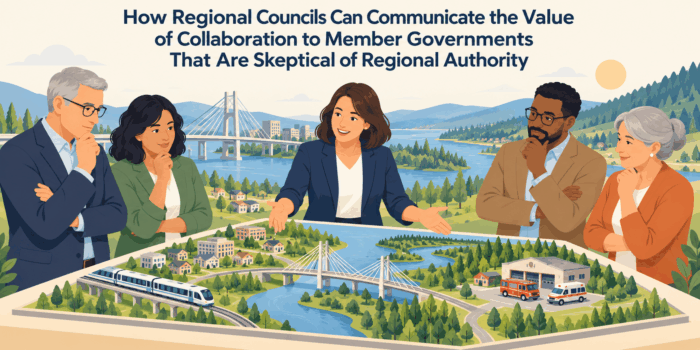
How Regional Councils Can Communicate the Value of Collaboration to Member Governments That Are Skeptical of Regional Authority
Skepticism toward regional authority is not a communication problem. It is a political and institutional reality that has deep roots in the American tradition of local self-governance, in the historical experience of local governments that have seen regional coordination used to override local priorities, and in the rational calculation of local officials who recognize that their electoral accountability is to local constituents rather than to regional outcomes. A regional council that treats member government skepticism as a communication failure to be corrected misunderstands both the nature of the skepticism and the communication that might actually address it.
The skepticism that regional collaborative agencies most commonly encounter from member governments takes several distinct forms that require different communication responses. There is principled skepticism rooted in genuine commitment to local control and genuine concern about the encroachment of regional authority on local prerogatives. There is practical skepticism rooted in prior experience with regional bodies that promised benefits that did not materialize, that imposed costs that were not adequately anticipated, or that prioritized the interests of some member communities over others in ways that particular communities still remember. And there is political skepticism rooted in the calculation that visible support for regional coordination may generate local political costs that outweigh the regional program benefits the official can point to.
Each of these forms of skepticism requires a different communication response. Principled skepticism about local control is most effectively addressed not by arguing for regional authority but by demonstrating that regional coordination serves local self-determination rather than undermining it, by showing how the specific regional programs at issue give local communities capacities and resources they would not have independently rather than imposing mandates they would not otherwise face. Practical skepticism rooted in prior experience requires honest acknowledgment of the prior experiences that produced it and specific demonstration that current programs are designed and managed differently than the programs that generated the skepticism. Political skepticism requires communication that equips local officials to communicate about regional coordination in ways that generate local political benefit rather than political cost.
This article examines how regional councils can communicate the value of collaboration to member governments that are skeptical of regional authority, distinguishing between the different forms of skepticism that require different responses, identifying the communication strategies that have proven most effective with each, and building the sustained communication program that converts isolated demonstrations of regional value into the institutional confidence that transforms skeptical member governments into active regional partners.
Starting With the Right Question
 The regional council that asks how to convince skeptical member governments of the value of regional collaboration is asking the wrong question. The right question is what specific value regional collaboration has actually delivered to each skeptical member government, and why that value has not been recognized. In most cases, regional collaborative agencies have delivered specific, tangible value to every member government, including governments that express skepticism about regional authority. The grants secured, the technical assistance provided, the data products generated, the infrastructure funded, and the regulatory compliance achieved with regional support, are all delivered to skeptical member governments alongside the enthusiastic ones. The communication failure is not that regional collaboration has no value for skeptical member governments. It is that the specific value delivered to those governments has not been communicated in terms those governments find compelling.
Auditing the specific value that regional collaboration has delivered to each skeptical member government, and then designing communication around that audit, is the most effective starting point for communicating the collaboration value to that specific government. The audit should include not only the direct program benefits, the grant dollars that flowed to the community, the technical assistance that solved a specific local problem, and the regional data that informed a local planning decision, but also the indirect benefits that are harder to quantify but no less real: the regulatory compliance that the regional body’s technical support made achievable, the market positioning that the regional economic development council’s data products supported, the infrastructure investment that the MPO’s funding allocation made possible. This specific, documented value inventory is the communication resource that makes skepticism-addressed messaging concrete rather than abstract.
The communication of this value inventory to skeptical member governments is most effective when it comes from sources that those governments trust. A regional council’s own communication about the value it has delivered is inherently self-serving, and skeptical officials may discount it accordingly. The same information communicated by the local official who was directly involved in accessing the regional program benefit, by the federal agency partner who facilitated the regional grant, or by the peer local government from another part of the region that experienced the same benefit from the same program, carries credibility that the regional council’s own communication cannot match. Building the peer referral and partner validation communication infrastructure that makes this third-party value communication possible is a skepticism-addressing communication investment that most regional councils have not made systematically.
From Fragmentation to Coordination: Communication Strategies for Councils of Governments, Metropolitan Planning Organizations, and Regional Planning Agencies
This article is part of our series on strategic communication for Councils of Governments, Metropolitan Planning Organizations, and Regional Planning Agencies. To learn more and to see the parent article, which links to other content just like this, click the button below.
Communicating That Collaboration Serves Local Control
The most fundamental form of principled skepticism about regional authority rests on the belief that regional coordination is in tension with local self-determination, that what the regional council decides constrains what member governments can decide on their own. This belief has enough historical foundation in specific regional governance conflicts to make it a reasonable prior assumption rather than an irrational prejudice. Regional bodies have, in specific historical instances, used regional planning authority to override local land use decisions, to impose regional infrastructure mandates on unwilling municipalities, and to allocate regional resources in ways that systematically disadvantaged specific member communities. Skepticism that is informed by this history is not misunderstanding. It is appropriate caution based on experience.
Communicating that regional collaboration serves local control rather than undermining it requires specific, honest evidence that is not simply the regional council’s assurance that it respects local prerogatives. It requires demonstration through program design that the specific programs the regional council operates enhance local capacity rather than constraining local decisions. A regional technical assistance program that helps a small municipality complete an environmental impact assessment that the municipality could not have conducted with its own staff is a program that serves local self-determination by giving the municipality the capacity to make an informed local decision. A regional data program that gives every member government access to regional market research, demographic analysis, and infrastructure condition data that no individual municipality could afford to generate independently, is a program that serves local decision-making rather than supplanting it.
The distinction that matters for skeptical member governments is between regional programs that require local governments to do things they would not otherwise do, which is where genuine local control tension lives, and regional programs that enable local governments to do things they want to do but cannot do independently, which is where genuine collaboration value lives. Most regional collaborative agency programs fall primarily in the enabling category, but they are often communicated in ways that emphasize the regional mandate rather than the local capacity that the regional program creates. Skepticism-addressing communication leads with the local capacity dimension and acknowledges the mandate dimension honestly rather than avoiding it.
Federal mandate translation is a specific form of enabling communication that often goes unrecognized as a local control service. Most regional collaborative agencies exist partly because federal programs require regional coordination as a condition for federal funding access. An MPO that a metropolitan area must have to receive federal transportation funds is an agency that, seen from a certain angle, is imposed on local governments by federal requirements. Seen from another angle, it is an agency that local governments collectively created and collectively control in order to access the federal resources that the regional coordination structure unlocks. Communicating the second perspective honestly, including how regional governance structures give local governments collective control over federal program decisions that they would otherwise have no influence on, is a local control argument for regional collaboration that is both accurate and compelling for principled local control skeptics.
Addressing Practical Skepticism Honestly
Acknowledging Prior Failures
The most effective communication with practically skeptical member governments begins with honest acknowledgment of the prior experiences that produced the skepticism. A regional council that attempts to communicate the value of collaboration to a member government that remembers being shortchanged in a regional funding allocation, or that was promised technical assistance that never materialized, or that participated in a regional planning process whose recommendations were never implemented, without first acknowledging those prior experiences, is asking the skeptical government to set aside specific institutional memories in favor of general assurances that the regional council values collaboration. Specific institutional memories are more persuasive than general assurances, and communication that does not acknowledge them will be evaluated against them.
Honest acknowledgment of prior failures requires the regional council to have done the institutional work of understanding what specifically went wrong in the interactions that produced the skepticism. This is not always comfortable institutional self-examination. It may reveal that the regional council made commitments it did not keep, that its funding allocation processes systematically disadvantaged specific community types, or that its technical assistance programs were designed for the easiest-to-serve communities rather than the communities with the most need. Whatever the specific finding, communicating to the skeptical government that the regional council has examined the prior experience honestly and has identified what it will do differently, is more credible than communication that implicitly asks the skeptical government to forget what happened.
The specific program design changes that respond to prior failures are the most credible form of skepticism-addressing communication available. An MPO that changed its project selection criteria after a funding allocation process that was widely perceived as politically driven, and that can explain specifically how the new criteria are more transparent and more objectively applied, is making a communication about program change that skeptical governments can evaluate rather than a claim about commitment to collaboration that they have no basis for evaluating. Communication of program design changes in response to prior failures is institutional accountability communication of the most direct kind.
Demonstrating Program Improvement
Skeptical member governments that have had specific negative experiences with regional programs need to see specific evidence of program improvement before they will update their assessment of the value of collaboration. General communication about the regional council’s commitment to improvement, or testimonials from member governments that have had different experiences with the programs in question, do not provide the specific evidence that practically skeptical governments need. What they need is program performance data that shows specifically what has changed, compared to the conditions that produced the prior negative experience, and why those changes are likely to produce different results.
Before-and-after program performance data that compares program outcomes under prior management with outcomes under current management, using metrics that the skeptical government finds meaningful rather than metrics that the regional council finds convenient, is the most persuasive program improvement communication available. A regional transportation planning process that was criticized for political project selection can demonstrate improvement through data on how the new selection criteria changed the distribution of project funding across community types, showing specifically whether the communities that were disadvantaged under prior criteria are receiving more equitable treatment under the new ones. A regional technical assistance program that was criticized for being slow and unresponsive can demonstrate improvement through response time data and client satisfaction ratings that show specific improvement compared to the prior period.
Addressing Political Skepticism
Political skepticism about regional collaboration is perhaps the most difficult form to address through communication because its source is not a substantive disagreement about the value of collaboration but a calculation about the local political costs and benefits of visible regional engagement. A local official who privately understands the value of regional collaboration but who finds visible regional engagement generates more local political cost than benefit, in the form of constituent concerns about regional authority, opposition from local interest groups that prefer local autonomy, or local media coverage that frames regional governance as an accountability problem, will remain publicly skeptical regardless of how compelling the substantive case for collaboration is.
Addressing political skepticism requires communication that changes the local political calculation around regional engagement rather than simply making a stronger substantive case for collaboration. This means helping locally skeptical officials identify and claim local political credit for regional program benefits, so that regional engagement produces local political benefit rather than only local political risk. The official who can point to a specific federal grant that came to their community through regional collaboration, to a specific infrastructure project that regional funding allocation made possible, or to a specific regulatory compliance achievement that regional technical assistance enabled, has a local political narrative for regional engagement that translates regional value into local electoral terms.
Communication support that provides skeptical officials with the specific local credit-claiming communication they need to benefit politically from regional collaboration, including press release templates that frame regional program benefits as local achievements, talking points that explain regional decisions in local terms that resonate with their constituents, and data summaries that highlight the specific program benefits their community has received, is communication investment that changes the local political incentive calculation around regional engagement. An official who can point to specific, tangible local benefits from regional collaboration and who has the communication materials to claim credit for those benefits, has a different political relationship with regional engagement than one who experiences only the political costs of association with an institution that their constituents may distrust.
Media communication strategies that help skeptical officials communicate about regional collaboration in ways that generate positive local coverage rather than negative coverage are among the most valuable communication investments that regional councils can make with politically skeptical member governments. Local media that cover regional governance primarily through the frame of accountability concerns, of costs, of local loss of control, are shaping the local political environment in which regional collaboration is evaluated. Regional councils that help local officials generate positive local media coverage of specific regional program benefits, through press releases, by facilitating media briefings, or by connecting local reporters to the regional data and regional stories that make compelling local coverage, are changing the local media environment that shapes how regional collaboration registers politically in each member community.
The Value of Collaboration in Specific Program Areas
Abstract arguments for the value of collaboration are less persuasive than concrete demonstrations in specific program areas that skeptical member governments care about. The most effective skepticism-addressing communication is program-specific, community-specific, and outcome-specific rather than general and institutional. A rural county that is skeptical of regional authority but that participates in a regional conservation program, and that has received specific cost-share payments and specific conservation practice installations through that program, has a specific, concrete experience of collaboration value in a program area it cares about. Communication that builds on that specific, concrete experience is more likely to reduce skepticism than communication that asks the county to accept the general proposition that regional collaboration is valuable.
Emergency management and public safety are program areas where collaboration value is often most immediately and most universally recognized across the political diversity of member governments. A regional emergency management program that coordinates mutual aid across municipal boundaries during a disaster provides a service that every local government, regardless of its political orientation toward regional authority, recognizes as valuable because the alternative, each municipality managing disasters with only its own resources, is visibly inferior. Communication that leads with emergency management collaboration value is leading with the program area where skeptical member governments are most likely to have direct experience of regional collaboration delivering results that local government alone could not have matched.
Procurement and purchasing cooperatives administered through regional councils offer another program area where collaboration value is often concrete, quantifiable, and politically accessible to skeptical member governments. A local government that saves measurable dollars on equipment, supplies, or services through a regional purchasing cooperative has experienced collaboration value in the most legible possible form: a specific dollar amount saved relative to what the municipality would have paid purchasing independently. Communication that documents and highlights these specific savings, jurisdiction by jurisdiction, is collaboration value communication that even the most principled local control skeptic can recognize as relevant to their community’s interests.
Building the Long-Term Case for Collaboration
 Converting skeptical member governments from grudging participants in regional programs to active regional partners is a long-term communication project that cannot be accomplished through any single communication campaign or any single demonstration of regional value. It requires the sustained investment in honest, specific, outcome-focused communication that builds the cumulative case for collaboration through a track record of delivered value rather than through repeated arguments about why collaboration should be valued.
The track record is the communication. An agency that has delivered on its commitments to every member government over a decade, that has communicated those deliveries specifically and honestly, that has acknowledged and addressed failures when they occurred, and that has demonstrated through its program design and its resource allocation that it takes every member community’s interests seriously, has built the collaboration value case through institutional performance rather than through institutional messaging. The communication of that track record, in the form of annual program outcome reports, specific community impact summaries, and honest assessments of what has and has not been achieved, is the long-term skepticism-addressing communication that sustained program delivery enables.
Peer learning and intergovernmental relationship programs that connect officials and staff from skeptical member governments with their counterparts in member governments that have moved from skepticism to active partnership, provide the peer influence that institutional communication alone cannot match. A county administrator who is skeptical of regional collaboration and who has an honest conversation with a counterpart in a neighboring county who was equally skeptical five years ago but who has become an active regional partner because of specific program experiences, is receiving collaboration value communication from the most credible possible source. Building the peer networks that enable these conversations, through regional convening, through intergovernmental working groups, and through the professional development programs that bring local government staff together across jurisdictional boundaries, is a skepticism-addressing strategy that most regional councils underinvest in.
How Skepticism-Addressing Communication Compares With General Stakeholder Communication
Communication with skeptical member governments is fundamentally different from general stakeholder communication in its starting point, its evidence standard, and its credibility requirements. General stakeholder communication can begin from the assumption that the audience is receptive to the institutional perspective and needs primarily the information that supports an informed evaluation of that perspective. Skepticism-addressing communication must begin from the assumption that the audience has specific reasons for their skepticism, that those reasons deserve honest engagement rather than institutional promotion, and that any communication that does not engage the specific basis of the skepticism will be evaluated against it rather than independently.
The comparison with crisis communication is instructive. Both skepticism-addressing and crisis communication operate in environments where institutional credibility is under challenge and where institutional messaging is evaluated with heightened scrutiny. Both require the honest acknowledgment of the specific basis of the challenge rather than the defensive deflection that produces the impression of evasion. And both require the specific, verifiable commitments and demonstrations of institutional change that make honest acknowledgment credible rather than merely rhetorical. Treating skepticism-addressing communication with the same institutional honesty that crisis communication demands produces communication that is more credible and ultimately more effective than communication that treats skepticism as a misunderstanding to be corrected.
Communicating Regional Collaboration to Constituent Audiences
Skeptical local officials often face the challenge of explaining regional collaboration to their own constituents in ways that justify their participation in a regional body that those constituents may view with suspicion. A county commissioner who attends regional council meetings and votes on regional program decisions needs to be able to explain to their constituents what those meetings accomplish and why the county’s participation serves the county’s interests. If the commissioner cannot make that case convincingly, their continued engagement with regional governance becomes a local political liability rather than a local political asset.
Communication support that equips skeptical officials to explain regional collaboration to their constituents is therefore one of the most valuable investments that regional councils can make with skeptical member governments. This support should include the specific program benefit data and talking points that officials need for constituent conversations, the local impact analyses that translate regional program outcomes into terms locally relevant to their specific community, and the media communication guidance that helps officials generate positive local coverage of regional program benefits rather than being defined by negative coverage of regional governance. An official who is equipped to explain regional collaboration compellingly to their constituents has a different relationship with regional governance than one who cannot.
Constituent communication toolkits for regional programs, which provide member government officials and staff with accessible, locally adapted materials for explaining specific regional programs to their own audiences, reduce the communication work that individual officials must do independently to explain regional collaboration in their local political environments. These toolkits should include program fact sheets adapted for local use, frequently asked question documents that address the specific questions that local constituents ask about regional programs, and social media content that member governments can share through their own channels. Making these materials easy to use and easy to adapt for local contexts increases the likelihood that skeptical member governments will actually use them.
Peer ambassador programs that engage the officials and staff of member governments that have moved from skepticism to active regional partnership, and that enlist them as informal advocates for regional collaboration with their still-skeptical counterparts, create the peer influence network that institutional communication alone cannot replicate. A county administrator who has become a regional collaboration advocate and who is willing to have conversations with skeptical counterparts in other counties, sharing their own experience of how regional collaboration has served their community, is providing skepticism-addressing communication from the most credible possible source. Facilitating these peer conversations, through regional convening, through intergovernmental working groups, and through the informal networks that regional council staff can help connect, is a skepticism-addressing strategy that most regional councils have not developed systematically.
Measuring Skepticism and Progress Toward Partnership
Regional councils that are systematically attempting to convert skeptical member governments into active regional partners need the measurement infrastructure to assess whether their skepticism-addressing communication is working. The most direct measurement is the behavior of skeptical member governments over time: whether they are engaging more actively with regional programs, whether their officials are attending regional governance meetings more regularly, whether their staff are using regional technical assistance more frequently, and whether their formal positions on regional planning and policy questions are shifting from skeptical to supportive. These behavioral measures require systematic tracking that most regional councils have not built into their program management and communication evaluation systems.
Annual member government satisfaction surveys that specifically measure skeptical member governments’ assessments of the regional council’s performance on the dimensions most relevant to skepticism, including program fairness, communication transparency, responsiveness to local concerns, and value delivered to their community, provide the systematic feedback that behavioral measures supplement but cannot replace. A skeptical county that reports improved satisfaction with regional program fairness and value delivered to its community is providing evidence of skepticism reduction that behavioral measures may not yet reflect, because attitudes change before behavior does. Tracking these attitudinal changes through regular survey measurement allows the regional council to assess whether its skepticism-addressing communication investment is producing the intermediate attitudinal outcomes that eventually convert into behavioral change.
Regional council staff assessments of member government relationship health, which evaluate the quality and productivity of the intergovernmental relationships with each member government across a defined set of relationship dimensions, provide the internal organizational measurement of skepticism-addressing progress that complements the external member government survey measurement. Staff who work regularly with specific member government counterparts have the relationship intelligence to assess whether a previously skeptical government is becoming more engaged, more trusting, and more willing to participate constructively in regional governance, or whether skepticism is deepening despite communication investment. Systematizing these staff assessments, rather than leaving them as informal knowledge held by individual staff members, creates the organizational intelligence that guides communication investment toward the member governments and the program areas where skepticism-addressing attention is most needed.
Regional Collaboration and Fiscal Shared Services
Shared services programs administered through regional councils, including joint purchasing, shared IT infrastructure, regional health insurance pools, and coordinated administrative functions, offer some of the most concrete and most fiscally legible demonstrations of collaboration value available to skeptical member governments. The local official who is skeptical of regional planning authority may be enthusiastic about regional procurement savings, because the fiscal benefit of shared purchasing is immediate, quantifiable, and completely consistent with local control principles. Regional councils that have developed strong shared services programs have a skepticism-addressing resource that most planning-focused regional bodies do not, because shared services deliver collaboration value in the terms that local fiscal officials find most compelling.
Communicating shared services value to skeptical member governments requires the same specific, community-level documentation that other collaboration value communication requires. The savings that a specific county realized from a regional purchasing cooperative, the IT infrastructure costs that a specific municipality avoided through a regional shared services arrangement, and the administrative capacity that a specific township freed up through regional human resources coordination, are all specific, verifiable demonstrations of collaboration value that general promotion of shared services cannot match. Community-by-community value documentation for shared services, updated annually with current program participation and savings data, is the collaboration value communication that turns fiscal skeptics into shared services enthusiasts and, over time, into regional collaboration partners.
The pathway from shared services partnership to broader regional collaboration is not automatic, but it is real. Local officials and staff who have developed working relationships with regional council staff through shared services programs, and who have direct experience of regional collaboration delivering fiscal value to their community, have a relationship with the regional council that skeptical governments that have not participated in shared services lack. These relationships are the foundation on which broader collaboration partnerships can be built, and communicating shared services value is therefore not only a collaboration value communication program but a relationship development program that creates the foundation for future regional engagement on more contested planning and coordination issues.
Regional Collaboration in Crisis and Emergency Contexts
Regional collaborative agencies often demonstrate their most compelling collaboration value during regional emergencies, when the coordination across jurisdictional boundaries that is the defining function of regional governance becomes not merely useful but essential. A regional emergency management collaboration that coordinates mutual aid across municipal boundaries during a flood, a regional public health response that coordinates vaccination distribution across county lines, or a regional economic response that coordinates small business assistance across municipal boundaries during an economic disruption, provides collaboration value demonstrations that even the most principled local control skeptic finds difficult to dismiss.
Crisis and emergency collaboration value is particularly powerful for skepticism reduction because it connects regional coordination to the most fundamental public safety and community welfare functions that local government is designed to provide. The local official who is skeptical of regional planning authority will often be deeply committed to regional emergency coordination, because the regional coordination function in emergency contexts is visibly irreplaceable by local action. Building on this emergency coordination credibility, by connecting the regional planning and program coordination that occurs in non-emergency contexts to the same regional capacity that emergency coordination demonstrates, is a skepticism-addressing communication strategy that most regional councils have not developed deliberately.
Emergency collaboration communication that documents what regional coordination contributed to specific emergency responses, which communities received mutual aid from other member governments through regional coordination, and what the outcomes would have been if the response had been limited to what each municipality could provide independently, provides the most visceral and most universally compelling demonstration of collaboration value available. Communicating this documentation to skeptical member governments, connecting it to the specific regional coordination functions that those governments have been skeptical of in non-emergency planning contexts, builds the bridge between emergency collaboration credibility and planning coordination credibility that effective skepticism-addressing requires.
Addressing Skepticism in Regional Association Meetings
Regional council member meetings are the most direct forum for addressing member government skepticism about regional collaboration, because they bring skeptical and supportive officials and staff together in the governance context where regional collaboration most directly operates. The communication that happens in these meetings, including how regional staff present program information, how regional leadership responds to member government concerns, and how the meeting agenda is designed to facilitate genuine intergovernmental dialogue, shapes the institutional experience of regional collaboration for every meeting participant.
Meeting communication that creates genuine space for member government concerns to be raised and specifically addressed, rather than managing member government engagement through presentations that minimize contested questions, is the most direct form of skepticism-addressing communication available in the regional governance context. The regional council meeting where a skeptical county commissioner raises a specific concern about regional funding allocation and receives a specific, honest response from the regional executive director or program staff, is a meeting where that commissioner’s experience of regional governance is fundamentally more positive than a meeting where the same concern is redirected without specific response.
Regular member government peer sharing sessions, which provide structured opportunities for member government officials and staff to discuss their experiences with regional programs, create the intergovernmental peer dialogue that most effectively addresses practical skepticism through peer validation rather than institutional promotion. A session where a previously skeptical township administrator shares how a specific regional technical assistance program helped solve a specific local planning problem, speaking directly to the skeptical counterparts who have not yet had that experience, is more effective skepticism-addressing than any number of regional council presentations about the value of technical assistance programs.
Responsive agenda development that incorporates the specific concerns and priorities of skeptical member governments into regional meeting agendas, demonstrating that the regional council takes those concerns seriously enough to make them a formal part of regional governance discussion, is a governance structure communication that builds institutional trust with skeptical governments more effectively than communication about the regional council’s responsiveness to member concerns. The skeptical government that sees its specific concern on the agenda of the next regional board meeting, and that participates in a genuine board discussion of that concern, has a different experience of regional governance accountability than one that raises concerns through informal channels and receives informal assurances.
Documenting Skepticism Reduction Over Time
Regional councils that systematically track the evolution of member government skepticism over time, using annual relationship quality assessments, member government satisfaction surveys, and behavioral indicators of engagement, build the longitudinal dataset that makes skepticism reduction visible as an institutional achievement rather than a vague aspiration. An agency that can demonstrate through tracked data that three member governments that rated their regional council relationship as poor five years ago now rate it as good or excellent, and that identifies which specific program experiences and communication investments produced that improvement, has the institutional learning resource that makes skepticism reduction sustainable rather than dependent on individual relationship luck.
The documentation of skepticism reduction is also a program accountability communication in its own right. A regional council that can report to its board, its member governments, and its funders that it has measurably improved its relationships with previously skeptical member governments, and that can explain specifically how it achieved that improvement, is an institution that is demonstrating the governance effectiveness that regional collaborative agencies are rarely held accountable for in explicit terms. Most regional governance accountability focuses on program outputs and financial performance rather than on the quality of member government relationships that ultimately determine whether regional programs can be effectively implemented. Making relationship quality a formal accountability dimension, measured and reported alongside program outputs and financial performance, elevates the institutional investment in skepticism-addressing communication to the governance priority it deserves.
Tying It All Together
The value of regional collaboration is real, specific, and demonstrable to every member government, including those that are most skeptical of regional authority. The communication challenge is not to invent a value proposition that does not exist but to communicate the real value proposition that does exist in terms that skeptical member governments find specific, credible, and relevant to their particular form of skepticism. This requires understanding the specific basis of each member government’s skepticism, communicating the collaboration value that is most relevant to that specific skepticism, addressing prior failures honestly rather than avoiding them, and building the long-term track record of delivered value that converts skepticism into partnership through demonstrated performance rather than institutional persuasion.
Regional councils that invest in this sustained, specific, and honest skepticism-addressing communication find that skepticism is not a fixed condition of member government political culture but a provisional assessment that responds to specific evidence of regional value delivered and regional failures acknowledged. Member governments that were once the most skeptical regional participants become some of the most engaged regional partners when they have specific, consistent experience of collaboration that delivers value they recognize, acknowledges failures they remember, and takes their communities’ interests seriously in ways they can observe. The communication investment that produces this transformation is not primarily a messaging investment. It is a program investment, in the delivery of specific regional value to every member community, and a communication investment in reporting that delivery specifically and honestly to the members who need to see it most.
Strategic Communication Support for Skepticism-Addressing Programs
 Developing the value audit frameworks, peer referral programs, political credit-claiming communication materials, and long-term track record communication systems that effective skepticism-addressing communication requires is work that most regional council communication teams have not been staffed or resourced to accomplish. The combination of political intelligence, program performance documentation, intergovernmental relationship investment, and communication design that skepticism-addressing programs demand makes external communication support a productive investment for regional councils seeking to expand their effective membership base.
Stegmeier Consulting Group (SCG) works with regional collaborative agencies to develop skepticism-addressing communication programs that are built around the specific political diversity, program history, and member government relationship landscape of each agency’s context. This includes developing the value audit processes that document specific collaboration benefits delivered to each skeptical member government, designing the peer referral and intergovernmental relationship programs that create the third-party validation most effective for skepticism reduction, creating the political credit-claiming communication support that changes the local political incentive calculation around regional engagement, and building the long-term track record communication systems that convert sustained program delivery into sustained skepticism reduction over time.
Future Trends in Collaboration Value Communication
The political environment for regional collaboration is likely to become more rather than less challenging in the coming decade, as political polarization increases the ideological distance between some member governments in regional service areas and as the competition for public resources intensifies the scrutiny of regional program spending. Regional councils that have not developed effective skepticism-addressing communication will find these trends increasingly difficult to navigate. Those that have built the institutional practices of honest value documentation, peer referral communication, and sustained track record reporting will find the same trends more manageable because they have the communication infrastructure to demonstrate collaboration value specifically rather than arguing for it abstractly.
Digital transparency tools that make regional program performance data available to the public and to member governments in real-time formats are creating new opportunities for collaboration value communication that most regional councils have not yet fully developed. A regional council that maintains a public-facing program performance dashboard showing specific program outcomes for each member community, updated regularly with current program data, is providing the ongoing collaboration value documentation that annual reports alone cannot sustain. This digital transparency is itself a skepticism-addressing communication investment, because it demonstrates the institutional confidence in program performance that agencies with poor program performance would not choose to make visible.
Regional equity frameworks that explicitly address the distributional dimensions of collaboration value, including how regional programs distribute benefits and costs across communities with different fiscal capacities, different demographic characteristics, and different levels of historical investment from regional programs, are creating new communication demands for regional councils. Skeptical member governments that represent lower-income communities or communities that have historically received less than their proportional share of regional program benefits have specific skepticism about whether regional collaboration will serve their communities equitably. Communication that addresses this equity skepticism specifically, through transparent data on program benefit distribution and through specific commitments about how equity goals will shape future program design, is the most relevant skepticism-addressing communication for this specific form of skeptical engagement.
Conclusion
Regional collaborative agencies that communicate the value of collaboration to skeptical member governments by leading with honest acknowledgment of the specific basis of that skepticism, by providing specific, verifiable evidence of collaboration value delivered to those specific communities, and by building the sustained track record of program delivery and honest communication that converts skepticism into partnership through demonstrated performance, are doing the most important communication work available to them. Skeptical member governments represent both the greatest governance challenge and the greatest governance opportunity for regional councils: the challenge of convincing the unconvinced, and the opportunity of demonstrating through sustained honest engagement that regional collaboration serves the interests of every member community rather than only the interests of those already predisposed to regional engagement.
This communication is not fundamentally a persuasion project. It is a governance accountability project. The regional council that takes every member government’s skepticism seriously, that examines its own program performance and resource allocation honestly in response to that skepticism, and that communicates what it finds to the skeptical governments whose concerns prompted the examination, is an institution that is improving its governance through the skepticism rather than defending itself against it. That orientation, maintained consistently over time, builds the kind of institutional credibility that no amount of collaboration value messaging can substitute for.
Stegmeier Consulting Group’s Strategic Approach to Communication Systems
Build skepticism-addressing communication around honest value documentation, prior failure acknowledgment, and the sustained track record that converts skeptical participants into genuine regional partners.
Regional councils that address member government skepticism with specific evidence of collaboration value delivered, honest acknowledgment of prior failures, and sustained program performance that builds credibility through demonstrated delivery rather than institutional messaging, build the member government confidence that regional coordination requires to be effective. Stegmeier Consulting Group (SCG) helps agencies develop the value audit frameworks, peer referral programs, political credit-claiming support, and track record communication systems that transform skeptical member governments into active regional partners.
Use the form below to connect with our team and explore how strategic communication support can strengthen your agency’s collaboration value communication program.