
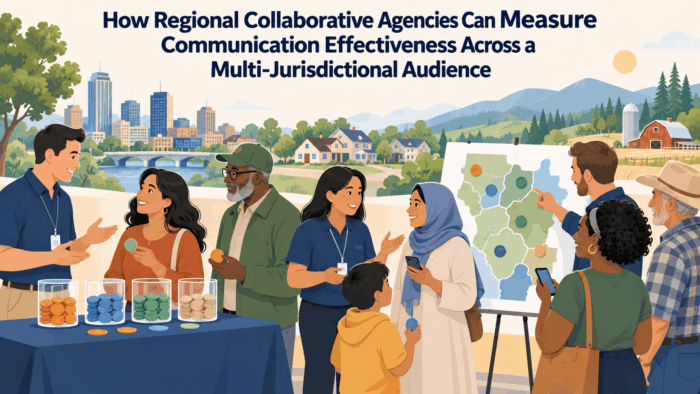
How Regional Collaborative Agencies Can Measure Communication Effectiveness Across a Multi-Jurisdictional Audience
Regional collaborative agencies invest significant organizational resources in communication, including staff time, publication costs, digital infrastructure, and event production, without typically having systematic measures of whether those investments are producing the governance communication outcomes they are designed to achieve. Most regional agencies measure communication outputs, the number of meetings held, the number of materials distributed, the number of social media followers, and the website visits generated, without measuring communication outcomes, whether specific audiences understand regional planning well enough to engage meaningfully with it, whether member governments have the information they need to support regional governance decisions, and whether the public has developed the regional planning understanding that sustained public support for regional investment requires.
The measurement gap between communication output and communication outcome is not simply a technical limitation. It reflects an organizational orientation toward communication as a compliance function whose success is defined by the production of required outputs rather than as a governance function whose success is defined by the quality of understanding, engagement, and trust it produces in the audiences it serves. An agency that measures communication success by counting meeting attendance has defined communication success as the agency showing up, not as the audience learning something useful. An agency that measures communication success by assessing whether participants in regional planning meetings understand the decisions being made and have the information to engage meaningfully with them, has defined communication success as the audience being served.
Multi-jurisdictional measurement of communication effectiveness is more complex than single-jurisdiction measurement because the audience is more diverse, the communication channels are more varied, and the baseline understanding and engagement levels differ significantly across different jurisdictions and different community types in the service area. A survey instrument that accurately measures communication effectiveness for English-speaking, digitally connected, civically engaged residents of a major urban jurisdiction, may miss the communication realities of non-English-speaking residents, digitally unconnected communities, or politically skeptical rural jurisdictions whose engagement with regional planning communication looks entirely different from the urban core that shapes most agencies’ default understanding of their audience.
This article examines how regional collaborative agencies can build communication measurement programs that assess outcomes rather than only outputs, that cover the full diversity of jurisdictions and communities in the service area, and that produce the specific measurement intelligence that drives systematic communication program improvement over time.
Defining Communication Outcomes for Regional Agencies
 The first requirement for measuring communication effectiveness is defining what effective communication means for the specific governance purposes that regional planning communication is designed to serve. For most regional collaborative agencies, effective communication at the minimum means that key audiences, including member government officials and staff, civic and business leaders, and the general public, have enough understanding of what the agency does and why it matters to support its governance function, engage with its planning processes, and provide the political support that its capital programs and regulatory programs require. More ambitiously, effective communication means that those audiences have the specific planning knowledge and the governance engagement that allows them to contribute meaningfully to the regional planning process rather than simply receiving its outputs.
Outcome definitions should be specific enough to be measurable. General outcome aspirations, such as the public will understand regional planning better, are not measurable and do not provide the specific feedback that communication program improvement requires. Specific outcome definitions, such as seventy-five percent of member government transportation staff will be able to accurately explain the TIP development process and project selection criteria within three months of the new TIP cycle beginning, provide a measurable standard that a specific survey or knowledge assessment instrument can evaluate. Building these specific, measurable outcome definitions for each major communication program is the foundational investment in communication measurement that most agencies have not made.
Different audience types require different outcome definitions that reflect the specific governance roles those audiences play and the specific communication investments that serve those roles. Member government elected official communication outcomes should be defined in terms of the officials’ ability to explain regional planning decisions to their local constituencies, support regional governance positions in local deliberations, and represent their communities’ interests effectively in regional governance processes. Public communication outcomes should be defined in terms of the general public’s awareness of what regional planning decisions affect their communities and their capacity to engage in public participation processes that influence those decisions. Media communication outcomes should be defined in terms of the accuracy and the contextual completeness of regional planning coverage in local media outlets across the service area.
From Fragmentation to Coordination: Communication Strategies for Councils of Governments, Metropolitan Planning Organizations, and Regional Planning Agencies
This article is part of our series on strategic communication for Councils of Governments, Metropolitan Planning Organizations, and Regional Planning Agencies. To learn more and to see the parent article, which links to other content just like this, click the button below.
Survey Research for Multi-Jurisdictional Measurement
Designing Effective Multi-Jurisdictional Surveys
Survey research is the most direct method for measuring communication outcomes across a multi-jurisdictional regional planning audience, because it can assess specific understanding, engagement, and trust dimensions of communication effectiveness that behavioral analytics and participation count data cannot reach. But multi-jurisdictional survey research presents specific design challenges that standard single-jurisdiction survey instruments do not fully address: the sampling challenge of reaching a representative cross-section of a geographically and demographically diverse service area population, the instrument design challenge of creating survey questions that are equally meaningful and accessible for audiences with very different baseline familiarity with regional planning, and the analysis challenge of disaggregating results by jurisdiction and by population subgroup in ways that produce the jurisdiction-specific measurement intelligence that multi-jurisdictional communication programs require.
Stratified sampling approaches that ensure adequate representation of different jurisdiction types, different demographic groups, and different geographic areas of the service area in the survey sample, are essential for producing the multi-jurisdictional measurement intelligence that regional communication programs need. A survey that draws its sample from a region-wide email list or a region-wide web survey will systematically over-represent the more digitally connected, more civically engaged, and more English-speaking population segments that are already better served by current communication programs, and will under-represent the populations whose communication needs are greatest and whose current communication effectiveness is most likely to be poor.
Language-appropriate survey administration that conducts surveys in the languages of target language communities, using instrument translation quality that reflects the cultural and linguistic diversity of those communities rather than the machine translation adequacy that allows a survey to technically exist in another language without being meaningfully accessible in it, is the language access commitment applied to measurement rather than only to communication programs themselves. An agency that measures communication effectiveness only among English-speaking respondents will not detect the communication failures affecting non-English-speaking communities that are systematically excluded from the English-language measurement infrastructure.
Member Government Staff and Official Surveys
Member government staff and official surveys provide the intergovernmental relationship communication measurement that general public surveys cannot supply. The planning director who was asked to assess how well the regional agency communicated the TIP development timeline and project selection criteria has a very specific and very professionally grounded assessment of the communication she received in her role as a local government participant in the regional planning process. That assessment provides the regional agency with the specific feedback of the professional audience that is most important for the quality of intergovernmental regional planning communication, and it provides it from the perspective of the governance function that intergovernmental communication is most important for serving.
Annual member government relationship surveys that assess how well the regional agency is communicating with member government staff and officials across a range of dimensions, including advance notice of upcoming regional decisions, accessibility of regional plan documents and data products, responsiveness to member government questions and concerns, and usefulness of regional technical assistance, provide the annual accountability measurement that intergovernmental communication quality requires. These surveys should be administered across all member governments, not only those with which the regional agency has the strongest existing relationships, so that the measurement results reflect the full range of intergovernmental communication quality rather than the subset that self-selected engaged governments represent.
Behavioral Analytics for Communication Effectiveness
Behavioral analytics, including website analytics, email engagement analytics, social media analytics, and document download tracking, provide continuous, real-time measurement of how audiences engage with regional agency communication products that survey-based measurement cannot provide between survey cycles. These analytics measure behaviors, the actions that audiences take in response to communication, rather than the attitudes and understanding that surveys measure, providing a complementary measurement perspective that, combined with survey research, gives agencies the most complete picture of communication effectiveness available.
Website analytics that track which pages users visit, how long they spend on specific content, where they navigate from specific pages, and which pages they exit without taking the intended action, reveal the communication effectiveness of specific web content at the level of individual page engagement that aggregate website visit counts cannot supply. A regional agency that discovers through website analytics that its TIP development guide page has high visit volume but very high early exit rates, suggesting that visitors are not finding the content useful or accessible enough to engage with, has identified a specific content quality problem that the visit count alone does not reveal. Acting on that finding to improve the TIP development guide’s accessibility and usefulness, and then tracking whether subsequent analytics show improved engagement, is the behavioral analytics-driven improvement cycle that most agencies have not built.
Email analytics that track open rates, click-through rates, and specific link engagement for different content types and different audience segments, provide the audience-specific communication effectiveness feedback that allows agencies to assess which content is most and least engaging for different parts of their stakeholder audience. A member government email newsletter that has high open rates among planning director recipients but low open rates among elected official recipients suggests a content or format issue that is serving one audience segment better than another. Investigating the specific content and format differences that produce this differential engagement, and adjusting the communication accordingly, is the email analytics-driven improvement that most agencies could pursue but have not systematically undertaken.
Social media analytics that measure engagement rates, reach, and the specific content characteristics associated with higher and lower engagement across different platforms and different audience segments, provide the social media communication effectiveness feedback that allows agencies to optimize social media content for the specific audiences they are trying to reach. The regional agency that discovers through social media analytics that posts featuring local project photos generate three times the engagement of posts featuring planning process announcements has learned something specific and actionable about what its social media audience finds compelling, and can use that finding to improve the balance of content types in its social media communication.
Measuring Communication Equity Across Jurisdictions
Communication effectiveness measurement for regional collaborative agencies must include the equity dimension of whether communication is reaching and serving communities across the full diversity of the service area, not only those communities that are already most engaged with regional planning. A measurement program that demonstrates high overall communication effectiveness while concealing significant disparities in communication reach and effectiveness across communities with different income levels, different language backgrounds, and different prior engagement with regional planning, is a measurement program that is optimizing for aggregate performance while ignoring the equity failures that aggregate performance conceals.
Geographic equity measurement that assesses communication reach and communication effectiveness by jurisdiction, neighborhood, and geographic area within the service area, provides the spatial communication equity intelligence that aggregate service-area-wide measurement cannot supply. A regional agency that can show through geographically disaggregated survey research that its communication effectiveness scores are consistently higher in the wealthier, more politically connected jurisdictions and lower in the lower-income, more politically marginalized jurisdictions, has identified a communication equity pattern that investment in targeted communication improvement for underserved jurisdictions should address.
Demographic equity measurement that assesses communication effectiveness by income level, language background, age, and disability status, provides the population-level equity intelligence that geographic measurement alone cannot fully capture. Communities are not internally homogeneous, and the communication effectiveness that a geographically defined community or jurisdiction achieves as an average conceals the within-community equity variations that demographic disaggregation reveals. The high-income suburb that achieves high overall communication effectiveness may conceal a much lower communication effectiveness score among its lower-income residents, its non-English-speaking households, or its elderly residents, any of which represent communication equity failures that deserve specific program responses.
Building Continuous Improvement From Measurement
 Communication measurement that does not drive program improvement is organizational documentation rather than organizational learning. The investment in survey research, behavioral analytics, and communication equity measurement is justified by the program improvement that measurement makes possible, not by the documentation that measurement produces. Building the organizational process that converts measurement findings into program decisions, and that tracks whether program decisions driven by measurement findings actually produce the improvements those findings identified, is the organizational learning commitment that makes communication measurement an investment rather than an overhead cost.
Measurement finding review cycles that schedule specific organizational attention to measurement results, translate those results into specific program improvement priorities, and assign responsibility for program modifications to specific staff members with specific timelines, create the organizational accountability for acting on measurement findings that most agencies lack. A quarterly communication effectiveness review that examines recent analytics data and the latest survey findings, identifies the two or three most significant communication quality gaps that the data reveals, and assigns specific staff responsibility for addressing those gaps in the next quarter’s communication program, is a continuous improvement process that most agencies could implement without major additional resource investment.
A/B testing of communication design choices, which compares the effectiveness of alternative communication approaches for the same message or the same audience by deploying different versions to matched audience segments and measuring the outcome differences, provides the most direct evidence available of which communication design decisions produce better audience outcomes. A regional agency that tests two different framings of a rate increase communication, one that leads with the service improvement rationale and one that leads with the infrastructure investment rationale, and that measures the understanding and the acceptance outcomes for each framing among comparable audience segments, has direct evidence of which framing better serves the governance communication goals of the rate increase communication. Applying that evidence systematically to future rate increase communications is the A/B testing return that most agencies are not capturing from their communication investments.
How Multi-Jurisdictional Measurement Compares With Single-Jurisdiction Measurement
Multi-jurisdictional communication effectiveness measurement is more demanding than single-jurisdiction measurement in every dimension: the sampling complexity is greater, the instrument design requirements are more varied, the analysis requirements are more extensive, and the program improvement implications are more geographically and demographically specific. These additional demands are the price of the additional governance communication intelligence that multi-jurisdictional measurement provides, and they are demands that agencies serving diverse regional populations must meet if their communication measurement is to provide the genuine program improvement intelligence that governance communication quality requires.
The comparison with the measurement practices of large public health agencies that conduct population health surveillance across diverse metropolitan populations reveals a measurement model that regional planning agencies can adapt for governance communication measurement. Public health agencies that conduct annual health surveys stratified by geography and demographics, that track health outcome trends over time with the longitudinal measurement infrastructure that enables trend analysis, and that use health surveillance data to drive specific public health program improvements, are practicing the measurement discipline that regional planning agencies need to apply to communication effectiveness. The population health surveillance model, adapted for the specific dimensions of communication effectiveness rather than health status, is the measurement program architecture that multi-jurisdictional regional communication measurement requires.
Qualitative Methods for Communication Effectiveness Assessment
Survey research and behavioral analytics provide quantitative evidence of communication effectiveness that is essential for systematic program improvement but that does not fully capture the qualitative dimensions of communication quality that governance communication requires. The planning director who gives the regional agency’s TIP communication high marks on a survey may still harbor specific concerns about the accessibility of specific technical documents or the adequacy of advance notice for specific planning decisions that a closed-ended survey instrument does not reveal. The community organization leader who rates regional planning communication as adequate may have specific suggestions for how the agency could better reach the communities her organization serves that a quantitative survey cannot elicit.
Focus groups with key stakeholder segments, conducted periodically to explore the qualitative dimensions of communication effectiveness that surveys cannot reach, provide the specific, contextually rich communication quality feedback that most effective programs need alongside their quantitative measurement infrastructure. A focus group with member government planning staff that explores specifically which aspects of regional communication they find most and least useful, what specific improvements would make regional communication more valuable for their local planning work, and what communication gaps most limit their ability to engage effectively with regional planning governance, produces the specific program improvement intelligence that survey ratings alone cannot supply.
Key informant interviews with individual stakeholders who have significant experience with regional planning communication, including governing board members, experienced local government planning directors, and community organization leaders who have engaged extensively with regional planning processes, provide the expert communication quality assessment that reveals the nuanced dimensions of communication effectiveness that neither surveys nor focus groups may fully expose. A fifteen-minute interview with a governing board member who has served for three years asking specifically what communication from the regional agency has been most valuable for their governance role and what has been least valuable, produces a specific and authoritative quality assessment that no standardized survey can replicate.
Mystery auditor programs that engage trained assessors, acting as members of specific stakeholder groups, to evaluate the quality of regional agency communication from the recipient’s perspective, provide an independent quality assessment that internal staff evaluations cannot supply. A mystery auditor posing as a first-time meeting attendee at a regional planning public meeting, evaluating the accessibility of the meeting materials, the adequacy of the plain-language explanation, and the genuineness of the public participation process, provides an external quality perspective that the staff running the meeting cannot self-assess with the same independence.
Measuring Media Communication Effectiveness
Regional planning agencies that invest in media relations and media outreach need measures of media communication effectiveness that assess whether those investments are producing the accurate, contextual, and broadly distributed coverage of regional planning issues that media communication is designed to generate. Most agencies track media mentions as a proxy for media communication effectiveness, counting the number of times the agency or its programs are mentioned in regional media without assessing the accuracy of that coverage, the contextual completeness of regional planning stories, or the diversity of media outlets and audiences that regional planning coverage reaches.
Media coverage quality analysis that assesses a sample of regional planning media coverage for factual accuracy, contextual completeness, balance of perspective, and the quality of the regional planning explanation provided to general audiences, gives agencies the specific media communication quality feedback that mention counts cannot provide. The regional agency whose media coverage is consistently accurate, contextually complete, and explanatorily adequate has achieved a media communication quality outcome that mention counts confirm and quality analysis validates. The agency whose coverage is frequent but consistently incomplete, inaccurate, or lacking the regional planning context that general audiences need, has a media communication quality problem that mention count reporting conceals.
Media audience reach measurement that assesses the demographics and the geographic distribution of the audiences reached by regional planning media coverage, compared with the demographics and geographic distribution of the regional planning service area, provides the media communication equity assessment that geographic coverage measurement alone cannot supply. A regional planning agency whose media coverage is concentrated in the metropolitan core’s major newspapers and television stations, and that is absent from the community newspapers, radio stations, and digital platforms that serve the rural and suburban periphery of the service area, has a media communication equity gap that overall coverage volume does not reveal.
Reporter relationship quality assessment that evaluates the quality of the regional agency’s relationships with the journalists who most regularly cover regional planning issues, including how readily those reporters contact the agency for information and comment, how accurately they characterize regional planning in their coverage, and how contextually complete their regional planning stories are, provides the media relationship quality measure that is the most direct indicator of media communication effectiveness. A regional planning agency whose key journalists call frequently for background, quote agency staff as primary sources, and consistently provide contextually complete regional planning coverage, has achieved the media relationship quality that effective media communication produces.
Communication Effectiveness and Governance Outcomes
The ultimate test of communication effectiveness for regional collaborative agencies is not whether audiences understand regional planning or even whether they engage with regional planning processes. It is whether the communication investments the agency makes produce the governance outcomes that regional planning requires: the political support for regional transportation investment, the member government cooperation with regional land use frameworks, the public engagement with regional environmental planning, and the business community advocacy for regional workforce and infrastructure investment that regional planning’s governance mission depends on. Connecting communication effectiveness measurement to governance outcome measurement is the most ambitious and the most important measurement challenge in regional collaborative agency communication.
Governance outcome indicators that reflect the quality of the regional agency’s communication program, including the legislative success rate of regional transportation funding advocacy, the member government compliance rate with regional plan consistency requirements, the public participation rate in major regional planning processes, and the rate of business community endorsement of regional infrastructure investment proposals, provide the governance outcome anchors that make communication effectiveness measurement governmentally relevant rather than only programmatically significant. An agency that can demonstrate a correlation between its communication investment in member government TIP process education and the quality of member government TIP project submissions in subsequent cycles, has evidence of a communication effectiveness-governance outcome connection that most agencies cannot currently demonstrate because they have not built the measurement infrastructure that would reveal it.
Long-term communication effectiveness tracking that measures the same governance understanding and engagement indicators for the same audience segments over multiple years, providing the longitudinal evidence of whether communication investments are producing the cumulative understanding improvement that regional planning governance requires, is the most demanding and the most valuable communication measurement investment available. An agency that has measured the same key governance communication outcomes for the same sample of member government staff and community members for five years has the longitudinal evidence base for evaluating whether its communication investment is producing meaningful cumulative improvement or whether it is maintaining a static level of governance understanding that is inadequate for the agency’s long-range governance goals.
Building a Communication Measurement Culture
Communication effectiveness measurement is not primarily a technical challenge. It is an organizational culture challenge. Agencies that consistently measure communication effectiveness are agencies whose leadership has decided that communication accountability is as important as program delivery accountability, whose communication staff have the skills and the organizational support to conduct and use measurement research, and whose program improvement culture treats communication quality gaps as organizational improvement opportunities rather than as institutional failures to be minimized.
Building this measurement culture requires specific organizational investments alongside the technical measurement infrastructure. Leadership communication that explicitly values measurement-driven communication improvement, that requests and acts on measurement findings in the same way it requests and acts on program performance data, and that recognizes communication staff who use measurement to drive program improvement, creates the organizational context that makes communication measurement a genuine organizational commitment rather than a periodic compliance activity.
Staff development in communication research methods, including survey design, behavioral analytics interpretation, qualitative research facilitation, and measurement finding translation into program improvement decisions, builds the internal capability that makes communication measurement sustainable without permanent dependence on external measurement support. A communication team that has the research skills to design and analyze its own measurement instruments, to interpret behavioral analytics in governance communication terms, and to translate measurement findings into specific program improvement recommendations, is a team that can build the continuous improvement cycle that strategic communication measurement is designed to produce.
Return on Investment for Communication Measurement
Communication effectiveness measurement requires organizational investment in survey research, analytics infrastructure, and program improvement processes that communication teams must justify to leadership who are weighing measurement investment against the direct program costs that the same resources could fund. Building the organizational case for communication measurement investment requires the same evidence-based argumentation that measurement-driven communication programs apply to their content: specific, credible evidence of the governance returns that communication measurement produces relative to its cost.
The most direct return on communication measurement investment is the program improvement that measurement findings enable, which produces better communication outcomes from the same or smaller communication resource investment by concentrating that investment in the approaches that measurement demonstrates are most effective. A regional agency that discovers through measurement that its member government briefing program produces significantly better governance understanding outcomes than its general public meeting program, per dollar of communication investment, has evidence for reallocating communication resources toward higher-return activities that ad hoc program evaluation cannot provide with the same specificity or the same credibility.
Political risk reduction is another return on communication measurement investment that is difficult to quantify but that is real and significant for regional collaborative agencies whose governance depends on the political support of member governments and the general public. An agency that knows through measurement that specific stakeholder groups have inadequate understanding of specific regional planning issues, before those understanding gaps produce governance crises, can invest in targeted communication improvement that reduces the political risk that the understanding gaps represent. The cost of that preventive communication investment is almost always lower than the cost of managing the political crisis that the unaddressed understanding gap would eventually produce.
Federal accountability return on communication measurement investment comes from the evidence that measurement provides of communication program quality in the dimensions that federal oversight increasingly examines, including equity of communication reach across demographic groups, quality of public participation processes, and effectiveness of environmental justice community engagement. An agency that has systematic measurement evidence of its communication equity performance, that can demonstrate through survey data that its public participation programs are reaching underrepresented communities at rates comparable to more typically engaged communities, is better positioned in federal oversight reviews than an agency that relies on participation count data alone to demonstrate communication equity performance.
Communication Systems and Organizational Governance Quality
The communication systems that regional collaborative agencies build around their planning cycles, their measurement programs, and their accountability documents, are governance infrastructure in the same sense that their transportation networks and their environmental monitoring systems are governance infrastructure. They are the systems through which the agency exercises its governance function in a way that is accessible, accountable, and democratic rather than technically competent but institutionally opaque. Building these communication systems with the same organizational seriousness that regional agencies apply to their technical planning and program delivery functions is the governance investment that distinguishes agencies that are genuinely committed to democratic governance from those that are primarily committed to technical program delivery.
The interconnection among communication calendar management, communication effectiveness measurement, and annual accountability communication is the integration that makes strategic communication a coherent organizational function rather than a set of separate activities. A communication calendar that is built around governance accountability goals produces the advance planning that makes accountability documentation more complete. A communication measurement program that assesses the effectiveness of calendar-driven communication produces the specific improvement intelligence that makes successive calendar cycles better than their predecessors. An annual report that synthesizes the year’s communication calendar activities and measurement findings into a coherent governance accountability narrative produces the institutional credibility that makes the next planning year’s communication calendar investments more effective. These three elements are the system, and each is stronger for the others.
Regional collaborative agencies that build this integrated communication system, that invest in strategic calendar management, in systematic measurement of communication effectiveness, and in genuinely readable accountability communication, are agencies that are fulfilling their governance communication obligations at the level of quality that their democratic mandate requires. Those that manage communication reactively, measure it inadequately, and report it in forms that their audiences cannot read or use, are falling short of that mandate in ways that their technical planning quality cannot compensate for. Communication quality is governance quality, and the investment required to achieve it is among the most consequential governance investments that regional collaborative agencies can make.
Tying It All Together
Communication effectiveness measurement across a multi-jurisdictional audience is the organizational investment that transforms regional communication from a self-assessed function that produces whatever output it produces, to an accountable governance function whose performance is visible, comparable over time, and continuously improved by the specific feedback that measurement provides. The agency that measures communication effectiveness consistently, that disaggregates its measurement results by jurisdiction and by population group to reveal the equity dimensions of its communication performance, and that uses measurement findings to drive specific program improvements, is an agency that is genuinely accountable for the quality of governance communication it provides rather than simply for the volume of communication activities it produces.
The governance returns on communication effectiveness measurement accumulate in the same way that the governance returns on communication quality accumulate: not through any single measurement cycle but through the cumulative effect of measurement-driven improvement over multiple cycles. The agency that has measured and improved its communication effectiveness for three years has a communication program that is meaningfully better than the one it started with, and that would not have improved systematically without the measurement program that drove each improvement decision. That cumulative improvement is the most important return on communication measurement investment, and it is the return that most regional agencies are forgoing by not measuring communication effectiveness systematically.
Strategic Communication Support for Measurement Programs
 Developing the survey research instruments, the behavioral analytics frameworks, the communication equity measurement programs, and the organizational improvement processes that effective multi-jurisdictional communication measurement requires is work that most regional collaborative agency communication teams have not been staffed or resourced to build independently. The combination of research methodology expertise, statistical analysis capacity, communication equity analysis, and organizational process design that comprehensive communication measurement demands makes external communication measurement support a productive investment for agencies seeking to build genuine communication accountability.
Stegmeier Consulting Group (SCG) works with regional collaborative agencies to develop communication effectiveness measurement programs built around the specific audience diversity, governance communication goals, and program improvement priorities of each agency’s context. SCG’s engagement begins with an assessment of current communication measurement practices, identifying what is currently being measured, what is not, where the measurement gaps are most significant for program improvement, and what the organizational capacity and infrastructure for communication measurement development currently looks like.
From that assessment, SCG develops the specific measurement instruments, measurement protocols, and measurement infrastructure that address identified gaps, including stratified survey instruments for multi-jurisdictional audience measurement, member government communication effectiveness survey programs, behavioral analytics dashboards that make digital communication performance visible and comparable across time, and communication equity measurement frameworks that disaggregate communication effectiveness by jurisdiction and by population group. Each measurement program element is designed for the specific audience diversity and governance communication goals of the agency’s service area.
SCG also works with agency communication and leadership staff to build the organizational processes that make measurement findings drive program improvement, including measurement review cycles that translate findings into program decisions, A/B testing protocols that build direct evidence for communication design choices, and annual communication quality reporting that makes communication effectiveness visible and accountable to agency leadership and to the governing board.
Future Trends in Communication Effectiveness Measurement
Artificial intelligence tools for content analysis and sentiment monitoring are creating new possibilities for continuous, scalable communication effectiveness measurement that surveys and manual analytics cannot provide. AI-assisted media monitoring that tracks how regional planning issues are covered across the full range of local media outlets in a service area, assessing coverage volume, coverage sentiment, and coverage accuracy in near-real time, provides the media communication effectiveness monitoring that manual media tracking cannot scale to multi-jurisdictional service areas. Similarly, AI-assisted social media sentiment analysis that tracks how communities across the service area are discussing regional planning issues, identifying emerging concerns and communication gaps before they become public trust crises, provides the real-time community communication intelligence that periodic survey research cannot match.
Passive communication effectiveness indicators, including property values near regional infrastructure investments as proxies for community confidence in regional planning outcomes, business location decisions near transit investments as proxies for business community confidence in regional transportation planning, and volunteer participation in regional environmental programs as a proxy for public engagement with regional environmental planning, provide the behavioral outcome measurement that active survey research supplements rather than replaces. These behavioral indicators are not strictly communication effectiveness measures, since they are influenced by many factors beyond communication quality, but they provide the real-world outcome anchors that give communication effectiveness measurement its governance relevance.
Continuous listening programs that monitor community feedback about regional planning through multiple channels simultaneously, including social media, customer service contacts, community organization feedback, and elected official constituent communications, provide the ongoing community communication intelligence that episodic survey research cannot sustain between survey cycles. Regional agencies that build continuous listening infrastructure, and that systematically analyze and respond to the community communication signals it provides, are developing the real-time community relationship intelligence that strategic communication management at the governance quality level requires.
Conclusion
Measuring communication effectiveness across a multi-jurisdictional audience is the organizational commitment that makes regional collaborative agency communication genuinely accountable for the governance outcomes it is designed to produce rather than only for the compliance outputs it is required to generate. The measurement program that provides specific, comparable, equity-disaggregated evidence of how well regional communication is serving the full diversity of the service area’s jurisdictions and communities, and that drives the specific program improvements that measurement findings identify, is the organizational investment that distinguishes agencies that are genuinely pursuing governance communication quality from those that are producing communication output in compliance with regulatory requirements.
The multi-jurisdictional measurement challenge is real, but it is manageable with the right combination of survey research methodology, behavioral analytics infrastructure, and organizational improvement processes. Agencies that build this measurement capacity find that the governance communication intelligence it provides is worth its investment many times over, because it replaces the agency’s assumptions about what its communication is accomplishing with the specific evidence of what it is and is not accomplishing, and it replaces the hope that communication will improve with the organizational discipline that makes communication improvement systematic and sustained.
Stegmeier Consulting Group’s Strategic Approach to Communication Systems
Build communication effectiveness measurement around outcome metrics rather than output counts, equity-disaggregated analysis that reveals the full service area’s communication quality, and organizational improvement processes that convert measurement findings into systematic program improvement.
Regional collaborative agencies need to measure communication effectiveness through outcomes, not simply the volume of materials produced or audiences reached. Stegmeier Consulting Group (SCG) helps agencies develop measurement programs tailored to their audience diversity, governance communication goals, and improvement priorities. SCG assesses current measurement practices, identifies gaps in useful performance intelligence, and evaluates the organizational capacity needed to sustain a stronger measurement program.
Based on this assessment, SCG develops audience surveys, member government feedback programs, behavioral analytics dashboards, and equity-focused measurement frameworks that provide meaningful insight into communication effectiveness. SCG also helps establish measurement review cycles, testing processes, and annual reporting practices that turn findings into systematic program improvements. The objective is a communication organization that understands how effectively it serves its audiences and uses that knowledge to continuously improve.
Use the form below to connect with our team and explore how strategic communication support can strengthen your agency’s communication measurement program.