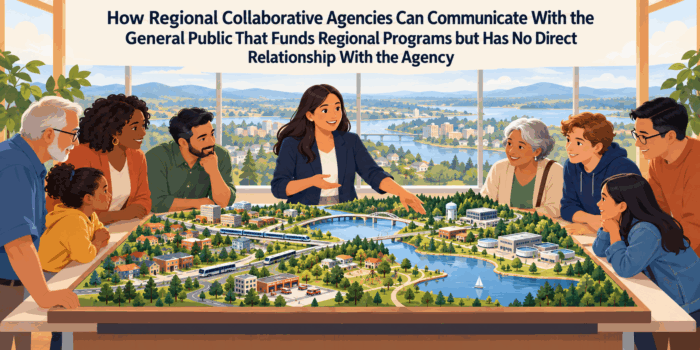
How Regional Collaborative Agencies Can Communicate With the General Public That Funds Regional Programs but Has No Direct Relationship With the Agency
The general public occupies a paradoxical position in regional collaborative agency governance. It is the ultimate funder of regional programs, through the federal and state taxes, the local property assessments, and the utility rates that flow upward through the governmental structures that regional agencies depend on for their resources. It is the ultimate beneficiary of regional planning, through the transportation conditions, the environmental quality, the housing availability, and the economic opportunity that regional coordination shapes over decades. And it is the governance constituency that most regional collaborative agencies have the least direct relationship with, communicating sporadically when regulatory requirements demand public participation, or when specific project decisions generate controversy that makes public engagement unavoidable.
This relational gap is not simply a communication failure. It reflects the structural reality that most regional collaborative agencies have no direct electoral relationship with the general public, no billing relationship through which they can reach ratepayers directly, and no program delivery relationship through which they provide services that residents recognize as coming from the regional agency. A city government provides services that residents directly experience, from trash collection to road maintenance to park programming, and can communicate through those service relationships to build public awareness of what city government does and why it matters. A regional planning agency provides planning coordination, data products, technical assistance, and program management that produce outcomes visible only through the local government actions that regional coordination enables, not through any service that the resident directly receives from the regional body itself.
Yet the general public’s understanding of and engagement with regional planning matters enormously for the long-term political sustainability of regional coordination as a governance form. Public funding for regional programs depends on public support. The voter who has never heard of the metropolitan planning organization cannot advocate for MPO funding. The resident who does not understand the connection between regional housing planning and local housing costs cannot engage with the regional governance decisions that shape those costs. The taxpayer who does not know what the council of governments does cannot evaluate whether the investment in regional coordination is worth the cost. Building the general public understanding and engagement that regional planning governance requires is a long-term communication investment that most regional agencies have not made systematically.
This article examines how regional collaborative agencies can communicate with the general public that funds their programs but has no direct relationship with them, including how to reach general audiences through the channels they actually use, how to explain regional planning’s relevance to the daily concerns that motivate civic engagement, and how to build the cumulative public understanding that makes regional planning politically sustainable over the long horizons that regional coordination requires.
Starting With What the Public Cares About
 The most common failure in general public communication for regional collaborative agencies is starting with what the agency does and expecting the general public to recognize its relevance, rather than starting with what the public cares about and demonstrating regional planning’s connection to those concerns. The public that cares about housing costs, traffic congestion, air quality, school quality, job access, and neighborhood safety will not automatically recognize the connection between those concerns and the regional planning activities that shape them. Building that connection requires starting with the concern and working toward the regional planning dimension rather than starting with the regional planning activity and working toward the public relevance.
Traffic congestion is among the most universally recognized regional transportation conditions that connects general public experience to regional planning investment in ways that any resident who commutes understands personally. A regional transportation plan that is communicated as a comprehensive multi-modal transportation improvement program for the metropolitan area will reach the planning professionals and civic leaders who engage with planning documents. The same plan communicated as the regional strategy for reducing the commute times that are costing commuters specific hours per week and specific hundreds of dollars per year in wasted fuel and time, is a communication that connects the planning investment to the daily life cost that every commuting resident experiences personally.
Housing cost is the regional planning issue with the most universal general public relevance across the economic diversity of regional populations, because housing affordability affects residents at every income level in different ways: the renter who cannot afford to stay in the neighborhood where they work, the first-time homebuyer who cannot find a home in their price range anywhere near their employer, the homeowner who watches their property taxes increase faster than their income, and the employer whose workforce recruitment is constrained by housing costs that their employees cannot afford. Regional housing planning communication that starts with these specific housing cost experiences, and that explains how regional planning decisions about housing allocation and land use contribute to or address those experiences, is communication that the general public finds immediately relevant.
Environmental quality concerns provide another general public entry point for regional planning communication that connects to the daily life experience of residents in ways that abstract environmental planning communication does not. The parent who wants to know whether the air near their child’s school is safe, the family that wants to use regional waterways for recreation but is concerned about water quality, and the homeowner who is worried about flooding risk in their neighborhood, all have specific environmental concerns that regional environmental planning addresses and that regional environmental communication can connect to the specific planning investments and policies that the agency is pursuing in response.
From Fragmentation to Coordination: Communication Strategies for Councils of Governments, Metropolitan Planning Organizations, and Regional Planning Agencies
This article is part of our series on strategic communication for Councils of Governments, Metropolitan Planning Organizations, and Regional Planning Agencies. To learn more and to see the parent article, which links to other content just like this, click the button below.
Reaching the General Public Through Non-Governmental Channels
The general public that has no direct relationship with the regional planning agency will not seek out the agency’s communication through the agency’s own channels. Regional agency websites, regional agency newsletters, regional agency social media accounts, and regional agency public meeting notices, all reach primarily the audiences that already have an interest in regional planning. Reaching the general public requires placing regional planning communication in the channels and contexts that general audiences already use, through the media outlets they already trust, the community organizations they already belong to, and the social networks where they already consume information about their communities.
Local media partnerships are the most effective channel for reaching general audiences with regional planning communication, because local media already have the trust, the reach, and the audience relationships with general public audiences that regional agencies do not have. A regional agency that has invested in genuine media relationships with local reporters across its service area, that provides those reporters with accessible regional planning information, story ideas with local relevance, and expert sources for regional planning stories, will generate more effective general public communication through media coverage than through any combination of direct agency communication efforts. The story that a trusted local reporter writes about how regional transportation planning affects commute times in a specific community reaches that community’s residents with the credibility that a regional agency press release cannot achieve.
Community organization partnerships that distribute regional planning communication through the civic associations, faith communities, neighborhood organizations, and social service organizations that residents already belong to, extend regional planning communication reach into the community networks where general public audiences actually engage with information about their communities. A regional transit authority that partners with a neighborhood association to share its service planning updates through the association’s existing member communication channels, is reaching association members who would never visit the transit authority’s website or follow its social media account, through a trusted community channel that they already use.
Employer communication channels that reach residents through their workplaces, including employee newsletters, intranet posts, lunch-and-learn programs, and workplace sustainability or wellness programs that connect regional transportation and environmental planning to employee concerns, provide access to general public audiences in the professional contexts where they already receive community information. A regional agency that provides content for regional employers’ internal communication about how regional transportation investments will affect employee commutes, or how regional environmental programs connect to the sustainability interests that employees have expressed, is reaching a captive general audience through a trusted organizational channel.
Digital Communication for General Audiences
Social Media Strategy for General Public Reach
Social media is the most accessible channel for reaching general audiences who would never seek out a regional planning agency’s own communication, because social media allows the agency to place content where general audiences are already present rather than requiring those audiences to come to the agency’s digital properties. But effective social media communication for general audiences requires content that is designed for social media engagement norms, not for planning professional communication standards. Regional planning agencies that produce social media content in the same format and at the same reading level as their technical planning documents will not reach general social media audiences, because general social media audiences scroll past institutional content that does not immediately signal relevance to their concerns.
Visual storytelling on social media, using photography, infographics, short videos, and interactive content that makes regional planning visible in terms of specific places, specific people, and specific outcomes rather than in terms of abstract planning concepts and regulatory processes, is the social media content format that connects regional planning communication to the general audiences that regional agencies most need to reach. A social media post that shows a specific before-and-after comparison of a regional infrastructure improvement in a specific neighborhood, paired with a brief explanation of how that improvement connects to regional planning investment, communicates more effectively to general social media audiences than a post announcing the adoption of a regional plan document.
Platform-specific content strategy that adapts regional planning communication to the specific engagement norms, content formats, and audience demographics of different social media platforms, produces more effective general public reach than the platform-agnostic content that most agencies post identically across multiple channels. The regional agency that posts the same press release text to every social platform is not using any platform effectively. The agency that produces platform-specific content, short-form video for the video platforms, infographic series for image-focused platforms, and thread-format explanatory content for text-based platforms, is communicating with the audiences of each platform in the formats that those audiences find engaging.
Website Communication for Non-Specialist Visitors
Regional agency websites are typically organized for the convenience of planning professionals and compliance reviewers rather than for general public visitors who do not know what the agency does and are trying to find out whether it is relevant to their concerns. A website that leads with the agency’s organizational structure, its committee meetings, and its program documents, is organized for an audience that already knows why those things matter. A website that leads with the regional conditions the agency is working to improve, the specific investments and policies it is pursuing, and the ways that residents can get involved, is organized for the general public audience that needs to understand the agency’s relevance before it can engage with its governance processes.
Plain-language web content that answers the questions general visitors are actually asking, including what the agency does, why it matters for my community, how it affects my daily life, who pays for it, and how I can get involved, provides the general public accessibility that most regional agency websites lack. Each of these questions deserves a specific, accessible, non-jargon answer that any adult without planning background can read and understand in the two to three minutes that most web visitors devote to initial page engagement before deciding whether to stay or leave.
Connecting Regional Planning to Local Identity and Community Pride
General audiences engage most readily with communication that connects to their sense of place, their local community identity, and their pride in the region they live in. Regional planning communication that frames regional investment in terms of the specific places it is improving, the specific communities it is serving, and the specific regional identity it is building, connects to the emotional engagement with place that motivates the civic participation that abstract governance communication cannot generate.
Place-based storytelling that narrates how regional planning investments have improved specific neighborhoods, supported specific community aspirations, and protected specific environmental and cultural resources that residents value, communicates regional planning value in terms that connect to residents’ personal relationships with specific places in their region. The resident who has no interest in the Transportation Improvement Program may be deeply interested in the story of how regional transportation investment transformed a specific waterfront neighborhood they love, if that story is told in terms of the neighborhood’s character and its residents’ experiences rather than in terms of the planning process that produced the investment.
Regional identity communication that frames regional planning as the governance mechanism through which a specific metropolitan community manages the shared resources, the shared infrastructure, and the shared environmental conditions that define regional identity, positions regional coordination as an expression of regional civic pride rather than as a bureaucratic governance layer. The region that understands its regional planning agency as the institution through which the metropolitan community manages its shared transportation system, its shared environmental resources, and its shared economic development potential, is a region that can engage with regional planning governance as an expression of regional civic identity rather than as an external governance imposition.
Managing the Attention Economy
The general public that regional agencies are trying to reach is a public with limited attention for public institutional communication that is competing with entertainment, social connection, personal news, and the full range of private sector communication for the same finite attention resources. Regional planning communication that fails to earn audience attention within the first few seconds of a first encounter will not be given the sustained engagement that complex governance communication requires. Earning that initial attention requires communication that is immediately visually compelling, emotionally resonant, or personally relevant, before asking for the deeper attention that genuine public understanding requires.
Attention economy communication strategy for regional agencies requires the same communication design discipline that effective private sector consumer communication employs: specific, concrete benefits stated immediately rather than buried in institutional preambles, visual design that communicates value before words carry the message, and progressive disclosure that allows audiences to engage at the level of attention they are willing to invest without requiring full commitment before any value is delivered. A regional agency that leads its public communication with the most specific, most tangible, and most personally relevant element of its message, before providing the institutional context that explains why the agency is making the communication, is using the attention economy communication discipline that general public reach requires.
Content serialization that delivers regional planning communication in multiple small installments over time, rather than in comprehensive single communications that require sustained attention that most general audiences will not provide, allows regional agencies to build cumulative public understanding through the accumulated engagement of many brief, accessible communication touchpoints. A regional transportation agency that explains its long-range plan through a twelve-part series of two-minute videos, each addressing one specific aspect of the plan in terms that general audiences find immediately relevant, builds more cumulative public understanding through the series than through a single comprehensive public hearing or a full plan document that only planning professionals and highly engaged civic activists will engage with.
Community Events and In-Person General Public Engagement
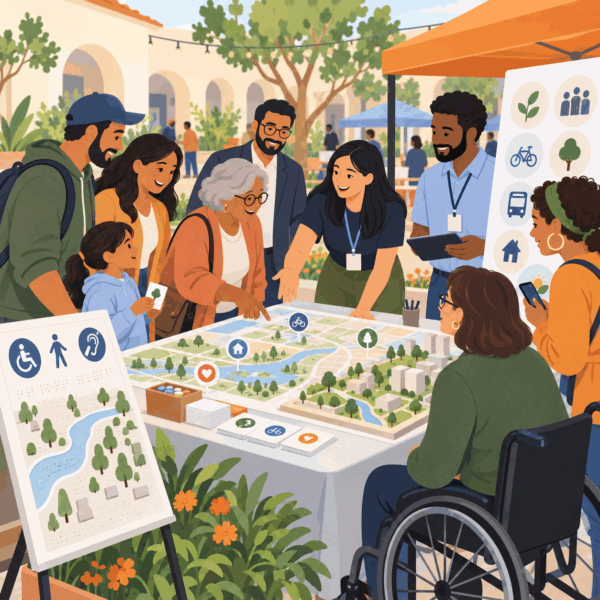
Community events, including festivals, farmers markets, street fairs, and neighborhood gatherings, provide access to general public audiences in social contexts where people are open to community engagement that formal governance meetings do not create. A regional transportation agency that staffs a booth at a regional street festival, that provides interactive transportation choice demonstrations, distributes useful information about transit options and bicycle infrastructure, and engages passers-by in brief conversations about regional transportation priorities, is reaching general public audiences in a social context where regional planning information is received as community engagement rather than as institutional communication.
Pop-up community engagement at transit stops, libraries, community centers, and other locations where general public audiences are present in the natural course of their daily routines, brings regional planning communication to the places where residents already are rather than asking them to travel to where regional planning meetings are held. A regional planning agency that sets up a brief interactive engagement station at a major transit hub, allowing commuters to spend five minutes exploring regional transportation data visualizations and providing input on regional transportation priorities during their commute, is engaging a general audience that would never attend a regional planning public meeting with the same governance questions that public meetings address.
Partnerships with community events that are already drawing general public audiences, including sponsoring or providing programming at community festivals, organizing regional planning walking tours or cycling tours that explore specific regional planning investments in specific neighborhoods, and participating in community fairs organized by civic organizations, extend regional planning communication into the community event contexts where general audiences are most open to engagement without requiring those audiences to attend separately scheduled regional planning events.
How General Public Communication Differs From Stakeholder Communication
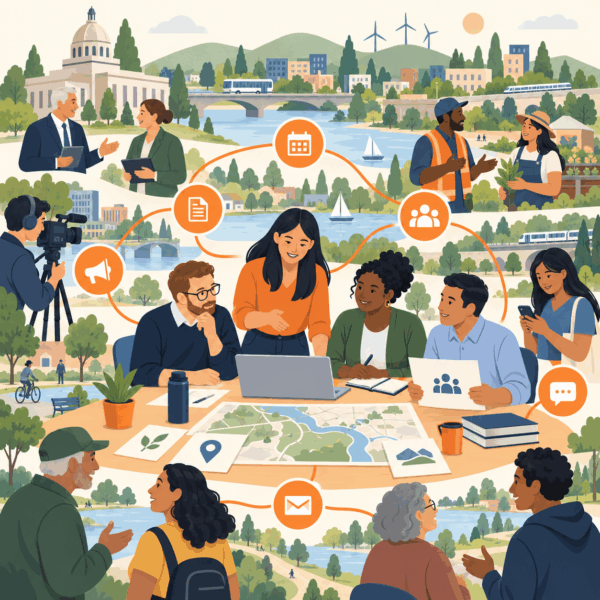 General public communication for regional collaborative agencies is fundamentally different from the stakeholder communication that most regional agencies have developed for member governments, the business community, and civic planning organizations, because the general public lacks the institutional context, the planning literacy, and the governance engagement motivation that specialized stakeholder audiences bring to regional planning communication. Stakeholder communication can assume baseline familiarity with regional planning processes, can use planning vocabulary without extensive explanation, and can engage audiences that are motivated to pay attention because they have direct institutional interests in regional planning outcomes. General public communication must build that baseline familiarity, must explain planning vocabulary, and must earn the attention of audiences whose motivation for engaging with regional planning communication must be created by the communication itself.
The comparison with effective public health communication for general audiences reveals the communication discipline that regional planning general public communication requires. Public health agencies that have developed effective general public communication about complex health issues, including vaccination programs, chronic disease prevention, and environmental health risks, have learned to lead with personal relevance rather than institutional authority, to use specific, concrete examples rather than abstract health concepts, and to distribute communication through trusted community channels rather than primarily through health department institutional channels. Regional planning agencies that apply these same communication disciplines to general public communication about regional transportation, environmental, housing, and economic planning will reach general audiences more effectively than those that apply the communication norms of professional planning communication to general public contexts.
Regional Planning and Generational Equity Communication
General public communication about regional planning has a generational dimension that most agencies have not fully addressed: the obligation to communicate with younger generations about regional planning decisions whose consequences they will live with far longer than the adults who are making those decisions today. The teenager who will spend the next sixty years in a region whose transportation infrastructure is being designed now, whose housing market is being shaped by land use decisions made now, and whose environmental conditions are being determined by environmental planning choices made now, has a stake in regional planning governance that no current electoral mechanism adequately represents.
Youth-facing regional planning communication that explains regional planning decisions in terms relevant to the concerns of younger generations, including climate impacts, housing affordability, transportation access for people who do not own cars, and the quality of the regional environment they will inherit, connects regional planning to the intergenerational equity dimensions that younger audiences are increasingly engaged with as civic concerns. A regional council that communicates its long-range plan to a general young adult audience in terms of how the plan addresses the housing, transportation, and environmental concerns that that audience has identified as most important to their regional future, is communicating with a constituency that is underrepresented in current regional planning participation but that has significant long-term stakes in regional planning outcomes.
Intergenerational accountability communication that tracks how regional planning decisions made in each decade are affecting the regional conditions that subsequent generations are inheriting, and that presents this longitudinal accountability to current general audiences as evidence of regional planning’s long-term governance responsibility, builds the civic understanding that regional planning is a multi-generational governance project rather than a current-cycle administrative function. The region that can show how transportation investments made twenty years ago are shaping the commute conditions of today’s workforce, and how land use decisions made thirty years ago are determining the housing options available to today’s first-time homebuyers, is providing the intergenerational evidence of regional planning’s long-range consequences that motivates civic engagement with the long-range planning decisions being made now.
Digital engagement with younger general audiences, including social media content designed specifically for the platforms and content formats that younger audiences use, interactive scenario planning tools that allow younger audiences to explore the regional planning choices that will shape their futures, and regional planning career information that connects regional planning governance to the professional interests of students and young professionals who might contribute to regional planning as participants rather than only as subjects, extends regional planning communication to the generational audiences that most need to understand and engage with regional planning governance if that governance is to remain democratically legitimate over the long term.
Public Accountability for Regional Investment Returns
The general public that funds regional programs through its taxes and fees has a right to understand whether those investments are producing the outcomes they were designed to produce, at the cost that was promised when the investment was authorized. Most regional collaborative agencies do not provide this return on investment accounting to the general public in accessible terms, producing program outcome reports for technical and compliance audiences without the investment-return framing that the general public, as the ultimate funder of regional programs, has a right to expect.
Program return on investment communication that presents specific regional program outcomes in terms of the specific public benefits produced per dollar of program investment, including congestion minutes reduced per transportation dollar invested, housing units produced per housing program dollar invested, and acres of natural resource protected per conservation dollar invested, gives the general public the performance accountability information it needs to evaluate whether regional program investment is worth the cost. These return on investment framings are not marketing metrics. They are genuine accountability measures that connect public investment to public benefit in terms that any taxpayer or ratepayer can evaluate as a good deal or a poor one.
Failed investment communication that honestly acknowledges when regional programs have not produced the promised outcomes, and that explains specifically why those outcomes were not achieved and what the agency is doing to improve performance, is the most difficult but the most credibility-building form of general public accountability communication. The general public that has learned through regional agency communication that a specific program underperformed its targets, that understands the specific reasons for that underperformance, and that has heard the specific changes the agency is making in response, is a public that trusts regional accountability communication more than one that only receives positive outcome reports that never acknowledge shortfalls.
Comparative efficiency communication that shows how regional programs perform relative to alternative service provision approaches, including the cost comparison between regional shared services and equivalent independent local service provision, and the outcome comparison between regionally coordinated program delivery and what local governments could achieve independently with the same resources, provides the structural efficiency argument for regional coordination that general audiences can evaluate as a governance rationale for the regional investment they are being asked to support.
Building Civic Infrastructure Through General Public Communication
The general public communication that regional collaborative agencies invest in does not simply inform individual residents about regional planning. Over time, it builds the civic infrastructure of regional understanding, regional identity, and regional engagement that makes regional governance democratically legitimate and politically sustainable. A region whose general public has developed genuine understanding of regional interdependence, regional planning’s role in managing shared regional conditions, and regional coordination’s value relative to local government acting alone, is a region whose civic infrastructure supports the sustained regional planning investment that long-range planning requires.
Regional civic identity communication that frames the metropolitan region as a shared civic community whose residents have collective stakes in shared transportation conditions, shared environmental quality, shared housing market dynamics, and shared economic competitiveness, builds the sense of regional civic belonging that motivates general public engagement with regional governance. Most residents identify strongly with their city, their neighborhood, and their local community, but weakly with the metropolitan region that shapes the conditions of that local community in fundamental ways. Building regional civic identity alongside local community identity is a communication goal that regional planning agencies rarely pursue explicitly but that would produce significant long-term returns in public support for regional planning investment.
Regional civic education for community leaders, including civic associations, neighborhood organizations, school parent groups, faith community leaders, and local business associations, extends regional planning communication reach through the community leadership networks that shape how general public audiences engage with regional governance issues. A community association leader who understands regional transportation planning’s connection to local commute conditions, and who can explain that connection to association members when regional transportation decisions arise in local civic discussions, is extending regional planning communication through a trusted community leadership channel that regional agency direct communication cannot replicate.
Long-term public understanding tracking that measures how general public understanding of regional planning’s role in shaping regional conditions changes over years of sustained communication investment, provides the evidence of civic infrastructure building that justifies the long-term communication investment that building genuine general public understanding requires. An agency that can demonstrate through annual public understanding surveys that general public awareness of regional coordination’s value has increased significantly over five years of sustained general public communication investment, has the evidence that its long-term communication investment is producing the civic infrastructure returns it was designed to achieve.
Communication as Democratic Infrastructure
The communication programs that regional collaborative agencies build for their diverse audiences, from the general public with no direct agency relationship to tribal nations with sovereign governmental relationships to rural communities with geographic and cultural barriers to participation, are together the democratic infrastructure through which regional planning governance derives its legitimacy, sustains its political support, and exercises its accountability to the communities it serves. No single communication program serves all of these audiences adequately. The democratic infrastructure of regional governance communication is the sum of the specific programs, the specific relationships, and the specific communication investments that together give every community in the regional planning area the access to regional planning information and the opportunity for regional planning engagement that democratic governance requires.
Regional collaborative agencies that invest in this full democratic infrastructure of regional governance communication, reaching general audiences through trusted community channels, consulting tribal nations through government-to-government protocols, engaging rural communities through the geographic and cultural channels they actually use, and communicating regional data and research in the accessible formats that make regional planning empirically understandable, are agencies that are fulfilling the democratic accountability obligations of regional governance rather than satisfying only the regulatory compliance requirements that define minimum acceptable practice. The difference between these two standards is the difference between regional governance that the communities it serves regard as legitimate and accountable, and regional governance that those communities tolerate as an administrative reality without trusting as a genuine representative institution.
The investment required to build this democratic communication infrastructure is substantial but not unlimited. It requires organizational commitment, sustained staff capacity, and communication program investment at levels that most regional agencies have not historically provided for communication functions. But it is an investment that produces returns in political sustainability, planning quality, and governance legitimacy that far exceed the alternative cost of regional governance that lacks the democratic infrastructure to sustain its mandate through the political cycles, the governance challenges, and the community conflicts that every regional planning agency must navigate over the decades-long time horizon of regional coordination.
Communication Governance and Organizational Accountability
The communication programs that regional collaborative agencies build around their governance responsibilities, whether those programs are oriented toward general public understanding, tribal and rural community engagement, or data-driven civic education, are most effective when they are governed with the same organizational accountability that the agencies apply to their technical planning and program delivery functions. Communication governance that assigns specific staff responsibility for specific communication program outcomes, that measures those outcomes against specific performance standards, and that reports program performance honestly to agency leadership and to the governing board, is organizational accountability for communication quality that most regional agencies have not established at the same level as their accountability for technical program delivery.
Communication quality standards that define what adequate and excellent communication looks like for each major audience type and each major communication program, provide the performance benchmarks that make communication accountability specific and evaluable rather than aspirational. A regional council that has defined specific standards for the quality of member government briefing materials, the quality of tribal consultation process, the quality of rural community engagement formats, and the quality of public data communication, is a council that can assess its communication performance against those standards and can identify specific improvements needed to meet them.
Annual communication program evaluation that assesses each major communication program against its defined quality standards and its defined outcome goals, that identifies the specific programs that are meeting those standards and those that are falling short, and that recommends specific program changes in response to the evaluation findings, provides the organizational learning infrastructure that makes communication program quality improve over time rather than remaining static at the level of initial program design. This annual evaluation should be conducted with the same rigor and the same organizational attention that financial audits and program performance reviews receive, because communication quality is as important to regional governance effectiveness as financial integrity and program delivery quality.
Tying It All Together
The general public that funds regional programs through its taxes and fees, and that ultimately experiences the outcomes of regional planning through its transportation conditions, its housing costs, and its environmental quality, deserves regional planning communication that is designed for its actual information environment, its actual attention resources, and its actual governance engagement interests rather than for the planning professional and civic activist audience that shows up for regional planning meetings. Building that communication requires the organizational commitment to start with what the public cares about rather than what the agency does, to reach general audiences through the channels they already use rather than through the agency’s own institutional communication properties, and to earn and sustain attention through the content design disciplines that effective public communication requires.
The long-term return on this general public communication investment accumulates in the political sustainability of regional planning governance, in the public understanding that makes regional planning funding debates more informed, and in the civic engagement that connects general residents to the regional governance decisions that shape their daily lives. Regional agencies that build genuine general public understanding of what they do and why it matters are agencies that have built the democratic foundation that regional planning governance, as an exercise of public authority over shared resources and shared conditions, requires.
Strategic Communication Support for General Public Programs
 Developing the media partnership strategies, community organization outreach programs, social media content systems, in-person community engagement programs, and attention economy communication disciplines that effective general public regional planning communication requires is work that most regional collaborative agency communication teams have not been resourced or structured to accomplish alongside their compliance, stakeholder, and intergovernmental communication responsibilities.
Stegmeier Consulting Group (SCG) works with regional collaborative agencies to develop general public communication programs that are built around the specific regional public’s information environment, the specific daily life concerns that connect most directly to regional planning’s relevance for general audiences, and the specific communication channels and formats that reach general audiences most effectively in each agency’s service area. SCG’s engagement begins with a general public communication audit that assesses how well current agency communication is reaching and engaging general public audiences, identifying the specific gaps between where general audiences are getting information about their region and where regional planning communication is being produced.
From that audit, SCG develops the specific media partnership programs, community organization distribution strategies, social media content architectures, digital general public communication systems, and in-person community engagement programs that address identified gaps. These programs are designed for the specific regional public, the specific media landscape, and the specific community organization infrastructure of each agency’s service area, because general public communication strategies that work in dense urban metropolitan areas will not work unchanged for regional agencies serving more dispersed or rural populations.
SCG also works with regional agency communication staff to build the editorial disciplines, the content production workflows, and the audience engagement practices that sustain effective general public communication as a continuous program rather than as an episodic campaign, including social media content calendars organized around the public communication priorities of the agency’s planning cycle, media relationship development practices that build the journalist access that generates effective general public media coverage, and community event engagement protocols that make in-person general public engagement a routine agency communication practice.
Future Trends in General Public Communication
The general public information environment is continuing to fragment in ways that make single-channel general public communication strategies increasingly inadequate for reaching the full diversity of general audiences that regional planning serves. The decline of traditional local newspapers and local television news that historically provided common regional information environments is being replaced by algorithmically curated individual information environments in which different segments of the regional public receive very different information about their region from very different sources. Regional agencies that understand these fragmented information environments and that distribute their communication across the full range of channels that different general public segments actually use, will reach more of the general public more effectively than those that rely on the broadcast media relationships that once provided common regional information environments.
Artificial intelligence tools for content personalization are creating new possibilities for general public communication that is tailored to the specific interests, the specific locations, and the specific daily life concerns of individual residents in ways that broadcast communication cannot achieve. A regional transportation agency that can send a personalized commute impact notification to a specific resident when a regional transportation investment is being made that will improve access from their neighborhood to their typical employment destinations, is providing general public communication that is directly relevant to a specific individual’s daily life in ways that generic regional transportation announcements cannot match.
Community journalism and hyperlocal digital media are growing as alternatives to declining traditional local newspapers, and they represent emerging general public communication channels that regional agencies have not yet fully developed relationships with. The neighborhood newsletter, the community blog, and the local podcast that serve specific communities within a regional agency’s service area have audiences that know and trust those media in ways that institutional regional agency communication cannot replicate, and they represent communication partnership opportunities that regional agencies with limited communication resources can leverage to extend general public reach without proportional increases in communication production costs.
Conclusion
Regional collaborative agencies that communicate effectively with the general public that funds their programs but has no direct relationship with them are agencies that have built the democratic legitimacy that public investment in regional governance requires. The general public’s support for regional planning investment does not come automatically from the quality of regional technical planning. It comes from the quality of the communication that connects regional planning to the daily life concerns, the community values, and the civic aspirations of the residents whose taxes and fees fund the programs that regional planning agencies administer. Building that communication is among the most important and the most consistently underinvested dimensions of regional collaborative agency governance.
The general public communication investment that builds this support is not primarily a marketing investment in the agency’s reputation. It is a democratic governance investment in the public’s capacity to understand and engage with the regional planning decisions that shape their communities. The agency that communicates effectively with the general public is an agency that is fulfilling its democratic accountability obligation to the citizens whose communities it is planning for, not merely satisfying the regulatory public participation requirements that define the minimum public engagement its programs must achieve.
Stegmeier Consulting Group’s Strategic Approach to Communication Systems
Build general public communication around the daily life concerns that connect to regional planning’s relevance, distributing that communication through the channels and in the formats that general audiences actually use rather than expecting those audiences to seek out agency communication through institutional channels.
Regional collaborative agencies need public communication that starts with the issues people care about and reaches them through trusted community, media, and digital channels. Stegmeier Consulting Group (SCG) helps agencies develop public communication programs tailored to their communities, information habits, and local concerns. SCG assesses current communication through media analysis, community organization mapping, social media review, and public research to identify gaps in reach, relevance, and engagement.
Based on this assessment, SCG develops media partnerships, community distribution strategies, social media content approaches, and in-person engagement programs suited to the service area’s specific communication environment. SCG also supports editorial standards, content workflows, and community engagement practices that sustain public communication beyond individual campaigns. The objective is an agency that the public understands, recognizes as relevant, and can meaningfully engage with on regional planning issues.
Use the form below to connect with our team and explore how strategic communication support can strengthen your agency’s general public communication program.