
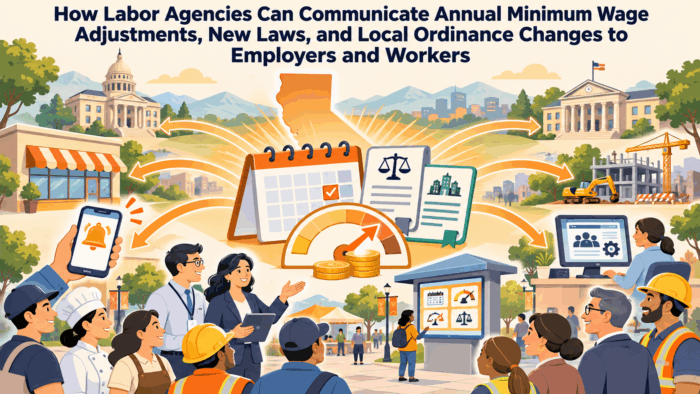
How Labor Agencies Can Communicate Annual Minimum Wage Adjustments, New Laws, and Local Ordinance Changes to Employers and Workers
Minimum wage adjustments and other labor law changes create a recurring communication challenge for agencies. Employers need to know which requirements apply, when new rates or rules take effect, and what operational changes they must make. Workers need to understand what they should expect in their paychecks and where to go when they have questions.
The challenge becomes more complicated when requirements differ by location, employer size, industry, worker category, or effective date. A business may need to account for federal, state, county, and municipal requirements, while a worker may move between worksites governed by different rules. A general announcement that simply states a new rate may therefore leave important questions unanswered.
Labor agencies can reduce confusion by treating annual adjustments and new laws as planned communication campaigns rather than one-time notices. Communication should begin before the effective date, provide practical implementation guidance, and continue after the change takes effect. Employers and workers should encounter the same core information across websites, email, social media, partner outreach, and agency staff.
A strong approach also distinguishes communication from legal interpretation. Agencies can explain requirements, effective dates, jurisdiction, available tools, and enforcement processes without providing individualized legal advice. The objective is to make compliance expectations and worker rights easier to understand before a change begins affecting paychecks.
Build an Annual Communication Calendar Around Known Changes
 Many minimum wage adjustments occur on predictable schedules. Labor agencies can use those recurring dates to build an annual communication calendar that starts well before the new rate takes effect. Planning early gives employers time to update payroll systems and gives workers time to understand what should change.
The calendar should identify when the agency will announce the new rate, publish updated guidance, distribute employer reminders, refresh worker materials, and communicate through partner organizations. Multiple communication points are generally more useful than one announcement issued immediately before the effective date.
Agencies should also account for changes that do not follow the regular annual cycle. Newly enacted laws, amended regulations, emergency measures, or local ordinances may require a separate communication schedule. The same planning framework can be adapted even when the implementation period is shorter.
A shared calendar also improves internal coordination. Communications staff, enforcement teams, call centers, web administrators, and outreach personnel can prepare together instead of discovering shortly before implementation that different materials contain different information.
Lead With the New Requirement, Effective Date, and Who Is Covered
The first questions employers and workers have are usually straightforward. What is changing, when does it change, and does it apply to me? Those answers should appear at the beginning of every major communication about a new wage rate or labor requirement.
For a minimum wage adjustment, the new rate and effective date should be highly visible. If different rates apply to particular employers, industries, worker categories, or geographic areas, those distinctions should be introduced immediately rather than buried later in the guidance.
New laws require the same discipline. The agency should summarize the practical change before providing legislative history, statutory references, or detailed technical explanation. Employers and workers should first understand what will be different in everyday workplace practice.
This structure also makes agency communication easier to reuse. Email alerts, web pages, social posts, fact sheets, and partner materials can begin with the same core information and then provide different levels of detail for audiences that need more explanation.
Explain Why the Rate or Requirement Changed
Annual adjustments can confuse employers and workers when a new number appears without explanation. Agencies should briefly explain whether the change results from legislation, an indexed adjustment, a scheduled phase-in, a local ordinance, or another established mechanism. The explanation should remain factual and concise.
This context helps employers recognize that the adjustment is an official requirement rather than an optional recommendation or agency initiative. It can also help workers understand why rates may change regularly without a new law being enacted every year.
Agencies should avoid allowing the explanation of the policy mechanism to overwhelm the practical message. Most audiences need only enough context to understand why the requirement changed and whether future adjustments may occur.
Where different requirements change for different reasons, agencies should explain those distinctions clearly. A state minimum wage adjustment and a new municipal ordinance may take effect at similar times while following different legal structures.
Help Employers Determine Which Wage Rate or Rule Applies
Determining the applicable requirement can be harder than learning the new number. Employers operating in multiple jurisdictions may face state and local rates, while particular workers or industries may be governed by additional provisions. Agencies should help businesses identify the questions they need to ask.
Guidance can be organized around work location, employer characteristics, employee category, and effective date. Where appropriate, agencies can direct users to official local resources rather than attempting to summarize every outside jurisdiction themselves.
The agency should also explain its own authority. Employers should know whether the labor agency enforces the requirement being described or whether another state or local entity is responsible. Clear jurisdictional explanations reduce misdirected calls and incorrect assumptions.
When several requirements might apply, agencies should avoid oversimplified statements that could be interpreted as individualized legal conclusions. Communication should help businesses locate authoritative information and recognize when additional review may be necessary.
Create Location-Based Guidance for Employers Operating Across Jurisdictions
Employers with workers in several cities or counties may need a faster way to determine where local ordinances exist. A location-based resource can direct businesses toward official information based on where work is performed rather than requiring them to search multiple agency pages.
The tool does not need to interpret every possible employment arrangement. Its primary purpose can be navigation, helping users identify relevant government sources, effective dates, and available guidance.
Agencies should establish a process for keeping location-based information current. A directory that continues displaying outdated rates or ordinances can create more compliance risk than providing no directory at all.
Translate Legal Changes Into Payroll and Workplace Actions
Employers need more than an announcement that a new rate or requirement exists. They need to understand what operational systems may require attention before the effective date. Agency communication should connect legal changes to common payroll, scheduling, recordkeeping, and employee communication tasks.
For a minimum wage adjustment, employers may need to review pay rates, payroll configuration, notices, employee records, or related practices affected by the new threshold. Agencies can provide a general implementation checklist without attempting to manage individual businesses.
Other labor law changes may require different operational steps. A new notice requirement may affect onboarding, while a change involving leave, scheduling, or pay practices may require updates to policies and supervisor guidance.
Action-oriented communication makes implementation more manageable for small employers in particular. Instead of telling businesses only to “comply with the new law,” the agency helps them recognize which parts of their existing operations deserve review.
Explain Changes to Workers in Terms of Their Pay and Rights
Worker communication should not simply reuse employer guidance. Employees are more likely to ask what rate applies to their work, when they should see the change in their pay, and what they can do if they believe they were paid incorrectly.
Agencies should explain the effective date in relation to actual work performed and pay practices as accurately as the governing requirements allow. Workers should not be left to assume that every paycheck issued after a particular date necessarily reflects the same calculation.
Materials should also explain how workers can verify relevant information. This may include reviewing pay statements, tracking hours, locating official wage information, or contacting the agency when questions cannot be resolved.
Worker-facing communication should be available through channels that reach people outside traditional government websites. Community organizations, worker centers, libraries, workforce agencies, social media, and other trusted partners can help extend the reach of official information.
Coordinate State and Local Communication Where Requirements Overlap
Local ordinances can create confusion when workers and employers receive separate announcements from multiple governments. State labor agencies and local jurisdictions can reduce that confusion by clearly distinguishing their respective requirements and enforcement responsibilities.
Coordination does not require agencies to create one unified policy. It can involve sharing effective dates, linking to authoritative local guidance, aligning terminology where appropriate, and ensuring that referral information is accurate.
Local governments can also benefit from understanding when major state changes will be communicated. Closely timed announcements can otherwise cause employers to confuse one rate or requirement with another.
The broader goal is a clearer public information environment. Workers and employers should be able to move between state and local resources without encountering contradictory explanations about which agency does what.
Use Multiple Reminders Before and After the Effective Date
A single announcement is rarely enough to reach every employer and worker affected by a change. Agencies should use a sequence of reminders that begins before implementation and continues after the new requirement takes effect.
Early communication can focus on awareness and preparation. Messages closer to the effective date can emphasize immediate actions, while post-implementation communication can address recurring questions and remind workers how to identify potential problems.
The messages do not need to repeat the entire guidance each time. Short reminders can highlight one key action and direct audiences toward a central authoritative resource containing the complete information.
Repeated communication also gives agencies an opportunity to correct misunderstandings. Questions received after the first announcement can reveal where additional explanation is needed before the effective date arrives.
Treat Annual Changes as a Recurring Compliance Communication System
Minimum wage adjustments and labor law changes should be incorporated into the agency’s permanent communication infrastructure. Templates, calendars, partner lists, web update procedures, translation workflows, and staff guidance can be prepared in advance and reused each year.
Agencies should review the communication process after each implementation cycle. Call center questions, employer inquiries, worker complaints, website searches, and partner feedback can identify which aspects of the change were difficult to understand.
Those lessons should shape the next cycle. If employers repeatedly misunderstand which local rate applies or workers are uncertain about when a new wage should appear in their pay, the following year’s materials can address those questions more prominently.
A mature system turns recurring legal changes into predictable communication events. Employers receive enough time and information to prepare, workers understand what should change, and agency staff spend less time correcting confusion that could have been prevented through earlier and clearer communication.
Build Separate Employer and Worker Communication Tracks
Employers and workers need different information from the same legal change. Employers usually need implementation guidance, effective dates, payroll implications, posting requirements, recordkeeping considerations, and information about which jurisdictional rule applies. Workers are more likely to focus on what rate or protection applies to them, when they should see the change, and what they can do if they believe the requirement is not being followed.
Labor agencies should therefore avoid relying on one generic fact sheet for every audience. A shared core message can provide the official change, effective date, and legal authority, but the supporting communication should branch into employer-facing and worker-facing guidance. This makes the information more actionable without requiring the agency to duplicate every resource.
Separate communication tracks also allow agencies to use different examples and channels. Employer materials may focus on payroll preparation, policy updates, and compliance checklists, while worker materials may focus on pay statements, hours worked, workplace notices, and complaint pathways. Both tracks should remain aligned so the agency does not create conflicting explanations.
The most effective approach is coordinated rather than completely separate. Employers and workers should see the same official rate, effective date, and scope, while receiving different practical guidance based on what each audience needs to do with that information. This balance supports consistency and usefulness at the same time.
Build Employer Implementation Checklists Before the Effective Date
When a new minimum wage rate or labor requirement is approaching, employers benefit from a concise list of actions to review before the change takes effect. Agencies can develop implementation checklists that prompt businesses to examine payroll settings, employee classifications, notices, policies, scheduling practices, and other areas that may be affected. The checklist should remain general enough to apply broadly while pointing users toward more detailed guidance.
The checklist should distinguish between actions that are clearly required and steps that are simply recommended as good preparation. This helps prevent employers from mistaking an internal planning suggestion for a legal obligation. Clear labels can preserve both usefulness and accuracy.
Agencies should also encourage employers to involve the right internal roles. Payroll staff, supervisors, human resources personnel, owners, and external payroll providers may each need to understand a different part of the change. A checklist can help businesses identify who should review what before implementation.
The goal is to move employers from awareness to readiness. Announcing a new wage rate is only the first step. A good checklist helps businesses convert that announcement into operational changes before the first affected payroll period.
Make the Checklist Easy to Update and Reuse
A recurring annual checklist should be designed for easy revision. Agencies can maintain a standard structure and update only the specific rate, effective date, jurisdictional distinctions, and any related legal changes. This reduces preparation time and supports consistency from year to year.
The checklist should also be available in formats that employers actually use. A webpage, downloadable PDF, email summary, and partner toolkit version may all be appropriate depending on the agency’s outreach strategy. The core content should remain the same across formats.
Agencies should retire outdated versions promptly. Employers often save prior-year materials, so every new checklist should display the current effective date clearly and direct users to the authoritative source for future updates.
Explain Overlapping State and Local Requirements With Side-by-Side Guidance
Local ordinances can create some of the greatest confusion in wage and hour communication. Employers may know the state minimum wage but overlook a higher local rate or another local labor standard that applies where employees actually work. Workers may also assume the state rate is the only relevant requirement.
Side-by-side guidance can help audiences understand where state and local rules differ. The agency can organize the information by jurisdiction, effective date, covered workers, responsible agency, and official source. This approach allows users to compare requirements without requiring the state agency to interpret every possible scenario.
The communication should also explain that local requirements may change on different schedules. A city ordinance may take effect at a different time from a state adjustment, or a local rate may be updated through a separate indexing process. Employers operating in several locations should be encouraged to review each jurisdiction separately.
Agencies should avoid implying that their own webpage overrides local guidance. Where local agencies have authority, the state agency should link directly to the official local source and make that division of responsibility clear. Coordination is strongest when each level of government remains authoritative within its own role.
Communicate New Laws in Terms of What Changes From Current Practice
New labor laws are easier to understand when agencies explain what is different from the prior rule. Employers and workers may already be familiar with the existing requirement, so a communication that simply restates the entire law can make it difficult to identify the actual change.
Agencies can use a clear before-and-after structure where appropriate. This might explain that a threshold changed, a new notice is required, a category of workers is newly covered, or a deadline has been modified. The comparison should remain accurate and should avoid oversimplifying legal distinctions.
A change-focused approach can also reduce unnecessary questions. Employers can quickly identify which existing processes need review, while workers can see whether the law changes something that directly affects them. This is especially useful when legislation amends only one part of a larger regulatory framework.
The agency should still provide access to the full official requirement. A practical summary is a navigation tool, not a substitute for the underlying law. Clear links and references allow users to move from the summary to the authoritative source when they need more detail.
Build Communication Around the Actual Effective Date, Not Just the Announcement Date
A new law may be enacted months before it takes effect, creating a long period in which employers and workers know a change is coming but may not yet know what action is required. Agencies should structure communication around the implementation timeline rather than treating enactment as the final communication event.
An early announcement can explain what was enacted and when it will take effect. Later communication can provide more detailed implementation guidance, updated forms, employer checklists, worker education, and reminders as the effective date approaches. This staged approach gives the agency time to develop accurate resources while maintaining public awareness.
Agencies should be careful when details remain unresolved. If regulations, guidance, or implementation procedures are still being developed, the agency should say so clearly. It is better to distinguish known information from pending details than to publish guidance that later requires major correction.
Post-effective-date communication should continue as well. The first weeks after implementation often reveal recurring questions that were not anticipated during planning. Agencies can use those questions to update FAQs and issue targeted clarification.
Make Required Workplace Notices Easy to Find and Replace
Minimum wage adjustments and new labor laws often require employers to update workplace postings or other notices. Agencies should make current materials easy to locate and should clearly identify which versions have been replaced. Employers should not need to compare several similar PDFs to determine which notice is current.
A dedicated notice page can list the effective date, applicable jurisdiction, available languages, and instructions for use. When an older poster becomes obsolete, the agency should mark it clearly and remove outdated links where possible. Version control is especially important because employers often reuse files saved in prior years.
The agency should also explain when a notice must be physically posted, distributed electronically, provided directly to workers, or handled through another method where applicable. Employers should not have to infer the delivery requirement from the existence of the document itself.
Worker-facing communication can reinforce the same message by showing employees what updated information they should expect to see. This creates another layer of awareness and helps workers recognize when their workplace materials may be outdated.
Use Multilingual Communication Before the Change Takes Effect
Minimum wage and labor law changes affect workers who may receive workplace information in many languages. Agencies should build translation into the implementation schedule rather than waiting until after the English materials are released. Delayed translation can create unequal access during the most important preparation period.
The same principle applies to employer communication. Small business owners may prefer information in languages other than English, particularly in industries and communities where multilingual entrepreneurship is common. Employer-facing translations can improve compliance as well as worker awareness.
Agencies should prioritize the most action-oriented content first when resources are limited. The new rate, effective date, coverage information, required actions, and complaint or assistance pathways should be available early. Longer technical guidance can follow according to the agency’s translation process.
Translated content should remain synchronized with the source material. If the English guidance is revised, the translated versions should be updated promptly. A multilingual communication system is only effective when all audiences receive current information.
Coordinate With Payroll Providers and Business Intermediaries
Payroll providers, accountants, business associations, chambers of commerce, and other intermediaries can extend the reach of annual wage and law-change communication. Small employers often rely on these organizations for operational information, making them valuable distribution partners for official guidance.
Agencies can provide partners with approved summaries, implementation checklists, links, sample email language, and webinar information. The goal is to help partners direct employers toward authoritative sources rather than asking them to independently interpret the law.
The agency should also establish a reliable update channel for these intermediaries. If guidance changes after an initial announcement, partners need to receive the revision quickly so outdated information does not continue circulating. A dedicated email list or partner bulletin can support that process.
Partnerships should remain clearly bounded. Payroll providers and business organizations may help distribute information, but the agency should remain the authoritative source for official requirements within its jurisdiction. Clear roles protect both accuracy and trust.
Use Questions Received Before Implementation to Refine the Message
The period between announcement and implementation provides valuable information about where confusion is developing. Employer calls, worker inquiries, webinar questions, website searches, and partner feedback can reveal which parts of the new requirement are not yet clear.
Agencies should review those questions regularly rather than waiting until after the effective date. A recurring misunderstanding may justify a revised FAQ, new example, targeted email, or updated webpage before the change begins affecting payroll and workplace practices.
This feedback loop also helps agencies identify where different audiences are asking different questions. Employers may focus on operational implementation while workers focus on coverage or complaint rights. Separate clarifications can address both without making one document unnecessarily long.
By treating pre-implementation questions as communication data, agencies can improve the campaign while it is still underway. This reduces the amount of confusion that would otherwise become enforcement inquiries after the law takes effect.
Explain How Changes Affect Different Types of Employers
Not every employer experiences a minimum wage adjustment, new labor law, or local ordinance change in the same way, because business size, operating structure, workforce composition, location, and payroll practices can all shape how implementation occurs. A small employer with one location may need straightforward guidance about updating pay rates and workplace notices, while a multi-location employer may need to coordinate different requirements across several jurisdictions. Agencies should acknowledge these operational differences without creating unnecessary complexity or implying that every employer within the same category is covered identically.
Employer-facing guidance can explain which internal systems or decisions deserve attention based on the nature of the business. Multi-location employers may need to review geographic differences in wage rates, while small businesses may need additional help determining which payroll settings, notices, recordkeeping practices, or supervisory procedures should be updated before the effective date. The communication should help employers recognize the relevant implementation questions without presenting generalized examples as individualized legal conclusions.
Agencies can also provide practical examples showing how the same legal change may create different implementation tasks depending on the employer’s structure. A business operating only within one jurisdiction may have a relatively simple payroll update, while an employer with workers crossing city or county boundaries may need to examine where work is performed and which official sources apply. These examples can make the guidance more concrete while remaining clearly identified as illustrations rather than definitive answers for every workplace.
The objective is to move employers from broad awareness of a change toward a more focused internal review of the systems and practices that may be affected. Communication is more useful when businesses understand not only that a requirement has changed, but also which parts of payroll, scheduling, supervision, recordkeeping, or employee communication deserve attention before implementation begins.
Clarify How Changes Apply to Workers in Different Circumstances
Workers may also experience wage and labor law changes differently depending on where they perform work, how they are compensated, what type of work they perform, and which jurisdictional requirements apply to the employment relationship. A new minimum wage rate may affect one group of workers immediately while another group is governed by a different local rate, special provision, or effective date. Worker communication should therefore explain coverage carefully rather than assuming that one headline number tells every employee what they need to know.
Agencies can organize worker-facing information around practical questions such as where the work is performed, when the new requirement becomes effective, what records or pay information workers should review, and where they can find authoritative guidance if their situation is more complicated. This gives employees a framework for understanding whether a new rate or protection may apply without requiring them to interpret dense legal language on their own.
The agency should also avoid broad statements that unintentionally create false expectations about universal coverage. When exceptions, thresholds, geographic distinctions, or special provisions exist, those differences should be acknowledged in clear language so workers understand when they may need to consult additional official guidance. A concise explanation of complexity is generally more useful than an overly simple statement that later requires correction.
This approach helps reduce both missed rights and unnecessary confusion. Workers are better equipped to understand a change when the agency explains the basic coverage questions, effective dates, and available resources rather than relying only on a general announcement that a new wage rate or labor requirement has taken effect.
Create a Consistent Framework for Communicating Local Ordinance Changes
 Local labor ordinances can be especially difficult to communicate because cities and counties may adopt different wage rates, effective dates, coverage provisions, and terminology, sometimes within the same broader labor market. Employers operating across several jurisdictions may receive overlapping notices, while workers may be unsure whether a city, county, or state requirement applies to the location where they actually perform their work. Agencies should therefore create a consistent framework for presenting local changes so audiences can compare information more easily.
That framework can identify the jurisdiction, effective date, official rate or requirement, covered subject area, enforcing agency, and direct link or referral to the authoritative local source. Using the same organizational structure for each local update allows employers and workers to scan several requirements without having to relearn how information is presented every time. Consistency in format can be especially valuable when multiple local changes take effect near the same date.
Agencies should also explain clearly when a local change is separate from a state adjustment, because two increases or new requirements may occur close together while relying on different legal authority and coverage rules. A state minimum wage announcement should not create the impression that it replaces a higher local requirement, and a local ordinance update should not imply that the state agency necessarily administers or enforces the local rule. Clear distinctions help audiences understand how the systems relate without oversimplifying them.
Where the state labor agency does not enforce a local ordinance, the communication should say so directly and guide users toward the correct local source. This reduces misdirected calls, limits confusion about agency authority, and makes the state resource more useful as a navigation tool for employers and workers who are trying to understand overlapping requirements.
Use Comparison Tools Without Oversimplifying Jurisdictional Differences
A side-by-side chart or comparison tool can help employers and workers review wage rates, effective dates, covered locations, and responsible agencies across several jurisdictions without searching through multiple pages independently. These tools can be particularly useful for businesses with multiple worksites and for workers who regularly perform work in more than one city or county.
The comparison should still make clear that a table cannot resolve every fact-specific coverage question. Where applicability depends on work location, employer characteristics, worker category, or another legal factor, the tool should direct users to the authoritative source rather than presenting the comparison as a complete legal determination.
Every comparison tool should also display a clear update date and identify where users can verify the most current information. Because local ordinances may change on different schedules, maintaining visible version control is essential to preventing outdated rates or requirements from being mistaken for current law.
Communicate Midyear Changes Differently From Predictable Annual Adjustments
Annual minimum wage adjustments often follow a recurring schedule that allows agencies, employers, workers, and partners to anticipate when new information will be released. Midyear legislative or ordinance changes can create a very different communication environment because employers may have much less time to revise payroll systems, notices, policies, and internal guidance before the new requirement takes effect. Workers may also be less likely to expect a wage or labor law change outside the normal annual cycle.
Agencies should adjust the communication cadence to reflect that shorter implementation period. A midyear change may require more frequent reminders, direct outreach to employer and worker organizations, accelerated translation, stronger partner distribution, and more prominent emphasis on the effective date. The urgency of the communication should come from the implementation timeline rather than from dramatic language.
The message should also recognize that many employers may already have completed their normal annual compliance review and may not be actively monitoring for additional changes. Agencies should clearly distinguish the midyear requirement from the next scheduled annual adjustment so businesses understand that action may be required sooner than expected. Repetition across several channels can help overcome the assumption that no further changes are coming.
At the same time, agencies should avoid creating unnecessary alarm or confusion. Communication should remain focused on what changed, who may be affected, when the requirement begins, and what employers or workers should review before that date. A clear implementation message is more useful than an urgent message that lacks practical direction.
Build Supervisor and Manager Communication Into Employer Guidance
A new wage rate or labor law may require operational changes that supervisors and frontline managers need to understand, even when payroll or human resources staff are responsible for formal implementation. Managers may approve time, adjust schedules, respond to employee questions, authorize overtime, or apply workplace policies that are directly affected by the new requirement. If they are not informed, an employer may update its formal systems while daily practices remain inconsistent.
Agency guidance can encourage employers to brief supervisors on the practical effects of the change without expecting managers to become legal experts. Supervisors should understand what changed, which routine workplace practices may be affected, and where they should direct employee questions that require more detailed interpretation. This creates a stronger connection between formal compliance planning and day-to-day management.
Agencies can support this internal communication by providing concise employer-ready summaries, manager briefing points, or short implementation checklists that businesses can adapt for their own use. These materials can reinforce the same terminology used in public guidance while helping employers communicate the change consistently across departments and locations.
This is particularly important for employers with decentralized operations. A central payroll system may be updated correctly while local supervisors continue relying on outdated assumptions about scheduling, notices, recordkeeping, or employee communication. Effective implementation depends on reaching the people who apply the new requirement in everyday workplace decisions.
Use Enforcement and Inquiry Data to Identify Where Implementation Is Breaking Down
Once a new minimum wage rate, labor law, or ordinance takes effect, agencies should monitor where confusion continues rather than assuming that publication alone produced understanding. Complaint patterns, call center questions, employer inquiries, website searches, webinar questions, and early enforcement contacts can reveal which parts of the implementation message are still unclear. These signals can help agencies distinguish isolated questions from broader communication problems.
If employers repeatedly misunderstand which local rate applies, when a new requirement begins, or what workplace notice must be updated, the agency may need to issue a targeted clarification rather than another broad announcement. Similarly, if workers consistently ask when a wage increase should appear in their pay or whether a local ordinance covers their work location, the agency can strengthen the worker-facing explanation around those specific questions.
Early implementation data can also reveal whether certain audiences were missed by the original campaign. A particular industry, geographic area, language group, or employer segment may generate unusually high levels of confusion, suggesting that the problem is not simply the content but also the reach of the communication. Targeted outreach may be more effective than repeating the same message to everyone.
This creates a practical feedback loop between implementation, enforcement, and communication. Agencies can use real questions and observed behavior to refine guidance while the change is still new, reducing the likelihood that preventable misunderstandings continue across multiple pay periods or become recurring enforcement issues.
Prepare for Misinformation and Outdated Rate Information
Minimum wage adjustments and labor law changes are frequently discussed through news articles, payroll blogs, social media posts, business forums, industry newsletters, and informal workplace conversations. Some of this information may be accurate, while other material may be outdated, incomplete, based on another jurisdiction, or stripped of important coverage details. Agencies should anticipate this environment rather than assuming employers and workers will encounter official information first.
The agency’s central webpage should therefore be easy to identify as the authoritative source, with prominent effective dates, clear jurisdictional labels, visible update information, and direct links from high-traffic agency pages. Search-friendly headings and concise summaries can also help official resources compete with older third-party pages that may appear prominently in search results.
When misinformation becomes widespread enough to affect compliance or worker understanding, the agency can issue a focused clarification that addresses the specific point of confusion. The response should state the correct information, identify the effective date and applicable jurisdiction, and direct users back to the authoritative source without unnecessarily amplifying every inaccurate claim.
Agencies should not attempt to correct every mistaken social media post or informal discussion. The priority should be misinformation that could materially affect pay practices, worker expectations, or public confidence. A stable, current, and easily accessible official source remains the strongest defense against recurring confusion.
Keep Archived Guidance Available Without Confusing It With Current Requirements
Employers and workers may need historical wage rates, prior guidance, or older notices when reviewing previous pay periods, resolving disputes, or understanding when a requirement changed. Completely removing older materials can make that work difficult, but leaving outdated guidance mixed with current information can create significant compliance risk. Agencies should therefore maintain archives that are accessible but clearly separated from active requirements.
Each archived resource should identify the period during which it applied and prominently state that it is no longer the current guidance. Current rates, notices, and requirements should be easier to locate, while historical materials should remain available through a clearly labeled archive or prior-years section.
Search engines can complicate this task because an older agency page may continue ranking prominently after a new rate takes effect. Agencies should use clear page titles, update notices, internal links, and archive labels to reduce the likelihood that users mistake a historical page for the current requirement. Where practical, old pages can also direct users prominently toward the current version.
A well-managed archive supports both transparency and practical compliance. Employers and workers can reconstruct what requirements applied during an earlier period without confusing those historical rules with current obligations, and agency staff have a reliable source to reference when questions involve prior years.
Treat Implementation Communication as a Shared Operational Responsibility
Annual minimum wage adjustments, new labor laws, and local ordinance changes affect far more than the agency’s communications team. Enforcement staff, legal personnel, call centers, web administrators, translators, outreach teams, program managers, and leadership all contribute to whether employers and workers receive accurate and consistent information. Implementation communication should therefore be managed as a shared operational responsibility.
A coordinated process should identify who confirms the legal change, who develops plain-language explanations, who updates web resources, who manages translations, who prepares employer and worker materials, and who briefs staff before the public rollout. Clear roles reduce the risk that one channel is updated while another continues presenting outdated information.
Internal staff should receive final guidance before or at the same time as the public announcement so they are prepared to answer predictable questions immediately. Employees should not be learning the details of a new wage rate or ordinance from callers who saw the agency’s external announcement first. Internal readiness is part of public communication quality.
After the implementation period, agencies should review what worked, what caused confusion, and which resources were used most heavily. Those lessons can improve the next annual adjustment, legislative rollout, or local ordinance update and gradually create a more reliable communication system for recurring labor law changes.
Build Governance Around Recurring Wage and Law Change Communication
Annual minimum wage adjustments, newly enacted labor laws, and local ordinance changes should be managed through a standing communication process rather than handled as isolated announcements. Because these changes can affect employers, workers, payroll providers, local governments, call centers, enforcement staff, and community partners at the same time, agencies need clear ownership for how information is developed, approved, updated, and distributed. A repeatable governance structure reduces the risk that different parts of the agency publish conflicting guidance or prepare for implementation on different timelines.
The governance model should identify who confirms the legal change, who translates it into plain-language guidance, who updates digital resources, who manages employer and worker outreach, and who oversees translation and accessibility. Legal and program staff may need to confirm substantive requirements, while communications staff can help organize the information around what audiences need to know and do. Clear roles make the process faster because each team understands where responsibility begins and ends.
Agencies should also establish a formal process for handling changes that occur after initial guidance is published. Legislative amendments, revised regulations, local implementation updates, or new agency interpretations can require adjustments to previously released materials. Without a controlled update process, employers and workers may continue relying on older versions that remain available through search engines, partner websites, or saved files.
Leadership should periodically review whether the governance process is working as intended. If translations are consistently delayed, internal briefings occur after public release, or local coordination happens too late, those patterns should be addressed before the next cycle. Annual adjustments provide a recurring opportunity to strengthen the system rather than repeat the same communication problems.
Create One Authoritative Source for Current Rates and Requirements
Labor agencies should maintain one central source where employers and workers can verify the current minimum wage rate, effective date, major legal changes, and links to local requirements where relevant. This source should be easy to find from the agency’s main website and should clearly distinguish current information from prior-year materials. A fragmented web environment can create unnecessary risk when users encounter several pages that appear equally authoritative.
The central resource should provide a concise summary first, followed by links to more detailed guidance for employers, workers, local ordinances, notices, and implementation tools. This layered structure allows users to confirm the essential information quickly while still giving them access to deeper explanations when their situation is more complex. The page should also display the date it was last updated so users can judge whether they are looking at current information.
Agencies should direct all major communication channels back to this source. Email alerts, social posts, partner toolkits, webinar materials, press releases, and staff responses should reinforce the same destination rather than sending audiences to different pages with slightly different wording. A single authoritative source makes version control and correction easier.
The agency should also monitor whether outdated third-party sources are outranking official pages in common searches. Search-friendly page titles, current dates, strong internal linking, and clear jurisdictional terms can improve the visibility of official guidance. Employers and workers are more likely to comply when the authoritative information is also the easiest information to find.
Standardize How Rates, Effective Dates, and Coverage Are Presented
Recurring changes should be communicated through a consistent format so employers and workers know where to look for the most important information each year. The new rate, effective date, jurisdiction, coverage summary, and responsible agency should appear in predictable locations across webpages, notices, emails, and downloadable materials. Consistency reduces the amount of interpretation required every time a new adjustment is announced.
Agencies should also standardize the language used to distinguish current rates from future or historical rates. Phrases such as “effective January 1,” “current minimum wage,” or “previous rate” should be used consistently enough that users do not confuse an announced future rate with the one currently in effect. This is especially important during the weeks before an annual change.
The same principle applies to new laws and local ordinances. If the agency uses one structure to explain state changes and another completely different structure for local changes, users may struggle to compare them. A shared format can make jurisdictional differences easier to understand without suggesting that the laws themselves are identical.
Standardization also helps internal staff. Call center employees, enforcement teams, and outreach personnel can rely on the same structure when answering questions, which reduces the likelihood that one employee emphasizes information another omits. Consistent presentation strengthens both external communication and internal confidence.
Use Controlled Templates for Annual and Midyear Updates
Agencies can create reusable templates for annual minimum wage changes, newly enacted laws, midyear adjustments, and local ordinance updates. Each template can include standard fields for the new requirement, effective date, who may be covered, employer actions, worker information, and links to authoritative guidance.
The template should remain flexible enough to accommodate differences in legal complexity. A routine indexed adjustment may require a concise communication package, while a major new law may need a longer implementation campaign and more extensive FAQs.
Using controlled templates can reduce drafting time while improving quality. Staff can focus on the substance of the new requirement rather than rebuilding the communication structure each time.
Build Formal Coordination With Local Governments and Other Agencies
Where local wage or labor ordinances exist, state and local agencies should establish communication relationships before major changes take effect. Employers and workers benefit when agencies understand one another’s implementation timelines, terminology, and authoritative resources. Coordination can reduce contradictory messages without requiring one government to speak for another.
A formal coordination process can include advance notice of upcoming changes, shared contact information, links between official webpages, and agreed referral pathways for questions that fall outside one agency’s jurisdiction. Local agencies may also be able to flag changes that state staff would otherwise discover only after employers begin calling.
Agencies should be clear about the limits of coordination. A state labor department should not interpret a local ordinance unless it has authority to do so, and a local government should not imply that it administers a state requirement it does not enforce. The public benefit comes from accurate navigation, not blurred jurisdictional roles.
Coordination should also extend to major overlapping implementation dates. If several jurisdictions change rates at the same time, agencies can anticipate where confusion is likely and prepare comparison resources or joint navigation guidance. This makes the broader labor law environment easier to understand without oversimplifying the underlying requirements.
Build Translation, Accessibility, and Language Access Into the Release Schedule
Language access should be planned at the beginning of the communication process rather than added after English materials are complete. Employers and workers who rely on translated information need time to prepare before a new wage rate or law becomes effective, not weeks after implementation. Delayed translation can create unequal access to critical compliance and rights information.
Agencies should identify which materials require early translation based on urgency and public use. The new rate, effective date, employer actions, worker rights, local distinctions, and contact information should generally be prioritized. Longer technical materials can follow as needed, but core action information should be available early enough to support implementation.
Accessibility should be treated with the same priority. Webpages, downloadable notices, tables, comparison tools, and forms should be designed so users relying on assistive technology can navigate them effectively. Information should not depend on color, visual placement, or inaccessible document formatting alone.
Agencies should also establish a synchronized update process. When English guidance changes, translated and accessible versions should be revised promptly so one audience is not relying on outdated instructions. Maintaining alignment across formats and languages is part of maintaining the accuracy of the overall communication system.
Prepare Internal Staff Before Public Rollout
The public communication campaign will be less effective if agency staff are not prepared to answer the questions it generates. Call center employees, investigators, outreach teams, enforcement staff, and supervisors should receive the final guidance before or at the same time the public announcement is released. Internal readiness should be treated as part of implementation.
Staff briefings should cover the new rate or requirement, effective date, major coverage distinctions, available employer and worker resources, local jurisdiction issues, and referral pathways. Employees should also know which questions they can answer directly and which should be escalated to legal or program staff. This reduces inconsistent responses.
Agencies can provide concise internal talking points, FAQs, and scenario-based examples to reinforce the public materials. These resources are especially useful when a change introduces new terminology or when multiple local rules are taking effect at the same time. Internal staff should not need to reconstruct the agency’s official explanation during live calls.
The agency should also create a mechanism for staff to report recurring questions during implementation. Call center and enforcement teams often identify confusion before communications staff see it through web analytics or formal feedback. Rapid internal feedback can improve the public guidance while the rollout is still active.
Establish Version Control for Posters, FAQs, Toolkits, and Web Content
Annual wage adjustments and law changes generate large numbers of materials that can remain in circulation after they become outdated. Employers may save posters locally, partners may host old PDFs, and search engines may continue surfacing prior-year FAQs. Agencies need strong version control to reduce this risk.
Every major resource should display a clear effective date and, where practical, a version date. Current materials should be easy to distinguish from historical versions, while older documents should be archived rather than left in active resource libraries. This is particularly important for workplace posters and employer toolkits.
Partner organizations should also be notified when materials are replaced. A business association or payroll provider may continue distributing an older file if it does not know a new version exists. Agencies should make update notifications part of their partner communication process.
Version control should include web content as well as downloadable files. Old pages should link prominently to current guidance, and internal agency links should be updated so users are directed toward the latest information. The goal is to preserve useful historical records without allowing them to compete with current requirements.
Measure Whether Employers and Workers Understand the Change
Communication performance should be evaluated by more than how many emails were sent or webpages were viewed. Agencies should examine whether employers and workers can correctly identify the new rate, effective date, applicable jurisdiction, and next steps. Understanding is a stronger measure of success than simple exposure.
Call reasons, website search terms, FAQ usage, webinar questions, partner feedback, and early implementation inquiries can provide valuable evidence. If audiences repeatedly ask questions that were supposedly answered in the original materials, the agency should review whether the guidance was too difficult to find or too difficult to interpret.
Agencies can also use short surveys or targeted feedback during webinars and outreach events. Asking employers or workers to identify the most confusing part of a new requirement can produce practical information that is difficult to capture through analytics alone.
Measurement should continue after the effective date. Some communication problems appear only when employers begin processing payroll or workers receive their first affected paycheck. Post-implementation feedback can reveal whether the campaign prepared people adequately or whether additional clarification is needed.
Make Annual and Legislative Updates Part of a Long-Term Communication System
Recurring wage adjustments and labor law changes should become part of the agency’s permanent operating calendar. Communications teams should not have to rebuild partner lists, translation workflows, staff guidance, or implementation procedures every year. A standing system can preserve what works and improve what does not.
Leadership should assign responsibility for maintaining templates, contact lists, local coordination, archived materials, translation schedules, web resources, and performance measures. Clear ownership helps ensure that preparation begins early rather than only when a new effective date is approaching.
The agency should conduct a brief review after each major implementation cycle. The review can identify which messages generated confusion, which channels reached employers and workers effectively, and which internal processes caused delays. Those findings should be documented and incorporated into the next cycle.
Over time, this approach can make wage and law changes feel more predictable to both the agency and the public. Employers receive clearer implementation support, workers receive timely rights information, and the agency reduces the volume of confusion that otherwise appears after every new rate or legal change.
Strategic Communication Support for Minimum Wage and Labor Law Changes
 Annual minimum wage adjustments, newly enacted labor laws, and local ordinance changes create recurring communication demands that require more than a single announcement or updated webpage. Employers need enough advanced information to prepare payroll systems, workplace notices, supervisory guidance, and internal policies, while workers need clear explanations of when new protections or wage rates take effect and how those changes may apply to them. Agencies also need a coordinated process for keeping information consistent across jurisdictions, languages, channels, and implementation stages.
Stegmeier Consulting Group (SCG) can support labor agencies by developing implementation communication plans, employer and worker message frameworks, annual outreach calendars, plain-language guidance, comparison tools, local ordinance navigation resources, partner toolkits, staff talking points, multilingual communication strategies, and performance measurement approaches. SCG can also help agencies structure recurring campaigns so communication begins before an effective date and continues through the implementation period, when questions and misunderstandings are most likely to emerge.
Strategic communication support can be especially valuable when several changes occur close together or when state and local requirements overlap. A coordinated approach can help agencies distinguish different effective dates, responsible jurisdictions, employer obligations, and worker protections without forcing audiences to interpret several disconnected government announcements. This makes the overall communication environment easier to navigate while preserving the authority and responsibilities of each individual agency.
SCG’s role remains focused on communication strategy, implementation planning, plain-language content, stakeholder outreach, internal alignment, language access, accessibility, and communication measurement. SCG does not provide legal advice, determine which law applies to a particular employer or worker, establish wage rates, interpret local ordinances on behalf of another jurisdiction, make enforcement decisions, or replace agency counsel, investigators, payroll professionals, or other authorized experts. Strategic communication support helps agencies explain official requirements more clearly while preserving formal legal and enforcement responsibilities.
Future Trends
Labor agencies are likely to move toward more centralized digital systems that help employers and workers navigate wage rates and labor requirements across jurisdictions. Instead of relying on separate announcements, users may increasingly expect searchable tools that identify current rates, effective dates, local variations, official sources, and responsible agencies. These systems can make recurring changes easier to understand, but they will require strong maintenance and version control to remain trustworthy.
Agencies may also use more targeted communication based on geography, industry, employer type, and implementation timing. Rather than sending the same message to every audience, agencies can deliver reminders that are more relevant to businesses operating in particular locations or workers affected by specific changes. Better targeting can reduce information overload while improving the likelihood that important updates are noticed.
Data will likely play a greater role in refining these campaigns. Website searches, call center questions, webinar participation, employer inquiries, worker complaints, and partner feedback can show where audiences remain confused after an announcement. Agencies can use those signals to issue focused clarifications rather than waiting until misunderstandings become recurring enforcement problems.
Intergovernmental coordination may also become more important as local labor ordinances continue to create overlapping communication environments. Employers and workers increasingly expect government sources to help them navigate those overlaps, even when authority remains divided among several agencies. The agencies that communicate most effectively will be those that make jurisdictional differences easier to understand without pretending those differences do not exist.
Conclusion
Annual wage adjustments and labor law changes are predictable communication challenges that can become unnecessarily difficult when agencies rely on isolated notices, technical summaries, or last-minute reminders. Employers need enough lead time to understand what operational systems may require attention, while workers need enough clarity to recognize what should change in their pay or workplace protections. Effective communication begins before implementation and continues after the new requirement takes effect.
The strongest campaigns organize information around a small number of practical questions. What changed, when does it take effect, who may be covered, which agency is responsible, and what should employers or workers do next? When those answers remain consistent across webpages, emails, translated materials, partner outreach, staff guidance, and local referrals, audiences are less likely to rely on incomplete or outdated information.
Agencies should also treat implementation as a learning process rather than a one-time publication event. Questions received before and after an effective date can reveal unclear guidance, overlooked audiences, outdated partner materials, or jurisdictional confusion. Using that information to refine the campaign allows the agency to address problems while the change is still new.
A mature communication system makes recurring wage and labor law changes more predictable for everyone involved. Employers receive clearer implementation guidance, workers gain better access to current rights information, partner organizations know where to direct questions, and agency staff spend less time correcting misunderstandings that could have been prevented through earlier and more coordinated communication.
Stegmeier Consulting Group’s Strategic Approach to Communication Systems
Build recurring labor law communication systems that make wage adjustments, new laws, and local ordinance changes easier to understand before they affect payroll and workplace practices.
Labor agencies need communication systems that connect annual calendars, employer implementation guidance, worker education, local ordinance coordination, multilingual outreach, staff preparation, partner distribution, version control, and post-implementation measurement into one consistent framework. Stegmeier Consulting Group (SCG) helps agencies develop those systems so important changes can be communicated early, clearly, and consistently across the full implementation lifecycle.
A strong framework should also make future updates easier to manage. Reusable templates, established approval processes, maintained partner lists, controlled terminology, and defined communication triggers allow agencies to respond more efficiently each time a new wage rate or labor law change approaches.
The result is a communication system that supports both compliance and awareness without asking employers or workers to interpret fragmented government information on their own. Agencies can preserve legal precision while making official changes more practical to understand and implement.
Use the form below to connect with our team and explore how strategic communication support can strengthen annual minimum wage communication, labor law implementation, local ordinance coordination, employer readiness, and worker education.