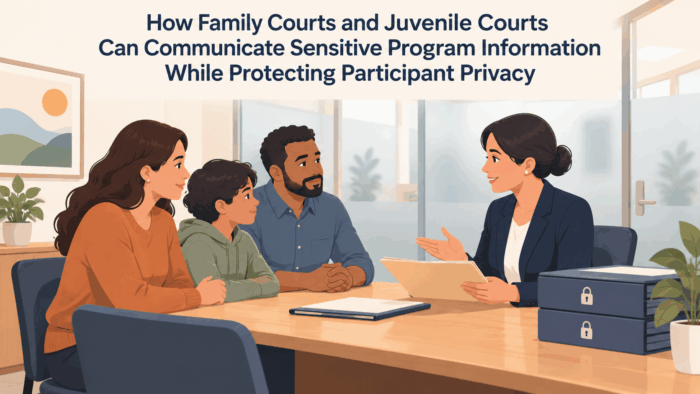
How Family Courts and Juvenile Courts Can Communicate Sensitive Program Information While Protecting Participant Privacy
Family courts and juvenile courts handle some of the most personal information that any part of the justice system encounters, and their communication challenges reflect that sensitivity. A single case may involve a child’s mental health history, a parent’s substance use treatment, allegations of abuse or neglect, school disciplinary records, the details of a divorce, a protective order, or a young person’s first contact with law enforcement. The court must share enough of this information with the right people to make good decisions and deliver services, while shielding it from the people who have no legitimate need to know. No other part of the court system faces this balance so constantly, and none is well served by communication practices designed for open adult courtrooms.
The purpose of family and juvenile court programs creates communication obligations that other courts do not share to the same degree. Many juvenile courts are built on the principle that young people can change, and that a mistake made in adolescence should not define the rest of a life. Family courts exist to protect children and to help families through transitions that are often painful and sometimes dangerous. In both settings, the court’s programs, which may include diversion, treatment, parenting education, mediation, supervised visitation, family drug courts, truancy interventions, and reentry support, depend on participants trusting the court enough to be honest. That trust cannot survive careless handling of private information, and a single disclosure to the wrong person can harm a child, endanger a parent, or damage a family for years.
Communicating sensitive program information is the challenge that most directly tests whether a court takes privacy seriously. Every notice mailed to a home, every text message sent to a teenager, every report shared with a school, every call to a treatment provider, every statement to a reporter, and every update to a funder carries the possibility of exposing something that should have stayed protected. A court that treats privacy only as a legal compliance exercise, handled by a policy manual and a shredder, is leaving the most consequential communication challenge in its programs unaddressed. Privacy protection must be built into the way the court communicates, not added afterward.
This article examines the communication demands of family and juvenile courts that must share sensitive program information while protecting participant privacy, covering the legal and ethical framework, communication with youth and parents, consent and release practices, information sharing with schools, treatment providers, and child welfare agencies, victim and survivor safety, courtroom and written communication, digital tools, media and public records, privacy incident response, equity, training, and the communication of program results without exposing the people behind the data.
Why Privacy Is the Foundation of Family and Juvenile Court Communication
 Privacy in family and juvenile courts is not a courtesy. It is a condition of the work. A young person who believes that what they tell a probation officer or a counselor will be repeated in the hallway, shared with classmates, or used against them in unrelated settings will stop talking. A parent who fears that disclosing a relapse will lead to automatic loss of custody will conceal it. A survivor of domestic violence who worries that the court will reveal her new address to an abuser may decide not to seek protection at all. The effectiveness of these programs depends on candor, and candor depends on privacy.
The harms of privacy failures in these settings are also unusually lasting. A juvenile record that becomes known to an employer, a landlord, a college, or a community can follow a person well into adulthood. Information about a child’s mental health, abuse history, or family circumstances can lead to stigma, bullying, or exploitation. Details of a custody dispute can be used to harass a parent or to damage a child’s relationships. Because the people affected are often children who have no ability to protect themselves, the court carries a heightened duty of care.
Privacy must also be balanced against other legitimate interests, including the child’s safety, the rights of parents and parties, the needs of victims, the public’s interest in an accountable court system, and the practical need for agencies to coordinate services. The balance is rarely simple. A school may need to know that a student is under court supervision in order to provide support, yet sharing too much may lead to unfair treatment. A treatment provider may need court information to plan care, while the court needs treatment information to monitor progress. Effective communication does not eliminate these tensions. It manages them through clear rules, careful judgment, and consistent practice.
The most useful organizing principle is minimum necessary disclosure. For each communication, the court should ask who needs to know, what they need to know, why they need to know it, and what the least revealing way is to give them that information. Courts that build this question into their routines make better decisions than those that rely on either blanket secrecy, which prevents coordination, or casual sharing, which exposes participants to avoidable harm.
Court Communication Strategies for State and Local Judicial Systems: Building Public Trust, Improving Access to Justice, and Explaining Court Processes
This article is part of our series on strategic communication for State and Local Courts, Judicial Systems, and Court Administration. To learn more about court communication strategies for building public trust, improving access to justice, and explaining court processes, and to see the parent article, which links to other content just like this, click the button below.
Understanding the Legal and Ethical Framework
The legal framework that governs family and juvenile court information is complex, varies considerably from state to state, and changes over time. Court leaders and staff should rely on legal counsel for authoritative guidance in their own jurisdiction, but every communication program benefits from a shared understanding of the general categories of rules that apply. These typically include state statutes that make juvenile and child welfare proceedings and records confidential or limit access to them, court rules governing access to files and hearings, federal and state health privacy laws, rules protecting substance use treatment records, education privacy laws, protections for victims and survivors of violence, and professional ethics rules for attorneys, clinicians, and social workers.
Health information held by treatment providers is generally subject to federal and state privacy laws, and records of substance use disorder treatment may be subject to additional protections that limit redisclosure even when a participant has consented to an initial release. Education records are protected by federal law and by state rules, and schools often have their own limits on what they can share with courts and what they may receive. Child welfare information is commonly protected by both federal funding requirements and state statutes, with specific exceptions for sharing among agencies that work with the same family. Court staff do not need to master every provision, but they do need to know when a question requires a legal answer and where to find it.
Ethical duties add another layer. Attorneys owe confidentiality to their clients. Clinicians owe confidentiality to their patients, subject to mandated reporting duties. Guardians ad litem and court appointed special advocates have defined roles with their own expectations for what they report to the court and to whom. Mediators typically promise confidentiality of the mediation process, with exceptions for safety. A court communication program must respect each of these duties, which sometimes point in different directions, and must make the rules visible to participants so that no one is surprised by what is shared.
Courts should translate this legal framework into plain operating guidance. A one-page matrix that lists the types of information the court handles, the audiences who may request them, the legal basis for sharing, the required consent or order, and the person who authorizes disclosure gives staff a practical tool and reduces the temptation to improvise. Such guidance should be reviewed by counsel, updated when laws change, and incorporated into training. It should also be paired with a clear escalation path, so that staff who are unsure whether information can be shared know who to ask before acting.
Communicating With Youth Participants
Young people in juvenile court programs are entitled to understand what is happening to them, and communication directed to them should not be an afterthought to the communication with their parents and professionals. Adolescents who are told what a program involves, why it exists, who will see their information, and what the consequences are of various choices are more likely to engage honestly and less likely to feel that the process is being done to them. Developmentally appropriate communication respects the young person’s capacity while recognizing that their understanding differs from an adult’s.
Privacy explanations for youth should be concrete. A statement that information is confidential is of little use to a fifteen-year-old who does not know what that means in practice. A better explanation names the people who will see what, such as the probation officer, the counselor, the judge, and the attorney; gives examples of what will and will not be shared with parents, school, and others; and describes the limits, including safety situations where the adults are required to act. Young people respond to honesty about these limits far better than to promises of absolute secrecy that cannot be kept.
Channels matter as much as content. Many young people rarely check email or answer calls from unknown numbers, but they respond to text messages. Courts and probation departments can use text reminders effectively, provided that the content is carefully neutral and the young person has agreed to be contacted that way. Messages should avoid references to charges, diagnoses, or program names that would be revealing if a phone were seen by a friend, teacher, or family member. Where a young person shares a phone or plan with others, alternative arrangements should be made.
Hearings and meetings should be conducted in ways that give youth a voice. Judges and staff who speak to the young person directly, use plain language, check understanding, and invite questions communicate respect and encourage honesty. Young people who have experienced trauma may react strongly to environments that feel threatening, and a calm, predictable approach helps. Where possible, the court can offer a youth-friendly orientation that explains the courtroom, the roles of the people in it, and what will happen at each stage.
Youth voice in program design is also valuable. Young people who have completed court programs can offer insight into which messages were helpful, which were confusing or frightening, and how privacy concerns appeared from their perspective. Advisory groups, peer mentors, and feedback surveys give the court information that professionals alone cannot supply, and they communicate to current participants that their experience matters.
Communicating With Parents, Guardians, and Caregivers
Parents and caregivers are essential partners in nearly every juvenile and family court program, and they are also among the most anxious audiences the court addresses. A parent whose child has been arrested, removed from the home, or placed in a program may feel shame, anger, fear, or confusion. Some parents have been working for years to obtain services for a struggling child, while others are themselves the subject of concern. The court’s communication must respect their legal role without compromising the privacy and safety of the child or of other family members.
Parents have legal rights to information in many circumstances, but those rights are not unlimited, and they may differ depending on the type of case, the age of the child, and the family situation. A parent may be entitled to know about the court schedule, the conditions imposed on the child, and the child’s overall progress, yet not to the content of confidential counseling sessions. In cases involving abuse or neglect, one parent may be the alleged source of harm, and sharing certain information could endanger the child or the other parent. Staff should never assume that all adults in a family are entitled to the same information.
Plain-language explanations help parents understand what they can expect. A parent guide that describes the program, the roles of the people involved, the parent’s responsibilities, the kinds of updates they will receive, and the limits on what the court can share reduces frustration and sets realistic expectations. The guide should also explain how parents can raise concerns, how they can reach a staff member, and what to do in an emergency. Parents who understand the reasons behind the limits are less likely to see them as obstruction.
The tone of parent communication carries enormous weight. Many parents have had negative experiences with institutions and expect to be judged. Language that is respectful, strengths-based, and free of blame encourages cooperation, while language that implies fault can drive parents away. Staff should be cautious about written notes and reports that parents may later read, and should write with the expectation that the subject of the writing could see it.
When parents disagree with each other or are in conflict, communication requires extra care. Court staff should avoid being drawn into disputes, should communicate equally and consistently with each parent who is legally entitled to information, and should document what is shared and with whom. In cases with a history of violence or coercive control, communication should be structured so that one parent cannot use the court’s messages to harass or locate the other.
Communication in Family Court Programs: Custody, Mediation, and Parenting Services
Family courts offer a range of programs that involve sensitive information, including mediation, parenting education, co-parenting classes, supervised visitation and exchange, custody evaluation, family treatment courts, and services for self-represented litigants. Each presents its own privacy challenges. Mediation depends on confidentiality to encourage candor, yet mediators must report certain safety risks. Supervised visitation requires coordination among parents, supervisors, and the court, often when relationships are hostile. Parenting classes may involve sharing personal stories in groups, raising questions about what participants can repeat outside the room.
Program orientation should explain confidentiality in practical terms. Participants should know what is protected, what is not, who will see attendance and progress reports, and what the facilitator is required to report. Group programs should adopt clear ground rules that ask participants to respect each other’s privacy, with an honest acknowledgment that the program cannot guarantee that others will comply. Participants who are told this up front can make informed choices about what to share.
Communication in supervised visitation and exchange programs must protect safety first. Schedules, locations, and arrival times may need to be staggered so that parties do not encounter each other. Written communication should be routed through the program rather than between parents, and staff should be trained to avoid disclosing any party’s contact information, address, or workplace to the other. Observation notes should be factual and neutral, recognizing that they may be read by both parents, attorneys, and the judge.
Self-represented litigants are a significant audience in family courts, and they often struggle to understand procedures and privacy rules. Clear instructions about what information must be included in filings, what should be redacted, and what is publicly accessible help prevent inadvertent disclosure of sensitive details such as children’s names, financial account numbers, or medical information. Court websites, self-help centers, and clerks can share simple guidance that protects litigants from harming themselves.
Consent, Assent, and Release Communication
Consent and release forms are the mechanisms through which sensitive information legitimately moves from one party to another, and the quality of communication around them determines whether the consent is genuine. A form handed to a stressed parent or a frightened teenager and signed in a hurry does not reflect real understanding. The court should treat each consent conversation as an opportunity to explain, not merely to obtain a signature.
A good consent conversation covers who will receive the information, what information will be shared, for what purpose, for how long the permission lasts, and how it can be revoked. It also covers what happens if the person declines, including whether declining affects participation in the program. Where consent is truly voluntary, the person should not be pressured, and where participation in the program depends on certain sharing, that should be stated honestly. Forms should be written in plain language, at a reading level the audience can follow, and available in the languages commonly spoken in the community.
For minors, consent rules vary by age, type of service, and jurisdiction. In some situations a parent consents on behalf of the child, in others the young person may consent for themselves, and in many programs the best practice is to seek the young person’s assent in addition to parental consent. Assent communication explains the plan in age-appropriate terms and invites the young person’s agreement, recognizing their role as a participant rather than an object of the process. Staff should know the rules that apply in their jurisdiction and should not guess.
Consent should be specific rather than blanket wherever possible. A broad authorization that allows any agency to share any information with any other agency fails to give participants meaningful control and invites overbroad disclosure. Narrower consent, tied to named recipients and defined purposes, better protects privacy and is usually easier for participants to understand. Courts should keep a record of consents, track expiration dates, and make it easy for participants to revoke permission.
Consent is not a one-time event. As a case progresses, new partners may become involved, circumstances may change, and participants may reconsider. Staff should revisit consent at key points, explain any new sharing before it occurs, and honor participants’ decisions to limit it within the bounds of the law.
Communicating With Schools and Education Partners
Schools are among the most important partners for juvenile courts, since education is one of the strongest protective factors for young people, and school problems are often connected to court involvement. Truancy programs, school-based diversion, reentry after placement, and special education coordination all require communication between the court and the school. At the same time, school communication carries a high risk of stigma, because a young person known to be involved with the court may be treated differently by teachers and peers.
The court should begin by identifying exactly what information the school needs. In many cases the school needs to know about conditions that affect attendance, safety, or supports, such as a requirement to attend school daily, a no-contact order involving another student, or a transition plan after residential placement. The school rarely needs details about the underlying charge, family circumstances, or treatment. Communicating only the necessary information, to the specific school staff who need it, reduces the risk of unfair treatment.
Designating a single point of contact in the school, such as a counselor or administrator, and limiting distribution of court information to that person, is a practical safeguard. The designated person can then share what is needed with teachers in general terms without revealing sensitive details. The court should explain this approach to the school in writing, and should clarify the school’s obligations regarding redisclosure and record keeping.
Communication with schools should also run in the other direction. Schools can provide the court with attendance records, grades, behavior information, and special education plans that inform decisions, but those records are protected by education privacy rules and should be requested with appropriate authority or consent. A clear process, agreed in advance and set out in a written agreement, helps both sides comply with their obligations while supporting the young person.
Young people and families should know what is being shared with the school and why. A conversation with the young person before the school is contacted allows them to voice concerns and sometimes to participate in the communication, such as by meeting with a counselor to plan a return after a placement. Shared planning builds trust and gives the young person a measure of control over their own story.
Information Sharing With Treatment Providers, Child Welfare Agencies, and Probation
Coordinated services are central to the effectiveness of family and juvenile court programs, and coordination depends on information flowing among the court, probation, child welfare, behavioral health providers, schools, and community organizations. Without that flow, families are asked to repeat their stories to each agency and services overlap or conflict. With uncontrolled flow, sensitive information is spread widely and participants lose trust. The solution is a deliberate information-sharing framework.
Written interagency agreements are the foundation. They should identify the parties, the purposes for which information will be shared, the categories of information involved, the legal authority, the security requirements, the limits on redisclosure, and the process for resolving disputes or addressing violations. Agreements should be developed with counsel from each agency, reviewed regularly, and shared with frontline staff in understandable terms. The agreement should be treated as a working document rather than a file to be signed and forgotten.
Routine reporting protocols reduce the temptation to share more than necessary. Standard report templates, which ask for specific, defined information such as attendance, engagement, and general progress, are safer and more useful than open-ended narratives that may contain extraneous detail. Providers who are asked for the same data in the same format each time can respond efficiently, and the court receives information that supports its decisions without overexposing participants.
Case conferences and multidisciplinary team meetings offer an opportunity to coordinate, but they also present risks, because many people may be present and sensitive details may be discussed freely. Teams should confirm who is in the room, establish ground rules about confidentiality, share only what is relevant to the agenda, and avoid discussing cases in public spaces. Meeting notes should be stored securely and distributed only to those with a need for them.
Mandated reporting and safety exceptions require clear communication. Participants should be told at the outset that certain information, such as threats of serious harm or suspected abuse, must be reported regardless of confidentiality. When a report is necessary, staff should explain what they are doing and why, to the extent safe to do so. Open communication about these limits preserves trust even in difficult moments.
Working With Attorneys, Guardians ad Litem, and Court Appointed Special Advocates
Attorneys, guardians ad litem, and court appointed special advocates occupy distinctive roles in family and juvenile cases, and communication among them and the court must respect those roles. A defense attorney or a child’s attorney owes duties of confidentiality to the client, and a guardian ad litem often reports to the court about the child’s best interests. Confusion about these roles can lead to privacy breaches or to mistrust, particularly when a child does not understand who is on their side.
Clear role explanations help children and families. A young person should know whether the person speaking with them is their lawyer, who keeps their confidences, or an advocate who will report to the judge. The distinction should be explained in plain language at the first meeting and repeated when needed. Families should be told how these professionals communicate with the court, what they will share, and what they will keep private.
The court should set expectations for reports and filings. Reports prepared by guardians ad litem, evaluators, and advocates often contain highly sensitive information about the child and family. Court rules and local practice should specify who receives these reports, how they are delivered, how they are stored, and whether portions should be sealed or redacted. Professionals should be reminded to include only information relevant to the court’s decision, to avoid unnecessary detail, and to write in a respectful tone.
Volunteers, including court appointed special advocates, require training in confidentiality and clear guidance on social media, conversations with outsiders, and handling of documents. Because volunteers come from the community and may know the families they serve, they face particular temptations to discuss cases informally. A strong orientation, written confidentiality commitments, and regular supervision help volunteers understand the seriousness of their responsibilities.
Communicating With Foster Parents, Kinship Caregivers, and Extended Family
Children in family and juvenile court cases are often cared for by people other than their parents, including foster parents, relatives, family friends, and staff of group or residential facilities. These caregivers need information to provide safe and effective care, yet the child’s records and history may contain details that are extremely sensitive, and some may be unrelated to the caregiver’s role. Courts and agencies must decide what caregivers need to know and how to tell them in a way that supports the child without exposing private matters.
Caregivers generally need information about health conditions, medications, behavioral triggers, safety concerns, educational needs, and the schedule and conditions of court involvement. They usually do not need the details of a child’s abuse history, a parent’s treatment records, or the specifics of allegations. Providing a concise, structured summary prepared by the case worker, rather than full case files, allows caregivers to meet the child’s needs and respects the child’s dignity. When more detail is required for safety, it should be shared deliberately, with explanation, and with guidance on how to use it.
Caregivers also need clear instructions about what they may and may not share with others. A foster parent who posts about a child on social media, discusses the child’s history with neighbors, or tells a school more than necessary can inadvertently cause harm. Written guidance on confidentiality, discussed at placement and repeated periodically, helps caregivers understand their responsibilities. Kinship caregivers, who may also be related to the child’s parents, face the additional challenge of managing family relationships while keeping information appropriately restricted.
Extended family members, such as grandparents, aunts, and uncles, may seek information about a child or family and may be important sources of support. The court should be clear about who is entitled to information, how family members can be involved, and how to handle requests from relatives who are not authorized. Communicating respectfully with relatives who cannot receive information, and offering ways for them to support the family, preserves goodwill while maintaining boundaries.
Communication for Youth Involved in Both Child Welfare and Juvenile Justice Systems
Some young people are involved in both the child welfare and juvenile justice systems, a situation often described as dual-status or crossover youth. These young people face particularly complicated communication challenges because multiple agencies hold information about them, each with its own rules, and because the young person may have experienced trauma that makes trust difficult. Poor coordination can result in conflicting messages, duplicated requirements, and repeated disclosure of painful history.
Joint protocols between the agencies and courts involved help ensure that information is shared appropriately and that the young person is not forced to retell their story to every new professional. A lead contact or coordinated case team can serve as the single point of communication for the young person and their caregivers, with clear rules about what is shared among members. The young person should be told who is on the team, what their roles are, and what information each can see.
Communication with these youth should give particular attention to stability and predictability. Frequent changes in placement, caseworkers, or schools can leave a young person feeling that no one is reliably present. Introducing new professionals gradually, explaining the reasons for changes, and maintaining continuity of key relationships where possible all support trust. When information must be shared across systems, the young person should hear it from a trusted adult first rather than discovering it through a letter or a hearing.
Protecting Victims and Survivors in Court Communication
Many family and juvenile cases involve victims or survivors of violence, abuse, or exploitation, and the court’s communication must protect their safety. A survivor of domestic violence who seeks a protective order may be in more danger when the abuser learns of the filing, and the information that the court handles, including addresses, workplaces, children’s schools, and daily schedules, can be used to locate or harm her. Careful communication is not only a matter of privacy, it can be a matter of life and safety.
The court should establish procedures that keep protected locations and contact information confidential. Many jurisdictions offer address confidentiality programs that allow survivors to use a substitute address, and court staff should know how to recognize and honor them. Forms and notices should be designed so that a survivor’s contact information is not sent to the other party unless required, and clerks should be trained to check carefully before releasing documents or answering questions by phone.
Communication with survivors should take account of the possibility that their devices, email accounts, and mail are monitored. Staff should ask how it is safe to contact the person, avoid leaving detailed voicemails or messages, and use neutral language in written materials. Safety planning resources, information about advocacy services, and clear explanations of what the court can and cannot do help survivors make informed choices.
In juvenile cases, victims have their own rights and interests, including notification about hearings, the right to be heard in many jurisdictions, and information about restitution and restorative processes. Victim communication should be respectful, timely, and explicit about what information can be shared about the young person. Victims often want to know what happens in the case, and they deserve honest explanations of the limits that confidentiality places on the information they receive. Victim advocates can assist in conveying difficult messages with sensitivity.
Courtroom and Hearing Communication
 The hearing is where private information meets the public setting, and courts must decide how to communicate sensitive details in ways that protect participants. Some hearings are closed to the public by law, while others are open with limits, and practice varies across jurisdictions. Even in closed proceedings, people such as witnesses, relatives, and professionals not directly connected to the case may be present, and conversations in hallways and waiting rooms can be overheard.
Judges and attorneys can adopt practices that minimize unnecessary disclosure. They can refer to individuals by initials or first names where permitted, avoid reading aloud sensitive details that do not bear on the decision, and use written submissions under seal for the most delicate matters. Questions about diagnosis, abuse, or family history should be framed to obtain what is needed without inviting extended public narrative. When the court must hear private information, it can clear the room of those who do not need to be present.
Physical environment matters. Waiting areas should be arranged so that families involved in different cases are not forced into close contact, and so that conversations with attorneys or case workers are not overheard. Separate entrances, separate waiting rooms for parties with safety concerns, and private spaces for confidential conversations are valuable features. Courts that cannot change their buildings can use scheduling, staggered arrival times, and staff escorts to achieve similar protection.
Remote hearings introduce new privacy considerations. Participants may be in homes where others can hear, links may be shared beyond those who should have them, and recording by unauthorized people is difficult to prevent. Courts should provide clear instructions for remote participation, including finding a private space, using headphones, avoiding recording, and understanding that the court may limit who may attend. Waiting room controls, password protection, and monitoring of attendees help maintain security.
Plain-language explanation of the process is itself a privacy protection. A participant who understands what will be discussed and who will be present can prepare, ask for accommodations, and raise concerns. Pre-hearing information sheets, brief orientation by staff, and the opportunity to speak with an attorney or advocate before the hearing reduce surprises and the distress that comes with them.
Written Notices, Mail, and Court Documents
Written communication is a frequent source of unintended disclosure in family and juvenile courts. A notice mailed to a family home may be opened by someone other than the intended recipient. An envelope bearing the name of a juvenile program may reveal to a landlord, a roommate, or a neighbor that a young person is involved with the court. A document filed in a publicly accessible record may contain information that should have been redacted. Careful design of written materials reduces these risks significantly.
Notices should contain the minimum information needed to inform the recipient of the date, time, place, and necessary action. Return addresses and envelope markings should be neutral where possible. Letters should avoid mentioning charges, diagnoses, or sensitive program details in the text of reminders and instead direct the recipient to a contact person for more information. Where the law requires specific content, the court should use the most protective format available.
Court forms should be designed with privacy in mind. Forms that ask for sensitive details should explain why the information is needed and who can see it. Instructions should tell litigants what to leave out of public filings and how to submit confidential information separately. Court staff who review filings should be trained to spot information that should be redacted, and clear procedures should exist for correcting errors when sensitive material is accidentally made public.
Records management completes the picture. Paper files should be stored securely, access should be limited to those with a legitimate need, and retention and destruction schedules should be followed. Electronic records should have role-based access controls and audit logs showing who viewed what. Procedures for sealing, expunging, or otherwise limiting access to juvenile records should be explained to participants, who often do not know what rights they have or how to exercise them.
Communicating about record relief is an important service. Young people who complete diversion or probation programs may be eligible to have their records sealed or expunged, but many never apply because they do not know it is possible, or because the process is confusing. Courts that proactively explain the process, provide forms, and connect participants with legal help help them move forward without the long shadow of a juvenile record.
Helping Participants Understand and Exercise Their Own Privacy Rights
Privacy protection is most effective when participants know their own rights and can act on them. Many families do not realize that they can ask who has accessed their information, request corrections to errors, limit certain disclosures, or seek sealing of records. Courts that communicate these rights plainly and invite participants to use them demonstrate that privacy is something done with families, not merely to them.
A short rights summary, given at intake and available throughout the program, can explain what information the court holds, who may see it, how to request a copy where the law allows, how to ask for corrections, and whom to contact with a concern. The summary should be written in plain language, translated as needed, and reviewed in conversation rather than simply handed over. Young people should receive a version written for them, so that they understand their own protections and not only those that belong to their parents.
Courts should also make it easy to raise a privacy concern. A named contact, a simple complaint process, and assurance that raising a concern will not affect the participant’s standing in the program encourage families to speak up. Responses should be prompt and respectful, and the court should use the feedback to improve its practices.
Digital Communication, Text Messaging, and Data Security
Technology can improve communication with families, but it also creates new avenues for privacy breaches. Text reminders, email, online portals, video platforms, and case management systems all require thoughtful design and clear policies. The court’s duty to protect sensitive information does not diminish because communication is conducted through a convenient device.
Text messaging is among the most effective ways to reach young people and busy parents, and it can reduce failures to appear and missed appointments. To use it safely, courts should obtain consent to text communication, explain the risks, keep messages brief and neutral, and avoid including sensitive details. A reminder might say that the recipient has an appointment at a specific time and place, without naming the program or the reason. Courts should also have a plan for what to do if a message is sent to the wrong number or if a participant reports that someone else is reading their messages.
Email and portals should use secure platforms where sensitive content is involved. Staff should avoid sending protected information through unencrypted channels, should verify recipient addresses carefully, and should understand how to use secure messaging features. Strong passwords, multi-factor authentication, and automatic logoff are baseline safeguards. Portals that allow families to view schedules or documents should be designed so that access is limited to the proper individuals and so that an abusive family member cannot easily gain access.
Personal devices and accounts present special risks. Staff who use personal phones for work communication, store files in unapproved cloud services, or discuss cases through consumer messaging apps may expose sensitive information to breaches and to unauthorized access. Policies should specify approved tools, and training should explain the reasons behind them. Court-provided devices and accounts, with appropriate security, are preferable.
Vendors who provide case management software, reminder services, or analytics are part of the privacy chain. Contracts with vendors should specify how data is stored and protected, who may access it, what happens in the event of a breach, and what happens to the data when the contract ends. Courts should review vendors’ security practices and should not assume that a commercial product is automatically adequate.
Court Websites, Social Media, and Public-Facing Communication
Courts have good reasons to communicate publicly about their programs. Public information builds understanding, supports referrals, and helps families find help. But public-facing communication presents a direct tension with confidentiality, and courts must be disciplined about what they publish. A well-meaning story about a program participant, a photo of a graduation, or a post celebrating a milestone can reveal the identity of a young person or a family who never agreed to be known.
Photographs and personal stories should be used only with informed, written consent, and in the case of minors, with consent from the appropriate adults and the assent of the young person. Consent should be specific about where the material will appear, how long it will be used, and how it can be withdrawn. Courts should consider whether the risk to the participant outweighs the value of the story, and should offer alternatives such as composite narratives, anonymized examples, or stories told by adult alumni who are comfortable sharing.
Even without names, details can identify people in a small community. A story that mentions a particular school, a rare circumstance, or a distinctive event may allow readers to recognize the person. Reviewers should consider whether combinations of details could lead to identification and should remove or alter them. When in doubt, the safer course is to say less.
Social media policies should apply to staff, volunteers, and partners. Posts about program events, comments on community pages, and even likes and shares can reveal participation in programs. Staff should be trained to avoid discussing participants online, to refrain from tagging people at events, and to consult communication leadership before posting. The court’s official channels should use generic images and descriptions of programs, and should include moderation to prevent participants or others from posting identifying information in comments.
The court’s website should offer clear, accessible information about how to access programs, what to expect, who to call, and how privacy is protected. A plain-language privacy statement, written for families rather than lawyers, builds trust by showing that the court takes the issue seriously. The site should also explain how to request records, how to seek sealing or expungement, and how to report a privacy concern.
Media Relations and Public Records Requests
Family and juvenile courts regularly receive inquiries from reporters and members of the public, and the court’s responses must satisfy both transparency obligations and confidentiality duties. Some court proceedings and records are open, while others are closed or restricted, and the applicable rules differ by case type. Without clear procedures, staff can inadvertently disclose protected information or, conversely, refuse legitimate requests and erode public trust.
A designated spokesperson, ideally with training in privacy rules, should handle media contact. Staff who receive inquiries should know to refer them rather than answer, and the spokesperson should have access to legal counsel. Prepared statements can explain that the court cannot comment on specific cases or confidential matters while offering general information about how programs work. A courteous, informative response, even when it cannot provide the requested detail, maintains the relationship with the press.
Building relationships with reporters before a crisis helps. Courts can offer background briefings on the structure of juvenile and family court programs, explain why confidentiality exists, and share what information is available. Reporters who understand the reasons for restrictions are more likely to cover the system fairly and less likely to pursue sensational angles. Some jurisdictions allow media access to certain hearings with conditions, such as not identifying minors, and courts should communicate those conditions clearly.
Public records requests require a defined process. Requests should be logged, reviewed by trained staff, and evaluated against statutory exemptions. Redaction should be careful and complete, and releases should be reviewed by someone other than the person who prepared them when the material is sensitive. Requestors should receive timely, clear responses that explain any denials and cite the legal basis.
High-profile cases present the greatest risk. A case that attracts public attention may draw requests for information from many sources, pressure from advocacy groups, and speculation online. Courts should coordinate their response, limit the number of people who speak, and be prepared to explain the limits on disclosure without implying wrongdoing. Compassion for those involved, particularly children, should guide the tone of any statement.
Communicating Program Results Without Exposing Participants
Funders, legislators, researchers, and community partners all want to know whether family and juvenile court programs work, and answering their questions requires data about participants. The task is to communicate results credibly while protecting the people behind the numbers. This is both a technical challenge and an ethical one, because small program sizes and detailed characteristics can make individuals identifiable even when names are removed.
Aggregate reporting is the standard approach. Outcomes such as completion rates, school attendance, reductions in new referrals, family reunification, and participant satisfaction can be reported for groups rather than individuals. Courts should establish minimum cell sizes, below which results are not reported, to prevent the identification of individuals in small categories. For example, reporting outcomes for a single gender and a single school in a small program could effectively identify a particular young person.
Data sharing with researchers and evaluators should be governed by written agreements that define the purpose, the data elements, the security requirements, the limits on use, and the requirements for publishing results. Institutional review processes can add protection. Whenever possible, researchers should work with de-identified data, and the court should maintain control over the key that links records to individuals.
Stories and testimonials add meaning to numbers, but they must be handled with the care described earlier. Courts can invite alumni who have reached adulthood and are comfortable sharing to speak at events or to officials, and can prepare them for the experience. Participants who share their stories should know they can change their minds and should be supported if the attention becomes uncomfortable.
Communication with elected officials should explain not only what the programs achieve but also why privacy rules limit what can be shown. Officials who understand that a court cannot take them into a hearing or share case files are more likely to accept alternative forms of oversight, such as aggregate data, site visits that do not reveal identities, and reports from independent evaluators. Building this understanding in advance prevents conflicts when officials request information that the court cannot provide.
Responding to Privacy Incidents and Breaches
Despite best efforts, privacy incidents will occur. A document is sent to the wrong address, a staff member discusses a case in a public place, a laptop is lost, an email is misdirected, or a hearing link is shared too widely. How the court communicates in the aftermath determines whether trust is damaged further or restored. A prepared response plan allows the court to act quickly and coherently rather than improvising under pressure.
The first step is to contain the problem. Staff should know to report incidents immediately to a designated person without fear of punishment for honest mistakes, since delay compounds harm. The response team should work to retrieve documents, recall messages, secure accounts, and prevent further disclosure. Speed matters because information shared in error can spread quickly.
The second step is to assess the incident and determine what notifications are required. Laws may require notice to affected individuals, agencies, or regulators within specified periods, and counsel should be involved early. The assessment should identify who was affected, what information was exposed, who received it, and what risk the disclosure creates, including risks to safety.
The third step is to communicate with affected people honestly and compassionately. They should be told what happened, what information was involved, what the court has done, what they can do to protect themselves, and whom to contact. The tone should be direct and apologetic where appropriate, avoiding legal jargon and defensiveness. For families in sensitive situations, particularly those involving safety risks, the court should offer additional support, such as safety planning, address confidentiality assistance, or expedited protective measures.
The final step is to learn from the incident. A review should identify the cause, whether it was a training gap, a flawed process, a technology weakness, or a human error, and the court should implement changes and share lessons with staff. A culture that treats incidents as opportunities for improvement rather than occasions for blame encourages reporting and strengthens protection.
Equity, Language Access, and Trauma-Informed Communication
Privacy protection and equity are linked. Families with limited English proficiency, disabilities, low literacy, unstable housing, or limited access to technology may find it harder to understand privacy notices, exercise their rights, or participate in programs safely. Communities that have experienced discrimination or over-surveillance by the justice system may have reasons to distrust the court’s assurances. A court that wants to protect all participants must design its communication with these realities in mind.
Language access is essential. Privacy notices, consent forms, parent guides, and reminders should be available in the languages spoken by the community, and qualified interpreters should be used rather than family members, especially children. Using a minor to interpret for a parent in a sensitive hearing can expose the child to distressing information and compromise accuracy. Courts should also consider cultural differences in how families understand privacy, authority, and disclosure.
Trauma-informed communication principles support both privacy and engagement. People who have experienced abuse, neglect, violence, or system involvement often respond to uncertainty and perceived threat with fear or withdrawal. Communication that is predictable, transparent about what will happen, respectful of boundaries, and attentive to choice helps people feel safe. Staff can explain why they are asking certain questions, give people time to answer, and avoid pressuring them to disclose more than is necessary.
Disparities in how privacy is protected, or in who receives information, should be monitored. Courts can examine whether certain groups are more likely to experience breaches, to have records sealed, to receive translated materials, or to be offered consent options. The results can guide improvements and should be shared with community advisory groups. Partnership with trusted community organizations helps extend the court’s messages and gather feedback from families who might otherwise stay silent.
Staff Training and Building a Culture of Privacy
Policies are only as strong as the people who carry them out. A privacy culture exists when every member of the court community, from judges to clerks to volunteers, understands the reasons for confidentiality, knows the rules that apply to their role, and feels responsible for upholding them. Building that culture requires sustained attention rather than a single training session.
Training should be role-specific and practical. A clerk needs to know how to respond to a caller asking about a case, how to verify identity, and what can be released at the counter. A probation officer needs to know what to say to a school, how to write a report, and how to text a young person. A judge needs to know how to manage sensitive testimony. Scenarios drawn from real situations, with opportunities to practice responses, are more effective than lectures on statutes. Training should be provided at hiring and refreshed regularly, and updated when laws or technology change.
Leadership sets the tone. When judges and administrators model careful behavior, discuss privacy openly, and respond constructively to mistakes, staff follow their lead. Clear accountability for violations is important, but so is encouraging staff to ask questions and report concerns. A court in which employees fear being blamed for honest mistakes will hide problems, while a court that rewards vigilance will find and fix them.
Everyday habits matter as much as formal rules. Locking screens, avoiding conversations in elevators and hallways, double-checking addresses, using cover sheets, clearing printers, and verifying callers all reduce risk. Checklists, reminders posted in work areas, and periodic audits reinforce habits. Peer observation and friendly feedback can help staff notice practices they might otherwise miss.
How Family and Juvenile Court Communication Compares With Adult Criminal Court Communication
Adult criminal courts operate under a strong presumption of openness. Hearings are generally public, records are accessible, and the media and public play an important role in monitoring the system. Communication in these courts is directed largely at parties, attorneys, and the public, with confidentiality exceptions for particular categories of information. Family and juvenile courts operate on a different premise, in which privacy is often the default, and openness is the exception tailored to specific circumstances.
This difference changes the communication task. In adult criminal court, the question is often how to make information accessible and understandable. In family and juvenile court, the question is more often how to share the right information with the right people while keeping everyone else out. Staff must be comfortable with a more granular approach to disclosure, in which different audiences receive different levels of information and the same fact may be shareable in one context and protected in another.
The participants differ as well. Juvenile courts serve children whose capacity to understand and protect their interests is still developing, and family courts serve people during periods of crisis, often with children caught in the middle. The relationships involved are ongoing, since families will continue to interact long after the case ends. A careless disclosure may therefore have effects that extend far beyond the courtroom, shaping a child’s school experience, a parent’s custody arrangement, or a family’s standing in the community.
Finally, the goals of the programs are more rehabilitative and protective than punitive, and communication reflects this orientation. The tone is supportive, the emphasis is on strengths and change, and the aim is to engage families as partners. Courts that carry the posture of adult criminal court into these settings, with formal language, adversarial framing, and broad public disclosure, risk undermining the purposes that family and juvenile programs are meant to serve.
Common Privacy Communication Pitfalls and How to Avoid Them
Courts across the country encounter similar privacy communication problems, and many are preventable. One common pitfall is oversharing in the name of coordination. Well-meaning professionals share full case histories when a simple summary would do, creating risk without benefit. The remedy is the minimum necessary standard, applied consistently and supported by standard report templates.
A second pitfall is under-sharing out of fear. Staff who are unsure of the rules may refuse to share even information that is clearly permitted and important, leaving partners without what they need to help a child. Clear guidance, accessible legal support, and a culture that encourages asking questions help staff find the right balance.
A third is relying on blanket consent forms that participants do not understand. These forms may satisfy a technical requirement but fail to give participants real control. Specific, explained consent is both more ethical and more durable.
A fourth is neglecting the physical and digital environment. Conversations in public hallways, unattended documents, shared passwords, and unsecured devices cause a substantial portion of real-world breaches, and they are fixable through simple changes in layout, equipment, and habit.
A fifth is inconsistent practice across staff and units. When different people give different answers about what can be shared, participants lose confidence and the risk of error grows. Common protocols, shared training, and regular review keep practice aligned.
The last is treating privacy communication as a one-time project. Laws change, technology evolves, and staff turn over. Courts that revisit their practices at regular intervals and learn from near misses stay ahead of problems rather than reacting to them.
Building a Privacy-Centered Communication Plan
A written communication plan converts good principles into consistent practice. It should begin with an inventory of the court’s programs and the sensitive information each handles, identifying the audiences who communicate with the court, including participants, parents, schools, providers, agencies, victims, media, funders, and the public. For each audience, the plan should specify what information they may receive, the legal basis, the consent required, the channel to be used, and the person responsible.
The plan should then address each communication channel: in-person conversations, hearings, phone calls, mail, text messages, email, portals, websites, social media, and media statements. For each, it should state the privacy safeguards that apply, such as neutral language, secure platforms, verification of identity, or redaction. Standard templates for notices, reminders, reports, and consent forms promote consistency and reduce errors.
Contingency planning is a critical component. The plan should include procedures for privacy incidents, media inquiries about confidential matters, safety emergencies, and requests for records. Roles should be assigned in advance, and key staff should rehearse their responses. Having a plan in place before a problem occurs enables the court to act with confidence.
The plan should build in participant and community voice. Families and young people can review materials for clarity and sensitivity, and community advisory groups can provide feedback on whether the court’s privacy practices are meeting their needs. Their input improves the plan and signals that the court views privacy as a shared commitment.
Finally, the plan should include measurement and review. The court can track indicators such as the number of privacy incidents and near misses, the time taken to respond, participant understanding of consent, results of staff knowledge checks, and feedback from families and partners. An annual review, led by a designated privacy officer or committee, ensures that the plan evolves with the court’s needs.
Tying It All Together
Communication in family and juvenile courts serves a purpose that extends beyond the transmission of information. It is the means by which a court earns the trust of children and families at moments of great vulnerability, coordinates the many professionals whose work touches their lives, and maintains the public confidence that sustains programs over time. The specific challenges of consent, school communication, victim safety, digital tools, media relations, and program reporting all connect to a single commitment: sharing what must be shared, protecting what must be protected, and being honest about the difference.
Courts that communicate with this discipline find that trust builds on itself. The young person who is told honestly what will and will not be shared is more likely to speak candidly with a counselor. The parent who receives respectful, clear communication is more likely to participate fully in a program. The school that receives only what it needs is more likely to support a returning student without stigma. The community that sees a court handle privacy responsibly is more likely to support its work. Trust, built through consistent and careful communication, is the most valuable asset a family or juvenile court can hold, and privacy-conscious communication is the primary way of earning it.
Strategic Communication Support for Family and Juvenile Courts
 Developing the privacy-centered consent materials, parent and youth guides, interagency communication protocols, school coordination procedures, victim safety communication practices, digital messaging standards, media and records response procedures, incident response plans, and de-identified reporting frameworks that family and juvenile courts require is work that most court teams cannot complete at the level of quality and specificity each challenge demands. Court administrators and staff are often managing heavy caseloads, limited resources, and constant change, and communication development competes with daily operations. External communication expertise is a practical necessity for courts seeking to protect participants while sharing the information their programs depend on.
Stegmeier Consulting Group (SCG) works with family courts, juvenile courts, and their justice and human service partners to develop communication programs that address the full range of challenges specific to confidential, family-centered court work, with particular attention to the balance between transparency, coordination, and the protection of vulnerable participants. This includes developing plain-language consent and privacy materials, designing communication frameworks for schools, providers, and agencies, preparing media and incident response plans, and building reporting approaches that tell the court’s story credibly to funders and officials without exposing the people it serves.
Future Trends in Family and Juvenile Court Communication
Digital transformation will continue to reshape how family and juvenile courts communicate. Remote hearings, electronic filing, online dispute resolution, text-based reminders, and portals for families are becoming standard features, expanding access for many people while raising new privacy and security concerns. Courts will need to communicate clearly about how these tools work, what protections are in place, and what alternatives are available for those who cannot or prefer not to use them.
Data sharing across systems is likely to grow, driven by interest in whole-family approaches that coordinate education, child welfare, behavioral health, housing, and justice services. Integrated data systems can help identify needs and improve outcomes, but they also concentrate sensitive information and raise questions about consent, governance, and permissible use. Courts that participate in such efforts will need strong communication about what data is shared, why, and how families can understand and influence the process.
Artificial intelligence tools, including automated translation, document summarization, chat assistants, and risk assessment instruments, are entering court operations. Their potential to improve efficiency and access is real, but so are the risks of exposing sensitive information to third-party systems, introducing errors or bias, and reducing human judgment. Courts should communicate openly about whether and how such tools are used, apply careful vendor review, prohibit the entry of confidential information into unapproved systems, and ensure that people remain responsible for decisions.
Expectations about transparency and youth rights are also evolving. Reform efforts in many jurisdictions emphasize limiting the long-term consequences of juvenile records, expanding sealing and expungement, and giving young people more voice in proceedings. Communication will play a central role in making these protections real, by informing eligible individuals of their rights, simplifying processes, and ensuring that employers, schools, and agencies respect them.
Conclusion
Family courts and juvenile courts face communication challenges that are unusual in their combination of emotional sensitivity, legal complexity, safety implications, and long-term consequences for children and families. The teenager who must trust that a counselor will keep a confidence, the parent who must understand what the court can and cannot tell them, the survivor whose address must remain hidden, the school that needs just enough information to help a student succeed, and the funder who wants proof that the program works are all audiences that the same court communication program must be designed to serve.
The courts that meet these challenges best are those that treat privacy as an essential part of how they communicate rather than a constraint placed upon it. They explain rules in plain language, share only what is necessary, choose channels carefully, train their people thoroughly, prepare for mistakes, and keep faith with the participants whose trust makes the work possible. That orientation produces the honesty that makes programs effective, the partnerships that make services work, and the public confidence that allows family and juvenile courts to continue their mission.
Stegmeier Consulting Group’s Strategic Approach to Communication Systems
Build family and juvenile court communication around the privacy, safety, and trust that vulnerable participants require, sharing the right information with the right people while protecting everyone else.
Family and juvenile courts that communicate sensitive program information with the clarity, discipline, and compassion that participant privacy requires build the trust that makes their programs effective. Stegmeier Consulting Group (SCG) helps courts and their partners develop the consent and privacy materials, interagency communication protocols, digital and media communication standards, incident response plans, and reporting frameworks that serve the full range of family and juvenile court communication challenges.
Use the form below to connect with our team and explore how strategic communication support can strengthen your court’s communication program.