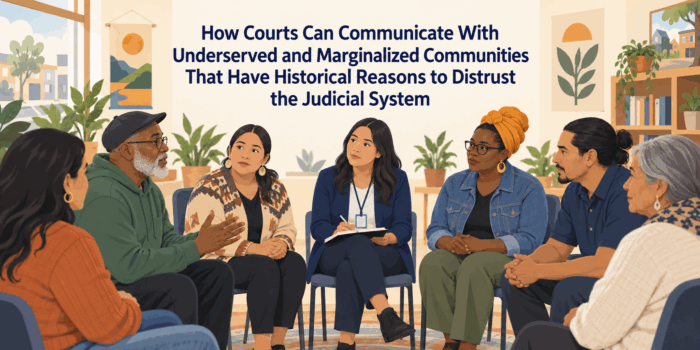
How Courts Can Communicate With Underserved and Marginalized Communities That Have Historical Reasons to Distrust the Judicial System
Courts communicate with the public in a setting where trust is not evenly distributed, and the communication challenges that follow reflect histories that courts did not create alone but in which they took part. For some communities, the judicial system has been associated with exclusion from juries, unequal enforcement of the law, forced removal from homelands, separation of families, the criminalization of poverty, and decisions that denied basic rights. Those histories are not abstractions. They are carried in family stories, community memory, and present-day experiences, and they shape how people read a summons, a website, a courthouse entrance, or a friendly invitation to a community event. A court that communicates as though every resident approaches it with equal confidence will fail the people who most need to be reached.
The distrust that many underserved and marginalized communities feel creates communication obligations that courts cannot meet with the practices designed for the general public. Press releases, websites, public notices, and standard outreach events assume an audience that is willing to listen and inclined to believe what the court says. Where trust is low, the same communication may be ignored, doubted, or read as a warning. People who fear that contact with the court could lead to arrest, loss of custody, a fine they cannot pay, or immigration consequences may avoid the courthouse even when they need protection or want to resolve a dispute. In those circumstances, communication is not merely a means of informing people. It is part of the work of earning the standing to be heard.
Credibility is the dimension of this communication that is hardest to build and easiest to lose. A court can improve its forms, translate its materials, and open a new help center, yet still be disbelieved if its message arrives through channels the community does not trust, in words that sound evasive, or without acknowledgment of what people have lived through. Trust is earned through consistent behavior over time and through communication that is honest about both the court’s role and its shortcomings. A court that treats distrust as a misunderstanding to be corrected, rather than as a reasoned response to real experience, is leaving the central communication challenge unaddressed, regardless of the quality of its outreach materials.
This article examines how courts can communicate with communities that have historical reasons to distrust the judicial system, covering the nature and sources of distrust, principles of credible communication, acknowledgment of history, listening and community research, trusted messengers and partnerships, language access and plain language, cultural humility, staff interaction and the courthouse environment, fines, fees, and fear of enforcement, communication with specific communities, self-represented litigants, digital access, youth and civic education, transparency about disparities and reform, response to broken trust, advisory structures, and the measurement and planning practices that make this work lasting.
Understanding Historical Distrust as a Reasonable Response
 The starting point for effective communication is to treat distrust as reasonable. In many communities, distrust of the courts is grounded in documented history and in recent experience, not in ignorance or hostility. Families may remember relatives who were excluded from juries, convicted without meaningful defense, denied the protection of the law, or removed from land and community by legal process. Individuals may have been treated with disrespect at a counter, held for a fine they could not pay, or seen a loved one sentenced in a way they believed was unequal. These experiences accumulate, and they inform how people interpret every new encounter.
Distrust also takes forms that courts may misread. A person who does not appear for a hearing may be seen as irresponsible, when the person may be afraid, may not have understood the notice, may have lacked transportation or childcare, or may have concluded that the outcome was predetermined. A person who answers questions tersely may be seen as uncooperative, when the person has learned that anything said in court can be used against them. A community that does not use available services may be seen as uninterested, when it may be waiting for evidence that the services are safe and respectful.
Understanding distrust as reasonable changes the posture of the court. Instead of asking why people do not trust the system, the court asks what it would take to deserve trust. Instead of seeking to persuade people that their fears are unfounded, it asks which fears are well founded and what it can do about them. This shift does not require a court to accept every criticism as accurate, but it does require willingness to listen to criticism seriously and to act where it is justified.
Distrust is not uniform. Within any community there are people with different experiences, views, and levels of engagement with the courts. Some have had positive experiences, some have been harmed, and many have mixed feelings. Courts should avoid treating any community as monolithic and should avoid assuming that individuals share the attitudes attributed to their group. The most reliable approach is to ask people about their own experiences and concerns, and to treat each person as an individual.
Court Communication Strategies for State and Local Judicial Systems: Building Public Trust, Improving Access to Justice, and Explaining Court Processes
This article is part of our series on strategic communication for State and Local Courts, Judicial Systems, and Court Administration. To learn more about court communication strategies for building public trust, improving access to justice, and explaining court processes, and to see the parent article, which links to other content just like this, click the button below.
Identifying the Communities and Respecting Their Distinct Histories
Communities that have reason to distrust the judicial system do not share a single history, and effective communication depends on understanding the particular experience of those the court serves. Racial and ethnic minority communities may carry histories of discriminatory enforcement, exclusion from juries, and unequal sentencing. Native nations and Indigenous people have a distinct history involving treaties, jurisdiction, removal, and the imposition of foreign legal systems. Immigrants and refugees may associate legal institutions with persecution in their countries of origin or with fear of detention and deportation in their new home.
Other communities face different but related concerns. People with disabilities have experienced inaccessible facilities, disregard of their testimony, and decisions made about them without their participation. LGBTQ+ people have been criminalized, disbelieved, and harmed by legal processes, and many still encounter hostility or ignorance. People living in poverty experience a system in which fines, fees, bail, and the costs of legal representation can determine outcomes. People with criminal records may feel permanently marked. People experiencing homelessness are frequently cited and arrested for conditions of survival. Religious minorities, rural residents, and people with limited literacy may also feel that the court was not built for them.
Courts should learn the specific history of their own jurisdiction. Local history, such as documented patterns of unequal enforcement, closure of courthouses in certain areas, or past incidents that damaged trust, is part of the context in which the court communicates. Local historical societies, universities, community archives, and elders can help court leaders understand this background. Knowing the local story prevents tone-deaf communication and demonstrates respect.
Intersectionality matters. A person may belong to multiple communities and face compounding barriers, such as an immigrant woman with a disability who is also a survivor of violence. Court communication should be flexible enough to address overlapping circumstances. Asking individuals what they need, rather than assuming based on a category, serves them better.
How Distrust Shapes Behavior and Communication Outcomes
Distrust affects how people respond to court communication in ways that have practical consequences. Notices may go unopened because past letters brought bad news. Calls from unknown numbers may go unanswered. Online forms may be abandoned out of concern about how personal information will be used. Invitations to community meetings may be viewed with suspicion as attempts at surveillance or public relations. A court that measures the success of its outreach by how many notices were sent, rather than by whether they were received and trusted, will overestimate its impact.
Distrust also affects what people are willing to say. In interviews with court staff, in hearings, and in surveys, people may give guarded or minimal answers. They may avoid disclosing information that would help the court assist them, such as the existence of domestic violence, a disability, or a language need, because they fear being judged or penalized. Staff who interpret reticence as lack of interest or honesty may make decisions on incomplete or misleading information.
The consequences extend to legal outcomes. People who avoid the courts may forgo protective orders, tenant defenses, custody arrangements, or the opportunity to contest charges. They may accept unfavorable outcomes without challenge, miss deadlines, or fail to appear, leading to default judgments and warrants. Communities may rely on informal means of resolving disputes that lack legal protection. These patterns reinforce disadvantage and in turn deepen distrust.
Understanding these patterns allows courts to design communication that anticipates and addresses them. For example, a notice that explains what the hearing is for, what will happen if the person attends, and what will happen if they do not, in language that does not threaten, may be more effective than a notice that emphasizes penalties. A statement that the court does not ask about immigration status at the counter may reduce fear of seeking help. Anticipating the questions behind the silence is a core communication skill.
Principles of Credible Communication
Several principles guide communication in conditions of low trust. The first is honesty. A court must say what it knows and does not know, what it can and cannot do, and where it has fallen short. Overpromising or minimizing problems destroys credibility quickly. Honest communication includes admitting when the court does not have the answer and committing to find it.
The second is humility. Courts have authority, but authority is not the same as trust. A tone of humility, expressed through listening, acknowledging mistakes, and valuing community knowledge, signals respect. Humility does not mean weakness. It means recognizing that those who have experienced the system understand things about it that those inside may not.
The third is reciprocity. Communication should flow in both directions, with the court listening as much as it speaks and responding to what it hears. Outreach that consists only of announcements invites cynicism. Outreach that invites feedback and visibly acts on it demonstrates that the court values the community’s views.
The fourth is consistency. Trust is built through repeated experiences that match what was promised. If a court announces that it welcomes everyone but staff treat visitors with suspicion, the announcement will be disbelieved. Alignment between words and actions, across all points of contact, is the most persuasive communication.
The fifth is accountability. Communities want to know that if something goes wrong, someone will take responsibility and make it right. Clear complaint processes, timely responses, and public reporting of what has been learned and changed demonstrate accountability. Communication that acknowledges a problem and describes the corrective action is far more credible than defensiveness.
Acknowledging History Without Defensiveness
Many communities wait for the court to acknowledge what has happened. Without such acknowledgment, other communication may ring hollow. At the same time, courts need to approach acknowledgment thoughtfully, because a poorly considered statement can cause offense, create legal concerns, or appear performative. The goal is a sincere recognition of historical and present harms, offered in a way that opens rather than closes the conversation.
Acknowledgment may take several forms. Judicial leaders may speak publicly about the history of the court’s local jurisdiction and its role in unequal treatment. Courts may support historical research, exhibits, or commemorations in partnership with community organizations. They may hold listening sessions at which leaders hear community members describe their experiences. They may incorporate this history into staff training, so that those who serve the public understand the context.
Acknowledgment should be paired with action. A statement of regret without any change in practice may be seen as empty. Courts can describe specific steps they are taking, such as revising fine and fee practices, improving language services, changing hours or locations, or reviewing policies for disparate impact. Even modest, concrete steps are more credible than broad declarations.
Courts should be mindful of their role and legal constraints. Judges and court administrators must remain impartial in individual cases and should seek guidance from ethics advisors and counsel on public statements. Acknowledgment of history and commitment to improving access and fairness are consistent with judicial neutrality, and many courts have found ways to speak about them in appropriate terms. Focusing on the court’s administrative practices, access, and treatment of the public keeps the discussion within proper bounds.
Acknowledgment is not a single event. As relationships develop, community members may share more, and the court may need to revisit its understanding. A willingness to continue the conversation, to be corrected, and to adjust is part of a credible approach.
Listening First: Community Research and Engagement
Courts often begin outreach by deciding what to say. A more effective approach begins by listening. Understanding how a community views the court, what barriers it faces, what information it needs, and whom it trusts allows the court to tailor communication and avoid avoidable mistakes. Listening is also a communication act in itself, demonstrating respect and interest.
Several methods can be used. Listening sessions held in community venues, at times and places convenient to residents, allow people to speak freely. Focus groups led by trained facilitators from the community can explore perceptions in depth. Surveys, available in multiple languages and formats, can reach a wider audience, although low-trust communities may be less likely to respond. Interviews with community leaders, service providers, and advocates provide additional perspective. Observation of the court from the user’s point of view, such as walking through the process as a first-time visitor, can reveal obstacles that staff no longer notice.
The way listening is conducted matters. Sessions should be led or co-led by people the community trusts. Court officials should attend in a spirit of learning, not defending. Participants should be told how their input will be used and should be thanked. Compensation for time, food, childcare, and transportation shows respect and reduces barriers to participation. Privacy and safety must be protected, especially for those who may fear repercussions.
Listening requires follow-through. Communities have often been asked for their views without seeing any result. Courts should summarize what they heard, share the summary with participants, and describe what they will do. Even when the court cannot act on a request, explaining why demonstrates honesty. Returning to report progress, and inviting correction, builds credibility over time.
Data can complement listening. Court records may reveal patterns, such as high rates of failure to appear in certain neighborhoods, concentrations of default judgments, or disproportionate use of fines. Combining this data with community input provides a fuller understanding and points to where communication and practice changes could make a difference.
Working With Trusted Messengers and Community Partners
In communities where the court is not trusted, information is often more credible when it comes from someone who is. Trusted messengers may include faith leaders, community health workers, neighborhood associations, cultural organizations, legal aid providers, tenants’ groups, immigrant service agencies, tribal leaders, peer support groups, and local media outlets. Partnering with them can extend the court’s reach and lend its message credibility it might not otherwise have.
Effective partnership is based on mutual respect, not instrumental use. Community organizations are not simply distribution channels for the court’s materials. They have their own missions, constraints, and relationships, and they risk their own credibility by associating with a court. Courts should approach partners as equals, ask what they need, and be prepared to offer something in return, such as training for their staff, resources, or influence on court practices.
Partners should be given accurate, usable information and the ability to ask questions. Briefings, plain-language guides, and a designated court contact allow partners to answer questions confidently. Court staff should be honest about what the court cannot do and avoid asking partners to give assurances that the court cannot guarantee. If a partner is asked whether it is safe to go to the courthouse, the court should have given the partner an honest and complete answer.
Compensation and capacity are important. Small organizations may lack resources to participate in outreach, and courts should consider grants, contracts, or in-kind support that recognize the value of their contribution. Overreliance on volunteers or unfunded community groups can exhaust them and breed resentment.
Courts should also be prepared for partners to criticize them. A trusted messenger who is asked to represent the court may relay community concerns, and the court should treat this feedback as valuable. Partners who feel free to speak honestly are more credible, and the court’s willingness to hear criticism enhances its own credibility.
Language Access as a Foundation of Trust
Language is often the first barrier people face, and the way a court handles it signals whether it takes them seriously. People with limited English proficiency may hesitate to seek help, may misunderstand legal documents, and may rely on informal interpreters whose accuracy is uncertain. Courts have legal obligations to provide language access, and beyond those obligations, quality language services are among the most visible demonstrations of respect.
Language access should be considered at every point of contact. Signage, forms, websites, notices, telephone systems, help centers, and community events should be available in the languages commonly spoken in the community. Qualified interpreters should be provided for proceedings and for communications with court staff, and the availability of interpreters should be advertised clearly so that people know they can request one without cost or stigma. Using children or family members to interpret should be avoided, particularly in sensitive matters.
Translation requires more than converting words. Materials should be translated by qualified professionals, reviewed by native speakers from the community, and adapted for cultural context. Some concepts have no direct equivalents, and literal translation can confuse or offend. For languages with limited written use, or for communities with low literacy, audio and video materials, community radio, and in-person explanations may be more effective than printed handouts.
The range of languages in many communities is broad, and courts cannot translate everything into every language. Prioritization based on data, with a plan for less common languages, is necessary. Vital documents, such as notices of hearings and information about rights, should be prioritized. Telephone interpreter services and translated summaries can address the long tail. Courts should communicate about their language policies openly, including what is available and how to ask for it.
Indigenous languages and dialects deserve special attention. Some communities speak languages that have few trained interpreters, and the court may need to work with tribal governments, cultural organizations, and community members to identify resources. Respect for language is also respect for identity and history, and efforts to support it can build goodwill.
Plain Language, Forms, and Notices
Even people fluent in English can be shut out by legal language. Summonses, notices, orders, and forms often use technical vocabulary and complex sentences that are difficult for anyone without legal training. For communities with histories of mistrust, impenetrable documents reinforce a sense that the system was not designed for them and may be hiding something.
Plain language is a tool of equity. Documents should state clearly what the recipient must do, by when, where, and what will happen if they do not. They should explain terms, avoid jargon, use short sentences, and present the most important information first. Headings, bullet points, and white space improve readability. Contact information for help should be prominent.
Tone matters as much as vocabulary. Documents that begin with threats or emphasize penalties communicate hostility. A neutral and respectful tone, which also explains the person’s rights and options, communicates that the court is not simply trying to catch them out. Statements about available help, such as fee waivers, payment plans, interpreters, accommodations, and legal aid, should accompany notices that require action.
Testing is essential. Drafts should be reviewed by people from the communities the court serves, who can identify confusing passages and unintended implications. Courts that adopt this practice often find that small changes, such as replacing a legal term with an everyday phrase or reorganizing a notice, significantly improve comprehension and response.
Reminders can make a measurable difference in appearance rates. Text messages, phone calls, or mailed postcards that give the date, time, and location, and explain what to do if the person cannot attend, help prevent unnecessary warrants. Messages should be designed with privacy in mind and sent only with consent where required.
Cultural Humility in Court Communication
Cultural humility is an approach that recognizes the limits of one’s own understanding and commits to ongoing learning, self-reflection, and respect for others’ perspectives. It differs from cultural competence in that it does not suggest that one can master another culture. For court staff and judges, cultural humility means asking rather than assuming, noticing one’s own biases, and adjusting communication to the person in front of them.
Cultural factors affect communication in many ways. Norms about eye contact, personal space, deference to authority, direct versus indirect speech, the role of family and community in decision making, and ways of showing respect vary. Understandings of illness, disability, family, and conflict resolution differ. Staff who interpret behavior through a single cultural lens may misread it, for example, taking lack of eye contact as evasiveness when it is a sign of respect.
Names, titles, and pronouns matter. Pronouncing names correctly, using preferred titles, and respecting gender identity are simple ways to show regard. Staff should be encouraged to ask how a person wishes to be addressed and to apologize and correct mistakes gracefully. Forms should allow for names and identities that do not fit narrow categories.
Cultural humility also applies to religious observance, dietary needs, dress, and scheduling around holy days. Courts can accommodate many such needs with modest flexibility. Communicating about available accommodations, in notices and on the website, signals inclusion and allows people to plan.
Training in cultural humility is most effective when led by members of the communities served, grounded in local realities, and reinforced over time. One-time sessions seldom change behavior. Ongoing dialogue, case discussions, and feedback from community members help staff internalize the principles.
Staff Interactions and the Courthouse Experience
For many people, the clearest indicator of whether the court is trustworthy is how they are treated at the counter, in the hallway, and at the security checkpoint. These small interactions carry great weight. A courteous greeting, a clear explanation, and patience with confusion can offset years of mistrust, while a brusque response or visible suspicion can confirm it.
Frontline staff are the court’s most important communicators, and they should be supported accordingly. Training in customer service, de-escalation, trauma-informed practice, and procedural fairness helps them respond to anxious or angry visitors. Clear guidance about what they can and cannot say, particularly about legal advice, prevents misunderstandings while allowing staff to be helpful. Staff should have easy access to translated materials, interpreters, and referral resources.
The physical environment communicates as well. Welcoming signage in multiple languages, clear wayfinding, comfortable waiting areas, accessible facilities, and visible help desks tell visitors they are expected and valued. Security procedures should be explained in advance, applied consistently, and carried out respectfully. Artwork and displays that reflect the community’s diversity, and that avoid exclusively depicting a narrow slice of history, convey inclusion.
Courts should consider the experience of those who come with children, those who rely on public transit, and those who work during court hours. Child-friendly areas, information about transit, and extended or flexible hours reduce barriers. Communicating these features in notices and online lets people plan.
Procedural fairness principles provide a useful framework. Research on how people evaluate legal authorities suggests that perceptions of fairness depend heavily on whether people feel they had a voice, were treated with dignity and respect, were dealt with by neutral decision makers, and trusted the motives of those in authority. Judges and staff who explain what is happening and why, listen to people, and act consistently build legitimacy even when the outcome is unfavorable.
Fines, Fees, Warrants, and the Fear of Enforcement
Few issues damage trust as much as the perception that courts operate as collection agencies. For people with limited income, fines and fees can lead to escalating debt, license suspension, loss of employment, arrest on warrants, and incarceration for inability to pay. Communities that have experienced these consequences may view any contact with the court as a financial threat. Communication about financial obligations must therefore be especially clear and compassionate.
Courts should explain what is owed, why, and what options exist. Notices should state the amount, deadlines, payment methods, and the availability of ability-to-pay determinations, payment plans, community service alternatives, and fee waivers. They should state who to contact for help and should not suggest that nonpayment will inevitably lead to arrest. If the court has changed its practices to reduce reliance on fines and fees, it should communicate those changes widely.
Warrant amnesty or recall programs, where available, can be powerful signals when communicated effectively. People who have outstanding warrants for minor matters may be afraid to come to court to resolve them. A program that allows them to appear without arrest, accompanied by clear messaging through trusted partners, can bring many back into the system. The communication must be unambiguous about the terms, because a misunderstanding could lead to harm and long-lasting distrust.
Fear of arrest at the courthouse is a significant barrier. Courts should communicate clearly about their policies concerning law enforcement presence, immigration enforcement, and warrant execution, to the extent they have authority and can make accurate statements. Where policies limit enforcement activity at or near the courthouse, publishing and explaining them reassures visitors. Where the court cannot make guarantees, honesty about the limits is better than vague assurances.
Legal aid and advocacy organizations can help people navigate financial obligations. Providing information about where to get help, hosting clinics at the courthouse or in the community, and referring people promptly can prevent small problems from escalating into serious consequences.
Communicating With Specific Communities
 While every community is unique, certain patterns merit particular attention. The following reflections are not substitutes for direct engagement with the communities in each jurisdiction, but they illustrate how courts can approach different contexts.
Communities of color, particularly Black, Latino, and other communities with histories of discriminatory enforcement, often have strong reasons to question the fairness of courts. Communication should acknowledge disparities where data show them, describe reforms underway, and reflect the diversity of the community in imagery, staffing, and leadership. Partnership with churches, civic associations, fraternal organizations, and local media can extend reach. Youth and families should be engaged early, before they have a crisis.
Immigrant and refugee communities may fear that any interaction with government can lead to immigration consequences. Courts should communicate clearly about their role, which is distinct from immigration enforcement, and about any policies regarding information sharing and enforcement activity at the courthouse. They should provide multilingual information, work with immigrant-serving organizations, and offer interpreters at no cost. Messages should be consistent and avoid promises the court cannot keep.
Native nations and Indigenous communities have a distinct political and legal status, and communication must respect tribal sovereignty. Courts should engage with tribal governments and courts as governmental partners, not merely as community groups. Coordination on jurisdictional questions, recognition of tribal court orders, and respectful consultation reflect this relationship. Communication should also reflect awareness of the history of federal and state policies affecting Native peoples, including those involving children and families.
People with disabilities need accessible communication in every sense. Materials should be provided in formats that meet diverse needs, sign language interpreters and captioning should be available, and physical access should be assured. Communication should respect the person’s autonomy, address them directly rather than through companions, and invite them to state their needs. Disability organizations can advise on practices and help spread information.
LGBTQ+ people may fear discrimination, misgendering, or disclosure of identity. Courts can signal respect through inclusive forms, trained staff, nondiscrimination statements, and accommodations such as using chosen names. Privacy protections regarding sexual orientation and gender identity should be explained. Partnerships with LGBTQ+ organizations can help the court understand specific concerns, such as safety and recognition of families.
Rural communities, people experiencing homelessness, formerly incarcerated people, and religious minorities each have their own relationship to the court. Rural residents may face long travel distances and limited services, and may distrust distant institutions. People experiencing homelessness often lack addresses and phones and fear citations. Formerly incarcerated people may fear that any contact will lead to new consequences. Religious minorities may worry about bias or lack of accommodation. For each, listening, partnership, and practical accommodations are central.
Courtroom Communication and the Role of the Judge
The courtroom is where the court’s authority is most visible, and the way judges communicate there has a powerful effect on how people from distrustful communities experience the system. A judge who speaks plainly, explains each step, addresses people by name, and invites questions conveys respect that no brochure can match. A judge who speaks quickly, uses legal terms without explanation, or appears dismissive can confirm every fear the person brought through the door.
Judges can adopt practices that support understanding. They can begin hearings by explaining what will happen and who is who in the room. They can check understanding by asking people to describe in their own words what they have been told. They can pause to ensure that interpreters have conveyed what was said, and can speak at a pace that allows accurate interpretation. They can explain the reasons for their decisions in terms the person can follow, and describe the next steps and how to get help.
Judicial communication also involves tone and demeanor. Research on procedural fairness suggests that people who feel heard and respected are more likely to accept outcomes and comply with orders. Listening without interruption, acknowledging the person’s perspective, and treating everyone with the same courtesy contribute to this. Judges should be mindful that people may be nervous, may be unfamiliar with courtroom norms, and may react in ways that reflect fear rather than disrespect.
Judicial education and peer discussion support these practices. Judges benefit from opportunities to hear from community members, observe colleagues, and receive feedback on their communication. Courts can invite judges to participate in community listening sessions, and can include communication skills in judicial training. Leadership by respected judges helps normalize practices that build trust.
Supporting Self-Represented Litigants
Many people from underserved communities cannot afford lawyers and must navigate the court on their own. For them, communication is not merely helpful. It is essential to their ability to exercise legal rights. The complexity of procedures, the risk of errors, and the stakes in matters such as eviction, custody, debt, and protection from abuse make clear guidance vital.
Courts can offer help centers, self-help websites, plain-language forms, instructional videos, workshops, and referral to legal aid and pro bono services. Information should explain the process step by step, what documents are needed, how to file, deadlines, and what to expect at hearings. It should also tell people what the court staff can and cannot do, so that expectations are realistic.
Communication with self-represented litigants must be respectful. Many feel intimidated, embarrassed, or fearful of being judged. Staff and judges who explain procedures patiently, avoid condescension, and treat people as capable adults help them participate effectively. Judges can use plain language in the courtroom, explain what is happening, and ensure that litigants understand before moving forward.
Partnerships with legal aid organizations, law schools, bar associations, libraries, and community groups expand the reach of assistance. Co-locating services at the courthouse or in community venues, and ensuring that referrals are warm rather than a list of phone numbers, improve uptake. The court should keep referral information current and clearly describe eligibility.
Outcome data can demonstrate the value of these efforts. Reporting on the use of help centers, reductions in default judgments, and improvements in compliance with orders builds support among funders and the community. Stories from users, shared with consent, show the human impact.
Communicating About Rights and Legal Protections Safely
Many people in marginalized communities want to know what rights they have and how to use them, yet they may be reluctant to ask a court employee directly. Know-your-rights information is one of the most valuable forms of court communication, provided it is accurate, accessible, and delivered by sources people trust. Courts must be careful, however, to distinguish legal information from legal advice, which staff cannot give.
Rights materials should be written in plain language and focus on practical questions. What happens at an arraignment? Can I bring someone with me? What if I cannot afford a lawyer? What if I cannot pay a fine? Who can help me with an interpreter? How do I ask for an accommodation? Answers should be honest about limits and about how rights operate in practice. Overstating protections or promising results can mislead people and harm them.
Delivery matters as much as content. Short videos, illustrated guides, text message series, community workshops, and resources in libraries and clinics can reach people who would not seek out a court website. Partnering with legal aid providers allows people to ask questions of someone who can offer advice. Courts should make clear where the line between information and advice falls and where people can get individualized help.
Digital Access, Channels, and the Digital Divide
Courts increasingly offer services online, including e-filing, remote hearings, case lookups, and payment systems. These can improve access for many, but they can exclude those without devices, connectivity, digital skills, or private spaces. Communities that are already marginalized are often disproportionately affected by the digital divide, and an exclusive reliance on online communication can widen gaps.
Courts should offer multiple channels for communication. Phone lines staffed by people, in-person help, mailed notices, text messages, and community-based assistance should remain available alongside online options. Information about each should be clear, so people know their choices. Where remote hearings are available, courts should provide guidance on how to participate, offer technical support, and provide places where people can join using court-provided equipment.
Mobile access is critical, since many people rely on smartphones as their primary or only internet connection. Websites and forms should be designed for small screens and low bandwidth. Text messaging is often the most reliable way to reach people, but privacy and consent issues must be addressed. Messages should be brief, clear, and free of sensitive details.
Trust in digital channels also requires attention to privacy and security. Communities with experiences of surveillance may be wary of providing information online. Courts should explain what data is collected, how it is used, who can see it, and how long it is kept, in plain language. They should avoid collecting unnecessary data and should not share information in ways people do not expect.
Digital literacy support can help. Libraries, community centers, and court help desks can assist people in using online tools. Training for community partners enables them to serve as local resources. Feedback from users about what works and what does not guides improvements.
Community Education, Youth, and Civic Engagement
Trust develops through familiarity as well as through fairness. Many people know the court only through media portrayals or stressful personal encounters. Community education programs can introduce the court as an institution that serves residents and demystify its operations. Courthouse tours, mock trials, open houses, judges visiting schools and community groups, and know-your-rights workshops allow people to see the system and ask questions in a nonthreatening setting.
Young people are an especially important audience. Youth in marginalized communities may have had negative contact with law enforcement, and their views of the court are often shaped by that experience. Programs in schools, youth centers, and community organizations can teach about rights and responsibilities, the role of judges and juries, and ways to participate in civic life. Involving youth in designing programs, serving in youth advisory councils, and meeting judges and staff who share their backgrounds can foster understanding and interest.
Education programs should be honest. Presenting an idealized picture of the court that ignores its flaws will ring false, particularly to those who have experienced them. Programs that acknowledge historical and current problems while explaining how rights can be asserted and how reform efforts operate are more credible. Inviting participants to share their experiences and concerns makes the encounter a dialogue.
Opportunities for civic participation, such as jury service, serving on advisory committees, volunteering as court observers, and working for the court, deepen engagement. Outreach to underrepresented communities about jury service, with clear information about eligibility, compensation, and employer obligations, can help make juries more representative. Removing barriers such as transportation and childcare costs encourages participation.
Community events should be designed to be welcoming. Hosting them in familiar locations, offering food and activities, providing interpreters, and ensuring that court personnel are approachable make a difference. Events that are well attended but result in no follow-up can leave a negative impression, so courts should plan how to continue the relationships they begin.
Jury Service and Representation of the Community
Juries are one of the most direct ways in which communities participate in the justice system, and the composition of juries has historically been a source of grievance. Exclusion of certain groups, and the continuing underrepresentation that some communities experience, can reinforce the sense that courts are institutions that act upon them rather than with them. Communication about jury service is therefore a trust-building opportunity.
Outreach should begin with the summons. Summons materials should be written in plain language and offered in multiple languages. They should explain the purpose and importance of jury service, the eligibility rules, how to request an accommodation or deferral, and what compensation and employer protections apply. Many people from low-income communities cannot afford to miss work, and clear information about hardship procedures and payment is vital.
Courts should look closely at their jury source lists, response rates, and exemptions, and communicate openly about steps taken to improve representativeness. Community presentations, partnerships with civic organizations, and reminders can raise response rates. Reducing barriers such as transportation, childcare, and parking costs signals that the court values the participation of all residents.
The jury experience itself should be respectful. Clear instructions, comfortable facilities, efficient use of time, and appreciation for service shape how people talk about the court afterward. Jurors who feel valued become ambassadors, while those who are treated poorly spread negative impressions. Post-service surveys and follow-up communication can help the court learn and respond.
Communicating Honestly About Disparities and Reform
Communities are well aware of disparities in the justice system, and a court that does not discuss them appears either uninformed or unwilling to confront them. Honest communication about disparities, grounded in data and accompanied by a plan, can improve credibility. This requires courts to examine their own data, with appropriate care and expertise, and to share findings with the public.
Reporting should explain what the data show and what they do not. Disparities in outcomes may arise from many factors, some within the court’s control and some beyond it. Courts should avoid both defensiveness and oversimplification, acknowledging the complexity while making clear that the court takes responsibility for the parts it can influence. Describing how the court is investigating causes, and what it has changed in response, shows seriousness.
Reform efforts should be communicated plainly and tracked over time. If the court has revised bail practices, reduced reliance on fines, expanded language access, or changed jury selection procedures, it should explain the changes, the reasons, and the results. Reporting progress and setbacks alike builds trust that the court is committed to improvement rather than public relations.
Community input into reform is crucial. Communities should have opportunities to review data, suggest priorities, and offer feedback on proposed changes. Reform that is imposed without consultation may miss the mark and invite skepticism. Advisory groups, public forums, and partnerships with community organizations facilitate dialogue.
Courts should be careful not to overstate achievements. Declaring success prematurely or highlighting small steps as transformative will be viewed with suspicion. Modest, accurate claims and a continuing commitment to do more are more convincing.
Communicating During High-Profile Cases and Moments of Community Tension
Certain cases or events bring long-standing grievances to the surface. A decision that appears to treat members of one community differently, a widely publicized incident involving law enforcement, a verdict that provokes protest, or a policy change that affects a vulnerable group can intensify distrust and test the court’s communication. Preparation before such moments determines how well the court can respond.
Courts should establish relationships with community leaders before tension arises. When a crisis occurs, those relationships allow the court to communicate directly, to understand concerns quickly, and to avoid misinformation. A court that appears for the first time in a community when trouble begins is poorly positioned to be heard.
Communication during tense periods should be calm, factual, and respectful. The court should explain, within the limits of judicial ethics and confidentiality, how the legal process works, what stage the case is in, and what avenues exist for appeal or review. It should avoid commenting on the merits of pending matters and should not respond to public pressure by suggesting a particular outcome. Explaining the reasons for these limits helps people understand that silence on the merits is not indifference.
Safety and access during demonstrations or heightened attention should be addressed practically. Courts should provide clear information about security procedures, public access to proceedings, and designated areas for observers and media. Respect for peaceful expression and clear, consistent rules reduce conflict. Afterward, the court should engage with the community to discuss what was learned.
Responding When Trust Is Broken
Despite best efforts, incidents will occur that damage trust. A staff member may treat a visitor disrespectfully. A policy may produce harsh results. A high-profile case may inflame community feeling. A data error may lead to wrongful arrest. How the court responds in these moments is often more influential than months of routine outreach.
Speed and sincerity matter. The court should acknowledge the incident promptly, express concern for those affected, and commit to investigate. Delays or silence suggest indifference. Statements should be free of legalistic defensiveness and should avoid blaming the individual or the community. Where legal constraints limit what can be said, the court should explain the constraints and say what it can.
Investigation and accountability should be transparent to the extent possible. The community should know who is reviewing the incident, the timeline, and how findings will be shared. Where mistakes occurred, the court should say so, apologize, and describe corrective actions. Following through, and reporting back, is critical.
Direct engagement with those harmed is important. A personal outreach from a court leader, an opportunity to be heard, and an effort to make things right, such as correcting records or waiving penalties, demonstrate respect. Community leaders and partners should be informed and consulted so that they hear from the court first and can help address concerns.
Each incident is an opportunity to learn. Reviewing what went wrong, adjusting training or procedures, and sharing lessons with staff and the public contributes to improvement. Courts that handle difficult moments with candor often find that trust, while damaged, can emerge stronger.
Ethnic Media, Community Media, and Public Messaging
Mainstream media may not reach or be trusted by all communities. Ethnic and community media, including newspapers, radio stations, television programs, podcasts, and social media networks, play a vital role in conveying information in languages and cultural frameworks that resonate. Courts that engage these outlets can reach audiences that traditional press releases miss.
Building relationships with community media requires respect and consistency. Courts should identify outlets serving their communities, learn about their audiences, and provide information that is relevant and timely. Offering interviews with judges and administrators, explaining court procedures, and answering questions help journalists inform their audiences. Courts should provide materials in the outlet’s language and be willing to engage in live discussions, call-in shows, and community forums.
Messages should be tested for clarity and cultural resonance. A slogan that works in one community may be confusing or offensive in another. Using images that reflect the community, avoiding stereotypes, and choosing spokespeople who can connect with the audience improve effectiveness.
Paid outreach in community media, where the court has the authority and resources, can supplement news coverage. Public service announcements about rights, services, and events are useful. However, advertising alone does not build trust. It should accompany genuine engagement and be consistent with the court’s practices.
Advisory Councils and Shared Governance
One of the most credible ways to build trust is to share some measure of influence with those the court serves. Community advisory councils, access and fairness committees, and user panels give community members a formal voice in shaping communication and practice. They also provide a channel through which the court can test ideas, receive early warning of problems, and demonstrate openness.
Advisory bodies are effective when they are real. Members should reflect the diversity of the community, including people with direct experience of the court. They should have a clear charter, regular meetings, access to data, and a defined relationship to court leadership. Their recommendations should be taken seriously, and the court should report back on what it has done in response, including when it chooses not to follow a suggestion and why.
Barriers to participation should be addressed. Meetings should be scheduled at accessible times and places, with interpretation, childcare, transportation assistance, and compensation where possible. Members should receive orientation and support so they can contribute meaningfully. Court leaders should attend and listen, rather than delegate.
Courts should be cautious about tokenism. Inviting a few individuals to attend meetings without giving them influence can breed cynicism. Honest conversations about the council’s role, limits, and authority, along with visible follow-through, build credibility.
Council members can serve as ambassadors and sounding boards for communication. They can review draft materials, advise on messaging, and help spread information. Their involvement signals to the broader community that the court is listening.
Measuring Trust and Progress
Building trust is a long-term effort, and courts need ways to tell whether they are making progress. Measurement can guide improvement, demonstrate accountability, and sustain commitment during the long periods when change is gradual. Because trust is subjective, measures must be chosen carefully.
Surveys of court users and community members can assess perceptions of fairness, respect, understanding, and confidence. Surveys should be offered in multiple languages and formats, administered in settings where people feel comfortable, and designed to capture differences among groups. Results should be analyzed by demographic characteristics, where legally permitted and appropriate, to see whether some communities are having a different experience.
Behavioral indicators complement perception. Rates of appearance at hearings, use of help centers, requests for interpreters, participation in community events, jury summons response rates, and complaint volumes can suggest changes in engagement and confidence. These should be interpreted cautiously, since multiple factors affect them.
Qualitative feedback adds depth. Conversations with community partners, comments at forums, and stories shared with staff provide context that numbers cannot. Courts should record and analyze this feedback systematically.
Results should be shared with the community and used to guide action. Publishing findings, including unflattering ones, and describing planned responses show that the court takes the data seriously. Setting goals and reporting progress annually creates accountability.
How Communicating With Marginalized Communities Differs From General Public Outreach
General public outreach assumes a baseline of goodwill and interest. It typically aims to inform people about services, explain the court’s role, and encourage participation. Communication with communities that have reason to distrust the courts must first address the baseline. It requires time, relationships, and evidence of change, and its success cannot be measured by reach alone.
The role of messenger differs. For the general public, court officials and mainstream media may be credible. For marginalized communities, community members, peers, and trusted organizations often carry more weight. Courts must be willing to share the stage and to let others tell the story.
The content of communication also differs. Messages must address fears directly, such as fear of arrest, deportation, loss of children, or financial penalty. They must provide concrete assurances where possible and honest limits where not. They must offer practical assistance, such as interpreters, childcare, and legal help, and make clear how to get it.
The time horizon is longer. Outreach to the general public may be effective in a single campaign. Rebuilding trust takes years and demands sustained attention, consistent behavior, and patience. Courts must be prepared for slow progress and for setbacks, and must resist the temptation to declare victory prematurely.
Common Pitfalls and How to Avoid Them
Courts working to reach distrustful communities often encounter familiar problems. One is treating outreach as a one-time event rather than an ongoing relationship. A single community fair does not build trust, and its absence the following year may confirm suspicion. Planning for sustained engagement avoids this.
A second is communicating without changing practice. Messages that promise respect and fairness while the experience of visitors remains unchanged will be disbelieved. Communication and operations must advance together.
A third is assuming that translation is enough. Providing a translated document does not guarantee understanding or trust. Community review, culturally appropriate delivery, and trusted messengers matter.
A fourth is treating communities as monolithic or relying on a single spokesperson. No individual speaks for an entire community. Broad engagement, with multiple voices, provides a more accurate picture.
A fifth is defensiveness. Responding to criticism by explaining why it is wrong, rather than listening to what lies behind it, closes off dialogue. Receptivity builds credibility.
A sixth is overpromising. Assurances that cannot be kept, such as guarantees about enforcement or outcomes, cause lasting harm when they fail. Honest statements about limits are better.
A seventh is neglecting staff. Frontline employees are asked to carry out the court’s commitments, and without training, support, and authority, they may be unable to. Investing in staff is essential to credible communication.
Sustaining the Work: Leadership, Staff Capacity, and Wellbeing
Communicating across lines of historical distrust is demanding work. It requires emotional labor from staff, particularly those from the communities involved, who may be asked to represent the court to people who are angry or hurt. It requires courage from leaders, who must hear criticism and sometimes admit fault. Courts that expect this work to succeed without support will see burnout and disengagement.
Leadership commitment sets the tone. When the chief judge and court administrator speak about community trust as a priority, allocate resources, attend community events, and hold themselves accountable, staff understand that the work matters. Leaders should communicate consistently, through words and decisions, that building trust is part of the court’s mission.
Staff capacity should be built deliberately. Training, mentoring, and clear role definitions help employees take on community engagement. Staff from affected communities should not be treated as unpaid liaisons; their expertise should be recognized and compensated, and their workloads adjusted. Opportunities for debriefing and support allow staff to process difficult interactions.
Continuity matters. Relationships are often with individuals, and when those individuals leave, trust can fray. Documenting relationships, introducing successors, and building institutional rather than personal ties preserve progress. Succession planning for key community engagement roles prevents gaps.
Building a Community Trust and Communication Plan
A written plan helps courts move from good intentions to sustained practice. It should begin with an assessment of the communities served, the history and current experience of each with the court, and existing relationships and resources. It should identify priority communities and specific barriers, based on data and community input.
The plan should state goals in concrete terms, such as increasing appearance rates, expanding use of help centers, improving satisfaction among particular groups, or establishing partnerships with named organizations. It should outline strategies for listening, partnership, language access, plain-language materials, staff training, courthouse improvements, and community education, with responsibilities, timelines, and budgets.
The plan should include mechanisms for community oversight. Advisory councils, regular reporting, and opportunities for community members to review progress give the plan legitimacy. Evaluation should be built in, with indicators defined in advance and results shared.
Contingency planning is also important. The plan should anticipate incidents that could damage trust and set out how the court will respond. Designated spokespersons, response protocols, and relationships with community leaders in advance allow faster, more credible action.
Finally, the plan should be reviewed regularly and revised in light of experience. Communities change, and so do their needs and perceptions. A plan that evolves, with community participation, reflects a commitment to learning and partnership.
Tying It All Together
Communicating with underserved and marginalized communities is not a specialized outreach function attached to the margins of court operations. It is a test of whether the court is willing to be the institution it says it is. Every element of this work, including listening, partnership, language access, plain language, cultural humility, respectful service, fair treatment of fines and fees, honesty about disparities, and accountability when things go wrong, contributes to a single outcome: communities coming to believe that the court is a place where they can be heard, treated fairly, and protected by the law.
Courts that approach this work with patience and honesty find that trust grows through accumulation. A resident who is treated with respect at the counter tells a neighbor. A community organization that sees the court follow through on a commitment is more willing to vouch for it. A young person who sits in a courtroom and asks a judge a question may become a juror, an advocate, or a court employee. Trust, built through consistent and honest communication and visible changes in practice, is the most valuable asset a court can hold in its relationships with communities that have good reasons to be wary.
Strategic Communication Support for Courts Serving Distrustful Communities
 Developing the community research, trusted messenger partnerships, multilingual and plain-language materials, staff training, courthouse communication, fines and fees messaging, disparities reporting, incident response plans, advisory structures, and evaluation frameworks that courts require is work that most court teams cannot complete at the level of quality and sensitivity that each challenge demands. Court administrators and staff are often managing heavy workloads and limited resources, and relationship-based communication competes with daily operations. External communication expertise is a practical necessity for courts seeking to build trust with the communities they serve.
Stegmeier Consulting Group (SCG) works with courts and justice system partners to develop communication programs that address the full range of challenges specific to engagement with underserved and marginalized communities, with particular attention to the credibility, cultural humility, and accountability dimensions that distinguish this work from general public outreach. This includes designing community listening processes, developing plain-language and multilingual materials, building partnerships with trusted messengers, preparing staff for respectful and effective interactions, and creating evaluation approaches that help courts measure progress over time.
Future Trends in Court Communication With Marginalized Communities
Courts are increasingly recognizing that access to justice and public trust are inseparable, and many are making them strategic priorities. Procedural fairness, language access, plain-language reform, and community engagement are becoming part of standard court planning. Funding and policy attention to these areas are likely to grow, creating opportunities for courts that are prepared.
Technology will play a growing role. Remote hearings, mobile-friendly services, text-based communication, translation tools, and virtual help centers can expand access, particularly for those facing distance or mobility barriers. However, technology can also deepen exclusion if not accompanied by support for those with limited access or literacy. Courts will need to adopt tools thoughtfully, test them with affected communities, and maintain human alternatives.
Artificial intelligence tools for translation, document drafting, and chat assistance may help courts reach more people in more languages. They carry risks of errors, bias, and privacy breaches, which can be especially harmful to communities already wary of institutions. Courts should disclose their use, test accuracy with community reviewers, protect confidential information, and ensure that people can reach a human being.
Community-driven approaches are also likely to expand. Participatory processes in which communities help design court services, restorative and community justice models, and collaborations with community-based organizations reflect a shift toward shared responsibility for justice. Communication will be central, as courts explain new approaches, invite participation, and report results.
Conclusion
Courts face communication challenges with underserved and marginalized communities that are unique in their combination of historical grievance, present-day barrier, legal complexity, and emotional weight. The elder who remembers how the court treated her family, the immigrant who fears that a visit could separate him from his children, the tenant who cannot read the notice on her door, the young man who expects to be treated as a suspect, and the tribal citizen whose nation’s authority is unrecognized are all audiences that the same court communication program must be designed to reach.
The courts that meet these challenges most effectively are those that treat communication as inseparable from the court’s conduct. They listen before speaking, acknowledge history honestly, share influence with communities, provide language and plain-language access, train and support their staff, correct practices that cause harm, and report openly on progress and failure. That approach produces the engagement that enables people to use the court, the legitimacy that supports compliance with its decisions, and the public confidence that justice requires.
Stegmeier Consulting Group’s Strategic Approach to Communication Systems
Build court communication with underserved and marginalized communities around the honesty, humility, and accountability that rebuilding trust requires.
Courts that communicate with communities that have historical reasons to distrust the judicial system with honesty, humility, and consistency build the trust that makes access to justice real. Stegmeier Consulting Group (SCG) helps courts and their partners develop the community listening processes, multilingual and plain-language materials, trusted messenger partnerships, staff training programs, incident response plans, and evaluation frameworks that serve the full range of community trust and engagement challenges.
Use the form below to connect with our team and explore how strategic communication support can strengthen your court’s communication program.