
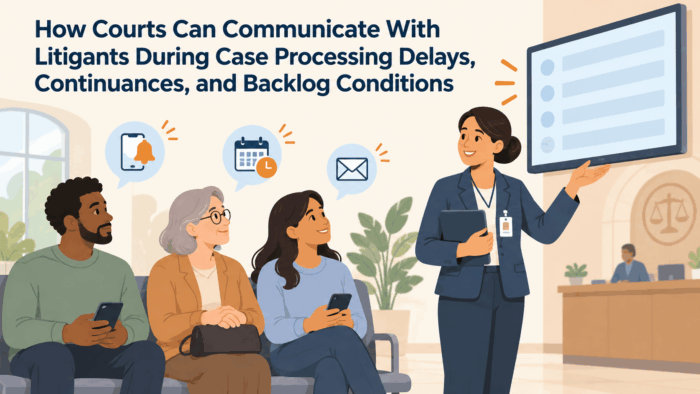
How Courts Can Communicate With Litigants During Case Processing Delays, Continuances, and Backlog Conditions
Case processing delays can be among the most frustrating aspects of the court experience for litigants. A continuance, postponed hearing, rescheduled trial, delayed order, or growing case backlog may affect employment, childcare, transportation, housing, family arrangements, legal expenses, personal safety, and the ability to plan around other obligations. Even when a delay results from legitimate procedural, staffing, scheduling, or case-specific circumstances, litigants may experience it simply as uncertainty about what is happening and why.
Courts cannot always prevent delays, nor can they guarantee when a case will reach a particular milestone. They can, however, reduce unnecessary confusion surrounding those delays. Clear communication can help litigants distinguish between a routine scheduling change and a more significant case-processing problem, understand whether they need to take action, identify which deadlines remain in effect, and know where to obtain authoritative information about the next stage of the proceeding.
This responsibility requires particular care because courts must communicate operational information without commenting on the merits of a pending case or implying how a judge may rule. Court staff also must avoid providing legal advice when explaining procedural status. Effective delay communication therefore depends on disciplined distinctions between information about scheduling and process, information that only a judge or court order can establish, and questions that litigants may need to address with an attorney, legal aid provider, self-help center, or other appropriate resource.
Courts that treat delay communication as part of access to justice can reduce the burden created by uncertainty even when the underlying delay remains unavoidable. The objective is not to make every litigant satisfied with the pace of the case. It is to ensure that people can understand what has changed, what has not changed, what they are expected to do next, and how the court will communicate additional developments.
Explain the Difference Between a Delay, a Continuance, and a Backlog
 Litigants may use the word “delay” to describe any situation in which a case takes longer than expected, but different procedural circumstances can have different meanings. A hearing may be continued to another date, a matter may remain pending while the court awaits filings or another required step, or a broader backlog may affect scheduling across many cases. Courts should explain these distinctions in plain language when they are relevant to what a litigant is experiencing.
A continuance is generally tied to a particular proceeding or scheduled event and results in that event being moved to another date or time. A backlog is broader and may reflect a volume of pending matters that exceeds available judicial, courtroom, staffing, or scheduling capacity. Other delays may arise from procedural requirements, incomplete filings, service issues, interpreter availability, discovery disputes, evaluations, or other case-specific circumstances depending on the type of case and applicable rules.
Public-facing communication should not imply that every postponement reflects a systemic backlog or that every backlog affects every case equally. Litigants need information about the circumstances affecting their own proceeding, while broader court communication can separately explain systemwide conditions when those conditions materially affect scheduling.
Making these categories understandable gives litigants a more accurate frame for interpreting what they see on the docket or hear from court staff. It also helps courts communicate about operational pressures without making unsupported assumptions about why a particular case has not moved forward.
Tell Litigants What Changed and What Did Not
When a hearing, conference, trial, or other event is postponed, the most useful communication begins with a direct explanation of what changed. Courts should identify the affected event, the prior date where appropriate, the new date if one has been established, and whether the litigant must take any immediate action.
Equally important is explaining what did not change. A continuance may not alter existing filing deadlines, protective orders, release conditions, temporary orders, payment obligations, discovery responsibilities, or other requirements unless the court has expressly modified them. Litigants should not be left to assume that postponement of one event automatically suspends every obligation associated with the case.
Courts should be particularly careful when the new schedule remains uncertain. If no replacement date has been set, communication should say that directly and explain how the litigant will be notified when scheduling occurs. Providing a speculative estimate can create greater confusion if the date later changes again.
A consistent “what changed, what remains in effect, and what happens next” framework can make rescheduling communication substantially easier to follow. It gives litigants the information needed to act without requiring them to interpret the procedural effect of the change on their own.
Make the New Date and Required Action Difficult to Miss
Rescheduling notices should make critical information visually prominent. The new date, time, location or remote-access instructions, and any action required before the appearance should not be buried in several paragraphs of procedural language.
Courts should also distinguish clearly between a confirmed new date and a date that remains subject to later scheduling. When the next event has not yet been set, the notice should identify the method through which the litigant will receive an update and direct the person to the authoritative case-information source where appropriate.
This simple communication discipline can reduce missed appearances and prevent litigants from relying on an earlier notice after the schedule has changed.
Court Communication Strategies for State and Local Judicial Systems: Building Public Trust, Improving Access to Justice, and Explaining Court Processes
This article is part of our series on strategic communication for State and Local Courts, Judicial Systems, and Court Administration. To learn more about court communication strategies for building public trust, improving access to justice, and explaining court processes, and to see the parent article, which links to other content just like this, click the button below.
Explain the Reason for a Scheduling Change Without Commenting on the Merits
Litigants often want to know why a proceeding has been continued or why their case has not moved forward. Courts should provide as much procedural explanation as is appropriate without discussing judicial reasoning that has not been placed on the record or commenting on disputed issues in a pending case.
In some situations, a neutral explanation may be straightforward. A courtroom may be unavailable, a judge may be reassigned, an interpreter may be unavailable, a required filing may still be pending, or the matter may have been continued by court order. Where the official record states the reason, communication can point litigants toward that information rather than creating a separate explanation that may differ from the record.
In other cases, staff may not be able to explain the underlying reason beyond what appears in the docket or order. Courts should be comfortable saying that the official order or docket contains the available information rather than speculating about judicial motives, attorney strategy, or the likely direction of the case.
This boundary supports both transparency and judicial integrity. Litigants receive procedural information that helps them understand the scheduling change while the court avoids statements that could be interpreted as commentary on a pending matter.
Distinguish Systemwide Backlog Information From Individual Case Status
When a court is experiencing substantial backlog conditions, public communication may need to explain broader operational pressures. Increased filings, judicial vacancies, staffing limitations, courtroom availability, technology transitions, or unusually complex calendars may affect how quickly matters can be scheduled. Courts can communicate those conditions without suggesting that every pending case is delayed for the same reason.
Systemwide information should provide context, not substitute for individual case information. A litigant needs to know the status of the specific proceeding, and a general statement about court congestion does not answer whether a filing has been processed, whether a hearing has been scheduled, or whether a judge has issued an order.
Courts should therefore maintain a clear separation between broad operational updates and case-specific information. A courtwide webpage may explain current scheduling pressures, while litigants are directed to the docket, clerk’s office, notification system, or other authoritative source for their own case.
This distinction also helps courts avoid creating the impression that backlog conditions excuse every delay. Some cases may move quickly despite broader congestion, while others may take longer for case-specific reasons. Accurate communication should preserve that complexity.
Avoid Giving Litigants False Precision About When a Case Will Move
Litigants understandably want dates. When courts are facing uncertain calendars or substantial backlogs, however, precise estimates can become counterproductive if they are repeatedly missed. Courts should avoid promising that a hearing, decision, or next procedural step will occur within a specific period unless that expectation is sufficiently reliable.
Where possible, courts can provide ranges, current scheduling practices, or procedural milestones rather than unsupported predictions. A court may be able to explain that certain matters are currently being scheduled several weeks or months ahead, while making clear that individual cases vary according to case type, judicial assignment, procedural posture, and other applicable factors.
The same caution applies to pending rulings or orders. Court staff should not predict when a judge will decide a matter unless an official timeline has been established. Statements that appear to promise judicial action can create expectations that staff are not authorized to fulfill.
Useful communication does not require certainty where certainty does not exist. Litigants are often better served by a realistic explanation of the current process and the next known milestone than by a specific estimate that may later prove inaccurate.
Explain What Litigants Should Do While the Case Is Delayed
Delay communication should not end with an explanation that the court is experiencing scheduling difficulties. Litigants need to understand whether they have responsibilities during the period before the next proceeding. Courts should identify any procedural obligations that remain visible from the official record and provide clear directions for obtaining further information.
This may include monitoring notices from the court, maintaining current contact information, complying with existing orders, meeting applicable filing deadlines, appearing on any other scheduled dates, or reviewing the docket for updates. Courts should present these responsibilities as procedural information and avoid advising litigants about what legal strategy they should pursue.
Self-represented litigants may need additional navigation assistance because they cannot rely on counsel to interpret every scheduling development. Courts can direct them toward self-help centers, approved forms, legal aid resources, or other appropriate assistance while maintaining the distinction between procedural guidance and legal advice.
The period between court events should therefore be treated as part of the communication process. A case may be temporarily inactive on the calendar while still requiring attention from the parties, and litigants should understand that difference.
Make Case Status Information Easy to Find and Verify
Litigants should have a reliable way to confirm whether a hearing has been continued, whether a new date has been assigned, or whether another case event has occurred. Courts should identify the authoritative source for current scheduling information and use consistent language across notices, websites, automated systems, and clerk communications.
Digital case information can be valuable, but courts should not assume that every litigant has reliable internet access, understands docket terminology, or knows which online entry controls when several documents appear. Public-facing instructions should explain where official scheduling information can be found and what to do when online information appears inconsistent with a received notice.
Courts should also make clear that unofficial sources, old calendar information, attorney websites, search engines, or third-party case services may not reflect the latest court action. When dates change, prior notices can remain in circulation, so litigants need a clear method for determining which information is current.
Reliable verification becomes especially important during periods of heavy backlog because schedules may change more frequently. One authoritative pathway for current information can reduce unnecessary calls, missed appearances, and reliance on outdated materials.
Recognize the Practical Hardship Created by Repeated Continuances
A continuance is a procedural event for the court, but for a litigant it may mean rearranging work, transportation, childcare, caregiving, medical appointments, interpreter assistance, or travel. Repeated scheduling changes can impose substantial burdens even when each continuance is procedurally justified.
Courts should acknowledge these practical effects in the way scheduling information is communicated. This does not require apologizing for judicial decisions or implying that a continuance was improper. It means giving notice as promptly as circumstances allow, clearly identifying new obligations, and avoiding unnecessary ambiguity that forces litigants to make plans around incomplete information.
Communication systems should also account for the possibility that litigants will miss an update if the court relies on only one channel. Where available and appropriate, electronic notifications, mailed notices, case portals, automated reminders, or other tools can reinforce significant scheduling changes while the official record remains controlling.
Respectful communication cannot eliminate the inconvenience created by delay. It can prevent the court’s communication practices from adding avoidable hardship to a situation that is already difficult for litigants to manage.
Explain the Procedural Consequences of a Continuance
A continuance changes the timing of a court event, but litigants may not understand what other procedural consequences follow from that change. Courts should explain whether the continuance affects related deadlines, future appearances, briefing schedules, temporary orders, discovery obligations, or other case requirements when that information is reflected in the court’s order or rules.
This is especially important when a hearing date moves but another obligation does not. A litigant may assume that every deadline tied to the original hearing has also shifted, even when the court has not ordered that change. Clear notices should identify which obligations remain in effect and direct litigants to the controlling order when necessary.
Courts should also distinguish between an automatic rescheduling process and a continuance that requires further action. In some matters, the court may assign a new date immediately. In others, the parties may need to wait for a future scheduling order, conference, or calendar notice.
This procedural clarity helps reduce missed deadlines and unnecessary inquiries. Litigants are better able to manage the case when they understand the effect of the continuance rather than seeing only a changed date.
Communicate Repeated Continuances With Greater Context
A single scheduling change may be relatively easy to understand. Repeated continuances are more difficult because they can create uncertainty about whether the case is progressing at all. Courts should provide additional procedural context when a matter has been rescheduled multiple times.
Where appropriate, communication can identify whether the latest continuance results from a court order, scheduling conflict, unresolved procedural issue, pending evaluation, incomplete service, attorney availability, or another reason stated in the record. Courts should avoid adding explanations that are not part of the official record or speculating about the motives of a party or judge.
Repeated changes also increase the importance of clearly identifying the current controlling date. Old notices, calendar entries, text reminders, or printed documents may remain in a litigant’s possession. The latest communication should make it obvious that prior scheduling information has been superseded.
Greater context does not eliminate frustration, but it can reduce the sense that the case is moving without explanation. Litigants are more likely to understand the process when each scheduling change is connected to the current procedural status.
Explain What a Backlog Means for Different Types of Cases
Court backlogs do not necessarily affect every case category in the same way. Criminal, civil, family, housing, probate, juvenile, traffic, and other calendars may face different scheduling pressures, statutory priorities, judicial resources, and procedural requirements.
Courts should avoid broad statements that suggest all matters are delayed equally. If backlog conditions are concentrated in particular divisions or case types, public communication should make that distinction visible. Litigants need information that is relevant to the calendar handling their case.
The court can also explain that some matters may receive priority because of legal requirements, emergency circumstances, custody issues, public safety considerations, or other applicable standards. This should be described neutrally and generally rather than in a way that suggests how any particular pending matter will be decided.
More precise backlog communication helps litigants form realistic expectations. It also reduces the risk that a systemwide message about congestion is interpreted as a prediction about one individual case.
Avoid Treating Average Processing Times as Promises
Courts may publish average or typical processing times to help the public understand workload conditions. These figures can be useful, but they should be presented as general context rather than as guarantees.
A litigant whose case extends beyond an average may otherwise assume that something has gone wrong or that the court has overlooked the matter. Courts should explain that individual timelines can vary based on case complexity, motions, service, evidence, party availability, judicial assignment, and other procedural factors.
Average timing information is most useful when it helps set expectations without creating false precision.
Communicate Delayed Rulings Carefully
Litigants may become particularly concerned when a hearing has occurred but a ruling has not yet been issued. The court should provide procedural information where available without predicting when the judge will decide the matter or suggesting what the outcome may be.
Court staff can explain whether the matter remains under advisement, whether additional filings have been ordered, or whether another procedural step is pending if that information appears in the official record. They should not speculate about the reasons for the length of deliberation or imply that delay favors one party.
Public-facing guidance can also explain that judicial decision-making timelines vary depending on the type and complexity of the matter. Where applicable, courts may point litigants to rules or official case information governing status inquiries rather than offering informal estimates.
Careful communication protects judicial independence while still helping litigants understand that the matter remains active. Silence should not force people to guess whether a ruling was issued, delayed, or lost in the process.
Explain How Staffing and Operational Conditions Affect Case Processing
Some delays arise from operational constraints rather than case-specific circumstances. Judicial vacancies, staff shortages, courtroom limitations, interpreter availability, technology problems, or temporary facility disruptions can affect how quickly cases move.
Courts can communicate these conditions at a system level when they materially affect service. Doing so can provide useful context without suggesting that operational challenges excuse every delay or determine the outcome of any case.
The communication should focus on practical effect. If a staffing shortage is extending processing times for filings or a courtroom closure is reducing hearing capacity, litigants should understand which services are affected and what temporary procedures apply.
Operational transparency is most useful when paired with current instructions. Litigants need to know not only that the court is experiencing constraints, but also whether those constraints change filing procedures, hearing locations, notification practices, or expected response times.
Make Self-Represented Litigants a Priority Audience During Delays
Represented litigants can often rely on counsel to interpret continuances, procedural changes, and docket activity. Self-represented litigants may have to make those interpretations on their own, which makes clear court communication especially important during periods of delay.
Courts should provide plain-language explanations of scheduling status, next procedural steps, and available self-help resources without crossing into legal advice. Notices should avoid unnecessary legal terminology where a simpler explanation can convey the same procedural information accurately.
Self-help centers, court navigators, approved instructional materials, and referral resources can be particularly valuable when a delay creates questions about forms, deadlines, or future appearances. These resources should be easy to locate from the same pages or notices that communicate the scheduling change.
Designing delay communication around the needs of self-represented litigants improves accessibility for the broader public as well. Clearer explanations benefit represented parties, family members, interpreters, advocates, and anyone trying to understand the case-processing system.
Coordinate Scheduling Communication Across Court Channels
Litigants may receive court information through mailed notices, electronic filing systems, text reminders, online calendars, case portals, clerk communications, and courtroom announcements. When schedules change, these channels should not display conflicting information for longer than necessary.
Courts should establish which system serves as the authoritative source and how updates propagate across related tools. A litigant who receives a text reminder for an old hearing date after a continuance may reasonably question whether the case was actually rescheduled.
Public instructions should explain what litigants should do when two sources appear inconsistent. Directing users to the controlling court order, docket entry, clerk’s office, or other designated source can reduce uncertainty.
Coordination across channels becomes more important during backlog conditions because scheduling changes may occur more frequently. Reliable synchronization helps prevent the court’s own communication systems from contributing to missed appearances or unnecessary confusion.
Explain When a Delay Requires No Action From the Litigant
 Not every delay requires the litigant to file something, contact the court, or request a new date. Courts should say explicitly when no immediate action is required.
This can reduce unnecessary calls and filings from people who believe they must respond simply because the case has been postponed. The notice can explain that the court will issue additional information when the next event is scheduled or that existing obligations remain in place unless modified by a later order.
The same communication should identify any circumstances that do require action, such as maintaining updated contact information, complying with an existing order, or reviewing a new scheduling notice when it arrives.
Telling litigants when they do not need to act is an important form of procedural clarity. It reduces burden on both the public and court staff while helping people focus on the obligations that actually matter.
Organize Delay Communication Around the Questions Litigants Are Actually Asking
When cases slow down, litigants usually are not looking for a broad explanation of court administration. They want to know whether their case is still active, why the next event has not occurred, whether they need to do anything, and when they should expect another update. Courts should organize delay communication around those practical questions rather than around internal scheduling processes.
This is especially important during periods of backlog, when litigants may hear that the court is experiencing systemwide delays but still have no clear information about their own matter. A general notice about congestion should therefore be paired with case-specific pathways for checking status, confirming upcoming events, and understanding whether any immediate obligations remain.
Courts can also reduce confusion by separating questions they can answer from questions that remain dependent on judicial action. Staff may be able to explain whether a hearing has been rescheduled, whether a filing has been docketed, or whether another notice will be issued. They should not predict when a judge will rule or speculate about why a particular matter has not yet been decided.
A question-centered approach makes delay communication more useful without crossing into legal advice. Litigants receive practical navigation through the process while the court preserves appropriate boundaries around judicial decision-making.
Explain What a Litigant Can Reli On as the Authoritative Status
Backlog conditions can create an environment in which litigants receive multiple pieces of information at different times. A mailed notice may show one date, an online calendar another, and a text reminder may still reflect an earlier schedule. Courts should make clear which source controls when these channels do not appear to match.
The authoritative source may be the court order, docket, official case-management system, clerk’s office, or another designated source depending on the court’s structure. Litigants should not have to determine this hierarchy on their own.
Public-facing instructions should also explain how quickly updates may appear across systems. If an electronic reminder service is supplemental rather than controlling, that limitation should be stated directly. This reduces the risk that a litigant relies on a secondary system that has not yet been updated.
Clarity about the authoritative source becomes especially important when continuances occur close to a scheduled appearance. A reliable verification pathway can prevent missed hearings, unnecessary travel, and avoidable calls to multiple court offices.
Communicate Differently When the Delay Is Court-Created, Party-Requested, or Procedurally Required
Not all delays arise from the same source. Some result from court scheduling or operational capacity, others from motions or requests by one or more parties, and others from procedural requirements that must be completed before the case can advance. Courts should explain these distinctions where the official record supports them.
When the court itself reschedules a matter because of calendar or operational conditions, the communication can say so directly. When a continuance is granted on motion, the notice should reflect the procedural action without implying that the court endorses the reasons advanced by either party beyond what the order states.
Some delays may arise because a statutory, evidentiary, service, evaluation, or other procedural step has not yet been completed. In those situations, courts should explain the process in neutral terms rather than assign blame unless the official record does so.
This distinction helps litigants understand that “delay” is not one uniform condition. It can result from very different procedural circumstances, and the communication should reflect that difference accurately.
Avoid Framing Every Delay as Administrative
Courts should be careful not to describe every scheduling problem as a backlog or administrative issue when the actual cause is case-specific. Doing so can create a misleading impression about the court’s operations.
Similarly, a systemwide backlog should not be hidden behind vague case-specific language if the broader condition is materially affecting scheduling across many matters. The explanation should match the actual source of delay as closely as the official record allows.
Accurate framing supports credibility because litigants are less likely to receive explanations that appear generic or disconnected from what is happening in their case.
Explain Delay Without Making Litigants Feel Their Case Has Been Forgotten
One of the most damaging effects of prolonged inactivity is the perception that the case has disappeared within the system. Even when the matter remains properly pending, long periods without visible activity can make litigants question whether the court is still tracking it.
Courts should communicate continued status when appropriate, particularly in categories of cases affected by substantial backlog. A status page, periodic update, docket notation, or other official communication can confirm that the matter remains pending even when no new hearing date has been assigned.
This does not require courts to create unnecessary notices for every inactive period. The objective is to prevent prolonged silence from becoming the only information litigants receive. Where delays are likely to be substantial, courts can explain what stage the case remains in and what event or action is expected to move it forward.
This type of communication can reduce repeated status inquiries while also helping litigants distinguish inactivity from administrative loss or abandonment.
Explain How Priority Scheduling Works Without Suggesting That Some Litigants Matter More
Courts may need to prioritize certain matters because of statutory requirements, emergency circumstances, custody considerations, public safety, time-sensitive rights, or other legally relevant factors. During backlog conditions, this can mean that some cases move more quickly than others.
Courts should explain priority scheduling carefully. The public should understand that different case categories may be governed by different timing requirements without hearing the message that some parties are more deserving of attention than others.
The communication should focus on the procedural basis for prioritization. Courts can explain that certain matters receive expedited scheduling because of applicable law, emergency conditions, or case type, while avoiding commentary on the relative importance of individual disputes.
This distinction can help reduce frustration when litigants compare their own timeline with another case that appears to be moving more quickly. It provides context without undermining confidence in equal treatment.
Make Status Updates Useful Even When There Is No New Date
Courts may sometimes have no new hearing date, ruling date, or scheduling milestone to provide. That does not mean a status update has to be empty. Litigants can still benefit from knowing what remains pending and what event will determine the next step.
A useful update might explain that the case is awaiting judicial review, a scheduling order, completion of service, submission of required materials, or another procedural action reflected in the record. Where the court cannot identify a specific date, it should avoid inventing an estimate simply to provide reassurance.
The update should also say whether the litigant needs to do anything during that period. If no immediate action is required, that can be stated directly. If a deadline or existing order remains in effect, the communication should make that equally clear.
Providing meaningful status without false precision can reduce anxiety and unnecessary contact. It gives litigants information they can rely on even when the court cannot yet tell them exactly when the next event will occur.
Use Plain Language to Explain Docket Activity During Delays
Litigants may see docket entries that are technically accurate but difficult to interpret, particularly during a prolonged or repeatedly continued case. Terms such as “continued,” “under advisement,” “reset,” “held in abeyance,” or other procedural language may not make the practical consequence obvious to someone unfamiliar with court process.
Courts should provide plain-language support for common case-status terms where feasible. This may take the form of glossary content, help text, self-help resources, or short explanations accompanying online status information.
Plain-language explanation should not reinterpret the court’s order or substitute for the official docket. Its purpose is to help litigants understand the procedural significance of commonly encountered terms so they can navigate the record more effectively.
This is particularly valuable for self-represented litigants, who may have no attorney translating procedural entries into practical meaning. Better docket explanation can reduce misunderstanding without requiring court staff to provide individualized legal advice.
Coordinate Delay Communication With Accessibility and Language Access
Scheduling changes and backlog updates can create additional barriers for litigants who use interpreters, have disabilities, or rely on translated information. Courts should ensure that delay communication remains accessible when dates, locations, or appearance formats change.
If an interpreted hearing is continued, the new communication should make clear whether interpretation arrangements will carry forward or whether the litigant needs to take another step. Similarly, changes from in-person to remote appearance may create accessibility implications that should be addressed in the updated notice.
Translated notices and multilingual information should be updated at the same time as English-language versions whenever practical. A delayed translation of a new hearing date can create the same harm as a delayed notice.
Accessible delay communication is not a separate administrative concern. It is part of ensuring that all litigants receive the same practical opportunity to comply with court instructions and appear when required.
Create a Clear Communication Handoff When a Case Moves Between Departments or Judicial Assignments
Cases may move between judges, courtrooms, divisions, clerks, specialized calendars, or other internal structures over time. During periods of delay, these transitions can make it harder for litigants to know who is responsible for the next update.
Courts should make significant handoffs visible when they affect how litigants receive information. If the case has been reassigned, transferred, or moved to another calendar, the communication should identify where future notices will come from and whether any prior contact information has changed.
Internal handoffs should also preserve communication history. New staff should be able to see prior continuances, notices, accessibility needs, and unresolved scheduling issues so litigants do not have to reconstruct the history each time the case changes hands.
A clear transition reduces fragmentation. Litigants experience one continuous court process even when responsibility for managing the case shifts internally.
Build Delay Communication Into Court Operations
Delay communication is most reliable when it is built into case management and scheduling operations rather than handled only after litigants begin calling for answers. Courts should identify communication responsibilities at the same time they establish calendaring, continuance, reassignment, and backlog management procedures.
Operational planning should define who updates the docket, who issues notices, who maintains online calendars, who communicates systemwide backlog information, and who responds when a litigant reports conflicting information. These functions may involve several departments, but the handoff between them should be clear enough that a scheduling change does not create inconsistent public information.
Courts should also identify which events trigger an affirmative communication. A continuance, courtroom change, judicial reassignment, altered appearance format, extended processing delay, or newly available hearing date may each warrant a different type of notice.
Integrating communication into operations reduces the risk that litigants learn about changes indirectly or too late. It also helps the court treat communication as part of case administration rather than as a separate customer-service function.
Create Standard Communication Frameworks for Common Delay Scenarios
Courts should develop repeatable communication frameworks for common situations such as continued hearings, delayed rulings, reassignment, courtroom closure, staffing-related backlog, unavailable interpreters, and systemwide scheduling pressure. Standardization can improve speed and consistency without turning every notice into generic boilerplate.
Each framework should answer the same core questions: what changed, why the court can explain the change, what remains in effect, whether the litigant needs to act, and where the next authoritative update will appear. The specific content should then be adapted to the circumstances of the case.
Templates should also distinguish between information that court staff can communicate and information that depends on a judicial order or case-specific ruling. This protects staff from being placed in the position of interpreting judicial intent or offering legal advice.
A strong standard framework helps litigants receive familiar, understandable information even when the cause of delay varies. It also reduces the likelihood that different court divisions explain similar scheduling events in materially different ways.
Coordinate Case Management Systems, Notices, and Reminder Tools
Modern courts often rely on several systems to communicate scheduling information, including case management software, electronic filing systems, mailed notices, text reminders, online calendars, and public case portals. These tools should be coordinated so that one scheduling change does not produce several conflicting versions of the record.
Courts should establish which system serves as the source of truth and how changes are propagated across secondary communication channels. Staff should know what happens when an update fails to synchronize and what guidance should be given to litigants who report inconsistent information.
Reminder systems deserve particular attention because litigants may treat a text or email alert as authoritative. If those services are supplemental, the court should communicate that limitation clearly while still working to keep them current.
Reducing system conflicts can directly reduce missed appearances and unnecessary calls. It also strengthens confidence that the court’s digital tools reflect the same procedural status as the official record.
Create a Clear Correction Process for Scheduling Errors
Even well-managed systems can produce incorrect or outdated information. Courts should have a defined process for correcting scheduling errors across the docket, online systems, mailed notices, and reminder tools.
The correction should identify the current controlling information and, where appropriate, state that an earlier notice or entry should no longer be relied upon. This is particularly important when the error affects an imminent hearing or appearance.
A visible correction process helps the court resolve mistakes without forcing litigants to determine which version of the schedule is valid.
Prepare Staff to Communicate Delay Without Giving Legal Advice
Clerks, call-center staff, court navigators, self-help personnel, and other front-line employees are often the people litigants contact first when a case is delayed. Courts should prepare these staff to explain procedural status clearly while maintaining appropriate limits.
Training should distinguish between procedural information and legal advice. Staff may explain that a hearing was continued, that a new date has not yet been assigned, or that a filing remains pending. They should not advise a litigant whether to file a motion, whether a continuance benefits one side, or what strategy should be pursued because of the delay.
Staff should also know how to handle questions they cannot answer. A clear referral pathway to the docket, judicial order, self-help center, legal aid provider, or other appropriate resource is more useful than speculation.
Consistent staff preparation reduces variation in the answers litigants receive. It also gives employees a practical framework for being helpful without crossing boundaries that protect judicial neutrality and the integrity of pending matters.
Build Accessibility and Language Access Into Rescheduling Systems
Continuances and backlog conditions can create disproportionate burdens for litigants who rely on interpreters, translated notices, disability accommodations, transportation assistance, or other access supports. Courts should ensure that rescheduling systems preserve those arrangements whenever a case event changes.
If an interpreter was arranged for the original hearing, the court should have a process for determining whether interpretation will automatically transfer to the new date or whether another request is required. Similar attention may be necessary for assistive listening, remote-access accommodations, mobility needs, or other approved arrangements.
Translated scheduling notices should be updated promptly when material information changes. A litigant who receives a new English-language date but must wait for the translated notice does not have equal practical access to the schedule.
Embedding these considerations into operational workflows is more reliable than addressing them case by case after a problem arises. Accessibility remains part of the scheduling system rather than an additional task performed only when someone complains.
Plan Communication for Sustained Backlog Conditions
Short-term disruption requires a different communication strategy from a backlog that is expected to persist for months. Courts facing sustained congestion should develop an ongoing public communication framework rather than issuing isolated notices whenever delays become visible.
The framework can explain which case categories are most affected, what operational measures the court is taking, how litigants can check individual status, and when broader backlog information will be updated. The court should avoid repeatedly announcing the same general problem without providing practical navigation.
Sustained backlog communication should also evolve as conditions improve or worsen. If scheduling intervals change, judicial capacity increases, or particular calendars recover more quickly than others, public information should reflect those developments.
This approach helps the court demonstrate that backlog conditions are being actively managed rather than simply acknowledged. It gives litigants a more realistic basis for understanding changes over time.
Measure Where Delay Communication Is Failing
Courts should evaluate delay communication by examining where litigants remain confused, not only by counting the number of notices or webpage visits. Repeated calls about the same scheduling issue can reveal that existing notices are not sufficiently clear.
Useful indicators may include missed appearances following continuances, recurring questions about whether deadlines moved, reports of conflicting dates, high volumes of status calls, interpreter-related rescheduling problems, or repeated confusion about where authoritative information is located.
Front-line staff can provide important insight because they hear the questions litigants ask after receiving formal notices. Self-help centers, clerk offices, and court navigators may be able to identify patterns that are not visible in administrative statistics alone.
Measurement should lead to operational improvement. Courts can revise templates, update digital systems, improve staff guidance, change notification timing, or strengthen case-status instructions based on the confusion they observe.
Preserve Institutional Knowledge About Delay and Backlog Communication
Courts should not depend entirely on individual staff members who know how to manage difficult scheduling situations because of years of experience. Those practices should be documented so they survive turnover, reassignment, emergencies, and changes in court leadership.
Institutional resources can include continuance templates, backlog communication protocols, staff scripts, accessibility procedures, escalation pathways, system correction processes, and guidance for handling repeated litigant inquiries. These resources should be reviewed periodically as court technology and operations change.
Courts should also preserve lessons from major periods of disruption. A prolonged backlog, courthouse closure, judicial vacancy, or technology failure may reveal recurring weaknesses in how scheduling information moves from internal systems to litigants.
Building this knowledge into court operations creates a more durable communication system. Litigants are more likely to receive consistent information even when the people, systems, or operational pressures managing their cases change.
Strategic Communication Support for Court Delay and Backlog Communication
 Case processing delays, continuances, and backlog conditions can create substantial communication demands for courts because litigants need timely procedural information while judges and staff must preserve neutrality, avoid legal advice, and maintain the integrity of pending matters. Courts may understand internally why schedules are shifting, which case categories are most affected, and how operational constraints are being managed, yet litigants may experience the same conditions as uncertainty, silence, or inconsistency. External strategic communication support can help courts organize those operational realities into clearer public information systems without interfering with judicial decision-making.
Stegmeier Consulting Group (SCG) can support state and local courts by developing delay communication frameworks, continuance notice templates, backlog explainers, case-status guidance, public FAQs, staff talking points, self-help content, multilingual materials, website structures, reminder-system guidance, and communication protocols for major operational disruptions. SCG can also help courts align messaging across clerk offices, self-help centers, court administration, judicial leadership, public information staff, and digital channels so that litigants receive consistent information about what changed, what remains in effect, and what happens next.
External support can be especially useful when internal capacity is limited, when several divisions are communicating differently, or when an objective outside perspective can identify where technically accurate notices are still creating confusion for litigants. SCG’s role remains focused on communication strategy, information organization, public-facing systems, and stakeholder understanding. SCG does not provide legal advice, interpret judicial intent, make scheduling decisions, determine case priority, or communicate substantive conclusions about pending matters on behalf of the court.
Future Trends
Courts will increasingly be expected to provide more transparent and real-time case-status communication as litigants become accustomed to digital tracking in other areas of public and private service. Online portals, text notifications, email alerts, and automated reminders will likely play a larger role in communicating scheduling changes, but those tools will need to remain synchronized with the official court record.
Backlog communication will also become more data-informed. Courts may increasingly publish systemwide processing information, scheduling ranges, or workload conditions to help the public understand broader operational pressures. These tools can improve transparency, but courts will need to present them carefully so average processing times are not mistaken for guarantees about individual cases.
Accessibility and language access will become more important as scheduling communication moves further into digital systems. Courts will need to ensure that rescheduling notices, remote-appearance instructions, interpreter information, and case-status tools remain usable by litigants who rely on translated content, disability accommodations, or non-digital alternatives.
Technology can improve notification speed and reduce routine status inquiries, but it will not eliminate the need for human judgment. Courts will still need to decide what can be communicated about the reason for a delay, how to distinguish case-specific circumstances from systemwide backlog, and how to provide useful information without crossing into legal advice or commentary on pending matters.
Conclusion
Case processing delays and continuances are not merely scheduling issues from the litigant’s perspective. They can affect work, transportation, childcare, housing, family responsibilities, legal expenses, and the ability to plan around important court obligations. Courts cannot always eliminate these disruptions, but they can reduce the uncertainty surrounding them.
Effective communication begins by telling litigants what changed, what remains in effect, whether they need to act, and where the authoritative case information can be found. It also requires courts to distinguish between individual case delay, systemwide backlog, judicial decision-making, and operational constraints so that one explanation is not used to describe several different circumstances.
The strongest court communication systems remain consistent across mailed notices, portals, clerk communications, reminder tools, self-help resources, and public webpages. They also preserve accessibility, language access, and clear staff boundaries so that self-represented litigants and other court users can navigate scheduling changes without needing specialized knowledge of court administration.
Backlogs and continuances may continue to frustrate litigants even when communication is strong. The goal is not to persuade people that delay is acceptable. It is to ensure that the court does not add unnecessary confusion to an already difficult experience and that litigants can continue participating in the process with a clear understanding of what happens next.
Stegmeier Consulting Group’s Strategic Approach to Communication Systems
Make case delays easier to navigate by connecting scheduling changes, case-status information, staff guidance, accessibility, and litigant expectations in one clear communication system.
State and local courts need communication systems that help litigants understand continuances, backlog conditions, delayed rulings, scheduling changes, and next procedural steps without requiring them to interpret complex court operations on their own. Stegmeier Consulting Group (SCG) helps courts organize case-processing information, strengthen plain-language notices, align public-facing communication across departments and digital channels, improve accessibility and self-help guidance, and build durable communication frameworks that reduce confusion while preserving judicial neutrality.
Use the form below to connect with our team and explore how strategic communication support can strengthen court delay and backlog communication.