
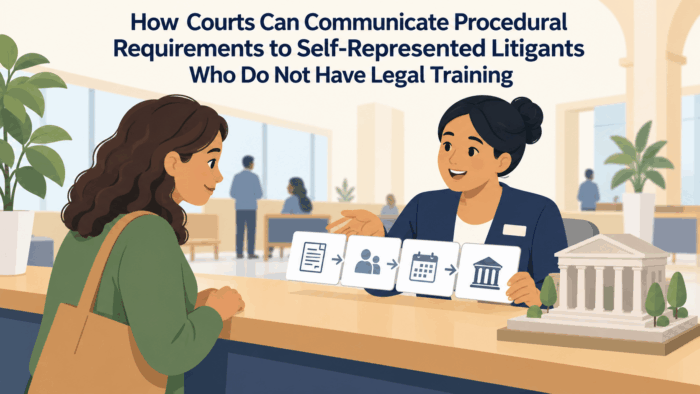
How Courts Can Communicate Procedural Requirements to Self-Represented Litigants Who Do Not Have Legal Training
Self-represented litigants often enter court at the point where legal procedure becomes consequential but remains unfamiliar. They may be responsible for filing documents, meeting deadlines, serving another party, appearing at a hearing, responding to an order, or presenting information to the court without the training that attorneys use to navigate those requirements routinely. For court administrators, that creates a communication challenge that is both practical and institutional. Courts must help people understand how to participate in the process without crossing the line into individualized legal advice.
The difficulty is not that court procedures are inherently impossible to explain. It is that many procedural requirements are embedded in legal terminology, formal notices, local rules, filing systems, and case-specific sequences that assume some prior knowledge of how courts work. A person without legal training may not know which requirement is mandatory, which document is informational, which deadline controls the next step, or what happens after a filing is submitted. Even when the correct information is technically available, it may not be usable.
Court administrators can address this gap by treating procedural communication as a core access function. The objective is not to teach self-represented litigants substantive law or strategy. It is to make procedural obligations visible, organized, and understandable enough that people can identify what they need to do, when they need to do it, where they need to do it, and where they can obtain further authorized assistance.
That distinction matters because poor procedural communication creates consequences beyond user frustration. It can contribute to incomplete filings, missed deadlines, unnecessary continuances, repeat visits to clerk counters, confusion at hearings, and additional workload for staff. Clear communication supports both court users and court operations by reducing preventable administrative errors before they reach the courtroom.
Start With the Procedural Decision the Litigant Must Make
 Court information is often organized around rules, forms, and departments rather than around the decision the litigant is facing. Self-represented users may be asked to select a filing category or procedural pathway before they understand what those categories mean.
Court administrators should structure public guidance around recognizable actions such as responding to court papers, filing a document, serving another party, preparing for a hearing, requesting an interpreter, or understanding what happens after a judge issues an order.
This approach helps users identify the correct procedural pathway before they become lost in internal court structure. It also reduces the chance that they choose the wrong form or resource simply because the terminology is unfamiliar.
A decision-centered structure does not eliminate the underlying legal rules. It makes those rules easier to reach by starting with the practical question the litigant already understands.
Separate Procedural Information From Legal Advice Clearly and Positively
Self-represented litigants often do not know where the boundary lies between procedural information and legal advice. A question about how to file may quickly become a question about what to argue, which claim to bring, or whether a particular position is likely to succeed.
Court administrators should explain this boundary in language that remains helpful rather than defensive. Staff may be able to explain where a form is filed, what a deadline refers to, what the next procedural step is, or where self-help resources are available. They cannot tell the litigant which legal argument to make or what strategy is best.
The distinction should be visible in websites, self-help materials, staff guidance, and public-facing notices. When people understand the boundary in advance, they are less likely to interpret a refusal to give legal advice as unwillingness to help.
Clear boundary communication also protects staff. It gives front-line employees a consistent framework for answering questions without improvising around difficult legal-advice issues.
Use Referral Paths Instead of Dead Ends
When a question crosses into legal advice, the response should not end with a simple refusal if an appropriate referral exists.
Court administrators can direct litigants toward self-help centers, legal aid organizations, lawyer referral services, or other authorized resources depending on what is available in the jurisdiction.
The referral should explain what that resource may be able to provide and how to access it. This keeps the interaction constructive while preserving the court’s neutral role.
Court Communication Strategies for State and Local Judicial Systems: Building Public Trust, Improving Access to Justice, and Explaining Court Processes
This article is part of our series on strategic communication for State and Local Courts, Judicial Systems, and Court Administration. To learn more about court communication strategies for building public trust, improving access to justice, and explaining court processes, and to see the parent article, which links to other content just like this, click the button below.
Explain Procedural Requirements as a Sequence, Not as Isolated Rules
Self-represented litigants often receive instructions one requirement at a time. A form must be filed, a copy must be served, a hearing must be attended, and a response may be due later. Without a clear sequence, those requirements can feel unrelated.
Court administrators should explain procedures as a progression. Users should be able to see what happens first, what follows, what triggers the next step, and where deadlines fit into the process.
This is especially important when one action does not complete the matter. Filing a document may begin a process rather than end it. Attending a hearing may produce another order or deadline. Serving another party may be a separate requirement from filing with the court.
Sequence-based communication helps users understand the procedural logic of the case. It reduces the risk that someone completes one step and assumes no further action is required.
Explain Forms by Purpose Before Explaining How to Complete Them
Court forms can be intimidating because they often present legal terminology without first explaining what the form is designed to accomplish. A self-represented litigant may understand how to enter information into a field without understanding why the document is being filed.
Court administrators should introduce common forms with a plain-language explanation of purpose. Users should know what the form generally does, when it is typically used, and what happens after it is submitted.
This does not require the court to advise a litigant whether a particular filing is strategically appropriate. It simply helps the user understand the procedural role of the document.
Purpose-based explanations make form instructions more meaningful. Litigants are better able to follow technical directions when they understand how the form fits into the larger court process.
Make Deadlines Visible and Explain What They Control
Deadlines can be among the most consequential procedural requirements for self-represented litigants, yet the significance of a date is not always obvious from a notice or form.
Court administrators should make deadlines prominent and explain what action the date controls. A response deadline, filing deadline, service deadline, hearing date, and payment date are not interchangeable.
Where appropriate, communication can explain that missing a deadline may affect the case while avoiding predictions about the legal consequence in an individual matter.
The court should also identify where users can verify the current deadline. This is especially important when schedules change or when different documents contain several dates.
Explain Service Requirements Without Assuming Prior Legal Knowledge
Service is a common source of confusion because many self-represented litigants do not understand that filing a document with the court and providing it to another party can be separate procedural obligations.
Court administrators should explain what service means, why it exists, who may perform it under applicable rules, what proof may be required, and where users can find the governing instructions.
The explanation should avoid giving case-specific strategy. Its purpose is to make the procedural requirement understandable enough that users know it is a distinct step.
Clear service communication can prevent a filing from appearing complete to the user when an additional procedural obligation remains unresolved.
Use Plain Language Without Removing Necessary Legal Terms
Self-represented litigants need understandable explanations, but they also need to recognize the legal terms they will continue encountering in court documents and hearings.
Court administrators should retain necessary formal terminology while providing immediate plain-language explanation. Terms such as motion, continuance, service, appearance, order, judgment, petitioner, respondent, plaintiff, and defendant should not be left undefined simply because they are common within the court.
This approach helps users build procedural vocabulary over time. They can connect the formal term to the practical meaning rather than relying on simplified language that may not appear again elsewhere.
Plain language should therefore function as a bridge into the court’s terminology, not as a substitute that disconnects public guidance from the documents litigants will actually receive.
Explain What Happens After a Filing Is Submitted
Self-represented litigants may assume that submitting a form means the court has accepted their legal position or that the requested outcome has been granted. Court administrators should explain what filing actually means procedurally.
A filed document may be reviewed, scheduled, served, opposed, returned for correction, or placed before a judge depending on the process involved. The court should explain the next administrative step without predicting the judicial outcome.
Users should also know how to confirm that a filing was received and where future notices or case updates will appear.
This prevents one of the most common procedural misunderstandings. Submission is often only one stage in a larger process, and clear communication should make that visible from the beginning.
Design Procedural Guidance Around Common Failure Points
Self-represented litigants often encounter the same procedural difficulties repeatedly. They may use the wrong form, miss a required signature, overlook a service requirement, misunderstand a hearing notice, or fail to complete a follow-up step because the sequence was not clear.
Court administrators should identify these recurring failure points and build communication around them. Information from rejected filings, clerk inquiries, self-help requests, missed appearances, and incomplete submissions can reveal where procedural instructions are not working as intended.
Once those patterns are visible, courts can place clarification directly at the point where confusion usually occurs. A filing instruction can explain the most common missing elements, a hearing notice can distinguish preparation from appearance requirements, and a service guide can show where proof of service fits into the larger process.
This approach turns procedural communication into an operational improvement tool. Instead of relying on staff to correct the same misunderstandings individually, the court addresses the source of confusion in the communication system itself.
Distinguish Mandatory Steps From Optional Resources
Self-represented litigants may struggle to identify which instructions are required and which resources are simply available to help them. A webpage may place a filing deadline, an optional worksheet, a self-help appointment, and general educational material in the same visual hierarchy.
Court administrators should make procedural priority visible. Required filings, appearances, service obligations, deadlines, and other mandatory steps should be clearly distinguished from optional tools and supplemental resources.
This does not mean that optional resources are unimportant. Self-help services, informational videos, checklists, and workshops may substantially improve a litigant’s ability to navigate the process. The communication should simply make clear that using those resources is different from satisfying a procedural requirement.
Clear prioritization helps users allocate attention correctly. It reduces the risk that someone completes an optional educational step while overlooking a mandatory action that affects the case.
Explain Procedural Consequences Without Giving Case-Specific Advice
Self-represented litigants often want to know what will happen if they do not complete a required step. Court administrators need to communicate enough about procedural consequences to make the requirement meaningful without predicting the outcome of an individual case.
General guidance can explain that missing a filing deadline, failing to appear, or not completing a required service step may affect how the case proceeds. The exact consequence may depend on the case, the applicable rules, and judicial determination.
This balance is important because instructions that omit consequences can make mandatory steps appear optional. At the same time, overly specific warnings can become inaccurate or sound like legal advice.
The stronger approach is to explain the procedural significance of the requirement and direct users toward appropriate legal assistance when individualized interpretation is necessary.
Make Hearing Preparation Distinct From Hearing Advocacy
Self-represented litigants may not know the difference between preparing procedurally for a hearing and preparing the substance of their legal argument. Court administrators can provide meaningful assistance with the first while remaining outside the second.
Procedural preparation can include confirming the hearing date and location, understanding whether the appearance is in person or remote, knowing how to check in, arranging interpretation or accessibility support, locating filed documents, and understanding general courtroom expectations.
The court should avoid telling litigants which evidence to present, which witnesses to call, what arguments to emphasize, or how to persuade the judge. Those questions move into legal strategy.
Making this distinction explicit helps users understand why the court can assist extensively with logistics and process while remaining neutral about the substance of the dispute.
Explain the Purpose of Different Hearing Types
A first-time litigant may assume that every hearing is designed to resolve the entire case. In reality, hearings may serve very different procedural functions.
Court administrators can provide general explanations of common hearing types used in the jurisdiction, including whether the proceeding is typically focused on scheduling, a specific motion, case management, settlement, evidence, or another procedural purpose.
This helps litigants understand what kind of event they are attending without predicting what will happen in their particular case.
Build Checklists Around the Procedural Sequence
Checklists can be especially useful for self-represented litigants because they convert a complex process into a visible sequence. Court administrators should use them selectively where several required steps must occur in a defined order.
A useful checklist can identify the document to complete, where it is filed, whether service is required, what confirmation to retain, what deadline applies, and what the next procedural step may be.
The checklist should not attempt to resolve legal judgment. It should remain focused on administrative and procedural actions the court is authorized to explain.
When designed carefully, checklists reduce cognitive burden. Users can track what they have completed and what remains instead of relying on memory across several separate instructions.
Explain Rejected or Incomplete Filings in a Way That Supports Correction
When a filing cannot be accepted or must be corrected, self-represented litigants need to understand what procedural issue prevented it from moving forward. A generic rejection can leave the user unsure what to fix.
Court administrators should ensure that rejection or correction notices identify the administrative issue clearly where court rules and systems allow. Missing signatures, incomplete fields, incorrect filing locations, unavailable attachments, or other correctable procedural issues should be described in understandable language.
The communication should avoid advising the litigant how to strengthen the legal substance of the filing. Its purpose is to explain why the submission did not satisfy the procedural requirement.
Clear correction communication can reduce repeat errors and unnecessary trips to the courthouse. It also helps users distinguish between a filing that has not been accepted procedurally and a legal position that has been rejected judicially.
Explain Court Orders as Procedural Instructions as Well as Decisions
Self-represented litigants may read an order primarily for the outcome and overlook the procedural directions that follow. An order may require another filing, establish a future hearing date, direct service, or set a deadline.
Court administrators should help users understand where to look for those next-step requirements without interpreting the judge’s reasoning. Public-facing materials can explain generally that orders may contain both decisions and instructions that affect what happens next.
Users should also know where authoritative copies of orders can be obtained and how future dates or deadlines are communicated.
This is especially important because an order can change the procedural path of a case. A litigant who understands the decision but misses the follow-up requirement may still encounter avoidable problems.
Make Digital Filing Systems Understandable to First-Time Users
Electronic filing can improve access, but it can also introduce new procedural barriers for people unfamiliar with court technology. A self-represented litigant may not know how to create an account, choose a filing category, upload documents, confirm submission, or determine whether the filing has actually been accepted.
Court administrators should provide step-by-step guidance that separates the technology process from legal judgment. Instructions can explain how to navigate the system without telling the user what substantive document they should file.
The system should also make status clear. Submitted, received, accepted, rejected, and pending review may represent different stages, and users should understand those distinctions.
Digital guidance should include a pathway for users who cannot complete the process independently. Technology should expand access rather than simply transfer procedural complexity from a clerk counter to a screen.
Explain Remote Appearance Requirements With the Same Precision as In-Person Procedures
Remote proceedings can reduce travel and access barriers, but they also require users to understand technology, check-in procedures, audio and video expectations, document access, and contingency plans for connection failure.
Court administrators should provide clear instructions about when to join, how to identify oneself, what platform is used, how to test the connection, and what to do if technology fails.
The communication should also reinforce that a remote hearing remains a formal court proceeding. Users should understand expectations for conduct, privacy, interpretation, and participation where applicable.
Clear remote appearance guidance prevents technology from becoming another procedural obstacle for litigants who are already navigating the legal system without professional assistance.
Use Multiple Formats for High-Value Procedural Information
Some users understand written instructions easily, while others may benefit from diagrams, videos, process maps, examples, or staff-guided explanations. Court administrators should identify the procedural topics that justify multiple formats.
A complex filing sequence may be easier to understand through a process map. A remote hearing procedure may benefit from a short demonstration. A service requirement may be clearer when written instructions are paired with a visual sequence.
Multiple formats should reinforce the same procedural information rather than introduce new versions of the rule. Consistency remains essential.
Providing information in more than one format can make procedural guidance more usable for people with different literacy levels, learning preferences, disabilities, or levels of familiarity with court systems.
Build Procedural Communication Around the Full User Journey
Self-represented litigants rarely experience court procedure as a single task. They move through a sequence of notices, forms, filings, service requirements, hearings, orders, and follow-up obligations that can extend over weeks or months. Court administrators should design communication around that full journey rather than treating each interaction as an isolated event.
A useful approach is to map the procedural pathway from first contact through case completion and identify where users are most likely to become confused. The court can then place guidance before those moments rather than waiting for litigants to make an error and seek help afterward.
The journey should also make visible when responsibility shifts back to the litigant. A person may complete one step successfully and still have another action to take later. Clear transition points can prevent users from assuming that the court will automatically move the case forward without additional participation.
Designing communication around the full journey helps the court create continuity. Each notice, webpage, form instruction, and hearing guide becomes part of one connected system rather than a collection of separate administrative messages.
Organize Court Websites Around Tasks Self-Represented Litigants Recognize
 Court websites often reflect internal organizational structures that make sense to staff but not to people without legal training. A self-represented litigant may not know which division, department, or procedural category applies to the problem they are trying to solve.
Court administrators should provide entry points based on recognizable tasks, such as responding to court papers, filing a document, serving another party, preparing for a hearing, finding an order, or requesting help.
The website can still preserve traditional navigation for attorneys and experienced users, but first-time litigants should not be required to understand court structure before they can find basic procedural guidance.
Task-based navigation reduces the number of decisions users must make before reaching relevant information. It also aligns digital communication more closely with the practical questions people bring to the court.
Connect Every Procedural Instruction to the Next Reliable Source of Help
Self-represented litigants often reach a point where general procedural guidance is no longer enough. Court administrators should design communication so that users can move from basic information to more specialized assistance without losing the thread of the process.
A filing guide can connect to self-help resources. A hearing notice can identify interpreter or accessibility services. A rejection notice can direct the user toward the correct filing information. A case status page can explain where official orders are located.
These connections should be deliberate. Simply placing a generic “help” link on every page may not be enough if the user does not know which resource can address the specific problem.
Clear referral pathways make procedural communication more functional. They help users move forward while preserving the boundary between neutral court information and individualized legal advice.
Explain What Each Help Resource Can and Cannot Do
Self-help centers, clerk offices, interpreter services, legal aid programs, and lawyer referral services may all appear to a litigant as forms of assistance, but they serve different purposes.
Court administrators should explain the role of each resource so users know where to direct different types of questions.
This reduces unnecessary referrals between services and helps litigants understand when they have reached the point where outside legal advice may be necessary.
Use Consistent Terminology Across Forms, Notices, Websites, and Staff Interactions
Self-represented litigants can become confused when the same concept is described differently across court materials. A notice may use one term, a website another, and a staff member a third.
Court administrators should identify core procedural terms and develop consistent plain-language explanations that can be used across public-facing channels. The formal legal term can remain, but the explanation should stay stable.
Consistency matters because litigants build understanding incrementally. When they encounter the same term and explanation repeatedly, they can connect information from one stage of the case to the next.
A shared terminology framework also supports staff training and translation. It reduces the risk that users receive materially different explanations depending on which office or language resource they encounter.
Explain Case Status in a Way That Avoids False Assumptions
Self-represented litigants often rely on online case systems or docket information to understand what is happening, but status labels may not be intuitive. Terms such as pending, filed, submitted, accepted, scheduled, disposed, or closed can be misunderstood.
Court administrators should provide plain-language explanations of common status terms and make clear that administrative status does not necessarily indicate the substantive outcome of the case.
Users should also understand that a filing appearing online does not automatically mean the court has ruled on it and that a case marked active may still be waiting for a specific procedural event.
Clear case-status communication helps litigants avoid acting on incorrect assumptions and reduces repeated inquiries to court staff.
Design Notices for Action, Not Just Formal Compliance
Formal notices may satisfy legal requirements while still being difficult for self-represented litigants to use. Court administrators should review whether notices make the required action, deadline, location, and next step easy to identify.
Where formal language must remain, it can be paired with a plain-language summary that explains what the user needs to pay attention to first.
The notice should also make clear which parts are informational and which require action. A long document can otherwise obscure the most consequential instruction.
Action-oriented notice design supports procedural compliance because it reduces the likelihood that litigants overlook a requirement hidden within dense text.
Prepare Staff to Recognize Procedural Confusion Before It Becomes Error
Front-line court staff often see signs of misunderstanding before a procedural mistake occurs. A litigant may ask a question that reveals they believe filing and service are the same thing, that a hearing will automatically resolve the case, or that submitting a document guarantees judicial approval.
Court administrators should train staff to recognize these misunderstandings and provide neutral clarification within appropriate boundaries.
The goal is not to give legal advice. It is to identify when the user has misunderstood the process and point them toward the correct procedural explanation.
This kind of early intervention can prevent repeat visits, rejected filings, missed steps, and frustration while reducing administrative workload over time.
Incorporate Language Access Into Procedural Guidance From the Beginning
Self-represented litigants with limited English proficiency face a compounded challenge. They must navigate unfamiliar legal procedure while also interpreting terminology in a language they may not use fluently.
Court administrators should integrate translated procedural guidance, interpreter information, and language-access pathways into the primary user journey rather than placing them in a separate area that users must discover independently.
Translation should preserve the procedural meaning of key terms and remain consistent across notices, forms, websites, and staff explanations.
Language access is most effective when it is built into the same communication system as all other procedural guidance. This ensures that non-English-speaking litigants receive the same sequence of information rather than a reduced or delayed version of it.
Build Accessibility Into Every Procedural Communication Format
Procedural information must also be usable by people with visual, hearing, cognitive, mobility, or other disabilities. Court administrators should ensure that digital documents, videos, forms, websites, and in-person communication pathways are designed with accessibility in mind.
A procedural guide that cannot be read by assistive technology or a video without captions may be effectively unavailable to some litigants even though the content technically exists.
Accessibility should also extend to the process of requesting accommodations. Users should know when and how to make a request and where to find assistance if a standard procedure creates a barrier.
Designing for accessibility from the beginning reduces the need for last-minute corrections and helps ensure that procedural communication supports meaningful participation across different user needs.
Use Feedback From Self-Represented Litigants to Improve Procedural Communication
Court administrators can learn a great deal from the questions and difficulties self-represented litigants encounter repeatedly. These patterns provide direct evidence about where procedural communication is failing.
Feedback can come from self-help centers, clerk counters, help lines, online search behavior, user surveys, rejected filings, or recurring questions at hearings. The purpose is not to evaluate the litigant’s legal position but to identify communication problems.
If users repeatedly misunderstand the same deadline, form, service requirement, or hearing instruction, the court should treat that as a signal to revise the communication rather than simply continue answering the same question individually.
Over time, this feedback loop can make procedural guidance more precise, reduce administrative friction, and improve the ability of self-represented litigants to navigate court requirements without legal training.
Build Procedural Communication Into Court Operations
Procedural communication is most effective when it is integrated into routine court administration rather than treated as a separate public information function. Court administrators should identify the recurring points where self-represented litigants need guidance and connect those needs to the operational processes that already govern filings, notices, hearings, records, self-help services, and case management.
This requires coordination across clerks, court administration, self-help programs, interpreters, accessibility staff, technology teams, and communications personnel. Each group may interact with the same litigant at a different stage of the case. If those interactions use inconsistent terminology or provide different procedural explanations, confusion can increase even when each employee is trying to be helpful.
A stronger approach is to establish shared standards for how common procedural steps are explained. These standards can define which terms should be clarified in plain language, which instructions should appear consistently across channels, where users should be referred for additional help, and how new procedural changes should be reflected throughout the court’s communication system.
Embedding communication into operations makes procedural clarity more durable. It reduces dependence on individual staff members who may explain the same requirement differently and creates a more consistent experience for litigants regardless of which office, website, or service point they encounter.
Create Standard Procedural Pathways for High-Volume Case Types
Self-represented litigants often appear in case types that generate recurring procedural questions. Court administrators can improve clarity by developing standardized public-facing pathways for the processes that most frequently involve people without counsel.
These pathways can show the typical sequence of filing, service, response, hearing, order, and follow-up while making clear that individual cases may vary. The goal is not to predict the course of a case but to make the common structure visible.
Each pathway should connect users to the forms, deadlines, hearing guidance, self-help resources, language access services, and other relevant tools associated with that stage. This reduces the need for users to assemble the process themselves from several disconnected pages.
Standardized pathways also support staff consistency. When front-line employees and digital resources rely on the same procedural framework, litigants are less likely to receive competing explanations about what comes next.
Review Forms and Notices as Part of the Same Communication System
Forms and notices should not be treated as separate from the broader procedural communication strategy. They are often the primary documents self-represented litigants rely on to understand what the court expects.
Court administrators should review whether the language in forms, notices, website instructions, and self-help materials aligns. A requirement described one way on a form and another way online may create unnecessary uncertainty.
The review should also examine sequencing. If a notice tells the litigant to complete a step that depends on information located elsewhere, the connection should be explicit. Users should not have to infer which webpage, form instruction, or office explains the next action.
Treating these materials as one system improves continuity. A litigant can move from notice to form to hearing preparation without having to reinterpret the process at each stage.
Flag the Most Consequential Instructions Visibly
Not every line of a notice or form carries the same procedural importance. Court administrators should make critical deadlines, required appearances, filing instructions, and next steps easy to identify.
This can be done without altering the legal content of the document. Clear hierarchy, concise labels, and plain-language summaries can help users locate the information that demands immediate attention.
Visual prioritization reduces the risk that an important requirement is technically disclosed but functionally buried.
Develop Staff Reference Tools for Recurring Procedural Questions
Front-line staff often answer the same categories of questions repeatedly. Court administrators should convert that recurring experience into shared reference tools.
A staff guide can identify common procedural questions, approved plain-language explanations, appropriate referral pathways, and the boundary between neutral information and individualized legal advice. It should also explain when a question should be escalated rather than answered informally.
The purpose is not to make staff interactions mechanical. It is to give employees a consistent informational foundation so users do not receive materially different answers depending on who happens to respond.
Reference tools are particularly valuable during staffing changes or when temporary employees are assigned to high-volume public service functions. They preserve institutional knowledge that might otherwise depend on experienced individuals.
Align Procedural Changes Across Every Public-Facing Channel
Court procedures change over time. Filing systems are updated, remote hearing practices change, office locations move, forms are revised, or local rules are modified. Self-represented litigants are especially vulnerable to outdated instructions because they may not recognize that the information they found no longer applies.
Court administrators should establish a process for updating public communication whenever a procedural change occurs. Websites, forms, FAQs, handouts, phone scripts, self-help materials, and staff reference tools should be reviewed together.
Outdated versions should be removed or clearly marked where they must remain publicly available. A litigant should not have to compare several documents to determine which instruction is current.
Coordinated updates reduce procedural error and staff workload. They also make the court appear more reliable because users encounter one current process rather than conflicting generations of information.
Build Procedural Support Into Digital Case Systems
Case portals and electronic filing systems can do more than process transactions. They can also provide contextual guidance at the moment a self-represented litigant needs it.
Court administrators can work with technology teams to identify places where brief procedural explanations, status definitions, reminders, or links to authoritative guidance can reduce confusion. A filing confirmation screen, for example, can explain what submission status means and where the user should look for the next update.
The system should avoid making substantive recommendations. Its role is to clarify what the platform is doing and how that action fits into the administrative process.
Well-designed digital guidance reduces the gap between completing an online transaction and understanding its procedural significance.
Prepare Self-Help Services for Consistent Procedural Communication
Self-help programs often serve as the bridge between general court information and the more complex needs of litigants without attorneys. Court administrators should ensure that these services are integrated into the same procedural communication framework used elsewhere.
Self-help staff should have access to current forms, procedural guides, terminology standards, referral pathways, and information about operational changes. Their explanations should reinforce rather than contradict what users see on court websites or receive from clerks.
The court should also explain the scope of self-help services clearly. Litigants need to understand what assistance is available and where individualized legal representation may still be necessary.
When self-help programs are aligned with broader court communication, they become a more effective extension of procedural access rather than a separate service operating with its own information system.
Measure Procedural Communication Through Administrative Outcomes
Courts can evaluate procedural communication by examining whether recurring errors and confusion decrease over time. The number of forms posted or guides distributed says little about whether litigants can actually use them.
Useful signals may include rejected filings, repeat visits, common help-line questions, missed procedural steps, confusion about hearing logistics, or frequent requests for clarification at clerk counters. These patterns can indicate where instructions remain unclear.
Court administrators should compare these patterns before and after communication improvements. If a revised service guide reduces repeat errors or a redesigned hearing notice reduces clarification calls, the change has produced a measurable operational benefit.
The goal is not to evaluate whether self-represented litigants win or lose cases. It is to determine whether the court is making its procedures understandable enough for people to participate without avoidable administrative confusion.
Conduct Regular Plain-Language and Usability Reviews
Procedural materials can become difficult to use even when they were originally well designed. Rule changes, added instructions, new technology, and years of incremental edits can gradually make a form or webpage more complex.
Court administrators should review high-use materials periodically for clarity, sequencing, consistency, and accessibility. Staff who answer public questions can provide valuable insight into where language continues to create problems.
Usability review should also include people who are not familiar with court operations. A process that seems obvious to experienced staff may remain unclear to someone encountering it for the first time.
Regular review prevents procedural communication from becoming outdated or overly technical. It also reinforces the principle that accessibility requires ongoing maintenance rather than a one-time rewrite.
Build an Institutional Procedural Communication System That Can Survive Staff Turnover
The quality of procedural communication should not depend on a few experienced employees who know how to explain the court informally. Court administrators should document the frameworks, terminology, referral paths, forms guidance, and user pathways that support self-represented litigants.
These resources should be incorporated into staff onboarding and training so new employees understand not only the rules but also how those rules are communicated to people without legal training.
Institutionalizing the system helps preserve consistency during leadership changes, retirements, technology transitions, and organizational restructuring.
Over time, the court develops a durable communication infrastructure in which procedural clarity is treated as part of administration itself. Self-represented litigants receive more reliable guidance, while staff spend less time correcting problems that clearer communication could have prevented.
Strategic Communication Support for Self-Represented Litigant Communication
 Courts that serve large numbers of self-represented litigants face a communication challenge that reaches across forms, websites, notices, self-help services, clerk interactions, digital filing systems, and courtroom preparation. The issue is not simply whether information exists. It is whether people without legal training can identify what applies to them, understand what action is required, distinguish procedure from legal advice, and move from one stage of a case to the next without unnecessary confusion.
Stegmeier Consulting Group (SCG) can support courts by developing plain-language procedural guides, self-represented litigant pathways, notice and form communication strategies, staff reference tools, website content frameworks, digital filing guidance, self-help communication materials, multilingual resources, accessibility-focused content, and consistency standards across public-facing channels. SCG can also help courts identify recurring points of procedural confusion and redesign communication around the places where users most often make preventable administrative errors.
External strategic communication support can be especially useful when procedural information has accumulated across multiple systems, forms, offices, and webpages over time. SCG’s role remains focused on communication strategy, information design, public-facing systems, staff communication, and user experience. SCG does not provide legal advice, determine court procedures, interpret law for individual litigants, select legal strategies, or advise parties about the merits of their cases.
Future Trends
Courts will increasingly need to design procedural communication for users who begin their interaction with the judiciary digitally. Online filing, case portals, automated reminders, remote hearings, and self-service tools can reduce some barriers while creating new ones for people who do not understand the procedural significance of what they are doing.
Artificial intelligence and automated assistance may also become more common in court information systems. These tools may help users locate forms, understand terminology, or navigate procedural resources, but courts will need strong safeguards around accuracy, privacy, authoritative information, and the boundary between general procedural guidance and individualized legal advice.
Self-help communication is also likely to become more integrated across channels. Rather than treating the self-help center as a separate destination, courts may increasingly embed procedural explanation into filing platforms, notices, hearing reminders, and case-status systems so users receive guidance at the point where they need it.
Language access and accessibility will remain central to this evolution. Courts will need to ensure that digital modernization does not create a system that works well only for English-speaking users with strong literacy, reliable technology, and familiarity with government websites. Procedural communication will need to function across languages, devices, abilities, and levels of legal knowledge.
Conclusion
Self-represented litigants do not need courts to become their legal advisers. They need court procedures to be understandable enough that they can identify required actions, meet deadlines, use the correct forms, prepare for hearings, and locate appropriate help when the issue moves beyond procedural information.
The strongest communication systems make procedure visible as a sequence. They explain what each step is for, what the litigant must do, what happens next, and where the court’s informational role ends. They also align forms, notices, websites, digital systems, staff explanations, self-help services, and language-access resources around the same procedural framework.
For court administrators, this is both an access issue and an operational issue. Clearer procedural communication can reduce rejected filings, repeat questions, missed steps, unnecessary visits, and administrative confusion without affecting the substance of judicial decision-making.
When courts design communication for people who do not already understand the system, they make the institution easier to navigate while preserving neutrality and legal boundaries. Procedural clarity becomes part of the infrastructure that allows self-represented litigants to participate meaningfully in the judicial process.
Stegmeier Consulting Group’s Strategic Approach to Communication Systems
Build procedural communication systems that help self-represented litigants act correctly without crossing the boundary into legal advice.
Court administrators need communication systems that make forms, deadlines, service requirements, hearings, digital filing, orders, and next steps understandable to people without legal training. Stegmeier Consulting Group (SCG) helps public institutions organize complex procedural information, improve plain-language communication, strengthen staff and self-help resources, align digital and in-person guidance, and build durable communication frameworks that reduce preventable confusion while preserving institutional neutrality.
Use the form below to connect with our team and explore how strategic communication support can strengthen access and procedural understanding for self-represented litigants.