
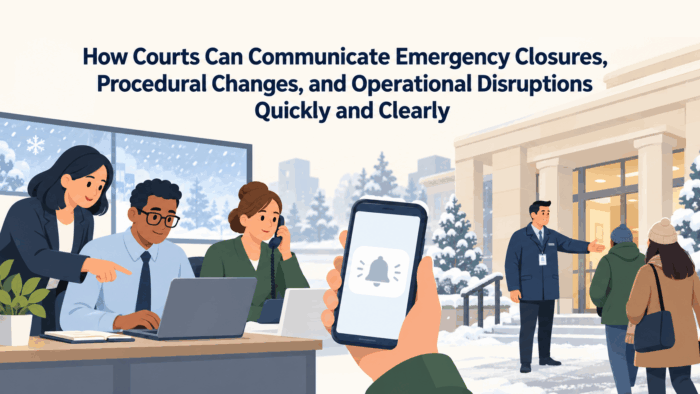
How Courts Can Communicate Emergency Closures, Procedural Changes, and Operational Disruptions Quickly and Clearly
Court operations depend on predictability. People need to know when a courthouse is open, whether a hearing will proceed, where to appear, how to file documents, and what changes apply when normal operations are disrupted. When those expectations change suddenly because of severe weather, infrastructure failure, public safety events, technology outages, staffing emergencies, or other operational problems, the communication burden becomes immediate.
For court administrators, the challenge is not simply to announce that something has changed. Emergency communication must tell court users exactly what the change means for their next action. A closure notice that does not explain whether hearings are postponed, filings remain due, remote appearances are available, or another courthouse is handling urgent matters can create more confusion than clarity. The same is true when procedures change temporarily but public information continues to reflect normal operations.
Operational disruption also creates a coordination problem inside the court. Judges, clerks, security personnel, technology staff, self-help services, interpreters, attorneys, media contacts, and justice-system partners may all need the same current information. If those groups receive updates at different times or through different channels, court users may encounter contradictory instructions precisely when they most need certainty.
The strongest emergency communication systems therefore connect operational decision-making directly to public information. Court administrators need to establish how a closure or procedural change will be translated into clear instructions, who will update each communication channel, how staff will stay aligned, and how users will know when normal operations resume. Speed matters, but speed without precision can create additional disruption.
Communicate the Operational Impact, Not Just the Event
 When a court closes or changes operations, the public needs more than the reason for the disruption. They need to understand how the change affects hearings, filing deadlines, courthouse access, remote proceedings, payments, records, self-help services, interpreter arrangements, and other immediate court functions.
A message that says a courthouse is closed because of severe weather may be accurate but incomplete. Court users may still not know whether their hearing will be rescheduled automatically, whether they should attempt to appear remotely, whether electronic filing remains available, or whether urgent matters are being handled elsewhere.
Court administrators should therefore organize emergency communication around the practical consequences of the disruption. The communication should identify what has stopped, what remains available, what has moved, and what users should do next.
This approach reduces uncertainty because it connects the operational event to the decisions people must make. The closure itself is only part of the message. The more important information is how the court continues to function under changed conditions.
Distinguish Full Closures From Partial Operational Changes
Not every disruption affects the entire court system. A courthouse may close while electronic filing remains available. One courtroom may be unavailable while the rest of the building operates normally. In-person services may be suspended while hearings continue remotely. A technology failure may affect online access without changing scheduled proceedings.
Court administrators should communicate these distinctions clearly. Broad language such as “court closed” or “operations suspended” can lead users to assume that every service has stopped when only one part of the system is affected.
Messages should identify the scope of the change. They should specify which courthouse, division, courtroom, service, or platform is affected and which services remain available.
This precision is especially important in larger court systems where several locations or divisions operate simultaneously. A disruption at one site should not create unnecessary confusion across the rest of the system.
Use Explicit Status Categories During Disruptions
Courts can reduce ambiguity by using consistent categories such as closed, delayed opening, limited operations, remote operations, service disruption, or normal operations with specific exceptions. The exact terminology should fit the court’s structure.
Each category should have a defined meaning so staff and the public interpret it consistently. If “limited operations” means hearings continue but public counters are closed, that should be clear wherever the term appears.
Consistent status categories make emergency updates easier to understand and reduce the need to rewrite basic explanations each time an operational problem occurs.
Court Communication Strategies for State and Local Judicial Systems: Building Public Trust, Improving Access to Justice, and Explaining Court Processes
This article is part of our series on strategic communication for State and Local Courts, Judicial Systems, and Court Administration. To learn more about court communication strategies for building public trust, improving access to justice, and explaining court processes, and to see the parent article, which links to other content just like this, click the button below.
Tell Court Users What to Do About Scheduled Hearings
Scheduled appearances are often the first concern during an emergency disruption. Court users may worry that failing to appear will harm their case, even when the courthouse itself is closed or access has changed.
Court administrators should make hearing instructions prominent in every emergency update. Users should be told whether hearings are canceled, postponed, relocated, moved online, or proceeding as scheduled.
When the final status of a hearing is not yet known, the court should say so and identify where the authoritative update will appear. People should not be expected to infer whether they must appear based on a general closure announcement.
Clear hearing communication reduces both public anxiety and administrative burden. When instructions are specific, fewer users need to contact clerks or court staff individually for confirmation.
Explain What Happens to Filing and Payment Obligations
Closures and operational disruptions can create uncertainty about filings, payments, and deadlines. Court administrators should address these issues directly while remaining within the procedural authority of the court and avoiding statements that exceed what has formally been ordered.
Public communication should explain which filing methods remain available, whether electronic filing systems are functioning, and where users can find any official orders or rules addressing deadline changes. If deadlines remain unchanged, that information may also need to be communicated clearly.
The same principle applies to payments, records requests, and other administrative transactions. Users should know whether online systems remain accessible, whether in-person transactions are suspended, and when normal processing is expected to resume if that information is known.
Courts should avoid making informal promises about deadline relief that have not been formally authorized. Emergency communication must remain aligned with applicable orders, rules, and judicial direction.
Maintain One Authoritative Source for Current Operational Status
During emergencies, information can quickly become fragmented across court websites, social media accounts, phone messages, email alerts, local news, and third-party legal platforms. Court administrators should identify one authoritative source where the current operational status is maintained.
That source should display the latest status, the time of the most recent update, affected locations or services, hearing instructions, and links to any relevant orders or procedural guidance.
Other communication channels should direct users back to that source rather than attempt to maintain separate and potentially inconsistent versions of the same information.
A single source of truth becomes especially important when conditions change repeatedly. Court users should be able to confirm the current status without sorting through several earlier announcements.
Update Information as Conditions Change, Not Only When the Disruption Begins
Emergency communication often begins strongly and then becomes less consistent as the disruption continues. A court may issue an initial closure announcement but provide little information about whether the closure will continue, when operations may resume, or what users should expect next.
Court administrators should establish a predictable update rhythm. Even when there is no major change, an update can confirm that the previous status remains in effect and identify when the next review will occur.
This approach reduces speculation. People are less likely to rely on unofficial sources when they know the court will provide another update at a defined time.
As normal operations resume, the court should also communicate what has changed back. Reopening information should address rescheduled hearings, restored services, filing access, and any temporary procedures that remain in place after the immediate emergency has ended.
Keep Staff Communication Ahead of Public Communication Whenever Possible
Court users may contact clerks, security personnel, self-help staff, or other employees immediately after an emergency announcement. If front-line staff have not received the same information, the public can receive conflicting answers even when the official announcement is accurate.
Court administrators should therefore coordinate internal communication before or at the same time as public release whenever circumstances allow. Staff should know the operational status, what users are being told, which questions they can answer, and where unresolved issues should be referred.
Internal updates should also make clear when information is preliminary. Staff should not present tentative reopening times, hearing arrangements, or technical recovery estimates as confirmed facts.
Keeping employees aligned supports both accuracy and confidence. The public experience of an emergency update depends not only on what is posted online but also on whether every court contact point reinforces the same current information.
Make Emergency Communication Accessible Across Multiple Channels
Court users do not all receive information in the same way. Some rely on the court website, others on text or email notifications, phone systems, social media, attorneys, courthouse signage, or local news.
Court administrators should distribute major operational updates through the channels most likely to reach affected users while keeping the core information consistent. The goal is not to duplicate every detail everywhere, but to ensure that people can discover that a change has occurred and reach the authoritative source for current instructions.
Accessibility also includes language and disability access. Emergency notices should be understandable, compatible with accessible digital formats, and translated or supported through language-access systems where necessary and feasible.
The urgency of an operational disruption does not reduce the need for accessible communication. In many cases, it increases it because court users have less time than usual to understand what they need to do.
Create a Decision Framework for What Must Be Communicated First
During an operational disruption, courts may have more information than they can communicate effectively in a single message. The first public update should prioritize the information that affects immediate behavior and legal participation.
Court administrators should identify the highest-priority questions users need answered. These generally include whether the courthouse or service is available, whether scheduled appearances are proceeding, what alternative procedures apply, whether filing or payment systems remain available, and where the next official update will appear.
Lower-priority details can follow after the immediate instructions are clear. The cause of a technology outage or the technical specifics of a building problem may matter, but those details should not displace the information users need in order to avoid missing a hearing or filing incorrectly.
A clear hierarchy helps courts communicate quickly without overwhelming users. It also gives staff a repeatable structure that can be used across different types of emergencies.
Use Time Stamps and Effective Periods on Every Emergency Update
Operational information can become outdated quickly during emergencies. Court administrators should time-stamp major updates so users can determine whether the information they are reading is current.
A closure notice should identify when the status took effect and, where possible, how long the condition is expected to remain in place. If the end time is unknown, the message should state when the court expects to issue another update.
Time stamps are especially important when information is shared across social media, email, text alerts, local news, and screenshots. An older message may continue circulating even after circumstances have changed.
Clear timing helps users distinguish the current instruction from earlier guidance. It also allows the court to correct outdated information without assuming that everyone has seen the latest message.
Explain Temporary Procedures in Practical Terms
Operational disruptions often require temporary procedures that differ from normal court practice. Hearings may move online, filings may be redirected, public counters may operate on reduced hours, or certain services may shift to another location.
Court administrators should explain temporary procedures as a sequence of actions rather than merely announcing that an alternative process exists. Users should know where to go, what platform or location to use, what time the temporary procedure begins, and where to get help if the alternative does not work.
The communication should also identify whether the temporary procedure applies to everyone or only to specific case types, divisions, or services. Broad instructions can create unnecessary confusion when only part of the court is affected.
Practical explanation is particularly important when the temporary process is unfamiliar. The more significant the departure from normal operations, the more specific the instructions should be.
Label Temporary Procedures Clearly
Temporary processes should be visibly identified as temporary. Court users should not have to determine whether a new filing location, remote appearance process, or reduced service schedule has become permanent.
Court administrators should state when the temporary procedure begins, what event or condition will end it, and where users can confirm when normal operations resume.
Clear labeling helps prevent emergency procedures from continuing to circulate after they are no longer in effect.
Prepare Separate Communication for Different User Groups When Necessary
A single emergency notice may not adequately serve every audience. Attorneys, self-represented litigants, jurors, witnesses, interpreters, vendors, and members of the public may need different instructions during the same disruption.
Court administrators should identify when audience-specific communication is necessary. Jurors may need reporting instructions, attorneys may need filing or scheduling information, and self-represented litigants may need more detailed guidance on where to obtain help.
The core operational facts should remain consistent across all versions. Different messages should clarify the practical implications for each audience rather than create different accounts of the disruption.
This approach improves usability while maintaining coherence. People receive the information most relevant to their role without being forced to sort through instructions that do not apply to them.
Coordinate With Attorneys and Justice-System Partners Without Relying on Them as the Primary Public Channel
Attorneys, prosecutors, public defenders, law enforcement agencies, detention facilities, and other justice-system partners may play an important role in spreading operational information during a disruption. Court administrators should coordinate with those organizations so they receive the same current instructions.
These partners should not become the only source through which court users learn about a closure or procedural change. Self-represented litigants and members of the public may not have access to an attorney or partner organization.
The court should therefore maintain direct public communication while using justice-system partners as additional distribution channels. Partner messages should point back to the authoritative court source whenever possible.
This layered approach extends reach without fragmenting responsibility for the official information.
Build Contingency Communication for Technology Outages
Technology failures create a distinct communication challenge because the same systems courts normally use to distribute updates may also be unavailable. A website outage, electronic filing failure, case management interruption, or remote hearing platform failure can affect both court operations and the channels used to explain the problem.
Court administrators should prepare alternative communication pathways in advance. These may include phone recordings, text alerts, social media, email systems not dependent on the affected platform, physical signage, or coordination with local media.
The court should explain what technology is unavailable, which court functions are affected, and what alternatives remain operational. Users should not be left to assume that a website outage means the courthouse itself is closed.
Contingency communication is most effective when it has been planned and tested before an outage. Waiting until digital systems fail to decide how information will be distributed can significantly delay public guidance.
Communicate Building and Security Disruptions Without Creating Additional Risk
Some operational disruptions involve security threats, infrastructure failures, hazardous conditions, or other situations in which the court cannot disclose every detail immediately. Court administrators must balance public information needs with safety and operational considerations.
Even when the cause cannot be fully explained, users still need practical instructions. The court can communicate that a facility is inaccessible, hearings are being relocated or delayed, and another update will follow without disclosing sensitive security information.
Messages should avoid speculation. If the cause of an evacuation, closure, or restricted access has not been confirmed for public release, the court should not provide an unofficial explanation simply to fill the information gap.
Clear operational guidance can coexist with limited disclosure. The key is to communicate what users need to do while being precise about what information remains unavailable.
Prevent Old Emergency Messages From Becoming New Sources of Confusion
Emergency notices often remain online long after the event has ended. A user searching for current information may encounter an old closure announcement through a search engine, shared social media post, or outdated webpage.
Court administrators should establish procedures for labeling, archiving, or removing expired emergency information. Older notices that remain publicly accessible should clearly indicate that they are no longer current.
The authoritative status page should also display normal operations explicitly after a disruption ends. Simply removing a closure notice may not reassure users who previously saw that the courthouse was unavailable.
Managing outdated information is part of emergency communication. A message that was once accurate can become misleading if it continues to circulate without clear status labeling.
Prepare for Multi-Day and Extended Disruptions
A disruption that lasts several hours requires different communication from one that lasts several days or weeks. Extended closures can affect hearing calendars, records access, filing workflows, staffing, juror reporting, and public services in increasingly complex ways.
Court administrators should shift from short emergency notices to a more structured communication system when a disruption continues. Users may need consolidated guidance, frequently updated FAQs, revised schedules, and clearer explanations of which temporary procedures remain in effect.
Extended disruptions also require stronger internal coordination because different parts of the court may recover at different rates. One service may return while another remains unavailable.
A structured approach helps users understand that recovery may occur in stages. It also prevents every update from becoming a complete rewrite of the court’s operational status.
Coordinate the Return to Normal Operations as Carefully as the Initial Closure
Reopening communication should receive the same attention as the first emergency announcement. Court users need to know not only that the courthouse or service has reopened but also what unresolved changes remain.
Court administrators should explain which hearings have been rescheduled, whether temporary remote procedures are ending, when public counters resume normal hours, and whether filing or technology systems are fully restored.
Some emergency arrangements may continue after the primary disruption ends. A courthouse may reopen while one courtroom remains unavailable, or electronic systems may recover gradually. The communication should describe those exceptions explicitly.
A well-managed return to normal operations closes the information loop. It prevents users from relying on emergency instructions after those instructions are no longer appropriate and helps restore predictability to court operations.
Design Emergency Messages Around the User’s Next Required Action
 Emergency communication is most useful when it tells court users exactly what they need to do next. A closure notice, delayed opening, technology outage, or temporary procedural change may be operationally significant to the court, but the public experiences it primarily as a change in required action.
Court administrators should structure messages around decisions such as whether to appear, where to appear, whether to file, whether to wait for rescheduling, and where to check for updates. The operational explanation should support those instructions rather than overshadow them.
This is especially important when different users face different obligations. A juror, attorney, self-represented litigant, witness, and member of the public may all receive the same closure notice but need very different follow-up information.
Designing messages around the next action reduces ambiguity. It also makes emergency communication easier to scan quickly, which is critical when users may be reading the notice on a phone or while traveling to court.
Separate Confirmed Instructions From Information That Is Still Developing
Operational disruptions evolve quickly. Court administrators may know that a courthouse is temporarily inaccessible before they know how afternoon hearings will be handled, when technology will be restored, or whether the closure will extend into the next day.
Emergency messages should distinguish clearly between what has been confirmed and what remains under review. Users should not have to infer whether an instruction is final or tentative.
When the court does not yet know the answer to an important question, it should say so and identify when or where the next update will appear. That is more reliable than issuing a premature estimate that later requires correction.
Clear separation between confirmed and developing information helps users make appropriate decisions while giving the court room to adapt as conditions change.
Use a Consistent Emergency Message Structure Across Disruptions
Court users benefit when emergency notices follow a predictable structure. The type of disruption may vary, but the information architecture can remain consistent.
A strong emergency message can identify the affected court or service, current operational status, effective time, impact on hearings, impact on filings or payments, alternative procedures, contact or help information, and timing of the next update.
Using the same structure across weather closures, building problems, technology outages, security incidents, and other disruptions reduces the cognitive burden on users. They learn where to look for the information that matters most.
Consistency also supports staff efficiency. Court administrators do not need to reinvent the format during every emergency, and different departments are more likely to communicate the same core facts.
Put the Most Time-Sensitive Information First
Emergency notices should not begin with a lengthy description of why the disruption occurred if users first need to know whether they should still appear.
The most urgent instructions should appear at the beginning, followed by operational detail and context. This is particularly important for mobile users and people reading notices quickly.
Prioritizing action does not mean omitting context. It means sequencing the information according to the decisions users must make first.
Prepare Templates for Recurring Disruption Scenarios
Many court disruptions fall into recognizable categories. Severe weather, delayed openings, courthouse evacuations, utility failures, electronic filing outages, remote hearing platform failures, and temporary service reductions can often be anticipated even if the timing cannot.
Court administrators should prepare adaptable communication templates for these scenarios before they occur. Templates can provide the structure for status, hearing instructions, filing guidance, alternative procedures, contact information, and update timing.
Templates should not become rigid scripts. Each disruption may require different details, and staff should verify the information before release. Their value is that they reduce the time spent building the message architecture while conditions are changing.
Prepared templates also encourage consistency across different incidents. Court users become more likely to recognize the format and locate the instructions they need quickly.
Coordinate Emergency Communication With Judges and Courtroom Operations
A courthouse disruption may affect different judges or calendars in different ways. One courtroom may move proceedings online, another may postpone matters, and another may continue from a different location.
Court administrators should establish a process for translating judicial and courtroom decisions into coordinated public communication. Individual courtroom instructions should not conflict with the broader operational status message.
This requires clear responsibility for collecting current information from courtroom operations and ensuring that public channels reflect those decisions accurately. It also requires clarity about what court administration can announce and what must be supported by an official order or judicial direction.
Strong coordination helps prevent one of the most consequential emergency communication failures: telling users that the court is operating under one set of conditions while their actual case is being handled differently.
Build Redundancy Into Emergency Communication Channels
Emergency communication systems should assume that one or more channels may fail. A power outage may disrupt phone systems. A technology incident may affect the website. Severe weather may prevent physical signage from reaching people before they begin traveling.
Court administrators should identify multiple communication channels that can operate independently where possible. These may include the court website, text or email alerts, recorded phone messages, social media, local media coordination, courthouse signage, and direct notifications through case systems.
Redundancy should not mean publishing inconsistent versions of the same information. Each channel should point users toward the same current operational status and core instructions.
A redundant system is more resilient because it does not depend on one technology or one point of contact to reach affected users.
Make Language Access Part of Emergency Preparedness
Emergency messages often need to be released quickly, which can make translation and language access an afterthought. For court users with limited English proficiency, that delay can mean receiving critical hearing or access instructions after the time to act has already passed.
Court administrators should identify the most common emergency message types in advance and prepare translated templates or rapid translation workflows where appropriate. Core concepts such as closure, delayed opening, hearing postponed, remote appearance, and next update can often be prepared before an incident.
Language access should focus on the action the user needs to take rather than on a literal translation of complex administrative language. The goal is functional understanding during a time-sensitive disruption.
Integrating translation into emergency planning makes multilingual communication part of the response system rather than a secondary step that occurs only after English-language users have already been informed.
Design Emergency Communication for Accessibility Under Time Pressure
People with disabilities may experience operational disruptions differently. A relocated courtroom may affect accessible routes. A remote replacement for an in-person hearing may introduce assistive technology issues. A building closure may change where accommodation services are available.
Court administrators should include accessibility implications when developing emergency guidance. Users should know how to request assistance, whether existing accommodations remain in effect, and who to contact if the temporary procedure creates a new barrier.
Digital emergency notices should also remain accessible. Updates should be readable by assistive technologies and should not depend entirely on images or visual formatting to convey critical information.
Accessibility should not be deferred because the situation is urgent. Emergency conditions often increase the consequences of inaccessible communication.
Coordinate Emergency Communication With Local Government and Public Safety Partners
Some disruptions affect more than the courthouse. Severe weather, infrastructure failures, civil emergencies, or public safety events may involve local government, emergency management, law enforcement, transportation agencies, or other institutions.
Court administrators should coordinate with relevant partners so public messages do not conflict. If local government says a district is inaccessible while the court website still shows normal operations, users may not know which instruction controls.
Coordination does not require every agency to issue identical language. Each institution has different responsibilities. The key is that operational facts such as closures, access limitations, and timing should align.
Partner coordination can also extend reach. Local emergency alerts and public safety channels may reach users who do not routinely follow court communications.
Monitor User Confusion While the Disruption Is Still Active
Court administrators should not wait until an emergency ends to learn whether the message was understood. Questions arriving through phone lines, email, social media, clerk counters, or partner organizations can reveal confusion while there is still time to correct it.
If many users are asking whether hearings remain scheduled, the current notice may not be explicit enough. If users continue arriving at a closed location, the distribution channels may not be reaching the intended audience.
Administrators should use these signals to revise or supplement the public message. Emergency communication should be treated as an active feedback process rather than a one-time announcement.
Real-time adjustment improves both public understanding and court operations. It allows the communication system to respond to actual user behavior instead of assuming that publication alone guarantees comprehension.
Build Emergency Communication Into Court Continuity Planning
Emergency communication should be treated as part of continuity planning rather than as a separate task assigned after an operational problem occurs. Court administrators should identify in advance how public information will be developed, approved, distributed, updated, and retired when normal operations are interrupted.
Continuity plans can define who has authority to confirm an operational change, who translates that decision into public instructions, which communication channels must be updated, and how staff throughout the court will receive the same information. Those responsibilities should remain clear even when normal leadership or technology systems are unavailable.
The communication component should also address the possibility that the disruption affects the people responsible for issuing the message. A courthouse evacuation, power failure, severe weather event, or cybersecurity incident may prevent normal staff from reaching their offices or accessing standard systems. Backup responsibilities and alternative publishing methods should therefore be established in advance.
Integrating communication into continuity planning makes public information part of the court’s operational response. The court is not simply managing the disruption internally and then informing users afterward. Communication becomes one of the functions required to keep the judicial system usable during abnormal conditions.
Establish a Clear Chain of Authority for Operational Messages
Emergency communication can become unreliable when several people believe they have authority to announce a closure or procedural change. Court administrators should define who can authorize public operational messages and how that authority changes if normal decision-makers are unavailable.
The chain of authority should distinguish between the decision to change court operations and the communication of that decision. A judge, presiding judicial officer, court executive, emergency official, or other authorized person may determine the operational response, while designated administrative or communications staff convert that decision into public guidance.
This distinction helps prevent communication staff from making procedural determinations that exceed their role. It also prevents a valid operational decision from remaining uncommunicated because staff are uncertain whether they have authority to publish it.
A clear chain of authority supports speed because people know who must confirm the information and who is responsible for distributing it. During an emergency, eliminating unnecessary uncertainty inside the organization is one of the most effective ways to reduce uncertainty for the public.
Maintain a Current Emergency Communication Contact System
Court administrators should maintain reliable contact information for the internal and external partners who may need immediate operational updates. That can include judges, clerks, court executives, security personnel, technology staff, interpreters, self-help programs, jury administration, communications staff, local emergency management, justice-system partners, and other relevant contacts.
Contact information should not exist only in systems that may be inaccessible during an outage. Courts should maintain an appropriate backup that authorized staff can reach when normal email, internal networks, or building access are unavailable.
The contact structure should also identify responsibility rather than merely list names. Staff need to know who manages hearing information, who updates the website, who coordinates with security, who handles media inquiries, and who communicates with partner organizations.
Maintaining this system requires periodic review. Staff turnover, technology changes, and organizational restructuring can make an emergency contact list unreliable if it is treated as a static document.
Test the Communication Chain Before an Emergency
Emergency communication plans can appear complete on paper while failing in practice. Court administrators should periodically test whether designated staff can actually reach one another, access publishing systems, and issue coordinated information under disrupted conditions.
Exercises can reveal outdated contacts, unclear approval paths, inaccessible credentials, or overdependence on one person or technology platform.
Testing allows courts to correct those weaknesses before a real operational disruption places public access at risk.
Create Channel-Specific Responsibilities and Backup Procedures
Court websites, text alerts, email systems, social media accounts, phone recordings, digital signage, physical notices, and local media may all play a role during an operational disruption. Court administrators should define who is responsible for each channel and what backup process applies if the primary channel cannot be used.
A strong system avoids dependence on one employee who has exclusive access to a critical account. Appropriate backup personnel should be able to update emergency information while maintaining necessary security and access controls.
Channel responsibilities should also include removal and correction. Someone should be responsible not only for posting the initial closure notice but also for updating it when circumstances change and removing or archiving it when normal operations resume.
Clear ownership reduces the likelihood that one channel displays current information while another continues showing an earlier status. During fast-moving disruptions, synchronization across channels is as important as the initial announcement.
Integrate Hearing, Jury, Filing, and Public Service Communication
Different court functions may respond differently to the same disruption. Hearings may be delayed, jury reporting may be suspended, electronic filing may remain available, and certain public counters may operate remotely. Court administrators should integrate these updates rather than forcing users to piece together several independent notices.
Operational communication should identify the status of the major court functions affected by the disruption. The exact categories will vary by court, but users should be able to determine whether their specific reason for interacting with the court has changed.
Internal coordination is necessary because responsibility for these functions may be divided among different units. Jury administration may know one set of instructions while clerks, courtroom staff, and technology teams know others. A central communication process should consolidate those decisions before they reach the public.
This integrated approach reduces contradictory messaging and gives users a more complete understanding of what the court can still provide under disrupted conditions.
Prepare Physical Communication for Users Who Arrive Despite Digital Notices
Even strong digital communication will not reach everyone before they travel to court. Some users may not have seen the website, may have limited internet access, or may rely on a notice received before the disruption occurred.
Court administrators should therefore plan for physical communication at courthouse entrances, parking areas, security checkpoints, and other appropriate locations. Signs should identify the current operational status, explain what users should do next, and direct them toward an authoritative source for updates.
Physical notices are particularly important when people arrive at a closed building. A sign that simply says “closed” can leave users uncertain about whether they have missed a hearing or must take another action immediately.
The physical environment should reinforce the same message being communicated digitally. Users who arrive in person should not discover materially different instructions from those published online.
Plan Communication for Users With Limited Digital Access
Emergency communication strategies often assume that court users can check a website, receive text alerts, or join a remote proceeding. That assumption does not hold for everyone.
Court administrators should consider how people with limited internet access, limited data plans, older devices, or low digital literacy will receive critical operational information. Phone recordings, local media, physical signage, community partners, and staffed help lines may remain important during disruptions.
Alternative access is particularly important when the court shifts services online. A temporary remote process can preserve operations for many users while creating a new barrier for people who cannot reliably access the technology.
Emergency communication should therefore explain not only the digital alternative but also what assistance or non-digital pathway exists where the court provides one. Operational continuity should not depend entirely on digital capability if other options remain available.
Coordinate Recovery Communication Across Different Service Timelines
Court operations may not return to normal all at once. A building may reopen before every courtroom is usable. The electronic filing system may return before the case management system. Public counters may resume while remote hearing technology remains disrupted.
Court administrators should prepare communication for phased recovery. Instead of announcing broadly that the court has reopened, updates should identify which functions have resumed and which temporary procedures remain in effect.
This is particularly important because the word “reopened” may lead users to assume that all normal rules and services have returned. If exceptions remain, they should be communicated prominently.
Phased recovery messaging helps the public adjust gradually while allowing operational teams to restore systems at different speeds. It also prevents the court from declaring the disruption over before the user experience has actually returned to normal.
Measure Emergency Communication Through Operational Outcomes
Courts can evaluate emergency communication by examining whether users received and understood the information required to act correctly. The number of notices published is less meaningful than whether those notices reduced confusion and prevented avoidable procedural problems.
Useful operational signals may include the volume of calls asking whether the court is open, the number of users arriving at a closed facility, repeated questions about hearing status, confusion about temporary filing procedures, or difficulty locating the latest update.
Court administrators should compare these patterns across incidents. If the same questions recur each time, the communication framework may need to be revised even if messages are being published quickly.
Measurement should focus on whether communication supported continuity. The goal is to determine whether users were able to understand the disruption and navigate the temporary process with as little additional administrative friction as possible.
Conduct After-Action Reviews and Update the Emergency Communication System
Every significant disruption provides information about how well the court’s communication system works under pressure. Court administrators should review major incidents after normal operations resume and document what succeeded, what failed, and what created unnecessary confusion.
The review can examine approval speed, internal coordination, public message clarity, website reliability, translation timing, accessibility, partner communication, staff consistency, and the effectiveness of backup channels.
Feedback from front-line employees can be especially valuable because clerks, security staff, help desk personnel, and self-help programs often see the confusion that public notices do not reveal. Patterns in user questions can show where instructions were technically accurate but insufficiently clear.
After-action findings should result in updated templates, contacts, protocols, training, and continuity plans. Emergency communication becomes stronger when each disruption improves the system that will be used during the next one.
Build an Emergency Communication System That Does Not Depend on Individual Staff
A court’s ability to communicate during disruption should not depend on whether one experienced employee happens to be available. Institutional resilience requires documented procedures, shared access, trained backups, and clearly assigned responsibilities.
Court administrators should preserve emergency templates, account access procedures, contact lists, approval pathways, translation resources, accessibility standards, and partner communication protocols in a form that authorized staff can use when needed.
New employees should be introduced to these systems as part of operational training rather than learning them only during an emergency. Leadership transitions should also include explicit handoff of emergency communication responsibilities.
Institutionalizing the system allows the court to respond consistently despite staff turnover, absences, or changing circumstances. The public receives reliable guidance because the capability belongs to the institution rather than to one person who knows how to make the process work.
Strategic Communication Support for Court Emergency and Operational Communication
 Court disruptions create communication challenges because operational decisions, procedural consequences, staff coordination, and public expectations can all change at once. Court administrators may need to communicate closures, delayed openings, relocated hearings, technology outages, filing changes, jury instructions, security restrictions, and service interruptions under significant time pressure. External strategic communication support can help courts turn those operational decisions into clear, coordinated public guidance before confusion spreads across multiple channels.
Stegmeier Consulting Group (SCG) can support courts by developing emergency communication plans, closure and disruption templates, continuity communication protocols, internal approval pathways, staff reference materials, multilingual and accessible messaging systems, digital status pages, stakeholder notification procedures, media coordination frameworks, and after-action review processes. SCG can also help courts organize communication around the actions users need to take so that hearing instructions, filing information, courthouse access, and temporary procedures remain consistent across websites, phone systems, email, text alerts, signage, and staff interactions.
External support can be particularly useful when a court is modernizing fragmented emergency procedures, preparing for recurring weather or technology risks, or trying to reduce dependence on individual staff members during high-pressure events. SCG’s role remains focused on communication strategy, information organization, stakeholder coordination, and public-facing systems. SCG does not determine court closures, set procedural rules, modify filing deadlines, make judicial decisions, or direct emergency and security operations on behalf of the court.
Future Trends
Court emergency communication will increasingly depend on interconnected digital systems. Text notifications, electronic filing platforms, online calendars, remote hearing technology, case portals, and automated alerts can help courts reach users quickly, but they also create new vulnerabilities when the technology itself is part of the disruption. Courts will need communication plans that assume primary digital channels may sometimes fail.
Remote and hybrid court operations will also continue to change what an operational disruption means. A building closure may no longer require complete suspension of court activity, while a technology outage may have consequences that once would have been limited to the physical courthouse. Court administrators will need to communicate these distinctions precisely so users understand which functions remain available and which have actually stopped.
Expectations for individualized notification are also likely to increase. Court users increasingly expect to receive updates that relate specifically to their hearing, jury obligation, filing, or service rather than relying entirely on broad courthouse announcements. Where court technology supports those notifications, administrators will need to integrate them with general public communication so individualized messages and public status information remain consistent.
Accessibility and language access will become more deeply embedded in emergency readiness as well. The ability to publish quickly will increasingly be measured alongside the ability to reach users with disabilities, limited English proficiency, limited internet access, and different levels of digital literacy. Effective emergency communication will depend on resilience across audiences as well as resilience across technology.
Conclusion
Court emergencies create uncertainty at precisely the moment when people need procedural instructions to be most reliable. A closure, outage, security event, weather emergency, or temporary operational change can affect whether people appear for hearings, submit filings, report for jury service, access records, or obtain assistance. Communication therefore becomes part of maintaining access to the judicial system during disruption.
The strongest emergency communication does more than announce that something happened. It identifies who is affected, what court functions have changed, what remains available, what users should do next, and where the authoritative update can be found. It also distinguishes confirmed instructions from information that is still developing.
Internal coordination is equally important. Judges, clerks, court administrators, security personnel, technology teams, interpreters, self-help programs, and external partners need access to the same current operational information so that public guidance remains consistent across every point of contact.
Courts cannot prevent every operational disruption, but they can reduce the procedural confusion that follows one. When emergency communication is built into continuity planning, tested before it is needed, and improved after each incident, the court is better positioned to preserve access, predictability, and public confidence even when normal operations cannot continue.
Stegmeier Consulting Group’s Strategic Approach to Communication Systems
Build emergency communication systems that keep court users informed, staff aligned, and essential services understandable when normal operations are disrupted.
Court administrators need communication systems that can move quickly without sacrificing accuracy when closures, procedural changes, technology failures, security events, or other disruptions affect court operations. Stegmeier Consulting Group (SCG) helps public institutions develop continuity communication plans, emergency message frameworks, internal coordination systems, multilingual and accessible public information, digital status structures, and after-action processes that make operational changes easier to understand and act on.
Use the form below to connect with our team and explore how strategic communication support can strengthen court emergency preparedness and operational communication.