How Occupational Safety Programs Can Communicate Inspection Findings and Abatement Requirements Without Losing Employer Cooperation
Occupational safety programs have to communicate inspection findings with enough clarity that employers understand what was observed, what requirements apply, what must be corrected, and what happens next. At the same time, the communication process can influence whether an employer responds constructively or becomes defensive, confused, or disengaged. When findings are delivered only as technical violations or formal enforcement language, employers may understand that they have a problem without understanding how to move from the finding to an effective correction.
The challenge becomes more significant when inspections identify serious hazards, multiple violations, disputed facts, or corrective actions that require operational changes. Employers may focus on the possibility of penalties, question whether the agency understands the workplace, or worry that acknowledging a problem will weaken their position in later proceedings. Inspectors and program staff therefore need communication practices that preserve enforcement authority while keeping the employer focused on hazard correction and worker protection.
Employer cooperation should not be confused with avoiding difficult findings or softening requirements that the agency is obligated to enforce. A cooperative relationship is valuable because employers often control the resources, staffing, equipment, training, and operational decisions needed to eliminate hazards. The agency’s communication should make the seriousness of the findings unmistakable while helping the employer understand exactly what corrective action is expected and how compliance will be evaluated.
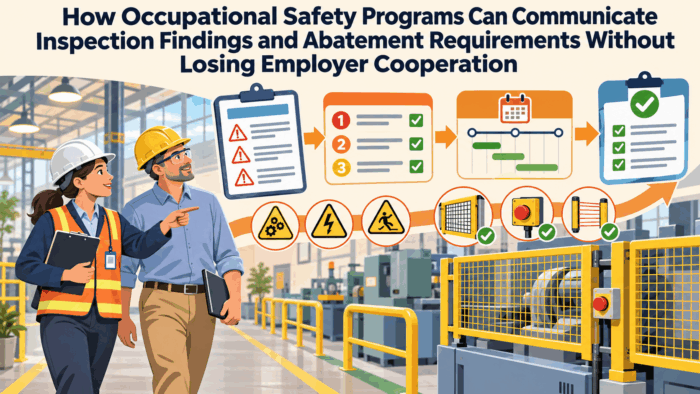
A strong communication strategy connects inspection findings, abatement requirements, timelines, evidence expectations, follow-up procedures, and available assistance into one understandable process. When employers can distinguish between what the agency observed, what the applicable requirement means, what must change, and what options exist for asking questions or demonstrating correction, enforcement communication becomes more effective without sacrificing accountability.
Explain the Purpose of the Findings Before Discussing Individual Violations
 Employers may receive inspection findings as a list of deficiencies without understanding how those findings fit into the broader purpose of the inspection. Occupational safety programs should begin by explaining that the findings identify conditions or practices the agency determined require attention under the applicable safety framework. This provides context before the employer begins evaluating each citation, notice, or corrective requirement individually.
The communication should distinguish between the agency’s role in identifying hazards and the employer’s responsibility for correcting them. Employers should understand that the purpose of the findings is not merely to document noncompliance but to establish what conditions must change to protect workers and satisfy applicable requirements. This framing keeps the conversation centered on correction even when formal enforcement consequences are also involved.
Agencies should avoid overly generic statements that sound reassuring but provide little practical meaning. Employers need a direct explanation of what was found, why it matters, and how the agency expects the next stage to proceed. A short introductory explanation can help prevent the findings from being interpreted only as a penalty document.
Beginning with purpose also creates a more productive communication environment. Employers may still disagree with particular findings, but they can understand that the agency is separating the immediate need to address hazards from any procedural rights they may have to contest or seek review.
Separate the Hazard, the Requirement, and the Corrective Action
Inspection communication becomes difficult to follow when the description of the hazardous condition, the regulatory requirement, and the required correction are blended into one paragraph of technical language. Occupational safety programs should separate these concepts so employers can understand what the agency observed, why the condition is a problem, and what must be done in response.
The hazard description should identify the workplace condition or practice as specifically as possible without adding unsupported assumptions about cause or intent. The regulatory explanation should then identify the applicable requirement or standard. Finally, the abatement communication should describe what outcome the employer must achieve to correct the condition.
This structure helps employers distinguish between disagreement about the agency’s factual observations and questions about how to achieve compliance. A business may accept that a hazardous condition existed but need clarification about acceptable corrective approaches. Conversely, it may dispute the underlying observation while still choosing to address the condition promptly.
Separating these elements also improves internal employer communication. Safety managers, supervisors, maintenance teams, and executives may need different parts of the information, but all of them benefit from a finding that makes the relationship among hazard, requirement, and correction visible.
Translate Technical Findings Into Operational Language
Inspection findings may need to use formal terminology for legal and administrative purposes, but employers also need an operational explanation that helps supervisors and safety personnel understand what needs to change in the workplace. Agencies should preserve the official finding while providing plain-language context that can be used by the people responsible for correction.
Operational language should explain the condition in terms of the work being performed, the exposure created, and the safety outcome that needs to be achieved. This does not require the agency to design the employer’s entire corrective solution. It means making the finding understandable enough that the employer can begin evaluating appropriate controls.
Agencies should avoid assuming that every recipient has the same level of technical expertise. A corporate safety director may understand regulatory terminology immediately, while a small business owner or frontline supervisor may not. Clear communication should work for both without becoming inaccurate or overly simplified.
Plain-language explanation also reduces the chance that an employer focuses on a technical phrase while missing the underlying hazard. The formal requirement remains important, but operational understanding helps move the employer from reading the citation to planning an effective correction.
Explain the Difference Between Immediate Hazard Control and Final Abatement
Some inspection findings may require employers to take immediate steps to reduce exposure while a more complete corrective solution is developed. Employers should understand the distinction between temporary controls, interim protective measures, and final abatement where those concepts apply. Without that distinction, a temporary action may be mistaken for complete correction.
The agency should explain what must happen immediately and what additional work remains. If the employer installs a temporary barrier, changes a work procedure, or removes equipment from service while a permanent solution is developed, the communication should make clear whether that action satisfies the requirement or merely reduces risk during the abatement period.
This distinction can also support cooperation because employers may be more able to act quickly when they understand that immediate protection and long-term correction can be managed as related stages. A complex engineering change may take time, but workers may still need protection during the interim.
Agencies should remain careful not to imply that temporary measures automatically satisfy the final requirement. The communication should identify the expected endpoint and any documentation or follow-up needed to demonstrate that full abatement has occurred.
Use an “Immediate Action” and “Final Correction” Format for Complex Findings
For findings that require more than one stage of response, agencies can use a simple format separating what the employer should address immediately from what must ultimately be completed. This structure can make complex abatement requirements easier to manage.
The immediate-action section can focus on reducing current worker exposure, while the final-correction section explains the condition that must exist for the finding to be considered fully abated. The exact language should reflect the applicable authority and the facts of the inspection.
This format helps employers organize work without weakening the formal requirement. It also gives inspectors and follow-up staff a clearer basis for discussing progress when interim steps have been completed but final abatement is still underway.
Explain Abatement Deadlines as Part of a Corrective Process
Employers may see an abatement date as a single deadline with little explanation of what must occur before that date. Occupational safety programs should communicate the deadline as part of a corrective process, identifying the expected outcome, any required documentation, and what the employer should do if it encounters legitimate obstacles to completion. The exact options available will depend on the governing framework.
The agency should distinguish between the date by which the hazardous condition must be corrected and other procedural dates associated with contest rights, documentation, or follow-up. When several deadlines appear in the same enforcement package, employers can easily confuse them. Clear labeling helps prevent missed obligations.
Where the program allows extensions, modification requests, or another procedure for addressing circumstances that prevent timely completion, the agency should explain how that process works without implying that additional time is automatic. Employers should understand that they are expected to act promptly and that any request should be made through the appropriate formal channel.
Deadline communication is more effective when employers understand what success looks like. A date alone creates urgency, but a date combined with a clear corrective outcome gives the employer something concrete to manage toward.
Explain What Evidence the Agency Needs to Confirm Abatement
Employers may believe they have corrected a violation while the agency still lacks enough information to close the finding. Occupational safety programs should explain what evidence is required to demonstrate abatement so businesses do not discover after the deadline that their documentation was incomplete. The evidence should be proportionate to the finding and consistent with applicable procedures.
Depending on the program and hazard, evidence may include photographs, invoices, revised procedures, training records, equipment documentation, certification statements, or other appropriate materials. Agencies should identify the type of evidence needed without creating unnecessary administrative burdens unrelated to verifying correction.
The communication should also distinguish between evidence that a corrective step occurred and evidence that the hazard has actually been addressed. Purchasing new equipment, for example, may not demonstrate that it was installed or used correctly. Employers benefit from understanding the difference before submitting documentation.
Clear evidence requirements can improve both cooperation and efficiency. Employers know what to prepare, and agency staff spend less time requesting follow-up information. The abatement process becomes easier to complete because the documentation expectations are visible from the beginning.
Allow Employers to Ask Questions Without Treating Clarification as Resistance
Employers may need clarification about findings, terminology, deadlines, or acceptable documentation, and those questions should not automatically be interpreted as unwillingness to comply. Occupational safety programs should create clear pathways for employers to seek procedural and technical clarification while preserving the distinction between receiving information and formally contesting a finding.
Inspectors and program staff should be prepared to explain what the agency observed, how the requirement is being applied, and what documentation is expected within the limits of their role. If a question requires a legal determination, formal review, or another level of authority, staff should know where to refer the employer rather than improvising an answer.
A respectful clarification process can strengthen cooperation because employers are more likely to act when they understand what is expected. Confusion that remains unresolved can produce delay, incomplete corrections, or unnecessary disputes that could have been avoided through clearer communication.
The agency should still maintain firm boundaries. Answering questions does not require renegotiating the finding informally or advising the employer on litigation strategy. The objective is to make the formal requirements understandable enough for the employer to respond appropriately.
Distinguish Cooperation From Agreement With the Findings
Employers may believe that taking corrective action will be interpreted as admitting every factual or legal conclusion in the inspection. This concern can create unnecessary resistance, especially when a business wants to protect workers immediately while preserving procedural rights. Agencies should explain, where consistent with their rules, how corrective action relates to any available review or contest process.
The communication should make clear that the agency expects hazardous conditions to be addressed according to applicable requirements while also explaining the employer’s formal procedural options. Employers should not have to choose between understanding their rights and taking worker-protection measures simply because the two topics were never explained together.
This distinction can be particularly important when the employer disputes the classification, scope, or legal basis of a finding but recognizes that a physical condition should still be improved. Clear communication allows the employer to separate immediate safety decisions from the formal process for challenging an agency action.
Agencies should avoid making broad promises about the legal consequences of corrective action if those consequences depend on jurisdiction-specific rules. The goal is to explain the process accurately, not to provide legal advice. Even that limited clarity can reduce the tendency to equate cooperation with surrender.
Communicate Serious Findings Firmly Without Making the Employer Relationship Adversarial
Some inspection findings involve conditions that require strong communication because workers face significant risk or the employer has failed to address known hazards. Firm enforcement language may be necessary, but firmness does not require a hostile tone. Agencies can communicate urgency, responsibility, and consequences while keeping the employer focused on the actions needed to protect workers.
The message should emphasize the seriousness of the condition through facts and requirements rather than through accusations about the employer’s motives or overall commitment to safety. If the inspection established particular conduct or repeated conditions, the agency can describe those findings accurately. It should avoid adding rhetoric that is not necessary to explain the enforcement action.
A professional tone can be especially important when the employer is already defensive. Escalating the interaction through unnecessary confrontation may make it harder for safety managers and operational staff to obtain internal support for corrective action. Clear, factual communication gives those employees a stronger basis for moving the organization toward compliance.
Maintaining professionalism does not mean minimizing consequences. Employers should understand required deadlines, potential follow-up, and the significance of failing to abate. Cooperation is strengthened when accountability is clear and the communication remains centered on what must happen next.
Make the Closing Conference and Written Findings Reinforce Each Other
Employers should not leave an inspection hearing one explanation and later receive written findings that appear to describe a completely different problem. Occupational safety programs should align closing discussions, preliminary explanations, and formal written communication as closely as procedural rules allow. Consistency between spoken and written information can substantially improve employer understanding.
During a closing conference or comparable interaction, staff can explain the general nature of observed concerns, the next procedural steps, and when formal findings will be issued. They should also be careful about presenting preliminary observations as final determinations when additional review must occur before the agency takes formal action.
Once written findings are issued, employers should be able to connect them to the issues previously discussed. If the final action differs materially from what was described earlier, the communication should provide enough context for the employer to understand the change rather than leaving the business to assume that the agency reversed itself without explanation.
Alignment across communication stages supports credibility. Employers are more likely to cooperate with abatement requirements when the process feels predictable, the agency’s terminology remains consistent, and each new document builds on information they have already received rather than forcing them to reinterpret the inspection from the beginning.
Explain How Citation Severity and Classification Affect the Employer’s Response
Employers may receive inspection findings categorized by severity, type, or another formal classification, but those labels can be difficult to interpret without additional explanation. Occupational safety programs should explain what the classification means within the jurisdiction’s enforcement framework, why the finding was placed in that category, and what practical implications follow. This helps employers understand the seriousness of the action without relying on assumptions based on terminology alone.
The agency should distinguish the formal classification from the underlying hazard. A label may influence penalties, deadlines, or procedural rights, but the employer still needs to understand the actual workplace condition that led to the finding. Clear communication should connect the classification back to the facts rather than allowing the label to become the entire message.
Employers should also understand when classifications may be subject to review, contest, or modification through formal procedures. If a category can change after additional fact-finding or adjudication, the agency should avoid presenting the initial classification as irrevocable when it is not. Procedural accuracy can reduce unnecessary defensiveness.
The strongest explanation combines the seriousness of the finding with the next steps required of the employer. A classification should help the employer understand the agency’s determination, not create a separate layer of confusion that distracts from correction.
Explain Penalties Without Letting Dollar Amounts Overshadow Abatement
Monetary penalties can dominate an employer’s attention, particularly when the amount is substantial, but the corrective obligation should remain central to the communication. Occupational safety programs should explain penalties clearly while reinforcing that paying a penalty does not necessarily resolve the underlying hazard. The employer must understand both the financial consequence and the abatement requirement.
The agency should distinguish proposed, assessed, adjusted, settled, and final amounts where those stages apply. Employers may otherwise treat an initial figure as the final obligation or assume that a later reduction eliminates the need for corrective action. Clear terminology helps separate the penalty process from the abatement process.
Communication should also explain the relationship between different findings and their associated penalties where multiple violations are involved. A single total can obscure which conditions contributed most significantly to the enforcement action. Providing enough structure can help employers prioritize both procedural response and hazard correction.
At the same time, the agency should avoid allowing penalty language to make the communication sound primarily punitive. The strongest message keeps worker protection, corrective action, and compliance at the center while explaining the financial consequences accurately and transparently.
Use Abatement Plans for Complex or Multi-Step Corrections
Some hazards cannot be fully corrected through a single action, particularly when equipment replacement, engineering redesign, procurement, contractor work, training, or operational changes are required. Occupational safety programs should use clear abatement planning where the governing framework allows it so employers can understand how a multi-step correction will be monitored. A plan can make a difficult requirement more manageable without reducing the final expectation.
The communication should identify interim milestones, responsible actions, expected evidence, and the final correction date. Employers should know which steps are considered progress and which condition must exist before the agency considers the finding fully abated. This prevents the plan itself from being mistaken for compliance.
Agencies should also explain how changes to the plan are handled if unforeseen circumstances arise. Equipment delays, permitting issues, contractor availability, or technical complications may affect implementation, but the employer should understand when and how to communicate those issues through the appropriate process. Informal delay should not replace formal communication.
A structured abatement plan can preserve cooperation because it gives both the employer and the agency a shared roadmap. Progress becomes visible, expectations remain clear, and the discussion can stay focused on reducing risk rather than repeatedly renegotiating what the original finding required.
Use Milestones to Make Long-Term Abatement Easier to Monitor
For complex findings, agencies can identify a series of milestones that show whether the employer is moving toward full correction. These may include procurement, installation, procedure revision, employee training, testing, or another step appropriate to the hazard.
Each milestone should have a clear purpose and should not be presented as a substitute for final abatement. Employers should understand that partial completion demonstrates progress but does not automatically close the finding.
Milestones can also improve follow-up communication because inspectors and employers have a common reference point for discussing status. This reduces ambiguity during long correction periods and makes delays easier to identify early.
Explain Follow-Up Inspections Before They Occur
Employers may interpret a follow-up inspection as evidence that the agency distrusts them or has decided to escalate the case, especially if they believed their documentation had already demonstrated compliance. Occupational safety programs should explain when follow-up inspections may occur and what they are intended to verify. Predictability can reduce unnecessary tension.
The communication should distinguish routine verification from additional enforcement triggered by new information or noncompliance. Where the agency uses follow-up inspections to confirm that serious hazards were corrected, that purpose should be stated clearly. Employers are more likely to cooperate when they understand why the agency is returning.
Agencies should also explain what records, equipment, work areas, or personnel may need to be available during follow-up. This allows employers to prepare appropriately and reduces the risk that incomplete access creates further delay. The guidance should remain consistent with the actual authority and scope of the inspection.
When follow-up confirms successful abatement, the agency should communicate that outcome clearly. Closing the loop demonstrates that the program recognizes completed corrective work and reinforces the message that enforcement is directed toward hazard elimination rather than indefinite scrutiny.
Explain Repeat and Failure-to-Abate Findings With Historical Context
Repeat or failure-to-abate findings can create a more adversarial response because employers may perceive them as judgments about the organization’s overall safety culture rather than as formal enforcement categories. Occupational safety programs should explain the factual and procedural basis for these findings with enough historical context that employers understand how the current action relates to earlier requirements.
The communication should identify the prior finding or corrective obligation that is relevant and explain how the current condition relates to it. Agencies should avoid relying on labels alone, because an employer may not understand why the agency considers the current issue connected to an earlier one.
Where the governing framework distinguishes repeated violations from continued failure to correct the same condition, those distinctions should be explained accurately. Employers should understand whether the agency is addressing recurrence, incomplete correction, or another form of noncompliance.
Clear historical context can support cooperation even when the enforcement consequence is significant. The employer can see what earlier expectation was not sustained or completed and can focus corrective efforts on preventing the same issue from continuing.
Use Closing Conferences to Confirm Understanding, Not Merely Deliver Findings
Closing conferences can become missed opportunities when they function only as formal delivery points for citations or procedural information. Occupational safety programs should use these conversations to confirm that the employer understands the major findings, the abatement expectations, the deadlines, and the next steps. The objective is not to negotiate the findings informally but to reduce ambiguity before the employer leaves the process.
Inspectors can ask employers to summarize their understanding of what must be corrected or identify questions that remain unresolved. This can reveal misunderstandings immediately, such as an employer believing that documentation alone satisfies a requirement when additional physical correction is needed. Clarifying the issue early can prevent later noncompliance.
The conference should also identify which questions the inspector can answer directly and which require formal review, legal interpretation, or another program contact. Employers should leave knowing where to direct follow-up questions rather than attempting to reopen every issue through the inspector.
A well-structured closing conference creates a bridge between inspection and abatement. The employer receives a clearer understanding of the path forward, while the agency gains confidence that the requirements were communicated accurately and comprehensibly.
Prepare Supervisors and Frontline Managers to Understand the Findings
Senior management or safety professionals may receive the formal inspection documents, but the people responsible for day-to-day implementation are often supervisors, maintenance staff, operations managers, or frontline leaders. Occupational safety programs should encourage employers to translate findings internally so the people closest to the work understand what must change. Agencies can support this without assuming responsibility for the employer’s internal management.
Findings should be written clearly enough that operational staff can understand the condition and the expected safety outcome. Excessively technical communication may be legally precise but difficult for the people responsible for implementing the correction. Plain-language context can make the requirement more usable across the organization.
Employers may also benefit from guidance on communicating temporary controls and final abatement steps to workers. If procedures, equipment, access, or protective measures are changing, employees need to understand how the correction affects their work. The agency can emphasize this need without prescribing every internal communication detail.
Better internal understanding supports sustained compliance. A correction is more likely to remain in place when supervisors and employees understand why it was required rather than viewing it as a short-term response to an inspector’s visit.
Coordinate Enforcement Communication With Compliance Assistance Resources
An employer that receives an inspection finding may also need technical information or educational resources to understand how to correct the hazard. Occupational safety programs should connect enforcement communication with appropriate compliance assistance while maintaining a clear distinction between mandatory requirements and optional support. The employer should know which parts of the communication are enforcement obligations and which are resources that may help with compliance.
Agencies can direct employers toward guidance documents, technical assistance, consultation programs, training resources, or industry-specific materials where appropriate. These resources can help businesses understand common corrective approaches without changing the formal finding or transferring responsibility for choosing an adequate solution back to the agency.
The communication should also clarify whether use of a particular resource affects enforcement status. Employers should not assume that attending a webinar, requesting consultation, or downloading guidance automatically satisfies an abatement requirement. Assistance should support compliance, not blur the definition of compliance.
Connecting enforcement with education can preserve cooperation because it shows employers a path forward after the finding is issued. The message remains firm about what must be corrected while also making it easier for the employer to locate useful information.
Document Communication So Expectations Remain Consistent
Complex inspections may involve multiple inspectors, supervisors, legal staff, employer representatives, consultants, and follow-up personnel over an extended period. Occupational safety programs should document important communication so the employer receives a consistent explanation even when different staff become involved. Informal conversations should not create obligations or expectations that conflict with the written enforcement record.
The agency should maintain clear records of significant clarifications, approved deadline changes, abatement discussions, documentation requests, and other material communications. This supports continuity and reduces disputes about what the employer was told. It also helps new staff understand the history if responsibility for the case changes.
Employers should receive important changes or clarifications in writing where appropriate. A verbal explanation that materially affects the employer’s understanding of an abatement requirement should not remain dependent on memory alone. Written confirmation protects both sides.
Consistent documentation also reinforces fairness across employers. Similar questions can be answered using the same standards, and unusual exceptions or modifications can be traced to their formal basis rather than appearing to result from informal relationships.
Evaluate Whether Enforcement Communication Is Producing Better Abatement
 Occupational safety programs should evaluate communication not only by whether notices were issued correctly but also by whether employers understood and completed abatement efficiently. Repeated requests for clarification, incomplete documentation, missed deadlines, and recurring misunderstandings can indicate that communication needs improvement even when the formal documents are legally sufficient.
Agencies can review common questions raised during closing conferences, the reasons employers submit inadequate abatement evidence, and the types of findings most likely to require repeated follow-up. These patterns can reveal where technical language, unclear responsibilities, or fragmented instructions are slowing correction.
Employer feedback can also provide useful information if it is collected without compromising enforcement integrity. Businesses can be asked whether they understood what needed to be corrected, whether deadlines were clear, and whether they knew how to obtain clarification. The agency does not need to ask whether employers agreed with the findings in order to evaluate whether they understood them.
Using this information to improve templates, staff guidance, and abatement instructions can strengthen enforcement outcomes over time. Effective communication should help move the case from finding to correction with fewer avoidable misunderstandings while preserving the agency’s authority and accountability.
Explain Disputed Findings Without Turning Clarification Into a Confrontation
Employers may disagree with an inspection finding because they believe the facts were misunderstood, the cited condition no longer exists, or the agency applied the wrong requirement. Occupational safety programs should provide a clear distinction between asking for clarification, submitting additional information, and initiating a formal contest or review process. When those pathways are unclear, ordinary questions can quickly become adversarial.
Agency staff should be prepared to explain the factual basis of the finding, the applicable requirement, and the procedural options available to the employer without debating the case informally. If an employer believes relevant information was overlooked, the agency should explain how that information can be presented through the authorized process. This keeps the conversation structured and reduces pressure on inspectors to make ad hoc determinations outside established procedures.
The communication should also acknowledge that employers can take corrective action while still preserving whatever formal rights are available under the jurisdiction’s rules. Agencies should avoid suggesting that every question signals resistance or that every correction constitutes agreement with all aspects of the finding. Clear procedural boundaries can reduce unnecessary defensiveness.
A professional clarification process helps keep employer attention on both safety and due process. The agency can remain firm about the finding while giving the employer an understandable path for raising legitimate questions through the appropriate channel.
Communicate When Multiple Findings Compete for Employer Attention
Inspections sometimes identify several hazards at once, and employers may struggle to understand which issues require immediate action, which involve longer-term abatement, and which carry separate documentation requirements. Occupational safety programs should organize communication so employers can see priorities without assuming that lower-priority items are optional. A long list of findings without structure can make effective response more difficult.
Agencies can group findings by urgency, hazard type, work area, or corrective sequence when that organization is consistent with the formal enforcement process. The communication should identify which conditions require immediate worker protection and which can be addressed through planned corrective work. Employers should understand the order of action without losing sight of every obligation.
This approach can be especially valuable for smaller businesses that do not have dedicated safety departments. Owners and supervisors may need to allocate limited resources across several corrections while maintaining normal operations. A clearer structure helps them understand how to begin without weakening any formal deadline or requirement.
The agency should still avoid informally reprioritizing findings in ways that conflict with the enforcement record. Communication should clarify the relationship among obligations, not create a new hierarchy that changes what the employer is legally required to do.
Explain Engineering, Administrative, and Work-Practice Corrections Without Oversimplifying Control Choices
Some inspection findings can be corrected through several types of controls, and employers may not understand which approaches are acceptable or why one type of correction is preferred. Occupational safety programs should explain the expected safety outcome and, where appropriate, the hierarchy or categories of controls relevant to the finding. The communication should support informed correction without becoming a substitute for the employer’s technical responsibility.
Agencies can explain the difference between eliminating a hazard, using engineering controls, changing work practices, applying administrative measures, or relying on personal protective equipment when those concepts are relevant to the requirement. This helps employers understand why a quick procedural fix may not be sufficient if a more protective control is expected.
The communication should remain careful when several compliant solutions are possible. Inspectors should not imply that one specific product, vendor, or design is mandatory unless the governing requirement actually makes it so. Employers should understand the required safety outcome while retaining responsibility for selecting an appropriate method of compliance.
Clear explanation of control choices can improve cooperation because employers can see the logic behind the abatement requirement. They are more likely to invest in an effective correction when they understand why the agency is seeking a particular level of protection rather than simply being told to “fix” the condition.
Use Outcome-Based Language When More Than One Corrective Method Is Acceptable
When the agency does not require one specific corrective method, the communication can define the condition that must exist after abatement rather than prescribing a single solution. This gives the employer enough direction to understand the goal while preserving flexibility in how the correction is achieved.
Outcome-based language should still identify any limits imposed by the applicable standard. Employers should not interpret flexibility as permission to choose a control that fails to provide the required level of protection.
This approach can support cooperation because it recognizes that employers understand their own operations while keeping the agency focused on the safety result that must be achieved.
Explain When Worker Training Is Part of Abatement
Some hazards cannot be fully corrected through equipment or physical changes alone. Revised procedures, employee instruction, supervisor training, or competency verification may also be necessary before abatement is complete. Occupational safety programs should make those expectations explicit rather than assuming employers will infer them from the underlying citation.
The communication should explain what workers or supervisors need to understand after the correction and how the agency will determine whether training requirements were satisfied. If records, attendance logs, written procedures, or other evidence are expected, employers should know that before the abatement deadline.
Agencies should also distinguish between one-time training and ongoing program requirements. A corrective training session may address the immediate finding, but some standards may require continuing instruction, refresher training, or documentation when conditions change. The employer should understand the difference between closing the immediate finding and maintaining future compliance.
Clear training expectations help prevent superficial corrections. A new machine guard or revised procedure may not protect workers if employees do not understand how to use it properly. Effective abatement communication therefore needs to address both the physical condition and the human behavior connected to it.
Explain When Policy or Procedure Changes Must Be Implemented in Practice
Employers may respond to an inspection finding by drafting a new policy or revising a written procedure, but a document alone does not always demonstrate that the workplace has actually changed. Occupational safety programs should explain when implementation, communication, supervision, or verification is necessary in addition to written documentation. This distinction is especially important for findings involving recurring work practices.
The agency should identify what evidence would show that the new procedure is operational. Depending on the finding, that may include training records, supervisor observations, updated checklists, work permits, maintenance logs, or other documentation showing that the process is being used. The specific evidence should remain proportionate to the hazard and the governing requirement.
Employers should also understand that policy changes may need to reach all affected workers rather than only managers. A procedure cannot reduce risk if employees do not know it exists or if supervisors continue directing work according to the old practice. Communication should therefore connect policy revision with actual workplace behavior.
This emphasis helps move abatement beyond paperwork compliance. The goal is not simply to produce a document for the agency but to ensure that the corrective measure changes how work is performed and reduces the hazard identified during inspection.
Explain How Abatement Applies Across Multiple Locations or Similar Operations
An inspection may identify a hazard at one worksite that could also exist in similar facilities, departments, or operations within the same organization. Employers may ask whether the correction applies only to the inspected location or whether broader review is expected. Occupational safety programs should explain the scope of the formal finding while also communicating the preventive value of examining similar conditions elsewhere.
The agency should distinguish between what the enforcement action specifically requires and what the employer may prudently review across its operations. A citation issued for one location should not automatically be described as legally binding at every other site unless the applicable framework supports that conclusion. Precision prevents the agency from expanding the formal finding through informal communication.
At the same time, employers can be encouraged to evaluate whether the same equipment, process, policy, or work practice exists elsewhere. A systemic review may help prevent recurrence and demonstrate stronger safety management. The communication should present this as a preventive opportunity where it is not part of the formal abatement obligation.
This distinction supports cooperation because the employer understands both the immediate requirement and the broader lesson. The agency can promote organizational learning without confusing voluntary preventive action with mandatory correction.
Communicate With Corporate and Local Management Without Creating Conflicting Expectations
Large employers may have corporate safety staff, local site managers, legal counsel, human resources personnel, and operational leaders involved in responding to an inspection. Occupational safety programs should communicate clearly enough that these groups receive a consistent understanding of the findings and abatement requirements. Conflicting messages can delay correction or create disputes about responsibility.
The agency should identify the appropriate official contact for formal communication while recognizing that operational staff may need additional explanation to implement the correction. Formal notices should not be diluted through informal conversations, and local managers should not receive instructions that differ materially from what corporate representatives were told.
Employers should also be encouraged to establish internal ownership for each corrective action. The agency does not need to manage the employer’s organizational structure, but it can make clear that someone must be responsible for completing, documenting, and maintaining the abatement. Internal ambiguity should not become a reason for missed deadlines.
Consistent communication across management levels helps preserve cooperation because everyone is working from the same record. It also reduces the risk that one part of the organization believes a finding has been resolved while another is still implementing the correction.
Explain Abatement in Contractor and Multi-Employer Workplaces
Construction sites, public works projects, industrial facilities, and other workplaces may involve several employers operating in the same environment. Inspection findings can therefore create confusion about which employer is responsible for correcting a condition, controlling access, training workers, or coordinating safety. Occupational safety programs should explain responsibilities with enough precision that the parties understand what each one is expected to do.
The communication should identify which employer received the finding and what conduct or condition formed the basis for that action. If several employers have different responsibilities under the applicable framework, those distinctions should be stated clearly rather than referring generically to “the employer.” Role clarity is essential in multi-employer settings.
Agencies should also explain when coordination among employers is necessary for effective abatement. One contractor may control equipment, another may supervise affected workers, and a host or project owner may control the broader worksite. Corrective action can fail if each party assumes another organization is responsible.
Clear multi-employer communication supports cooperation because it reduces blame shifting and makes the corrective pathway easier to understand. Each organization can focus on the responsibility actually assigned to it while coordinating where the hazard requires collective action.
Communicate When an Employer’s Proposed Correction Does Not Fully Abate the Hazard
Employers may submit documentation or implement a corrective action that they believe resolves the finding, only for the agency to determine that the hazard remains. These situations can damage cooperation if the agency simply rejects the submission without explaining what is still missing. Occupational safety programs should communicate the gap between the proposed correction and the required outcome as specifically as possible.
The agency should acknowledge what the employer has completed before identifying why the action is insufficient. For example, a new procedure may have been written but not implemented, a guard may have been installed but leave an exposure point, or training may have occurred without addressing the identified hazard. Specific explanation helps the employer understand what additional action is needed.
Where possible, the agency should distinguish between incomplete evidence and incomplete correction. An employer may have fully abated the hazard but submitted inadequate documentation, or the documentation may accurately show that the physical condition remains unresolved. Those situations require different responses.
A clear explanation can preserve momentum toward compliance. Employers are less likely to interpret the agency’s response as arbitrary when they can see precisely why the submitted action did not satisfy the requirement and what still needs to be addressed.
Use Completed Abatement to Reinforce Long-Term Employer Cooperation
When an employer successfully completes abatement, occupational safety programs should close the communication loop clearly rather than allowing the case to end in administrative silence. Confirmation that the agency has accepted the evidence or verified the correction gives the employer certainty and reinforces the connection between corrective action and case resolution.
The agency should identify which findings are considered resolved and whether any remaining obligations continue. If some items are closed while others remain open, the communication should distinguish them clearly. Employers should not have to infer case status from the absence of additional correspondence.
Completed abatement can also provide an opportunity to reinforce preventive practices. The agency can remind the employer to maintain the correction, monitor related hazards, or use available compliance resources without reopening the enforcement matter unnecessarily. This keeps the relationship oriented toward sustained safety performance.
Recognizing successful correction does not require praising the employer or minimizing the original violation. It simply demonstrates that the enforcement process has an identifiable endpoint. Clear closure can strengthen future cooperation because employers see that corrective action leads to a defined and transparent resolution.
Build a Formal Communication Governance Structure for Inspection and Abatement
Occupational safety programs should manage inspection findings and abatement communication through a coordinated governance structure rather than allowing individual inspectors, supervisors, legal staff, and communications personnel to develop separate approaches. Employers may interact with several parts of the agency during one case, and inconsistent terminology or expectations can quickly weaken cooperation. A shared framework helps ensure that the agency presents one coherent explanation from inspection through final abatement.
The governance model should identify who owns factual findings, who approves enforcement language, who explains abatement requirements, who handles formal procedural questions, and who communicates later changes or clarifications. Inspectors may understand the workplace conditions most directly, while program leadership and legal staff may need to confirm the formal requirements or procedural implications. Clear roles reduce the chance that employers receive conflicting answers from different offices.
Programs should also define when communication requires additional review. Routine findings may follow approved templates, while complex cases involving serious hazards, multiple employers, disputed facts, unusual abatement methods, or high public visibility may need broader coordination. The level of review should reflect the communication risk without making every case unnecessarily cumbersome.
Governance should include a process for learning from difficult cases. If employers repeatedly misunderstand a particular type of abatement requirement or if staff frequently disagree about how to explain a deadline, that issue should be addressed at the system level. Communication governance is strongest when recurring confusion leads to revised guidance rather than repeated case-by-case improvisation.
Create One Authoritative Framework for Findings and Abatement Language
Occupational safety programs should maintain a controlled language framework for describing inspection observations, violations, severity classifications, abatement expectations, deadlines, evidence requirements, and case closure. When staff use different words for the same procedural event, employers may interpret those differences as changes in the agency’s position. Consistent terminology helps keep the focus on the actual finding.
The framework should distinguish between formal enforcement language and the plain-language explanation provided to employers. An official citation may require specific statutory or regulatory terminology, while a companion explanation can describe the condition, expected correction, and next step in more accessible language. Both should remain consistent with one another.
Programs should also identify terms that commonly create misunderstanding. Words such as proposed, final, corrected, verified, abated, repeat, serious, imminent, and closed may carry specific procedural meaning. Employers should not have to infer whether one of those terms represents a preliminary assessment, a formal determination, or the end of the case.
The language framework should be reviewed periodically as standards, procedures, and enforcement practices change. Outdated terminology can create confusion even when the agency’s current practice is sound. Maintaining the framework is therefore part of maintaining consistent enforcement communication.
Standardize Written Findings So Employers Can Act on Them
Formal findings should follow a structure that makes the path from observation to correction easy to understand. Occupational safety programs can improve consistency by organizing written findings around the workplace condition, the applicable requirement, the expected corrective outcome, the abatement date, and the evidence needed for verification. This structure can remain consistent even when the technical details vary considerably.
A standardized format helps employers identify the information that requires immediate attention. Safety managers can locate the corrective requirement, executives can see the significance of the finding, and operational staff can understand what must change. The document becomes more useful as a management tool rather than functioning only as an enforcement record.
Standardization also makes multi-item cases easier to navigate. Employers dealing with several findings can compare requirements more efficiently and track progress across separate abatement obligations. Clear numbering, headings, and consistent placement of deadlines can reduce missed steps.
Templates should still allow enough flexibility for unusual cases. A complex hazard may require additional explanation, interim controls, or several milestones. Standardization should improve clarity without forcing every finding into a format that oversimplifies the actual safety issue.
Use a Consistent Finding-to-Abatement Structure Across Programs
A repeatable structure can guide employers through the same questions for every finding: what did the agency observe, why does it matter, what requirement applies, what must change, when must it change, and how will completion be demonstrated. Familiarity reduces the learning burden across multiple inspections.
The same structure can be adapted for different hazard types without changing the underlying communication logic. Employers can then focus on the substance of the finding rather than deciphering a different document format each time.
Using one framework across program areas also supports staff training and quality review. Supervisors can identify missing information more easily, while inspectors have a clearer model for drafting findings that are both technically sound and operationally understandable.
Establish Quality Control for Abatement Instructions
Abatement communication should be reviewed not only for legal sufficiency but also for whether the employer can understand what must happen next. Occupational safety programs should incorporate a practical quality-control step before complex findings are finalized. The review can examine whether corrective expectations are specific enough, deadlines are clearly identified, and evidence requirements are understandable.
Quality control should also identify when a finding unintentionally prescribes one corrective method even though several compliant solutions may be available. Where the agency’s role is to define the required safety outcome rather than select a specific design, the communication should preserve that distinction. This supports both technical accuracy and employer ownership of the solution.
Reviewers should check whether the language makes clear the difference between interim protection and final abatement. Cases involving long-term engineering work are especially vulnerable to confusion if a temporary measure is described in a way that appears to close the finding. A second review can catch these ambiguities before they affect compliance.
A practical quality-control process does not need to slow routine enforcement. Agencies can use checklists, standard language, and escalation thresholds so only unusual findings require extensive review. The objective is to prevent avoidable confusion at the point where it is easiest to correct.
Build Formal Protocols for Extensions, Modifications, and Changed Circumstances
Employers may encounter legitimate problems completing abatement exactly as originally planned, including equipment delays, contractor scheduling, unexpected engineering issues, or changes in workplace operations. Occupational safety programs should have clear communication protocols explaining what employers must do when circumstances change. Informal conversations should not become substitutes for any formal procedure required by the jurisdiction.
The agency should explain whether an employer can request additional time, propose a modified approach, submit supplemental information, or seek another form of review. The communication should identify where the request goes, what information is needed, and whether the existing deadline remains in effect while the request is considered. Employers should not have to guess whether simply notifying an inspector changes their obligation.
Programs should also explain what happens when the agency approves a modification. Updated deadlines, interim controls, new evidence requirements, or revised milestones should be confirmed clearly so both sides are working from the same current expectations. Version control becomes important whenever an original abatement plan changes.
Formal protocols support cooperation because they give employers a legitimate pathway for dealing with real implementation problems. The agency can remain firm about worker protection while avoiding a system in which employers feel compelled either to miss a deadline silently or rely on an informal understanding that may later be disputed.
Coordinate Inspection Communication With Legal and Contest Procedures
Inspection findings may lead to formal contests, appeals, informal conferences, settlement discussions, or other review procedures depending on the jurisdiction. Occupational safety programs should ensure that communication about abatement remains coordinated with those processes so employers do not receive one message from enforcement staff and another from legal or adjudicative personnel. Procedural clarity becomes especially important once a case is disputed.
The agency should explain which obligations remain active while review is pending and which may be stayed, modified, or handled differently under the applicable rules. These questions can have significant consequences, so the communication should reflect actual authority rather than assumptions. Where legal interpretation is required, staff should direct the employer to the appropriate formal source.
Inspectors should also understand the boundaries of their role after a case enters formal review. Continuing to discuss technical correction may be appropriate in some circumstances, while debating the legal merits of the citation may not be. Clear internal guidance protects both the employer and the integrity of the process.
Coordination helps preserve cooperation even when the parties disagree. An employer can challenge the agency’s action through the authorized process while still receiving consistent information about safety obligations, procedural status, and the path toward eventual resolution.
Train Inspectors to Communicate Firmly Without Becoming Adversarial
Technical expertise alone does not guarantee effective enforcement communication. Inspectors often deliver difficult information to employers who may be worried about penalties, reputation, production disruptions, or the consequences of acknowledging a hazard. Occupational safety programs should train staff to communicate findings in a way that is direct, professional, and focused on corrective action.
Training should help inspectors explain the difference between factual observations, regulatory conclusions, and corrective expectations. It should also prepare them for questions, disagreement, and emotionally charged responses without becoming defensive. Inspectors should be able to maintain authority while keeping the conversation centered on the workplace condition.
Staff should also learn when additional explanation is useful and when a question should be referred elsewhere. An inspector can clarify what was observed or what documentation is needed but may need to defer legal interpretation, settlement questions, or formal appeals to another office. Knowing those boundaries prevents inconsistent or unauthorized commitments.
Scenario-based practice can be especially valuable. Inspectors can rehearse conversations involving serious hazards, small employers, disputed findings, delayed abatement, or repeat violations. Strong communication becomes more reliable when staff have practiced how to handle difficult interactions before they occur.
Audit Inspection Communication for Consistency Across Employers
Occupational safety programs should periodically review whether similar findings are being communicated consistently across employers, industries, locations, and inspection teams. The formal standards may be applied consistently while the tone, level of explanation, or abatement guidance varies considerably. Those differences can affect both employer cooperation and perceptions of fairness.
An audit can compare how inspectors explain deadlines, corrective expectations, follow-up procedures, documentation requirements, and available assistance. It can also identify whether small employers receive less explanation than large organizations with dedicated safety staff, or whether certain offices rely more heavily on technical language than others.
Programs should distinguish appropriate variation from inconsistency. Complex hazards may legitimately require more detailed communication, and repeat cases may require stronger language. The key question is whether differences can be explained by the facts and enforcement framework rather than by individual communication style.
Audit findings should feed directly into revised templates, training, and supervisory guidance. The purpose is not to make every inspection sound identical but to ensure that employers receive the same level of procedural clarity and professionalism across the program.
Use Abatement Outcomes to Improve Future Communication
The completion of an enforcement case provides useful information about whether the agency’s communication worked. Occupational safety programs should examine which findings required repeated clarification, which abatement submissions were frequently rejected, which deadlines were misunderstood, and where employers needed substantial follow-up before reaching compliance. These patterns can reveal communication weaknesses that are not visible when the citation is first issued.
Programs can compare findings that moved efficiently from inspection to correction with those that generated repeated confusion. Differences may involve the complexity of the hazard, but they may also reflect clearer documentation, better closing conferences, more specific evidence requirements, or stronger staff follow-up. Understanding those factors can improve future practice.
Employer feedback can provide another perspective when collected appropriately. The agency can ask whether employers understood what had to be corrected and whether they knew how to seek clarification without asking them to agree with the enforcement action itself. This keeps the evaluation focused on communication quality rather than satisfaction with the outcome.
Using abatement outcomes as feedback creates a continuous improvement cycle. Findings, corrections, follow-up, and closure become sources of information for improving future enforcement communication. Over time, the agency can reduce avoidable misunderstanding while maintaining the rigor of its inspection program.
Make Clear Enforcement Communication a Permanent Part of Safety Program Management
Occupational safety programs should treat communication quality as part of enforcement effectiveness rather than as an optional customer service function. A technically correct citation can still produce weak outcomes if the employer does not understand the correction, documentation, or follow-up requirements. Clear communication helps translate enforcement authority into actual workplace change.
Leadership should assign ongoing responsibility for templates, terminology, staff training, abatement guidance, communication audits, and employer feedback. These tools require maintenance because standards, technology, enforcement practices, and workplace conditions continue to evolve. Communication systems should evolve with them.
Programs should also ensure that inspectors, supervisors, legal staff, compliance assistance personnel, and administrative teams understand how their roles connect. Employers experience the agency as one institution, even when internal responsibilities are divided across several units. Coordinated communication helps preserve that institutional coherence.
A mature enforcement communication system combines firmness with clarity, procedural discipline with practical guidance, and accountability with a visible path toward correction. When employers understand what was found, what must change, how to demonstrate abatement, and how the case will close, occupational safety programs can protect workers while maintaining the cooperation needed to achieve durable compliance.
Strategic Communication Support for Inspection Findings and Abatement Requirements
 Occupational safety programs need communication systems that explain inspection findings, corrective expectations, deadlines, evidence requirements, and follow-up procedures in a way that preserves both enforcement authority and employer understanding. Employers are more likely to respond constructively when they can distinguish the hazard from the formal violation, understand what must be corrected, know how abatement will be verified, and see how the case moves toward closure. Clear communication does not weaken enforcement. It makes the enforcement process more usable and more likely to produce durable corrective action.
Stegmeier Consulting Group (SCG) can support occupational safety programs by developing finding-to-abatement communication frameworks, plain-language citation explanations, abatement guidance, closing conference materials, inspector talking points, evidence requirement templates, employer FAQs, staff training, follow-up communication protocols, and communication measurement approaches. SCG can also help programs identify where current communication relies too heavily on technical terminology or where employers repeatedly misunderstand deadlines, corrective expectations, or documentation requirements.
Strategic communication support can be especially useful in complex inspections involving multiple hazards, long-term engineering corrections, disputed findings, repeat violations, or several employers operating in the same workplace. In those situations, communication needs to remain precise enough to support enforcement while also giving employers a clear operational path forward. A structured framework can help staff explain what is mandatory, what is temporary, what remains unresolved, and what the employer must do next without creating conflicting expectations.
SCG’s role remains focused on communication strategy, plain-language content, internal alignment, employer-facing guidance, staff preparation, accessibility, and communication measurement. SCG does not determine whether a violation occurred, establish penalties, interpret regulatory requirements, decide whether abatement is legally sufficient, conduct inspections, adjudicate contests, or provide legal advice. Strategic communication support helps agencies explain authorized findings and corrective requirements clearly while preserving the responsibilities of inspectors, supervisors, legal staff, hearing officers, and other authorized safety officials.
Future Trends
Occupational safety programs are likely to rely more heavily on digital case communication that allows employers to understand inspection findings, abatement deadlines, documentation requirements, and case status through one coordinated interface. Online portals, structured finding summaries, milestone tracking, document upload tools, and visible status updates can reduce uncertainty while giving both employers and agency staff a clearer record of what has been completed and what remains open.
Programs may also place greater emphasis on separating formal enforcement language from practical explanatory guidance. The official citation or finding may continue to use required legal terminology, while companion materials explain the hazard, corrective outcome, evidence expectations, and next steps in operational language. This layered approach can preserve legal precision while making the process more understandable to safety managers, supervisors, and smaller employers without specialized compliance staff.
Data from abatement performance may increasingly inform communication design. Agencies can examine which finding types generate repeated clarification, which evidence submissions are commonly rejected, where employers miss deadlines, and which corrective requirements require the most follow-up. These patterns can help programs improve templates, staff training, and digital guidance rather than treating every misunderstanding as an isolated employer problem.
The role of communication may also become more integrated with prevention and compliance assistance. Enforcement findings can direct employers toward technical resources, training, or consultation opportunities while maintaining a clear distinction between mandatory abatement and optional assistance. The strongest future systems will connect enforcement, correction, education, and closure without blurring the agency’s regulatory authority.
Conclusion
Inspection findings are most effective when employers understand not only that a violation or hazard has been identified but also what must happen next. Occupational safety programs should explain the observed condition, applicable requirement, corrective outcome, deadline, evidence expectation, and follow-up process in a way that allows employers to move from enforcement notice to actual abatement. Technical accuracy remains essential, but technical accuracy alone does not guarantee understanding.
Employer cooperation should not require the agency to soften serious findings or minimize consequences. Programs can communicate firmly while remaining precise, professional, and focused on corrective action. Employers are more likely to respond constructively when they know how to ask questions, how to document correction, what happens if the proposed solution is incomplete, and how the agency will determine that the finding is resolved.
Consistent communication also supports fairness across the enforcement program. Standard terminology, structured findings, clear closing conferences, documented clarifications, staff training, and cross-case audits can reduce variation in how employers experience the process. These systems help ensure that differences in communication reflect differences in the hazards and cases rather than differences in individual staff style.
A mature occupational safety communication system makes enforcement understandable from inspection through closure. Employers may disagree with findings or pursue formal review, but they should still know what the agency observed, what the formal process requires, and what corrective path is available. When communication supports that level of clarity, occupational safety programs can strengthen worker protection while preserving the cooperation needed to achieve lasting compliance.
Stegmeier Consulting Group’s Strategic Approach to Communication Systems
Occupational safety programs need communication systems that connect inspection findings, closing conferences, abatement instructions, evidence requirements, follow-up inspections, employer questions, formal review procedures, compliance assistance, and case closure into one coherent framework. Each part of the process should reinforce the others so employers do not receive one explanation during the inspection and a different interpretation when they begin implementing corrective action.
SCG helps agencies examine how enforcement information moves from inspectors and program leadership to employers, supervisors, workers, legal staff, and follow-up personnel. This can include developing communication architecture, finding templates, abatement language standards, staff scripts, digital status explanations, employer guidance, and methods for evaluating where confusion is delaying or weakening corrective action.
The broader objective is to create an enforcement communication system that remains firm enough to support accountability while becoming clear enough to support timely and durable abatement. Employers should be able to understand what was found, what must change, how completion will be demonstrated, and how the case will move toward closure without relying on repeated informal interpretation.
Build an inspection-to-abatement communication framework that keeps employers focused on correction while preserving enforcement authority.
A strong framework should connect the inspection finding, hazard explanation, formal requirement, immediate protective action, final abatement expectation, deadline, evidence requirement, and follow-up process into a sequence employers can understand. It should also identify where formal review, extensions, or other procedures may affect the path without creating uncertainty about who has authority to make those decisions.
The framework should connect public-facing and employer-facing communication with staff practice. Citation language, inspector explanations, closing conference materials, abatement letters, portal messages, and follow-up communication should use compatible terminology and reinforce the same expectations. This reduces the likelihood that employers receive conflicting guidance as the case moves from one office or staff member to another.
Over time, agencies should use abatement outcomes, clarification requests, documentation errors, missed deadlines, and employer feedback to refine the framework. Continuous improvement can help the program reduce avoidable misunderstandings while preserving the seriousness, consistency, and procedural discipline required for effective occupational safety enforcement.
Use the form below to connect with our team and explore how strategic communication support can strengthen inspection findings, abatement communication, employer cooperation, staff guidance, and enforcement transparency across occupational safety programs.