
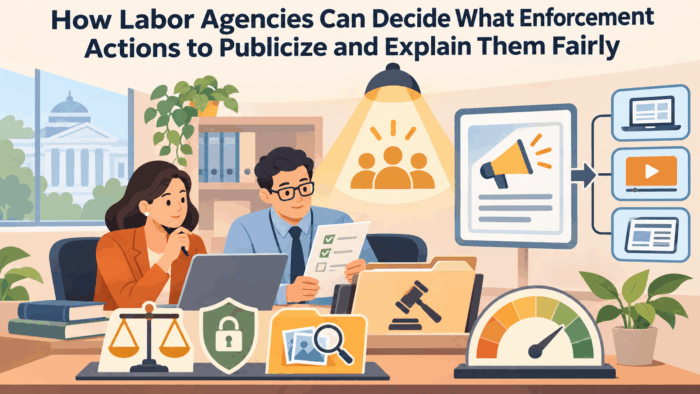
How Labor Agencies Can Decide What Enforcement Actions to Publicize and Explain Them Fairly
Labor agencies regularly make enforcement decisions that affect individual workers, employers, industries, and the broader public, but deciding which actions should receive public attention is a separate communication responsibility that requires its own standards. A citation, settlement, wage recovery, penalty, final order, or significant investigative finding may be legally public, yet that does not automatically mean it should receive the same level of publicity as every other enforcement action. Agencies need a deliberate way to distinguish routine transparency from situations where broader public communication serves a meaningful enforcement, educational, or accountability purpose.
The stakes are significant because enforcement publicity can influence how workers understand their rights, how employers perceive the agency’s priorities, and how the public evaluates whether labor protections are being enforced effectively. Well-designed communication can demonstrate accountability, encourage compliance, clarify legal requirements, and help workers recognize conduct that may warrant reporting. Poorly designed communication can overstate preliminary findings, create the impression that publicity itself is part of the punishment, or make similar enforcement actions appear to receive inconsistent treatment.
The challenge becomes more complicated when cases are still subject to review, settlement, appeal, or additional enforcement activity. Public announcements may attract attention long before a matter reaches its final procedural stage, and early descriptions can remain influential even when later developments materially change the outcome. Labor agencies therefore need communication practices that distinguish allegations from established findings, assessed amounts from collected amounts, and preliminary enforcement actions from final resolutions.
A strong enforcement publicity strategy begins with consistent selection criteria, disciplined language, procedural accuracy, and a clear understanding of the public purpose behind each communication. The objective is not to publicize as many cases as possible, nor to minimize visibility around meaningful enforcement work. It is to create a fair system in which significant actions are communicated in proportion to their public value, while workers, employers, media, and the public receive enough context to understand what the agency actually did and what remains unresolved.
Define the Public Purpose Before Deciding to Publicize an Enforcement Action
 Before deciding whether an enforcement action deserves broader publicity, the agency should identify the public purpose the communication is intended to serve. Possible purposes may include demonstrating accountability, educating workers about their rights, helping employers understand compliance expectations, deterring similar conduct, explaining an enforcement priority, or providing transparency around a matter of substantial public interest. Defining that purpose first helps prevent publicity from becoming an automatic extension of enforcement.
The same enforcement action may support more than one communication objective, but agencies should still be able to explain why broader publication adds value beyond the formal case record. A significant wage recovery may help workers understand that unpaid wages can be recovered, while a workplace safety action may help employers recognize a recurring hazard or compliance obligation. The public value should come from what the case teaches or demonstrates, not merely from the size of the penalty or the prominence of the employer involved.
Agencies should also consider whether a case-specific announcement is the best way to achieve the communication goal. In some circumstances, an industry advisory, compliance bulletin, annual enforcement summary, or broader educational campaign may provide greater value than highlighting one employer. Choosing the appropriate communication format is part of deciding whether publicity is warranted at all.
A clear purpose also makes later review easier. When enforcement, communications, legal, and leadership staff understand why a case is being considered for broader release, they can evaluate whether the proposed message actually advances that objective. This helps agencies avoid announcements that attract attention without improving transparency, education, compliance, or public understanding.
Establish Consistent Criteria for Which Cases Receive Broader Publicity
Labor agencies should develop a repeatable framework for determining which enforcement matters merit a press release, social promotion, media outreach, or another high-visibility communication. Criteria may include the seriousness of the violation, number of workers affected, amount of wages or penalties involved, repeat conduct, public safety implications, educational value, geographic scope, industry relevance, or whether the case illustrates a significant enforcement priority. The specific criteria will differ among agencies, but the decision should not depend primarily on which case appears most newsworthy.
No single factor should automatically determine whether an action is publicized. A high-dollar case may involve highly unusual facts that provide little broader compliance value, while a smaller matter may illustrate a widespread misunderstanding that many employers and workers need to understand. Agencies should evaluate the overall significance of the case rather than relying on monetary thresholds alone.
The framework should also consider procedural maturity. A final decision or completed settlement may support more definitive communication than an initial citation that remains subject to challenge. Cases involving unresolved factual disputes may still warrant communication, but the message should be calibrated to the stage of the process and the degree of certainty supported by the record.
Consistent criteria help agencies demonstrate that publicity decisions are based on legitimate institutional considerations rather than employer identity, political attention, industry pressure, or media interest. Similar cases may still receive different treatment when their public significance differs, but the agency should be able to explain internally why those differences make sense.
Use a Decision Matrix Without Turning Publicity Into a Mechanical Scoring Exercise
A decision matrix can help staff compare cases using the same core factors, including worker impact, seriousness, repeat conduct, public education value, procedural status, privacy concerns, and likelihood of misunderstanding. This creates structure around a decision that might otherwise be influenced by urgency or external attention.
The matrix should support judgment rather than replace it. A case that scores highly on several factors may still be inappropriate for broader publicity because of confidentiality concerns, unresolved proceedings, or limited educational value, while another matter may warrant attention because it addresses an emerging issue not captured well by the scoring system.
Agencies should periodically review whether the matrix is producing balanced results. If routine cases are being elevated too frequently or significant matters are consistently excluded, the criteria should be adjusted so the framework continues to support the agency’s transparency and communication goals.
Distinguish Routine Transparency From High-Visibility Enforcement Communication
Public transparency does not require every enforcement action to receive the same level of promotion. Agencies can make routine enforcement information available through searchable databases, annual reports, dashboards, case listings, or periodic summaries while reserving press releases and active media outreach for matters with broader public significance. This tiered approach can increase transparency without turning every case into a reputational event.
Routine publication can also reduce perceptions of selective disclosure. When a consistent baseline of enforcement information is available, the public can see that agency activity extends beyond the handful of cases that receive major announcements. High-visibility publicity then becomes an additional communication layer rather than the only way enforcement becomes visible.
Agencies should define the difference between these tiers internally so programs do not apply them inconsistently. A case might qualify for routine database publication because it meets normal disclosure requirements, while a separate determination is made about whether it warrants broader communication based on public-interest criteria. Keeping those decisions distinct supports fairness.
This structure also helps agencies communicate more strategically. High-profile releases can focus on cases that provide meaningful lessons or demonstrate significant outcomes, while routine transparency tools provide a fuller picture of enforcement activity. Together, the two approaches give workers, employers, and the public a more balanced understanding of agency performance.
Make Procedural Status Unmistakable in Every Public Announcement
One of the most important responsibilities in enforcement communication is accurately describing where the matter stands. An allegation, investigation, citation, proposed penalty, settlement, final order, appeal, and completed collection represent different procedural stages, and public communication should not collapse them into a single idea of enforcement success. The audience should be able to tell what has actually occurred.
Early-stage actions require especially careful wording because the agency may have taken formal action without reaching a final resolution. If an employer has a right to contest a citation or appeal a determination, the announcement should make that status clear. This does not weaken the agency’s message, but it ensures that the public understands the difference between a formal allegation or finding and a final outcome.
The same precision is necessary for monetary results. An agency that has assessed a penalty, ordered wages to be paid, reached a settlement, and actually collected money for workers has accomplished four different things. Communications should use verbs that accurately reflect those differences rather than treating every announced dollar amount as though it has already been recovered.
Procedural accuracy also protects the agency over time. If a case changes during review or appeal, carefully calibrated early communication is easier to update than an exaggerated announcement that implied finality from the beginning. Precise language creates a more durable public record.
Explain the Broader Compliance Lesson Without Overgeneralizing the Case
Enforcement publicity is most valuable when it helps audiences understand why the case matters beyond the individuals directly involved. A public announcement should explain the labor standard, workplace practice, or compliance issue at the center of the action so workers and employers can recognize its broader relevance. This turns enforcement communication into a form of education rather than simply a report of penalties.
The agency might explain that the case involved timekeeping, overtime, deductions, worker classification, retaliation, recordkeeping, or another requirement without suggesting that every workplace with similar characteristics has the same problem. The facts of one case can illustrate a broader issue while remaining limited to the actual findings and circumstances.
Employers should be able to use the communication to review their own practices. A well-designed enforcement announcement can encourage businesses to examine whether their systems create similar risk and direct them toward compliance resources before a problem becomes an enforcement matter. This adds preventive value to the publicity.
Workers can also benefit when the communication explains the underlying right in plain language. The case may help employees recognize a problem they previously assumed was normal or unavoidable. Publicity becomes more useful when it connects enforcement outcomes to practical understanding rather than focusing only on the employer that was cited.
Use Neutral Language That Communicates Accountability Without Public Shaming
Labor agencies can communicate serious violations firmly without using language that makes public embarrassment appear to be part of the sanction. Enforcement remedies should come from the legal and administrative process, while public communication should explain those remedies accurately. Headlines, quotes, and social posts should not add a rhetorical punishment beyond the official action.
Neutrality does not require the agency to minimize significant findings. When violations have been established, the communication can say so directly and explain the consequences. The distinction is between factual accountability and language designed primarily to humiliate, provoke, or celebrate punishment.
Tone becomes especially important in high-profile cases where media coverage may already be highly critical of the employer. The agency should maintain the same professional communication standards it would use in a less visible case, even when stronger language might generate more attention. Consistency protects institutional credibility.
A disciplined tone also benefits workers. Public communication can center the protection involved, the remedy obtained, and the broader lesson without treating affected workers as props in a public confrontation. Fairness in enforcement communication should extend to everyone involved in the case.
Explain Monetary Outcomes With Enough Context to Prevent Misunderstanding
Large wage recoveries, penalties, or settlements often become the most visible part of enforcement announcements because dollar amounts attract immediate attention. Agencies should provide enough context for the public to understand what the number represents and whether it reflects wages owed to workers, penalties payable to government, interest, restitution, or another category of relief. Combining different components into one headline figure can distort the meaning of the action.
The communication should also identify whether the amount has been assessed, ordered, agreed upon, or actually paid. These distinctions matter because an announced obligation may still be subject to review or collection. Workers and employers should not be left with the impression that money has changed hands when the case remains at an earlier stage.
Where appropriate, agencies can explain the scale of the amount by noting the number of affected workers, the relevant time period, or the types of violations involved. This provides context without sensationalizing the figure. A large total may be significant because it represents widespread underpayment rather than an unusually large amount owed to any one worker.
The broader communication should still explain the compliance issue itself. If the dollar amount becomes the entire story, the public may remember the number while learning very little about the labor standard the agency was enforcing. Context turns a financial headline into a useful enforcement message.
Protect Worker Privacy and Sensitive Information While Maintaining Transparency
Public enforcement actions can involve sensitive information about workers, witnesses, wages, immigration-related concerns, medical circumstances, or workplace disputes. Agencies should determine what information is necessary to explain the case and what should remain protected under applicable confidentiality, privacy, and disclosure requirements. Transparency should be purposeful rather than maximal.
Aggregate information can often communicate worker impact without identifying individuals. The agency may be able to explain how many workers were affected, the general nature of the violation, and the relief obtained while withholding names or personal details that are not necessary for public understanding. This can be particularly important when workers remain employed by the business or face potential retaliation concerns.
Agencies should also consider indirect identification. Even when names are omitted, combinations of job title, location, shift, personal circumstances, or case details may make individuals recognizable within a workplace or community. Privacy review should therefore consider how the information functions in context rather than focusing only on whether direct identifiers are present.
The same discipline applies to employer information that exceeds what is necessary to explain the enforcement action. Public availability does not always mean every detail needs to be emphasized in proactive communication. The agency should release enough information to support accountability while maintaining appropriate limits.
Prepare for the Questions Publicity Will Generate
A public enforcement announcement often creates a second wave of communication needs. Reporters may ask about evidence, employer history, appeals, penalties, related cases, or enforcement priorities, while workers may ask whether they are affected and employers may ask whether the case signals a change in agency interpretation. Agencies should anticipate these questions before the announcement is released.
A communication plan should include approved talking points, procedural explanations, disclosure limits, and referral paths for questions that cannot be answered through the public statement. Staff should know which questions belong with communications, enforcement personnel, legal staff, or another program. Preparation reduces the chance that different employees give conflicting explanations.
The agency should also be ready to explain why the case was publicized. Employers or industry groups may question why one organization received a press release when other enforcement matters did not. A consistent selection framework gives the agency a credible basis for answering that concern without needing to defend the individual case emotionally.
Preparation should not turn into an effort to publicly litigate every disputed fact. Some questions properly belong within the formal enforcement process rather than media communication. A mature publicity strategy makes those boundaries clear while still giving the public enough information to understand the action.
Treat Enforcement Publicity as One Part of a Broader Transparency System
Individual case announcements should not carry the entire burden of demonstrating how an agency uses its enforcement authority. Agencies can provide broader context through annual reports, searchable enforcement records, dashboards, compliance guidance, trend summaries, and explanations of enforcement priorities. These tools help workers and employers understand patterns rather than seeing only the most visible cases.
A broader transparency system can also make publicity decisions fairer. When routine enforcement activity is visible through consistent reporting, the agency does not need to issue a major public announcement simply to prove that a case occurred. High-visibility communication can then be reserved for actions with genuine educational or public-interest significance.
System-level transparency also helps the public interpret individual cases. A major settlement or penalty can be understood within the context of overall enforcement activity, recurring violation types, or broader compliance priorities. This prevents one dramatic case from becoming the sole representation of the agency’s work.
The long-term goal is a communication system in which enforcement visibility, public education, procedural fairness, and accountability reinforce one another. When agencies use consistent publication criteria, accurate procedural language, neutral tone, and broader transparency tools, they can explain significant enforcement actions clearly without making publicity itself part of the punishment.
Build a Formal Review Process Before High-Visibility Enforcement Communication
Labor agencies should establish a structured internal review process before deciding that an enforcement action deserves high-visibility publicity, because the decision often involves more than whether the underlying case is significant. Enforcement leadership, communications staff, legal personnel, program managers, and senior leadership may each see different risks or public-interest considerations, and a coordinated review helps ensure that those perspectives are considered before the agency commits to a public message.
The review should confirm the factual record, procedural status, disclosure authority, privacy considerations, and communication objective before drafting begins. Staff should identify which facts are fully established, which remain disputed, whether the matter is subject to appeal or further review, and what information the agency is authorized to release. This creates a shared factual foundation and reduces the likelihood that public messaging gets ahead of the enforcement process.
Agencies should also document the rationale for elevating a case beyond routine transparency, particularly when the matter is likely to attract media attention or industry scrutiny. The purpose is not to create unnecessary bureaucracy, but to make the decision traceable and consistent with the agency’s established criteria. A short internal record can later help leadership assess whether similar cases are receiving comparable treatment.
A formal review process can still be efficient when roles and approval thresholds are defined in advance. Agencies can use standard checklists, designated reviewers, and clear escalation rules so significant matters move quickly without sacrificing accuracy. Preparation allows the agency to communicate with confidence rather than improvising under external pressure.
Match the Communication Format to the Significance of the Enforcement Action
Not every enforcement matter that deserves public visibility requires a press release or active media outreach. Agencies should choose among routine database publication, web summaries, social media, targeted industry notices, press releases, newsletters, public dashboards, or broader educational campaigns based on the nature of the case and the communication purpose. Matching the format to the significance of the action helps prevent routine cases from being unnecessarily amplified.
A case involving a widespread compliance issue may benefit from a targeted employer advisory or worker education campaign even if the individual enforcement action is not unusually large. By contrast, a major final order with substantial worker impact may justify broader media communication because the public significance extends beyond the immediate parties. The format should follow the communication need rather than a fixed hierarchy based solely on penalties or dollar amounts.
Agencies should also consider how different channels change the tone and permanence of the message. A searchable enforcement database may provide durable transparency, while social media can compress context and increase the risk that procedural nuance is lost. Press releases can provide more explanation, but they may still be reduced to headlines when reported elsewhere.
Choosing the right format is therefore part of fairness. A communication approach that is disproportionately aggressive for one case can create the impression that publicity itself is being used as an additional sanction. Proportionality helps the agency maintain consistency across programs and enforcement outcomes.
Build Headlines and Opening Messages Around Procedural Accuracy
Headlines often shape public understanding before anyone reads the full announcement, which makes them especially important in enforcement communication. If a headline describes an allegation as though it were a final finding or suggests that money was recovered when it was only ordered, later explanatory paragraphs may not fully correct the initial impression. Agencies should therefore apply the same procedural discipline to headlines that they apply to the body of the release.
A strong headline can still be clear and compelling without overstating the case. It can identify the agency action, the type of violation or issue involved, the affected workers or workplace, and the current procedural stage. The wording should tell readers what happened while avoiding verbs or adjectives that imply more than the record supports.
Opening paragraphs should reinforce the same precision. Readers should quickly understand whether the agency issued a citation, reached a settlement, obtained a final order, or completed a recovery. That distinction should not be hidden in legal language several paragraphs later.
Consistency between headline, opening paragraph, social copy, and the formal enforcement record is essential. Agencies should review all public-facing formats together so one channel does not accidentally exaggerate what another explains more carefully. A disciplined first impression supports both credibility and fairness.
Explain Settlements Without Treating Them as Identical to Final Adjudication
Settlements are common and often important enforcement outcomes, but they can be misunderstood when public communication describes them as though every allegation was fully adjudicated. A settlement may secure wages, corrective action, penalties, or other remedies while leaving some factual or legal questions unresolved. Agencies should communicate the result accurately without diminishing its significance.
The announcement should explain what the parties agreed to and what obligations now follow, including payments, corrective actions, monitoring, or other terms that are appropriate for public disclosure. If the agreement includes no admission of liability or another relevant limitation, the communication should reflect that reality rather than implying a broader finding.
Agencies can also explain why settlement is a legitimate enforcement mechanism. Resolving a case through agreement can secure meaningful remedies while avoiding a longer contested process, and the public may benefit from understanding that settlement does not necessarily mean the agency abandoned enforcement. Context helps audiences interpret the outcome more accurately.
The same discipline should apply to shorter formats. Social media posts and headlines should not convert a nuanced settlement into language suggesting a final adjudicated violation if that is not what occurred. Fair communication requires consistency across every public channel.
Develop Standard Settlement Language for Common Outcomes
Agencies can reduce inconsistency by developing approved settlement language that distinguishes agreed payments, corrective actions, monitoring obligations, and procedural status. Standard phrasing gives communications staff a reliable starting point while preserving room for case-specific facts.
The language should be reviewed periodically to ensure that it remains accurate across different programs and settlement structures. A phrase that works for wage recovery may not fit a workplace safety or retaliation matter, so templates should support consistency without forcing every case into identical wording.
Standardization also makes later comparison easier. When similar settlement outcomes are described through similar terminology, the public is less likely to interpret differences in tone as differences in agency treatment.
Explain Employer Conduct Without Speculating About Motive
Enforcement findings often establish that an employer engaged in conduct that violated a requirement without necessarily determining why the conduct occurred. Public communication should distinguish between describing what the employer did and assigning motive, because terms suggesting intent, deception, or deliberate wrongdoing may go beyond what the agency actually established.
This distinction is particularly important in wage and hour cases where errors can arise from payroll systems, classification decisions, supervisory practices, recordkeeping weaknesses, or deliberate conduct. Unless intent has been established as part of the enforcement record, agencies should focus on the conduct and the applicable requirement rather than speculate about why the employer acted as it did.
Avoiding speculation does not require weak language. If the agency determined that workers were underpaid, records were inadequate, or a particular practice violated the law, it can say so directly. The communication becomes fairer when it describes established behavior precisely instead of converting the case into a judgment about the employer’s overall character.
This approach also improves the educational value of enforcement publicity. Other employers can better understand which practices create compliance risk when the agency focuses on the conduct itself. A message centered on behavior is more useful for prevention than one centered on rhetoric.
Explain Worker Impact Without Turning Individual Workers Into Public Symbols
 Workers are often central to the public significance of an enforcement case, especially when unpaid wages, retaliation, unsafe conditions, or other harms affected many people. Agencies should explain that impact clearly while avoiding unnecessary exposure of individual workers whose circumstances may already be sensitive. Aggregate information can often communicate the scale of the action effectively.
The agency may describe how many workers were affected, the general type of harm, the amount of recovery, or the workplace practices involved without identifying individuals. This can help the public understand the significance of the case while preserving privacy and reducing the likelihood that workers experience additional attention from coworkers, employers, or media.
Where individual stories or quotes are considered, agencies should approach them carefully and within applicable legal and ethical boundaries. Participation should never appear to be required in exchange for agency assistance, and workers should understand how their information may be used. The power imbalance between an agency and an individual worker makes thoughtful consent especially important.
Worker-centered communication should also avoid framing people only as victims. The agency can emphasize rights, remedies, reporting, and recovery while acknowledging the harm involved. This presents affected workers as participants in the enforcement process rather than simply as symbols in a public campaign.
Prepare for Appeals, Modifications, and Reversals Before the Initial Announcement
An enforcement action that is publicized early may change substantially as the case moves through administrative review, settlement, appeal, or litigation. Agencies should plan for that possibility before issuing the initial announcement so they know how the public record will be updated if the outcome changes. This is especially important when the original communication receives significant media attention.
The initial announcement should clearly identify any review rights and avoid language that would make later modification appear contradictory. If a penalty is proposed rather than final, or if a citation may be contested, the message should say so. This protects the agency from having to unwind an exaggerated early narrative.
Agencies should also establish a process for correcting or supplementing prior communication when material changes occur. A reduced penalty, vacated citation, amended order, or changed finding should not remain invisible while the original announcement continues circulating without context. Transparency should apply across the full lifecycle of the case.
This approach strengthens credibility because it demonstrates that the agency is committed to accuracy rather than only to publicizing its strongest enforcement moment. A fair communication system acknowledges outcomes that change in either direction.
Coordinate Enforcement Publicity With Compliance Education
Public attention around an enforcement case can create a valuable opportunity to help other employers and workers understand the underlying requirement. Agencies should consider what educational resources should accompany the announcement so the case becomes a gateway to broader compliance information rather than an isolated news event.
Employer-facing resources might include fact sheets, compliance checklists, webinars, consultation programs, or guidance explaining the issue in general terms. Worker-facing materials might explain the relevant right, how to recognize a potential problem, and where to seek information or file a complaint. These resources should be clearly separated from the specific facts of the case.
The agency should also make clear that one enforcement action does not automatically determine how the law applies to every other workplace. Broader guidance can explain general principles while directing users toward authoritative resources for more detailed questions. This preserves the distinction between education and case-specific legal advice.
Connecting enforcement to education can also improve the tone of public communication. The message becomes not only that one employer faced consequences, but also that other businesses and workers can learn from the issue and take preventive action. This creates a stronger public benefit from the publicity itself.
Prepare Internal Staff and External Partners Before a Major Enforcement Announcement
A significant enforcement announcement can generate an immediate increase in calls, complaints, media inquiries, and questions from employers, workers, elected officials, and community organizations. Agencies should prepare internal staff before publication so the public-facing message does not arrive before the people responsible for answering questions understand it.
Call center employees, investigators, outreach teams, communications staff, and leadership should receive a concise briefing covering the public facts, procedural status, key messages, disclosure limitations, and referral pathways. Staff should know which questions they can answer directly and which should be routed to legal, communications, or program leadership.
External partners may also need limited advance preparation when the announcement is expected to generate broader awareness. Worker organizations, employer associations, community groups, or industry partners can be provided with public resources and referral information so they can direct questions toward authoritative sources without speaking on behalf of the agency.
Internal and external preparation does not mean sharing confidential details before publication. The objective is operational readiness. When everyone understands the public message and the limits of what can be discussed, the agency is better positioned to handle the attention that follows.
Measure Whether Publicity Produces Transparency and Compliance Value
Agencies should evaluate enforcement publicity based on whether it advances the purpose identified before the case was publicized. Media coverage, web traffic, and social engagement may show that the announcement reached people, but they do not reveal whether workers understood their rights or employers learned anything useful about compliance.
Useful measures may include visits to related guidance, downloads of compliance materials, requests for employer assistance, worker inquiries, referrals from community partners, and changes in the types of questions the agency receives after the announcement. These indicators can help determine whether attention translated into practical understanding.
Agencies should also monitor unintended effects. If an announcement generates widespread confusion about procedural status, causes employers to misunderstand the scope of a rule, or leads workers to believe every similar workplace is automatically in violation, the communication may need refinement even if it attracted substantial attention.
Over time, measurement can improve both case selection and message design. The agency can learn which types of enforcement actions provide real educational value, which formats work best, and which communication choices create unnecessary misunderstanding. Publicity becomes more strategic when the agency evaluates outcomes rather than simply counting announcements.
Communicate Repeat Violations With Historical Context and Restraint
Repeat violations can justify broader publicity because they may show that earlier enforcement, education, or corrective action did not produce sustained compliance, but agencies should explain that history carefully rather than using the label as a rhetorical intensifier. The communication should identify what prior action occurred, when it occurred, and why it is relevant to the current matter, while avoiding the implication that every earlier interaction with the employer proves a continuing pattern of misconduct.
The agency should also distinguish between repeated violations, continuing violations, and separate incidents that happen to involve the same employer. These categories can carry different legal and practical meanings, and combining them can create a stronger public impression than the record supports. Precise language helps the audience understand why the history matters without treating every prior contact as evidence of the same problem.
Where prior enforcement is publicly available and directly relevant, the agency can explain how the current action relates to earlier findings or corrective expectations. This may be particularly useful when the same requirement was involved or when the employer had previously been directed to change a practice. The explanation should remain factual and avoid implying intent unless intent has actually been established.
Repeat cases can also provide a broader compliance lesson for other employers. The agency can explain that corrective action is expected to result in lasting change and that recurring problems may lead to additional consequences where authorized. This frames the history as part of the enforcement system rather than simply as a reason to intensify public criticism.
Explain Systemic or Multi-Location Cases Without Making the Entire Industry the Target
Some enforcement actions involve practices that extend across multiple worksites, business units, locations, or groups of workers, making the case broader than a single isolated violation. These matters may warrant significant public attention because they can reveal how one policy, payroll practice, or management system affected many employees at once. Agencies should explain the scope clearly without turning the case into a generalized judgment about an entire industry.
The communication should identify what made the case systemic. That may include a common policy used across locations, repeated application of the same pay practice, centralized decision-making, or the number of workers affected by one organizational approach. Specific explanation is more useful than simply describing the matter as widespread.
Agencies should avoid suggesting that similar businesses are presumed to have the same problem. An industry may face recurring compliance questions, but one employer’s systemic violation does not establish that every organization in that sector operates similarly. The broader educational message should therefore distinguish between a documented case and a potential area of compliance risk.
When the case does reveal a recurring industry issue supported by broader enforcement experience, agencies can create separate outreach to explain the general concern. This allows the case-specific communication to remain fair while a broader campaign addresses the preventive lesson for other employers and workers.
Communicate Multi-Employer and Contractor Cases With Clear Responsibility Distinctions
Enforcement actions involving contractors, subcontractors, staffing firms, franchise relationships, host employers, or other multi-employer arrangements can be difficult for the public to interpret because several organizations may appear in the same case. Agencies should explain each entity’s role carefully so responsibility is not assigned merely because multiple businesses are named together.
If several entities received separate citations, entered a joint settlement, or were found responsible under different provisions, the communication should distinguish those outcomes. The public should not have to infer which employer engaged in which conduct or whether all parties faced the same findings. Clear organization is especially important when one entity employed the workers while another controlled part of the work environment or business arrangement.
Agencies should also avoid using shorthand that obscures legal distinctions. Referring collectively to “the employer” may be misleading when multiple entities had different responsibilities, procedural statuses, or enforcement outcomes. Precise identification makes the announcement more accurate and more useful for other businesses operating under similar arrangements.
These cases can have strong educational value because they help employers understand that workplace responsibility may involve more than one organization. However, the agency should explain the general lesson without attempting to convert one enforcement matter into universal legal advice about every contractor or staffing relationship.
Use Visual or Structured Explanations When Several Entities Are Involved
A short structured summary can help readers understand which entities were involved, what role each played, and what enforcement action applied to each one. Tables, bullets, or clearly separated paragraphs can sometimes communicate these distinctions more effectively than dense narrative text.
The structure should remain descriptive rather than argumentative. Its purpose is to help readers follow the official record, not to rank responsibility or suggest conclusions beyond what the agency established.
Any simplified presentation should be reviewed against the formal enforcement documents so it does not accidentally collapse different findings into one. Clarity is useful only when the simplified explanation remains faithful to the underlying case.
Explain Cases Involving Worker Classification With Particular Precision
Worker classification cases often attract broad attention because terms such as employee, independent contractor, exempt worker, or joint employer can affect wages, overtime, recordkeeping, and other protections. Public communication should explain what classification issue the agency addressed without suggesting that every worker in a similar occupation or business model should automatically be classified the same way.
The announcement can describe the factual circumstances relevant to the agency’s determination at an appropriate level, such as how work was structured, compensated, supervised, or controlled. It should avoid reducing a complex legal analysis to a single factor if the governing standard requires a broader evaluation. This helps the public understand why the case matters without converting the announcement into an oversimplified test.
Procedural status is especially important in these cases because classification findings may be contested or appealed. If the matter remains under review, the communication should state that clearly and avoid presenting the classification outcome as permanently settled. Precise language protects both fairness and the educational value of the message.
Agencies should also link case publicity to broader authoritative guidance when classification is a recurring compliance issue. Employers and workers can then learn about the general framework without relying on a case-specific announcement as a substitute for understanding the applicable requirements.
Handle Politically Sensitive or High-Profile Cases Under the Same Communication Standards
Some enforcement matters attract immediate attention because they involve a major employer, prominent industry, public controversy, elected official interest, or issue already receiving substantial media coverage. These cases can create pressure for faster, stronger, or more frequent communication than the agency would normally use. Established publicity standards are most important when that pressure is highest.
The agency should continue applying the same requirements for factual verification, procedural accuracy, privacy, tone, and approval that would govern a less visible case. Increased attention may justify additional communication because more people are seeking information, but it should not justify more aggressive characterizations or premature conclusions. Visibility should affect communication capacity, not evidentiary standards.
Leadership remarks should also remain disciplined. Senior officials may appropriately explain the agency’s enforcement mission, acknowledge the significance of worker protections, or describe the broader importance of compliance, but they should avoid predictions about unresolved findings or outcomes. Political visibility should not blur the distinction between institutional values and case-specific determinations.
Consistency in high-profile cases protects the agency from perceptions that communication intensity changes according to politics or public pressure. Workers and employers are more likely to trust the broader enforcement system when prominent matters are handled according to the same communication principles applied elsewhere.
Communicate Enforcement Against Small Employers Without Losing Proportionality
Small employers can face significant enforcement actions, and agency transparency should not disappear simply because a business is small. At the same time, publicity can have a disproportionate reputational effect on a local business, especially in a small community where a single announcement may become the dominant public narrative about the organization. Agencies should consider proportionality without creating separate accountability standards.
The decision should remain grounded in the same public-interest criteria used for larger employers. Serious worker harm, repeat violations, substantial educational value, or significant enforcement outcomes may justify broader communication regardless of employer size. Conversely, a routine matter should not become high-profile merely because a small business is easy to identify or local media interest is unusually strong.
Tone is especially important in these cases because language that appears routine at the agency level can feel punitive when directed toward a small organization with limited public relations capacity. The agency should describe the conduct, findings, remedy, and procedural status clearly while avoiding unnecessary rhetorical escalation.
This approach preserves both fairness and accountability. Small employers should not receive less transparency simply because they are small, but agency communication should remain proportionate to the actual significance of the enforcement action rather than the reputational impact the announcement might generate.
Explain Employer Cooperation and Corrective Action Without Minimizing the Violation
Employers may respond to an investigation by providing records promptly, correcting pay practices, paying workers, changing policies, or implementing safeguards before the case is fully resolved. These actions may be relevant to the public understanding of the enforcement outcome, particularly when they materially shaped the resolution. Agencies should decide consistently when cooperation belongs in the announcement.
Acknowledging corrective action can demonstrate that enforcement is intended to produce compliance rather than publicity alone. It may also help other employers understand that responding constructively to identified problems is part of responsible compliance management. The communication should still make clear what violation or issue led to agency involvement in the first place.
Agencies should avoid allowing cooperation language to erase worker harm or make established violations sound insignificant. Corrective action after an investigation began does not necessarily change what happened before the correction. The announcement should distinguish the underlying conduct from the employer’s subsequent response.
The reverse is also true. Agencies should not characterize an employer as uncooperative unless the record supports that description and the fact is relevant to the enforcement action. Public communication should remain tied to established behavior rather than using cooperation as a measure of whether the agency likes or dislikes the employer’s response.
Handle Public Criticism of Penalties and Remedies With Clear Explanations of Agency Authority
Enforcement announcements may trigger criticism that a penalty is too small, a settlement is too lenient, or a remedy does not match the perceived seriousness of the conduct. Agencies should prepare to explain how penalties and remedies are determined within their authority without becoming defensive or suggesting discretion that does not actually exist.
Public communication can explain the categories of remedies involved, the statutory or regulatory framework governing them, and whether amounts are calculated according to established factors. The explanation should remain accessible and should avoid turning a media response into a technical legal memorandum. The goal is to help audiences understand the structure behind the outcome.
Agencies should also distinguish between remedies that benefit workers directly and penalties paid to government where that distinction applies. A case may involve both wage recovery and a separate civil penalty, and public criticism can arise when those amounts are combined or misunderstood. Clear breakdowns make the outcome easier to interpret.
If the agency’s authority limits what it can impose, that constraint should be stated accurately. Transparency about the boundaries of enforcement power can help the public understand why a serious violation does not always produce the remedy they expected. The agency should explain its role rather than imply that every desired outcome was within its control.
Use Aggregate Enforcement Data to Test Whether Publicity Decisions Are Fair
Individual publicity decisions may appear reasonable on their own while still producing an uneven pattern across the agency’s overall enforcement portfolio. Leadership should periodically examine which cases receive press releases, social promotion, or other high-visibility treatment and compare those choices across programs, industries, regions, employer sizes, and violation types.
The purpose is not to require equal publicity across every category. Enforcement activity itself may be concentrated in particular sectors or geographic areas, and some cases will naturally have greater public significance than others. The review should instead identify differences that cannot be explained by the agency’s stated selection criteria.
This analysis can reveal whether certain programs routinely elevate cases while others rarely communicate significant outcomes, whether high-dollar matters dominate at the expense of educational value, or whether politically visible employers receive disproportionate attention. These patterns may indicate that the publicity framework needs stronger governance or clearer thresholds.
Regular review helps transform fairness from an aspiration into a management practice. When agencies compare actual publicity choices with their established criteria, they can identify drift, improve consistency, and demonstrate internally that enforcement communication is being managed as a system rather than as a series of isolated decisions.
Build Governance Around Enforcement Publicity Decisions
Labor agencies should treat enforcement publicity as a governed communication function rather than a collection of individual press decisions made case by case. When different divisions develop their own informal standards, similar enforcement outcomes can receive very different levels of attention depending on who manages the case, which communications staff are involved, or how much outside interest happens to exist. A shared governance structure helps prevent those inconsistencies from becoming part of the agency’s public identity.
The governance model should define which offices participate in publicity decisions, who owns the final recommendation, and which circumstances require additional legal or executive review. Enforcement programs may provide substantive case information, communications staff may evaluate public value and message design, legal personnel may review disclosure and procedural concerns, and leadership may become involved when the matter carries broader institutional significance. Defining those responsibilities in advance allows the process to move more efficiently when a significant case arises.
Agencies should also determine which decisions can be made at the program level and which require centralized approval. A routine enforcement database entry should not necessarily require the same review as a major press release involving a high-profile employer, multiple jurisdictions, or unresolved litigation. Tiered authority can preserve oversight without making every communication unnecessarily cumbersome.
Governance should be reviewed periodically rather than treated as permanent once established. Changes in enforcement programs, leadership, disclosure requirements, technology, and public expectations may require the agency to revise its criteria or approval pathways. Regular review helps keep publicity practices aligned with the agency’s broader transparency and fairness goals.
Create Standard Publicity Tiers Across Enforcement Programs
A consistent enforcement communication system should define several levels of public visibility instead of treating publicity as a simple choice between silence and a press release. Routine disclosure, searchable case listings, periodic enforcement summaries, targeted compliance notices, social media, press releases, and proactive media outreach can each serve different purposes. Establishing these tiers helps agencies match communication intensity to the significance of the case.
Each tier should have general eligibility criteria and expected content. Routine database publication may require only standardized factual fields, while a press release may require a broader explanation of the public significance, worker impact, procedural status, and compliance lesson. More intensive media outreach may be reserved for cases with exceptional public interest or substantial educational value.
Using common tiers across programs can reduce internal disparities. A wage enforcement division and a workplace safety program may deal with different legal authorities, but both can apply the same general principle that communication intensity should reflect public significance rather than individual staff preference. Program-specific adjustments can still be made where necessary.
This structure also helps the public interpret agency communication. When high-visibility announcements are used selectively and routine enforcement remains accessible through other channels, audiences are less likely to assume that the cases receiving press coverage represent the agency’s entire enforcement workload. Publicity becomes one layer of transparency rather than the only visible layer.
Maintain a Controlled Library of Approved Enforcement Language
Labor agencies should maintain approved language for recurring enforcement stages, outcomes, and public explanations so staff do not have to invent terminology each time a case is publicized. Terms such as alleged, cited, assessed, ordered, settled, recovered, collected, appealed, modified, and final carry different meanings, and inconsistent usage can create confusion or unintended overstatement. A controlled language library helps preserve precision across programs.
The library can include preferred definitions, standard procedural descriptions, examples of language to avoid, and guidance about when stronger or more limited wording is appropriate. It can also identify phrases that are technically accurate but easily misunderstood by the public, allowing communications staff to pair them with clearer explanations. This supports both legal accuracy and plain-language communication.
Approved language should extend beyond press releases. Social media posts, enforcement dashboards, public reports, website summaries, talking points, and media responses should draw from the same terminology framework so one channel does not characterize the case more aggressively than another. Consistency strengthens credibility and reduces the risk that shortened formats distort the underlying action.
The language library should be reviewed when enforcement procedures, statutes, regulations, or agency practices change. Terminology that reflected an older process may become misleading after a procedural revision. Maintaining the language system is therefore part of maintaining the enforcement communication system itself.
Establish Formal Procedures for Updating Publicized Cases
Public enforcement communication should not end when the original announcement is issued. Appeals, settlements, amended orders, modified penalties, collection activity, judicial review, and case closure can all change how the public should understand an earlier action. Agencies should establish procedures for determining when those developments require updates.
The agency should identify which types of changes are material enough to warrant a revised web page, notation, follow-up announcement, or correction. A minor administrative adjustment may not justify new publicity, while a vacated citation, substantially reduced penalty, or final recovery of previously ordered wages may materially change the public record. Clear thresholds help staff make these decisions consistently.
Original announcements should also be preserved in a way that allows later context to be added without obscuring what was communicated at the time. A visible update notice can explain that the case developed after the original release and direct users to the current outcome. This is more transparent than silently changing historical language in a way that makes the sequence difficult to reconstruct.
Lifecycle communication reinforces fairness because it requires the agency to publicize developments that weaken or change its initial position as well as those that strengthen it. The public record becomes more credible when audiences can see the case evolve rather than encountering only the most dramatic enforcement stage.
Coordinate Enforcement Publicity With Media and Public Records Functions
High-profile enforcement cases often generate media inquiries and public records requests at the same time, making coordination among communications, legal, records, and enforcement staff especially important. Public statements should not characterize information in one way while released records suggest a materially different procedural status or factual context. Internal alignment helps prevent those contradictions.
Agencies should establish a process for sharing the approved public record across relevant teams. Communications staff should know what records have been released or may soon become public, while records personnel should understand which case developments have already been publicly explained. This does not mean that communication and public records functions should become interchangeable, but they should operate with awareness of one another.
The agency should also prepare for preliminary records that may contain information later corrected or refined. Where appropriate, communications staff can explain that early records reflect information available at a particular stage and should not be treated as final findings. This kind of context can be particularly important in complex or contested enforcement matters.
Coordination also improves response time. When the agency already knows which information is public, which remains confidential, and which procedural terms have been approved, media questions can be answered more consistently. The result is a more coherent public account across formal records and active communication.
Prepare Staff for the Operational Effects of Publicity
A significant enforcement announcement can change agency workload almost immediately by generating calls, complaints, employer inquiries, media requests, partner questions, and interest from elected officials or community organizations. Agencies should anticipate these operational effects rather than treating publicity as the communications team’s responsibility alone. Internal preparation can prevent a successful announcement from creating avoidable service problems elsewhere.
Before release, relevant staff should receive a concise briefing on the public facts, procedural status, core messages, available guidance, and referral pathways. Call center staff may need to know how to respond to workers who believe they experienced similar conduct, while employer assistance teams may receive questions from businesses trying to understand whether the case affects them. Each group should know what information it can provide.
The agency should also prepare for sudden increases in complaints or reports related to the issue. A widely publicized wage, retaliation, or workplace safety case may help workers recognize similar concerns in their own employment. Intake teams should be ready to receive those contacts without assuming that every similar allegation has the same legal outcome.
Operational planning makes publicity more useful because the agency can convert public attention into appropriate service rather than confusion. Enforcement communication should create pathways for action, not simply visibility. When those pathways are prepared in advance, the agency can respond more effectively to the interest it generates.
Build Quality Control Into Headlines, Quotes, Social Media, and Visual Materials
Formal press releases often receive extensive review, while shorter communication formats may be developed quickly and receive less scrutiny even though they can reach much larger audiences. Agencies should apply quality-control standards to headlines, executive quotes, social posts, graphics, videos, and other promotional materials because these formats can easily remove procedural nuance from the underlying case.
Headlines and social copy should be checked for the same distinctions used in the full announcement, including whether violations are alleged or final, whether money was ordered or recovered, and whether the matter remains subject to appeal. Shorter formats may require simpler language, but simplification should not become overstatement.
Executive quotes deserve particular attention because they can shift the tone of the announcement. Leadership can emphasize the importance of worker protections, compliance, or accountability without making statements about motive or guilt that exceed the formal findings. A strong institutional message does not need to become a personalized condemnation.
Visual materials should also be reviewed for fairness and context. Large penalty figures, employer logos, dramatic photographs, or other design choices can amplify a punitive tone even when the accompanying text is neutral. Communication design should support understanding of the enforcement action rather than turn the case into promotional content.
Audit Publicity Patterns for Consistency and Fairness
Labor agencies should periodically review their enforcement publicity as a portfolio rather than examining only individual announcements. A case-by-case process can appear fair while still producing cumulative patterns in which certain industries, employer sizes, geographic areas, or enforcement programs receive disproportionate high-visibility attention. Portfolio review helps leadership identify those patterns.
The audit can compare publicized cases with the agency’s underlying enforcement activity and selection criteria. If one program generates many press releases while another has significant enforcement outcomes that rarely receive public attention, leadership should determine whether the difference reflects legitimate public-interest considerations or inconsistent communication practices. Similar analysis can be applied to employer size, region, and violation category.
Agencies should also review tone and procedural language across announcements. Even when case selection is consistent, differences in wording can create perceptions that some employers are being treated more harshly in public communication than others. Standard language and cross-program review can reduce those disparities.
The purpose of the audit is not to make every case look identical. Enforcement matters differ, and communication should reflect those differences. The goal is to ensure that variation is explainable through established criteria rather than through habit, political pressure, staff preference, or media interest.
Make Enforcement Publicity a Long-Term Transparency and Compliance Strategy
Enforcement publicity should be integrated with the agency’s broader communication, transparency, compliance assistance, and performance systems rather than managed as an occasional public relations activity. Individual announcements become more useful when they connect to searchable records, employer guidance, worker education, annual reporting, and clear explanations of the agency’s enforcement role. This creates a fuller picture of how authority is being exercised.
Leadership should assign ongoing responsibility for maintaining publicity criteria, reviewing templates, updating procedural language, monitoring case outcomes, coordinating with records staff, and evaluating public response. These functions require continuity because the risks associated with inconsistent publicity accumulate over time. A mature system depends on maintenance as much as initial design.
Agencies should also use lessons from prior announcements to improve future communication. Cases that generated confusion about appeal status, monetary outcomes, employer responsibility, or worker coverage can reveal weaknesses in the existing framework. Those lessons should be incorporated into templates, staff guidance, and review procedures rather than addressed only within the individual case.
When enforcement publicity is managed as a long-term communication discipline, agencies can make important actions visible without turning attention itself into an unofficial sanction. Workers and employers gain a clearer understanding of enforcement priorities and compliance expectations, while the agency preserves procedural accuracy, proportionality, and public trust across the full enforcement system.
Strategic Communication Support for Enforcement Publicity
 Labor agencies need enforcement publicity systems that make significant actions visible without allowing publicity itself to become an additional punishment. Decisions about whether to issue a press release, publish a case summary, promote an action through social media, update an enforcement database, or launch a broader compliance campaign should be grounded in public value, procedural status, proportionality, and consistency. The strongest systems help agencies explain why an enforcement action matters while preserving the distinction between public communication and the formal penalties or remedies authorized through the enforcement process.
Stegmeier Consulting Group (SCG) can support labor agencies by developing enforcement publicity criteria, case-selection frameworks, communication tiers, message standards, review protocols, procedural-status language, media response guidance, internal talking points, and public transparency strategies. SCG can also help agencies examine how different programs communicate enforcement outcomes so leadership can identify inconsistencies in case selection, tone, terminology, or follow-up communication that may affect perceptions of fairness.
Strategic communication support can be especially useful when an agency is trying to balance several legitimate objectives at the same time. Workers may expect visible accountability, employers may expect proportional and accurate communication, media may seek immediate explanations, and agency leadership may want enforcement outcomes to reinforce broader compliance priorities. A structured communication framework helps those objectives coexist without allowing political attention, employer prominence, or the perceived news value of one case to determine the agency’s approach.
SCG’s role remains focused on communication strategy, public information systems, message development, media planning, stakeholder communication, internal alignment, transparency, and communication measurement. SCG does not determine whether information may legally be disclosed, make enforcement findings, decide penalties, conduct investigations, adjudicate disputes, interpret confidentiality requirements, or provide legal advice. Strategic communication support helps agencies explain authorized enforcement activity clearly and consistently while preserving the responsibilities of agency counsel, investigators, hearing officers, program leadership, and other authorized officials.
Future Trends
Labor agencies are likely to rely increasingly on tiered transparency systems rather than treating press releases as the primary way the public learns about enforcement activity. Routine actions may be available through searchable databases, dashboards, periodic enforcement summaries, or standardized case listings, while matters with broader worker impact, significant compliance value, or substantial public interest receive more active communication. This can give the public a more complete picture of enforcement while reducing pressure to elevate every case into a major announcement.
Agencies may also place greater emphasis on following publicized cases across their full procedural lifecycle. Initial citations, settlements, administrative review, modified penalties, final orders, collection outcomes, and case closure can all materially change the meaning of an earlier announcement. Digital publishing makes it increasingly practical to update case pages or add visible procedural notes so the public record reflects the current status rather than preserving only the most attention-generating stage.
Data analysis may become more important in evaluating whether publicity decisions are being applied consistently. Agencies can compare which industries, employer sizes, geographic areas, enforcement programs, violation types, and procedural stages receive high-visibility communication and determine whether those patterns align with documented selection criteria. This kind of review can help leadership identify communication drift before it becomes a source of external criticism or internal inconsistency.
Enforcement publicity is also likely to become more closely integrated with compliance education. Instead of ending with a description of penalties or recoveries, agencies can use publicized actions to direct employers toward guidance, consultation resources, or training and help workers understand the right involved and available reporting pathways. The most effective future model will treat enforcement publicity as one component of a larger communication system connecting accountability, prevention, transparency, and public understanding.
Conclusion
Publicizing labor enforcement can serve important public purposes when agencies are deliberate about which actions receive broader attention and how those actions are explained. Significant cases can demonstrate that worker protections are being enforced, help employers understand compliance expectations, clarify the agency’s authority, and provide transparency about how public institutions respond to violations. Those benefits are strongest when publicity decisions are based on consistent criteria rather than on attention alone.
Fair enforcement communication also requires precision about what the agency has actually established. Allegations should not be described as final findings, assessed penalties should not be presented as collected money, settlements should not be characterized as adjudicated outcomes when they are not, and pending appeals should remain visible in the public explanation. These distinctions protect procedural fairness while making the communication more credible over time.
A mature enforcement publicity system also recognizes that transparency extends beyond individual press releases. Searchable enforcement records, aggregate reporting, compliance guidance, case updates, media protocols, internal staff preparation, and portfolio-level review can work together to provide a more complete picture of agency activity. This broader system allows high-visibility communication to remain selective without making routine enforcement invisible.
When labor agencies use clear publication criteria, proportional communication tiers, disciplined language, procedural updates, and ongoing evaluation, they can make significant enforcement actions visible without turning attention itself into a sanction. Workers gain a clearer understanding of how protections are enforced, employers receive more useful compliance signals, and the public can better understand both the significance and the limits of individual enforcement actions.
Stegmeier Consulting Group’s Strategic Approach to Communication Systems
Labor agencies need communication systems that connect enforcement publicity criteria, case-selection decisions, procedural-status language, media response, internal staff guidance, compliance education, aggregate reporting, case updates, and performance measurement into one consistent framework. These systems should make significant enforcement actions understandable while also ensuring that similar cases are evaluated according to comparable communication standards across programs.
SCG helps agencies examine how enforcement information moves from case teams to communications staff, leadership, media, employers, workers, and the public. This can include developing decision frameworks, controlled terminology, communication tiers, message review procedures, partner guidance, and methods for assessing whether publicity is supporting transparency and compliance rather than simply generating attention.
The broader objective is to create an enforcement communication system that is strong enough to explain serious violations clearly and disciplined enough to preserve neutrality when a case is politically sensitive or highly visible. Agencies should be able to communicate accountability without sacrificing procedural accuracy, proportionality, or trust in the fairness of the enforcement process.
Build an enforcement publicity framework that makes significant actions visible while preserving procedural fairness and proportional communication.
A strong framework should help agencies decide which cases deserve broader attention, which communication format is appropriate, how procedural status should be explained, and when later developments require an update. These decisions should be supported by documented criteria so the agency can apply them consistently across programs and enforcement types.
The framework should also connect each publicized case to useful next steps for workers, employers, and agency staff. Media messaging, compliance guidance, worker education, call center preparation, and case updates should reinforce the same factual record rather than operate as separate communication activities.
Over time, the agency should review both individual announcements and the overall pattern of publicity to determine whether the system remains balanced. Consistent governance and measurement can help ensure that public communication continues to support accountability, education, and transparency without becoming an unofficial extension of enforcement penalties.
Use the form below to connect with our team and explore how strategic communication support can strengthen enforcement publicity decisions, fair case communication, transparency systems, media response, and compliance education across labor agency programs.