
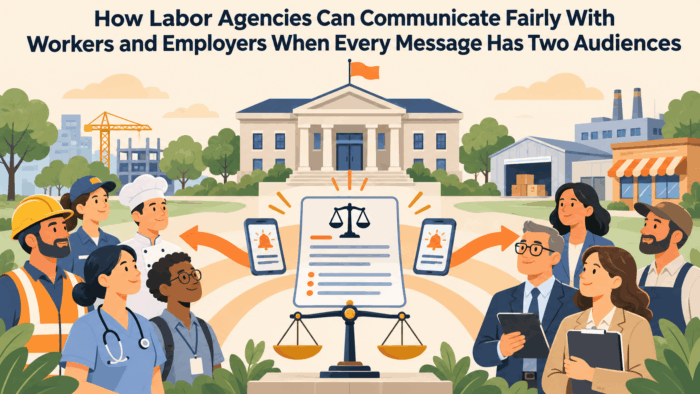
How Labor Agencies Can Communicate Fairly With Workers and Employers When Every Message Has Two Audiences
Labor agencies rarely communicate to only one audience at a time. A statement intended to help workers understand a wage rule may also be read by employers, attorneys, industry associations, unions, legislators, and reporters. Guidance written for employers may be scrutinized by workers and advocates to determine whether the agency is applying the law consistently. An enforcement announcement directed toward public accountability may also influence how regulated businesses understand compliance expectations. In this environment, nearly every message has at least two audiences, even when only one is named explicitly.
This creates a distinctive communication challenge. Labor agencies must explain rights in a way that does not sound like advocacy for workers against employers, and they must explain employer responsibilities without sounding apologetic about enforcement. They must communicate protections clearly enough that workers can recognize potential violations while giving employers enough information to understand how the same legal standard applies operationally. They must also avoid creating the impression that fairness means treating every dispute as though both sides are equally likely to be correct. The agency’s responsibility is to apply the law consistently, not to split the difference between competing perspectives.
Fair communication therefore depends on more than tone. It requires disciplined message architecture, consistent definitions, clear explanations of agency authority, careful distinctions between allegations and findings, and a willingness to present the same legal standard in ways that different audiences can understand. Worker-facing communication and employer-facing communication can emphasize different practical questions without contradicting one another. The underlying rule, process, and institutional role should remain stable across both.
A strong communication framework helps labor agencies maintain credibility when stakeholders disagree sharply. Workers can see that the agency takes rights and enforcement seriously. Employers can see that the agency provides clear expectations and does not presume wrongdoing before facts are established. Partners and the public can see that the agency’s communication is grounded in law, procedure, and evidence rather than in pressure from whichever constituency is most vocal at the moment.
Define Fairness as Consistency, Not Symmetry
 Labor agencies can make communication mistakes when they interpret fairness as giving workers and employers identical language, identical emphasis, or identical amounts of attention in every message. That kind of symmetry may appear neutral, but it can actually make communication less accurate because workers and employers often have different legal roles, different responsibilities, and different practical questions.
Fairness should instead mean that the same legal standard is explained consistently regardless of audience. If a worker-facing guide explains that a certain wage practice may violate the law, employer-facing guidance should explain the corresponding obligation in equally clear terms. If an employer resource explains an available compliance process, workers should be able to understand how that process affects their rights or the agency’s enforcement role.
This approach allows messages to be audience-specific without becoming substantively different. Workers may need information about how to recognize a problem, preserve relevant records, file a complaint, and understand retaliation protections. Employers may need information about implementation, recordkeeping, corrective action, and inspection procedures. The messages are not identical because the audiences are not in identical positions.
Consistency becomes the test. The agency should be able to place the worker-facing and employer-facing materials side by side and demonstrate that they describe the same law, the same authority, and the same process without hidden contradictions.
Separate Audience Adaptation From Legal Interpretation
Audience-specific communication is useful, but agencies should be careful that adaptation does not drift into changing the substance of the message. A simplified explanation for workers and a technical guide for employers may use different language, but they should not imply different legal thresholds.
This distinction is especially important when laws contain exceptions, definitions, exemptions, or factual tests. A worker guide should not omit a limitation simply because it complicates the message, while an employer guide should not emphasize exceptions so strongly that the general rule becomes difficult to see.
Agencies can address this by establishing a common legal and policy foundation for major topics. Public-facing materials can then be developed from that foundation, with different examples, emphasis, and formatting depending on the audience.
This process helps prevent audience tailoring from becoming audience bias. The agency remains responsive to different information needs without changing the underlying standard.
Build Messages From a Common Core
For major labor standards, agencies can create a common core message that identifies the rule, who it applies to, key exceptions, the agency’s authority, and the relevant process. Worker and employer materials can then be developed from that shared source.
This gives staff a reference point when questions arise about whether two public documents are saying the same thing.
A common core also makes updates easier because changes to the underlying policy can be reflected across both audience paths at the same time.
Explain Worker Rights Without Turning Education Into Advocacy
Labor agencies have a legitimate responsibility to explain the rights they enforce. Workers cannot recognize violations or seek assistance if the agency communicates those protections only through technical legal documents.
Worker-facing communication should therefore be direct. It can explain common rights, examples of potentially unlawful practices, how to file a complaint, what documentation may be useful, and what retaliation protections may apply. The language should not be so cautious that workers are left uncertain about whether the agency actually enforces the rule.
At the same time, the agency should avoid language that assumes every workplace concern is a confirmed violation. Phrases that distinguish possible violations from established findings help preserve accuracy without weakening the educational value of the message.
The goal is not to persuade workers that employers are likely to be violating the law. It is to help workers recognize when a situation may warrant further review and understand how to access the agency’s process.
Explain Employer Responsibilities Without Sounding Defensive About Enforcement
Employer communication can become overly cautious when agencies are trying to appear balanced. Guidance may use indirect language or emphasize assistance so strongly that the agency’s compliance expectations become unclear.
Fair communication should state employer obligations plainly. Businesses should understand what the law requires, what records or practices may be necessary, when a new standard takes effect, and what may happen if the requirement is not followed.
The agency can simultaneously provide compliance assistance, consultation resources, FAQs, webinars, or implementation support. Providing help does not weaken enforcement authority. In many cases, it reinforces enforcement by making expectations easier to understand before violations occur.
Employers are more likely to view enforcement as predictable when the agency has communicated the requirement clearly in advance. Fairness therefore includes giving regulated entities a reasonable opportunity to understand what compliance requires without suggesting that enforcement is optional.
Use the Same Definitions Across Worker and Employer Materials
Terminology can create hidden inconsistencies. A word such as employee, employer, retaliation, hazard, overtime, work time, independent contractor, or covered workplace may have specific legal significance that different agency programs are tempted to simplify differently.
A dedicated two-audience communication framework should establish shared definitions for high-priority terms. Worker-facing materials can explain those terms in plain language, while employer materials can provide more technical detail, but the core meaning should remain aligned.
This is especially important when several divisions create content independently. If one page defines a concept broadly and another uses a narrower explanation, stakeholders may interpret the inconsistency as evidence that the agency is changing its position depending on the audience.
Consistent terminology also helps front-line staff. Inspectors, investigators, call center personnel, and outreach staff can rely on the same definitions when explaining the law verbally.
Distinguish Allegations, Findings, and Final Outcomes Precisely
Labor agencies often communicate about active complaints, investigations, citations, settlements, and final decisions. These stages should be distinguished carefully because workers and employers may interpret the same announcement very differently.
A worker may see an enforcement announcement as confirmation that the agency believes a violation occurred. An employer may focus on whether the matter remains subject to appeal or further review. Both perspectives make precise procedural language important.
Agencies should identify whether a matter involves an allegation, preliminary determination, citation, administrative finding, settlement, final order, or other procedural status. Communication should not collapse these stages into a generic statement that the agency “found wrongdoing” unless that accurately reflects the legal posture.
Precision protects fairness because it allows the agency to explain enforcement activity without understating worker concerns or overstating the finality of the case.
Avoid Language That Assigns Motive Without Evidence
Public communication becomes less fair when it moves from describing conduct to speculating about intent. An agency may have evidence that wages were not paid correctly, required safety measures were absent, or records were incomplete without having evidence about why the employer acted that way.
Worker-facing communication should not imply malicious intent simply because a violation may have occurred. Employer-facing communication should likewise not assume that every violation was an innocent mistake.
The agency’s strongest position is usually to describe the conduct, the applicable requirement, the evidence or finding where appropriate, and the resulting enforcement action. Motive should be discussed only when it is legally relevant and supported.
This disciplined approach keeps communication focused on the agency’s regulatory role and reduces unnecessary escalation between stakeholder groups.
Make Enforcement Communication Useful to Both Audiences
An enforcement announcement can serve workers and employers simultaneously when it is structured carefully. Workers may learn that the agency is enforcing a particular right, while employers may learn more clearly what compliance requires.
A useful announcement can explain the underlying standard, describe the agency’s action accurately, identify the procedural status, and direct readers toward authoritative guidance. This gives the communication value beyond the individual case.
Agencies should avoid turning enforcement announcements into either celebratory messaging aimed at workers or defensive messaging aimed at employers. The focus should remain on the law, the facts, the agency’s action, and the broader compliance lesson.
This balance strengthens credibility because the same announcement can be read by both audiences without appearing to have been written to provoke one side or reassure the other.
Communicate Process Fairness as Clearly as Substantive Rights
Stakeholders often judge fairness not only by the final outcome but also by whether they understand the process. Workers may want to know what happens after a complaint is filed, while employers may want to know how they will be notified, what information may be requested, and how they can respond.
Agencies should explain the procedural structure openly where law and confidentiality permit. This can include intake, jurisdictional review, investigation, inspection, notice, response opportunities, hearings, appeals, or other stages relevant to the program.
Clear process communication does not guarantee that either party will agree with the final result. It does help people understand how the agency reached that point and what opportunities existed along the way.
When both audiences can see the same basic process, the agency reinforces the idea that fairness is built into how decisions are made rather than created through message tone after the fact.
Prepare Front-Line Staff for Two-Audience Questions
Front-line staff often experience the two-audience challenge more directly than communications teams. A worker may ask whether an employer’s conduct is illegal before the agency has reviewed the facts. An employer may ask whether a complaint is baseless before the investigation begins. Staff need a consistent way to respond without appearing to prejudge either side.
Training should help employees distinguish general information from case-specific conclusions. Staff can explain what the law generally requires, what the agency investigates, and what process applies without determining the outcome during an informal conversation.
Employees should also be prepared for questions framed in adversarial terms. A worker may ask why the agency is protecting employers, while an employer may ask why the agency always sides with workers. Staff should be able to explain the agency’s role calmly and redirect the conversation toward law, procedure, and available evidence.
Consistent front-line communication is essential because stakeholders often judge the agency by the individual employee they encounter, not only by formal publications.
Use Partner Organizations Without Allowing Them to Reframe the Agency’s Message
Labor agencies often communicate through worker centers, unions, employer associations, chambers of commerce, legal aid organizations, and community groups. These partners can extend reach, but they may also have their own advocacy or membership perspectives.
Agencies should provide partners with approved materials, current links, clear talking points, and guidance about what represents official agency information. Partners should be free to express their own views, but those views should not be confused with the agency’s official position.
This distinction is especially important when the same agency works with organizations on opposite sides of labor disputes. Partner engagement should be grounded in access, education, and compliance rather than ideological alignment.
Clear partner boundaries allow the agency to reach more people without surrendering control over the accuracy and neutrality of its message.
Treat Fair Communication as an Ongoing Institutional Practice
Fairness cannot be achieved through one carefully worded campaign if the rest of the agency communicates inconsistently. It should be built into message development, staff training, content review, enforcement communication, partner engagement, and internal governance.
Agencies should regularly compare worker-facing and employer-facing materials to identify contradictions, differences in tone, or gaps in explanation. Feedback from both audiences can also reveal where one group believes the agency is not communicating clearly or consistently.
The objective is not to eliminate disagreement. Labor agencies regulate issues where workers and employers may have fundamentally different interests, and communication cannot make every stakeholder satisfied with every decision.
The goal is to make the agency’s position understandable and predictable. When stakeholders can see that the same law, process, and standards are being communicated consistently, the agency is better positioned to maintain credibility even when the underlying dispute remains contested.
Build Parallel Communication Paths Without Creating Contradictory Messages
Labor agencies often need to communicate the same underlying issue through separate worker-facing and employer-facing materials. That can be useful because the two audiences usually have different questions, different levels of familiarity with the law, and different reasons for seeking information. The challenge is making those pathways distinct enough to be useful without allowing them to drift into conflicting explanations.
A worker-facing page may focus on how to recognize a potential violation, what records may be useful, how to file a complaint, and what retaliation protections may apply. An employer-facing page on the same subject may focus on compliance obligations, recordkeeping, corrective action, implementation steps, and what to expect during an investigation. The emphasis differs, but the legal foundation should remain the same.
Agencies should therefore review paired materials together rather than approving them in isolation. Staff should be able to compare the worker and employer versions and confirm that the same definitions, thresholds, timelines, exceptions, and procedural boundaries appear consistently.
This parallel structure can improve usability for both audiences while reinforcing that the agency is not changing its interpretation depending on who is reading the message.
Make Tone Neutral Without Making the Message Weak
Neutral tone does not require vague language. Labor agencies can communicate directly about worker protections and employer obligations while still avoiding language that sounds adversarial, accusatory, or defensive.
Worker communication should not be so softened that people cannot tell whether the agency actually enforces a right. Employer communication should not be so cautious that regulated entities are left uncertain about what compliance requires. Fairness comes from clarity and precision rather than from diluting the message equally on both sides.
Agencies should also avoid rhetorical framing that casts either audience as inherently problematic. Workers should not be portrayed primarily as complainants, and employers should not be portrayed primarily as violators. Both groups interact with the agency for many different reasons.
A disciplined tone allows the agency to communicate authority without hostility. It also helps staff maintain credibility when stakeholders are already approaching an issue from opposing perspectives.
Explain Rights and Responsibilities in the Same Communication System
Labor agencies often separate worker rights and employer responsibilities into different publications, which can make the two sides appear disconnected. A stronger communication strategy shows how the two relate.
When the agency explains a worker right, it can also identify the corresponding employer responsibility in general terms. When it explains an employer obligation, it can clarify which worker protection or public purpose the requirement supports.
This connection helps audiences understand that labor standards are not simply lists of advantages for one side and burdens for the other. They are regulatory frameworks that establish obligations, protections, procedures, and enforcement mechanisms.
Presenting rights and responsibilities as connected also makes agency communication more coherent. Workers and employers can see how the same rule operates from different positions within the workplace relationship.
Explain What the Agency Can Decide and What It Cannot Decide
Stakeholders may expect labor agencies to resolve questions that fall outside their authority. Workers may ask whether a particular employment decision was fair in a general sense, while employers may ask whether compliance with one requirement protects them from every related claim.
A fair communication strategy should define the agency’s authority clearly. Public materials should explain which issues the agency can investigate, enforce, adjudicate, or refer, and which matters belong to courts, another agency, collective bargaining, private legal counsel, or another process.
This boundary is especially important when workers and employers are already in conflict. The agency should not allow either side to treat its communication as broader validation of a position the agency has not actually decided.
Clear authority boundaries help prevent both overreliance and frustration. The public can understand what the agency is there to do and what other pathways may be necessary.
Use the Same Procedural Roadmap for Both Audiences
Workers and employers should be able to understand the same general enforcement process from their respective positions. A worker may need to know what happens after a complaint is filed, while an employer may need to know how and when the agency will contact them.
The agency should provide a consistent procedural roadmap that explains intake, jurisdictional review, investigation, inspection, notice, response opportunities, hearings, appeals, or other stages that apply. The level of detail may differ by audience, but the overall process should not appear fundamentally different.
This transparency can reduce suspicion. Workers are less likely to believe the agency is quietly protecting employers if they understand the procedural steps, while employers are less likely to assume the agency has prejudged the matter if they understand where evidence and response opportunities fit into the process.
A shared roadmap strengthens perceptions of fairness because both audiences can see how the agency moves from allegation to decision.
Show Where the Two Audience Paths Reconnect
Worker and employer communication may begin separately, but they should reconnect at key procedural points. Both audiences should understand when the agency is reviewing evidence, when a determination may be issued, and what formal options follow.
Agencies can use process maps or coordinated FAQs to show these points of convergence without disclosing confidential information.
This helps reinforce that the same institutional process applies even when participants enter it from opposite sides.
Be Consistent About Uncertainty
Labor agencies often communicate before all facts are known. A complaint may be under review, an investigation may be ongoing, or a new regulatory issue may still be developing. Fair communication requires consistency in how the agency describes uncertainty.
Workers should not receive language suggesting that a violation has already been established when the case is still being investigated. Employers should not receive language implying that a complaint lacks merit simply because no finding has been issued yet.
Agencies can use standard phrases that distinguish allegations, preliminary information, active review, findings, and final outcomes. These phrases should be applied consistently across worker, employer, media, and partner communication.
Consistent treatment of uncertainty protects procedural fairness and reduces the likelihood that one audience interprets silence or cautious language as evidence that the agency has already taken the other side.
Explain Evidence Requirements Without Discouraging Reporting
Workers may hesitate to contact an agency if public materials suggest they must already have complete proof of a violation. Employers, meanwhile, may fear that allegations alone will automatically trigger enforcement conclusions.
A fair communication strategy should explain that workers can raise concerns and provide available information without needing to conduct their own investigation. At the same time, it should make clear that the agency will evaluate facts before reaching a conclusion.
Employer-facing communication can explain how the agency may request records or other information and how the employer can participate in the process. Worker-facing communication can explain what documentation may be useful without suggesting that lacking a particular record makes reporting pointless.
This balance helps preserve access while reinforcing evidence-based decision-making.
Communicate Retaliation Protections Without Presuming Retaliation
Retaliation is one of the most sensitive two-audience topics because workers may fear reporting while employers may feel that any adverse workplace action could later be characterized as retaliatory. Agencies should explain the legal framework clearly without prejudging either side.
Worker-facing materials should identify the types of protected activity and the ways retaliation concerns can be reported where applicable. Employer-facing materials should explain the corresponding prohibition and the importance of evaluating workplace decisions carefully when protected activity has occurred.
The agency should also make clear that retaliation determinations depend on facts and applicable legal standards. Not every unfavorable employment action automatically establishes retaliation, just as a worker’s fear of retaliation should not be dismissed as irrelevant.
This kind of balanced explanation helps both audiences understand the rule without weakening the protection or overstating what the agency has concluded.
Use Examples That Work for Both Audiences
Examples are often one of the best ways to explain difficult labor standards, but they can create bias if they are written only from one perspective. An example that portrays the worker as obviously correct and the employer as obviously unlawful may educate one audience while alienating the other before the actual legal analysis is explained.
Agencies should design examples around the rule rather than around a moral narrative. The scenario can identify the facts, explain which legal issue is raised, and show what additional facts may matter.
Examples should also avoid presenting edge cases as though they are universal. If an outcome depends on specific facts, the example should make that limitation visible.
Well-constructed examples help both workers and employers understand how the agency analyzes a problem without implying that one side’s perspective automatically determines the result.
Prepare for Situations Where One Audience Dislikes a Message Intended for the Other
Even accurate communication can generate criticism when one audience sees a message developed primarily for the other. An employer association may object to a worker rights campaign, while worker advocates may criticize employer compliance materials as too accommodating.
Labor agencies should anticipate this reaction and evaluate criticism against the underlying communication standard. The key questions are whether the message is legally accurate, consistent with other agency guidance, within the agency’s authority, and appropriate to the audience.
Agencies should not automatically rewrite useful communication simply because another audience dislikes its emphasis. A worker guide can focus heavily on rights if employer guidance elsewhere explains the same legal standard accurately.
Fairness means maintaining the integrity of the communication system as a whole, not requiring every individual message to satisfy every audience equally.
Coordinate Communication Across Enforcement, Outreach, and Legal Teams
Two-audience communication can break down when different agency functions work independently. Outreach staff may emphasize accessibility and worker education, enforcement staff may focus on deterrence, legal staff may prioritize precision, and employer assistance teams may focus on implementation.
A fair communication strategy should bring these perspectives together before major messages are released. Each function contributes something necessary, but no single perspective should dominate every public communication.
Cross-functional review can identify where a message unintentionally changes meaning, uses inconsistent terminology, or creates a different impression for workers and employers.
This coordination also improves internal understanding. Staff are better able to explain why a message was framed a particular way and how it fits into the agency’s broader communication approach.
Give Front-Line Staff a Fairness Framework for Difficult Conversations
Workers and employers may approach agency staff with strongly framed questions. A worker may ask why the agency is allowing an employer to “get away with” something, while an employer may accuse the agency of automatically siding with the worker.
Front-line employees should have a clear framework for responding. They can acknowledge the concern, explain the agency’s authority, describe the applicable process, and clarify what has or has not been decided.
Staff should avoid arguing with the person about whether the agency is fair. The stronger response is to explain the institutional safeguards that support fairness, such as evidence review, response opportunities, consistent legal standards, and formal appeal or hearing processes where applicable.
A shared framework helps staff remain calm and consistent during interactions that can otherwise become highly adversarial.
Treat Fair Communication as a Measure of Institutional Credibility
Labor agencies may never persuade every worker or employer that every outcome is fair. Their stronger objective is to communicate in a way that makes their standards, processes, and reasoning predictable.
Institutional credibility grows when workers and employers can compare agency materials over time and see that definitions remain consistent, procedural status is described accurately, enforcement messages do not exaggerate, and public guidance does not change depending on who is asking.
Agencies should therefore evaluate fairness across the communication system rather than through individual reactions alone. Complaints from both sides do not automatically prove neutrality, and praise from one side does not automatically prove bias.
The stronger measure is whether the agency can demonstrate that its communication is grounded in the same legal authority, evidence standards, procedural rules, and public-service principles across audiences. When that consistency is visible, the agency is better positioned to retain credibility even in contested labor environments.
Build Fairness Into Enforcement Communication
Enforcement communication is one of the most difficult places to maintain balance because the agency is describing conduct that may have harmed workers while also communicating about an employer that is entitled to procedural fairness. A dedicated two-audience framework helps agencies explain enforcement activity without minimizing the seriousness of violations or overstating conclusions that remain subject to review.
The communication should identify the legal or regulatory issue, describe the agency’s action accurately, and state the procedural status of the matter. If the agency has issued a citation, preliminary determination, or other appealable action, the language should reflect that status. If the matter has resulted in a final order, settlement, or completed enforcement action, the communication can say so directly.
Worker audiences may focus on whether the agency is protecting rights effectively, while employer audiences may focus on whether the agency is respecting due process. The strongest enforcement communication addresses both concerns through precision. It shows that the agency takes violations seriously while also demonstrating that enforcement actions follow defined procedures.
This approach allows enforcement announcements to serve a broader educational purpose. Workers can better understand what kinds of conduct fall within the agency’s authority, and employers can see how the agency interprets and enforces the standard.
Explain Settlements Without Creating the Wrong Impression
 Settlements can be difficult to communicate because they may involve significant remedies without producing the same procedural record as a fully litigated decision. Agencies should avoid describing settlements in ways that imply more or less than the agreement actually establishes.
Worker-facing communication may emphasize recovered wages, corrective action, or other remedies. Employer-facing readers may focus on whether the settlement includes an admission of liability or whether claims remain contested. The agency should present the formal status accurately rather than allowing the communication to imply conclusions that the agreement does not contain.
The same discipline should apply to voluntary resolutions, consent orders, and negotiated corrective actions. These mechanisms can produce meaningful outcomes while still differing from adjudicated findings.
Clear settlement communication protects credibility with both audiences. It allows the agency to explain what was achieved without creating confusion about the legal significance of the resolution.
Communicate Corrective Action as Part of Compliance, Not as Favoritism
When employers correct violations, agencies may want to acknowledge that progress. Worker audiences, however, may interpret positive language about correction as minimizing the original harm, while employers may view silence about corrective efforts as evidence that the agency recognizes only punishment.
A fair communication framework can describe corrective action factually. The agency can explain what problem was identified, what corrective step occurred, and whether additional monitoring or obligations remain. It should avoid praise that implies endorsement of the employer’s broader practices.
Corrective action can also be presented as part of the regulatory system. Enforcement is not only about identifying violations. It may also be about bringing workplaces into compliance and preventing recurrence.
This framing allows both audiences to understand why remediation matters without suggesting that correction erases the original violation or that the agency has abandoned enforcement.
Distinguish Compliance Progress From Case Closure
An employer may take corrective action before every enforcement issue is fully resolved. Agencies should avoid language suggesting that improvement automatically means the case is closed.
Worker and employer audiences should be able to distinguish between a corrective step, a settlement, and a final disposition.
This distinction prevents both sides from drawing conclusions that go beyond the official record.
Communicate Repeat Violations Without Turning Enforcement Into Public Shaming
Repeat violations may be relevant to enforcement severity, deterrence, and public understanding, but agencies should describe them carefully. Worker audiences may expect strong language when an employer has violated the same requirement more than once, while employers may perceive aggressive messaging as punitive beyond the formal enforcement action.
The agency should explain why the conduct qualifies as repeat activity under the applicable framework and how that status affects enforcement where relevant. The communication should focus on documented history and formal findings rather than characterizing the employer’s attitude or intent unless that issue has been established.
This approach keeps the agency’s message tied to the regulatory record. It can communicate seriousness without shifting into rhetoric that appears designed to damage the employer’s reputation.
Fair enforcement communication is strongest when the facts themselves establish why the matter is significant.
Explain Penalties Without Reducing Enforcement to Dollar Amounts
Large penalties often attract public attention, but focusing too heavily on the financial number can distort the purpose of enforcement communication. Workers may view a large penalty as evidence of accountability, while employers may see the announcement as designed primarily for publicity.
Agencies should place penalties in context. Communication can explain the underlying requirement, the nature of the violation, how the agency reached the enforcement stage, and what corrective or compliance obligations accompany the penalty.
Where the amount can be contested or adjusted through formal procedures, that status should be clear. Initial proposed penalties should not be communicated as though they are necessarily the final amount.
Context helps both audiences understand that the penalty is one component of a broader regulatory response rather than the entire meaning of the case.
Communicate Employer Assistance Without Undermining Worker Confidence
Labor agencies may offer employer education, consultation, technical assistance, or compliance support. These services can strengthen voluntary compliance, but worker audiences may misinterpret them if they are framed as special assistance for regulated businesses.
Agencies should explain why employer assistance exists. Helping businesses understand requirements can prevent violations, improve workplace practices, and make protections more effective before workers need to file complaints.
The communication should also clarify that assistance does not excuse violations or guarantee that the employer is compliant. Participation in a webinar, consultation, or educational program should not be presented as agency approval of all workplace practices.
By connecting employer assistance directly to compliance and prevention, agencies can explain its public value without weakening worker confidence in enforcement.
Communicate Worker Outreach Without Making Employers Feel Targeted
Worker education campaigns may focus on industries, occupations, or communities where violations are common or where workers face barriers to reporting. Employers in those sectors may interpret targeted outreach as evidence that the agency assumes they are violating the law.
Agencies should explain why the outreach is occurring. Communication may be based on complaint patterns, known risks, language needs, emerging hazards, or a general need to improve awareness. The message should focus on rights, responsibilities, and access rather than implying that every employer in the sector is under suspicion.
The agency can also pair worker outreach with employer education on the same topic. This demonstrates that the objective is broader understanding of the standard, not adversarial targeting.
Coordinated outreach can strengthen both access and compliance while reducing unnecessary defensiveness.
Prepare for Disputes Over Public Data
Labor agencies may publish complaint totals, inspection results, wage recoveries, penalties, injury data, or other public metrics. Workers and employers may interpret the same numbers very differently, especially when they are used in public debate.
A fair communication strategy should explain what the data measures, what it does not measure, and what factors may affect interpretation. A high complaint count does not automatically prove widespread violations, while a low complaint count does not necessarily mean that problems are rare.
The agency should use stable definitions and methodologies so trends can be compared accurately over time. If reporting methods change, that change should be explained.
Contextual data communication helps prevent stakeholders from using isolated figures as proof of conclusions the agency itself has not drawn.
Explain Changes in Enforcement Priorities Carefully
Agencies may shift enforcement emphasis because of new laws, emerging hazards, recurring violations, changes in resources, or new evidence about where risks are concentrated. Workers may view a change as a sign that previous issues are being abandoned, while employers may view it as targeted enforcement.
The agency should explain the reason for the change in clear operational terms. If new priorities reflect complaint patterns, statutory changes, workplace risks, or other evidence, that basis should be visible where appropriate.
Communication should also avoid suggesting that lower-priority areas no longer matter. A change in emphasis does not necessarily mean the underlying law will no longer be enforced.
Transparent priority communication helps both audiences understand how the agency allocates attention without implying that enforcement decisions are arbitrary.
Maintain Fairness During High-Profile Workplace Incidents
Serious workplace injuries, fatalities, strikes, major enforcement actions, or public controversies can create intense pressure for immediate statements. Worker advocates may demand strong condemnation, while employers may insist that the agency avoid conclusions before the investigation is complete.
A fair communication framework should allow the agency to respond quickly while remaining disciplined. Early statements can confirm known facts, explain the agency’s jurisdiction, identify the investigative role, and describe when additional information may become available.
The agency should avoid speculating about cause, responsibility, or violation status before evidence supports those conclusions. At the same time, it should not use procedural caution as a reason to remain completely silent when the public needs basic information.
This balance demonstrates that the agency can take serious events seriously without abandoning due process.
Use Internal Review to Identify Audience Imbalance Before Publication
Agencies can improve fairness by reviewing high-impact messages through both worker and employer perspectives before release. This does not mean asking whether both audiences will like the message. It means asking whether either audience is likely to interpret the communication as inconsistent with the agency’s stated legal or procedural framework.
Reviewers can examine whether the message assumes wrongdoing before a finding, minimizes a worker protection, overstates an employer defense, omits an important exception, or uses emotionally loaded language that is unnecessary to explain the issue.
Cross-functional review can be especially valuable for enforcement announcements, major regulatory changes, controversial cases, and public data releases.
An intentional review process gives agencies a chance to correct imbalance before it becomes part of the public record.
Use Stakeholder Feedback Without Allowing Stakeholders to Control the Message
Workers, employers, unions, business associations, attorneys, and community groups can provide useful feedback about how agency communication is understood. Their perspectives can reveal ambiguous language, missing information, or unintended interpretations.
The agency should use that feedback as evidence, not as a veto. A stakeholder may object to a message because it is inaccurate, but they may also object simply because the message clearly states a legal obligation they dislike.
Leadership should evaluate whether the criticism identifies a real communication problem. The message should be revised when accuracy, clarity, or fairness can be improved, not merely to avoid disagreement.
This distinction allows the agency to remain responsive without surrendering its institutional role.
Make Fairness Visible Through Communication Systems, Not Just Individual Messages
Workers and employers develop perceptions of fairness over time. One balanced announcement cannot compensate for a broader pattern of inconsistent definitions, uneven access to information, or messages that appear to shift depending on the audience.
Agencies should therefore examine the full communication system. Worker and employer materials should be equally current, major changes should reach both groups, procedural explanations should be consistent, and staff should use the same core standards when answering questions.
Fairness also depends on access. If employers receive detailed technical webinars while workers receive only short promotional materials, or if worker advocates receive updates that small businesses cannot easily find, the communication system may be substantively uneven even when individual messages are accurate.
A fair system makes authoritative information visible, current, and understandable across audiences while recognizing that each audience may need a different pathway to reach it.
Treat Two-Audience Communication as a Core Regulatory Skill
Communicating fairly with workers and employers is not simply a public relations challenge. It is a regulatory skill that affects compliance, reporting, investigations, enforcement, and institutional credibility.
Agencies need staff who can explain rights without advocacy, obligations without hostility, enforcement without prejudgment, and uncertainty without appearing evasive. Those skills should be reflected in communication standards, staff training, review procedures, and leadership expectations.
The benefit is greater predictability. Workers and employers may still disagree about a case, a rule, or an outcome, but they can understand how the agency approaches communication and why the message is structured the way it is.
That predictability strengthens trust in the institution itself. In labor regulation, where disagreement is often unavoidable, a consistent and fair communication system can become one of the agency’s most important sources of credibility.
Build a Formal Review Process for Two-Audience Communication
Labor agencies should establish a formal review process for major messages that are likely to be read differently by workers and employers. Without this structure, individual divisions may unintentionally emphasize one audience’s perspective while overlooking how the same language will be interpreted by the other. A two-audience review process helps the agency identify those imbalances before publication rather than after criticism begins.
The review should consider legal accuracy, procedural status, terminology, audience emphasis, tone, and whether the same underlying standard appears consistently across related materials. Reviewers should ask whether the message explains the agency’s authority clearly, whether it distinguishes allegations from findings, and whether any examples or descriptions imply more than the agency has actually determined.
Different types of communication may require different levels of review. Routine educational materials may need program and communications approval, while major enforcement announcements, high-profile workplace incidents, controversial regulatory changes, or public data releases may require legal, executive, and policy review as well.
A formal process strengthens fairness because the agency is not relying on individual instinct. It creates a repeatable method for testing whether communication remains consistent across audiences.
Establish Shared Message Standards Across Programs
Labor agencies often contain multiple programs that communicate with workers and employers independently. Wage enforcement, workplace safety, labor relations, personnel administration, retaliation enforcement, and other functions may each develop their own language over time.
A two-audience communication strategy should establish shared standards for how the agency describes core concepts such as rights, responsibilities, allegations, findings, compliance, enforcement, appeals, retaliation, and procedural status. Programs can still maintain specialized terminology where the law requires it, but the overall communication framework should remain coherent.
Shared standards are particularly important when one issue crosses program boundaries. A worker may move from a wage complaint into a retaliation process, or an employer may encounter both compliance assistance and enforcement. The agency should not appear to change its communication philosophy depending on which division is involved.
Agency-wide standards help workers and employers see one institution rather than a collection of disconnected offices with different approaches to fairness.
Build Version Control Across Worker and Employer Materials
Fairness can be undermined when one audience receives updated information while the other continues relying on an older version. Labor agencies should therefore maintain version control across paired worker and employer materials.
When a rule, procedure, definition, or enforcement practice changes, the agency should identify every affected resource. Worker FAQs, employer guidance, staff talking points, partner toolkits, training presentations, complaint instructions, and website pages may all need revision.
Revision dates or another clear version indicator can help staff and users recognize current guidance. Older materials should be removed from active navigation where possible or clearly labeled if they must remain available for historical purposes.
Synchronizing updates across audiences prevents a situation in which workers and employers are technically reading official agency materials but receiving different explanations simply because one document was updated sooner than another.
Audit Paired Materials During Major Policy Changes
When a significant rule or process changes, agencies should compare worker-facing and employer-facing materials directly rather than updating them independently.
The audit should verify that definitions, effective dates, exceptions, enforcement procedures, and referral information remain aligned across both sides.
This simple review step can prevent small differences from becoming larger credibility problems.
Coordinate Internal Staff Before Public Release
Workers and employers often contact the agency immediately after a major announcement. Front-line staff should therefore understand the new message before the public sees it.
Internal briefings should explain what changed, what each audience is being told, what questions staff should expect, and where the agency’s legal or procedural boundaries remain. Staff should also receive links to the current materials and clear escalation contacts for questions that go beyond routine guidance.
This preparation is especially important when the agency issues paired worker and employer communication. Staff need to understand why the two versions may use different emphasis while remaining substantively aligned.
Internal coordination reduces the risk that a well-designed public message is undermined by inconsistent explanations from inspectors, call centers, investigators, or regional offices.
Create Standards for Partner Distribution
External partners can amplify agency communication quickly, but they can also reshape messages unintentionally. Worker centers may emphasize rights and enforcement, while employer associations may emphasize compliance burdens or implementation flexibility.
Labor agencies should provide partners with approved language, current links, clear summaries, and guidance about which materials represent the official agency position. Partners can add their own perspective, but they should not present modified interpretations as though they come directly from the agency.
The same standards should apply across worker and employer partners. Agencies should avoid providing one side with detailed advance guidance while the other side receives only general public information unless there is a legitimate operational reason.
Transparent partner distribution supports fairness because both audiences can trace information back to the same authoritative source.
Build a Rapid Correction Process for Misunderstood Messages
Even carefully reviewed communication can be misunderstood once it reaches the public. Agencies should have a process for correcting ambiguity quickly when workers, employers, media, or partners interpret a message in a way the agency did not intend.
The correction process should distinguish between actual inaccuracy and disagreement with the message. If wording is genuinely confusing, the agency should clarify it. If the message is accurate but unpopular with one audience, revision may not be necessary.
Corrections should also propagate across channels. Updating a website alone may not be enough if the original language was distributed through email, social media, partner materials, or presentations.
A rapid correction process protects credibility because the agency demonstrates that it is willing to clarify communication while still standing behind accurate policy and enforcement messages.
Prepare Leadership for Public Criticism From Both Sides
Labor agency leaders may face criticism from worker advocates and employer groups over the same message. One side may argue that the agency is too cautious, while the other argues that the message is too aggressive.
Leadership should be prepared to explain the agency’s communication framework rather than reactively modifying language based on whichever criticism is loudest. The strongest response is to show that the message is grounded in the applicable law, established process, and consistent agency standards.
Leaders should also distinguish between substantive criticism and communication criticism. A stakeholder may disagree with the law itself while framing that disagreement as a problem with agency messaging.
Maintaining this distinction helps the agency remain stable under pressure and reinforces that fairness is based on consistent administration rather than equal satisfaction among stakeholders.
Use Public Data With Consistent Definitions
Data communication can easily create perceptions of bias if metrics are defined differently depending on the audience. Workers may see wage recovery or complaint totals as evidence of enforcement success, while employers may focus on how many complaints resulted in findings or how cases were resolved.
Labor agencies should use stable definitions and provide enough context for both audiences to understand what the numbers represent. Complaint totals, inspection counts, penalties, recoveries, case durations, or consultation participation should not be presented without explanation when interpretation could be misleading.
If methodology changes, the agency should say so. Comparisons across years or programs may otherwise create false conclusions about trends.
Consistent data communication allows stakeholders to debate policy or performance while still working from the same underlying facts.
Coordinate Fairness Across Media and Public Statements
Media coverage can compress complex labor issues into short statements, which makes disciplined communication especially important. Agencies should establish protocols for how worker and employer perspectives are addressed when reporters ask about active cases, enforcement trends, or controversial standards.
Spokespeople should rely on the same core language used in official materials. They should avoid making stronger statements to the media than the agency has made in formal guidance or enforcement documents.
When a matter is unresolved, the agency should say so clearly. When a finding is final, the agency should not weaken its language merely to appear balanced.
Media communication should reinforce the same fairness framework that governs direct worker and employer communication.
Measure Whether Both Audiences Can Understand the Same System
Labor agencies should evaluate whether workers and employers can both navigate the agency’s processes successfully. Communication measurement should look beyond publication counts and examine whether each audience understands the same underlying system.
Indicators may include whether workers can identify the correct complaint pathway, whether employers can find relevant compliance guidance, whether both groups understand enforcement stages, and whether recurring questions suggest different interpretations of the same policy.
Agencies should also compare feedback across audiences. If workers and employers are both confused by the same issue for different reasons, the problem may lie in the underlying communication structure rather than in one audience’s reaction.
Measurement helps the agency identify where fairness is being communicated successfully and where additional alignment is needed.
Create a Continuous Fairness Review
Two-audience communication should be reviewed regularly rather than only when controversy occurs. Agencies should periodically compare worker and employer materials, enforcement announcements, partner communications, and internal guidance to identify drift.
The review can examine whether one audience consistently receives more detailed information, whether terminology has diverged, or whether new programs have created gaps in the communication framework.
Feedback from staff, worker organizations, employer associations, and other stakeholders can inform this review, but the agency should evaluate changes against its own fairness standards.
A continuous review helps prevent small inconsistencies from accumulating into a broader perception that the agency communicates differently depending on the audience.
Preserve Institutional Knowledge About Two-Audience Communication
Many fairness safeguards are created after difficult experiences. An enforcement announcement may have been misunderstood, a worker campaign may have triggered employer confusion, or a policy rollout may have exposed contradictory definitions across programs.
Agencies should document these lessons so future staff understand why certain review steps, terminology standards, and paired communication practices exist. Otherwise, a later team may remove a safeguard without realizing what problem it was designed to prevent.
Institutional resources can include review checklists, paired-message templates, terminology standards, partner protocols, data definitions, escalation procedures, and examples of effective two-audience communication.
Preserving this knowledge makes fairness more durable. The agency does not need to relearn the same communication lessons every time leadership, staff, or policy priorities change.
Strategic Communication Support for Two-Audience Labor Communication
 Labor agencies operate in a communication environment where almost every public message is read by more than the audience it appears to target. Worker rights materials are reviewed by employers and industry associations. Employer guidance is scrutinized by workers, unions, and advocates. Enforcement announcements are interpreted by all sides for signals about how the agency views compliance, fairness, and future enforcement. This makes communication strategy especially important because imbalance in one message can affect credibility across the entire system.
Stegmeier Consulting Group (SCG) can support labor standards, workplace safety, labor relations, and personnel agencies by developing two-audience communication frameworks, paired worker and employer messaging, common-core message systems, plain-language standards, enforcement communication protocols, partner guidance, internal staff talking points, regulatory rollout plans, public data communication, and fairness review processes. SCG can also help agencies compare existing worker-facing and employer-facing materials to identify where terminology, emphasis, legal framing, or procedural explanations have drifted apart over time.
External strategic communication support can be especially valuable when agencies are dealing with controversial standards, high-profile enforcement actions, major policy changes, or strong stakeholder criticism from multiple directions. An outside communication perspective can help test whether the message remains grounded in the same authority and process for both audiences without attempting to make every stakeholder equally satisfied with the result.
SCG’s role remains focused on communication strategy, message architecture, public information, stakeholder engagement, internal alignment, and communication systems. SCG does not provide legal advice, determine whether a violation occurred, decide enforcement outcomes, represent workers or employers, or substitute communication judgment for the agency’s legal and regulatory authority.
Future Trends
Two-audience communication will become more important as labor agencies communicate through increasingly fragmented channels. Workers may encounter agency information through social media, community organizations, mobile searches, or automated systems, while employers may rely on newsletters, compliance alerts, webinars, industry associations, and technical guidance. Agencies will need stronger systems to ensure that these different pathways still lead back to the same authoritative legal and procedural foundation.
Audience segmentation will also become more sophisticated. Agencies will increasingly need to distinguish not only between workers and employers but also among small businesses, large employers, unionized workplaces, temporary workers, public employees, limited English proficient workers, high-risk industries, and other groups. The challenge will be adapting language and channel without creating different substantive interpretations of the same rule.
Public scrutiny of enforcement communication is also likely to increase. Stakeholders can compare agency statements instantly across websites, social media, press coverage, and archived materials. Small inconsistencies in terminology or procedural status may be amplified quickly. Agencies with shared message standards, paired-material review, and disciplined version control will be better positioned to maintain credibility.
Automated tools may create both opportunities and risks. Conversational interfaces, automated search, translation tools, and digital guidance can help workers and employers find information faster, but they may also generate different answers depending on how questions are phrased. Agencies will need strong governance to ensure that automated assistance does not create separate legal interpretations for different audiences.
The broader trend will be toward fairness becoming more visible through systems rather than tone alone. Stakeholders will increasingly judge whether both audiences can access current information, whether definitions remain stable, whether enforcement stages are described accurately, and whether staff use the same core standards across programs. Agencies that build fairness into structure will be better positioned than those that rely only on carefully worded individual messages.
Conclusion
Labor agencies cannot communicate effectively by pretending that every public message has only one audience. Worker-facing information will be read by employers, and employer guidance will be evaluated by workers and advocates. Enforcement announcements, regulatory rollouts, public data, partner communication, and staff explanations all operate in an environment where competing audiences are watching for evidence of consistency.
The strongest approach defines fairness as consistency rather than symmetry. Workers and employers do not need identical messages because they have different roles, responsibilities, and questions. They do need to encounter the same legal standards, the same procedural framework, the same definitions, and the same institutional boundaries regardless of which communication path they enter.
Fair communication also requires precision about uncertainty and procedural status. Allegations should not be presented as findings, corrective action should not automatically be presented as case closure, and employer assistance should not be confused with endorsement. Worker rights should be communicated clearly without presuming that every allegation is proven, while employer obligations should be explained directly without weakening enforcement expectations.
Agencies should also recognize that fairness is experienced through the full communication system. If one audience consistently receives more current information, more detailed guidance, or easier access to staff, the system may feel uneven even when individual messages are technically accurate. Paired review, shared standards, synchronized updates, partner protocols, internal training, and continuous fairness audits help address this risk.
Ultimately, labor agencies will not eliminate disagreement between workers and employers through communication. Their more important task is to make the agency’s role, standards, and processes predictable. When both audiences can see that the same authority and procedures are being applied consistently, the agency is better positioned to maintain credibility even when the underlying dispute remains contested.
Stegmeier Consulting Group’s Strategic Approach to Communication Systems
Build labor agency communication systems that adapt to different audiences while preserving the same standards, definitions, procedures, and institutional credibility.
Labor agencies need communication systems that help workers understand rights, help employers understand responsibilities, and help both audiences see that the same regulatory framework is being applied consistently. Stegmeier Consulting Group (SCG) helps agencies develop paired message systems, plain-language standards, enforcement communication protocols, partner guidance, staff talking points, regulatory rollout frameworks, fairness review processes, and communication governance that strengthen clarity without creating conflicting interpretations for different audiences. Use the form below to connect with our team and explore how strategic communication support can strengthen worker and employer communication, enforcement transparency, stakeholder trust, and agency-wide consistency.
Use the form below to connect with our team and explore how strategic communication support can help your agency communicate fairly with workers and employers, clarify expectations, address competing audience needs, and strengthen trust, understanding, and compliance.