
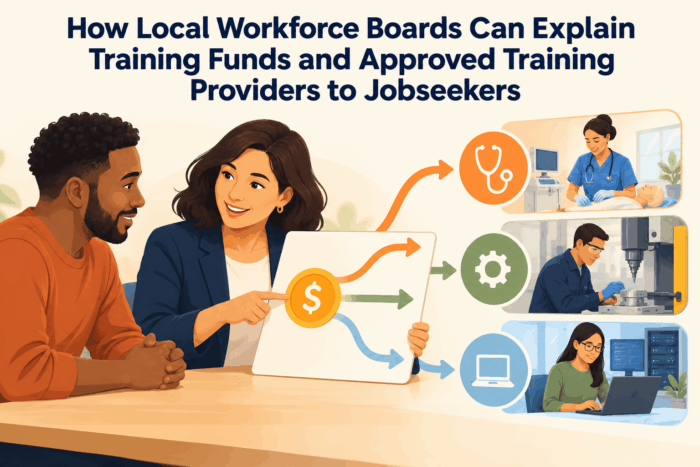
How Local Workforce Boards Can Explain Training Funds and Approved Training Providers to Jobseekers
The public workforce system’s approach to paying for training rests on an idea borrowed from the marketplace. Rather than assigning jobseekers to programs, the Workforce Innovation and Opportunity Act generally provides training through individual training accounts, which eligible participants use to choose among approved training providers. The intent is to respect jobseekers as decision-makers, encourage providers to compete on quality, and connect public dollars to programs with demonstrated results. In principle, the jobseeker is a consumer making an informed choice with public funds.
In practice, many jobseekers are asked to act as informed consumers in a market they have never seen, using information they cannot easily interpret, under financial pressure, and with only a vague idea of what the funding actually covers. They hear that the career center can pay for training, and some imagine that any program they choose will be funded in full. They are shown a list of approved providers that may run to hundreds of entries, organized in ways that make sense to administrators. They are told that training must lead to an in-demand occupation, without a clear sense of what that means locally. They learn late in the process that funding is capped, that other aid must be considered first, or that the year’s funds are nearly committed. And they encounter training providers whose marketing describes outcomes in the most favorable possible terms.
The gap between the marketplace ideal and the jobseeker’s actual experience is fundamentally a communication gap. The rules governing training funds and approved providers are not inherently incomprehensible. They are simply rarely explained in a way that allows jobseekers to understand them, compare options, and make decisions that serve their interests. When the explanation is missing, informed choice becomes guesswork, and the consequences can be serious: jobseekers who enroll in programs poorly matched to their goals, who encounter unexpected costs, or who complete training only to find limited job prospects.
This article examines how local workforce boards, together with their career centers and partners, can explain training funds and approved training providers to jobseekers. Its central argument is that the individual training account model only fulfills its promise when the board treats the explanation of funding rules and provider information as part of the service itself, not as a procedural preliminary. That means describing how funding works in plain terms, making the eligible training provider list a usable decision tool, being honest about limits and availability, coordinating clearly with other funding sources, preparing career advisors to support informed decisions, holding providers to accurate communication, and making local training policies public. Each of these strengthens the conditions under which jobseekers can actually exercise the choice the system was designed to give them.
Training Funds Are a Promise With Conditions
 Of everything the public workforce system offers, training funds are among the most compelling to jobseekers and among the most frequently misunderstood. The phrase free training, or the career center can pay for your training, is powerful because it addresses one of the most significant barriers people face in changing careers: the cost of acquiring new skills. Outreach materials often feature it prominently, and for good reason. But the phrase carries an implicit promise that the system cannot always keep in the form jobseekers imagine. Training funds are real, but they come with conditions, and those conditions shape whether a given jobseeker will receive funding, for which programs, in what amount, and when.
The conditions are numerous. A jobseeker must be determined eligible for a program that provides training, typically the Adult, Dislocated Worker, or Youth program, and in the Adult program, priority of service applies. The jobseeker must generally be found, after an interview, evaluation, or assessment and career planning, to be unlikely or unable to obtain or retain employment leading to economic self-sufficiency or higher wages through career services alone, to be in need of training, and to have the skills and qualifications to participate successfully. The training must generally be linked to in-demand employment opportunities in the local area or in an area to which the jobseeker is willing to relocate. The training provider and program must generally be on the state’s eligible training provider list. The jobseeker must be unable to obtain other grant assistance, such as Pell Grants, to cover the full cost, or must require assistance beyond what other grants provide. Local boards may set limits on the amount and duration of funding. And funds are finite, so availability can change over the program year.
Each of these conditions has a sound policy rationale. Together, they make training funds less like a voucher anyone can redeem and more like a carefully managed investment. That is appropriate for public funds, but it means that the simple promise in outreach materials and the complex reality of the process diverge. Jobseekers who hear the promise without the conditions may invest time and hope in a path that leads to disappointment. Those who encounter the conditions without explanation may conclude that the system is arbitrary or that it does not want to help them.
The board’s communication challenge is to convey both the opportunity and its conditions in a way that motivates jobseekers to pursue training when it fits them, prepares them for the steps involved, and avoids promises the system cannot keep. This is not a matter of choosing between enthusiasm and honesty. A message that says the career center may be able to help pay for training in fields where local employers are hiring, for people who qualify, and that staff will help each person figure out whether training is the right step and what funding might be available, is both encouraging and accurate. It invites jobseekers to explore the possibility while signaling that there is a process.
The conditions also carry an implication that is easy to overlook: the decision about training is shared. The jobseeker chooses a field and a provider, but the career center assesses need, verifies eligibility, confirms the link to in-demand occupations, and authorizes funding. Jobseekers who understand this shared structure can participate in it constructively, preparing for assessments, researching options, and asking informed questions. Jobseekers who do not understand it may experience each step as an obstacle rather than as part of a joint decision.
The remaining sections describe how boards can explain this structure plainly, beginning with the basic mechanics of how training funds work.
Skilled & Connected: Communication Strategies for Workforce Development Agencies, Career Centers, and Local Employment Services
This article is part of our series on strategic communication for Workforce Development Agencies, Career Centers, and Local Employment Services. To learn more and to see the parent article, which links to other content just like this, click the button below.
How Training Funds Work, in Plain Terms
Jobseekers need a simple, accurate picture of how training funds work before they can make sense of their options. The picture should be short enough to explain in a few minutes and concrete enough that a jobseeker can describe it to someone else afterward. The elements below are the core of that picture. Local details vary, and boards should adapt the explanation to their own policies.
Training Accounts
In most cases, training is paid for through an individual training account, which is essentially an amount of funding set aside for an eligible participant to pay for an approved training program. In plain terms, the career center can set aside money to help pay for a training program the jobseeker chooses from an approved list, up to a local limit. The jobseeker does not receive cash. The funds are paid to the training provider on the jobseeker’s behalf. Explaining this distinction prevents misunderstandings about how funds will flow and what they can be used for.
WIOA also allows certain types of training to be provided through other arrangements, including on-the-job training, customized training, incumbent worker training, and in some circumstances contracts with providers. Registered apprenticeship programs have a special status regarding provider eligibility. Jobseekers generally do not need to understand all of these mechanisms, but they should know that training funds can support classroom programs and, in some cases, training on the job with an employer.
Approved Providers
Training paid for through training accounts must generally be offered by a provider and program on the state’s eligible training provider list. In plain terms, the state keeps a list of training programs that meet certain requirements, and the career center can help pay only for programs on that list. Explaining the purpose of the list, that it is meant to ensure public funds go to programs that meet quality and performance requirements, helps jobseekers see it as a protection rather than a restriction.
In-Demand Occupations
Training must generally be connected to occupations that are in demand in the local area or an area to which the jobseeker is willing to move. Local boards typically identify in-demand occupations or sectors based on labor market information. In plain terms, the career center focuses training funds on jobs that local employers are hiring for, so that training is more likely to lead to work. Boards that publish their lists of in-demand occupations, in plain language, allow jobseekers to see which fields are likely to qualify before they invest time in planning.
Limits and Amounts
Most local boards set limits on how much funding a single participant can receive and sometimes on how long training can last. In plain terms, there is usually a maximum amount the career center can contribute, and if a program costs more, the jobseeker may need other funding to cover the difference. Being specific about the local limit, where policy allows it to be shared, helps jobseekers evaluate their options realistically.
Other Funding First
WIOA generally requires that training funds be coordinated with other grant assistance, such as federal Pell Grants, so that public workforce funds are used where other grants are unavailable or insufficient. In plain terms, the career center will look at whether the jobseeker can get other grants first, and training funds may cover what other grants do not. This step can surprise jobseekers, so explaining it early is important.
Availability
Training funds come from annual allocations, and boards must manage them across the program year. In plain terms, the amount of training funding available can change during the year, and in some periods there may be waiting lists or limits on new training enrollments. Honesty about this possibility prevents jobseekers from assuming that funding is unlimited and always immediately available.
These six elements, explained together in a few plain sentences, give jobseekers a working understanding of the system. Everything else, including the details of eligibility determination and provider selection, can be explained as it becomes relevant.
The Eligible Training Provider List as a Communication Tool
The eligible training provider list is usually understood as a regulatory instrument: a mechanism for determining which providers and programs can receive training account funds. It is also, potentially, one of the most useful communication tools in the workforce system, because it contains information jobseekers need to make informed choices. Whether it functions as a communication tool depends on how it is presented, explained, and supplemented.
What the List Contains
Under WIOA, states establish criteria and procedures for determining provider eligibility, in consultation with local boards, and maintain the statewide list. Providers apply to have programs placed on the list and must submit performance and cost information. WIOA calls for performance information on matters such as the share of participants who are employed after exit, median earnings, and credential attainment, along with information about program cost. States are expected to make information about eligible providers and their performance available to the public, and the Department of Labor has supported public-facing tools for viewing training provider performance information. Registered apprenticeship programs that request inclusion are generally treated as eligible while they remain registered. Local boards may set additional criteria for providers serving their areas.
Why the List Often Fails as a Tool
In many states, the list is presented as a searchable database designed primarily for administrators and providers. Jobseekers may encounter hundreds of programs, organized by provider name or program code, with performance data that is incomplete, unexplained, or presented in technical terms. Programs with small numbers of participants may have no reportable performance data at all, or data that fluctuates widely. Cost information may not include all expenses, such as books, tools, uniforms, licensing fees, and transportation. And the list typically does not tell jobseekers how a program fits local hiring needs, what the schedule is, or how it compares with similar programs. A jobseeker who is simply handed access to the list, or a long printout, is unlikely to use it effectively.
Making the List Usable
Boards and career centers can make the list more useful by organizing, explaining, and supplementing it. Organization means presenting programs by occupational field and in-demand occupation, rather than only by provider, so jobseekers can see all their options for becoming, for example, a certified nursing assistant or a commercial truck driver. It means highlighting programs available locally or within reasonable commuting distance, and noting schedules and formats such as evening, weekend, or online options.
Explanation means helping jobseekers understand what the performance information means and what it does not. A plain-language guide can explain that employment rates show how many recent participants were working a few months after finishing, that median earnings show typical earnings among those participants, that credential rates show how many earned a certificate or license, and that small programs may have limited or no data. It can explain that these figures describe past participants and do not guarantee future results. It can encourage jobseekers to ask providers about outcomes, total costs, and job placement support.
Supplementation means adding information the list does not contain. Career centers can provide local labor market information about each occupation, including typical wages and the number of openings. They can share information about total costs, including expenses beyond tuition. They can note which programs have relationships with local employers. And they can share, carefully and without endorsement, what participants have reported about their experiences with particular programs, where this information is reliable and appropriate to share.
Presented in this way, the eligible training provider list becomes a genuine decision aid. It does not make decisions for jobseekers, but it gives them the information they need to make decisions themselves, which is what the training account model assumes they can do.
Helping Jobseekers Compare Training Programs
Informed choice is the premise of the training account model, but choosing among training programs is a difficult decision for anyone, and especially for jobseekers who may be under financial pressure, unfamiliar with the occupations they are considering, and unaccustomed to evaluating educational programs. Boards and career centers that help jobseekers compare programs systematically enable better decisions without making those decisions for them. The aim is not to steer jobseekers toward particular programs but to help them weigh the factors that matter for their own goals and circumstances.
The first factor is fit with the jobseeker’s goals and interests. A program that leads to a well-paying occupation is a poor choice for someone who will not enjoy or cannot sustain the work. Career exploration, including information about what the work involves day to day, physical demands, schedules, and working conditions, helps jobseekers assess fit before committing. Opportunities to talk with people in the occupation, visit worksites, or try short introductory activities can be particularly helpful, and career centers that facilitate these opportunities help jobseekers avoid costly mismatches.
The second factor is the local labor market. Jobseekers should understand how many openings exist for the occupation locally, what typical starting wages are, what advancement looks like, and what employers require. This information helps jobseekers judge whether training is likely to lead to work. Career centers can provide it in plain terms, drawing on labor market information and their relationships with local employers, while being honest that labor market conditions can change.
The third factor is program outcomes. As discussed above, performance information on the eligible training provider list can show how past participants fared. Jobseekers comparing programs for the same occupation can look at completion, credential attainment, employment, and earnings, keeping in mind the limitations of the data. Programs with consistently weak outcomes warrant careful questions, and programs with strong outcomes may be worth prioritizing, although outcomes also reflect the participants each program serves.
The fourth factor is total cost and funding. Jobseekers should understand the full cost of each program, including tuition, fees, books, tools, uniforms, exam and licensing fees, and transportation, and how much of that cost will be covered by training funds and other grants. Programs that cost more than the local limit may require the jobseeker to find other funding or pay out of pocket. Comparing net costs helps jobseekers avoid unexpected financial burdens.
The fifth factor is practical feasibility. Program length, schedule, location, format, and prerequisites affect whether a jobseeker can actually complete it. A program that requires full-time daytime attendance may not work for someone who must keep a job or care for children. A program located far away may be impractical without reliable transportation. Online programs may suit some jobseekers and not others. Discussing these factors candidly helps jobseekers choose programs they can finish.
The sixth factor is support. Some programs offer tutoring, job placement assistance, employer connections, or flexibility for students facing difficulties. These features can matter significantly for completion and employment. Jobseekers can ask providers about them, and career centers can share what they know.
Career centers can bring these factors together in a simple comparison tool, such as a worksheet that jobseekers complete for two or three programs they are considering, listing goals, labor market information, outcomes, costs, schedule, and support for each. Completing the comparison with a career advisor encourages jobseekers to think through each factor and to ask questions they might otherwise overlook. The tool should be in plain language, available in multiple languages, and accessible.
Throughout, the career center’s role is to inform rather than to decide. Jobseekers may choose programs that a career advisor would not have chosen, and as long as the choice meets program requirements, that is their right. Respecting their choice, while ensuring it is informed, is the balance the training account model asks for.
Explaining Funding Limits, Caps, and Availability Honestly
Few moments in the workforce system are as disappointing to jobseekers as learning, after investing time and hope, that the training they want will not be funded, will be only partly funded, or must wait. These moments are often avoidable, not because the limits can be removed but because they can be communicated early and clearly enough that jobseekers plan around them. Honest communication about limits, caps, and availability protects jobseekers from wasted effort and protects the career center’s credibility.
Local training funding limits are set by boards to stretch finite resources across as many participants as possible. These limits may be expressed as a maximum dollar amount per participant, a maximum duration, or both, and they may differ by program or occupation. When a training program costs more than the limit, the jobseeker must find other funding, such as Pell Grants, employer contributions, or personal resources, to cover the gap, or choose a different program. Jobseekers who learn about the limit only after selecting a program may feel misled. Jobseekers who learn about it at the start can factor it into their choices.
The principle is to communicate limits as early as they become relevant. When a jobseeker first expresses interest in training, staff can explain that training funds have a local maximum and describe it, where policy permits, along with the requirement to consider other grants. Written materials about training should state the limit or explain that one exists and that staff will provide details. The plain-language explanation of the eligible training provider list can encourage jobseekers to compare program costs against the limit. By the time a jobseeker selects a program, the limit should not be news.
Availability is harder to communicate because it changes. Boards manage training funds across the program year, and in some periods funds may be largely committed, leading to waiting lists, temporary pauses, or prioritization of certain participants. Communicating this uncertainty is uncomfortable, because it may discourage jobseekers who would otherwise pursue training. But concealing it is worse. A jobseeker who completes several appointments and gathers documents, only to be told that funds are not currently available, will reasonably feel that her time was wasted and that the career center was not honest with her.
Boards can address availability communication in several ways. They can establish a clear internal process for monitoring training fund commitments and informing staff promptly when availability changes. They can develop plain-language explanations of current availability that staff use consistently, such as a statement that training funds are currently limited and staff will explain what that means for each person. They can maintain waiting lists with clear communication about how they work and how long waits may last, and they can keep waiting jobseekers informed. They can identify alternative pathways, such as on-the-job training, registered apprenticeship, employer-funded training, or other grants, that may remain available when training account funds are limited.
Timing of outreach also matters. Outreach that emphasizes training funds heavily at times when funds are nearly committed creates expectations the system cannot meet. Coordinating outreach messages with funding availability, for example by emphasizing other services when training funds are limited, prevents this mismatch.
Finally, honesty about limits extends to what training funds cannot do. Training funds generally cannot replace income during training, though supportive services or needs-related payments may help in some circumstances where local policy allows and funds are available. Jobseekers need to understand how they will support themselves while in training, and career centers should discuss this candidly. A jobseeker who enrolls in full-time training without a plan for income may be forced to drop out, which serves no one.
Communicating limits honestly may sometimes reduce the number of jobseekers who pursue training. But the jobseekers who do pursue it will be better prepared, more likely to complete, and more likely to trust the career center throughout the process.
Coordinating Training Funds With Pell Grants and Other Sources
One of the least understood aspects of workforce training funds is their relationship to other sources of financial aid. WIOA generally requires that training funds be provided only to individuals who are unable to obtain other grant assistance for training, such as federal Pell Grants, or who require assistance beyond what other grants provide, and it calls for coordination so that funds are used efficiently. In practice, this means career centers often need to consider a jobseeker’s eligibility for Pell Grants and other aid before authorizing training funds, particularly for programs at institutions that participate in federal student aid.
This coordination is sensible, because it allows workforce funds to serve more people and leverages other resources. But it adds steps and complexity that jobseekers rarely anticipate. A jobseeker who expected the career center to pay for training may be asked to complete a federal financial aid application, which involves its own forms, documentation, and timelines. She may learn that a Pell Grant will cover part of the cost and training funds the rest, or that training funds will cover expenses the Pell Grant does not. She may wonder why the career center is sending her to another office when she came for help with training.
Clear communication can turn this potential source of confusion into a source of reassurance. The explanation can be framed around the jobseeker’s benefit: combining different sources of help can stretch funding further, potentially covering more of the costs of training and leaving training funds available for expenses such as books, tools, or fees. Jobseekers should understand that the career center is not trying to avoid paying but is trying to maximize the total help available to them and to others.
The practical steps should be explained early and supported. If a jobseeker will need to apply for federal student aid, she should learn this at the start of training planning, not after selecting a program. She should receive help completing the application, either from career center staff or through coordination with the training institution’s financial aid office or community organizations that assist with financial aid. She should understand the timeline, since financial aid processing can take time and may affect when training can begin.
The landscape of federal student aid for short-term training has been changing. Federal legislation enacted in 2025 extended Pell Grant eligibility to certain short-term workforce training programs, beginning with the 2026 to 2027 award year and subject to requirements related to program length, quality, and outcomes. As this change is implemented, more short-term programs that previously could be funded only through workforce funds or personal resources may become eligible for Pell Grants, which could affect how career centers coordinate funding. The details of which programs qualify and how coordination will work in practice are still developing, and boards should follow federal and state guidance closely and update their communication as implementation proceeds.
Other funding sources may also be relevant. Some employers offer tuition assistance or sponsor training for new hires. Registered apprenticeship programs typically combine paid work with related instruction, often at little or no cost to the apprentice. State-funded grants, scholarships from community foundations, and assistance from other programs, such as vocational rehabilitation for eligible individuals with disabilities or veterans’ education benefits, may contribute. Career centers that help jobseekers identify and combine these sources provide significant value, and communicating this role clearly positions the career center as a navigator rather than a single source of funds.
Coordination with training providers is important. Providers’ financial aid offices and admissions staff interact with jobseekers about costs and aid, and inconsistent information from the provider and the career center can confuse jobseekers. Boards can establish clear communication with providers about how training funds and other aid are coordinated, so that both give jobseekers consistent explanations.
Finally, jobseekers should understand the obligations attached to different funding sources. Student loans, in particular, carry repayment obligations, and some jobseekers may be offered loans as part of financial aid packages. Career centers should be careful to distinguish grants from loans in their explanations and to encourage jobseekers to understand any borrowing before they accept it.
The Career Advisor’s Role in Training Conversations
Written explanations and comparison tools help, but most jobseekers make training decisions through conversations with career advisors. These conversations shape what jobseekers understand about training funds, which programs they consider, and how they weigh their options. The career advisor’s role is delicate: advisors must assess whether training is appropriate, provide information, verify eligibility, and authorize funding, while respecting jobseekers’ choices. How advisors communicate in this role determines whether the training account model produces genuinely informed choices.
The first element of the advisor’s role is assessment. WIOA generally requires that training be provided to individuals who, after an interview, evaluation, or assessment and career planning, are determined to need training to obtain or retain employment leading to self-sufficiency or higher wages and to have the skills and qualifications to participate successfully. Advisors should explain the purpose of assessment in plain terms: to understand the jobseeker’s skills, interests, and goals, and to make sure training is a good next step. Assessment should feel like a collaborative exploration, not a test the jobseeker must pass. Where assessments include standardized tests of basic skills, advisors should explain why they are used, how results will be used, and what happens if results suggest the jobseeker would benefit from skill-building before or during training.
The second element is information. Advisors are often the jobseeker’s primary source of information about training options, labor market conditions, funding rules, and provider performance. They should present this information accurately, completely, and without bias, helping jobseekers understand the factors discussed earlier. Advisors who know the local labor market well, who understand the eligible training provider list and its limitations, and who can explain funding rules clearly are invaluable. Advisors who are uncertain may give incomplete or inconsistent information, which is why training and reference materials for advisors matter.
The third element is guidance without steering. Advisors bring knowledge and experience that can help jobseekers make better decisions, and they should share honest observations, such as concerns about a program’s outcomes, a mismatch between the jobseeker’s goals and the occupation, or practical obstacles to completion. But the decision belongs to the jobseeker, within program requirements. Advisors should avoid steering jobseekers toward programs for reasons unrelated to the jobseeker’s interests, such as performance pressures, relationships with particular providers, or assumptions about what kinds of jobs suit particular people. Steering based on assumptions about gender, race, age, disability, or other characteristics would be inconsistent with nondiscrimination obligations as well as with informed choice.
The fourth element is clarity about the process. Advisors should explain the steps from training interest to enrollment, including eligibility determination, assessment, program selection, coordination with other funding, approval, and enrollment, along with realistic timelines. Jobseekers who understand the process can plan and are less likely to become frustrated by delays.
The fifth element is honesty about outcomes and uncertainty. Advisors should be careful not to imply that training guarantees a job or a particular wage. They can explain that training in an in-demand field improves a jobseeker’s prospects, that completion and credentials matter, and that the career center will help with job search afterward, while acknowledging that outcomes depend on many factors. This honesty protects jobseekers from false expectations and protects the advisor’s credibility.
The sixth element is documentation of the decision. Advisors typically record the reasons for training decisions in case files, and jobseekers should understand what has been decided and why. A brief written summary of the training plan, including the program, funding, timeline, and next steps, gives jobseekers a reference and reinforces understanding.
Supporting advisors in this role requires training, reference materials, reasonable caseloads, and supervision that emphasizes informed choice and accurate communication rather than only enrollment numbers. Boards that invest in advisor preparation strengthen the quality of every training decision.
When Training Is Not the Right Next Step
 Training fund communication often assumes that the goal is to move interested jobseekers into training. Yet one of the most valuable outcomes of a good training conversation is sometimes the conclusion that classroom training is not the right next step, at least not now. A jobseeker may discover, after exploring an occupation, that it does not fit her interests. She may realize that she cannot afford to reduce her working hours for the length of the program. She may find that her existing skills qualify her for jobs she had not considered, making a direct job search the faster path. Or she may need to build basic skills, stabilize housing, or arrange childcare before training is realistic. Communicating these possibilities well is part of explaining training funds honestly, because it protects jobseekers from investing in training that is unlikely to work for them and preserves funds for those ready to use them.
The challenge is that jobseekers who arrive excited about training may experience any suggestion of an alternative as a denial. A jobseeker who hears that training may not be the best step can easily conclude that the career center does not want to pay for her training or does not believe in her. How the conversation is framed determines whether she experiences it as respectful guidance or as rejection.
The most effective framing centers on the jobseeker’s own goals. If her goal is a better-paying job within a few months, the advisor can explain how different paths compare in reaching that goal: a direct job search using her current skills, short-term training, longer training, or a work-based option such as on-the-job training or registered apprenticeship, where available. Laying out these paths, with honest information about time, cost, income during the process, and likely outcomes, allows the jobseeker to see that the conversation is about reaching her goal rather than about whether she deserves training.
Work-based alternatives deserve particular attention in this conversation. On-the-job training, in which an employer hires a participant and receives partial reimbursement for training costs, allows jobseekers to earn wages while learning. Registered apprenticeship combines paid employment with related instruction and leads to a recognized credential. These options can suit jobseekers who cannot afford to stop working, though their availability depends on employer participation and local programs. Explaining them as genuine alternatives, rather than as consolation prizes, broadens the jobseeker’s sense of what is possible.
Preparatory steps also deserve respectful explanation. A jobseeker whose basic skills assessment suggests she would struggle in a particular program can be offered adult education or integrated programs that combine skill-building with occupational training. This should be presented as a way to increase her chances of success, not as a judgment about her ability. Similarly, a jobseeker facing immediate barriers such as housing instability or lack of childcare can be connected with supportive services and partner resources, with the understanding that training remains an option when circumstances allow.
The decision should remain the jobseeker’s, within program requirements. Advisors can share honest concerns and information, but a jobseeker who understands the tradeoffs and still wishes to pursue training, and who meets the requirements, should be supported. Conversely, a jobseeker who decides training is not right for her should not be pressured into it to meet enrollment goals.
Finally, the door should stay open. A jobseeker who chooses a direct job search today may want training in six months or a year, after she has stabilized her income or clarified her goals. Making clear that she can return to discuss training later, and keeping her connected through career services, ensures that a decision not to train now does not become a permanent exit from the system.
Communicating With Training Providers
Jobseekers learn about training programs not only from career centers but from the providers themselves, through websites, advertisements, admissions conversations, and open houses. Providers’ communication shapes jobseekers’ expectations about cost, schedule, outcomes, and the role of workforce funding. When providers and career centers communicate consistently and accurately, jobseekers receive a coherent picture. When they do not, jobseekers may be confused, misled, or caught between conflicting accounts. Boards have both an interest and a role in shaping how providers communicate with jobseekers about training funded through the workforce system.
Providers vary widely. They include community colleges, technical schools, universities, private for-profit and nonprofit training organizations, labor-management training programs, and registered apprenticeship sponsors. Most communicate responsibly. But the incentives of the training market can encourage some providers to emphasize favorable outcomes, minimize costs or requirements, or suggest that workforce funding is readily available. Jobseekers who hear from a provider that the career center will pay for their program may arrive at the career center with expectations that do not match the process or the local limits.
Boards can address this through clear communication with providers. Many boards hold orientation sessions or issue guidance for providers on the eligible training provider list, explaining how training accounts work, local policies, limits, the process for jobseekers, and expectations for provider communication. This guidance can ask providers to describe workforce funding accurately, to direct jobseekers to the career center for eligibility determination rather than implying that funding is assured, to disclose total program costs including fees and supplies, and to present outcome information accurately and consistently with what they report for the eligible training provider list.
Consistent information about costs is particularly important. Jobseekers comparing programs need accurate total costs, and career centers need them to determine how much training funds will cover. Boards can ask providers to provide cost information in a standard format, including tuition, fees, books, tools, uniforms, and testing or licensing fees. This information can then be presented to jobseekers consistently across programs.
Outcome claims deserve attention. Provider marketing may cite placement rates or earnings that are calculated differently from the performance information reported for the eligible training provider list, or that reflect only selected graduates. Jobseekers comparing these claims with official performance data may become confused. Boards can encourage providers to use consistent, verifiable outcome information and can help jobseekers understand the difference between marketing claims and reported performance.
Providers are also partners in supporting jobseekers through training. Communication between career centers and providers about participants’ progress, attendance, difficulties, and completion, with appropriate consent, allows career centers to offer support when participants struggle and to help them transition to employment. Clear protocols for this communication, consistent with privacy requirements including student privacy laws where they apply, benefit participants.
Boards also have a role when providers communicate inaccurately. If a provider repeatedly misrepresents workforce funding, costs, or outcomes, boards and states have mechanisms to address provider eligibility and performance. Communicating expectations clearly at the outset, monitoring how providers describe their programs, and addressing problems promptly protects jobseekers and the integrity of the system.
Finally, providers can be valuable channels for reaching jobseekers. Community colleges and training organizations interact with many prospective students who may be eligible for workforce funding but do not know about it. Providers that understand the system can refer prospective students to career centers, extending outreach. Coordinated communication, in which providers and career centers describe workforce funding consistently, makes these referrals more effective.
Making Local Training Policies Public and Understandable
Local boards set many of the policies that determine how training funds are used: funding limits, in-demand occupation lists, additional provider criteria, priority groups, training durations, and procedures for requesting exceptions. These policies directly affect what jobseekers can receive. Yet they are often difficult for jobseekers to find, written in technical language, or available only as board policy documents. Making local training policies public and understandable supports informed choice, fairness, and accountability.
The first step is publication. The board’s key training policies should be available on its website and at career centers, in a place jobseekers can find them. This includes the local funding limit, the list of in-demand occupations or sectors for which training is supported, any additional criteria for providers or programs, and the process for requesting exceptions or appealing decisions. WIOA’s sunshine provisions call for boards to make information about their activities available to the public, and training policies are among the most relevant to residents.
The second step is translation into plain language. Board policies are written for governance and compliance, and their language reflects that purpose. A plain-language summary, perhaps a single page, can explain what the policies mean for jobseekers: how much funding is typically available, which fields are supported, how long training can last, what to do if a desired program is not on the list or exceeds the limit, and how decisions can be reviewed. This summary should be accurate to the policies and updated whenever they change.
The third step is explaining the reasoning. Jobseekers are more likely to accept policies they understand. A brief explanation of why the board sets a funding limit, such as to serve as many people as possible with finite funds, and why it focuses on in-demand occupations, such as to increase the likelihood that training leads to employment, helps jobseekers see the policies as reasonable rather than arbitrary.
The fourth step is consistency. When policies are applied inconsistently, with some jobseekers receiving exceptions and others not without clear criteria, perceptions of unfairness follow. Publishing exception procedures and criteria, and training staff to apply them consistently, protects both fairness and the board’s credibility.
The fifth step is communicating changes. Boards adjust training policies in response to funding levels, labor market changes, and performance. When policies change, jobseekers currently in the process, those in training, staff, and providers need to know. A plain-language notice explaining what changed, why, when it takes effect, and how it affects people already in the process prevents confusion and protects jobseekers who planned based on earlier policies. Where possible, boards should consider transition provisions for jobseekers who were well into planning under previous policies.
The sixth step is inviting input. In-demand occupation lists and training policies benefit from the perspectives of employers, training providers, jobseekers, and community organizations. Boards can invite comment when they revise these policies, through board meetings, surveys, or listening sessions, and can explain how input was considered. This engagement improves the policies and builds understanding of them.
Publishing and explaining training policies also helps career center staff. When policies are clear and public, staff can point jobseekers to them, explain them consistently, and avoid situations in which jobseekers believe a staff member is personally denying their request. The policy, rather than the individual, becomes the reference point, which supports the staff member’s relationship with the jobseeker.
Ethical Commitments in Training Fund Communication
Communication about training funds involves public money, jobseekers’ futures, and a marketplace with commercial incentives. These conditions create ethical responsibilities for boards, career centers, and staff. Meeting them protects jobseekers and preserves public trust in the system’s stewardship of training dollars.
The first commitment is honesty about outcomes. Training improves many jobseekers’ prospects, but it does not guarantee employment or particular wages. Communication that implies guarantees, whether in outreach materials, advisor conversations, or provider marketing that the board permits to go unchallenged, misleads jobseekers into decisions with real costs. Training requires time, often foregone earnings, and sometimes personal expense or borrowing. Jobseekers deserve accurate information about the range of outcomes they might experience, so they can weigh those costs against realistic benefits.
The second commitment is informed choice free from steering. The training account model rests on jobseekers’ choices. Communication that subtly or overtly steers jobseekers toward particular programs or providers, for reasons other than the jobseeker’s interests, undermines that model. Steering might arise from performance pressures, relationships with providers, convenience, or unexamined assumptions about what kinds of training suit particular people. Steering based on characteristics such as sex, race, national origin, age, or disability would also raise nondiscrimination concerns under WIOA Section 188. Boards should set clear expectations that advisors provide balanced information and support jobseekers’ own choices.
The third commitment is avoiding conflicts of interest. Board members, staff, and service providers may have relationships with training providers, such as employment, board service, or financial interests. These relationships should be disclosed and managed so that they do not influence decisions about provider eligibility, information presented to jobseekers, or individual training decisions. Transparency about conflict of interest policies builds public confidence.
The fourth commitment is protecting jobseekers from predatory practices. Some training markets include providers that use aggressive recruitment, high costs, misleading outcome claims, or pressure to borrow. The eligible training provider list’s performance requirements provide some protection, but jobseekers may also encounter providers not on the list. Career centers can help jobseekers recognize warning signs, such as pressure to enroll quickly, unclear costs, guarantees of employment, and reluctance to share outcome information, and can encourage them to consult the career center before committing to any program.
The fifth commitment is fairness in access. Training funds are limited, and decisions about who receives them have equity implications. Priority of service rules, local priorities, and staff discretion all shape distribution. Boards should ensure that policies are applied consistently, that exceptions follow published criteria, and that access is monitored across groups. Communication should make clear how decisions are made, so jobseekers can see that they are treated fairly.
The sixth commitment is respecting privacy. Training decisions involve sharing information among career centers, providers, and sometimes financial aid offices. Jobseekers should understand what information will be shared, with whom, and why, and should consent where consent is required. Information about participants’ progress, difficulties, or circumstances should be shared only as needed and with appropriate protections.
Finally, ethical communication includes accountability to the public. Boards spend public funds on training and should be able to explain how those funds are used, what results they produce, and how the board ensures quality. Public reporting on training investments and outcomes, in plain language and at an aggregate level that protects individuals, demonstrates stewardship.
Accessibility and Language Access in Training Information
Training decisions require jobseekers to absorb and compare a substantial amount of information: funding rules, program details, costs, outcomes, schedules, and labor market conditions. When this information is available only in technical English, only online, or only in formats inaccessible to people with disabilities, the jobseekers who face the greatest barriers are least able to make informed choices. Accessibility and language access are therefore not peripheral concerns in training communication. They determine whether the training account model’s promise of informed choice extends to everyone.
Jobseekers with limited English proficiency need training information in their languages. Federal civil rights requirements call for reasonable steps to provide meaningful access, and WIOA’s nondiscrimination provisions reinforce that obligation. For training, this means translated explanations of how training funds work, translated comparison tools, and interpretation during advisor conversations about training choices. It also means considering whether training programs themselves are accessible to jobseekers with limited English, such as programs with language support or bilingual instruction, and communicating this information so jobseekers can choose programs they can succeed in. Jobseekers with limited English may also need information about English language training as a pathway alongside or before occupational training.
Jobseekers with disabilities need accessible information and accessible programs. Training materials, the eligible training provider list interface, comparison tools, and provider information should be available in accessible formats and should work with assistive technology. Websites and online tools should meet recognized accessibility standards, consistent with the Department of Justice’s 2024 rule establishing technical standards for state and local government web content and mobile applications. Advisors should be prepared to discuss accommodations available in training programs and to coordinate with vocational rehabilitation, which can provide additional support for eligible individuals. Information about training providers’ accessibility and accommodation practices helps jobseekers with disabilities choose programs where they can succeed.
Jobseekers with limited literacy need training information in plain language and, often, through spoken explanation. Comparing programs using written performance data and cost tables can be difficult for jobseekers who read at a basic level, and advisors should be prepared to walk through comparisons verbally, use visual aids, and check understanding. Jobseekers with limited literacy may also benefit from information about programs that integrate basic skills instruction with occupational training, which can make training more accessible.
Jobseekers with limited digital access face barriers when training information and applications are primarily online. Many eligible training provider list interfaces, financial aid applications, and provider application processes require internet access and digital skills. Career centers should provide access to computers, assistance navigating online tools, and printed alternatives where possible.
Accessibility also extends to the format of training conversations. Jobseekers with caregiving responsibilities, jobs, or transportation limitations may struggle to attend multiple in-person appointments for training planning. Offering phone or video appointments, evening hours, and consolidated planning sessions makes the process more accessible.
Finally, accessibility should be monitored. Boards can examine whether jobseekers with limited English, disabilities, or other barriers enter training at rates comparable to other participants, and whether they complete training and find employment. Disparities may signal that training information, advising, or programs themselves are not accessible, and they can guide targeted improvements.
A Training Funds Explanation in Practice
The following hypothetical example illustrates how a local board and its career centers might improve the way they explain training funds and approved providers. It does not describe an actual local area.
A local board notices several troubling patterns. Many jobseekers who express interest in training never enroll. Some who enroll choose programs that exceed the local funding limit and then struggle to cover the difference. Career advisors report that jobseekers frequently arrive with expectations shaped by provider advertising, believing their training will be fully paid for. And training completion rates vary widely across programs, with some jobseekers dropping out after discovering costs or schedules they had not anticipated.
The board convenes a working group of career advisors, a community college financial aid director, representatives of two private training providers, and several recent training participants. The group reviews the materials jobseekers receive about training. It finds that the career center’s website describes training funds in a single sentence promising free training, that the local funding limit is mentioned only in a board policy document, that jobseekers are given a link to the statewide eligible training provider list without explanation, and that the requirement to apply for federal student aid is typically raised only after a jobseeker has chosen a program.
The board makes several changes. It develops a one-page plain-language explanation of how training funds work, covering training accounts, approved providers, in-demand occupations, the local funding limit, coordination with other aid, and the possibility of limited availability. It publishes this explanation on the website and gives it to every jobseeker who expresses interest in training. It creates guides to the eligible training provider list for the local area’s most common in-demand occupations, listing nearby programs with total costs, schedules, and plain-language explanations of performance information. It develops a simple comparison worksheet that advisors complete with jobseekers.
The board revises the training planning process so that advisors discuss the funding limit and financial aid at the first training conversation. It partners with the community college and a local nonprofit to provide help completing financial aid applications. It issues guidance to providers on the eligible training provider list asking them to describe workforce funding accurately, provide total costs in a standard format, and refer prospective students to the career center for eligibility. It also establishes a protocol for monitoring training fund commitments and informing advisors and the public when availability changes.
The board trains advisors on the new materials, on explaining performance information, on supporting informed choice without steering, and on discussing how jobseekers will support themselves during training.
Over the following year, the board tracks results. Fewer jobseekers choose programs exceeding the limit without a plan for the difference. More jobseekers complete financial aid applications early. Advisors report that conversations about training are more productive because jobseekers arrive with a basic understanding of the process. Training completion improves in some programs, though the board recognizes that many factors influence completion. Some providers adjust their marketing in response to the guidance.
The example illustrates the core elements: plain-language explanation of funding rules, a usable presentation of the eligible training provider list, early discussion of limits and other aid, comparison tools, clear communication with providers, monitoring and communication of availability, and advisor preparation.
Measuring Whether Jobseekers Understand Training Funds
Boards typically measure training through enrollments, completions, credentials, and employment outcomes. These are important, but they do not reveal whether jobseekers understood the training funding process or made informed choices. Measuring communication effectiveness directly helps boards identify where explanations are failing and whether improvements are working.
The path from training interest to enrollment is a useful starting point. Tracking how many jobseekers express interest in training, how many complete assessment, how many select a program, how many complete coordination with other funding, how many receive approval, and how many enroll reveals where jobseekers drop out. Large losses at particular steps suggest communication or process problems. For example, many jobseekers lost after learning about financial aid requirements may indicate that this step needs earlier explanation or more support.
Understanding can be measured directly. Brief surveys of jobseekers at key points can ask whether they understood how training funds work, whether they knew about the local limit, whether they understood the eligible training provider list information, and whether anything surprised them. Surveys of training participants can ask whether the actual costs, schedule, and requirements matched what they expected. Surprise is a strong indicator of communication gaps.
The quality of decisions can be assessed indirectly. Indicators include the share of jobseekers choosing programs that exceed the funding limit without a plan to cover the gap, the share changing programs after enrollment, and early dropout rates. While these outcomes reflect many factors, patterns may point to communication problems, such as inadequate information about costs or schedules.
Several questions are worth tracking consistently:
-
At which step between training interest and enrollment are the most jobseekers lost, and what do they say about why?
-
Do jobseekers report understanding the local funding limit and the role of other aid before they choose a program?
-
How often do training participants report that costs, schedules, or requirements differed from what they expected?
-
Do completion and employment outcomes differ by program in ways that suggest jobseekers lacked information about program quality?
-
Do jobseekers with limited English, disabilities, or other barriers enter and complete training at comparable rates?
Provider communication can be monitored as well. Reviewing provider marketing for accuracy about workforce funding, costs, and outcomes, and gathering jobseekers’ reports about what providers told them, reveals whether guidance to providers is effective.
Equity measures are essential. Comparing training access, program choices, completion, and outcomes across groups can reveal whether some jobseekers are receiving less complete information, being steered toward particular programs, or facing barriers that others do not. Disparities warrant investigation and targeted improvements.
Finally, measurement should be reported and used. Sharing results with advisors, providers, and the board makes communication quality a visible priority and allows improvements to be tested and refined. Reporting publicly on training investments and outcomes, in plain language, supports accountability for the use of public funds.
How Training Fund Communication Compares With Other Agency Types
The challenge of helping people use public funds to choose education and training is not unique to the workforce system. Comparing training fund communication with related contexts highlights lessons and distinctive features.
Federal student aid offers the closest parallel. Students and families navigate complex rules about eligibility, grants, loans, and costs, and choose among institutions with varying outcomes. Federal efforts to provide comparable information about colleges, including costs, completion rates, and earnings, reflect the same informed-choice logic as the eligible training provider list. These efforts have shown that providing data is not enough; it must be presented in ways people can understand and use, and personal assistance significantly improves decision-making. Workforce boards can draw on these lessons, particularly regarding standardized cost presentation and plain-language explanation of outcome data.
Veterans’ education benefits programs help veterans choose and pay for education and training, and they have dealt with concerns about aggressive recruitment by some providers. Efforts to help veterans compare programs and recognize warning signs offer lessons for protecting jobseekers from predatory practices.
Vocational rehabilitation agencies fund training for eligible individuals with disabilities and emphasize informed choice in developing individualized plans. Their practice of exploring options collaboratively with participants, while providing professional guidance, parallels the career advisor’s role in training conversations.
Consumer protection agencies regulate disclosures in markets where consumers make significant financial decisions with limited information. Their emphasis on clear, standardized disclosure of costs and terms suggests approaches boards can apply to training provider information.
What distinguishes workforce training fund communication is the combination of eligibility requirements, local funding limits and policies, coordination with other aid, a provider list maintained at the state level with local additions, the connection to in-demand occupations, and the fact that training decisions occur within an ongoing relationship with a career center. Jobseekers are asked to be consumers, but they are consumers guided by advisors, constrained by rules, and funded by a public system with its own accountability requirements. Communication must therefore serve multiple purposes at once: informing choice, explaining rules, managing expectations, and supporting the advisor relationship. This combination makes plain-language explanation, usable provider information, and well-prepared advisors especially important.
Tying It All Together
Training fund communication is not a side function of administering individual training accounts. It is the condition that makes the training account model work. The model assumes that jobseekers can make informed choices among approved providers, and that assumption holds only when jobseekers understand how funding works, what their options are, and what each option is likely to involve. Without that understanding, informed choice becomes guesswork, and public funds may support decisions that do not serve jobseekers well.
The starting point is acknowledging that training funds are a promise with conditions. Outreach that conveys the opportunity without the conditions sets up disappointment, while communication that conveys both, early and plainly, prepares jobseekers to pursue training effectively.
A plain-language explanation of training accounts, approved providers, in-demand occupations, funding limits, coordination with other aid, and availability gives jobseekers a working understanding of the system. Presenting the eligible training provider list in organized, explained, and supplemented form turns a regulatory instrument into a decision tool. Comparison tools and advisor support help jobseekers weigh fit, labor market prospects, outcomes, costs, feasibility, and support.
Honesty about funding limits and availability, discussed early, protects jobseekers from wasted effort. Clear explanation and practical help with Pell Grants and other aid turn coordination from a surprise into a benefit. Career advisors who assess collaboratively, inform accurately, guide without steering, and are honest about outcomes are central to informed choice.
Boards also shape the broader information environment. Guidance to providers about accurate communication on funding, costs, and outcomes reduces confusion and protects jobseekers. Publishing local training policies in plain language, explaining their reasoning, applying them consistently, and communicating changes clearly support fairness and accountability.
Ethical commitments to honesty, informed choice, conflict avoidance, protection from predatory practices, fair access, and privacy guide all of this work. Accessibility and language access ensure that informed choice is available to all jobseekers. And measurement of where jobseekers are lost, whether they understand the process, and whether outcomes differ across groups reveals whether communication is achieving its purpose.
Strategic Communication Support
 Explaining training funds and approved providers well requires coordinated work across the board, career centers, training providers, and financial aid partners: translating funding rules and policies into plain language, redesigning the presentation of provider information, developing comparison tools, preparing advisors, guiding provider communication, and measuring whether jobseekers understand. Board and career center staff manage training funds daily but rarely have the time or specialized capacity to redesign how the whole system communicates about them. External support can help boards build these practices efficiently and sustainably.
Stegmeier Consulting Group (SCG) helps public agencies make complex processes understandable to the people who navigate them. For local workforce boards, that work can begin with research into how jobseekers currently experience training funds: interviews and focus groups with jobseekers who pursued training and those who did not, interviews with career advisors and training providers, review of materials and the presentation of the eligible training provider list, and analysis of the path from training interest to enrollment.
From that foundation, SCG can help boards develop plain-language explanations of training funds and local policies, guides to the eligible training provider list organized by occupation, explanations of performance information, comparison tools, and communication about funding limits, availability, and coordination with Pell Grants and other aid. SCG can help draft guidance for training providers on accurate communication and facilitate working sessions that bring providers, financial aid offices, and career centers together to align their messages.
Implementation support can include training for career advisors on explaining funding rules, supporting informed choice without steering, and discussing outcomes honestly, along with leadership toolkits that help supervisors maintain consistency. SCG can also help translate and adapt materials for language access and accessibility.
Evaluation support helps boards track where jobseekers are lost in the training process, gather feedback on understanding and surprises, monitor provider communication, and examine equity in training access and outcomes. The aim is a training system in which jobseekers can exercise genuinely informed choice and public funds support decisions that serve them well.
Future Trends
Several established and emerging developments are reshaping how boards communicate about training funds and providers. The most significant established change is the extension of Pell Grant eligibility to certain short-term workforce training programs under federal legislation enacted in 2025, beginning with the 2026 to 2027 award year. This change may expand the funding available for short-term programs and alter how workforce funds are coordinated with federal student aid. It also introduces new eligibility and quality requirements for programs seeking Pell eligibility. Implementation details, including which programs qualify and how institutions and workforce boards will coordinate, are still developing. Boards should follow federal and state guidance closely, update their explanations of funding coordination as practices become clear, and help jobseekers understand how these sources fit together.
The growth of short-term credentials, industry certifications, and non-degree programs continues. Jobseekers face a widening array of training options of varying quality and labor market value. This makes clear information about outcomes and employer recognition more important. Boards that help jobseekers understand which credentials local employers value, using labor market information and employer input, will provide significant value.
Online and hybrid training options have expanded considerably. These formats can increase access for jobseekers with schedule or transportation constraints, but they also vary in quality and may not suit every learner. Communicating the advantages and challenges of online training, and helping jobseekers assess whether a format fits their circumstances, is an increasingly important part of training conversations.
Data on training outcomes may become more robust over time as states improve their data systems and as federal efforts to provide comparable outcome information continue. More reliable data would make the eligible training provider list a stronger decision tool. At the same time, data limitations, such as small program sizes and differences in the populations programs serve, will persist, and boards will need to continue explaining what data can and cannot show.
Emerging technologies, including artificial intelligence tools, are being explored to help jobseekers search for training programs, compare options, and match their skills to occupations. Such tools could make the eligible training provider list and labor market information more accessible. They could also produce inaccurate or biased recommendations if their data or design is flawed. Boards considering them should evaluate their accuracy, test them with jobseekers, maintain human advising, and be transparent about how recommendations are generated. Their appropriate role in training decisions remains unsettled.
Finally, the structure of federal workforce funding may change. Budget proposals in recent cycles have contemplated consolidating workforce funding streams, which could alter how training is funded and administered. Whether such changes occur is uncertain. Boards that have developed clear, jobseeker-centered communication about training will be better positioned to explain any changes that come.
Conclusion
The individual training account was designed to put jobseekers in charge of their own training decisions, with public funds following their choices to approved programs. That design expresses respect for jobseekers’ judgment, but respect without information is an empty gesture. A jobseeker handed an unexplained provider list, a vague promise of free training, and a process whose conditions emerge one surprise at a time is not exercising choice in any meaningful sense. She is navigating a market blindfolded, with her time, income, and future at stake.
For local boards, the implication is that the explanation of training funds and approved providers is part of the service, not a preliminary to it. Boards control the local policies that shape training, the materials jobseekers receive, the expectations set for providers, and the preparation of the advisors who guide decisions. Using that control to make funding rules plain, provider information usable, limits visible early, and advising balanced and honest is how boards turn the training account model’s premise into practice. It also strengthens the board’s stewardship of public funds, because informed decisions are more likely to produce completions, credentials, and employment.
Boards that take this responsibility seriously will find that jobseekers arrive at training better prepared, choose programs that fit their goals and circumstances, and trust the career center to tell them the truth. Those outcomes serve jobseekers, employers, and the public that funds the system.
Stegmeier Consulting Group’s Strategic Approach to Communication Systems
SCG approaches training fund communication as a communication system that must support informed choice in a complex, rule-bound marketplace. That approach begins with research into how jobseekers, advisors, and providers currently experience the process, identifying where expectations diverge from reality and where jobseekers are lost. It continues by translating funding rules and local policies into plain language, turning the eligible training provider list into a usable decision tool, bringing limits and coordination with other aid forward to the start of the conversation, and aligning the messages of career centers, providers, and financial aid partners.
For local workforce boards, this means jobseekers who understand what training funds can and cannot do before they invest their time, advisors equipped to inform without steering, providers held to accurate descriptions of funding, costs, and outcomes, and published policies that make the board’s decisions transparent and fair. It means accessible and translated information so informed choice extends to every jobseeker, and measurement that shows whether communication is working and whether outcomes are equitable.
Use the form below to connect with our team and explore how strategic communication support can help your workforce board explain training funds and approved training providers so jobseekers can make informed choices.