
How Career Centers Can Explain Adult, Dislocated Worker, and Youth Program Eligibility in Plain Language Without Losing People at Intake
Eligibility determination is two conversations happening at once. In one, the career center is deciding whether a resident fits the requirements of a federally funded program: her age, her employment history, her income, her documents, her circumstances. In the other, the resident is deciding whether the career center is worth her time: whether staff seem to want to help her, whether the questions make sense, whether the paperwork is manageable, and whether she is likely to get anything at the end. The first conversation produces a determination recorded in a case management system. The second produces a decision no system records, and it often happens before the first is complete. Many residents decide to leave before the career center has decided whether they qualify.
This is one of the least examined points of failure in the public workforce system. Career centers invest considerable effort in outreach, and many residents respond. They call, visit, attend an orientation, and begin the process. Then, somewhere between first contact and enrollment, a substantial share of them disappear. They do not return with the requested documents. They miss the follow-up appointment. They complete part of the paperwork and never finish. When staff try to reach them, phone numbers no longer work or calls go unanswered. Each departure has its own reasons, but a common thread runs through many of them: the explanation of eligibility left the resident confused, discouraged, overwhelmed, or doubtful that she would qualify, and so she stopped.
The programs at the center of this problem are the three formula-funded Title I programs of the Workforce Innovation and Opportunity Act: Adult, Dislocated Worker, and Youth. Each has its own eligibility criteria, priorities, and documentation requirements, established in federal law and regulation and shaped by state and local policy. Staff must understand these rules in detail to determine eligibility correctly and to meet compliance and data validation requirements. Residents, however, do not need to understand them in the same way, and when staff explain eligibility in the terms staff use, residents often hear a list of conditions they may not meet rather than an invitation to get help.
This article examines how career centers can explain Adult, Dislocated Worker, and Youth program eligibility in plain language without losing people at intake. Its central argument is that eligibility communication should be designed around the resident’s decision, not only the program’s determination: leading with what the career center can do, explaining requirements only as they become relevant, telling people early what documents they will need and helping them get them, and handling ineligibility with alternatives rather than dead ends. It addresses what the three programs mean in plain terms, how to separate what residents need to know from what staff need to know, how to explain priority of service and documentation, how to write materials and design the intake conversation, how to treat ineligibility and co-enrollment, and how to measure where people are being lost.
Why Eligibility Is Where the System Loses People
 Eligibility is the point at which a resident’s interest meets the system’s rules, and that meeting is often uncomfortable. Before eligibility, the resident has been hearing about what the career center can offer: help finding a job, training, support. At eligibility, the conversation turns to what the resident must prove: her age, her work authorization, her income, her layoff, her school status, her circumstances. For many residents, this shift feels like a change in the relationship, from an invitation to an examination. How the career center manages that shift determines whether the resident continues.
Several features of eligibility make it especially prone to losing people. The first is complexity. The three Title I programs have different criteria, and the criteria interact with priority of service rules, local policies, and partner programs. Staff who must apply these rules precisely may explain them in detail, and detail can overwhelm. A resident who hears a long list of conditions, several of which she is unsure about, may conclude that she probably does not qualify and stop.
The second is documentation. Determining eligibility requires verification, and verification requires documents. Many residents do not have the required documents readily available. Some lack identification, birth certificates, or proof of income. Some have documents but cannot easily access them because of housing instability or family circumstances. Some do not understand what counts as acceptable documentation. Each missing document is a reason to leave and possibly not come back.
The third is time. Eligibility determination often requires more than one visit: an orientation, an initial appointment, a follow-up with documents, and sometimes additional meetings before enrollment. Each visit requires time off work, childcare, transportation, and persistence. Residents with jobs, children, and limited resources may not be able to sustain multiple visits, especially if they do not understand why each is necessary.
The fourth is uncertainty. Residents often do not know, until late in the process, whether they will qualify for the services they want, particularly training. They may invest several visits and gather documents only to learn that they do not meet a criterion or that funding is limited. Anticipating this possibility, some residents disengage early to avoid investing effort in an uncertain outcome.
The fifth is emotional. Questions about income, public assistance, criminal history, disability, housing, and family circumstances can feel intrusive or stigmatizing, especially when asked without explanation. Residents who have had negative experiences with public agencies may react to these questions with discomfort, embarrassment, or suspicion. The eligibility process can thus trigger feelings that make continuing harder.
Each of these features is partly inherent in the programs’ design and partly a matter of how eligibility is communicated. Career centers cannot eliminate the rules, but they can control how and when the rules are explained, what residents are told about documentation and timelines, how questions are asked, and how the process feels. Small changes in these areas can significantly reduce the number of people lost. Because each resident lost at eligibility represents someone who was interested enough to start, these losses are among the most costly in the system, and among the most addressable.
Skilled & Connected: Communication Strategies for Workforce Development Agencies, Career Centers, and Local Employment Services
This article is part of our series on strategic communication for Workforce Development Agencies, Career Centers, and Local Employment Services. To learn more and to see the parent article, which links to other content just like this, click the button below.
The Adult, Dislocated Worker, and Youth Programs in Plain Terms
Before a career center can explain eligibility plainly to residents, its staff need a shared, plain understanding of what each program is for and whom it generally serves. The descriptions below summarize the programs in general terms. They are not a substitute for federal regulations, state policy, and local procedures, which govern actual determinations and vary in their details.
Services Available Without Program Eligibility
It is important to begin with what is available to everyone. Basic career services, which include information about the labor market, job listings, help with job search, information about training providers and support services, and initial assessment, are available to individuals through the one-stop system without a Title I eligibility determination. Wagner-Peyser employment services are available to any jobseeker. Residents who do not qualify for the Adult, Dislocated Worker, or Youth programs can still receive meaningful help, and communicating this clearly prevents residents from concluding that ineligibility means no help at all.
The Adult Program
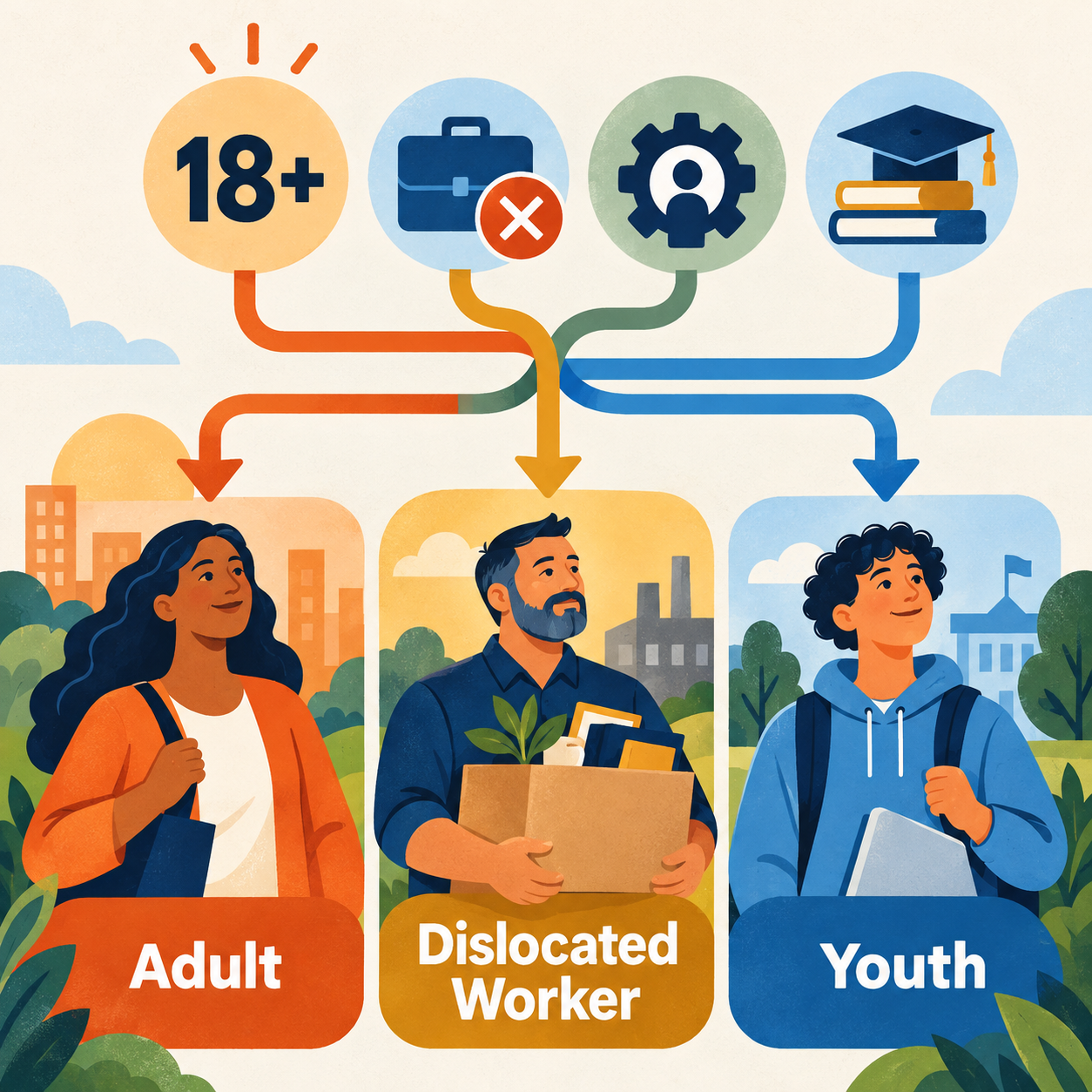
The Adult program generally serves individuals aged eighteen and older. Individualized career services and training under the Adult program are subject to priority of service, which gives priority to recipients of public assistance, other low-income individuals, and individuals who are basic skills deficient. In plain terms, the Adult program is for adults who need more than basic help to find work or advance, with priority for people with lower incomes or who need help with basic skills. Local boards may establish additional priority groups within federal parameters, and veterans and eligible spouses receive priority of service under separate federal law.
The Dislocated Worker Program
The Dislocated Worker program generally serves people who have lost their jobs, or received notice that they will lose them, through no fault of their own and who are unlikely to return to their previous industry or occupation, as well as certain other groups. These include people affected by permanent plant closures or substantial layoffs, self-employed individuals who lost their livelihood because of general economic conditions or natural disasters, displaced homemakers who have lost the income of a family member on whom they depended, and certain military spouses who lost employment because of a service member’s relocation or other circumstances. In plain terms, the Dislocated Worker program is for people whose jobs ended because of layoffs, closures, or similar events, and who need help moving to new work.
The Youth Program
The Youth program serves two groups. In-school youth are generally aged fourteen through twenty-one, attending school, low-income, and facing at least one additional barrier, such as basic skills deficiency, English language learner status, involvement with the justice system, homelessness, foster care involvement, pregnancy or parenting, disability, or needing additional assistance to complete education or secure employment. Out-of-school youth are generally aged sixteen through twenty-four, not attending school, and meeting at least one additional criterion, such as having left school without a diploma, being low-income with a diploma but basic skills deficient or an English language learner, justice involvement, homelessness, foster care involvement, pregnancy or parenting, disability, or being low-income and needing additional assistance. In plain terms, the Youth program is for young people who face challenges in finishing school or getting started in work.
General Requirements
All three programs share certain general requirements, such as eligibility to work in the United States and, for male applicants born on or after January 1, 1960, compliance with Selective Service registration requirements. These requirements apply across programs and are often among the documentation steps residents find most confusing, so staff should be able to explain them simply.
These summaries illustrate how much complexity sits behind each program. Staff need to understand the details. Residents need a much simpler picture, which the next section addresses.
What Residents Need to Know and What Staff Need to Know
One of the most common causes of confusing eligibility communication is that staff explain eligibility to residents in the same terms they use among themselves. Staff need to know the precise criteria, documentation requirements, priority categories, and program distinctions, because they must make accurate determinations and meet compliance requirements. Residents need something different: enough understanding to decide whether to proceed, prepare for what is coming, and trust that the process is worth completing. Separating these two kinds of knowledge, and communicating to residents only what they need when they need it, is the foundation of plain-language eligibility communication.
Residents generally need to know a small number of things. They need to know that the career center offers help to anyone looking for work, and that some services, especially training funds, depend on meeting certain requirements. They need to know, in broad terms, who the more intensive services are designed for, such as adults who need extra help, people who lost their jobs through layoffs or closures, and young people facing challenges in school or work. They need to know that staff will work with them to figure out which programs fit, so they do not have to determine eligibility themselves. They need to know what documents they will probably need to bring, and that staff can help if they do not have everything. They need to know roughly how long the process takes and what the steps are. And they need to know that if they do not qualify for one program, there are other options.
Residents generally do not need to know the names of the programs’ funding titles, the specific categories of barriers under youth eligibility, the order of priority of service categories, the definition of basic skills deficient, or the distinction between basic and individualized career services. These details matter for staff determinations, and residents may ask about them, in which case staff should answer clearly. But leading with them overwhelms residents with information that does not help them decide whether to continue.
This distinction suggests a principle of progressive disclosure: giving residents information in stages, at the point in the process where it becomes relevant. At first contact, residents need to know that help is available and what the next step is. At orientation or first appointment, they need to know what services might fit them and what to bring. During eligibility determination, they need to understand the specific requirements that apply to them and why information is being requested. At enrollment, they need to understand what they are enrolling in and what comes next. Each stage builds on the previous one without front-loading details that will only become relevant later.
Progressive disclosure is not concealment. Residents should never be surprised by a requirement that could have been mentioned earlier, especially one that might affect their decision to continue. If training funding is limited, residents interested in training should know that early. If a particular document is essential and often difficult to obtain, residents should be told about it at first contact so they can begin gathering it. The goal is to give residents the right information at the right time, not to withhold information that matters.
Separating resident knowledge from staff knowledge also clarifies what materials are needed. Staff need detailed eligibility guides, desk aids, and policy references. Residents need short, plain-language explanations of what the career center offers, who it serves, what to bring, and what to expect. Producing these as separate materials, rather than handing residents documents written for staff, is one of the simplest and most effective improvements a career center can make.
Leading With Services, Not Rules
The order in which information is presented shapes how residents feel about it. When the first thing a resident hears about a program is its eligibility requirements, the program feels like a gate to be passed through. When the first thing she hears is what the program can do for her, followed by what is needed to get there, the program feels like an opportunity with steps attached. The information may be identical, but the experience is entirely different. Career centers that lead with services rather than rules keep more residents engaged through eligibility.
Consider two ways of opening an orientation or intake conversation. In the first, staff begin by explaining that the career center administers several programs, each with eligibility requirements, and then describe the requirements for each program in turn: age, income, layoff status, school status, documentation. Residents listen to a series of conditions and begin mentally checking whether they meet them. Some conclude that they probably do not and stop paying attention, or leave. In the second, staff begin by asking residents what they hope to accomplish, such as finding a better job, getting training, or changing careers, and then describe how the career center can help with those goals. Only after residents understand the possibilities do staff explain that some services, particularly training funds, require meeting certain criteria, and that staff will help each person figure out what fits. Residents in the second scenario stay engaged because the conversation is about their goals, and requirements appear as steps toward those goals rather than barriers in front of them.
Leading with services also means leading with what is available to everyone. Many residents assume that if they do not qualify for a particular program, they cannot get any help. Telling residents early that basic career services, job search assistance, labor market information, and access to resources are available to anyone looking for work establishes that they will receive something regardless of eligibility. This reassurance reduces the anxiety that eligibility conversations can provoke and keeps residents from disengaging if they suspect they will not qualify for more intensive services.
The principle applies to written materials as well. Brochures, web pages, and flyers that begin with eligibility criteria lose readers before they learn what is offered. Materials that begin with what the career center can help people do, followed by a simple explanation that some services depend on eligibility and that staff will help determine what fits, invite readers to continue. Detailed criteria, where they need to be presented, can appear later in the material or in a separate document for residents who want them.
Leading with services does not mean minimizing requirements. Residents need accurate information about what is required, and concealing requirements until late in the process creates frustration and erodes trust. The point is sequence, not omission. Residents who understand what they might gain are more willing to engage with what is required. Residents who encounter requirements first, without understanding what they lead to, have little reason to persist.
This approach also changes how staff experience eligibility conversations. When conversations begin with residents’ goals, staff learn what each resident is seeking, which helps them identify the most relevant programs and requirements, rather than reciting all requirements for all programs. Conversations become more efficient and more personal. Staff can focus on the requirements that matter for each resident’s situation, explain them in context, and help the resident plan how to meet them. The eligibility process becomes part of a plan rather than a test.
Finally, leading with services reinforces the career center’s identity as a resource rather than a gatekeeper. Residents who leave an orientation or first appointment remembering what the career center can help them do are more likely to return with their documents, complete the process, and recommend the center to others. Residents who leave remembering a list of requirements are less likely to do any of these.
Explaining Priority of Service Without Making People Feel Ranked
Priority of service is one of the more delicate topics in eligibility communication. In the Adult program, federal law gives priority for individualized career services and training to recipients of public assistance, other low-income individuals, and individuals who are basic skills deficient. Veterans and eligible spouses receive priority of service across Department of Labor-funded programs under separate law, and local boards may establish additional local priorities within federal parameters. These rules exist for sound policy reasons, directing limited resources toward people with the greatest need. But communicated poorly, they can make residents feel that they are being ranked, that they are not important enough, or, conversely, that they are being singled out because of their poverty or limited skills.
For residents outside the priority groups, the risk is discouragement. A resident who hears that the program gives priority to low-income individuals and public assistance recipients may conclude that she, with a modest income above the threshold, will not be served. In many local areas, residents outside priority groups can still receive services when resources allow, and they can always receive basic career services. But if priority is explained as a ranking without this context, residents may leave before finding out.
For residents within priority groups, the risk is stigma. Asking about public assistance receipt, income, and basic skills can feel intrusive and can communicate that the resident is being categorized by her disadvantages. Residents who are proud of their independence or who have faced judgment for receiving assistance may react with discomfort or defensiveness.
Plain-language communication about priority of service addresses both risks. The explanation can be framed in terms of how the career center uses limited resources fairly: some services, especially training funds, are limited, and the law asks career centers to make sure people who need the most help get it first. This framing explains the purpose of priority without implying that anyone is more or less deserving as a person. It should be followed immediately by reassurance: everyone can get help with their job search, and staff will work with each person to find the services that fit, including options for people outside the priority groups.
Questions related to priority should be asked with explanation. Rather than simply asking whether a resident receives public assistance or what her household income is, staff can explain that some services are prioritized for people with lower incomes, so they need to ask about income to see which services are available. This explanation transforms a potentially intrusive question into a step toward finding the right help. Staff should ask only what is necessary, and should be prepared to explain how information will be used and protected.
Veterans’ priority of service deserves separate attention, since covered individuals are entitled to be informed of their priority. Career centers typically identify veterans and eligible spouses at the point of entry and inform them of their priority and of available services. This communication should be clear and respectful, and staff should ensure that identifying veterans’ priority does not lead other residents to feel deprioritized in ways that discourage them.
Finally, consistency matters. If different staff members explain priority of service differently, residents receive mixed messages, and some may be discouraged unnecessarily. A shared, plain-language explanation of priority, used by all staff and reflected in written materials, ensures that every resident hears the same fair and reassuring account. That explanation should be reviewed whenever local priorities change and should accurately reflect the local board’s current policies and funding situation.
Documentation: The Step Where Most People Are Lost
If there is a single step in the eligibility process where residents are most often lost, it is documentation. Residents who are interested, who have attended an orientation, and who have begun the process are asked to return with documents verifying their identity, work authorization, age, income, layoff, school status, or other circumstances. Many never return. Some cannot find the documents. Some do not understand which documents are acceptable. Some do not have them at all and do not know how to get them. Some find the request overwhelming on top of everything else they are managing. Communication about documentation, and the support offered around it, is therefore among the most important levers a career center has for reducing attrition.
Telling People Early
Residents should learn what documents they will likely need as early as possible, ideally at first contact. A resident who is told during a phone inquiry or on the website what to bring to the first appointment can gather documents in advance and avoid an extra trip. A resident who learns only at the end of an orientation that she must return with several documents faces a delay that may cost her interest. Early communication should be specific and practical: a short, plain-language checklist of commonly needed documents, with examples of what counts for each, and a reassurance that staff can help if something is missing.
The checklist should be tailored where possible. A resident interested in dislocated worker services may need documentation of a layoff, while a young adult may need documentation of school status. Generic lists that include every possible document for every program can overwhelm residents and lead them to believe they must gather far more than they actually need. Even a simple tailoring, such as separate checklists for adults, people who were laid off, and young people, makes the request more manageable.
Helping People Obtain Documents
Many residents lack documents not because they are unwilling to provide them but because they genuinely do not have them. Birth certificates, Social Security cards, and identification can be difficult to replace, particularly for people who have experienced homelessness, incarceration, displacement, or family disruption. Proof of income may be hard to produce for people with irregular or informal work. Career centers that help residents obtain missing documents, by explaining how to request records, providing information about fees and fee waivers where they exist, partnering with organizations that assist with identification, and allowing time for documents to arrive, keep residents engaged rather than turning them away.
Using Available Flexibility
Federal and state guidance allow some flexibility in documentation. For certain eligibility elements, self-attestation or alternative forms of verification may be acceptable under state policy, consistent with federal guidance and data validation requirements. Staff should understand exactly what flexibility their state permits and should use it appropriately, rather than defaulting to the most burdensome documentation in every case. Communicating this flexibility to residents, for example by explaining that if they do not have a particular document there may be other ways to verify the information, reduces the sense that a single missing paper will end the process.
Explaining Why Documents Are Needed
Residents are more willing to provide documents when they understand why they are needed. A brief explanation that federally funded programs must verify eligibility, and that documents help the career center confirm which services a person can receive, frames the request as a normal part of a public program rather than as suspicion of the resident. Staff should also explain how documents will be handled and protected, since some residents are reluctant to share sensitive records.
Taken together, early, specific, tailored communication about documentation, combined with practical help and appropriate flexibility, can convert the documentation step from a point of attrition into a manageable part of the process.
Writing Eligibility Materials Residents Can Use
Written materials about eligibility, including web pages, brochures, orientation handouts, document checklists, and letters, shape residents’ understanding before and between conversations with staff. Many career centers rely on materials adapted from policy documents or written by staff for staff, which are accurate but difficult for residents to use. Writing materials specifically for residents, in plain language, is one of the most effective ways to reduce confusion and attrition.
Plain language means writing so that the intended reader can find what she needs, understand it, and act on it the first time she reads it. For eligibility materials, this involves several practical choices. Sentences should be short and direct. Common words should replace technical terms wherever possible, and necessary terms should be explained. The most important information, what the career center can help with and what to do next, should come first. Information should be organized around the resident’s questions rather than the program’s structure. And materials should be tested with residents to confirm that they work.
The following practices are particularly useful for eligibility materials:
-
Begin with what the career center can help people do, before any requirements.
-
State clearly that basic help is available to anyone looking for work.
-
Describe who the more intensive programs are designed for in everyday terms, such as adults who need extra help, people who lost a job through a layoff or closure, and young people facing challenges with school or work.
-
Explain that staff will help each person figure out which services fit, so residents do not need to determine eligibility on their own.
-
Provide a short, tailored checklist of commonly needed documents, with examples of what counts.
-
Say plainly that staff can help if a document is missing and that there may be other ways to verify information.
-
Describe the steps in the process and roughly how long they take.
-
Be honest that some services, such as training funds, are limited and depend on eligibility.
-
Explain why personal information is requested and how it is protected.
-
Offer materials in the languages most common locally and in accessible formats, and say how to request them.
Visual design supports plain language. Clear headings, short sections, white space, and simple layouts help readers find information quickly. Icons or simple illustrations can help readers with limited literacy, provided they clarify rather than decorate. Checklists with boxes residents can mark help them track what they have gathered.
Testing is essential. Materials that seem clear to staff may confuse residents, because staff cannot easily unlearn their own knowledge. Asking a few residents, or partner staff who work with residents, to read a draft and explain what it says, what they would do next, and what confused them reveals problems quickly. Adult education partners can be particularly helpful in testing materials for readability.
Materials also need to be accurate and current. Eligibility policies, priority groups, funding availability, and documentation requirements change, and materials that describe outdated rules mislead residents. Assigning responsibility for reviewing eligibility materials whenever policies change, and conducting a regular review at least annually, keeps them reliable.
Finally, written materials should be consistent with what staff say. If a brochure describes the process one way and staff describe it another, residents become confused and lose confidence. Developing materials and staff scripts together, from the same plain-language source, ensures consistency.
Designing the Intake Conversation
 The intake conversation is where eligibility communication becomes personal. Whether it takes place in a one-on-one appointment, a group orientation followed by individual meetings, or a phone or video session, it is the moment when a staff member and a resident work through the resident’s situation together. The structure and tone of this conversation determine whether the resident leaves feeling supported and clear about next steps, or confused, discouraged, and unlikely to return. Designing the intake conversation deliberately, rather than leaving it to each staff member’s habits, is one of the most effective ways to reduce attrition.
The conversation should begin with the resident. Asking what brought her to the career center, what she hopes to accomplish, and what her situation is like establishes that the conversation is about her goals. It also gives staff the information they need to identify which programs and requirements are relevant, so the rest of the conversation can focus on what matters for her rather than covering every possibility.
Next, the staff member can explain, in plain terms, the services that might help her and how the career center decides which programs fit. This is the point to explain that some services are available to everyone, that others depend on certain requirements, and that the staff member will help her figure out what applies. Using the resident’s own goals as the frame, for example by saying that since she wants training to become a medical assistant, the program that can help pay for training is the one they will look at, makes the explanation concrete.
When it is time to ask eligibility questions, each question or group of questions should be introduced with a brief explanation of why it is asked. Questions about income can be introduced by explaining that some services are prioritized for people with lower incomes. Questions about a layoff can be introduced by explaining that one program is designed for people who lost jobs through layoffs. Questions about sensitive topics should be asked only when necessary, with clear explanation and assurance about confidentiality. Explaining the purpose of questions reduces the sense of interrogation and increases residents’ willingness to answer.
As the conversation proceeds, the staff member should summarize what is known and what remains. For example, the staff member might say that based on what the resident has shared, she appears to fit the dislocated worker program, and that the next step is to confirm her layoff and work authorization with documents. This summary tells the resident where she stands and reduces the uncertainty that often leads to disengagement.
The conversation should end with a clear, specific plan. The resident should leave knowing exactly what she needs to do next, which documents to bring, when her next appointment is, whom to contact with questions, and what will happen after that. Writing this plan down, on a simple form or in a text message, gives her a reference. Scheduling the next appointment before she leaves, rather than asking her to call back, reduces the chance that she will not return.
Throughout, tone matters as much as content. Staff who are warm, patient, and respectful, who listen and respond to the resident’s concerns, and who convey that they want her to succeed make the eligibility process feel like a partnership. Staff who are rushed, mechanical, or skeptical make it feel like a test. Supervisors can support good intake conversations by providing a structured guide, observing conversations and offering feedback, and ensuring that staff have enough time to conduct intake properly.
Finally, intake conversations should be accessible. Interpretation, accommodations for people with disabilities, and help with reading and completing forms should be offered routinely, not only when residents ask. Residents who struggle with forms or language may not request help, and offering it proactively prevents them from leaving the conversation confused.
Explaining Ineligibility and Offering Alternatives
Not every resident will qualify for the program she hoped for. Some will not meet a program’s criteria. Some will qualify but face limited funding or waiting lists. Some will be eligible for one program but not the specific service, such as training in a particular occupation, they wanted. How a career center communicates these outcomes affects not only whether the resident stays engaged with the services she can receive but also what she tells others about the career center, and whether she returns in the future when her circumstances change.
The first principle is to avoid dead ends. A determination that a resident is not eligible for a particular program should never be the end of the conversation. Basic career services remain available, and other programs, partners, or community resources may fit her situation. Staff should present these alternatives immediately and concretely, explaining what the resident can still receive and how to access it. A resident who leaves knowing what she can do next is far more likely to stay engaged than one who leaves with only a no.
The second principle is clarity about the reason. Residents deserve to understand why they do not qualify, in plain language. A vague explanation, or one that hides behind program jargon, leaves residents confused and may lead them to believe the decision was arbitrary or personal. A clear explanation, such as that the dislocated worker program is for people who lost jobs through layoffs or closures, and since she left her job voluntarily, that program is not the right fit, but the adult program may be, helps the resident understand the rules and see the path forward.
The third principle is honesty about limited funding. When a resident qualifies for a program but training funds are limited or exhausted, staff should explain this candidly, including any timeline for when funding might become available, any waiting list process, and any alternative funding sources, such as Pell Grants for eligible students or employer-sponsored training. Residents who understand the situation can make plans. Residents who are given vague assurances may wait indefinitely and grow frustrated.
The fourth principle is respect for the resident’s effort. A resident who has attended orientation, gathered documents, and completed intake has invested real time and effort. Acknowledging that investment, thanking her, and making clear that the career center still wants to help her preserves the relationship. Communicating ineligibility in a way that feels dismissive, as if her effort were wasted, damages trust.
The fifth principle is information about review and reconsideration. Residents who disagree with an eligibility determination should know how to ask questions, how to request a review, and how to file a grievance or complaint under the career center’s procedures. WIOA requires grievance procedures, and residents should be informed of them in plain language. Explaining these options respectfully, without suggesting that the resident is wrong to ask, demonstrates fairness.
The sixth principle is the open door. Circumstances change. A resident who does not qualify today may qualify after a layoff, a change in income, or another life event. Telling residents that they are welcome to return if their situation changes, and keeping them connected through basic services, preserves the possibility of future engagement.
Finally, career centers should anticipate ineligibility early when possible. If certain information shared at first contact suggests a resident is unlikely to qualify for a particular program, staff can discuss this honestly at that point and redirect her toward other options, rather than allowing her to invest effort in a process likely to end in disappointment. Early honesty is a form of respect for the resident’s time.
Co-Enrollment and Program Boundaries Without Confusion
Many residents qualify for more than one program, and co-enrollment across programs can help them access a broader set of services. A young adult aged eighteen through twenty-four may be eligible for both the Youth and Adult programs. A dislocated worker may also be eligible for the Adult program. A resident with a disability may be served by both Title I programs and vocational rehabilitation. A resident improving basic skills may be enrolled in adult education alongside career services. Co-enrollment can make sense from both a service and a resource perspective, and federal guidance has generally encouraged it where appropriate. But it can also create confusion for residents if it is not explained clearly.
Residents generally do not need to understand the administrative logic of co-enrollment. They need to understand what services they will receive, who will work with them, and what is expected of them. A resident who is told that she is being enrolled in two programs, each with its own requirements and staff, may worry that she has twice as much paperwork, twice as many appointments, or competing expectations. A resident who is told that the career center can combine help from more than one source to support her plan, and that her main contact will coordinate, understands the benefit without being burdened by the structure.
Where co-enrollment does involve additional steps, such as separate intake for a partner program or additional documentation, residents should be told in advance and helped through them. Partner programs often have their own eligibility processes, and residents referred or co-enrolled may face a second intake that feels like starting over. Coordinating with partners to share information where residents consent, and explaining why any additional steps are necessary, reduces frustration.
The distinction between Youth and Adult programs for young adults aged eighteen through twenty-four deserves particular care. Some young adults may be better served by the Youth program, with its focus on education and youth development, while others may be better served by the Adult program, with its focus on career services and training. Some may be co-enrolled. Staff should help young adults understand their options in plain terms, focusing on what each program offers rather than on eligibility categories, and should make the decision in the young person’s interest rather than according to program enrollment targets.
Program boundaries also arise when residents move between programs over time. A resident enrolled in the Adult program who is later laid off may become eligible for the Dislocated Worker program. A youth participant who turns twenty-five may transition to adult services. These transitions should be communicated clearly, with explanation of what will change, what will stay the same, and who the resident’s contact will be.
Consistency among staff is important here as well. If one staff member describes a resident’s options one way and another describes them differently, the resident may become confused or suspicious. A shared understanding among staff of how co-enrollment and program transitions are explained to residents, supported by plain-language descriptions, prevents this.
Finally, residents should never feel that program boundaries are an obstacle to getting help. Internally, programs have different rules and funding. Externally, the resident should experience a single career center working to help her. Communication that keeps program boundaries in the background, while being honest about any steps or limits they create, supports that experience.
Fairness, Language Access, and Accessibility in Eligibility Communication
Eligibility communication that works for some residents and not others produces unequal access, even when the eligibility rules themselves are applied fairly. A resident who reads fluently in English, has her documents organized, and is comfortable with institutional processes will navigate eligibility far more easily than a resident who reads at a basic level, speaks another language, has a disability, or has had negative experiences with public agencies. If eligibility communication is designed only for the first resident, the second will be lost at a higher rate, and the program will effectively serve those who need it least. Fairness requires designing eligibility communication for the full range of residents.
Language access is a legal obligation and a practical necessity. Federal civil rights requirements, reinforced by WIOA’s nondiscrimination provisions, call for reasonable steps to provide meaningful access to residents with limited English proficiency. For eligibility, this means that orientation, intake conversations, document checklists, eligibility explanations, and notices of determination should be available in the languages most common locally, with interpretation available for others. Eligibility involves precise information about requirements and documents, and misunderstanding can lead to missed steps or inaccurate determinations. Professional interpretation, rather than relying on family members, is important for accuracy and privacy.
Accessibility for residents with disabilities is equally essential. WIOA Section 188 and the Americans with Disabilities Act require equal access and reasonable accommodations. For eligibility, this means forms available in accessible formats, assistance completing forms, extended time where needed, materials that work with assistive technology, interpretation for residents who are deaf or hard of hearing, and plain-language explanations that work for residents with cognitive or learning disabilities. Online eligibility tools, increasingly common in statewide systems, must be accessible, consistent with the Department of Justice’s 2024 rule establishing technical standards for state and local government web content and mobile applications.
Literacy deserves particular attention, because eligibility processes often rely heavily on reading and writing. Residents with limited literacy may struggle to read checklists, understand forms, or follow written instructions, and they may be reluctant to admit it. Offering to read materials aloud, walking through forms together, and using plain language throughout, as a routine practice rather than an exception, prevents residents from being lost because of literacy.
Digital access is another dimension. Some states and local areas use online pre-registration or eligibility screening tools. These can be convenient for residents with reliable internet and digital skills, but they can exclude residents without them. Offering equivalent in-person and phone options, and helping residents who struggle with online systems, ensures that digital tools add convenience without creating new barriers.
Fairness also involves consistency in how staff apply flexibility. If some staff readily help residents obtain documents or use permitted alternatives while others insist on standard documentation, residents’ chances of enrollment depend on which staff member they happen to meet. Clear guidance, training, and supervision promote consistent application of available flexibility.
Finally, fairness requires attention to outcomes. Career centers can examine whether residents from different groups, such as those with limited English, disabilities, or lower literacy, are lost at different rates during eligibility. If some groups are lost disproportionately, the eligibility communication or process likely contains barriers that affect them, and targeted improvements can address them.
Privacy and the Information Intake Collects
Eligibility determination requires career centers to collect a significant amount of personal information: identification, Social Security numbers where required, income, public assistance receipt, employment history, layoff details, school status, disability, justice involvement, housing status, family circumstances, and more. Much of this information is sensitive, and residents are often uncertain about why it is needed, how it will be used, and who will see it. These uncertainties can lead residents to withhold information, provide incomplete answers, or abandon the process altogether. Clear, honest communication about privacy is therefore part of reducing attrition, as well as an ethical and legal obligation.
The first element is explaining purpose. Residents are more willing to share information when they understand why it is needed. Staff should explain that federally funded programs must verify eligibility and report on who is served and what results are achieved, and that specific information is needed to determine which services a person can receive. For sensitive questions, a specific explanation, such as that the career center asks about disability because it can open access to accommodations and additional services, helps residents decide whether and how to answer.
The second element is explaining use and sharing. Residents should know how their information will be used and whether it will be shared with others. In many states, information is entered into a statewide case management system accessible to authorized staff. It may be shared with one-stop partners for coordinated services, typically with consent. It may be used, in aggregate, for performance reporting. It may be matched with wage records to measure employment outcomes. Residents should understand these uses in plain terms. They should also understand what information is not shared, such as disability information not being disclosed to employers without consent.
The third element is explaining choice. Some information is required to determine eligibility for particular programs, and residents who decline to provide it may not be able to enroll in those programs. Other information is voluntary, such as certain demographic information collected for reporting, and residents should know they can decline to provide it without affecting their services. Being clear about which questions are required and which are optional respects residents’ autonomy.
The fourth element is protection. Residents should be assured, accurately, that their information is protected. Career centers must handle personally identifiable information securely, limit access to staff who need it, and follow federal and state requirements. Staff should be able to explain these protections in plain language and should practice them consistently, for example by not discussing residents’ information in public areas and by securing paper documents.
The fifth element is honesty about limits. Career centers should never promise that information will never be shared if there are circumstances in which sharing is required or permitted. Overstating confidentiality to encourage disclosure would be unethical and would damage trust when the truth emerged. Accurate explanation, even if it includes some limits, builds more durable trust than false reassurance.
Some residents have particular privacy concerns. Residents in immigrant families may worry about how information could be used in relation to family members. Residents with justice involvement may worry about information reaching employers or authorities. Residents experiencing domestic violence may need their location protected. Staff should be prepared to address these concerns accurately, with guidance from legal counsel and state policy, and to connect residents with appropriate resources when needed.
A plain-language privacy explanation, developed with legal review and provided to residents at intake, supports consistent communication. Staff training should ensure that every staff member can explain privacy practices clearly and answer common questions accurately.
Building Staff Fluency and Consistency
Plain-language materials and a well-designed intake process are only effective if staff use them consistently and can explain eligibility confidently in their own words. Eligibility rules are complex, policies change, and staff turnover means that new staff are regularly learning the system. Staff who are uncertain about rules may explain them in overly technical terms, hedge their answers, or give inconsistent information. Staff who understand both the rules and the plain-language way to explain them can guide residents smoothly through eligibility.
Fluency begins with understanding the rules well. Staff need solid knowledge of eligibility criteria for each program, priority of service, documentation requirements, permitted flexibility, co-enrollment practices, and local policies. Desk aids, quick-reference guides, and decision tools help staff apply rules accurately without memorizing every detail. These internal resources should be clear, current, and easy to use, and staff should know whom to ask when they encounter an unusual situation.
Fluency also requires practice in plain-language explanation. Knowing the rules is different from explaining them clearly. Training that includes practice explaining eligibility to a colleague playing a resident, with feedback on clarity, tone, and accuracy, builds this skill. Sample explanations for common situations, such as how to explain the dislocated worker program to someone who was laid off, how to explain priority of service, how to explain why a document is needed, and how to explain ineligibility with alternatives, give staff models they can adapt.
Consistency across staff is essential. When residents hear different explanations from different staff members, or from the same staff member at different times, they lose confidence. A shared set of plain-language explanations, used in training and reflected in written materials, helps ensure that residents hear the same account regardless of whom they meet. Periodic calibration sessions, in which staff discuss how they explain particular situations and align their approaches, reinforce consistency.
Policy changes must be communicated to staff before they affect residents. When eligibility rules, priority groups, documentation requirements, or funding availability change, staff should learn about the change, understand its implications, and receive updated plain-language explanations before they begin applying it. Few things undermine resident trust faster than a staff member who is unaware of a change residents have heard about, or who gives outdated information.
Supervisors play a key role. Observing intake conversations, reviewing case files for patterns of attrition, providing feedback, and supporting staff who struggle with particular situations help maintain quality. Supervisors can also identify where materials or processes create confusion, based on what they observe, and channel that information into improvements.
Partner staff should be included where appropriate. Residents may receive initial information about eligibility from Wagner-Peyser staff, partner agency staff, or front desk staff before meeting a career advisor. If these staff give inaccurate or discouraging information about eligibility, residents may never reach the career advisor. Equipping all front-line staff with accurate, plain-language explanations of who the programs serve, and with guidance on directing residents to the right next step, prevents this early loss.
Finally, staff fluency should be supported by reasonable workloads. Staff who are rushed through intake, with too many residents and too little time, cannot explain eligibility carefully or answer questions thoroughly. Ensuring that intake schedules allow sufficient time is an investment in reducing attrition.
An Intake Redesign in Practice
The following hypothetical example shows how a career center might apply the principles in this article. It does not describe an actual career center.
A career center notices that a large share of residents who attend its weekly orientation never complete enrollment. Staff assume the main reason is lack of interest, but a closer look suggests otherwise. The center tracks residents through each step and finds that most attrition occurs between orientation and the follow-up appointment at which residents must bring documents. Many who do return arrive without all required documents and need yet another appointment.
The center reviews its orientation. It runs for about ninety minutes and begins with a detailed explanation of the Adult, Dislocated Worker, and Youth programs, including eligibility criteria, priority of service categories, and documentation requirements, presented on slides adapted from staff training materials. Services are described in the second half. At the end, residents receive a two-page document list covering every possible requirement for every program and are asked to schedule a follow-up appointment by phone.
Staff invite a small group of recent orientation attendees, including some who enrolled and some who did not, to share their experience. Several say the orientation made them feel they probably would not qualify. Others say they did not understand which documents applied to them and were overwhelmed by the list. Some could not obtain certain documents and assumed they could not continue. Several did not call to schedule the follow-up because they were unsure what to bring.
The center redesigns the process. Orientation now begins with a brief welcome and a question about what residents hope to accomplish, followed by a description of how the career center can help with finding jobs, training, and support. Staff explain that everyone can receive help with their job search, that some services such as training funds depend on certain requirements, and that staff will help each person figure out what fits. Detailed eligibility criteria are removed from the group session.
Residents now receive one of three short checklists, for adults, people who were laid off, and young people, chosen based on a brief conversation at the end of orientation. Each checklist includes examples of acceptable documents and a statement that staff can help if something is missing. Follow-up appointments are scheduled before residents leave, and residents receive a text reminder with their checklist the day before. Staff are trained to help residents obtain missing documents and to use permitted flexibility consistently. The individual intake conversation follows a structured guide that begins with the resident’s goals and explains each eligibility question.
The center also creates a plain-language explanation of what happens if a resident does not qualify for a particular program, including the services still available, and trains staff to present alternatives immediately.
Over the following months, the center tracks the same steps. The share of orientation attendees who return for follow-up increases, and more of them arrive with the documents they need. Residents report that the process felt clearer and more welcoming. Some attrition remains, particularly among residents with unstable housing, and the center begins working with a local shelter to offer intake on site.
The example illustrates several principles: measuring where people are lost, listening to residents, leading with services, separating resident knowledge from staff knowledge, tailoring documentation guidance, helping with missing documents, scheduling next steps before residents leave, and explaining ineligibility with alternatives.
Measuring Where People Are Lost
Career centers cannot reduce attrition at eligibility without knowing where it occurs and why. Many centers track enrollments but not the steps that precede them, so they see only the residents who completed the process and not those who started and stopped. Measuring the path from first contact to enrollment reveals the specific points where communication and process changes can make the greatest difference.
The basic approach is to define the steps in the local eligibility process and track how many residents complete each one. A typical sequence might include initial inquiry or registration, attendance at orientation or first appointment, completion of an initial eligibility conversation, return with required documents, completion of eligibility determination, and enrollment in services. Counting residents at each step, and calculating the share who move from one step to the next, shows where the largest losses occur. Even rough counts, maintained consistently, can be highly informative.
Once the main points of attrition are identified, the next question is why residents are lost there. Several methods can help. Brief follow-up contacts with residents who did not return, by phone or text, can ask what prevented them from continuing. Short surveys at orientation and intake can ask whether residents understood what to do next and whether anything concerned them. Focus groups or interviews with recent attendees, including those who did not enroll, can reveal patterns. Staff observations about common questions and points of confusion add further insight.
Attrition should also be examined across groups. If residents with limited English proficiency, residents with disabilities, young adults, older workers, or residents from particular neighborhoods are lost at higher rates at particular steps, the process may contain barriers that affect them specifically. Disaggregating attrition data, where sample sizes allow and with attention to privacy, reveals these patterns.
Timing is another useful measure. Tracking how long residents take to move from inquiry to enrollment, and how long they wait between steps, often reveals the problem, because long gaps are often where residents are lost, since circumstances change and interest fades. Reducing time between steps, such as by scheduling follow-up appointments sooner or combining steps, can reduce attrition.
Changes should be tested. When a career center revises its orientation, checklists, or intake conversation, it can compare attrition before and after the change to assess whether it helped. Small, deliberate changes, evaluated one at a time where possible, allow the center to learn what works.
Measurement should also include residents’ experience of eligibility communication. Asking enrolled participants whether the eligibility process was clear, whether they understood why information was requested, whether they felt respected, and what could be improved provides feedback that complements attrition data.
Finally, measurement results should be shared with staff, supervisors, and leadership. Staff who see where residents are lost, and who participate in designing improvements, are more invested in making changes work. Leadership who see attrition data can allocate resources to address the most significant problems. Boards can understand eligibility communication as a factor in program performance, since residents lost before enrollment represent missed opportunities to serve the community and to achieve the outcomes the system is measured on.
How Eligibility Communication Compares With Other Agency Types
Eligibility communication is a challenge across many public programs, and comparing workforce eligibility with other contexts highlights both shared lessons and distinctive features.
Public benefit programs, such as food assistance, cash assistance, and health coverage, face similar challenges in explaining complex eligibility rules, collecting documentation, and retaining applicants through multi-step processes. Many benefit agencies have worked to simplify applications, adopt plain language, reduce documentation burdens through data matching, and track where applicants drop out. These efforts demonstrate that complex programs can communicate eligibility more clearly and that attrition can be reduced through process and communication changes. Workforce programs can learn from this work, while recognizing a key difference: benefit programs typically provide an entitlement once eligibility is established, while workforce programs often involve additional decisions, such as training selection and funding availability, after eligibility.
Higher education financial aid offers another parallel. Students navigating aid applications encounter complex rules, documentation requirements, and multiple steps, and many eligible students fail to complete the process. Efforts to simplify forms, provide personalized assistance, and send timely reminders have been used to increase completion. Workforce programs can adapt these approaches, particularly personalized help and timely reminders, to reduce attrition at eligibility.
Health care enrollment, particularly for insurance marketplaces and Medicaid, has used navigators and assisters to help people understand eligibility and complete applications. These programs illustrate the value of trained, trusted helpers who walk people through complex processes, an approach that aligns with the intake conversation and documentation assistance described in this article.
Vocational rehabilitation, a workforce system partner, has its own eligibility process, with requirements for determining eligibility within defined timeframes and an emphasis on informed choice. Its experience with explaining eligibility to people with disabilities and with person-centered intake offers lessons for Title I programs.
What distinguishes Title I eligibility communication is the combination of three programs with different criteria, priority of service rules, local policy variation, documentation requirements tied to performance data validation, the frequent need to explain limited funding for training, and an intake process that serves as the beginning of an ongoing service relationship rather than a one-time determination. Because eligibility is the start of a relationship, the way it is communicated shapes not only whether residents enroll but how they experience everything that follows. That makes the stakes of eligibility communication in workforce programs particularly high.
Tying It All Together
Eligibility communication is not a side function of administering the Adult, Dislocated Worker, and Youth programs. It is the point at which the career center either keeps or loses residents who were interested enough to begin. Every resident lost between first contact and enrollment represents outreach that worked and a process that did not, and many of those losses can be prevented through changes in how eligibility is explained and how the intake process is designed.
The starting point is recognizing that eligibility is two conversations: the career center’s determination and the resident’s decision. Communication designed only for the first neglects the second. Communication designed for both explains requirements accurately while helping residents decide to continue.
Separating what residents need to know from what staff need to know, and disclosing information progressively as it becomes relevant, prevents overload without concealing what matters. Leading with services rather than rules frames requirements as steps toward residents’ goals rather than barriers in front of them, and emphasizing that basic help is available to everyone reduces anxiety about qualifying.
Priority of service should be explained as a fair way of using limited resources, with reassurance for residents outside priority groups and sensitivity toward those within them. Documentation, the step where most residents are lost, calls for early, tailored checklists, practical help obtaining missing documents, appropriate use of permitted flexibility, and clear explanation of why documents are needed.
Plain-language materials written for residents, a structured intake conversation that begins with residents’ goals and explains each question, honest handling of ineligibility with alternatives, and clear explanations of co-enrollment all support residents through the process. Fairness requires designing eligibility communication for residents with limited English, disabilities, limited literacy, and limited digital access. Privacy communication that explains purpose, use, choice, protection, and limits builds the trust residents need to share sensitive information.
Finally, staff fluency and consistency, supported by training, desk aids, calibration, and reasonable workloads, ensure that these practices are applied in every conversation, and measurement of where and why residents are lost guides continuous improvement. Career centers that attend to all of these elements will find that more of the residents they reach become participants, and that the eligibility process becomes the beginning of a productive relationship rather than its end.
Strategic Communication Support
 Redesigning eligibility communication requires work that career center staff rarely have time for amid daily intake and case management: mapping where residents are lost, listening to residents who left, translating complex rules into plain language, designing materials and conversation guides, testing them with residents, and training staff to use them consistently. It also requires careful attention to compliance, since plain-language communication must remain accurate to federal, state, and local requirements. External support can help career centers make these changes efficiently and in a way staff can sustain.
Stegmeier Consulting Group (SCG) helps public agencies make complex processes understandable to the people who must navigate them. For career centers, that work can begin with a review of the eligibility and intake process: mapping each step from first contact to enrollment, analyzing attrition data, observing orientations and intake conversations, reviewing materials, and conducting interviews and focus groups with residents who enrolled and residents who did not. This review identifies where and why residents are lost and which communication changes are likely to have the greatest effect.
From that foundation, SCG can help career centers develop plain-language descriptions of the Adult, Dislocated Worker, and Youth programs, tailored documentation checklists, explanations of priority of service, privacy explanations, and guidance on communicating ineligibility with alternatives, all reviewed for accuracy against applicable requirements. SCG can help redesign orientations to lead with services and can develop structured intake conversation guides that begin with residents’ goals and explain each eligibility question.
Implementation support can include testing materials with residents, translating and adapting materials for language access and accessibility, and training staff and partner staff in plain-language eligibility communication through practice-based sessions and calibration exercises. Leadership toolkits can help supervisors observe intake, provide feedback, and maintain consistency as policies and staff change.
Evaluation support helps career centers establish ongoing tracking of the path from inquiry to enrollment, disaggregate attrition across groups, gather resident feedback, and test whether changes reduce attrition. The aim is an eligibility process that determines eligibility accurately while keeping residents engaged through every step.
Future Trends
Several established developments are affecting how career centers communicate eligibility. The movement toward online registration and pre-screening is one of the most significant. Many states have introduced online portals through which residents can register, provide initial information, and sometimes upload documents before meeting with staff. These tools can reduce the number of visits residents must make and allow them to begin the process on their own schedule. They can also introduce new barriers for residents with limited digital access, literacy, or English proficiency, and they can make eligibility feel more impersonal. Career centers will need to ensure that online tools are written in plain language, accessible, and paired with human help, and that residents who cannot use them have equally effective alternatives.
Data matching and electronic verification are also expanding in some states. Where state systems can verify certain eligibility elements, such as unemployment insurance receipt or public assistance participation, through data connections rather than documents, the documentation burden on residents can be reduced. The extent of these capabilities varies widely and depends on state systems, data-sharing agreements, and privacy rules. Career centers should understand what verification their state permits and communicate it to residents so they are not asked for documents unnecessarily.
Digital accessibility requirements have become more specific with the Department of Justice’s 2024 rule establishing technical standards for state and local government web content and mobile applications. As eligibility processes move online, these standards apply to registration portals, online forms, and document upload tools, and career centers should work with state partners to ensure compliance.
Changes in public assistance policy may affect eligibility communication. Federal legislation enacted in 2025 broadened work requirements associated with SNAP and introduced community engagement requirements for certain Medicaid enrollees, with implementation phased in by states. Residents referred to career centers in connection with these requirements may have questions about how workforce program eligibility relates to their benefit requirements. Career centers will need to explain the distinction clearly and coordinate with human services agencies so that residents receive consistent information. Public assistance receipt also bears on Adult program priority of service, so changes in who receives assistance may affect priority determinations. Implementation details continue to develop.
The structure of federal workforce programs may change. Budget proposals in recent cycles have contemplated consolidating workforce funding streams, which could alter the distinctions among the Adult, Dislocated Worker, and Youth programs. Whether such changes are enacted is uncertain. If they are, eligibility rules and their communication would need to be rebuilt, and career centers that have developed strong plain-language practices and resident-centered intake processes would be well positioned to adapt them.
Finally, some agencies are exploring automated tools to help residents understand which services they may be eligible for. These tools could help residents explore options before visiting, but they carry risks if they give inaccurate guidance, discourage residents who might qualify, or replace human conversation in situations where judgment and empathy matter. Career centers considering such tools should test them carefully with residents, ensure they reflect current rules, and present them as aids rather than final determinations.
Conclusion
The resident who leaves before her eligibility is determined has made a decision the system never sees. She did not fail a test. She concluded, based on what she heard and experienced, that continuing was not worth the effort or that she probably would not qualify. In many cases, that conclusion was wrong, and it was produced not by the program’s rules but by how those rules were communicated. Every career center has residents like her, and every career center can reduce their number.
For workforce board members, career center managers, and service provider leaders, the implications are practical and within reach. Eligibility communication should be treated as part of service design, not as a compliance procedure, with its own materials, conversation guides, training, and measures. The path from inquiry to enrollment should be tracked step by step, and the steps where residents are lost should receive focused attention. Documentation, the most common point of loss, deserves early communication, practical help, and consistent use of the flexibility the rules allow. And staff should be equipped and given time to explain eligibility clearly and respectfully, beginning with what residents hope to accomplish.
Career centers that make these changes will find that eligibility determination becomes less a point of loss and more a point of connection, where residents leave not only with a determination but with a plan, an understanding of what comes next, and confidence that the career center intends to help them get there.
Stegmeier Consulting Group’s Strategic Approach to Communication Systems
SCG approaches eligibility communication as a communication system that must serve two purposes at once: accurate determination by the career center and an informed, confident decision by the resident. That approach begins by mapping the path from first contact to enrollment, measuring where residents are lost, and listening to those who left. It continues by separating what residents need to know from what staff need to know, translating program rules into plain language that leads with services, and designing orientations, checklists, and intake conversations that keep residents moving forward while remaining accurate to federal, state, and local requirements.
For career centers, this means eligibility materials residents can actually use, documentation guidance delivered early with real help behind it, respectful and explained questions, honest treatment of priority of service and limited funding, and ineligibility conversations that always end with alternatives. It means designing for residents with limited English, disabilities, limited literacy, and limited digital access, communicating privacy practices clearly, and building staff fluency and consistency through training and calibration. And it means tracking attrition step by step so that each improvement can be measured and refined.
Use the form below to connect with our team and explore how strategic communication support can help your career center explain program eligibility in plain language and keep more residents engaged through intake.