
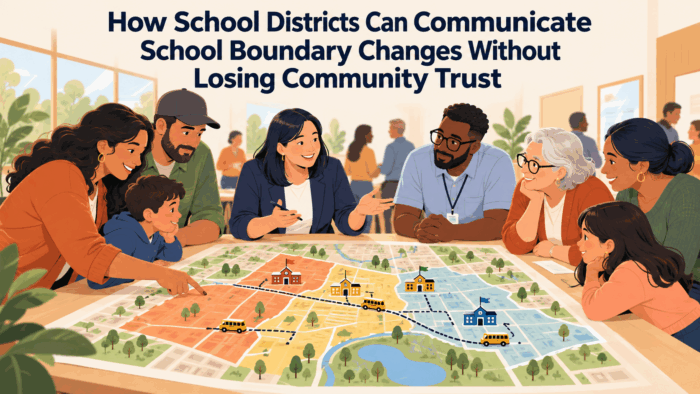
How School Districts Can Communicate School Boundary Changes Without Losing Community Trust
Few decisions generate as much intensity in a school community as changes to attendance boundaries. Boundaries determine which school a child attends, and for many families that school is woven into daily routines, friendships, neighborhood identity, property values, commutes, child care arrangements, and long-held expectations about where their children will grow up. When a district proposes to redraw boundaries, whether to relieve overcrowding, fill under-enrolled schools, open a new school, balance demographics, or respond to housing growth, families who might be affected often react with anxiety, frustration, and sometimes anger. Public meetings fill with worried parents. Social media groups spread rumors and speculation. Petitions circulate. Board members receive hundreds of emails. Even when the reasons for change are sound and the process is fair, boundary decisions can erode trust in district leadership for years if communication is mishandled.
Much of the conflict surrounding boundary changes stems not from the decisions themselves but from how families experience the process. Families who feel surprised, excluded, or misled tend to resist even reasonable proposals. Families who learn about potential changes through rumors rather than official communication assume the worst. Families who participate in engagement sessions but see no evidence that their input mattered conclude that the outcome was predetermined. Families who do not understand the data and criteria driving decisions may suspect that boundaries are being drawn to favor some neighborhoods over others. And families who speak languages other than English, work multiple jobs, or are otherwise less connected to district communication may not learn about proposals until decisions are final, leaving them with no voice in changes that affect their children as much as anyone’s.
Effective communication cannot make every family happy with a boundary decision, and it should not try to. Boundary changes inevitably involve tradeoffs, and some families will be disappointed. What communication can do is ensure that the process is transparent, that families understand why change is being considered and how decisions will be made, that every affected community has a genuine opportunity to be heard, that decisions are explained honestly, and that families receive the practical support they need to navigate the transition. When families trust the process, they are far more likely to accept outcomes they did not prefer, and the district’s relationship with its community can emerge intact or even strengthened.
This article examines how school districts can communicate school boundary changes without losing community trust. It looks at why boundary changes are so sensitive, how to build the case for change before proposing specific boundaries, and how to design a transparent process with clear criteria and timelines. It covers how to share data and maps in ways families can understand, how to engage the full community including families who are often underrepresented, how to manage rumors and misinformation, and how to communicate decisions honestly. It also addresses supporting families through the transition, including grandfathering and transportation questions, preparing board members and staff to communicate consistently, and measuring whether communication preserved trust. The goal is a boundary process that families experience as fair, open, and respectful, even when they disagree with the result.
Why Boundary Changes Are So Sensitive
 Boundary changes touch families where they live, quite literally. Unlike many district decisions that affect families indirectly, boundary decisions determine the daily experience of children and families in concrete, personal ways. A change might mean a longer commute, separation from friends, a different school culture, a loss of connection to a beloved teacher or principal, or a disruption in sibling arrangements. For some families, the school their child attends was a deciding factor in where they chose to live or buy a home. Understanding the depth of these connections helps district leaders and communicators approach boundary changes with the seriousness and empathy they deserve, rather than treating them as a technical exercise in balancing enrollment numbers.
Schools as Anchors of Identity and Community
Neighborhood schools often function as anchors of community identity. Families form friendships at drop-off, volunteer at school events, cheer at games, and see the school as a gathering place that defines their neighborhood. Children develop strong attachments to their school, their classmates, and their teachers. When a boundary change moves a family from one school to another, families may experience it as a loss of community and belonging, not merely a change in address on a form. These feelings are real and valid, and communication that dismisses them as emotional overreaction will deepen distrust.
Communication that acknowledges these connections, by recognizing what families value about their current school and expressing respect for those attachments, signals that district leaders understand what is at stake. This acknowledgment does not mean avoiding necessary change. It means approaching change with empathy, explaining why it is needed, and showing how the district will support families in building new connections. Families are far more open to difficult changes when they feel their concerns have been heard and respected.
Leaders can demonstrate this respect in concrete ways, such as visiting affected schools, attending community meetings in person, and speaking directly about what makes each school special. Sharing stories of how other communities have navigated similar changes, and how students formed new friendships and connections, can also offer reassurance without minimizing the loss families feel. Above all, leaders should avoid language that frames families’ concerns as obstacles to be overcome, and instead treat those concerns as information that can help the district design better solutions and smoother transitions.
Perceptions of Fairness and Equity
Boundary decisions often raise questions about fairness and equity. Families may worry that boundaries are being drawn to favor wealthier neighborhoods, to concentrate or disperse particular student populations, or to protect certain schools at the expense of others. In some communities, boundaries have historically reinforced segregation by race or income, and families who know this history may be deeply skeptical of any boundary process. At the same time, efforts to use boundaries to promote integration or balance enrollment across demographic lines can generate strong opposition from families who prefer the status quo.
Because fairness is so central to how families judge boundary decisions, communication must be transparent about the goals and criteria that guide decisions. If the district aims to balance enrollment, reduce overcrowding, keep neighborhoods together, minimize travel distances, or promote diversity, these goals should be stated clearly at the outset, along with how they will be weighed against one another. Families may disagree with the goals, but transparency allows the disagreement to be open and honest rather than driven by suspicion that hidden motives are at work.
Transparency about demographic data is particularly important when diversity or equity is among the district’s goals. Families should be able to see how options would affect the composition of each school and understand how those effects were weighed. Where legal constraints limit how demographic factors can be used in assignment decisions, the district should explain those constraints clearly. Open discussion of these issues, handled respectfully, is far better than allowing families to speculate about motives, and it allows the community to engage in an honest conversation about values and tradeoffs.
The Speed of Rumor and Social Media
Boundary discussions are particularly vulnerable to rumor. A draft map shared in a staff meeting, a comment by a board member, or a speculative social media post can spread through neighborhood groups within hours, often in distorted form. Families may hear that their neighborhood is being moved to a distant school, that a school is being closed, or that a decision has already been made, when none of these is true. Once rumors take hold, they are difficult to correct, and families who learned about potential changes through rumor rather than official communication often feel blindsided and distrustful.
Districts cannot prevent all rumors, but they can reduce their impact by communicating early, frequently, and transparently, by maintaining a single authoritative source of information, and by responding quickly to misinformation. When families know where to find accurate, up-to-date information and trust that the district will share developments promptly, rumors lose much of their power. Silence, by contrast, creates a vacuum that speculation quickly fills.
Districts can also reduce rumor risk by being careful about internal drafts. Staff and committee members should understand that working documents may be shared beyond their intended audience, and districts should consider publishing preliminary materials themselves, clearly labeled as drafts for discussion, rather than allowing them to leak without context. When families see draft materials directly from the district, accompanied by an explanation of where the process stands, they are far less likely to react with alarm than when they encounter the same materials secondhand on social media.
Learning Together: Communication Strategies for K-12 School Districts and Public Education Agencies
This article is part of our series on strategic communication for K-12 School Districts and Public Education Agencies. To learn more and to see the parent article, which links to other content just like this, click the button below.
Building the Case for Change Before Proposing Boundaries
One of the most common mistakes in boundary communication is presenting specific maps before the community understands why change is needed. When the first thing families see is a map showing their neighborhood assigned to a different school, their attention focuses entirely on the personal impact, and the rationale for change becomes an afterthought. Effective boundary processes begin by building shared understanding of the problem the district is trying to solve, whether that is overcrowding, under-enrollment, a new school opening, or demographic shifts. When families understand and ideally agree that a problem exists, they are more likely to engage constructively in discussing solutions.
Explaining the Problem Clearly
Communication should explain the underlying issue in plain language, supported by data and visuals. If schools are overcrowded, families should see current and projected enrollment compared with building capacity, along with the practical consequences, such as portable classrooms, larger class sizes, crowded hallways, or shortened lunch periods. If schools are under-enrolled, families should understand how low enrollment affects programs, staffing, and costs. If a new school is opening, families should understand why it was built and how it will relieve pressure on existing schools. Explaining the problem in terms of its effects on students and families makes it real and relevant.
Data should be presented honestly, with acknowledgment of uncertainty in projections. Enrollment projections depend on assumptions about birth rates, housing development, migration, and family choices, and families may question them. Explaining how projections are made, who made them, and how accurate past projections have been builds credibility. If independent demographers prepared projections, that should be noted. Inviting families to ask questions about the data demonstrates confidence and transparency.
Visual storytelling can help families grasp the problem. Photos of crowded hallways or portable classrooms, simple animations showing enrollment growth over time, or short videos featuring principals describing daily challenges can make abstract numbers concrete. Hosting information sessions focused solely on the problem, before any options are discussed, gives families space to understand and ask questions without the anxiety that maps immediately provoke. Families who understand and agree that a problem exists become partners in finding solutions rather than opponents of change.
Inviting Input on Goals and Criteria
Before drawing maps, districts can invite the community to weigh in on the goals and criteria that should guide boundary decisions. Families might be asked how important it is to keep neighborhoods together, to minimize travel time, to keep students with their feeder pattern into middle and high school, to balance enrollment across schools, to preserve walkability, or to promote diversity. Surveys, community meetings, and small group discussions can gather this input. Sharing the results, and explaining how they shaped the criteria the district adopted, demonstrates that community voices influenced the process from the start.
Agreeing on criteria before maps are drawn provides a framework for evaluating options and explaining decisions later. When a final map is adopted, the district can show how it reflects the agreed criteria, which makes the decision feel principled rather than arbitrary. Families who disagree with a particular outcome may still respect a process that applied consistent, publicly discussed criteria.
Criteria discussions also reveal genuine differences in community values that districts need to understand. Some neighborhoods may prioritize walkability, while others prioritize keeping students together from elementary through high school, and still others prioritize program access or diversity. Surfacing these differences openly, early in the process, allows the district and community to discuss tradeoffs before they become attached to specific maps and specific children. This makes later decisions easier to explain, because the district can point to a shared conversation about priorities rather than appearing to impose its own preferences.
Designing a Transparent Process
A transparent boundary process gives families a clear understanding of how decisions will be made, who will make them, when key milestones will occur, and how they can participate. Transparency reduces anxiety by replacing uncertainty with a visible roadmap, and it builds trust by demonstrating that the district has nothing to hide. A well-designed process also gives district leaders a structure for managing the many voices and pressures that boundary changes generate.
Publishing the Process and Timeline
At the outset, the district should publish a clear description of the boundary process, including the reasons for the review, the goals and criteria, the steps involved, the timeline for each step, the opportunities for public input, the role of any advisory committee, the role of the board, and when decisions will take effect. This description should be available on a dedicated web page, in printed materials, and in the languages families speak. A visual timeline helps families see where the process stands at any given time and when their input will matter most.
The timeline should allow enough time for meaningful engagement and for families to plan after decisions are made. Rushed processes, especially those that conclude just weeks before school assignments take effect, leave families feeling that their input was a formality and give them little time to adjust. Building in adequate time is one of the most important ways to demonstrate respect for families.
The timeline should also identify when the district will make final decisions and when no further changes will be considered, so that families know when they can begin planning. Unexpected extensions, sudden new options introduced late in the process, or reversals after decisions are announced can erode trust quickly. If changes to the timeline become necessary, the district should explain why promptly and clearly, and should provide families with an updated timeline so that the process remains predictable.
Advisory Committees That Reflect the Community
Many districts use advisory committees of parents, staff, and community members to review data, develop options, and make recommendations. Committees can bring valuable perspectives and add credibility to the process, but only if they genuinely reflect the community. Committees dominated by families from a few neighborhoods or with similar backgrounds will be seen as biased, and their recommendations may not account for the needs of underrepresented families. Districts should recruit members deliberately from every affected area and from diverse backgrounds, provide interpretation and support for participation, and make committee meetings and materials public.
The role of the committee should be clearly defined and communicated. Families should understand whether the committee is making recommendations or decisions, how the board will use its work, and how the public can provide input to the committee. Publishing committee agendas, materials, and summaries keeps the process transparent and allows families who are not members to follow along.
Committee members also need support to serve effectively. They should receive orientation on enrollment data, legal constraints, and the criteria, along with clear guidance on how to communicate with their neighbors about the committee’s work. Members can face intense pressure from friends and neighbors during boundary processes, and districts should prepare them for this, clarify that they may share public information but should direct questions to official channels, and support them if they experience criticism. Thanking committee members publicly when the process concludes recognizes the considerable time and emotional energy they contribute.
A Single Authoritative Source of Information
A dedicated boundary web page serves as the single authoritative source of information throughout the process. It should include the process description and timeline, the data and projections, the goals and criteria, all options under consideration with maps, frequently asked questions, meeting schedules and recordings, summaries of public input, and ways to submit comments. An address lookup tool that allows families to see how each option would affect their home is particularly valuable. The page should be updated promptly whenever new information is available, with a clear note indicating what changed and when.
Directing all communication back to this source, including board presentations, newsletters, social media posts, and staff talking points, helps ensure consistency and gives families a reliable place to check information when they encounter rumors. The page should be accessible, mobile friendly, and available in multiple languages.
Sharing Data and Maps Families Can Understand
 Boundary decisions rest on data about enrollment, capacity, demographics, travel distances, and housing development. Families who cannot understand this data cannot evaluate options or trust the reasoning behind them. Maps, too, can be confusing, especially when they are dense, technical, or difficult to read on a phone. Presenting data and maps clearly is essential to meaningful engagement and to building confidence that decisions are grounded in facts rather than favoritism.
Plain Language Data Presentation
Data should be presented in simple charts and tables with plain language explanations of what each shows and why it matters. For each option under consideration, families should be able to see how many students would move, which schools would gain or lose enrollment, how utilization would change, how demographics might shift, and how travel distances would be affected. Comparison tables showing how each option performs against the agreed criteria help families understand tradeoffs. Avoiding technical jargon, such as utilization rates without explanation, and providing short narrative summaries alongside data make information accessible to families without specialized knowledge.
Districts should also be transparent about limitations and uncertainties in the data. If projections might change with new housing developments, or if demographic data is estimated, that should be explained. Acknowledging uncertainty builds credibility, while presenting projections as certain invites skepticism when families notice gaps.
Interactive Maps and Address Lookup
Interactive maps allow families to explore options, zoom into their neighborhood, and see which school their address would be assigned to under each scenario. Address lookup tools that show exactly how an option would affect a specific home answer the question most families care about first and reduce the volume of individual inquiries. Maps should be clearly labeled, use readable colors and contrast, include street names and landmarks, and work well on mobile devices. Printed maps should be available for families without internet access, and staff should be available to help families interpret maps at community meetings.
When maps change during the process, the district should clearly indicate what changed and why, rather than quietly replacing old maps with new ones. Version labels and change summaries help families follow the evolution of options and understand how input influenced revisions.
Engaging the Full Community
Boundary engagement often draws the most vocal and well-organized families, who may represent particular neighborhoods or interests. Families who are less connected to district communication, including families who speak languages other than English, families working nonstandard hours, renters, and families in neighborhoods with historically low participation, are often underrepresented, even though boundary changes may affect them just as much. Engaging the full community requires deliberate outreach and a variety of engagement methods.
Multiple Methods and Locations
Districts should offer multiple ways to participate, including community meetings at different times and locations, virtual sessions, online surveys and comment forms, small group conversations hosted by community partners, and opportunities to speak with staff one-on-one. Meetings should be held in affected neighborhoods, not only at district offices, and should offer interpretation, childcare, and accessible facilities. Structured formats, such as small table discussions with facilitators, allow more families to share their views than open microphone sessions dominated by a few speakers.
Surveys should be available in multiple languages and formats, including paper, and should ask questions that help the district understand family priorities and concerns, not only which option families prefer. Comment forms should allow families to explain their concerns in their own words.
Reaching Underrepresented Families
Targeted outreach can increase participation among underrepresented families. Family liaisons, community organizations, faith leaders, and trusted messengers can share information and invite participation. Schools can send personal invitations through teachers and principals. Text messages and phone calls in families’ languages can reach families who do not read email. Engagement sessions held in partnership with community organizations, in familiar settings and in families’ languages, can provide comfortable spaces for families to share their views. Tracking participation by neighborhood and demographic group helps the district identify gaps and adjust outreach during the process.
Renters deserve particular attention, since they may not receive information distributed through homeowner associations and may move more frequently, making boundary changes especially disruptive. Families in apartment complexes can be reached through property managers, community rooms, and building notices. Districts should also consider the needs of families experiencing homelessness, families in foster care, and military families, whose school stability may be protected by specific laws and who may need individualized guidance about how boundary changes affect them. When engagement deliberately reaches these families, the resulting decisions reflect a fuller understanding of community needs, and families who are often overlooked see that their voices matter.
Closing the Loop on Input
Families need to see that their input mattered. After each round of engagement, the district should publish a summary of what it heard, organized by theme, and explain how input influenced options or criteria. When input could not be accommodated, the district should explain why. These summaries demonstrate that engagement is genuine and encourage continued participation.
Closing the loop is especially important when the district changes course in response to input, such as revising an option, adding a new scenario, or adjusting criteria. Highlighting these changes publicly, and crediting community input for them, shows families that participation can influence outcomes. When feedback leads to no changes, explaining the reasoning, such as legal constraints, capacity limits, or conflicting priorities expressed by other neighborhoods, helps families understand that their input was considered seriously even if it did not prevail. Families can accept disappointment far more readily than they can accept being ignored.
Managing Rumors and Communicating Decisions
Throughout the process, districts must manage misinformation and, at the end, communicate decisions in ways that are honest, clear, and respectful of families who are disappointed. How decisions are announced can determine whether families accept them and move forward or remain resentful.
Responding to Misinformation
Districts should monitor community conversations and respond quickly to misinformation with accurate information, directing families to the authoritative boundary web page. A rumor control section of frequently asked questions can address common misconceptions directly. Staff and board members should be equipped with accurate talking points so they can correct misinformation consistently. Responses should be factual and respectful, never dismissive of family concerns.
Timing matters. The longer misinformation circulates unanswered, the more firmly it takes hold, so districts should establish a process for identifying and responding to significant rumors within a day. Responses should go out through the same channels where rumors are circulating when possible, such as posting accurate information in community groups through trusted parents or partners, as well as on official district channels. Being transparent about what is still undecided is often the most effective response to rumors, since many rumors arise from families assuming that decisions have already been made behind closed doors.
Announcing Decisions Honestly
When the board makes a decision, the district should communicate it promptly and directly to affected families, before or at the same time as public announcements. Communication should explain what was decided, why, how the decision reflects the criteria and community input, what tradeoffs were made, and what happens next. It should acknowledge that some families are disappointed and express respect for their concerns. Personalized messages telling each affected family how the decision affects their child are especially valuable.
Decision communication should be carefully sequenced. Principals and staff at affected schools should be briefed before the public announcement so they can answer questions. Affected families should receive direct communication in their language at the same time as or before media coverage, so that they do not learn about changes affecting their children from the news or social media. A follow-up opportunity, such as office hours or a dedicated phone line, gives families a way to ask questions about their specific situation. Leaders should also be prepared to explain the decision in person at community meetings, demonstrating accountability and respect for families who participated in the process.
Supporting Families Through the Transition
A boundary decision is the beginning, not the end, of communication. Families moving to a new school need practical information and support to make the transition successful. Thoughtful transition communication can help families build connections with their new school and reduce lingering resentment.
Practical Information and Grandfathering
Families need clear information about when the change takes effect, whether students already enrolled can remain at their current school, whether siblings can attend together, how transportation will work, and how to request transfers if eligible. Grandfathering and sibling policies are often among the most important details for families and should be explained clearly and early.
Families also need to know whom to contact with questions about their individual circumstances, such as students with individualized education programs, students in specialized programs that may not exist at the new school, or families with children at multiple levels affected differently. Providing a clear contact and a simple process for resolving individual questions prevents families from feeling lost in the transition. Transportation details, including new bus routes, pickup times, and walking routes, should be communicated well before the first day so families can plan child care and work schedules.
Welcoming Families to New Schools
Receiving schools can welcome incoming families through letters from principals, tours, family events, and opportunities to meet teachers and other families. Sending schools can help students say goodbye and prepare for change. These efforts help families begin to see their new school as a community rather than a loss.
Connecting incoming families with current families at the receiving school, for example through parent ambassador programs or welcome events hosted by parent organizations, can help newcomers build relationships quickly. For students, opportunities to visit the new school, meet classmates, and participate in activities before the first day reduce anxiety. Sending schools can honor students’ time there through farewell events or memory activities that acknowledge the significance of the change. Paying attention to the emotional experience of transition, not only the logistics, signals that the district cares about families as people rather than as entries on an enrollment spreadsheet.
Preparing Leaders and Measuring Trust
Board members, principals, and staff all communicate with families during boundary processes, and inconsistent messages can undermine trust. Preparing leaders to communicate consistently and measuring how families experienced the process help districts improve future boundary work.
Consistent Messaging
Board members and staff should receive regular briefings, talking points, and frequently asked questions so they can answer questions accurately. Principals are often the first point of contact for worried families and need timely information. Clear guidance on how to respond to questions, and when to refer families to the boundary web page or staff, helps maintain consistency.
Board members face particular pressure during boundary processes, as constituents contact them directly with concerns and requests. Board members should understand the process thoroughly, avoid making commitments to individual families or neighborhoods outside the public process, and direct families to official channels for input. Coordinated messaging between the board and administration prevents mixed signals that can undermine trust. When board members disagree with recommendations, as they sometimes will, those disagreements should be expressed through public deliberation rather than in ways that confuse families about what the district is actually proposing.
Measuring Process and Trust
Districts can track participation by neighborhood and group, survey families about whether they felt informed and heard, and monitor the volume and nature of complaints. Reviewing these results after the process informs future boundary efforts and demonstrates commitment to improvement.
A brief public report after the process, summarizing participation, key themes from community input, how input shaped the outcome, and lessons the district learned, demonstrates accountability and builds trust for future decisions. Districts that reflect openly on what went well and what could have been better show families that they take the relationship seriously and intend to keep improving how they make difficult decisions together.
How Boundary Communication Compares With Other Agency Types
Many public agencies make decisions that change how and where residents receive services, and they face similar challenges of trust. Transit agencies redesign bus routes, affecting riders’ commutes. Election officials redraw precincts and polling locations. Planning departments rezone neighborhoods. Redistricting commissions redraw political boundaries. These agencies have learned that early explanation of the problem, transparent criteria, accessible maps and data, broad engagement, and honest communication of decisions are essential to public acceptance. Transit agencies, for example, often begin network redesigns by asking the public to weigh tradeoffs between frequency and coverage before drawing any routes, a strategy closely parallel to inviting input on boundary criteria before drawing maps. Redistricting commissions have developed interactive mapping tools and public data portals that allow residents to explore options and even submit their own maps.
School boundary changes are distinctive because they affect children, whose friendships, routines, and sense of belonging are at stake, and because schools are often central to neighborhood identity in ways that bus routes and precincts are not. Families also have strong emotional and financial investments in school assignments, and boundary decisions can intersect with sensitive issues of race, income, and opportunity. These factors raise the stakes of boundary communication and make empathy, transparency, and genuine engagement especially important.
Tying It All Together
Boundary change communication is not a side function. It determines whether families experience boundary decisions as fair and transparent or as arbitrary and imposed, and that experience shapes community trust in district leadership for years after the decision is made.
Effective districts recognize why boundary changes are so sensitive, including the role of schools as anchors of community identity, concerns about fairness and equity, and the speed with which rumors spread. They approach boundary work with empathy and transparency.
They build the case for change before proposing specific boundaries, explaining the underlying problem clearly with honest data and inviting community input on the goals and criteria that will guide decisions.
They design a transparent process with a published timeline, representative advisory committees, and a single authoritative source of information. They share data and maps in plain language, provide interactive tools and address lookup, and clearly document how options change.
They engage the full community through multiple methods and locations, reach underrepresented families deliberately, and close the loop by showing how input shaped decisions. They manage rumors quickly, announce decisions honestly, and support families through the transition with practical information and warm welcomes to new schools.
Finally, they prepare leaders to communicate consistently and measure whether families felt informed and heard. Taken together, these practices allow districts to make difficult boundary decisions while preserving, and sometimes strengthening, community trust.
Strategic Communication Support for School Boundary Changes
 Boundary changes affect where children attend school, how families plan their daily routines, and how neighborhoods understand their connection to local schools. Even when changes are necessary to address enrollment growth, facility capacity, or educational equity, they can generate strong reactions if families feel decisions were made without them or explained poorly. Because boundary processes require coordination across planning staff, district leadership, school board members, principals, transportation teams, and communication staff, districts often partner with Stegmeier Consulting Group (SCG) to design a more transparent and inclusive approach. SCG helps districts treat boundary communication as a structured engagement process that builds understanding from the first data review through the final transition, rather than a single announcement after decisions are made.
SCG supports districts in assessing community context before a boundary process begins. This can include reviewing enrollment projections, identifying the neighborhoods and schools most likely to be affected, examining past boundary experiences that may shape community expectations, and mapping the groups whose voices are often missing from public meetings. These insights help districts set clear engagement goals, define decision criteria, and develop a timeline that gives families meaningful opportunities to participate. Plain language explanations of data, maps, and scenarios help families understand why changes are being considered and how options were developed.
Sustained trust also depends on the people who represent the district throughout the process. Board members, principals, planning staff, and front office teams may all receive questions from concerned families, and inconsistent answers can quickly undermine confidence. SCG helps districts prepare spokespeople with talking points, frequently asked questions, and guidance for facilitating community meetings respectfully. Multilingual materials, accessible meeting formats, and clear feedback channels help ensure that families across every affected neighborhood can understand proposals and share their perspectives.
Rapid enrollment growth, new school openings, facility closures, and board deadlines can make boundary communication especially urgent. SCG helps districts plan engagement around these timelines, coordinate communication with transportation and enrollment changes, and prepare for media attention and public comment. By integrating communication planning into the boundary process from the beginning, districts can reduce the risk of surprise, rumor, and organized opposition that often emerge when families feel informed too late.
SCG also helps districts evaluate whether boundary communication is building understanding and preserving trust. Participation data, survey responses, public comment themes, inquiry volume, and family feedback after transitions can reveal which neighborhoods were reached effectively and where concerns remain. By incorporating these findings into future planning, districts can strengthen their approach to boundary decisions and demonstrate to communities that difficult changes can be handled with transparency, fairness, and respect.
Future Trends
Enrollment shifts driven by declining birth rates, housing costs, and family mobility are prompting more districts to review boundaries, often alongside school consolidations. Communication will need to address boundary changes and closures together, helping families understand how decisions are connected.
Interactive mapping tools are becoming more sophisticated and accessible, allowing families to explore options, see impacts on their homes, and even propose alternatives. These tools can increase transparency and engagement but must be paired with clear explanations and support.
Attention to equity in boundary decisions is growing, with districts considering how boundaries affect access to opportunity across communities. Communication will need to explain equity goals clearly and engage families across perspectives respectfully.
Social media and neighborhood platforms will continue to accelerate the spread of information and misinformation. Districts will need rapid response capacity and trusted channels to share accurate updates.
Finally, families increasingly expect meaningful participation in decisions that affect them. Districts that design genuinely participatory boundary processes will be better positioned to maintain trust through difficult changes.
Conclusion
Boundary changes will always be difficult, because they ask families to accept changes in where their children go to school and how their communities are defined. But difficulty does not have to mean distrust. The way districts communicate shapes whether families experience the process as fair, even when they disagree with the outcome.
Districts that build the case for change, design transparent processes, share data clearly, engage the full community, manage rumors, communicate decisions honestly, and support families through transitions can navigate boundary changes while preserving community trust.
When families believe they were heard and treated fairly, they are far more willing to move forward together, and the district emerges from a difficult decision with its relationships intact.
Stegmeier Consulting Group’s Strategic Approach to Communication Systems
Navigate boundary changes with transparency, fairness, and trust.
Stegmeier Consulting Group helps school districts communicate boundary changes in ways that preserve and strengthen community trust. We begin by understanding the district’s goals, data, community dynamics, and history, and by identifying where families are likely to have questions, concerns, and misperceptions.
Our team works alongside district leaders, planners, and board members to design transparent processes, translate data and maps into plain language, build dedicated web resources, plan inclusive engagement, facilitate community conversations, and prepare leaders and staff with consistent messaging. We help districts close the loop on community input and support families through transitions.
We treat boundary communication as a system that spans the case for change, criteria development, option review, decision making, and implementation. That means aligning every message with a single authoritative source and building measurement that shows whether families felt informed and heard.
Use the form below to connect with our team and explore how strategic boundary change communication can help your district engage families early, explain decisions transparently, and maintain community trust through one of the most sensitive processes a district undertakes.