
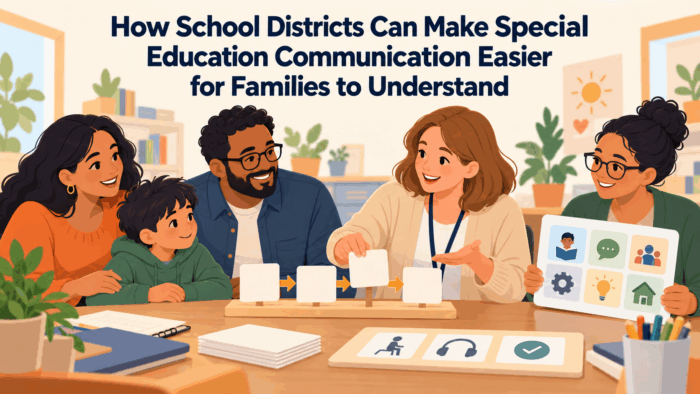
How School Districts Can Make Special Education Communication Easier for Families to Understand
Special education is built on a promise of partnership. Federal law envisions families as equal participants in decisions about their child’s evaluation, eligibility, services, and placement, and it gives families specific rights to receive information, provide consent, participate in meetings, and disagree with decisions. Districts devote enormous effort to meeting these obligations, producing evaluation reports, individualized education programs, prior written notices, procedural safeguards notices, progress reports, and meeting invitations for every eligible student. Special education staff, including case managers, school psychologists, speech-language pathologists, occupational therapists, and special education teachers, spend countless hours preparing documents and holding meetings. On paper, the system is designed to keep families fully informed and deeply involved.
In practice, many families describe special education communication as overwhelming, confusing, and sometimes intimidating. Evaluation reports can run dozens of pages filled with standardized scores, percentiles, and clinical terminology. Individualized education programs use specialized vocabulary and formats that are difficult to interpret without training. Procedural safeguards notices are long legal documents that few families read in full and fewer fully understand. Meetings may include many professionals speaking in technical terms while a parent sits across the table trying to follow the conversation, sometimes through an interpreter, sometimes after taking unpaid time off work, and often while processing difficult emotions about their child’s needs. Families leave meetings having signed documents they did not fully understand, unsure what services their child will receive or how to tell whether those services are working.
The gap between the promise of partnership and the experience of confusion has real consequences. Families who do not understand evaluation results may not know whether they agree with eligibility decisions. Families who cannot interpret an individualized education program may not notice when services are not being delivered or when goals are not being met. Families who do not understand their rights may not know they can request an independent evaluation, a meeting, or a change in services. Communication gaps also contribute to conflict, as misunderstandings escalate into disputes that are costly and stressful for everyone. Many of these disputes might be prevented if families had clearer information from the start and felt more confident as participants in the process.
This article examines how school districts can make special education communication easier for families to understand. It looks at why special education communication is so often confusing, how to explain the special education process in plain language, and how to make evaluation reports, individualized education programs, and procedural safeguards more understandable. It covers how to prepare families for meetings and conduct meetings that support genuine participation, how to communicate progress clearly, how to provide meaningful language access, and how to prepare staff to communicate with families as partners. Finally, it explores how districts can measure whether special education communication is improving. The goal is special education communication that turns the legal promise of partnership into a lived experience for every family.
Why Special Education Communication Is So Often Confusing
 Special education communication is shaped by legal requirements, professional conventions, and the complexity of the decisions involved. Each of these forces pushes communication toward precision, completeness, and technical accuracy, which are important, but often at the expense of clarity for families. Documents are written to satisfy compliance requirements and to be defensible if disputes arise. Professionals use the terminology of their disciplines because it is precise and familiar to them. The decisions themselves involve nuanced judgments about a child’s learning, development, and needs. Understanding these forces helps districts recognize that confusing communication is usually not the result of carelessness but of a system that has not been designed with family understanding as a central goal. Making family understanding a design priority, alongside compliance, is the key shift.
Compliance-Driven Documents
Many special education documents are designed primarily to demonstrate compliance with federal and state requirements. Prior written notices must contain specific elements. Individualized education programs must include required components such as present levels of performance, measurable annual goals, services, accommodations, and participation in assessments. Procedural safeguards notices must describe a long list of rights. Because these documents may be reviewed in audits or disputes, districts understandably focus on including every required element and using language that is legally precise. The resulting documents are often accurate and complete but difficult for families to read, and the most important information for families, such as what services their child will actually receive each week, can be buried among required language.
Compliance and clarity do not have to be in conflict. Districts can meet every legal requirement while also adding family-friendly summaries, plain language explanations, and visual formats that make documents easier to understand. A one-page summary at the front of an individualized education program, for example, can tell families in plain terms what services their child will receive, how often, from whom, and what goals they are working toward, while the full document provides the legally required detail. Treating family understanding as a goal alongside compliance leads to documents that serve both purposes.
Professional Language and Jargon
Special education professionals come from disciplines with their own specialized vocabularies, and they often use acronyms and terms that are second nature to them but unfamiliar to families. A single meeting might include references to specific learning disabilities, executive functioning, phonological processing, least restrictive environment, related services, specially designed instruction, extended school year, standard scores, and many acronyms. Families who do not know these terms may feel lost or embarrassed to ask, and they may nod along without understanding. Even families who are highly educated in other fields may struggle with special education terminology.
Reducing jargon requires deliberate effort. Professionals can explain terms when they first use them, replace jargon with everyday language when possible, and check for understanding throughout meetings and documents. A glossary of common special education terms, written in plain language and translated into the languages families speak, can help families learn the vocabulary at their own pace. But glossaries are not a substitute for clear communication; the goal should be to communicate in ways families understand without requiring them to learn a new language first.
Emotional Weight and Power Dynamics
Special education communication also carries emotional weight. Families may be learning for the first time that their child has a disability, processing grief or worry, or feeling frustration after years of struggling to get help. They may feel judged or blamed. Meetings can feel intimidating when families face a table of professionals who seem to have already made decisions. Families from cultures in which questioning educators is considered disrespectful, families with limited English proficiency, and families who had negative experiences in school themselves may be especially reluctant to speak up. These dynamics make it harder for families to absorb information and participate as equal partners.
Recognizing the emotional and relational dimensions of special education communication is essential. Staff who acknowledge families’ feelings, explain information patiently, invite questions, and genuinely value family input help balance the power dynamics. Simple practices, such as introducing everyone and their role, seating families as part of the team rather than across from it, and asking families to share their perspective first, can change how families experience meetings. Staff can also acknowledge the emotional dimension directly, for example by recognizing that hearing evaluation results can be difficult, and by inviting families to take a moment, ask questions, or schedule additional time if needed. These small acknowledgments signal respect and help families stay engaged in difficult conversations.
Learning Together: Communication Strategies for K-12 School Districts and Public Education Agencies
This article is part of our series on strategic communication for K-12 School Districts and Public Education Agencies. To learn more and to see the parent article, which links to other content just like this, click the button below.
Explaining the Special Education Process in Plain Language
Families often enter special education without a clear picture of how the process works. They may not know what happens after a referral, how long evaluations take, what eligibility means, how individualized education programs are developed, or what rights they have at each stage. A clear, plain language explanation of the process, provided at the very beginning, helps families understand where they are and what comes next. This explanation should be designed for families with no prior knowledge and should be available in multiple formats and languages.
A Family Guide to the Process
A family guide to special education should explain each step of the process in order: referral, consent for evaluation, evaluation, eligibility determination, development of the individualized education program, implementation of services, progress monitoring, annual reviews, and reevaluations. For each step, the guide should explain what happens, how long it typically takes, what role the family plays, what decisions are made, and what rights the family has. A visual timeline or flowchart can help families see the whole process at a glance and understand where they are at any given time.
The guide should also answer common questions, such as whether a child will be removed from general education classes, whether special education is permanent, how services are delivered, and what happens if the family disagrees with a decision. It should introduce key terms in plain language and provide contacts for questions. Short videos, available in multiple languages, can complement written guides and help families who prefer to learn by listening. Providing the guide at the time of referral, and reviewing it with families in a conversation, ensures that families start the process informed.
Explaining Timelines and What Families Can Expect
Special education processes involve legal timelines, such as the time allowed to complete an evaluation after consent is given and the frequency of individualized education program reviews. Families should understand these timelines so they know when to expect results and meetings. Communication should explain timelines in plain terms, such as stating the date by which the evaluation will be completed, rather than referring to a number of school days that families must calculate. Families should also understand what happens if timelines are not met and whom to contact with concerns, so that they can raise questions early rather than waiting until a deadline has long passed.
Families should also be kept informed as the process moves forward. Brief updates, such as letting a family know that testing has begun, that the evaluation is nearly complete, or that a meeting date is being scheduled, reduce uncertainty and build trust. When delays occur, families should be informed promptly with an explanation and a revised timeline. Silence during the evaluation period is one of the most common sources of family anxiety and frustration, since families often worry that their child’s needs are being overlooked. A short message every few weeks, even when there is little new to report, reassures families that the process is moving forward and that they have not been forgotten.
Making Evaluation Reports Understandable
Evaluation reports are among the most important and most confusing special education documents families receive. They contain the information used to determine eligibility and to plan services, but they are often long, technical, and filled with scores that families cannot interpret. Families who do not understand evaluation results cannot meaningfully participate in eligibility decisions or advocate for appropriate services. Making evaluation reports understandable is therefore central to family partnership. Clear reports also benefit staff, since general education teachers and others who work with the student need to understand findings in order to provide appropriate support in the classroom.
Summaries and Plain Language Explanations
Every evaluation report should begin with a plain language summary that explains, in a page or two, what was evaluated, what the evaluation found about the child’s strengths and needs, and what the findings suggest about eligibility and support. The summary should avoid jargon, explain any necessary terms, and focus on what the results mean for the child’s learning. It should highlight strengths as well as needs, since families appreciate seeing their child described as a whole person rather than a list of deficits.
Within the full report, explanations of assessments and scores should be written for families. Rather than simply listing standard scores and percentiles, reports can explain what each assessment measures, what the score means in plain terms, and how it compares with typical performance. Visual aids, such as a simple chart showing where scores fall relative to the average range, can make score information much easier to understand. Reports should also connect results to the student’s everyday experience, explaining, for example, how a weakness in processing speed might show up as difficulty finishing tests on time or copying notes from the board. These connections help families recognize their child in the report and understand why particular supports are being recommended.
Sharing Results Before the Meeting
Families should receive evaluation reports, or at least summaries, before the eligibility meeting whenever possible, so they have time to read, reflect, and prepare questions. Receiving a lengthy report for the first time at the meeting table, while professionals discuss it, makes meaningful participation nearly impossible. Some districts offer families a separate conversation with the evaluator before the meeting to walk through the results and answer questions, which allows families to absorb information without the pressure of a full team meeting. Some districts also share a short written guide explaining how to read the specific assessments included in the report, giving families a reference they can use while reviewing results at home.
When reports are shared in advance, families should also receive a brief note explaining what the meeting will address, what decisions will be made, and how they can prepare. Inviting families to share their own observations and questions before the meeting signals that their input is valued. Families should also be told that it is completely acceptable to disagree with findings or to ask for more information before eligibility decisions are made, since many families assume that evaluation results are final and that their role is simply to accept them.
Making Individualized Education Programs Usable
 The individualized education program is the central document of special education, describing the services, supports, and goals that will guide a student’s education. Yet many families find it difficult to understand and use. Programs can be long, with technical language and complex formats generated by special education software. Families may not be able to tell from the document what their child will actually experience each day, who will provide services, or how progress will be measured. Making individualized education programs usable for families is essential to partnership and accountability.
At-a-Glance Summaries
An at-a-glance summary, often one or two pages, can translate the individualized education program into a format families and teachers can use. It might include the student’s strengths and interests, key needs, annual goals stated in plain language, services with frequency and provider, accommodations and modifications, and contacts for questions. Many districts have found that these summaries are useful not only for families but also for general education teachers, substitutes, and other staff who need to understand a student’s supports quickly.
The summary should be reviewed with families at the end of each meeting and provided in their preferred language. Families can keep it at home as a reference and use it to ask questions about services and progress throughout the year. General education teachers, paraprofessionals, and specialists can use the same summary to ensure that accommodations are provided consistently across settings, which addresses a common family concern that supports written into the program are not actually happening in every class. When families and staff work from the same clear summary, conversations about services become far more productive.
Districts can develop a standard summary template that every school uses, ensuring consistency across the district and making it easier for families who move between schools. The template can be built into special education software so that summaries are generated alongside the full program, reducing extra work for case managers. Including a short section written in the student’s own words, especially for older students, about their strengths, goals, and what helps them learn, can make the summary more personal and remind everyone that the document describes a real young person with hopes and preferences, not simply a set of services.
Writing Goals and Services Clearly
Goals in individualized education programs should be written so that families can understand what their child is working toward and how progress will be measured. Goals that are clear and specific, such as stating that a student will read a grade-level passage aloud at a certain number of words per minute with a certain accuracy, are easier to understand than vague goals. Explaining each goal in plain language, including why it matters and how families can support it at home, makes goals meaningful to families.
Services should be described in concrete terms: what the service is, how often and for how long it occurs, where it takes place, and who provides it. Families should understand, for example, that their child will receive thirty minutes of speech therapy twice a week in a small group with a speech-language pathologist. Clear descriptions allow families to know what to expect and to ask questions if services do not seem to be happening as planned. Accommodations should be described with the same clarity, explaining what each accommodation is, when it applies, and how it will be provided, so that families can recognize whether their child is receiving the supports agreed upon in the program.
Making Procedural Safeguards Meaningful
Procedural safeguards notices explain families’ rights under special education law, including rights to participate, consent, access records, obtain independent evaluations, and resolve disputes. These rights are fundamental to the system, yet the notices are typically long legal documents that families receive repeatedly and rarely read. Making procedural safeguards meaningful requires supplementing the required notice with explanations families can understand and use. Families who understand their rights are better able to participate constructively, and districts that help families understand those rights demonstrate good faith and commitment to partnership.
Plain Language Summaries of Rights
Districts can provide a short, plain language summary of key rights alongside the required procedural safeguards notice. The summary might explain, in a page or two, that families have the right to participate in meetings, to give or refuse consent, to see their child’s records, to request an independent evaluation if they disagree with the district’s evaluation, to request meetings, and to use mediation or other processes if disagreements arise. It should explain how to exercise each right and whom to contact.
Staff should also explain key rights verbally at meetings, especially at the initial evaluation and eligibility stages. A brief conversation that highlights the most important rights and invites questions is more meaningful than simply handing families a document. Staff should also make sure families know they can ask about their rights at any time, not only when a notice is provided, and should respond to such questions openly. Families who feel comfortable asking about rights are more likely to raise concerns early and less likely to feel that formal disputes are their only option.
The timing of rights communication matters as well. Families often receive the full procedural safeguards notice at moments when they are already absorbing a great deal of new information, such as the first evaluation meeting. Districts can ease this burden by introducing key rights gradually, highlighting the rights most relevant to each stage of the process as families reach it. At the evaluation stage, for example, staff might emphasize the right to consent, to receive a copy of the evaluation, and to request an independent evaluation. At the planning stage, they might emphasize the right to participate in decisions and to request a meeting at any time. This staged approach helps families understand their rights in context, when the information is most useful.
Connecting Families to Support
Families benefit from knowing about organizations that can help them understand their rights and participate effectively. Parent training and information centers, which exist in every state, offer free information and support to families of children with disabilities. Local parent support groups and advocacy organizations can also help. Districts should share information about these resources proactively, signaling that they welcome informed, empowered families as partners. Some districts invite representatives of these organizations to family workshops or include their contact information in every family guide, which reinforces the message that the district wants families to have independent support and accurate information.
Districts can also build their own family support structures, such as special education parent advisory councils, peer mentor programs that pair experienced families with families new to special education, and family workshops on topics like understanding evaluations or preparing for transition planning. These structures give families a place to learn, ask questions, and connect with others who understand their experience. When districts communicate about these opportunities warmly and consistently, and when district leaders participate and listen, families come to see the district as genuinely invested in their success as partners rather than as an institution to be navigated or challenged.
Preparing Families for Meetings and Supporting Participation
Meetings are where many key special education decisions are made, and how families experience meetings shapes their sense of partnership. Preparation before meetings and thoughtful facilitation during them can transform meetings from intimidating events into genuine collaborations. Small changes in how meetings are scheduled, structured, and conducted can make a significant difference in family participation. Families who feel welcomed and prepared contribute more, ask more questions, and leave with a clearer understanding of decisions, which in turn makes implementation smoother and reduces the likelihood of later disagreements.
Before the Meeting
Families should receive meeting invitations well in advance, at times that work for them, with clear information about the purpose of the meeting, who will attend, what will be discussed, and how long it will take. Invitations should explain that families may bring someone with them, such as a relative, friend, or advocate. Draft documents, when used, should be shared before the meeting, with a clear statement that they are drafts open to family input. When families see draft documents for the first time at the meeting, they may assume that decisions have already been made without them, which undermines trust even when the team genuinely intends to collaborate. Sharing drafts in advance, and explicitly inviting families to suggest changes, demonstrates that the meeting is a real opportunity to shape decisions.
Many districts provide a simple pre-meeting questionnaire that asks families about their child’s strengths, concerns, and priorities. This allows families to organize their thoughts and ensures that their perspective is part of the conversation from the start. Staff can also offer a brief phone call before the meeting to answer questions, explain what will happen, and help families think about what they want to share. Families who arrive prepared, knowing the purpose of the meeting and what to expect, are far more likely to participate confidently and less likely to feel overwhelmed by the number of professionals and the volume of information.
During the Meeting
Meetings should begin with introductions that explain each person’s role, a review of the agenda, and an invitation for the family to share their perspective. Professionals should explain information in plain language, check for understanding, and invite questions throughout. Families should never feel rushed to sign documents; they should know that they can take time to review documents and ask questions. Professionals should pause regularly to ask whether the family has questions or concerns, and should invite the family’s perspective on each major decision rather than presenting conclusions for approval. When disagreements arise, staff should acknowledge them openly, explain their reasoning, and discuss options, including scheduling another meeting if more time or information is needed.
At the end of the meeting, a summary of decisions, next steps, and contacts helps ensure shared understanding. Following up after the meeting to ask whether the family has any questions reinforces partnership. Families often think of questions after they have had time to reflect or to discuss the meeting with others at home, and a brief follow-up call or message a few days later gives them a comfortable way to raise those questions. Providing a written summary of decisions in the family’s preferred language helps families share accurate information with other caregivers and refer back to agreements throughout the year.
Students themselves should be invited to participate in meetings when appropriate, particularly as they grow older. Student participation helps students understand their own needs and supports, builds self-advocacy skills that will matter throughout their lives, and often changes the tone of the meeting in positive ways, as adults speak more directly and respectfully when the student is present. Preparing students for meetings, for example by helping them identify what they want to share about their strengths and challenges, makes participation meaningful rather than intimidating. Families should be consulted about student participation and supported in preparing their child for the experience.
Communicating Progress and Providing Language Access
Families need to know whether their child is making progress toward individualized education program goals and whether services are working. Progress reports are required, but they are often brief, technical, or vague. Families who speak languages other than English need meaningful access to every part of special education communication. Both progress communication and language access are essential to partnership. Without clear progress information, families cannot judge whether services are working, and without meaningful language access, families cannot participate in any part of the process on equal terms.
Clear Progress Reports
Progress reports should explain, for each goal, what progress the student has made, using clear descriptions and data, and whether the student is on track to meet the goal by the end of the year. Reports should avoid vague phrases such as “progressing” without explanation. Including examples of student work or simple charts showing progress over time can make reports more meaningful. When students are not making expected progress, reports should explain what the team plans to do. Families should also be invited to discuss progress reports with the case manager, rather than simply receiving them, since a short conversation can clarify what the data means and allow families to share what they are seeing at home. Progress reports that arrive with a personal note and an offer to talk are far more likely to strengthen partnership than reports that arrive as one more form.
Progress communication should not be limited to formal reports issued a few times a year. Brief, informal updates from teachers and service providers, such as a note about a new skill the student demonstrated or a concern that has emerged, help families stay connected to their child’s learning between reporting periods. These updates also allow problems to be addressed quickly, before a formal report reveals that a goal is off track. Districts can support this kind of ongoing communication by setting expectations for regular contact, providing simple templates, and making translation readily available, so that every family, regardless of language, receives a steady flow of meaningful information about how their child is doing.
Meaningful Language Access
Families with limited English proficiency have the right to meaningful access to special education information and meetings. This means providing qualified interpreters at meetings, translating key documents, and ensuring that interpreters understand special education terminology. Families should never be asked to rely on their children or relatives to interpret special education meetings. Translated summaries of evaluation reports and individualized education programs can be particularly valuable. Interpreters should receive the meeting agenda and key documents in advance whenever possible so they can prepare for technical terminology, and meetings should allow extra time for interpretation so that families are not rushed. Districts should also confirm with families which language and format they prefer, since some families read one language but prefer to discuss complex matters in another.
Language access also includes attention to literacy and accessibility. Some families may have limited literacy in any language, and others may have disabilities of their own that affect how they receive information. Offering to review documents orally, providing audio or video explanations, using accessible document formats, and allowing extra time for families to process information all help ensure that every family can participate meaningfully. Districts should ask families about their communication needs at the start of the special education process and record those preferences so that every staff member honors them consistently throughout the student’s time in special education.
How Special Education Communication Compares With Other Agency Types
Health care systems, disability services agencies, and legal systems all communicate complex, consequential information to individuals and families. Health care has made significant progress in plain language communication, shared decision making, and patient education, recognizing that patients cannot participate in decisions they do not understand. Disability services agencies have developed person-centered planning approaches that emphasize individual strengths and preferences. Courts have developed self-help resources to make legal processes more understandable. Special education can learn from each of these fields. Health care’s use of teach-back, in which providers ask patients to explain information in their own words to confirm understanding, is one practice that translates particularly well to special education meetings and can quickly reveal where explanations need to be clearer.
Special education communication is distinctive because it combines educational, clinical, and legal dimensions, involves long-term relationships between families and schools, and concerns children whose development is ongoing. These features make clear, respectful communication both more challenging and more important. Unlike a single medical appointment or legal proceeding, special education involves years of ongoing interaction between families and school teams, so every communication either strengthens or erodes a relationship that both sides will depend on for the rest of the student’s time in school.
Tying It All Together
Special education communication is not a side function. It determines whether families can participate as the equal partners the law envisions, whether they understand their child’s needs and services, and whether they can advocate effectively when concerns arise. Because special education decisions shape a student’s daily experience, long-term opportunities, and sense of self, the quality of communication surrounding those decisions has consequences that extend far beyond any single meeting or document.
Effective districts recognize why special education communication is often confusing, including compliance-driven documents, professional jargon, and emotional and power dynamics. They make family understanding a design priority alongside compliance. They review documents and meetings from the family’s perspective, asking not only whether a document meets legal requirements but whether a parent reading it at the kitchen table would understand what it means for their child.
They explain the special education process in plain language, with family guides, visual timelines, and regular updates. They make evaluation reports understandable with summaries and clear score explanations, and they share results before meetings.
They make individualized education programs usable with at-a-glance summaries and clearly written goals and services. They make procedural safeguards meaningful with plain language summaries and connections to family support organizations. They explain rights in conversation, not only on paper, and they welcome informed families as partners rather than viewing knowledge of rights as a threat.
They prepare families for meetings and facilitate meetings that support genuine participation. They communicate progress clearly and provide meaningful language access. They treat every progress report and every interpreted meeting as an opportunity to strengthen trust, recognizing that families who understand how their child is doing are better able to support learning at home and to raise concerns early.
Taken together, these practices turn the legal promise of partnership into a lived experience for families, reducing conflict and improving outcomes for students. The investment required is modest compared with the cost of disputes, the time spent re-explaining decisions, and the lost opportunities that occur when families cannot fully support their child’s education.
Strategic Communication Support for Special Education Communication
 Special education decisions often involve complex evaluations, individualized education programs (IEPs), eligibility criteria, and procedural safeguards that families need to understand to participate meaningfully in their child’s education. Yet the language used in reports, meeting documents, and formal notices can be difficult to navigate without specialized knowledge. Because improving these materials requires dedicated communication expertise alongside extensive compliance and case management responsibilities, districts often partner with Strategic Communication Support (SCG) to make special education information more accessible and family-centered. SCG helps districts explain complex processes in ways that support informed participation while preserving the accuracy and procedural requirements of special education communication.
SCG supports districts in reviewing family-facing documents to identify technical terminology, unclear explanations, and opportunities to make essential information easier to follow. This may include developing plain-language family guides, simplifying evaluation summaries, and improving the organization of IEP documents so that families can more readily identify a student’s needs, goals, services, and next steps. These resources can help families prepare for meetings, understand decisions, and ask informed questions about their child’s educational support.
Effective communication also depends on how staff engage families throughout the special education process. Evaluation results, eligibility discussions, and disagreements about services can involve sensitive information and differing perspectives. SCG helps districts develop practical training for case managers, teachers, and other staff on explaining assessment findings without unnecessary jargon, facilitating meetings that encourage family input, and responding constructively when concerns arise. Guidance on working with interpreters can further support accurate, respectful communication with families who prefer to communicate in languages other than English.
When districts introduce new special education software, respond to family disputes, address state monitoring findings, or seek stronger family partnerships, communication practices may need broader review. SCG helps align document templates, staff guidance, and communication procedures so that families receive consistent explanations across schools and stages of the process. These improvements can reduce avoidable confusion while helping staff maintain attention to the individualized needs and educational progress of each student.
SCG also helps districts assess whether communication improvements are making special education processes easier for families to understand and navigate. Short surveys, focus groups, and feedback collected after meetings can reveal whether families understand important documents, feel able to contribute to decisions, and know what steps follow. By using these findings to refine materials, staff training, and communication procedures, districts can build a more responsive approach that strengthens family participation and keeps student learning and growth at the center of the process.
Future Trends
Many states and districts are adopting plain language and family-friendly formats for special education documents. Expect more at-a-glance summaries, visual progress reports, and family guides. Some states are developing model templates that districts can adopt, and districts that move early to redesign their documents will be well positioned as these expectations become standard. Families will increasingly compare the clarity of communication across districts, especially as more information is shared online.
Digital tools are making it easier to share documents in advance, schedule meetings flexibly, and hold virtual meetings, expanding access for families. Virtual and hybrid meetings, in particular, have made it easier for working parents, parents who live apart, and relatives who play important roles to participate. Districts should continue offering these options while ensuring that virtual participants can see documents, hear clearly, and contribute as fully as those in the room.
Translation technology is improving, but human review remains essential for accuracy in special education communication. Automated tools can produce quick drafts of translated documents, but special education terminology, legal rights, and nuanced descriptions of a child’s needs require review by qualified translators familiar with both the language and the field. Errors in translated evaluation summaries or rights notices can mislead families about decisions that profoundly affect their child, so districts will need clear policies about when automated translation is acceptable and when human translation is required.
Attention to family partnership and dispute prevention is growing, with more districts investing in facilitated meetings and family liaisons. Facilitated meetings, in which a neutral facilitator helps the team stay focused and ensures that every voice is heard, have helped many districts resolve disagreements before they escalate. Communicating that these options exist, and offering them early, signals that the district values collaboration over conflict.
Finally, families increasingly expect transparency and clear communication, and districts that meet those expectations will build stronger partnerships. Families today have access to more information about disabilities, services, and rights than ever before, and they increasingly expect schools to communicate with the same clarity they encounter in other parts of their lives. Districts that embrace this expectation, rather than resisting it, will find that informed families are often their strongest allies.
Conclusion
Special education is built on partnership, but partnership depends on understanding. When communication is confusing, families are left on the sidelines of decisions about their own children. That outcome undermines the very purpose of special education law and leaves students without the benefit of their families’ insight and advocacy.
Districts that explain the process plainly, make documents understandable, prepare families for meetings, communicate progress clearly, provide language access, and train staff as communicators can make special education communication work for families. These practices require planning and commitment, but they are well within reach for any district, and they pay dividends in trust, collaboration, and student outcomes.
When families understand and participate fully, students benefit from the combined knowledge and commitment of everyone who cares about their success. Families bring deep knowledge of their child’s history, strengths, and needs, and professionals bring expertise in learning and development. Clear communication is what allows these two kinds of knowledge to come together in decisions that truly serve the student.
Stegmeier Consulting Group’s Strategic Approach to Communication Systems
Turn special education paperwork into partnership families can understand.
Stegmeier Consulting Group helps school districts make special education communication easier for families to understand. We begin by reviewing documents, meetings, and family experiences to identify where communication creates confusion and where families feel excluded from decisions.
Our team works alongside special education leaders, case managers, evaluators, and legal counsel to develop plain language family guides, summaries of evaluation reports and individualized education programs, procedural safeguards summaries, and progress report templates. We design training that prepares staff to communicate as partners.
We treat special education communication as a system that spans referral, evaluation, planning, implementation, and review. That means aligning documents, meetings, and follow-up around family understanding while meeting every legal requirement.
Use the form below to connect with our team and explore how strategic special education communication can help your district explain evaluations, plans, services, and rights in language families understand, and build partnerships that place families at the center of their children’s education.