Snohomish County Public Utility District, Washington and the November 2024 Bomb Cyclone Lessons in Storm Communication
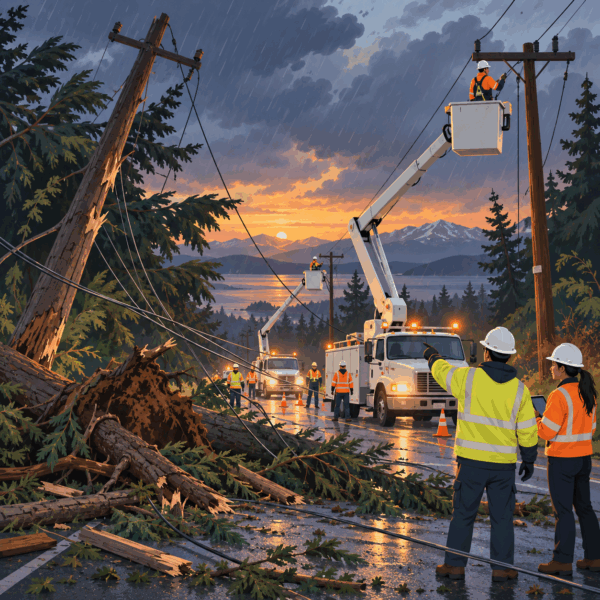
On November 19, 2024, a rare and fast-forming bomb cyclone tore across Puget Sound, delivering one of the most disruptive storms Snohomish County and Camano Island had experienced in years. A sudden plunge in atmospheric pressure unleashed fierce easterly and southeasterly winds, toppling trees, tearing down power lines, and overwhelming infrastructure already saturated by weeks of heavy rain. Within hours, nearly 166,000 Snohomish County Public Utility District customers, approximately 44 percent of the PUD’s entire customer base, were without power. Many of them were in areas unaccustomed to damage at that scale.
The storm’s operational impact was significant. At its peak, it represented the most pole damage the PUD had experienced in more than two decades. Restoration required 35 PUD line, service, and tree crews working alongside more than 40 mutual aid crews drawn from other utilities across the region, including crews from Chelan PUD who traveled from Eastern Washington to assist. Restoration to 99 percent of affected customers was complete by November 25, a week after the storm made landfall.
What made the November 2024 bomb cyclone particularly instructive as a communication case was not just the scale of the operational challenge, but the way communication systems failed precisely when ratepayers needed them most, and the comprehensive after-action process the PUD undertook to understand what happened and prevent it from happening again. The lessons Snohomish PUD drew from this event, published in a February 2026 article by the utility’s own PR and media liaison in the Northwest Public Power Association’s bulletin, provide a detailed and honest account of where storm communication worked, where it broke down, and what a public utility can do to rebuild more resilient communication infrastructure before the next major event.
The Snohomish County PUD serves Snohomish County and Camano Island in western Washington, a service territory that includes urban and suburban communities in and around Everett, densely populated areas in cities like Lake Stevens and Snohomish, and lower-density rural communities where storm damage is often most severe and restoration timelines longest. That geographic mix, combining areas with high ratepayer density and areas with limited road access, shapes both the operational and communication challenges the PUD faces during major storm events.
What Broke Down: The Communication Failures of November 2024
When the Outage Map Cannot Handle the Storm It Was Built For
Over the preceding decade, Snohomish PUD customers had grown accustomed to using the utility’s outage map as their primary tool for reporting outages and staying informed during storm events. The map had served the utility well through successive storm seasons and had become a core expectation of the customer experience during any significant weather event. Customers knew to go there first. Staff knew to direct them there. The communication model was built around it.
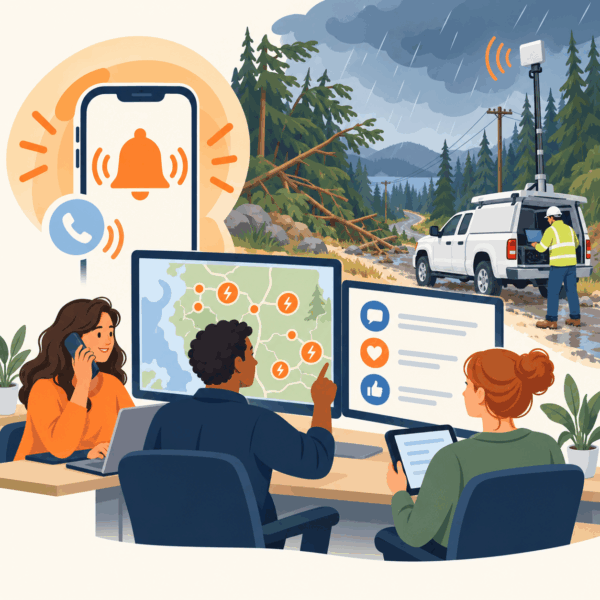
When the bomb cyclone struck, it did so abruptly and impacted much of the service territory almost simultaneously. Tens of thousands of customers lost power within a short window, creating an unprecedented surge in activity as customers attempted to report outages, enroll in outage alerts, and access real-time restoration information all at once. The volume and timing of user activity exceeded what the system had encountered in prior storm experiences. The outage map was temporarily overwhelmed.
The outage map, along with the outage alert and broadcast messaging tools that depended on it, was unavailable for several hours during the height of the outage event. In isolation, a few hours of system downtime during a multi-day restoration effort might seem like a manageable disruption. In context, it was not. The hours when the map went down coincided precisely with the moment when the largest number of customers were first losing power and actively seeking information. It was the moment of highest anxiety and highest demand, and the tool ratepayers expected to use was not available.
The second communication failure was in the field. Much of the storm’s most severe damage fell in rural areas of Snohomish County where cell coverage was weak or nonexistent. This created a practical communication problem for crews working to restore power: updating the outage map when arriving on a job site, a function that automatically notifies affected customers that their outage is being worked, requires cell connectivity. Without it, crews could be actively working on an outage with no ability to communicate that status to the customers waiting at home. The system that was designed to keep ratepayers informed of restoration progress could not function in the exact locations where damage was worst and restoration most complex.
Together, these two failures produced the communication experience that is most damaging to ratepayer trust during a major storm event: ratepayers losing power and finding that the official channel for updates was unavailable, then having no visibility into whether crews were working on their specific outage or when restoration might arrive. The operational restoration effort was moving. The communication system that should have been tracking and reporting that progress was not.
Clearer Taxpayer Communication: Strategies for State and Local Assessors, Treasurers, Revenue Departments, and Finance Offices
This article is part of our series on strategic communication for State and Local Assessors, Treasurers, Revenue Departments, and Finance Offices. Clear, timely, and accessible taxpayer communication helps government agencies improve compliance, reduce confusion, strengthen public trust, and enhance the citizen experience. To learn more and to see the parent article, which links to additional resources and best practices for taxpayer outreach and engagement, click the button below.
What Worked: Communication Successes Under Pressure
Social Media, Standardized Reporting, and Media Relationships as the Communication Backstop
While the outage map was down, the PUD’s communications staff turned to social media to keep customers informed about where crews were working and what progress restoration was making. Social media served as the communication backstop in exactly the situation it is best suited for: a high-urgency, real-time event where the primary digital channel has failed and ratepayers are actively monitoring available sources for information. The PUD’s ability to push updates through social media during the outage map outage maintained a connection with customers that would otherwise have been entirely severed.
The November 2024 storm was also the first time Snohomish PUD deployed a standardized storm report developed specifically to create cohesive and consistent internal communication during a major event. The standardized report included an external version that customer service representatives, strategic account managers, government relations liaisons, and emergency management staff could all reference to answer customer and stakeholder inquiries with aligned information. In a major storm event where different staff members across different functions are simultaneously fielding questions from different audiences, this kind of internal alignment document prevents the conflicting, inconsistent information that compounds ratepayer frustration when it reaches them through multiple channels.
Media inquiries poured in during the storm, as they do during any major regional event affecting hundreds of thousands of households. The PUD’s communications team, drawing on established relationships with line crews and field staff, was able to leverage those relationships to provide media access that went beyond standard press releases. Behind-the-scenes coverage of warehouse operations and mutual aid onboarding allowed journalists to tell a more complete story about the restoration effort. A photograph captured during the height of restoration work in Lake Stevens later won first place in the Northwest Public Power Association’s Excellence in Communications Awards contest. The media relationships built before the storm became a communication asset during it.
The Chief Communications Officer, reflecting on the response, noted that a storm of that magnitude tests all of an organization’s systems and its people simultaneously, and that watching the team work together to share information across the PUD while also keeping customers updated demonstrated what sustained communication investment and organizational commitment can produce even under extreme pressure.
The After-Action Review: Building a Learning System
From Event Response to Structural Reform
In the months following the November 2024 storm, Snohomish PUD undertook a comprehensive after-action review completed in March 2025, after the storm season had closed. Staff at all levels of the organization were interviewed to identify what had worked, what had not, and what specific improvements would produce better outcomes in the next major event. The review process was structured to generate actionable recommendations rather than simply document what happened.
The recommendations that emerged from the after-action review addressed both technology and organizational structure. On the technology side, the PUD focused on updating and improving the outage map to handle surge traffic without the failures that occurred in November 2024. Engineers upgraded the system’s underlying technology, reduced dependencies on other systems that had contributed to the cascading failure, and added user experience improvements that made the map more useful to customers during an active outage. The updated map allows customers to zoom in to the individual customer level, a specificity of information that the prior map could not provide, and groups outages by incident so customers can see what broader event their specific outage is part of.
Customers can now sign up for proactive outage alerts to receive text and email notifications as soon as their power goes out, and as soon as a crew is assigned to their specific outage, the estimated time of restoration is updated on the map and pushed to customers who have opted into text alerts. This combination of incident-level mapping and customer-level notification addresses directly the communication failure that occurred when the November 2024 map went down: customers who have received a text confirmation that a crew has been assigned to their outage do not need to refresh the outage map repeatedly for information they have already received.
On the organizational side, the leading recommendation from the after-action review was to hire a full-time storm coordinator, a role that had not previously existed at the PUD. The storm coordinator position focuses on fostering cross-departmental collaboration, enhancing internal communication, implementing metrics for storm response performance, and managing training programs that prepare staff before storm season rather than only responding after events occur. Just before the 2025 storm season, the PUD filled the position with an employee who had previously worked in the energy control center and brought direct operational knowledge of how the PUD’s systems function under stress.
The after-action review also produced a commitment to adopting a more formal incident command system structure for major storm events, a model borrowed from emergency management practice that provides clear lines of authority, defined communication roles, and structured information flow during complex, multi-agency operations. Tabletop exercises conducted during 2025 gave staff practice in the incident command framework before it was needed in an actual event.
The December 2025 Storm: Testing the Improvements
A Second Major Event as a Measure of After-Action Progress
The value of an after-action review is not measured by the quality of the report it produces. It is measured by whether the improvements it generates actually perform better in the next comparable event. In December 2025, Snohomish County and the surrounding Puget Sound region experienced a major storm with severe winds arriving on ground already saturated by historic flooding. At the height of the December storm, 63,700 Snohomish PUD customers were without power, a substantial event though smaller in scale than the November 2024 bomb cyclone.
The December 2025 storm provided a direct, real-world test of the improvements the PUD had made following the bomb cyclone after-action review. The outage map performed without downtime or performance concerns despite the increase in traffic, a direct contrast to the map failure that had defined the communication experience of the November 2024 event. Wi-Fi extenders installed in crew vehicles made it easier for field crews to update the system when arriving on job sites, even in areas where cell coverage had previously prevented those updates. The incident command system, newly implemented, produced measurably better information flow across departments during the event.
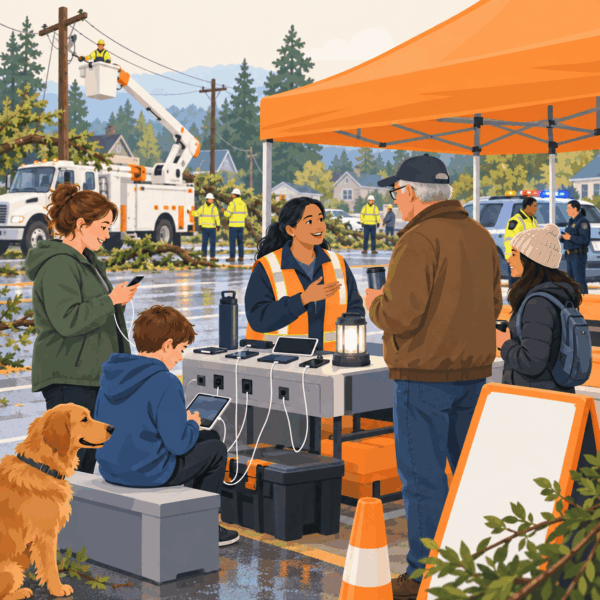
The PUD’s engagement team piloted a new approach during the December storm: deploying a charging station and information table in one of the hardest-hit areas, staffed by PUD employees who could provide residents with real-time restoration information while also helping them charge devices during an extended outage. The in-person presence served both practical and relational functions: practical, because it gave residents a direct, human source of current information when digital channels were unavailable; relational, because it demonstrated that the utility was physically present in the community during the disruption rather than communicating from a distance.
The PUD also embedded staff in the Snohomish County Department of Emergency Management’s operations center during the December storm, a practice that had emerged from the November 2024 experience. Emergency management staff used a countywide Microsoft Teams channel that included PUD employees, allowing real-time updates to reach 342 community partners simultaneously and enabling the PUD to address rumors and misinformation before they spread. The cross-agency relationships built through that embedding proved as valuable as the technology infrastructure that supported it.
Lessons for Public Utilities Managing Storm Communication
The Snohomish County PUD’s documented experience with the November 2024 bomb cyclone and its aftermath offers several lessons that transfer to public utilities of any type managing major service disruptions.
First, communication infrastructure has surge capacity requirements just as operational infrastructure does. The outage map that serves customers reliably during routine storms can fail under the simultaneous demand of a major event that affects a large portion of the service territory at once. Utilities that design digital communication systems for average demand rather than peak demand will find those systems unavailable precisely when they are most needed. Surge capacity planning for communication technology is as necessary as surge capacity planning for crew deployment.
Second, social media is an operational communication channel that functions as a backstop when primary digital channels fail. Utilities that maintain active, credible social media presences before a storm event have a fallback communication channel ready when the outage map goes down. Utilities that have not built that presence before the event cannot create it during one. The investment in routine social media communication is also an investment in storm readiness.
Third, internal alignment is a precondition for effective external communication. The standardized storm report that Snohomish PUD deployed for the first time during the November 2024 event, providing a single reference document that customer service, government relations, strategic accounts, and emergency management staff could all use to answer questions consistently, addressed one of the most common failures in major utility communication events: different staff giving different information to different audiences at the same time.
Fourth, a formal after-action review is the mechanism that converts a communication failure into a communication improvement. The bomb cyclone produced documented failures in both technology and organizational structure. The March 2025 after-action review produced specific, actionable recommendations that the PUD implemented before the next storm season. The December 2025 storm demonstrated that the improvements worked. Without the structured review process, the lessons of November 2024 would have remained informal observations rather than organizational changes.
Fifth, embedding staff in partner emergency operations centers extends communication reach in ways that no utility-owned channel can replicate. The 342 community partners reached through the Snohomish County emergency management Teams channel during the December 2025 storm would not have received real-time PUD updates through any other mechanism. The relationships built through that embedding also reduced the spread of misinformation that typically fills the information vacuum during major events when authoritative communication is delayed or unavailable.
Conclusion: The Bomb Cyclone as a Model for After-Action Communication Reform
Snohomish County PUD’s response to the November 2024 bomb cyclone illustrates what honest, structured after-action communication practice looks like for a public utility. The PUD did not minimize the communication failures the storm exposed. It published a detailed account of what broke down, conducted a comprehensive staff-level review to understand why, implemented specific structural and technological improvements before the next storm season, and then tested those improvements in a real event that validated the changes made.
The result is a utility that is measurably better prepared for the next major storm than it was before the bomb cyclone, not because the November 2024 event was managed perfectly, but because the organization treated its failures as learning opportunities rather than episodes to be managed and moved past. The storm coordinator hired as the leading recommendation from the after-action review captured the underlying principle directly: every storm teaches us something, and by strengthening how the utility collaborates, coordinates, and communicates, it builds a foundation that gets stronger with each season.
For public utilities across the country facing their own versions of the storm communication challenge, whether that challenge involves a hurricane, an ice storm, a wildfire, or a bomb cyclone, the Snohomish PUD experience offers both a specific model and a broader organizational commitment worth adopting. The communication infrastructure that keeps ratepayers informed during a major service disruption is not a technology problem alone. It is an organizational problem, a training problem, a partnership problem, and a continuous improvement problem that requires the same sustained investment as the operational infrastructure it supports.
 SCG’s Strategic Approach to Public Utility Communication
Align your agency’s messaging, notification systems, and ratepayer engagement strategies
SCG helps municipal energy providers, public utility districts, solid waste departments, wastewater agencies, stormwater utilities, broadband authorities, and public works departments build communication systems that make service disruptions, rate increases, and infrastructure investments easier for ratepayers to understand, anticipate, and navigate. By aligning multi-channel notification infrastructure, storm communication protocols, after-action review processes, internal alignment frameworks, and real-time update systems, agencies can reduce customer service call volume, improve ratepayer confidence during disruptions, and build the sustained public trust that long-term utility operations require.
Whether your agency is designing a storm communication protocol, building surge-resilient outage notification infrastructure, developing pre-event communication programs for vulnerable ratepayer populations, improving social media communication during major outage events, creating internal alignment tools for staff across customer service, field operations, and government relations, or establishing a formal after-action review process that converts storm experience into lasting communication improvement, a strategic communication framework can help ensure that every ratepayer receives the specific, actionable information they need during a service disruption.
Use the form below to connect with our team and explore how a strategic communication framework can strengthen your agency’s storm communication and ratepayer trust outcomes.