
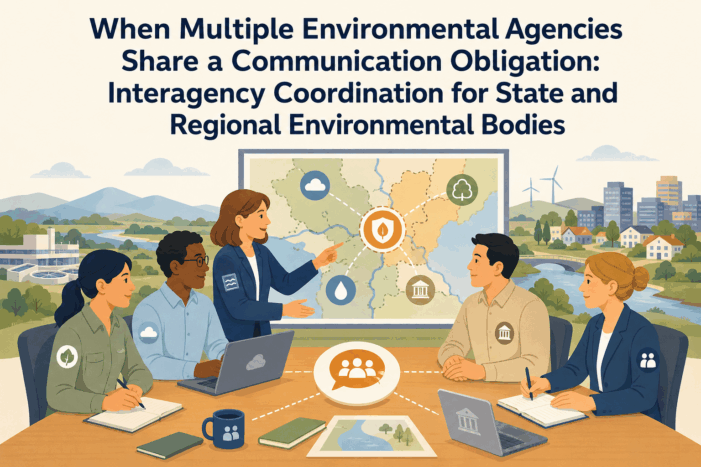
When Multiple Environmental Agencies Share a Communication Obligation: Interagency Coordination for State and Regional Environmental Bodies
Environmental issues rarely fit neatly within the boundaries of a single agency. A contaminated site may involve state environmental regulators, regional water quality authorities, local health departments, planning agencies, air districts, public works departments, and federal partners. A major permit or enforcement matter may require one agency to make the formal decision while several others provide technical analysis, conduct inspections, oversee related permits, or communicate with affected communities. During an emergency, those roles may overlap even more visibly as multiple agencies release updates about environmental conditions, public health precautions, regulatory action, and operational response.
This shared responsibility creates a communication obligation that is broader than simply ensuring agencies do not contradict one another. Stakeholders need to understand which agency is responsible for which decision, why several agencies are involved, what information is confirmed, and where they should go for the next update. When agencies communicate independently without a shared framework, the public can receive overlapping announcements, inconsistent terminology, different timelines, or conflicting explanations of the same environmental condition.
The problem becomes especially serious when the issue is controversial or technically complex. One agency may describe a condition as under investigation while another speaks about corrective action. A regional regulator may explain a permit requirement while a local agency describes the same requirement as a municipal policy. A public health agency may issue precautionary guidance while the environmental regulator emphasizes that a formal compliance determination has not yet been made. Each statement may be accurate within its own institutional context, yet the combined public message can appear inconsistent.
Effective interagency communication therefore requires deliberate coordination around facts, authority, timing, terminology, and public navigation. State and regional environmental bodies should establish how agencies will communicate together without blurring their separate regulatory roles. The objective is not to force every institution into one voice. It is to create a coherent public explanation in which each agency communicates from the same factual foundation, makes its own authority clear, and helps stakeholders understand how the pieces fit together.
Start by Defining the Communication Obligation, Not Just the Regulatory Roles
 Interagency coordination often begins with a discussion of jurisdiction: which agency issues the permit, which conducts monitoring, which enforces the requirement, and which manages local implementation. Those distinctions are essential, but communication planning should also identify which agencies have an obligation to explain the issue publicly and what each audience needs from them.
An agency may have limited decision-making authority yet still carry substantial communication responsibility because it maintains the public-facing relationship with residents or regulated entities. A municipality implementing requirements established by a regional regulator may be the institution residents contact first. A state environmental agency may lead the technical investigation while a local health department provides protective guidance. Communication responsibilities therefore do not always mirror regulatory authority exactly.
State and regional environmental bodies should identify who needs to explain the regulatory decision, who explains environmental conditions, who provides health or safety guidance, who communicates operational response, and who directs stakeholders toward the appropriate process. Mapping these responsibilities before public attention intensifies helps agencies avoid gaps in which every institution assumes another agency is handling a critical explanation.
This approach also makes coordination more practical. Rather than beginning with the question of who has the largest institutional role, agencies can begin with the information the public needs and assign communication responsibility accordingly.
Establish One Shared Factual Foundation Before Agencies Communicate Separately
Multiple agencies can communicate effectively in their own voices only if they begin from the same basic facts. State and regional environmental bodies should establish a shared factual foundation that identifies the environmental condition or regulatory issue, current procedural status, affected area, principal dates, confirmed technical findings, known uncertainties, and major actions underway.
This foundation should distinguish facts that all agencies can communicate from information that remains under technical review or is specific to one agency’s authority. If the source of contamination has not been confirmed, for example, no participating agency should present attribution as settled. If one agency has issued a permit decision while another related review remains pending, that distinction should appear consistently across public materials.
A shared fact base does not require identical messaging. A water quality board may focus on discharge requirements, while a health agency focuses on precautionary guidance and a municipality focuses on local services or access. Their emphasis can differ as long as the underlying description of what has happened and what remains unresolved is consistent.
Agencies should update this factual foundation as the situation evolves. Interagency coordination can break down when one institution continues using information that was accurate several days or weeks earlier while another has moved to a revised technical or procedural status.
Separate Shared Facts From Agency-Specific Conclusions
Some information should be common across every participating agency, while other conclusions belong to one regulator or technical authority. State and regional environmental bodies should make this distinction explicit internally before information is released.
The location of an incident, date of a permit action, existence of a monitoring result, or status of a public meeting may be shared facts. A compliance finding, health recommendation, permit interpretation, or enforcement determination may belong specifically to the agency authorized to make it.
This separation protects both clarity and institutional accountability. Agencies can coordinate closely without allowing one organization to speak beyond its authority or unintentionally imply that all participating agencies reached the same regulatory conclusion.
From Fragmentation to Coordination: Communication Strategies for Councils of Governments, Metropolitan Planning Organizations, and Regional Planning Agencies
This case study is part of SCG’s series on communication for councils of governments, metropolitan planning organizations, and regional planning agencies. To learn more and to see the parent article, which links to other content just like this, click the button below.
Explain Why Multiple Agencies Are Involved
From the public’s perspective, several environmental agencies working on one issue can look like duplication, fragmentation, or uncertainty about who is in charge. State and regional environmental bodies should explain the reason for the multi-agency structure rather than assuming stakeholders will understand it.
Environmental regulation is often divided by legal authority, technical subject matter, geography, and governmental level. One agency may regulate air emissions, another water discharges, another hazardous materials, and another land use. These responsibilities may converge around the same facility, contamination event, development proposal, watershed, or enforcement matter without becoming interchangeable.
Communication should explain this division through decisions rather than organizational descriptions. Stakeholders need to know which agency determines whether a permit is issued, which evaluates water quality, which oversees cleanup, which provides public health guidance, and which controls a related local approval. A list of agency names without this decision context does little to improve understanding.
Acknowledging that the structure is complicated can also improve credibility. Agencies do not need to defend governmental complexity. They need to make it navigable so the public can understand why several institutions are involved and which one is responsible for the issue they are trying to resolve.
Name the Lead Communicator Without Implying That One Agency Controls Every Decision
Multi-agency matters often benefit from a clearly identified lead communicator, particularly during high-interest projects, enforcement actions, contamination events, or emergencies. Without one, agencies may release separate updates that force the public to determine which source provides the most current overview.
The lead communicator should serve as the primary point for overall status information, coordination, and public navigation. That role does not necessarily belong to the agency with the broadest regulatory authority. It may be assigned based on operational leadership, public-facing responsibilities, incident command, project management, or another practical factor.
State and regional environmental bodies should explain the distinction between communication leadership and decision authority. A lead agency can coordinate updates while other agencies retain exclusive authority over specific permits, health recommendations, enforcement actions, or technical determinations. Public materials should identify those boundaries so stakeholders do not assume that the lead communicator can resolve every issue.
This structure reduces fragmentation while preserving accountability. The public receives a reliable entry point, and individual agencies remain clearly responsible for the decisions within their own jurisdiction.
Use Consistent Terminology Across Agencies
Environmental agencies often use different terminology for similar concepts because their programs developed under different statutes, regulations, technical disciplines, or institutional practices. During coordinated communication, those differences can create unnecessary confusion. One agency may describe a site as undergoing remediation while another refers to cleanup. One may discuss an exceedance, another an elevated result, and another a violation, even though those terms may carry different regulatory meanings.
State and regional environmental bodies should identify the terms most likely to appear across public communication and agree on how they will be used. This is especially important for words such as contamination, risk, compliance, exceedance, violation, mitigation, remediation, permit, monitoring, investigation, and enforcement. Agencies should not force different regulatory concepts into identical terminology when the meanings genuinely differ, but those differences should be explained.
Consistent terminology is also important for project and facility names, geographic descriptions, dates, regulatory stages, and agency roles. Small discrepancies can cause disproportionate confusion when residents are comparing multiple webpages, press releases, meeting materials, and technical reports.
A shared glossary or communication framework can support consistency without creating rigid scripts. The objective is to ensure that stakeholders do not have to translate between agency vocabularies before they can understand the environmental issue itself.
Coordinate Timing So Agencies Do Not Create Conflicting Versions of the Same Event
Even accurate messages can conflict when they are released at different stages of an evolving issue. One agency may announce preliminary monitoring results while another waits for validation. A local government may communicate a project change before the regional regulator has updated its materials. An enforcement agency may issue a notice while partner agencies continue describing the matter as under review.
State and regional environmental bodies should establish protocols for coordinating the timing of major announcements. Agencies should know when another institution is preparing a permit decision, monitoring update, enforcement action, public meeting announcement, or health advisory that could materially change how stakeholders interpret the situation.
Coordination does not mean every agency must publish simultaneously. Some actions have independent procedural requirements or urgent public information needs. The goal is to prevent avoidable situations in which one agency’s communication unintentionally makes another agency’s current information appear outdated or contradictory.
When timing cannot be aligned, agencies should acknowledge the different stages directly. A statement can explain that one regulatory action has been completed while another review remains underway. Making those parallel timelines visible is more credible than allowing the public to discover the discrepancy independently.
Make Referral Pathways Part of the Joint Communication System
Interagency environmental matters generate questions that often reach the wrong institution first. Residents may contact a state regulator about local land use, ask a municipality about a regional permit, or direct health questions to technical environmental staff. A coordinated communication system should anticipate these patterns and make referral part of the public service response.
Participating agencies should develop a shared understanding of which institution handles the most common question categories. Staff should be able to direct stakeholders toward the correct agency for permitting, monitoring, health guidance, enforcement, cleanup, public records, land use, or other recurring issues without relying on improvised referrals.
Public materials can reinforce this navigation by identifying agency contacts according to function. Instead of listing several phone numbers without explanation, communication should tell stakeholders which contact handles which type of question.
Reliable referral pathways reduce frustration and also protect agency authority. Staff are less likely to speculate outside their jurisdiction when they have a clear mechanism for transferring or directing the question to the institution that can answer it.
Build a Shared Communication Structure Before Public Attention Intensifies
Interagency communication becomes harder once an environmental issue is already generating public pressure. State and regional environmental bodies should establish a coordination structure early enough that agencies know who is responsible for overall status updates, which technical findings require joint review, how public questions will be routed, and when agency-specific announcements need to be coordinated.
The structure should identify a practical communication lead, participating agencies, subject-matter contacts, approval responsibilities, and escalation procedures for questions that cross jurisdictions. It should also establish how frequently agencies will exchange updates and how changes in technical or procedural status will be reflected across public materials.
This does not require a large formal process for every multi-agency matter. The level of coordination should match the complexity, public interest, regulatory risk, and number of institutions involved. A routine shared permit issue may need a simple coordination protocol, while a contamination event or controversial regional action may require a more structured system.
Early coordination reduces the likelihood that agencies begin aligning messages only after contradictory statements have already circulated. It creates a shared operating framework that can scale as public attention increases.
Distinguish Joint Communication From Joint Decision-Making
When agencies issue joint statements or appear together at public meetings, stakeholders may assume that they share authority over all aspects of the matter. State and regional environmental bodies should make clear that coordinated communication does not necessarily mean coordinated decision-making.
A joint update can explain shared facts, project status, monitoring results, or next steps while each agency retains responsibility for its own permits, enforcement actions, technical determinations, or health guidance. Public materials should identify which conclusions are shared and which belong specifically to one agency.
This distinction becomes especially important when agencies reach different procedural milestones at different times. One body may complete its permit decision while another continues technical review. A coordinated communication system should explain those parallel processes without suggesting that one agency’s decision automatically controls the other.
Clear separation between communication coordination and legal authority preserves accountability. Stakeholders can see that agencies are working together while still understanding who is responsible for each decision.
Create a Common Message Framework Without Forcing Identical Language
Interagency coordination is most effective when participating agencies share a common message framework but retain enough flexibility to communicate within their own authority and audience needs. A rigid script can make communication unnatural and may obscure important regulatory differences.
The shared framework should identify the core facts, current status, major areas of uncertainty, agency roles, next milestones, and public action steps. Each agency can then adapt that foundation to its own function. A water quality regulator may emphasize discharge requirements, while a municipality emphasizes local implementation and a health agency emphasizes protective guidance.
Agencies should also agree on which claims require additional review before being communicated. Source attribution, health implications, enforcement conclusions, compliance findings, and regulatory interpretations may carry different levels of risk and should not be improvised independently.
A common framework supports consistency without eliminating institutional precision. The public receives a coherent explanation while each agency remains accountable for the statements within its own expertise and authority.
Identify the Messages That Must Never Diverge
Not every detail needs to be phrased identically, but certain facts should remain consistent across agencies. These may include the location and nature of the issue, current procedural status, major dates, confirmed monitoring results, public meeting information, and which agency controls each decision.
State and regional environmental bodies should identify these non-negotiable points early. If one agency changes a key fact or status, the update should be communicated quickly to the others so outdated information does not continue circulating.
This discipline is especially important during rapidly changing situations. Consistency on foundational facts gives agencies room to explain their individual roles without making the overall public narrative appear fragmented.
Coordinate Technical Review Before Translating Findings for the Public
Environmental agencies may interpret technical data through different regulatory lenses. A monitoring result may be relevant to water quality, public health, remediation, permit compliance, or enforcement, but those programs may use different standards and analytical methods. Public communication should therefore follow technical coordination rather than precede it.
State and regional environmental bodies should establish which agency has primary technical responsibility for the finding and which partners need to review the interpretation before it is translated publicly. This helps prevent one institution from simplifying a result in a way that conflicts with another agency’s formal analysis.
The public-facing explanation should distinguish the measurement or observation from the regulatory conclusion that follows. A detected contaminant, elevated reading, or field observation may be a shared fact, while the significance of that finding may depend on agency-specific standards and additional analysis.
Technical coordination also improves speed over time. Agencies that already know who leads interpretation can respond more efficiently when new information emerges instead of debating authority and terminology during an active public communication cycle.
Make Multi-Agency Public Meetings Easier to Follow
Joint public meetings can improve access by bringing several agencies together, but they can also overwhelm participants when speakers repeat information or move rapidly between different jurisdictions. State and regional environmental bodies should design these meetings around public understanding rather than agency representation.
The meeting should begin with a concise explanation of why each agency is present and what decision or responsibility it holds. A shared overview can establish the facts and current status before individual agencies explain their specific roles. This prevents participants from having to infer institutional boundaries from separate presentations.
Question-and-answer procedures should also reflect agency responsibilities. Moderators can direct questions to the appropriate agency and explain when an issue requires follow-up from another body. Agencies should avoid answering outside their authority simply to keep the meeting moving.
A well-designed joint meeting makes the government appear coordinated without pretending that all responsibilities are shared. Participants leave with a clearer understanding of both the environmental issue and the institutional structure managing it.
Prepare for Disagreement Between Agencies Without Letting It Become Public Confusion
 Interagency coordination does not guarantee that agencies will agree on every technical interpretation, policy judgment, or regulatory approach. State and regional environmental bodies may have different statutory responsibilities, evidentiary standards, or program priorities. Communication planning should anticipate how legitimate disagreement will be handled.
When agencies reach different conclusions, the public explanation should identify the reason for the difference rather than conceal it. One regulator may apply a different legal standard, evaluate a different environmental medium, or have access to different evidence. Explaining those distinctions is more credible than forcing an artificial appearance of unanimity.
Internal disagreement should also be separated from unfinished coordination. If agencies have not yet resolved a factual discrepancy, public communication should describe the issue as under review rather than allow competing statements to emerge independently.
Transparent disagreement can actually strengthen trust when it is explained clearly. Stakeholders can see that different agencies are performing distinct responsibilities rather than assuming contradictory statements reflect incompetence or political conflict.
Coordinate Media Communication Around Roles and Facts
Media coverage can amplify interagency inconsistencies quickly, particularly when reporters contact several agencies about the same issue. Each institution may provide an individually accurate statement that creates a confusing combined story if the agencies have not aligned on current facts and jurisdictional roles.
State and regional environmental bodies should identify media contacts and establish how major factual updates will be shared before interviews occur. Spokespeople should understand which questions they can answer directly and which should be referred to another agency.
Joint media materials can be useful when the issue requires one shared status update, but agencies should still preserve role-specific attribution. A reporter should be able to identify which regulator made a compliance determination, which agency issued health guidance, and which body is responsible for operational response.
Coordinated media communication helps reduce the risk that institutional differences become the story. The public conversation remains focused on the environmental issue, the regulatory response, and the responsibilities of each participating agency.
Maintain One Public Navigation Path Across Multiple Agency Websites
Interagency communication often breaks down digitally even when staff coordination is strong. Each agency may maintain a separate webpage with different document structures, update schedules, terminology, and contact information. Residents moving between them can struggle to determine which site contains the most current information.
State and regional environmental bodies should create a clear navigation relationship among relevant agency pages. A lead page can provide the overall status and link directly to agency-specific materials, while partner pages can identify the lead source and explain what information is maintained locally.
Cross-links should be descriptive rather than generic. Stakeholders should know whether they are being directed to permitting information, health guidance, monitoring results, cleanup documents, local implementation, or another specific function.
A coordinated digital structure does not require agencies to merge their websites. It requires enough shared navigation that the public can move among institutions without losing the context of who is responsible for what.
Establish a Shared Public Narrative Without Erasing Institutional Differences
When several agencies communicate about the same environmental issue, the public needs a coherent explanation of what is happening, why it matters, and what comes next. That does not require every agency to use identical language or describe the issue from the same perspective. It requires enough alignment that separate communications reinforce rather than contradict one another.
State and regional environmental bodies should agree on the basic public narrative before major announcements, meetings, or updates. That narrative should identify the environmental issue, current status, principal agency roles, known facts, unresolved questions, and next milestones. Each agency can then explain the portions most relevant to its authority while maintaining the same overall sequence.
The shared narrative should also be updated when the situation changes. If new monitoring data, regulatory findings, project revisions, or enforcement actions alter the status, participating agencies should refresh their communication framework rather than allowing old explanations to continue circulating.
This approach gives the public one understandable story without pretending that the agencies have identical responsibilities. Institutional differences remain visible, but they exist within a coordinated explanation rather than as competing versions of events.
Define How Agencies Will Communicate Uncertainty
Environmental investigations, remediation, permitting, and compliance matters often involve uncertainty. Agencies may be waiting for laboratory results, reviewing modeling, evaluating possible sources, assessing risk, or determining whether an observed condition constitutes a formal violation. If agencies handle that uncertainty differently, one may appear overly cautious while another appears prematurely certain.
State and regional environmental bodies should agree on what is known, what remains uncertain, and which questions require further analysis before conclusions can be communicated. This does not require every agency to use the same technical standard, but it does require enough coordination that public statements do not imply incompatible levels of certainty.
Communication should also distinguish uncertainty about facts from uncertainty about responsibility. Agencies may know that contamination exists while still investigating the source, or they may know that an exceedance occurred while still determining the applicable enforcement response. Those stages should be explained separately.
Clear uncertainty language protects credibility. It allows agencies to communicate early without overstating conclusions and makes later updates easier to understand when new evidence changes the picture.
Coordinate Risk Communication Across Environmental and Public Health Agencies
Environmental conditions can quickly become health communication issues, particularly when contamination, air pollution, drinking water concerns, wildfire smoke, hazardous releases, or other exposures may affect residents. State and regional environmental bodies should coordinate closely with public health agencies so environmental findings and protective guidance do not appear disconnected.
The environmental agency may be responsible for monitoring, technical investigation, regulatory analysis, or source control, while a public health agency may provide recommendations about exposure, sensitive populations, or protective actions. Public communication should explain these roles clearly so residents understand why different agencies are speaking about different parts of the same problem.
Agencies should also coordinate terminology. Environmental staff may describe a detected contaminant or measured concentration, while health officials describe what that level means for exposure or precaution. If those messages use inconsistent benchmarks or risk language, the public may assume that the agencies disagree even when they are addressing different questions.
Joint planning is especially important during evolving events. Protective guidance may need to change as new data become available, and environmental findings may become more certain over time. Coordinated updates help residents see how technical evidence and health recommendations relate rather than treating them as separate or conflicting narratives.
Make Protective Guidance Operational and Role-Specific
When several agencies issue public guidance, residents should not have to determine which instruction applies to them. Communication should identify what action people should take, who should take it, and which agency is the authoritative source for that recommendation.
An environmental regulator may explain the measured condition and ongoing investigation, while the public health agency provides the specific protective action. A local government may then communicate where services, shelters, bottled water, cleanup resources, or other operational support can be accessed if those responses are relevant.
Separating these roles creates clarity without fragmentation. Each agency contributes the information it is best positioned to provide, and the public receives one coordinated pathway from environmental finding to practical action.
Align Community Engagement Before Agencies Meet With Stakeholders Separately
Multi-agency environmental matters often generate separate meetings with residents, regulated entities, tribal governments, local officials, advocacy organizations, and other stakeholders. If agencies engage independently without coordination, stakeholders may receive different explanations or be asked to repeat the same concerns multiple times.
State and regional environmental bodies should coordinate engagement objectives, roles, and follow-up before conducting separate outreach. Agencies should understand what information has already been shared, what questions remain unresolved, and which institution is responsible for responding to each issue.
This coordination should not eliminate agency-specific engagement. A regulator may need a technical meeting with a permittee, while a local government may need a community discussion and a public health agency may need targeted outreach to sensitive populations. The communication obligation is to ensure that these engagements connect rather than operate as isolated tracks.
A coordinated approach also improves accountability. Stakeholders are less likely to feel that agencies are passing concerns among themselves when there is a visible process for documenting questions, assigning responsibility, and communicating follow-up.
Develop a Shared Process for Correcting Public Errors and Misinformation
Multi-agency matters create opportunities for inaccurate information to spread because stakeholders may combine statements from several agencies or rely on outdated material. State and regional environmental bodies should decide how factual errors will be corrected and which agency is best positioned to address them.
Corrections should focus on verifiable facts rather than disagreement or criticism. If a public claim misstates the monitoring result, permit status, agency authority, cleanup schedule, or regulatory finding, the responsible agency can provide the correct information and direct audiences to the current record.
Agencies should coordinate corrections when an error affects more than one institution. One regulator should not publicly correct another agency’s technical conclusion without coordination unless immediate public safety or another compelling obligation requires it. Internal alignment reduces the risk that fact-checking itself becomes a new source of conflict.
The same discipline should apply to outdated information. A statement that was accurate earlier may become incorrect after new data or decisions emerge. Agencies should update the public record clearly rather than treating every discrepancy as misinformation.
Coordinate Communication With Regulated Entities Without Allowing Them to Define the Public Message
Facilities, project applicants, municipalities, utilities, and other regulated entities often possess important operational information during environmental matters. Agencies may need to coordinate with them about schedules, corrective actions, technical data, or public notices. That coordination should not blur the distinction between the regulator’s communication and the regulated party’s messaging.
State and regional environmental bodies should identify which facts can be confirmed jointly and which regulatory conclusions must come from the responsible agency. A facility may describe its operations or corrective actions, while the regulator explains whether those actions satisfy permit or enforcement requirements.
Public communication should avoid simply repeating applicant or facility statements as though they are agency findings. Similarly, agencies should not expect regulated entities to explain regulatory obligations that the government itself has a responsibility to communicate.
Clear separation supports credibility for both sides. The regulated entity can explain what it is doing, while the agency remains the authoritative source for compliance status, regulatory requirements, and enforcement decisions.
Prepare for Leadership and Elected Officials to Enter the Communication Environment
High-profile environmental matters can attract governors’ offices, legislators, county supervisors, city councils, boards, executive leadership, or other elected and appointed officials. Their statements can quickly become part of the public narrative even when they do not control the technical or regulatory determination.
State and regional environmental bodies should brief leadership on the confirmed facts, agency roles, current uncertainties, and decision boundaries before major public statements where possible. Concise briefing materials can help officials communicate accurately without requiring them to master every technical detail.
Agencies should also distinguish policy leadership from technical authority. An elected official may appropriately speak about concern, resources, oversight, or community priorities while the environmental regulator retains responsibility for compliance findings, permitting decisions, or scientific conclusions.
Prepared leadership communication reduces the likelihood that public statements create expectations the regulatory agencies cannot fulfill. It also helps maintain one coherent explanation when political attention increases around a technically complex issue.
Preserve a Coordinated Record of Major Public Communications
Interagency communication can become difficult to reconstruct over time when press releases, meeting materials, technical updates, FAQs, and agency statements are distributed across several websites and systems. State and regional environmental bodies should preserve a coordinated record of major public communications for significant multi-agency matters.
A lead project page or shared index can identify key updates, agency-specific decisions, meeting materials, monitoring information, and current contacts. Each agency can maintain its own authoritative records while linking them through a common navigation structure.
This record is especially important when the matter evolves over months or years. Communities, regulated entities, journalists, elected officials, and future staff may need to understand what agencies communicated at different stages and how the facts or regulatory status changed.
Preserving that chronology supports transparency and institutional memory. It also makes later communication easier because agencies can build on the existing public record rather than repeatedly reintroducing the history of the issue.
Build Interagency Communication Into the Operational Response Structure
Interagency communication is most reliable when it is built into the operational structure managing the environmental issue rather than handled as a separate public information function. State and regional environmental bodies should identify communication roles at the same time they establish technical, regulatory, investigative, and response responsibilities. This ensures that public updates reflect the same facts and milestones guiding agency operations.
The communication structure should identify who maintains the shared factual summary, who confirms technical changes, who coordinates public updates, and which agency approves statements involving enforcement, health guidance, permitting, or other sensitive conclusions. These roles should be documented clearly enough that staff can act quickly when conditions change without needing to recreate the coordination process each time.
Agencies should also define how new information moves from technical teams into public communication. A monitoring result, inspection finding, source update, permit action, or remediation milestone may be significant operationally but not yet ready for public interpretation. A clear pathway helps agencies distinguish between information that can be released immediately and findings that require additional review.
Embedding communication in the operational structure reduces lag and inconsistency. It allows public information to evolve alongside the actual response rather than remaining one step behind technical or regulatory developments.
Create a Shared Update Cycle for Long-Running Environmental Matters
Multi-agency environmental issues can continue for months or years. Cleanup projects, watershed investigations, permitting disputes, enforcement matters, and long-term monitoring programs may move through periods of intense activity followed by slower technical work. Without a shared update rhythm, agencies can either overcommunicate minor developments or leave communities without information for long periods.
State and regional environmental bodies should establish a reasonable update cycle based on the pace and significance of the work. Routine updates can summarize progress, upcoming milestones, completed technical activities, and unresolved questions, while major developments can trigger additional communication outside the normal schedule.
The update cycle should also clarify when no material change has occurred. In high-interest matters, prolonged silence can lead stakeholders to assume that agencies have stopped working or are withholding information. A concise status update can confirm that technical review, remediation, monitoring, or regulatory work continues even when there is no new conclusion to announce.
A predictable communication rhythm creates continuity. Stakeholders learn when to expect information and are less dependent on rumors, individual agency contacts, or third-party accounts to determine whether the matter is still active.
Maintain Version Control Across Agencies
Interagency communication can become confusing when one agency updates a webpage, fact sheet, or project description while others continue using older information. State and regional environmental bodies should maintain version control across shared materials so that the current status, terminology, and key facts remain aligned.
A designated communication lead or coordination team can track major public-facing materials and identify which updates require changes across multiple agency channels. This is particularly important when new technical findings, regulatory decisions, revised project plans, or changed timelines alter the meaning of earlier communication.
Historical materials may remain important for transparency, but they should be labeled clearly so stakeholders can distinguish past information from current guidance. Agencies should avoid silently replacing earlier documents when the evolution of the issue is relevant to public understanding.
Version control also supports staff consistency. Employees responding to inquiries should be able to identify the current approved explanation rather than relying on older briefing documents or archived materials that no longer reflect the present status.
Use a Shared Change Log for Material Public Updates
A shared change log can help agencies track the developments that materially alter the public narrative. These may include new monitoring results, confirmed source information, revised health guidance, permit decisions, enforcement actions, remediation milestones, or changes in agency responsibility.
The log does not need to capture every technical edit. Its purpose is to identify the developments that require coordinated public explanation and ensure participating agencies update their materials accordingly.
This simple practice can prevent one of the most common interagency failures: accurate information remaining inconsistent because different agencies updated at different times.
Establish Clear Escalation Rules for High-Risk Communication Decisions
Some communication decisions carry greater regulatory, legal, scientific, or reputational risk than routine status updates. Source attribution, compliance findings, health implications, enforcement conclusions, and statements about responsibility can create significant consequences if communicated prematurely or inconsistently.
State and regional environmental bodies should establish escalation rules that identify when additional technical, legal, executive, or interagency review is required before public release. Staff should know which statements can be issued through normal communication channels and which require higher-level confirmation.
The process should preserve speed where speed matters. Escalation should not become a reason to delay basic factual communication when the public needs timely information. Agencies can often confirm what is known, identify what remains under review, and explain the next step while more consequential conclusions are still being evaluated.
Clear escalation rules support disciplined communication. Staff are less likely to speculate under pressure, and agencies are better positioned to preserve a consistent record when high-risk findings emerge.
Coordinate Communication During Environmental Incidents and Emergencies
Environmental incidents can compress decision-making and communication into extremely short timeframes. Spills, fires, releases, contamination events, infrastructure failures, and other emergencies may involve environmental regulators, emergency managers, public health agencies, local governments, utilities, and law enforcement simultaneously.
Agencies should establish in advance how incident communication will align with emergency response structures. The public needs to know who provides immediate protective guidance, who explains environmental conditions, who manages operational response, and who conducts the regulatory investigation. Those roles may change as the incident moves from emergency response into longer-term cleanup or enforcement.
Initial communication should distinguish confirmed facts from preliminary information. Agencies may know that a release occurred before they know the quantity, source, environmental effect, or regulatory consequence. Public updates should reflect that sequence rather than waiting for every question to be resolved or filling information gaps with speculation.
As the incident stabilizes, communication should transition clearly from emergency guidance to investigation, cleanup, monitoring, and regulatory follow-up. A visible handoff helps stakeholders understand why different agencies may become more or less prominent at different stages.
Create a Formal Handoff When the Lead Agency Changes
The agency that leads communication during the first stage of an environmental matter may not remain the primary communicator throughout its lifecycle. An emergency management agency may lead during immediate response, while an environmental regulator later leads investigation and enforcement. A remediation agency may become the primary source once cleanup begins, or a local government may assume responsibility for long-term community updates.
State and regional environmental bodies should communicate these transitions explicitly. The public should know that leadership has shifted, why the shift occurred, which agency now maintains the primary status information, and where earlier records remain available.
The handoff should include more than a change in contact information. Participating agencies should transfer the current factual framework, unresolved questions, stakeholder commitments, communication history, and outstanding follow-up responsibilities so the new lead does not restart the public narrative from the beginning.
A formal handoff preserves continuity while reflecting changing operational responsibility. Stakeholders experience one evolving interagency process rather than a series of disconnected agency engagements.
Measure Whether Interagency Communication Is Reducing Public Confusion
State and regional environmental bodies should evaluate whether coordination is improving public understanding, not simply whether agencies are issuing joint statements or meeting regularly. The strongest indicator of success is whether stakeholders can identify who is responsible for what, where current information is located, and what happens next.
Useful indicators may include repeated questions about agency roles, conflicting explanations reaching call centers, confusion about which agency controls a decision, inconsistent media coverage, duplicate stakeholder inquiries, or recurring referrals between agencies. These patterns can reveal where the coordination structure remains unclear.
Agencies can also review whether updates are reaching stakeholders at the right time and whether major changes are reflected consistently across public materials. Community organizations, regulated entities, local officials, and front-line staff can provide valuable feedback about where the multi-agency process is still difficult to navigate.
The purpose of measurement is continuous improvement. Interagency communication systems should evolve as agencies learn which coordination practices reduce confusion and which institutional habits continue to create fragmentation.
Build Institutional Infrastructure for Future Multi-Agency Communication
Interagency communication should not depend entirely on relationships among individual staff members. Those relationships can be valuable, but turnover, emergencies, reorganizations, and new regulatory issues can quickly expose gaps when coordination procedures have never been institutionalized.
State and regional environmental bodies should preserve reusable tools such as role-mapping templates, shared fact frameworks, media coordination protocols, referral guides, joint meeting structures, risk communication procedures, escalation rules, change logs, and lead-agency handoff practices. These resources should be adaptable to different environmental matters rather than tied permanently to one project.
Agencies should also document lessons from complex or high-profile cases. If one matter revealed repeated confusion about authority, data interpretation, health messaging, leadership transitions, or public navigation, those lessons should inform future coordination before similar problems recur.
Institutional infrastructure makes interagency communication more resilient. It allows agencies with different authorities, cultures, and technical responsibilities to coordinate effectively without having to rebuild the communication system every time environmental responsibilities intersect.
Strategic Communication Support for Interagency Environmental Coordination
 Multi-agency environmental matters can become difficult to communicate because regulatory authority, technical expertise, public health guidance, operational response, and community engagement may be distributed across several institutions at once. Internal teams may understand their own responsibilities clearly while the public experiences the system as one complicated governmental response. External strategic communication support can help agencies create a shared communication structure, clarify institutional roles, and maintain consistent public information without collapsing separate regulatory authorities into one voice.
Stegmeier Consulting Group (SCG) can support state and regional environmental bodies by developing interagency communication plans, shared fact frameworks, role and responsibility maps, joint meeting materials, public FAQs, media coordination protocols, referral systems, change logs, handoff procedures, multilingual outreach, and communication structures for high-interest or rapidly evolving environmental matters. SCG can also help agencies identify where terminology, timing, risk language, or digital information is diverging across institutions and develop practical coordination tools that preserve each agency’s authority while improving the public’s ability to navigate the overall response.
External support can be particularly valuable when internal communication capacity is limited, when several agencies are operating under different legal and technical frameworks, or when an objective outside perspective can identify gaps that individual institutions may not see from within their own programs. SCG’s role remains focused on communication strategy, information organization, stakeholder engagement, and interagency coordination. SCG does not determine jurisdiction, make regulatory findings, conduct environmental or health analysis, issue permits, direct enforcement, or make substantive decisions on behalf of participating agencies.
Future Trends
Environmental governance will increasingly require communication across agencies rather than within individual institutions alone. Climate adaptation, contaminated-site redevelopment, watershed management, wildfire response, infrastructure resilience, cumulative pollution concerns, and major development projects often cross air, water, land use, public health, emergency management, and local government responsibilities. As these issues become more interconnected, fragmented agency communication will become more visible and less acceptable to stakeholders.
Digital government will also create stronger expectations for coordinated public information. Residents may move among state portals, regional agency pages, local government websites, monitoring dashboards, permit systems, and health advisories within minutes. When those sources describe the same issue differently, inconsistencies can quickly undermine confidence. Agencies will need stronger shared information architecture and clearer digital pathways showing which institution provides which type of authoritative information.
There will also be greater demand for continuity across long-running matters. Stakeholders will increasingly expect to see how an initial incident or regulatory issue moved through investigation, public health response, remediation, permitting, enforcement, and long-term monitoring. Agencies that preserve shared timelines, role transitions, and current status information will be better positioned to provide that continuity.
Technology can support faster coordination, shared records, version control, and public access, but it will not remove the need for human judgment. Agencies will still need to decide when information is sufficiently confirmed to communicate, how uncertainty should be described, which institution should speak to a particular conclusion, and how to explain legitimate interagency differences without creating public confusion.
Conclusion
When multiple environmental agencies are involved in the same issue, the public should not have to reconstruct the governmental structure in order to understand what is happening. State and regional environmental bodies need communication systems that clarify who is responsible for which decision, what facts are shared, where uncertainty remains, and where stakeholders should go for the next authoritative update.
Effective coordination begins with a shared factual foundation and a clear division between common information and agency-specific conclusions. It continues through aligned terminology, coordinated timing, defined public meeting roles, reliable referral pathways, and communication systems that remain current as technical or regulatory conditions change. Agencies do not need to speak with one institutional voice, but they do need to communicate from one coherent factual framework.
The strongest interagency systems also plan for change. Leadership may shift from emergency response to environmental investigation, from investigation to remediation, or from remediation to long-term monitoring and compliance. Public communication should make those transitions visible so stakeholders understand why different agencies become more or less prominent over time.
Interagency communication is most credible when coordination supports accountability rather than obscures it. Each agency should remain clearly responsible for its own technical and regulatory decisions while helping the public understand how those decisions fit into the larger environmental response. When communication is treated as shared infrastructure, agencies are better positioned to reduce confusion, maintain trust, and manage complex environmental responsibilities across institutional boundaries.
Stegmeier Consulting Group’s Strategic Approach to Communication Systems
Build one coordinated public information system while preserving the distinct authority of every agency involved.
State and regional environmental bodies need communication systems that help communities, regulated entities, local governments, elected officials, and partner agencies understand who is responsible for what, how technical and regulatory information is changing, and where authoritative updates can be found. Stegmeier Consulting Group (SCG) helps agencies organize shared facts, clarify roles, align public-facing messaging, strengthen referral and handoff systems, and build durable interagency communication structures that support coordination without blurring jurisdiction.
Use the form below to connect with our team and explore how strategic communication support can strengthen interagency environmental coordination and public understanding.