
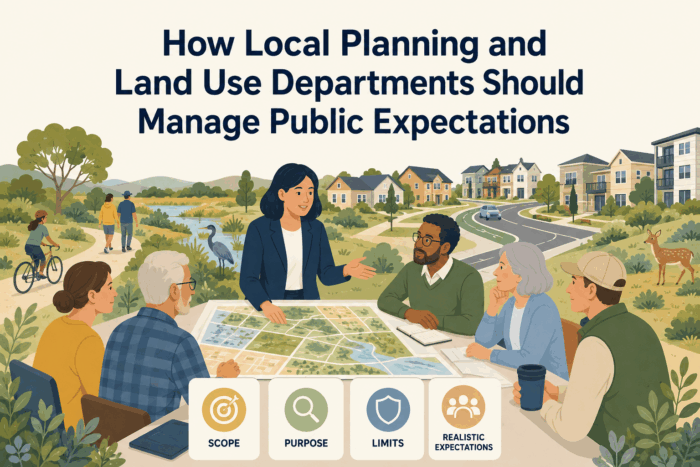
Navigating Environmental Review Communication: How Local Planning and Land Use Departments Should Manage Public Expectations
Environmental review is often one of the most visible and misunderstood parts of local planning and land use decision-making. Residents may encounter environmental review through notices, public hearings, draft documents, project websites, technical studies, or neighborhood meetings, but they may not understand how the review relates to zoning, development approval, infrastructure decisions, permitting, or the authority of other agencies. A proposed development can therefore generate expectations that the environmental review process will answer every question about whether the project should proceed, when in reality the process may be designed to evaluate environmental effects within a defined legal and procedural framework.
Local planning and land use departments sit at the center of this communication challenge because they are often the most accessible public-facing agency involved in a development proposal. Residents may direct questions to planners about traffic, schools, water supply, agricultural impacts, air quality, wildfire, neighborhood character, property values, environmental justice, infrastructure, and many other issues regardless of whether the department controls those matters directly. Project applicants may also expect staff to explain how environmental review affects schedules, redesign, mitigation, public participation, and eventual approval.
When departments do not explain the structure early, public expectations can become disconnected from what the process is actually capable of deciding. Some residents may assume that identifying a significant environmental impact automatically requires project denial. Others may believe that environmental review is merely a procedural formality because the project has already entered the planning process. Applicants may interpret requests for additional analysis as evidence that approval is moving farther away, while opponents may interpret technical review as evidence that the agency is trying to justify a project it has already decided to approve.
Effective communication should therefore begin by clarifying the role of environmental review within the larger land use process. Local planning and land use departments need to explain what is being analyzed, what decisions remain open, which findings can affect the project, how public input fits into the process, and which issues are controlled through separate authorities. The objective is not to reduce controversy around difficult development decisions. It is to prevent avoidable conflict caused by misunderstanding about what environmental review is, what it can change, and how it connects to the final land use decision.
Explain the Purpose of Environmental Review Before Explaining the Project
 Planning departments often begin public communication with the project description because it appears to be the most immediate information residents need. However, when a project is already controversial, audiences may interpret every environmental review document through the question of whether the agency supports or opposes the proposal. Local planning and land use departments should first explain the purpose of the environmental review process and then connect that process to the project under consideration.
Public-facing communication should explain that environmental review is designed to identify and evaluate environmental effects, consider applicable mitigation or alternatives, disclose information, and support decision-making under the governing framework. The exact legal requirements differ by jurisdiction and process, so departments should describe the review accurately without blending distinct state, federal, or local procedures together.
This explanation should also clarify that environmental review is not automatically synonymous with project approval or denial. A review may identify impacts that can be mitigated, impacts that remain significant, alternatives that reduce certain effects, or areas where additional analysis is required. The final land use outcome depends on the applicable decision framework and the authority of the responsible decision-maker.
Establishing this foundation helps residents interpret later technical findings more accurately. Instead of seeing every environmental conclusion as a direct statement about whether the project should be built, audiences can understand how the analysis informs a larger planning and decision process.
Clarify the Difference Between Environmental Review and Land Use Approval
One of the most persistent sources of confusion is the assumption that environmental review itself determines whether a project receives land use approval. In many cases, the review and the planning decision are connected but distinct. Local planning and land use departments should make that relationship visible from the beginning.
The department should identify which approvals are under consideration, such as zoning changes, conditional use permits, subdivision approvals, development agreements, variances, or other land use actions where applicable. It should then explain how environmental review informs those decisions rather than presenting the review as an independent yes-or-no vote on the project.
This distinction matters because the legal standards governing environmental analysis may differ from the policy standards governing the planning decision. A project may comply with zoning but still require environmental mitigation. A project may complete environmental review but still face a discretionary land use decision. Conversely, environmental review may identify significant effects without automatically requiring denial if the applicable framework allows the decision-maker to proceed under defined conditions.
Clear separation between these processes helps both applicants and communities understand where different arguments belong. Environmental analysis, land use compatibility, policy consistency, design, and community preference may all matter, but they may enter the decision through different legal and procedural pathways.
Explain Which Decisions Remain Open at Each Stage
Public frustration often grows when residents cannot tell whether the agency is still evaluating a project or has already moved into implementation. Local planning and land use departments should identify which decisions remain open at each major stage of review.
A draft environmental document may represent analysis that is still subject to comment and revision, while a staff recommendation may remain separate from the final decision of a planning commission, council, board, or other authority. Communication should distinguish those stages clearly so procedural progress is not mistaken for predetermined approval.
The same principle applies to applicants. Staff requests for additional analysis, revised project information, or mitigation development should not be interpreted as either a promise of approval or evidence of likely denial. The department should explain what the current review stage is designed to accomplish and what decision follows it.
From Fragmentation to Coordination: Communication Strategies for Councils of Governments, Metropolitan Planning Organizations, and Regional Planning Agencies
This case study is part of SCG’s series on communication for councils of governments, metropolitan planning organizations, and regional planning agencies. To learn more and to see the parent article, which links to other content just like this, click the button below.
Explain the Department’s Role Without Suggesting It Controls Every Environmental Issue
Local planning and land use departments may coordinate environmental review while relying on information, standards, or decisions from other agencies. Water supply, air quality, transportation infrastructure, hazardous materials, biological resources, public health, utilities, fire protection, and other issues may involve separate departments or regulatory authorities. Residents may nevertheless expect the planning department to resolve all of them because it is managing the development application.
The department should explain which environmental questions it is responsible for analyzing or coordinating and which require input or action from another agency. This distinction should be practical rather than organizational. Residents need to know who decides the issue, not simply which government office has a particular title.
Departments should also avoid presenting coordination as shared authority when the decision actually belongs elsewhere. Consulting with an air district, water agency, fire authority, transportation department, or environmental regulator does not necessarily mean the planning department can override that entity’s standards or decisions.
Clear role communication protects the department from becoming the assumed decision-maker for every issue surrounding a project. It also helps residents direct technical questions and concerns toward the agencies with the authority and expertise to address them.
Explain Environmental Significance Without Turning It Into a Simple Measure of Project Acceptability
Terms such as significant impact, less than significant, potentially significant, or significant and unavoidable can carry strong meaning for public audiences. Residents may interpret them as direct judgments about whether a project is safe, acceptable, environmentally responsible, or legally permissible. Local planning and land use departments should explain that significance findings operate within the environmental review framework and should not automatically be converted into broader conclusions.
A significance finding generally reflects the relationship between the identified environmental effect and the applicable analytical threshold, methodology, or regulatory standard. Public communication should explain what environmental question is being evaluated and why the finding matters to the review process. The department should avoid using phrases such as “no impact” when the actual conclusion is narrower.
This distinction becomes especially important when residents experience an issue differently from how it is categorized in the technical analysis. A traffic, noise, agricultural, air quality, or infrastructure effect may remain important to a community even when it does not meet the applicable significance threshold. The department should explain the formal finding without suggesting that community concern is therefore invalid.
Similarly, a significant finding should not be presented as proof that severe harm is certain or that the project must automatically be rejected. The communication should connect the finding to mitigation, alternatives, further analysis, or the decision framework that follows.
Explain Mitigation as a Project Obligation, Not a General Promise
Mitigation is one of the most consequential parts of environmental review because it can change project design, construction practices, monitoring, operations, or other aspects of implementation. Public audiences may hear that an impact will be “mitigated” without understanding what action is actually required or who will be responsible for carrying it out.
Local planning and land use departments should explain major mitigation measures in practical terms. Communication should identify what the measure requires, when it applies, which party is responsible, and how the obligation connects to the impact identified in the environmental analysis. This makes mitigation visible as an implementation requirement rather than an abstract assurance that concerns will be addressed later.
Departments should also distinguish mitigation from voluntary project features, staff recommendations, or unrelated development conditions. If a measure is formally tied to the environmental review process, that status should be clear. If another requirement arises through zoning, design review, infrastructure agreements, or a separate agency, the department should not present all conditions as though they originate from the same authority.
Clear mitigation communication helps residents evaluate whether the proposed response actually addresses the environmental issue they are concerned about. It also helps applicants understand that mitigation is not simply narrative language in an environmental document, but a responsibility that may continue into project implementation.
Explain Alternatives as Tradeoffs Rather Than Rankings
Environmental review may require analysis of alternatives to the proposed project, but public audiences often interpret the alternatives section as a ranking of which project the agency prefers. Local planning and land use departments should explain that alternatives are analytical tools used to examine whether different approaches could reduce or avoid certain environmental effects while meeting the applicable requirements of the review process.
An alternative may perform better on one environmental issue and worse on another. It may reduce development intensity, shift a location, modify access, preserve additional resources, or alter project design while creating different operational, infrastructure, or policy implications. Communication should make those tradeoffs visible rather than reducing the analysis to a simple “better” or “worse” comparison.
Departments should also distinguish an environmentally preferable or reduced-impact alternative from the alternative that may ultimately be selected through the land use decision. Environmental analysis informs the decision, but the final choice may also involve planning policy, feasibility, legal requirements, project objectives, and other considerations permitted under the applicable framework.
Explaining alternatives this way helps manage expectations on all sides. Project opponents are less likely to assume that identification of a lower-impact alternative guarantees its selection, while applicants are less likely to treat alternatives analysis as evidence that the agency has rejected the proposed project before the review is complete.
Explain the Review Timeline Without Making It Sound More Predictable Than It Is
Environmental review timelines are often difficult to communicate because they involve technical analysis, applicant revisions, agency coordination, public comment, staff review, and decision-making processes that may not unfold on a perfectly fixed schedule. Local planning and land use departments should provide enough structure for residents and applicants to understand what happens next while avoiding dates that imply more certainty than the process can support.
Public-facing timelines should focus on major milestones rather than attempting to predict every internal step. These may include application review, environmental document preparation, public release, comment periods, hearings, document revisions, staff recommendations, and final decision points. When dates are tentative, the department should say so and explain what factors could affect the schedule.
Applicants need the same clarity. A target date for environmental review completion should not be interpreted as a guarantee of entitlement approval, and a schedule extension should not automatically be communicated as evidence that the project is in trouble. The department should distinguish procedural timing from substantive project status.
Consistent timeline communication also helps manage expectations when schedules change. Rather than simply posting a new date, departments should explain what changed, what milestone moved, and whether the adjustment affects public participation or the expected decision sequence.
Explain Public Comment as Input Into the Review, Not a Vote on the Project
Environmental review comment periods can generate significant participation, particularly for controversial development proposals. Residents may assume that the number of comments for or against a project determines the environmental review outcome, while applicants may interpret large opposition campaigns as political pressure unrelated to the technical process. Local planning and land use departments should explain how comments are actually used.
Public-facing guidance should identify the kinds of information that can contribute to environmental review. Depending on the applicable process, comments may identify local conditions, question assumptions, raise concerns about environmental analysis, address mitigation or alternatives, provide technical information, or identify issues the commenter believes require further consideration. The department should tailor this guidance to the actual review framework rather than use generic participation language.
The department should also explain that public comment is not necessarily a referendum on project approval. Statements of support or opposition can be part of the public record, but the environmental review process evaluates substantive environmental issues under the applicable standards. The separate land use decision may involve additional policy and planning considerations.
This distinction does not diminish public participation. It helps residents understand how to make their comments more useful and reduces frustration when a large volume of opposition does not automatically result in project denial or when strong support does not eliminate the need for environmental analysis.
Communicate Technical Studies Through Practical Community Questions
Environmental review documents may rely on traffic analyses, air quality studies, biological surveys, noise assessments, water supply information, geotechnical studies, wildfire analysis, agricultural evaluations, or other technical material. Residents often approach these documents through practical questions rather than through the technical disciplines in which they are organized.
Local planning and land use departments should translate major studies by explaining what question each analysis was designed to answer. A traffic analysis should be connected to the relevant transportation issue, a biological study to the resources being evaluated, and a noise analysis to the locations, activities, and time periods it examines. This allows residents to understand why the study exists before they encounter its methodology.
Communication should also identify important limitations. A study may evaluate a defined geographic area, use specified assumptions, examine a particular project scenario, or rely on available data from a specific period. Those boundaries can materially affect what the results mean and should not be left entirely to technical appendices.
The objective is not to summarize every study exhaustively. It is to give residents enough orientation to determine which technical materials are relevant to their concern and how those materials fit into the larger environmental review.
Explain Baseline Conditions Before Discussing Project-Related Change
Residents often evaluate development proposals against the conditions they believe a community should have, while environmental analysis may compare project effects against an established baseline or existing condition defined under the applicable review framework. When this distinction is not explained, technical findings can appear disconnected from lived experience.
Local planning and land use departments should describe the relevant baseline before discussing the project’s incremental effect. If traffic congestion, noise, air quality concerns, water limitations, agricultural conflicts, or other conditions already exist, the department should explain how those existing conditions are treated in the analysis and how the project-related change is evaluated against them.
This explanation should not be used to dismiss existing problems. A conclusion that a project adds a limited incremental effect does not mean the underlying condition is unimportant. It means the environmental review is answering a particular analytical question about what changes because of the project.
Clear baseline communication helps residents distinguish between the broader condition they experience and the portion of that condition attributable to the proposal under review. That distinction supports more accurate discussion of both project impacts and existing community concerns.
Separate Existing Problems From New Project Effects
Existing environmental or infrastructure problems can dominate public discussion of a proposed development. Residents may reasonably ask why additional development should proceed when roads are already congested, water resources are constrained, or nearby neighborhoods already experience noise or other burdens.
The department should acknowledge those conditions while explaining how environmental review distinguishes existing circumstances from changes attributable to the project. This prevents a technical baseline from sounding like an argument that existing problems do not matter.
Where broader conditions are addressed through capital planning, policy updates, separate regulatory programs, or other governmental processes, the department can identify those pathways without implying that environmental review will resolve issues outside its scope.
Explain Project Revisions as Part of Review Without Suggesting the Original Analysis Was Meaningless
Development proposals often change during environmental review. Applicants may modify site plans, reduce project intensity, change access, revise infrastructure, preserve additional resources, or adopt design changes in response to technical findings, staff review, public input, or other considerations. These revisions can create confusion if the public has been following an earlier version of the proposal.
Local planning and land use departments should make material project changes visible and explain why updated analysis may be necessary. A revised project should not be communicated as though it is still identical to the version originally circulated, particularly when the changes affect environmental impacts, mitigation, alternatives, or public understanding.
At the same time, departments should avoid implying that revisions prove the earlier analysis was invalid. Environmental review is often iterative, and information developed during the process can lead to project modifications. The important communication question is whether the current analysis reflects the current proposal.
Clear revision summaries can help communities follow that evolution. Residents should be able to identify what changed, whether the change affects major environmental findings, and which documents now represent the current project under review.
Clarify How Staff Recommendations Relate to the Final Decision
Local planning staff may prepare recommendations after environmental review is completed or reaches a major milestone, but those recommendations are not always the final decision. Planning commissions, hearing officers, councils, boards, or other authorities may retain decision-making responsibility depending on the local process.
Departments should explain this distinction before releasing a staff recommendation. Residents should understand whether staff are advising approval, denial, modification, or another action and which decision-maker will ultimately consider that recommendation. Applicants should likewise understand that favorable staff analysis does not necessarily guarantee final approval.
Communication should also identify how environmental findings connect to the staff recommendation. The recommendation may reflect environmental analysis alongside zoning, general plan consistency, design standards, policy considerations, or other land use criteria. Presenting these components clearly helps audiences avoid treating the environmental document as the sole basis for the recommendation.
This clarity is especially important when the final decision differs from staff’s recommendation. If the institutional roles were clear from the beginning, a different outcome is less likely to appear as though the planning department unexpectedly reversed itself.
Communicate Unresolved Issues Without Turning Uncertainty Into a Prediction
Environmental review can leave questions unresolved while analysis is still underway. Additional studies may be needed, agencies may be reviewing technical information, project revisions may not yet be complete, or mitigation may still be under development. Stakeholders often pressure planning departments to predict what these unresolved issues will mean for the project.
Local planning and land use departments should distinguish known information from questions still under review. If a study has not been completed or a technical issue has not been resolved, staff should say so rather than speculate about the likely finding. This protects the credibility of later communication if the evidence develops differently.
The same discipline applies to project outcomes. Staff should avoid suggesting that an unresolved impact will necessarily result in denial or that a mitigation concept will definitely allow approval before the required analysis is complete. Preliminary discussion should be labeled accordingly.
Transparent uncertainty can improve trust because it shows that the department is not pretending to know more than the record supports. Residents and applicants can follow the process as evidence develops without interpreting every interim statement as a final conclusion.
Organize Public Communication Around the Decisions People Are Actually Trying to Understand
 Environmental review materials are usually organized around technical disciplines and procedural requirements, while residents tend to follow a project through more practical questions. They want to know what is changing, which impacts are most significant, whether the project can still be modified, what mitigation will actually require, and who makes the final decision. Local planning and land use departments should organize public-facing communication around these questions while keeping the formal environmental record fully accessible.
This approach can help departments avoid overwhelming residents with document structure before they understand the decision context. A public summary can identify the project, current review stage, major environmental issues, significant project revisions, mitigation commitments, and upcoming opportunities for participation. Readers who need more detail can then move into the technical analyses that support those explanations.
Question-based communication is especially useful when public concern is concentrated around a few issues such as traffic, wildfire, agricultural compatibility, water supply, biological resources, or construction impacts. Departments can provide issue-specific explanations that connect those concerns to the environmental analysis without implying that less visible topics are unimportant.
The objective is to make the process easier to navigate, not to replace the technical review with simplified talking points. Public communication should help residents understand where their questions appear in the record and how those questions connect to actual planning and environmental decisions.
Explain What Changes When New Information Enters the Review
Environmental review is rarely static. New technical information, agency comments, public input, revised project plans, or updated assumptions may change the analysis while the review is underway. Local planning and land use departments should explain how new information affects the process so stakeholders do not assume that every revision signals either failure or manipulation.
When a material change occurs, communication should identify what changed, why the information matters, and whether the change affects a major environmental conclusion, mitigation measure, alternative, or project feature. Departments should distinguish between substantive revisions and routine technical refinement so residents can understand the significance of the update.
The same principle applies when new information does not alter the conclusion. A study may be expanded, a methodology clarified, or additional data added without changing the overall finding. Explaining that distinction prevents stakeholders from assuming that any revision proves the earlier analysis was unreliable.
Clear change communication also helps applicants. Project teams can see how new requirements or findings fit into the review rather than interpreting every revision request as an unpredictable shift in agency expectations.
Explain How Environmental Review Findings Influence Project Design
Environmental review can affect a project before the final decision through changes to site layout, operational practices, infrastructure, construction methods, resource protection, or other design features. Local planning and land use departments should make these connections visible so the public can see that environmental analysis is not simply a document produced after the project is already fixed.
When a project changes in response to identified impacts, departments should explain the relationship clearly. A revised access point, reduced development footprint, additional buffer, altered construction practice, or other modification may reflect technical findings, mitigation development, agency coordination, public input, or several influences at once. Communication should avoid overstating one source of change unless the record supports it.
This visibility helps manage competing expectations. Residents can see where environmental review has shaped the proposal, while applicants can understand that revisions are part of a structured review process rather than evidence that the agency is continuously changing the rules.
Departments should also distinguish project design changes from formal mitigation. Both may reduce environmental effects, but they can carry different procedural and implementation implications. Preserving that distinction makes the final project and its obligations easier to understand.
Show What Changed Without Reconstructing the Entire Project History
A project may go through several versions before the environmental review is complete. Asking residents to compare multiple plan sets and technical documents places too much burden on the public and increases the likelihood that outdated project information continues circulating.
Local planning and land use departments should provide concise summaries of material changes at major review milestones. The summary should focus on modifications that affect environmental impacts, project intensity, site configuration, infrastructure, mitigation, or another issue central to public understanding.
This allows the public to follow the evolution of the proposal without turning every update into a complete restatement of the project record.
Explain Geographic Impacts Without Suggesting Every Area Is Affected Equally
Environmental effects are often spatially specific. Noise may affect properties near construction activity, traffic changes may concentrate at particular intersections, biological impacts may occur in defined habitat areas, and wildfire or drainage concerns may vary substantially across a site. Public communication should reflect these geographic distinctions.
Local planning and land use departments can use maps, location-based explanations, and neighborhood-specific context to show where major effects are expected. These tools should be designed to clarify the analysis rather than create the impression that every resident within a broad project area experiences the same level or type of impact.
Geographic communication should also distinguish between project boundaries, study areas, impact areas, and jurisdictional boundaries where those differences matter. Residents may assume that a study area indicates the full extent of a confirmed impact when it may simply define where analysis was conducted.
Clear spatial explanation helps residents determine which parts of the environmental record are most relevant to them while reducing overgeneralization about who is affected and how.
Explain Cumulative Effects Without Making One Project Responsible for Every Existing Problem
Residents often evaluate new development within the context of prior growth, existing congestion, water constraints, habitat loss, agricultural conversion, wildfire exposure, or other cumulative pressures. Environmental review may address cumulative effects through a defined analytical framework, but public audiences can interpret the concept more broadly as the total burden of development they have experienced over time.
Local planning and land use departments should explain how cumulative analysis works within the applicable review process while acknowledging the broader concern that often motivates public questions. The communication should distinguish the project contribution from existing and reasonably considered related conditions without suggesting that only the incremental effect matters to the community.
Departments should avoid implying that the proposed project caused every existing problem simply because cumulative effects are analyzed. They should also avoid using the presence of other contributors as a reason to dismiss the project’s own role. The most credible explanation identifies what the current review can establish about the project’s contribution and how that contribution fits within the broader condition.
This distinction is particularly important when community frustration has developed over several projects rather than one proposal. Environmental review communication should explain the current decision accurately while recognizing that residents may be responding to a longer development history.
Prepare Staff to Explain Technical Findings Without Turning Public Meetings Into Technical Lectures
Planning staff, environmental consultants, engineers, and other specialists may be asked to explain complex findings during public meetings or hearings. Their expertise is necessary, but answers can become difficult to follow when staff begin with methodology rather than the public question being asked.
Local planning and land use departments should prepare staff with a shared plain-language explanation of the major environmental findings, assumptions, mitigation measures, alternatives, unresolved issues, and procedural status. Technical staff can then provide deeper detail when needed without losing the connection to the decision residents are trying to understand.
Staff should also be prepared to distinguish between conclusions supported by the record and questions that remain open. Statements that sound more certain than the analysis can create problems later if the project changes or additional information produces a different result.
A well-prepared technical team does not need to oversimplify the analysis. It needs to explain the analysis in an order that makes sense to nontechnical audiences and remains consistent across meetings, written materials, and project webpages.
Correct Misunderstandings Without Treating Opposition as Misinformation
Controversial development proposals can produce factual errors, incomplete claims, policy disagreement, and legitimate differences in interpretation at the same time. Local planning and land use departments should distinguish among these categories rather than treating all criticism as misinformation.
When the public record clearly establishes a factual point, the department can correct inaccurate statements about project size, environmental findings, process status, mitigation, or agency authority. Corrections should remain factual and should point audiences toward the current record without characterizing the motives of the person or organization making the claim.
Policy disagreement should be handled differently. Residents may understand the technical findings and still believe the project is inconsistent with community priorities, development patterns, agricultural preservation, infrastructure capacity, or another planning value. Those disagreements should not be described as misunderstandings simply because they extend beyond the environmental analysis.
Maintaining this distinction protects the department’s credibility. Staff remain authoritative about what the review says while recognizing that stakeholders can understand the analysis and still disagree about the broader land use decision.
Keep Environmental Review Communication Connected to the Upcoming Decision
As the environmental review progresses, public communication should increasingly help residents understand how the analysis connects to the decision that will follow. Technical findings, mitigation, alternatives, project revisions, and public comments should not remain isolated pieces of information with no clear relationship to the planning process.
Local planning and land use departments should explain what decision-maker will consider the environmental record, what additional land use findings or policy questions may apply, and what major procedural steps remain. This helps residents understand when environmental review is complete and when the broader land use decision begins.
The department should also avoid suggesting that completion of environmental review itself determines the final outcome. Environmental review informs the decision, but the decision-maker may still need to consider other legally relevant planning criteria within the applicable framework.
Connecting the review to the next decision point creates continuity. Residents can see how the environmental analysis moves from technical study to public participation to final planning judgment without assuming that any one stage independently determines the project outcome.
Build Environmental Review Communication Into Project Management
Environmental review communication is most effective when it is planned alongside technical analysis, applicant coordination, agency review, and public participation rather than added shortly before a document release or hearing. Local planning and land use departments should identify major communication needs when the environmental review schedule is established so that public-facing information remains aligned with the project as it evolves.
Planning should identify when residents need explanations of the project description, technical studies, significant findings, alternatives, mitigation, public comment opportunities, and decision milestones. Departments should also anticipate when project revisions or new technical information may require updated public materials. This reduces the likelihood that outdated summaries remain in circulation while the formal environmental record moves forward.
Internal responsibilities should be clear as well. Planning staff, environmental consultants, technical specialists, legal staff, public information officers, and community engagement personnel may all contribute to the public explanation. A defined review process helps ensure that those materials remain accurate without becoming unnecessarily technical or delayed by unclear ownership.
Integrating communication into project management creates continuity. Residents and applicants are more likely to experience environmental review as one connected process rather than a sequence of isolated notices, reports, and hearings that appear without enough explanation of how they relate.
Create a Single Authoritative Source for Current Project Information
Environmental review information can become fragmented across planning portals, environmental documents, hearing notices, technical appendices, applicant webpages, meeting agendas, and archived materials. Residents may encounter several versions of the same project and struggle to determine which information represents the current proposal.
Local planning and land use departments should maintain one authoritative project page or equivalent source that identifies the current project description, environmental review status, major documents, public participation opportunities, decision schedule, and staff contacts. Draft, revised, and final materials should be labeled clearly so users can distinguish current information from historical documents.
The public-facing source should also connect accessible summaries with the formal record. Residents reading about mitigation, alternatives, traffic, water supply, biological resources, or another major issue should be able to move directly to the supporting technical material if they want greater detail.
A reliable source benefits more than residents. Elected officials, commissioners, media outlets, applicants, partner agencies, and staff can all reference the same current information, reducing the likelihood that conflicting project descriptions or outdated procedural information circulate simultaneously.
Maintain Version Control as the Project and Analysis Evolve
Environmental review frequently involves multiple project versions, revised technical studies, updated mitigation, and changes responding to agency or public input. Without clear version control, residents may continue discussing an earlier project configuration after the applicant has materially changed the proposal.
Local planning and land use departments should distinguish current documents from superseded materials across project webpages, meeting packets, summaries, and technical appendices. Historical records may remain important for transparency, but they should not appear to represent the current project under analysis.
When a significant revision occurs, the department should provide a concise explanation of what changed and whether the revision affects major environmental findings, mitigation measures, alternatives, or the project schedule. This is more useful than simply posting a new document and expecting residents to identify the differences themselves.
Version control also supports fairness to applicants and communities. Everyone evaluates the same current proposal, and disagreements are less likely to be driven by outdated plans or analyses that no longer govern the review.
Label Procedural Status as Clearly as Document Status
Confusion can arise not only from multiple project versions but also from uncertainty about where a document sits in the review process. A draft analysis, revised draft, final environmental document, staff recommendation, and adopted decision do not carry the same procedural meaning.
Local planning and land use departments should label these stages consistently across public-facing materials. Residents should be able to determine whether a document is open for comment, has been revised, is awaiting a hearing, or represents the completed record.
Clear procedural labeling helps prevent draft conclusions from being treated as final and reduces the perception that later revisions represent unexplained reversals.
Coordinate Environmental Review Communication Across Agencies Without Blurring Authority
Complex development proposals often involve agencies responsible for water, air quality, transportation, fire protection, utilities, biological resources, hazardous materials, or other issues. Local planning and land use departments may coordinate the overall review while relying on these agencies for technical information, standards, or separate regulatory decisions.
Departments should coordinate core factual information where appropriate, including project descriptions, review schedules, study assumptions, and major agency roles. At the same time, public communication should identify clearly which entity controls each decision. Coordination should make the process easier to understand, not create the impression that all participating agencies share the same authority.
This distinction is particularly important when residents ask the planning department to resolve an issue governed by another regulator. Staff should explain how that agency’s input connects to environmental review and whether a separate permit, approval, or regulatory process remains necessary.
Clear interagency communication also reduces contradictory public statements. When agencies understand the same project facts and procedural status, communities are less likely to receive conflicting explanations that undermine confidence in the broader review process.
Prepare Communication for High-Conflict Environmental Reviews
Some projects generate substantial conflict because of location, scale, environmental concerns, prior development history, political attention, or distrust of the applicant or agency. Local planning and land use departments should identify these conditions early enough to prepare communication before public controversy becomes the primary source of project information.
Preparation can include issue-specific summaries, staff talking points, meeting materials, translated information, media guidance, project FAQs, and clear explanations of decision authority. These tools should remain grounded in the environmental record and should not advocate for approval or denial while the decision remains open.
Departments should also anticipate the issues most likely to be misunderstood. Residents may assume that a draft finding represents final approval, that mitigation eliminates every effect, or that the planning department can override another regulator. Addressing these questions before major hearings can reduce confusion even when disagreement remains intense.
Prepared communication also helps staff remain consistent under pressure. Technical specialists can focus on explaining their analysis while designated communicators maintain the broader process narrative and ensure that public information remains current.
Connect Environmental Review Completion to Implementation and Monitoring
Public attention often declines after a project is approved, but many of the commitments established through environmental review become relevant only during construction or operation. Local planning and land use departments should explain how mitigation, monitoring, reporting, or other continuing obligations will be carried into implementation.
Residents should understand who is responsible for specific mitigation measures, which department or agency monitors compliance, and how concerns about implementation can be reported. If oversight shifts to another department after approval, the handoff should be visible rather than leaving residents to assume the planning department retains responsibility for every condition.
The department should also distinguish environmental mitigation from other project conditions. Zoning conditions, infrastructure agreements, building requirements, and separate regulatory permits may all affect implementation, but they may have different monitoring and enforcement pathways.
Clear post-approval communication strengthens accountability because residents can follow significant commitments beyond the environmental document itself. It also helps applicants understand which obligations continue after the planning decision is complete.
Measure Whether Environmental Review Communication Is Improving Public Understanding
Local planning and land use departments should evaluate whether communication helps residents understand the review process, not simply whether notices, webpages, meetings, or summaries were produced. Output measures are useful, but they do not show whether public expectations are becoming more accurate.
Useful indicators may include recurring questions about whether the project has already been approved, confusion between environmental review and land use decisions, misunderstanding of mitigation, reliance on outdated project information, or uncertainty about which agency controls a particular issue. These patterns can reveal where public materials need additional context.
Departments can also examine whether public comments become more focused as explanatory materials improve and whether staff spend less time correcting basic procedural misconceptions. Community organizations, commissioners, and partner agencies may provide additional insight into which parts of the process remain difficult to navigate.
The purpose of measurement is continuous improvement. When the same misunderstandings appear across multiple projects, departments can improve standard project-page structures, meeting formats, staff guidance, timeline explanations, and environmental review summaries rather than treating each conflict as unique.
Build Institutional Knowledge That Survives Individual Projects and Staff Changes
Environmental review knowledge can become highly project-specific, particularly when one planner or consultant manages a complicated proposal over several years. Local planning and land use departments should preserve communication practices and lessons so that future projects do not repeat the same avoidable misunderstandings.
Institutional resources can include environmental review explanation templates, project status language, document labeling standards, public meeting guidance, agency role descriptions, mitigation communication frameworks, version-control practices, and lessons from high-conflict projects. These tools should provide structure without replacing project-specific analysis.
Departments should also document recurring community questions. If residents repeatedly misunderstand alternatives, significance findings, project revisions, or decision authority, those topics should receive stronger explanation at the beginning of future reviews.
Strong institutional knowledge improves consistency across projects and staff transitions. It helps local planning and land use departments manage expectations through a durable communication system rather than relying primarily on the experience of individual planners.
Strategic Communication Support for Environmental Review and Land Use Processes
 Environmental review communication can become difficult when local planning and land use departments are managing complex technical studies, applicant coordination, public hearings, project revisions, agency input, and community expectations at the same time. Internal staff may understand how environmental review, land use approval, mitigation, alternatives, and agency jurisdiction fit together, while residents experience those elements as one confusing development process. External strategic communication support can help departments organize that complexity into a clearer public information system without altering the underlying environmental analysis or decision-making authority.
Stegmeier Consulting Group (SCG) can support local planning and land use departments by developing plain-language project summaries, environmental review explainers, public participation guidance, project webpages, meeting presentations, staff talking points, agency-role summaries, multilingual outreach, project-change summaries, mitigation communication, and communication plans for high-interest or controversial developments. SCG can also help departments align information across planners, consultants, technical specialists, partner agencies, elected officials, and public-facing channels so that the project description, review status, decision authority, and major environmental findings remain consistent.
External support can be especially valuable when internal capacity is limited, a project generates sustained public scrutiny, or an objective outside perspective can identify where technically accurate explanations are creating unrealistic expectations about what environmental review can accomplish. SCG’s role remains focused on communication strategy, information organization, stakeholder engagement, and public-facing content. SCG does not conduct environmental analysis, make significance determinations, select mitigation, determine project compliance, provide legal findings, or make land use approval decisions on behalf of the responsible agency.
Future Trends
Environmental review communication will increasingly need to operate in a digital environment where residents expect project information to be current, searchable, visually understandable, and easy to compare over time. Long environmental documents will remain important to the formal record, but public audiences will increasingly expect complementary project summaries, issue-specific explanations, map-based information, clear timelines, and visible descriptions of what has changed between project versions.
Local planning and land use departments may also face stronger expectations for transparency across the full development lifecycle. Residents will increasingly want to understand how concerns raised during environmental review translate into project revisions, mitigation measures, approval conditions, construction requirements, and post-approval monitoring. Departments that provide clear continuity across these stages will be better positioned to show how the review influenced implementation.
Interagency coordination will become more important as development proposals intersect with water supply, wildfire, air quality, transportation, habitat, infrastructure, climate adaptation, and other regulatory issues. Planning departments will need stronger communication systems for showing how these authorities relate without implying that the local land use process controls every environmental decision associated with the project.
Technology can improve document navigation, public access, translation, and project visualization, but it will not remove the need for careful professional judgment. Departments will still need to determine which findings require additional explanation, how uncertainty should be communicated, when a project revision is material to public understanding, and how to distinguish environmental analysis from the policy judgments involved in the final land use decision.
Conclusion
Environmental review becomes difficult for communities to navigate when technical analysis, project approval, public participation, mitigation, and agency authority are presented as though they are one undifferentiated process. Local planning and land use departments can manage public expectations more effectively by explaining how these pieces relate from the beginning.
Residents need to understand what environmental review evaluates, what decisions remain open, how significance findings and mitigation affect the project, and which issues belong to separate agencies or land use processes. Applicants need the same clarity so that technical review, project revisions, and schedule changes are not interpreted as informal signals about whether approval is guaranteed or unlikely.
The strongest communication systems also remain current as the project changes. They distinguish draft from final information, explain material revisions, connect public input to the review where the record supports that connection, and show how environmental commitments carry forward after approval. This continuity helps stakeholders evaluate the current project rather than relying on outdated versions or fragmented information.
Local planning and land use departments cannot eliminate disagreement around development through communication alone. They can reduce avoidable conflict by making the process, authority, evidence, and decision sequence easier to understand. When communication is treated as part of environmental review infrastructure, departments are better positioned to maintain public confidence even when stakeholders continue to disagree strongly about the project itself.
Stegmeier Consulting Group’s Strategic Approach to Communication Systems
Make environmental review easier to follow by connecting technical analysis, project changes, public participation, and land use decisions in one clear communication system.
Local planning and land use departments need communication systems that help residents, applicants, elected officials, and partner agencies understand what environmental review evaluates, which decisions remain open, how mitigation and alternatives affect the project, and where separate regulatory authorities fit into the process. Stegmeier Consulting Group (SCG) helps departments organize complex project information, develop plain-language materials, strengthen staff and public-facing messaging, improve digital navigation, and build communication frameworks that keep expectations aligned with the actual environmental review and land use decision process.
Use the form below to connect with our team and explore how strategic communication support can strengthen environmental review communication and public understanding.