
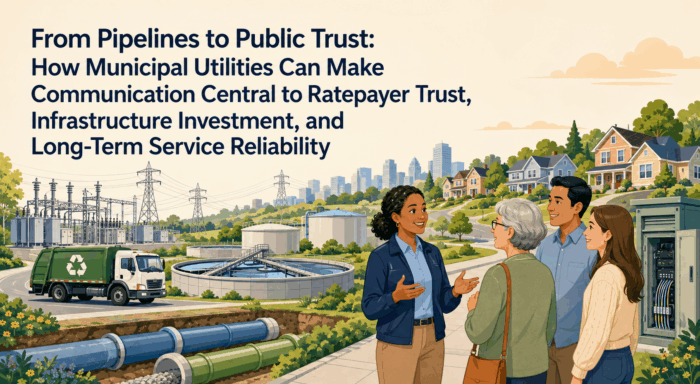
From Pipelines to Public Trust: How Municipal Utilities Can Make Communication Central to Ratepayer Trust, Infrastructure Investment, and Long-Term Service Reliability
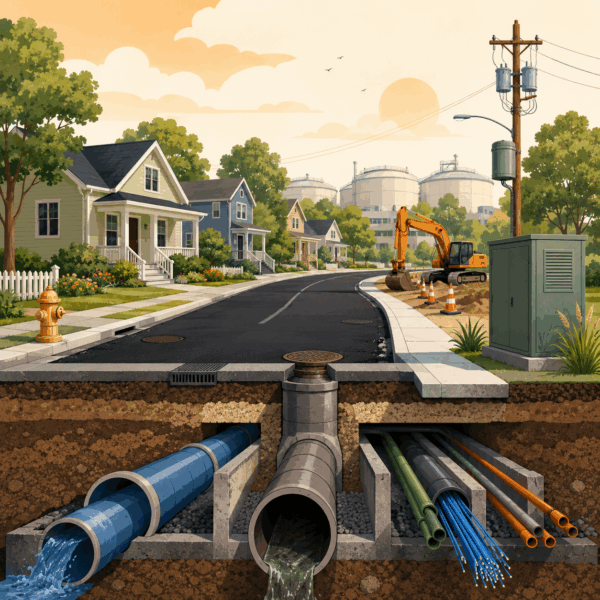 Municipal utilities and public works departments deliver something that most residents never think about until it is gone. The power that keeps the lights on, the sewer system that removes waste before it becomes a public health crisis, the garbage truck that arrives every Tuesday, the broadband connection that links a household to work and school and community, the water mains running beneath streets that were laid before most residents were born. These systems are invisible when they work. When they fail, they become the most urgent thing in a resident’s day.
That invisibility is the defining communication challenge for public utilities. Agencies that only communicate when something goes wrong, when rates rise, when service fails, when a spill event requires public health guidance, are agencies that have no reservoir of public trust to draw on when a crisis demands it. The utilities that communicate most effectively are those that have built ongoing relationships with ratepayers, elected officials, and community partners long before any disruption requires it.
Communication is not just a public affairs function layered on top of utility operations. It is the mechanism by which rate investments are understood and accepted, by which infrastructure projects maintain community support through years of construction and disruption, by which emergency events are managed without panic, and by which the long-term capital commitments that sustain utility systems are justified to the public that funds them. A utility that explains a rate increase badly does not just face a public relations problem. It faces a governance problem, a political problem, and often a legal problem, as ratepayer opposition becomes organized and formal.
The audience for public utility communication is also more difficult than most agency communication contexts because ratepayers are not voluntary customers. They cannot switch providers. They have no alternative to the sewer system, the solid waste collection route, or the electrical grid. This captive relationship creates both an obligation and a vulnerability: an obligation to communicate clearly and honestly because ratepayers have no other source of information about the system that serves them, and a vulnerability because trust, once damaged, is very difficult to rebuild when the customer has nowhere else to go.
This content hub provides a practical framework for building stronger public utility communication across energy providers, waste management departments, wastewater and sewer agencies, stormwater utilities, broadband authorities, public works departments, and port authorities. Every article addresses a real communication challenge these agencies face and offers actionable guidance grounded in the operational realities of public utility governance. The goal is communication that works for urban utility systems serving millions of ratepayers, mid-sized municipal utilities serving a single county, rural electric cooperatives serving dispersed agricultural communities, and regional solid waste authorities managing complex intergovernmental service agreements.
Who This Content Hub Is For
This content hub is designed for communication staff, program managers, utility directors, and agency leadership at the full range of public utility and infrastructure agency types.
Municipal energy providers and public power authorities bear responsibility for electricity generation, distribution, and retail service to residential, commercial, and industrial customers. Their communication obligations span outage notification, rate case proceedings, clean energy transition programs, energy efficiency outreach, and sustained engagement with elected officials and community partners who shape the political environment in which utility decisions are made.
Solid waste, recycling, and garbage collection departments manage collection services, recycling and composting programs, hazardous waste disposal, transfer station and landfill operations, and the public education programs that determine whether diversion goals are met or missed. Their communication challenges are as operational as any in public service: a missed collection notification generates more constituent complaints than almost any other local government communication failure.
Wastewater and sewer agencies operate treatment plants and collection systems that are essential to public health but almost entirely invisible to the residents who depend on them. Their communication obligations are concentrated around infrastructure investment, rate increases, service disruptions, and environmental compliance, with the additional complexity that their most consequential failures, spills and system failures, are public health events requiring rapid, coordinated communication with multiple agencies simultaneously.
Stormwater utilities occupy an unusual regulatory and communication position. They are required by federal MS4 permit obligations to conduct public education and outreach as a condition of their operating permit, making communication a regulatory requirement rather than an optional program enhancement. Their audiences include both the general public, whose behavior directly affects stormwater quality, and commercial and industrial operators who are themselves regulated parties under the same permit framework.
Municipal broadband and telecom authorities represent a newer and rapidly growing utility type whose communication challenges are compounded by political controversy, incumbent provider opposition, and the technical complexity of explaining network infrastructure to a general audience that has strong service expectations but limited understanding of how broadband networks are built and operated.
Public works departments are the operational backbone behind much of what residents experience as public infrastructure: roads, bridges, sidewalks, right-of-way projects, capital improvement programs, and the visible disruption of construction that affects businesses, residents, and commuters every day. Their communication challenges are among the most immediate and consequential in local government.
How to Use This Public Utilities and Infrastructure Communications Hub
Public utility agencies communicate with ratepayers, elected officials, regulatory bodies, community organizations, and the media across a wide range of operational contexts, from routine service notifications to crisis communication during major disruptions. This hub provides a central resource for all of those contexts, organized to help agencies find the guidance most relevant to their immediate challenge without requiring familiarity with the full content portfolio.
The sections below provide a broad framework for understanding public utility and infrastructure communication. They address the audiences agencies need to reach, the operational and policy decisions they need to explain, the situations in which communication most often becomes difficult, and the systems agencies can use to improve clarity, consistency, transparency, and public trust. Agencies can use this hub to evaluate and strengthen communication related to rates and cost increases, infrastructure investment, service disruptions, emergency response, energy and utility programs, waste and recycling services, wastewater and stormwater operations, broadband and public works initiatives, and other public-facing responsibilities.
Agencies can begin with the guidance most directly related to the communication challenge they are facing, whether that involves explaining a rate change, communicating during an outage or service disruption, introducing a new public program, engaging communities around infrastructure investment, or reporting on agency performance. The broader guidance throughout the hub can also help agencies build stronger communication systems that support routine operations, long-term planning, public engagement, crisis readiness, and accountability.
Our Comprehensive Guide to Public Communications for State and Local Government Agencies
This article is part of our series on strategic communication for state and local government agencies. To learn more and to see the parent article, which links to other content just like this, click the button below.
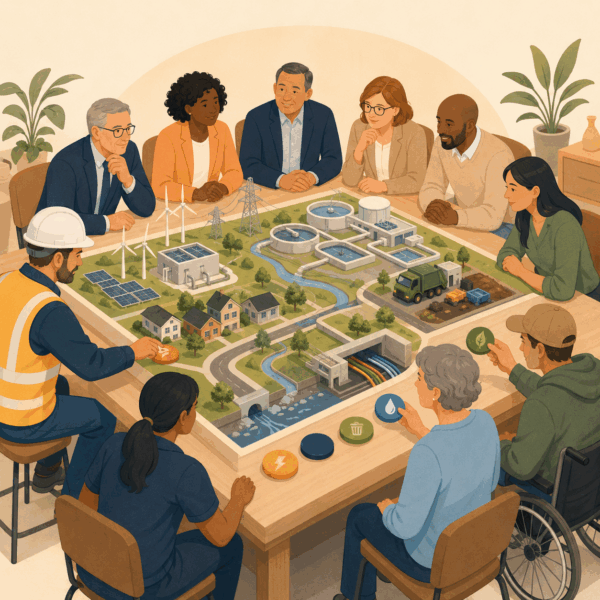
How Public Utilities Operate Across a Fragmented Service Landscape
Public utilities in the United States are not a single system. They are a fragmented collection of agency types, ownership structures, service territories, and regulatory frameworks that vary enormously by state, region, and community. Understanding who these agencies actually are matters before addressing how they should communicate.
Municipal Energy Providers and Public Power Authorities
Publicly owned electric utilities serve approximately 14 percent of electricity customers in the United States through more than 2,000 municipal utilities, public power districts, and state and regional authorities. Unlike investor-owned utilities regulated by state public utility commissions, public power entities are governed by elected or appointed boards that are directly accountable to the communities they serve. This governance structure gives public power utilities greater communication flexibility than their investor-owned counterparts, but it also means that communication failures have more immediate political consequences because the governing board is a local body rather than a distant corporate entity.
Public power utilities range from large regional authorities serving multiple states to small municipal departments serving a few thousand customers. Their communication obligations are similarly varied, but the core challenges are consistent: communicating service reliability and investment need in terms ratepayers understand, managing the political dimensions of rate increases, and building the sustained community relationships that make long-term capital investment politically viable.
Solid Waste, Recycling, and Garbage Collection Departments
Solid waste collection is among the most operationally visible of all public utility services. Residents interact with garbage and recycling collection weekly, and the consequences of communication failures are immediate and tangible: a missed collection notice generates a street full of uncollected garbage and a wave of constituent complaints. Solid waste agencies communicate about collection schedules, service changes, recycling and composting programs, hazardous waste disposal, and the long-term environmental management of transfer stations and landfills. Their audiences range from individual residential customers to commercial and industrial generators operating under separate regulatory frameworks.
The vocabulary of solid waste communication is itself contested. Residents use terms like garbage, trash, and refuse while agency staff and regulatory documents use solid waste, municipal solid waste, and waste stream. Recycling communication involves a constantly evolving set of acceptable materials, changing market conditions for recyclable commodities, and persistent contamination challenges that make public education a continuous operational requirement rather than a one-time campaign.
Wastewater and Sewer Agencies
Wastewater agencies operate infrastructure that is essential, invisible, and deeply unsexy. Treatment plants, collection systems, pump stations, and combined sewer overflows are not infrastructure that residents think about, fund raising campaigns rally around, or elected officials celebrate at ribbon-cuttings. Yet the capital investment requirements of aging wastewater systems are substantial, the regulatory obligations are significant, and the consequences of deferred investment are eventually both visible and catastrophic. Communication about wastewater infrastructure requires agencies to make the invisible legible, to translate the technical language of treatment processes and collection system capacity into terms that justify the rate increases that aging infrastructure inevitably demands.
Stormwater Utilities
Stormwater utilities occupy a distinctive regulatory and communication position. Under the Clean Water Act’s MS4 permit framework, municipal stormwater programs are required to implement public education and outreach as one of six minimum control measures. Communication is not an optional enhancement for stormwater programs, it is a permit condition. This regulatory mandate has produced some of the most sophisticated public behavior change communication programs in local government, focused on reducing illicit discharges, eliminating improper disposal into storm drains, and building resident understanding of the connection between everyday behavior and local water quality.
Broadband and Telecom Utilities
Municipal broadband represents one of the most politically contentious utility communication environments in local government. Communities considering public broadband investment face organized opposition from incumbent providers, skepticism from elected officials who have heard negative stories about failed municipal broadband projects, and a general public that has strong connectivity expectations but limited understanding of how broadband networks are built, operated, and financed. Communication for municipal broadband authorities must navigate this political landscape while delivering the factual case for public investment in terms that non-technical audiences can evaluate.
Public Works Departments
Public works departments are responsible for the capital projects and infrastructure maintenance programs that most visibly affect daily community life. Road construction, bridge rehabilitation, sidewalk replacement, utility corridor projects, and major capital improvement programs all generate the immediate communication demands of construction disruption: traffic diversions, access restrictions, noise and dust, extended timelines, and the persistent resident question of why it is taking so long. Public works communication is inherently local, immediate, and operational in a way that other utility types are not.
How Public Utilities Can Explain Service Obligations and Investment Needs Clearly
One of the most consistent communication failures in public utilities is the gap between how agencies describe their services and investments and how ratepayers actually experience and understand them. Rate increase notices are written to satisfy legal notice requirements, not to build ratepayer understanding. Capital program updates are produced for board meetings, not for the residents who fund the programs. Environmental compliance reports satisfy regulatory requirements but generate no public understanding of what the utility is doing or why it matters.
Rate Communication as a Year-Round Program
Rate increases are politically volatile in part because utilities treat them as discrete events rather than as episodes in an ongoing ratepayer relationship. An agency that communicates only when a rate increase is imminent teaches ratepayers that rate communication means bad news is coming. An agency that communicates infrastructure investment, maintenance activity, program performance, and financial sustainability throughout the year builds the foundation of ratepayer understanding that makes rate increases less surprising and more accepted when they arrive.
The most effective utility rate communication programs treat rate justification as a year-round narrative responsibility. They communicate infrastructure investment and maintenance activity as it happens, connecting daily operational work to the long-term capital requirements that rate revenue funds. They explain the financial structure of the utility in terms ratepayers can understand, including the relationship between rate revenue, debt service, operating costs, and capital reserves. And they communicate rate increase proposals early, before the formal notice period, in ways that give ratepayers genuine time to understand the proposal rather than simply to file a protest.
Infrastructure Investment Communication
Capital improvement programs represent some of the largest public investments a community makes, and most ratepayers have no idea what those investments involve, why they cost what they cost, or what would happen if the investment were deferred. The communication gap around capital investment is one of the most consequential in public utility governance because it leaves ratepayers without the context they need to evaluate rate proposals, support bond measures, or understand why service disruptions are occurring.
Effective infrastructure investment communication makes the invisible visible. It uses project maps, construction photos, timeline graphics, and plain-language project descriptions to connect abstract capital program expenditures to tangible infrastructure outcomes. It explains the relationship between aging infrastructure and service reliability in terms that are honest about the consequences of deferred maintenance. And it communicates project completion in ways that close the loop with ratepayers who experienced the disruption of construction, demonstrating that the investment delivered the promised improvement.
Service Change and Disruption Communication
Service changes and disruptions are among the highest-stakes communication moments for public utilities because they directly affect the ratepayer relationship in immediate and tangible ways. A power outage that lasts four hours but is communicated clearly and honestly is experienced differently than a power outage of equal duration accompanied by silence, inconsistent restoration estimates, and unanswered customer service inquiries. A garbage collection route change that is communicated clearly two weeks in advance generates minimal complaints. The same route change announced two days before implementation generates a week of constituent calls.
The operational lesson is that the communication investment required to manage service disruption well is far smaller than the trust recovery investment required after communication failure. Agencies that invest in notification systems, staff training, and communication protocols before disruptions occur are not spending more on communication. They are avoiding the compounding cost of reactive communication under pressure, inaccurate information that requires correction, and ratepayer distrust that outlasts the disruption itself.
Rate Communication as an Equity Program
Rate increase communication has equity dimensions that most utilities do not fully address. When a utility raises rates, the impact is not distributed evenly across the ratepayer base. Low-income ratepayers who spend a higher proportion of their household income on utility services experience the same dollar increase as higher-income ratepayers but with far greater financial impact. Ratepayers who are unaware of payment assistance programs, budget billing options, or rate discount programs for income-qualified customers face the full impact of a rate increase that could have been substantially mitigated by program enrollment.
Effective rate increase communication that takes equity seriously integrates payment assistance program information into every rate increase communication channel as a standard element rather than a supplemental disclosure. Rate increase notices that include clear, plain-language information about payment assistance eligibility, enrollment processes, and the range of bill reduction options available to income-qualified ratepayers are not just more equitable. They are more effective at preventing the payment defaults, service shutoffs, and account collection costs that utilities and ratepayers both experience when rate increases push bills beyond what some households can sustain. The upstream investment in accessible, proactive assistance program communication reduces the downstream costs of shutoff processing, reconnection logistics, and the customer service burden of managing accounts that have fallen behind.
Communicating Infrastructure Age and Investment Need
One of the most persistent failures in public utility communication is the inability to make aging infrastructure visible to ratepayers who cannot see the pipes beneath their streets, the treatment plant equipment running continuously behind a security fence, or the transmission infrastructure operating in industrial corridors most ratepayers never visit. Ratepayers who do not understand that a wastewater collection system has exceeded its design life, that a water treatment plant uses technology that predates most of its customers, or that an electrical distribution system has not been substantively upgraded since the generation that installed it have no basis for evaluating the rate increases that infrastructure replacement requires.
Effective infrastructure age and investment communication makes the invisible legible. Infrastructure condition assessments presented as maps showing the age and condition of system components by geographic area help ratepayers understand that infrastructure investment is not abstract. It is the pipe beneath their specific street, the pump station serving their neighborhood, the substation that feeds their block. Capital program updates that describe specific completed projects, the street address where the main was replaced, the neighborhood where the pump station was upgraded, the service territory where the substation was modernized, connect capital expenditures to tangible outcomes that ratepayers can drive by and verify. Long-form accountability documents like annual reports that present infrastructure age data, capital program completion rates, and deferred maintenance backlog trends in plain-language formats with accessible graphics give ratepayers and elected officials the information they need to evaluate whether the utility is managing its infrastructure responsibly.
How Public Utilities Can Improve On-the-Ground Communication
The gap between how public utilities communicate and how ratepayers, elected officials, and community partners actually receive and process information is one of the most persistent operational problems in utility governance. The following practical approaches address that gap directly.
Multi-Channel Notification as a Service Standard
Ratepayers receive utility information through a wide range of channels, and no single channel reaches everyone. Bill inserts reach customers who open their mail. Email alerts reach customers who provided an address and have not unsubscribed. Automated phone calls reach customers who have not opted out and are home to receive them. Social media reaches customers who follow the utility account and happen to see the post when it is published. Text alerts reach customers who opted in to text notification programs. Door hangers reach residents who receive them and read them before discarding.
Multi-channel notification is not a technology preference. It is a service equity requirement. Ratepayers with limited English proficiency may not receive English-language bill inserts as effectively as neighbors who are fluent. Elderly customers may not use digital notification channels. Low-income customers may have unreliable cell service or limited data plans. Any single notification channel systematically underserves some portion of the ratepayer base. Utilities that design multi-channel notification programs around the full demographic range of their service area, rather than around the communication preferences of the easiest-to-reach customers, produce better service change compliance, fewer missed collections, and fewer after-the-fact complaints from ratepayers who were not reached by standard outreach.
The practical implication is that notification system design should begin with a realistic assessment of who the ratepayer base actually includes, not who the agency assumes it includes. A utility whose service territory includes significant proportions of elderly residents, non-English-speaking households, low-income renters with limited digital access, and rural residents with unreliable cell service needs a notification architecture that serves each of those populations through channels that actually reach them. Automated phone calls for elderly customers without smartphones. Translated text messages for non-English-speaking ratepayers who have opted into mobile notification. Mailed postcards for service changes affecting rural residents who check their mail regularly but rarely use digital utility platforms. Door hangers for service disruptions affecting specific street segments where digital notification penetration is known to be low. Building this notification architecture requires upfront investment in ratepayer demographic data, communication preference research, and technology integration that many utilities have not made. The payoff is measured in reduced complaint volume, fewer repeat contacts from the same ratepayers, and equity outcomes that reflect the utility’s obligations to its full ratepayer base rather than its most easily reached customers.
Plain Language as an Operational Standard
Utility communication is consistently written for internal audiences rather than for ratepayers. Rate increase notices explain the revenue requirement in utility accounting terms that ratepayers cannot interpret. Service disruption notices describe system conditions in operational language that conveys no useful information to a resident without power. Environmental compliance reports satisfy regulatory requirements without communicating what the compliance status means for service quality or community health.
Plain language in utility communication is not a simplification. It is a translation. The goal is not to remove technical content but to make technical content accessible, actionable, and meaningful to the ratepayer audience. A rate increase notice that explains cost drivers in terms ratepayers can evaluate, connects the increase to specific infrastructure investments ratepayers can verify, and provides clear information about payment assistance options for customers who cannot absorb the increase is not a simpler document than a standard regulatory notice. It is a more effective one.
Volunteer and Citizen Engagement as a Communication Asset
Public utilities have underutilized communication assets in the form of volunteer programs, citizen advisory committees, and community liaison roles that can extend utility communication reach far beyond what agency staff alone can achieve. Citizen advisory committees whose members understand utility operations and rate structures become informal ambassadors who communicate utility programs and decisions through their own networks in ways that carry far more credibility than agency-issued communications. Volunteer programs that engage residents in stormwater stewardship, recycling education, or energy efficiency outreach build community knowledge and buy-in that sustains utility programs through rate increases and service changes that would otherwise generate organized opposition.
Utilities that invest in these community engagement relationships treat them as long-term communication infrastructure rather than as short-term outreach tactics. The value of a resident who has served on a utility advisory committee, participated in a stormwater monitoring program, or attended a wastewater treatment plant tour is not measured in the immediate outreach event. It is measured in the sustained understanding, goodwill, and advocacy that those experiences generate over time.
Physical and On-Site Communication
The physical communication environment of a public utility, at construction sites, service centers, public meetings, and community events, conveys messages about agency competence, transparency, and respect for ratepayers that no digital channel can replicate. A construction site with clearly posted project information, a contact number for questions, and regular updates on timeline and scope communicates a different message about agency accountability than a construction site with no signage, no contact information, and no proactive updates for affected residents and businesses.
Public utility customer service environments are communication environments. The accessibility of the service counter, the clarity of information displays, the availability of multilingual assistance, and the responsiveness of staff to customer questions all communicate whether the agency treats ratepayers as partners whose understanding matters or as customers whose compliance is expected. Utilities that invest in physical communication environments as carefully as they invest in digital channels build ratepayer relationships that are more resilient to the inevitable disruptions and rate pressures that utility operations produce.
Communication Alignment Before Major Operational Changes
Major utility operational changes, including service territory boundary changes, system interconnections, changes in collection schedules, transitions between utility providers, and major changes in rate structure, require internal alignment across all customer-facing staff before public communication begins. A ratepayer who calls the customer service line after receiving a notice about a major service change and reaches a representative who does not know what the notice says, cannot answer basic questions about how the change will affect the ratepayer’s service, and cannot direct the ratepayer to accurate online information has been failed by internal alignment failure, not by the external communication program.
Internal alignment for major utility communication events should include all customer service staff who will receive ratepayer inquiries, all field staff who may be asked questions by ratepayers during construction or service delivery, all billing staff who process transactions affected by rate or service changes, all public information staff who will respond to media inquiries, and all elected officials and board members who will receive constituent questions about the change. The alignment package for each audience should be different, reflecting what each group needs to know and the questions they are most likely to face, rather than a single document distributed uniformly to all staff and partners. Customer service talking points should be specific enough to answer the twenty most common questions that will follow a major communication event, because generic talking points that describe the change at a high level leave staff unable to answer the specific questions ratepayers actually ask.
How Public Utilities Can Strengthen Digital Communication
Most public utility websites are organized around agency structure rather than ratepayer needs. Navigation that requires customers to know whether their question about a water outage belongs to the engineering department, the customer service department, or the operations department is navigation that serves agency staff, not ratepayers. The most effective utility digital communication programs are organized around the questions ratepayers actually ask: How do I report an outage? What is included in my bill? How do I apply for payment assistance? What is happening on my street? When will my service be restored?
Digital communication for public utilities also encompasses the real-time channels that ratepayers rely on during service disruptions. Outage maps that show the geographic scope of a power outage and display estimated restoration times by area are more useful to a ratepayer than a general service restoration estimate. Construction project maps that show active work zones, affected access points, and anticipated timelines allow residents and businesses to plan around disruptions rather than encounter them unexpectedly. Social media channels that provide real-time updates during major service events reduce call volume at customer service centers and maintain ratepayer confidence during exactly the moments when utility credibility is most at risk.
Accessibility in Digital Utility Communication
Digital utility communication regularly fails ratepayers with disabilities, ratepayers with limited English proficiency, and ratepayers with limited digital literacy or internet access. Outage notification systems that rely exclusively on email or app-based alerts exclude ratepayers who do not have reliable smartphone access. Rate increase notices available only in English exclude ratepayers whose primary language is Spanish, Vietnamese, Tagalog, Somali, or any of the dozens of other languages spoken in utility service territories across the country. PDF documents that are not screen-reader accessible exclude ratepayers with visual impairments from the same information their neighbors receive.
Utility agencies that treat digital accessibility as a compliance requirement rather than a service quality standard consistently underserve the ratepayers who have the fewest alternatives. Accessibility planning should begin with a realistic assessment of the demographic and linguistic profile of the service territory and the digital access patterns of different ratepayer segments. It should produce communication programs that reach every ratepayer through at least one channel that actually works for them, rather than programs that reach most ratepayers through the channel that is most convenient for the agency to operate.
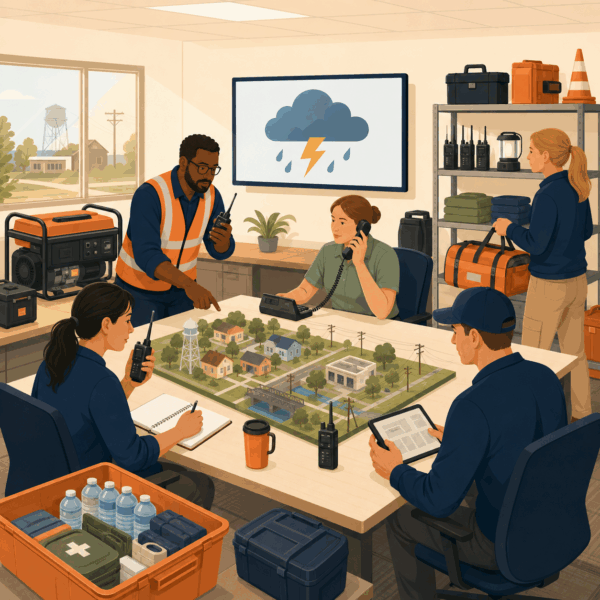 How Public Utilities Can Build a Communication Calendar Around Operational and Regulatory Cycles
Public utility communication is overwhelmingly reactive. Agencies issue rate increase notices when rate cases are filed, publish outage notifications when outages occur, announce service changes when operational decisions have already been made, and respond to community concerns when those concerns have already become organized opposition. A communication calendar moves utilities from reactive to ready, building the proactive communication cadence that makes each individual communication challenge easier to manage.
Utility communication cycles are predictable. Rate case proceedings follow defined regulatory timelines. Capital improvement programs have planned construction seasons. Environmental reporting deadlines are established years in advance. Service change implementations are planned internally before they are announced publicly. Annual report publication, board meeting schedules, and public hearing requirements all create predictable communication windows that agencies can prepare for rather than scramble to address.
A useful public utility communication calendar should include rate case preparation and public engagement windows, capital program construction season communication cycles, annual reporting and accountability publication timelines, board and commission meeting communication schedules, environmental compliance reporting and public disclosure windows, seasonal service demand communication windows including extreme weather preparedness and heating and cooling season programs, community event outreach cycles, staff training windows aligned with peak communication demand periods, and elected official briefing cadences aligned with budget cycles and legislative sessions.
Case Studies: How Public Utilities Build Trust, Manage Disruption, and Sustain Ratepayer Confidence
The following three case studies are drawn from documented programs conducted by public utility agencies and their partners across the United States. Each illustrates a specific communication challenge: multi-channel outage communication during a major storm event, targeted recycling education that reduced contamination through personalized outreach, and a wastewater agency rate increase communication program that maintained community trust through a difficult and extended public engagement process. Each offers practical lessons that transfer to other utility types and geographies.
Washington State: Multi-Channel Storm Communication in a Geographically Dispersed Public Utility District
Public utility districts serving geographically dispersed service territories, including island communities, remote rural areas, and communities separated from utility operations centers by water crossings, face storm communication challenges that urban utilities do not. When a major storm event affects a service territory that spans ferry-dependent islands and remote peninsula communities, the standard outage communication approach of a single outage map and a customer service phone number is structurally inadequate. Different communities within the same service territory may be experiencing very different outage conditions, restoration timelines that apply to one area may be misleading for another, and crews mobilized to restore service may face access limitations that affect restoration timelines in ways that ratepayers cannot predict from standard outage notifications.
The communication approach developed by public utility districts serving these types of service territories over multiple major storm events reflects hard lessons about what ratepayers need during extended outages. Geographic segmentation of outage communication, providing restoration timeline estimates specific to each affected community or service zone rather than a single territory-wide estimate, is among the most impactful changes these utilities have made. Ratepayers who receive a restoration estimate specific to their community are less likely to call the customer service center for clarification and more likely to make appropriate arrangements for extended outages, because the information they receive is directly actionable rather than requiring interpretation.
Pre-storm communication is equally important. Utilities that communicate preparation guidance, estimated storm impact, and planned restoration priorities before a storm event arrives reduce the post-storm demand on customer service channels and build ratepayer confidence that the utility is managing the event proactively rather than reactively. Ratepayers who understand before a storm that restoration priority will go first to critical infrastructure, then to the largest outage clusters, and finally to individual service locations will be more patient with a restoration sequence that places them later in the queue, because they understand the logic rather than experiencing it as arbitrary treatment.
The lesson for public utilities managing geographically dispersed service territories is that generic outage communication is communication designed for the convenience of the agency rather than the needs of the ratepayer. The investment in geographically segmented notification, pre-storm communication protocols, and proactive restoration timeline updates during events produces measurable reductions in customer service call volume, fewer repeat contacts from the same ratepayers, and higher post-event satisfaction even when outage duration is long.
East Lansing, Michigan: Personalized Recycling Education That Reduced Contamination Through Targeted Outreach
Recycling contamination is one of the most persistent public education failures in solid waste management. Agencies invest in public education campaigns, distribute sorting guides, and communicate program requirements through bill inserts and social media, yet contamination rates in residential recycling programs remain stubbornly high in many communities. The gap between what recycling programs communicate and what residents actually do is not primarily a matter of resident indifference. It is a matter of communication design.
A documented pilot program in East Lansing, Michigan illustrates what personalized, behaviorally targeted recycling communication can achieve. The program installed cameras on recycling collection vehicles that captured images of cart contents as they were emptied, used AI analysis to identify contamination, and sent personalized response mailers to the specific addresses where contamination was detected. Rather than broadcasting general recycling guidance to all residents, the program communicated directly with the households whose behavior needed to change, with evidence specific to their own recycling cart.
The results were significant. Overall recycling contamination decreased by 22.5 percent over the course of the pilot. Both educational mailers, which explained correct sorting practices in clear plain language, and emotional mailers, which framed recycling as a community value and acknowledged the resident’s role in the program, reduced contamination. Emotional messaging recipients contaminated 23 percent less and set out their carts 45 percent more often than before the intervention. Among households that had not been setting out their recycling carts at all, the personalized outreach made them 28 percent more likely to participate.
The communication lesson is not that every solid waste agency needs camera-equipped collection vehicles. It is that generic recycling education is significantly less effective than targeted communication directed at the specific households and behaviors that are driving contamination. The program’s success reflects a broader principle: communication that is specific, timely, and directly relevant to the recipient’s own behavior is more effective than communication designed for the average resident who is already doing the right thing. Agencies with the data to identify which households are contributing to contamination problems, whether through collection cameras, contamination audits, or complaint tracking, have the foundation for communication programs that are far more efficient than broadcast education.
Discovery Bay, California: Wastewater Rate Increase Communication That Maintained Community Trust
Wastewater rate increases are among the most difficult utility communication challenges because the infrastructure they fund is underground, the service it delivers is taken for granted, and the consequences of not investing are invisible until a system failure makes them catastrophic. Residents who do not understand what a wastewater treatment plant does, why collection system rehabilitation matters, or what deferred maintenance eventually produces have no basis for evaluating a rate increase proposal beyond whether it increases their bill.
A documented rate increase communication program conducted by a community services district in the San Francisco Bay Area region illustrates how wastewater agencies can build ratepayer understanding before a rate increase is proposed. Facing the need to raise water and wastewater rates to fund critical infrastructure improvements, the district engaged a communications firm to develop a comprehensive outreach program that preceded and accompanied the formal rate notice process. The program included a dedicated website section with plain-language descriptions of planned projects and rate study findings, an animated video explaining why the rate increase was necessary and how the revenue would be used, social media content that connected infrastructure investment to service reliability outcomes ratepayers could understand, digital advertising that reached beyond the district’s existing communication audience, and a community open house that gave ratepayers a direct opportunity to ask questions and learn about planned projects.
The program also produced bilingual materials, including notices and website content available in Spanish, to reach ratepayers whose primary language was not English. This multilingual outreach reflected a recognition that rate increase communication that does not reach all ratepayers is not just incomplete. It creates an equity problem, as ratepayers who do not receive accessible information about rate changes, payment assistance programs, or the formal protest process are disadvantaged relative to neighbors who received the same information in a language they could read.
The lesson for wastewater agencies approaching rate increase communication is that the formal Proposition 218 or equivalent notice process is the floor of communication obligation, not the ceiling. Agencies that communicate only through required legal notices will produce ratepayers who are legally notified but genuinely uninformed. Agencies that invest in proactive, accessible, multi-channel communication before and during the formal notice period produce ratepayers who understand why the rate increase is necessary, what it will fund, and what options are available if they cannot afford the increase without assistance. That understanding does not guarantee rate increase acceptance, but it makes meaningful participation in the public process possible for a much broader range of ratepayers.
How Public Utilities Can Align Internal Staff, Partners, and the Public Before Major Communication Moments
Public utility communication often fails not because the agency lacks information to communicate but because the internal communication system is not ready when the public-facing moment arrives. A ratepayer who calls a utility customer service line the day after a rate increase notice is mailed and reaches a representative who cannot explain the increase, cannot describe payment assistance programs, and cannot direct the ratepayer to accurate online information has been failed by internal alignment, not by the external communication program.
The most consequential public utility communication moments, rate case filings, capital program announcements, service disruptions, environmental incidents, and major service change implementations, all require internal alignment before external communication. That means customer service staff who understand the rate increase rationale and know how to explain it in plain language before the notice is mailed. It means field crews who can answer basic questions from residents during construction projects. It means billing staff who know what payment assistance programs exist and how to connect ratepayers with them. And it means elected officials and board members who have been briefed on major decisions before they appear in media coverage, so they can communicate consistently rather than being caught uninformed by constituent questions.
A strong alignment process for public utilities should include shared message frameworks for major communication events, staff talking points that are specific enough to be genuinely useful rather than general enough to be useless, partner briefing materials for community organizations and social service agencies that serve as trusted communication intermediaries for hard-to-reach ratepayer populations, and a single source of current accurate information on the utility website that all staff and partners can reference. Internal alignment is not about controlling the message. It is about making sure the core factual content is consistent and accessible across every channel through which ratepayers might encounter it.
How Public Utilities Can Use Social Media and Digital Tools Effectively
Social media has become an essential channel for public utility communication, particularly during service disruptions when ratepayers are actively seeking information and the volume of customer service contacts can overwhelm call center capacity. A utility that communicates accurately and promptly on social media during a major outage event reduces call volume, manages ratepayer expectations, and demonstrates the operational responsiveness that builds long-term trust. A utility that is silent on social media during a major disruption while ratepayers share speculation, frustration, and inaccurate restoration estimates in the same channels loses the opportunity to be the authoritative source of information during exactly the moment when ratepayer attention is highest.
Social media communication for public utilities requires a different discipline than traditional utility communication. Content must be written for rapid consumption by ratepayers who are scanning their feeds while managing a household without power or waiting for a service restoration that has been delayed. Restoration timeline estimates must be communicated with honest uncertainty rather than false precision, because a missed restoration estimate communicated on social media generates more ratepayer frustration than a conservative estimate that is ultimately exceeded. And social media channels must be monitored actively during major service events so that the inaccurate information that spreads through ratepayer social networks can be corrected before it generates additional complaint volume and erodes confidence in agency communication.
Content Strategy for Utility Social Media
Effective public utility social media programs are built around a content strategy that extends beyond service disruption communication. Utilities that communicate only during disruptions teach ratepayers that following the utility’s social media account means receiving bad news. Utilities that build regular, valuable content into their social media programs, infrastructure project updates with construction photos, program announcements with plain-language explanations, behind-the-scenes operational content that makes invisible utility work visible, and accountability reporting that connects rate revenue to service outcomes, build ratepayer audiences who are engaged before a crisis and receptive to agency communication when a crisis occurs.
Peer voice content is as effective for utility communication as it is for any other public agency type. A video interview with a ratepayer who enrolled in a payment assistance program and avoided service shutoff is more compelling outreach for that program than any agency-produced program description. A testimonial from a business customer who participated in an energy efficiency program and reduced their operating costs communicates the value of that program more credibly than utility marketing materials. Utilities that invest in collecting and sharing authentic ratepayer and community stories build communication credibility that institutional content cannot replicate.
Utility Websites Organized Around Ratepayer Questions
Most public utility websites are organized around the agency’s internal departmental structure rather than around the questions ratepayers actually ask. A ratepayer trying to report an outage should not have to navigate to the operations department page to find the outage reporting number. A ratepayer looking for payment assistance should not have to search through billing department content to find program information. A ratepayer trying to understand a rate increase should not have to read a regulatory filing to find a plain-language explanation of why the increase is occurring.
The most effective utility website redesigns begin with an audit of the most common ratepayer inquiries, drawn from customer service call records, social media comments, and public meeting questions, and use that data to reorganize website content around the questions ratepayers actually ask rather than the categories agency staff find internally logical. Navigation that leads with how to report an outage, how to pay a bill, how to get assistance if you cannot afford your bill, what is happening in your neighborhood, and how to contact a real person consistently produces higher ratepayer satisfaction and lower customer service call volume than navigation organized around agency programs and department names.
How Public Utilities Can Communicate About Environmental Stewardship and Sustainability
Public utilities are significant environmental actors. Municipal energy providers make decisions about generation mix and grid modernization that have major implications for greenhouse gas emissions and air quality. Solid waste agencies manage programs that determine how much municipal waste is diverted from landfills and how much is recovered as usable materials. Wastewater agencies discharge treated effluent into waterways and are responsible for preventing sewer overflows that would degrade water quality. Stormwater utilities manage programs designed to reduce pollution in local streams, rivers, and coastal waters. The environmental dimensions of utility operations create communication obligations that go beyond service delivery and rate justification.
Environmental stewardship communication is most effective when it connects utility operational decisions to visible environmental outcomes that ratepayers can observe and evaluate. A solid waste agency that communicates its annual diversion rate in tons and percentages is providing technically accurate information that most ratepayers cannot interpret meaningfully. The same agency that communicates the environmental outcome of that diversion, the landfill airspace preserved, the greenhouse gas emissions avoided, the energy recovered from recyclable materials, the water quality benefits of reduced landfill leachate, is communicating in terms that connect utility operations to environmental conditions that ratepayers experience and care about.
Clean Energy and Decarbonization Communication
Municipal energy providers navigating clean energy transition face one of the most politically complex communication environments in public utility governance. Clean energy transition programs involve contested policy questions, significant capital investment that translates into rate pressure, and a political environment in which ratepayers, elected officials, and community organizations have strong and often conflicting views about the pace, cost, and equity dimensions of the energy transition. Communication about clean energy programs must be honest about costs and timelines, genuinely responsive to ratepayer concerns about affordability and reliability, and specific enough about the transition pathway to allow ratepayers and elected officials to evaluate the agency’s plan.
The utilities that communicate most effectively about clean energy transition are those that have built ratepayer understanding of the current energy system before asking ratepayers to support changes to it. Ratepayers who understand how their current electric service is generated, transmitted, and delivered, who understand the age and condition of the infrastructure that provides that service, and who understand the regulatory and market forces that affect their rates are ratepayers who can meaningfully evaluate a clean energy transition proposal rather than experiencing it as an unexplained mandate that increases their bills.
Environmental Compliance Communication
Public utilities that operate under environmental permits have compliance communication obligations that go beyond satisfying the legal notice requirements of those permits. Wastewater agencies required to publish annual consumer confidence reports have an opportunity to communicate water quality outcomes and infrastructure investment in ways that build ratepayer confidence, or they can satisfy the requirement with technical documents that most ratepayers will never read. Stormwater agencies required to report on MS4 permit compliance have an opportunity to communicate the connection between their permit programs and the water quality of local streams and coastal waters, or they can file reports with regulatory agencies that generate no public understanding of what the programs are achieving.
The agencies that realize the full communication value of environmental compliance reporting are those that treat compliance documents as the starting point for public communication rather than the end product. A plain-language summary of annual water quality monitoring results, communicated through bill inserts, utility website content, and social media, reaches a far larger ratepayer audience than the monitoring report filed with the regulatory agency. A video tour of a wastewater treatment plant that explains what happens to the water before it is returned to the environment builds more ratepayer understanding of wastewater operations than any printed program description. Environmental compliance communication that makes the technical legible and connects regulatory compliance to visible environmental outcomes builds the ratepayer trust and political support that utility operations require.
How Public Electric Utilities Can Communicate Grid Reliability, Rate Increases, and Clean Energy Transition to Ratepayers and Elected Officials
Publicly owned electric utilities operate at the intersection of infrastructure management, environmental policy, and energy economics in ways that no other utility type does, and their communication challenges reflect that complexity. A publicly owned electric...
How Public Utilities Can Measure Communication Effectiveness and Use Data to Improve Ratepayer Engagement Over Time
Most public utility communication programs measure the wrong things. They count the notices sent, the social media posts published, the public meetings held, and the website pages visited. These are output measures, and they are easy to collect because they reflect...
How Public Works Departments Can Build Accountability Communication Around Capital Program Performance
Public works capital programs are among the largest and most consequential expenditures in local government, and most ratepayers and taxpayers have no reliable way to assess whether those programs are delivering value. A capital program that spends one hundred million...
How Port Authorities Can Communicate Environmental and Community Impact to Neighboring Populations
Port authorities operate some of the most consequential and most contested industrial facilities in any metropolitan area, and they do so in close proximity to residential communities that bear the concentrated environmental and quality-of-life costs of port...
How Public Works Departments Can Communicate Construction Disruptions and Right-of-Way Projects to Affected Communities
Construction communication is where public works departments most frequently damage community relationships, not because projects go wrong but because the people affected by them were not told what was coming, when it would end, or why it was worth enduring. The...
How Municipal Broadband Authorities Can Communicate Service Availability, Equity, and Infrastructure Plans
Municipal broadband is among the most politically contested utility investments that local governments undertake, and its communication challenges are correspondingly more complex than those facing any other utility type. Unlike water, wastewater, or solid waste,...
How Sewer and Stormwater Agencies Can Build Environmental Stewardship Communication Into Routine Outreach
Environmental stewardship communication is most effective when it does not announce itself as a campaign. The resident who opens a bill insert and reads about the connection between their household’s stormwater runoff and the health of the local creek is...
How Public Natural Gas Utilities Can Communicate Safety, Infrastructure Investment, and Energy Transition to Customers and Communities
Natural gas utilities communicate within a safety-first environment that no other utility type fully shares. The combustible nature of natural gas, its potential for explosive concentration in enclosed spaces, and the direct safety consequences of leaks, incidents,...
How Wastewater Agencies Can Communicate Rate Increases and Capital Program Investments Without Losing Public Trust
Wastewater rate increases occupy a particular position in the political economy of local public services. They fund infrastructure that no one sees, maintaining a service that no one thinks about until it fails, for a utility that most ratepayers regard as an...
How Stormwater Utilities Can Communicate MS4 Permit Obligations and Pollution Prevention to Residents and Businesses
Stormwater pollution prevention depends almost entirely on the behavior of thousands of individual residents and businesses who do not know that what they put in a storm drain affects water quality in local waterways. The fundamental challenge of municipal separate...
How Sewer Departments Can Communicate Service Disruptions, Emergency Repairs, and Spill Events
A sewer system failure is not simply an inconvenience. It is a public health event. When raw or partially treated sewage overflows a collection system, backs up into residential properties, or reaches a waterway, the consequences extend well beyond the operational...
How Wastewater Agencies Can Communicate Infrastructure Projects and System Upgrades to the Public
Wastewater infrastructure sits at a particular disadvantage in the competition for public understanding. The pipes, pump stations, treatment processes, and collection systems that handle every gallon of wastewater generated in a community are almost entirely invisible...
How Waste Management Departments Can Communicate Environmental Compliance and Landfill Operations Transparently
Landfills and transfer stations occupy a particular position in community life: they are essential infrastructure whose presence is a permanent source of concern for the neighborhoods that host them, whose operations generate ongoing questions about odor, traffic,...
How Solid Waste, Recycling, and Garbage Collection Agencies Can Partner With Community Organizations to Extend Outreach Into Underserved Populations
The residents who generate the most contamination, illegal dumping, and improper disposal in most solid waste agency service areas are not residents who disregard the environment. They are residents who have the least access to information about solid waste programs...
How Solid Waste, Recycling, and Garbage Collection Agencies Can Communicate Hazardous Waste Disposal Programs to Residential and Commercial Customers
Hazardous waste disposal programs are among the most safety-critical services that solid waste agencies provide, and among the most consistently underutilized. The gap between program availability and program participation is wider for household hazardous waste than...
How Solid Waste, Recycling, and Garbage Collection Agencies Can Build Public Education Programs Around Recycling, Composting, and Waste Reduction
Recycling and composting programs are among the most behaviorally dependent public services that local governments operate. Unlike water service or electricity, whose value is delivered to residents passively regardless of their behavior, recycling and composting...
How Solid Waste, Recycling, and Garbage Collection Agencies Can Communicate Service Changes, Route Adjustments, and Collection Program Updates
A missed garbage collection notice has an outsized effect on the relationship between a solid waste agency and the residents it serves. It is not a large harm. The garbage is still there the next day, and it gets picked up eventually. But the experience of putting...
How Energy Providers Can Communicate Rate Increases Tied to Capital Investment Without Triggering Ratepayer Backlash
Capital-driven rate increases are among the most difficult communication challenges that energy providers face because they ask ratepayers to accept a concrete and immediate financial burden in exchange for infrastructure benefits that will materialize slowly, that...
How Public Power Authorities Can Build Trust With Ratepayers During Long-Term Infrastructure Upgrades
The trust that ratepayers extend to a public power authority at the beginning of a major infrastructure upgrade program is almost always greater than what they extend at the middle of one. This is not because infrastructure programs fail to deliver value. Most do,...
How Public Power Authorities Can Communicate Clean Energy Transition Programs to Ratepayers and Elected Officials
Clean energy transition programs ask ratepayers and elected officials to accept something that ordinary infrastructure investment does not: a commitment to a long-term direction whose costs are immediate and concrete while its benefits are distributed, deferred, and...
How Municipal Utilities Can Communicate Energy Efficiency Programs and Rebate Offerings to Diverse Audiences
Energy efficiency programs are among the most consistently underperforming communication challenges in public utility management. The programs themselves are well-designed, genuinely beneficial, and directly responsive to the interests of the ratepayers they serve....
How Municipal Energy Providers Can Communicate Power Outages, Grid Events, and Restoration Timelines
The first hour of a power outage is the most consequential communication window in a municipal energy provider’s operational relationship with its customers. In that hour, customers decide whether the utility is managing the situation or has lost control of it,...
How Public Utilities Can Communicate With Vulnerable, Low-Income, and Underserved Ratepayers
Essential utility services occupy a unique position in the lives of the people who depend on them. They are not optional. A household that cannot pay its water bill does not simply go without a service it enjoys. It loses access to something essential for health,...