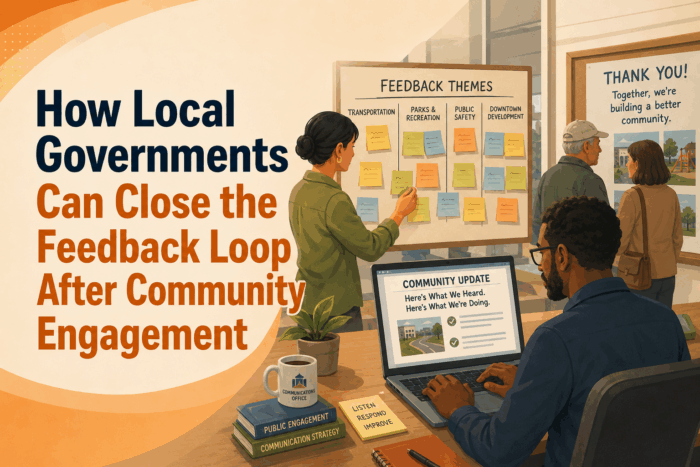
How Local Governments Can Close the Feedback Loop After Community Engagement
Residents who participate in a community survey, attend a public open house, submit comments on a proposed project, or show up at a listening session are making a specific kind of investment in their local government. They are offering time, attention, and often genuine care about the outcome of a decision that will affect them. In return, they are extending a form of trust: the assumption that their input will be heard, considered, and at minimum acknowledged. When that trust is not honored, when months pass without any communication about what the agency learned or how the input shaped the decision, residents do not simply feel mildly disappointed. They learn something important about whether participation is worth their time.
This is the feedback loop problem in local government community engagement, and it is one of the most common and most consequential failures in small government communication. Agencies invest real effort in designing engagement processes, distributing surveys, hosting open houses, and collecting input. What happens after that collection is far less reliably managed. The results are compiled or not compiled. The governing body is briefed or not briefed. The residents who participated are told what was learned or left to wonder. That gap between input collected and input acknowledged is where community engagement most often breaks down.
The consequences are measurable and compound over time. A community where residents have participated in engagement processes and never heard what happened to their input will produce progressively lower response rates to future engagement. The residents who participated will share their experience with neighbors and community members who then decide not to bother the next time. The engagement process itself becomes associated with the outcome of no visible effect, which is the outcome least likely to motivate future participation. The agency ends up with engagement processes that reach fewer and fewer people and that produce input less and less representative of the community as a whole.
This article addresses how local governments can close the feedback loop consistently and effectively. It covers what a feedback loop closure looks like, what information it should contain, how to handle the sensitive situations where community input was not reflected in the governing body’s decision, how to time the closure communication, which channels are most effective for different types of engagement, and how to build feedback loop closure into the standard workflow of the agency’s engagement process so that it happens reliably rather than occasionally. The goal is an engagement practice that residents experience as a genuine exchange rather than a one-way extraction of their time and attention.
What the Feedback Loop Is and Why It Matters
 The feedback loop in community engagement is the communication that tells participants what happened after they contributed their input. It answers the question that every thoughtful participant has: what did you do with what I told you? The loop is closed when participants receive an honest, specific answer to that question. The loop remains open, and trust continues to erode, when participants receive either nothing or a vague acknowledgment that their input was appreciated without any specific account of how it was used.
Closing the feedback loop is not the same as giving participants the outcome they wanted. A resident who submitted comments opposing a proposed rate increase has not had the feedback loop closed simply because the rate increase was adopted and they received a notice of the adoption. The feedback loop is closed when that resident receives a communication that tells them the agency received a specific number of comments, that the main concerns expressed included concern about impact on fixed-income households, and that the governing body addressed that concern by implementing a low-income assistance program as part of the rate change. Whether or not the rate increase was adopted, the resident knows their input was actually heard and considered.
This distinction matters because it determines whether residents experience engagement as genuine or performative. Residents who received a genuine response to their engagement are residents who may disagree with the outcome but who understand it was reached through a process that took their input seriously. That experience is qualitatively different from receiving an outcome with no explanation of how the engagement process informed it. The first builds the credibility of both the engagement process and the governing body. The second undermines both.
The feedback loop also serves an informational function for the community as a whole, not just for participants. When an agency publishes a summary of what it heard from an engagement process, the residents who did not participate also learn something: what their neighbors and community members think about the issue, what concerns were expressed, what areas of agreement or disagreement emerged. That shared community knowledge supports more informed subsequent public discussion and produces a more informed public when the governing body makes its decision.
Engaged & Connected: Communication Strategies for Small Towns, Villages, Townships, and Rural Communities
This article is part of our series on strategic communication for Small Towns, Villages, Townships, and Rural Local Governments. To learn more and to see the parent article, which links to other content just like this, click the button below.
The Elements of Effective Feedback Loop Communication
A complete feedback loop communication contains several specific elements that, taken together, give participants the account of what happened to their input that they deserve and that gives the agency the credibility it needs to sustain genuine engagement over time.
Participation Summary
The feedback loop communication should begin by describing how many people participated and in what form. How many surveys were completed? How many residents attended an open house? How many written comments were received? How many people participated in listening sessions, and from how many distinct community groups or geographic areas? This summary gives participants context for their own contribution: their individual input was part of a larger community response, and the community’s collective engagement is worth describing.
The participation summary should also note any significant patterns in who participated. If the engagement process reached a particularly diverse cross-section of the community, that is worth noting. If participation was heavily weighted toward one geographic area, one demographic group, or one stakeholder type, that is equally worth noting honestly, both because it informs how the input should be weighted and because it signals where future engagement should be strengthened. An agency that acknowledges participation gaps is more credible than one that presents skewed participation as representative of the whole community.
What Was Heard: Main Themes and Findings
The heart of the feedback loop communication is a clear, specific summary of what the agency heard from the engagement process. Not a general statement that residents expressed a range of views, but a substantive account of the main themes, the areas of agreement, the areas of disagreement, the most common concerns, and any notable outlier perspectives that deserve attention even if they were not widely shared.
Themes should be named specifically. If the most common concern expressed in a survey about a proposed park improvement was insufficient parking, the summary should say that. If listening sessions with agricultural producers consistently raised concerns about the impact of a drainage project on field drainage timing, the summary should say that. If open house attendees were overwhelmingly supportive of a proposed project with a specific concern about its impact on a wetland area, both the support and the specific concern should be described.
The summary should represent the range of perspectives heard rather than only the perspectives that align with the staff recommendation or the governing body’s inclination. If input was mixed or divided, the summary should say so honestly. Participants who expressed views that differ from the majority deserve to know their perspectives were included in the summary, and participants who held majority views deserve to know whether those views were representative of the community as a whole or only of those who chose to participate.
How Input Shaped the Decision or Recommendation
The most important and often the most difficult element of the feedback loop communication is explaining specifically how the community input influenced what the agency did next. This explanation is what separates genuine engagement from performative engagement, because it requires the agency to connect the input it received to specific changes in thinking, approach, plan, or recommendation that resulted from it.
When community input produced observable changes, those changes should be named clearly. A project design that was modified because open house feedback revealed an access concern that the original design had not addressed. A program element that was added because listening session participants identified a need the staff proposal had not anticipated. A policy approach that was refined because survey respondents indicated that the originally proposed timeline was unrealistic for the affected population. Each of these is a concrete example of engagement that produced a specific, nameable result.
When community input confirmed rather than changed a direction the agency was already considering, the summary should say that too. Confirmation is a legitimate outcome of engagement. An agency that was considering a specific approach and that found broad community support for it has learned something genuinely useful, and telling participants that their input confirmed a direction that the agency found worth pursuing is an honest and meaningful feedback loop closure.
The Decision and What Happens Next
The feedback loop communication should conclude by telling participants what decision was made or what the next step in the process is. If the governing body has acted, the communication should describe what was decided and when it will take effect. If the governing body has not yet acted, the communication should explain what stage the process is in, when a decision is expected, and whether there are additional opportunities for public input before the decision is final.
For an engagement that was conducted well before a final decision was made, the feedback loop closure for that stage of engagement should clearly identify it as the closure for that stage, not as a final communication. Residents should understand that they will hear from the agency again when the process moves to the next stage, so they can continue to follow the process with an accurate understanding of where it stands.
Handling Situations Where Input Was Not Reflected in the Decision
One of the most challenging feedback loop communications to write is the one that follows a governing body decision that differed significantly from what the majority of engagement participants expressed. If an engagement process produced strong community opposition to a proposed project and the governing body approved it anyway, the feedback loop communication must address that disconnect honestly without either apologizing for the governing body’s decision or pretending that the disagreement does not exist.
The honest approach is to acknowledge clearly what was heard from the community, to explain that the governing body considered that input as part of its deliberation, and to explain why it reached the decision it reached even in the face of community opposition. That explanation does not need to defend the decision as correct. It needs to explain the factors that the governing body weighed, including the community input, and to show that the decision was made with awareness of the community’s expressed concerns rather than in ignorance of them.
For decisions where financial, legal, regulatory, or safety considerations were determinative despite community opposition, the feedback loop communication should explain those considerations specifically. A decision that was required by a state regulatory mandate, that was financially necessary to maintain fiscal solvency, or that was driven by a public safety assessment that the community was not fully aware of can be explained on those terms. Residents who understand why a decision was made differently from what they expressed are better positioned to evaluate the governing body’s judgment than residents who simply experience the outcome as their input being ignored.
The feedback loop communication should also acknowledge when a community concern that did not change the primary decision did influence how the decision will be implemented. An opposition concern about a project’s impact on a specific neighborhood may not have stopped the project but may have resulted in a mitigation measure, a modified construction schedule, or an additional community benefit that was added in response to that concern. Naming those responsive changes, even when the primary decision went against the community’s expressed preference, demonstrates that engagement is not all-or-nothing: input can shape how a decision is implemented even when it does not change whether the decision is made.
Timing the Feedback Loop Communication
The timing of feedback loop communication significantly affects its impact and its credibility. A closure that comes too quickly after the engagement process may suggest that the input was not genuinely considered before the communication was drafted. A closure that comes too slowly, months after the engagement process ended, may arrive after residents have moved on and may feel disconnected from the engagement experience that prompted their participation.
For engagement conducted in connection with a specific decision, the feedback loop closure should come within a reasonable time after the governing body has made a decision that the feedback loop can accurately describe. That timing varies by the nature of the decision and the pace of the governing body’s deliberation. For decisions made relatively quickly after engagement closes, the feedback loop can follow within days or weeks of the decision. For decisions that involve extended deliberation, an interim feedback loop closure that describes what was heard and explains that deliberation is continuing may be appropriate, with a final closure to follow when the decision is made.
For engagement not tied to a specific pending decision, such as a general community priorities survey or a long-range planning engagement, the feedback loop closure should come as soon as the input has been analyzed and organized into a coherent summary, rather than waiting for a specific decision that may be months away. The community’s investment in the engagement process deserves acknowledgment on a timeline that reflects the promptness with which the agency is taking the input seriously.
A standing commitment to a specific feedback loop timeline, communicated to participants at the outset of the engagement process, is the most credible approach. If residents are told at the time of a survey that results will be shared within a specific number of weeks, and that timeline is consistently met, they develop a reliable expectation that participation will be acknowledged promptly. If the timeline is not consistently met, residents draw the same conclusion they draw from any unreliable communication: that the agency does not follow through on its commitments.
Channels for Feedback Loop Communication
The channels used for feedback loop communication should be at least as broad as the channels used for the original engagement, and ideally broader. Participants who completed a survey distributed only through the agency’s email list deserve to receive the feedback loop through the same channel. Residents who attended an open house deserve to receive the feedback loop through a channel that reaches them directly, which may require collecting contact information during the event or distributing the feedback loop through community channels they are likely to follow.
The website should carry the full feedback loop communication in a location where interested residents can find it whether or not they participated in the original engagement. A dedicated page for each engagement process, or a standing engagement results section of the website, serves both participants who want the full summary and community members who are following the issue but did not participate in the engagement. That page should be clearly linked from any page related to the project or decision that the engagement informed.
Social media is an important channel for reaching the broadest possible audience with the feedback loop closure, including residents who did not participate but who may be interested in what the community said. A social media post that summarizes the key findings and links to the full summary on the website gives those residents a meaningful window into the community’s views without requiring them to read a lengthy document.
For engagement processes that reached specific community groups, such as agricultural organizations, business associations, or neighborhood groups, the feedback loop communication should be delivered directly to those groups rather than only through general public channels. The group’s leader or contact should receive the summary and be encouraged to share it with members who participated. This direct delivery demonstrates that the agency’s commitment to those specific communities extends beyond the engagement process itself.
Scaling the Feedback Loop to the Engagement
 Not every engagement process warrants the same level of feedback loop communication. A brief survey included with a utility billing statement, asking residents for their priorities among three possible service improvements, does not require the same depth of feedback loop communication as a multi-month engagement process involving multiple open houses, focus groups, and a formal online comment period for a major long-range plan. Scaling the feedback loop to the engagement respects both the agency’s communication capacity and the investment that participants made in each type of process.
For simple surveys and brief input collection, a short summary of what was heard, posted to the website and briefly communicated through social media, is an appropriate feedback loop closure. The summary might be a single paragraph that describes participation levels and the main findings in broad terms. This minimal closure still honors the feedback loop commitment far better than no closure at all.
For substantive engagement processes involving significant community investment of time and attention, a more detailed closure is warranted. A formal engagement report that describes the process, the participation, the main findings, and the implications for the decision is appropriate for major planning processes, significant infrastructure decisions, significant service changes, or any engagement process where the agency explicitly invited extended community deliberation. This report should be published on the website and made available to any community member who requests it.
For engagement conducted over multiple stages of a multi-year decision process, the feedback loop should be closed after each significant stage rather than only at the end of the full process. Participants who contributed input to an early planning stage deserve acknowledgment of what was learned from that stage even before the final decision is made. That staged approach keeps participants engaged across a long process by demonstrating that their earlier contributions mattered before they are asked for additional contributions in later stages.
Making Feedback Loop Communication a Workflow Requirement
The most reliable way to ensure that feedback loop communication happens consistently is to make it a required step in the agency’s engagement workflow rather than an optional activity that depends on staff remembering to do it after the engagement process is complete. When the workflow that governs how a community engagement process is designed and conducted includes an explicit step for feedback loop closure, with a designated responsible person, a timeline, and a content checklist, the closure is no more likely to be skipped than any other step in the process.
The engagement planning process should include feedback loop planning from the outset. What will the summary cover? Who will write it? When will it be completed? Through which channels will it be distributed? How will it reach participants who attended in-person events? What will it say about how input was used if the governing body’s decision has not yet been made at the time of the summary? These questions should be answered before the engagement begins rather than improvised after it ends.
Including feedback loop completion as a criterion for considering an engagement process complete gives the agency a clear standard for when the process has fulfilled its obligations. An engagement process that collected input but did not close the feedback loop is an incomplete process, regardless of how well the input was gathered. That standard, built into the agency’s practices and into the expectations of the staff and officials responsible for managing engagement, makes feedback loop closure a professional expectation rather than an optional courtesy.
Building a Reputation for Genuine Engagement
The ultimate purpose of consistent, honest feedback loop communication is not simply to fulfill a procedural obligation. It is to build a reputation as a governing body and an agency that genuinely engages with its community rather than performing engagement as a procedural step. That reputation is built through consistent experience over time, and the feedback loop is the element of the engagement process that most directly determines whether the experience residents have is one of genuine dialogue or one-way information extraction.
Communities where residents have consistently experienced genuine engagement, including the honest feedback loop closure that characterizes it, are communities where participation rates in public engagement are higher, where the input that is collected is more representative and more thoughtful, where governing bodies have better information for their decisions, and where community relationships with local government are stronger. Those outcomes are not the result of sophisticated engagement programs or large budgets. They are the result of consistent honesty about what was heard and how it was used.
Agencies that are building this reputation will find that the investment in feedback loop communication pays dividends across their full range of governance activities. A community that trusts its local government to listen genuinely is a community that gives that government more benefit of the doubt when difficult decisions need to be made, more patience when projects encounter unexpected complications, and more willingness to engage constructively with the next question the agency needs community input on. Building that trust through the feedback loop is among the most durable and high-return communication investments a small local government can make.
Engagement Fatigue and How Feedback Loop Failures Cause It
Engagement fatigue is the phenomenon in which residents who have participated in multiple engagement processes over time become increasingly reluctant to participate in subsequent ones. It is commonly attributed to over-engagement, a sense that the agency asks for input too frequently. But the deeper and more common cause of engagement fatigue is not the frequency of engagement requests. It is the absence of visible results from previous engagement. Residents who have participated in three surveys over two years without ever hearing what the results showed, or without any observable connection between the input they provided and the decisions that followed, are not suffering from too much engagement. They are suffering from engagement that produced no perceptible return on their investment of time and attention.
Closing the feedback loop consistently is therefore not only a matter of courtesy or ethical obligation. It is the primary mechanism for preventing engagement fatigue and sustaining the participation rates that make community engagement representative and valuable. An agency that closes the feedback loop reliably after every engagement process is an agency that gives residents a reason to invest time in the next one: the experience of having been heard the last time.
Engagement fatigue, when it does set in, is very difficult to reverse because it is based on accumulated experience rather than a single interaction. A community that has learned from repeated experience that local government engagement produces no visible results will not be quickly convinced by a single well-designed engagement process that the practice has changed. Rebuilding trust after engagement fatigue requires consistent, sustained demonstration of genuine feedback loop closure over a period long enough to create a new pattern of experience. The most efficient path is to build that pattern from the beginning rather than trying to rebuild it after it has been damaged.
The governing body plays a role in preventing engagement fatigue through its own communication practices. When elected officials publicly acknowledge community input in their deliberations, refer to the findings of engagement processes in their public statements, and explicitly connect their decisions to community perspectives that were expressed through engagement, they reinforce the message that engagement matters. A board member who says at a public meeting that the engagement summary showed strong community concern about a specific issue, and that the board took that concern seriously in reaching its decision, is closing the feedback loop in a highly visible and credible way that no written communication alone can replicate.
Communicating When Engagement Results Are Unexpected or Unwelcome
Engagement processes sometimes produce results that are surprising, inconvenient, or politically uncomfortable for the agency. A survey that reveals significantly stronger community opposition to a proposed project than staff anticipated. A listening session that surfaces a concern the agency had not previously identified and that requires significant design changes to address. An open house at which residents expressed strong views about a service that the agency had not considered changing but that the engagement results suggest is underperforming. These unexpected findings are actually among the most valuable outcomes of genuine engagement, because they give the agency information it would not otherwise have had. Communicating honestly about them is essential to the credibility of the engagement practice.
Unexpected or unwelcome results should be described in the feedback loop communication with the same honesty and specificity as expected results. If the engagement revealed that a majority of participants oppose a proposal that the agency is pursuing, the summary should say so. If the engagement surfaced a concern the agency had not anticipated, the summary should acknowledge that the finding was unexpected and describe how the agency is taking it into account. If the results were more divided or more complex than anticipated, the summary should reflect that complexity rather than simplifying it to fit a narrative that is more convenient for the decision the agency is trying to make.
Agencies that communicate honestly about unexpected engagement results build more credibility with residents than those that seem to present only findings that support decisions they have already made. Residents who see an engagement summary that honestly describes mixed or divided input, and that explains how the governing body is weighing that complexity, are residents who believe the agency is actually listening. Residents who see engagement summaries that always seem to confirm whatever direction the agency was already heading will eventually notice the pattern and stop attributing it to coincidence.
The communication about unexpected findings should also address what the agency is doing in response. If a finding requires additional study or analysis, the summary should say that and identify when results of that additional work will be available. If a finding requires a design modification or a policy adjustment, the summary should describe the change being made. If a finding raises a question the agency is not yet in a position to answer, the summary should acknowledge the question honestly and commit to addressing it through a specific next step.
The Role of Leadership in Feedback Loop Communication
The feedback loop communication is more effective when it comes from or is clearly associated with agency leadership rather than being a purely administrative communication. A feedback loop summary produced and signed by the administrator, or framed as a communication from the governing board, carries more weight than one that appears to be a staff-level report with no visible leadership accountability. Leadership involvement signals that the feedback loop closure is a governance priority, not an administrative afterthought.
Elected officials can reinforce the feedback loop through their own communication channels. A board member who posts on a personal social media account that the engagement process showed strong community support for a project and that the board is taking that support seriously is reaching a different audience than the agency official channels and adding a personal accountability dimension to the feedback loop closure. A board chair who writes a brief message to the community describing what was heard in a recent engagement process and how it will inform the board upcoming deliberations is practicing the kind of representative communication that engagement is ultimately designed to support.
Agencies where leadership is actively involved in both the design of engagement processes and the communication of their results will find that community trust in the engagement practice is significantly higher than in agencies where engagement is treated as a staff function that leadership observes from a distance. The visible commitment of leadership to genuine engagement, expressed through personal involvement in feedback loop communication and through public acknowledgment of community input in deliberations, is the most credible form of engagement validation available.
Documenting Engagement for Institutional Memory
Feedback loop communication serves residents in the present, but the documentation underlying it serves the agency over a much longer horizon. Community engagement results that are carefully documented, archived, and retrievable become part of the institutional knowledge that informs future decisions on related issues. An agency that can point to what its community said about road priorities three years ago, what the main concerns were at a public engagement session on a drainage project five years ago, or what the survey results showed about resident satisfaction with park services has a foundation for understanding its community that transcends any individual staff member or governing body composition.
Documentation of engagement results should be stored in a format and location that is accessible to future staff, not just to those who conducted the engagement. A file system that organizes engagement documentation by project and date, with standardized file names that make retrieval straightforward, is a modest but important infrastructure investment. The documentation should include not only the summary that was distributed to participants but also the underlying data, the methodology description, the participation record, and any notes about how the input was used in the decision-making process.
When new staff members join the agency and take on responsibilities related to community engagement or to decisions connected to previous engagement processes, access to the engagement documentation history allows them to build on previous community conversations rather than starting from scratch. A new administrator who can read what the community said about drainage priorities two years ago, and who can reference that input in conversations with current residents and board members, is serving both the community and the governing body with a level of institutional knowledge that would otherwise be lost when staff turn over.
Engagement documentation also supports the governance accountability function that public records serve. Residents who want to understand the basis for a governing body decision can review the engagement summary that informed it. Journalists or advocacy organizations that are analyzing local government decision-making can assess whether engagement findings were reflected in outcomes. Oversight bodies that are evaluating the adequacy of public participation processes can review documentation of how those processes were conducted and how their results were communicated. Thorough engagement documentation is therefore not only a communication practice but a governance transparency practice.
Strategic Communication Support for Small and Rural Governments
 Closing the feedback loop consistently is a discipline challenge as much as a communication challenge. It requires building the habit of reporting back as a non-negotiable element of the engagement process, training staff and officials on what effective feedback loop communication looks like, and developing the workflow tools, including templates and checklists, that make closing the loop a manageable step rather than a significant additional burden. For agencies that have never built this practice, developing it requires some upfront investment in process design.
Stegmeier Consulting Group (SCG) helps small and rural governments develop community engagement systems that include feedback loop closure as a standard, non-negotiable element. That work includes engagement workflow design, feedback loop communication templates for different types of engagement, guidance on handling decisions that diverged from community input, staff training on feedback loop communication, and the workflow integration that makes closing the loop a reliable practice rather than an occasional achievement. Whether your agency is designing a new engagement process or trying to build the feedback loop habit into an existing practice, SCG can help you develop the approach that makes engagement a genuine exchange rather than a one-way process.
Future Trends in Engagement Feedback Loop Communication
The tools and expectations for engagement feedback loop communication are evolving alongside broader trends in local government transparency and digital communication. Online engagement platforms increasingly include built-in feedback loop functionality, allowing agencies to publish results and summaries directly within the same platform where engagement was conducted. Participants who completed a survey through an online platform may receive an automated notification when results are published, with a link to the summary within the platform. This integration makes the feedback loop more seamless and more likely to reach the specific participants whose input is being acknowledged.
Data visualization tools are making feedback loop summaries more accessible to residents who are not accustomed to reading quantitative research reports. A chart showing the distribution of survey responses, a graphic showing the most common themes in open-ended comments, or a simple visual showing the geographic distribution of participants can communicate the main findings of an engagement process far more efficiently than text alone. Small governments that incorporate basic data visualization into their feedback loop summaries will find that residents engage with the results more readily and come away with a clearer understanding of what the community as a whole said.
The expectation that engagement feedback loop communication will be available in multiple languages is growing, particularly in communities with significant non-English-speaking populations. A feedback loop summary published only in English does not close the loop for participants who engaged through non-English channels. Agencies that build translation of feedback loop summaries into their standard engagement workflow will be ahead of expectations that are likely to become more explicit as language access in public participation receives more regulatory and advocacy attention. Additionally, the growing use of accessible document formats, including screen-reader-compatible documents and plain-language summaries at accessible reading levels, will become a more prominent expectation as equity in public participation receives sustained attention from residents, oversight bodies, and advocacy organizations.
Stegmeier Consulting Group’s Strategic Approach to Communication Systems
Close the community engagement feedback loop to strengthen long-term public trust.
Community engagement does not end when a survey closes, a public meeting adjourns, or comments are collected. For small and rural governments, the most important communication often comes afterward—showing residents what was heard, how their input was considered, and what decisions followed. Without a reliable feedback loop, participation begins to feel one-sided, reducing public confidence and making future engagement efforts less effective.
Stegmeier Consulting Group helps local governments build communication systems that make feedback loop closure a consistent part of every engagement initiative. Rather than treating post-engagement communication as an optional final step, SCG works with agencies to establish repeatable workflows, clear timelines, audience-appropriate messaging, and documentation practices that ensure residents receive meaningful updates about outcomes. Whether community input directly shaped a decision or governing officials ultimately chose a different course, transparent follow-up helps demonstrate that public participation was valued and thoughtfully considered.
Use the form below to connect with our team and explore how SCG can help your agency develop communication systems that consistently close the feedback loop, strengthen community trust, and encourage meaningful participation in future engagement efforts.