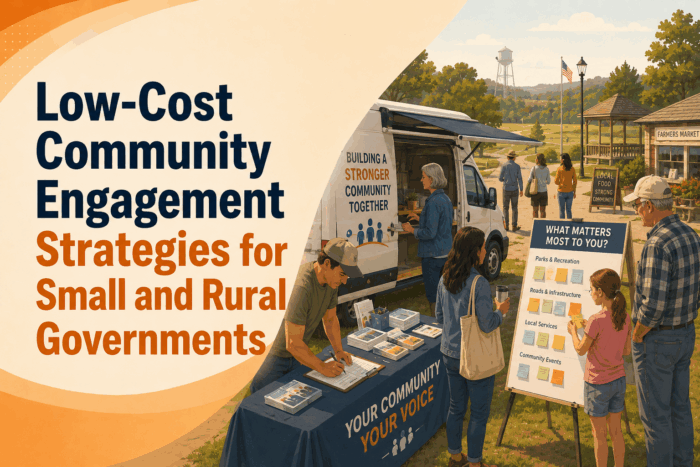
Low-Cost Community Engagement Strategies for Small and Rural Governments
The conventional image of public engagement, a formal public hearing in a government building where residents queue at a microphone to speak for three minutes before a governing board that has often already formed its views, represents both a legal necessity and a practical failure. It satisfies the procedural requirement for public input on certain decisions. It rarely produces the kind of genuine, representative community dialogue that helps governing bodies understand what residents actually think, value, and need.
Small and rural local governments are sometimes told that meaningful community engagement requires resources they do not have: professional facilitation, sophisticated online platforms, dedicated engagement staff, multi-language outreach infrastructure, and elaborate event production. That counsel is not wrong that those resources improve engagement when available. But it leaves small governments with the impression that meaningful engagement is beyond their reach, which leads them to default to the formal hearing model as their only option. The result is governing bodies that make decisions without representative community input and residents who feel that their government does not genuinely want to hear from them.
This article challenges that impression. Meaningful community engagement does not require a large budget or a dedicated engagement staff. It requires intentionality, creativity, willingness to go where residents already are, and commitment to listening rather than performing. Many of the most effective engagement approaches available to small and rural governments are low-cost or no-cost. They work not because of their production value but because they meet residents where they are, ask questions residents can actually answer, and create the experience of being genuinely heard rather than formally consulted.
The approaches described in this article are practical, tested, and appropriate for communities of varying sizes and geographic contexts. They range from approaches that require almost no budget to those that require modest investment, and they cover a variety of formats including written, in-person, and digital engagement. The goal is not to recommend a single engagement model but to give small and rural governments a repertoire of options they can select from and combine based on the specific decision, the available capacity, and the characteristics of the community they are trying to reach.
One important framing note: engagement strategies are most effective when they are genuinely open rather than performative. Residents can tell the difference between an agency that is asking questions because it actually wants to shape its decisions by the answers and an agency that is going through the motions of engagement while the real decision-making happens elsewhere. The strategies in this article are tools for genuine engagement. They will produce better outcomes for agencies that approach them honestly than for those that treat them as procedural requirements to be satisfied.
Short Surveys and Questionnaires
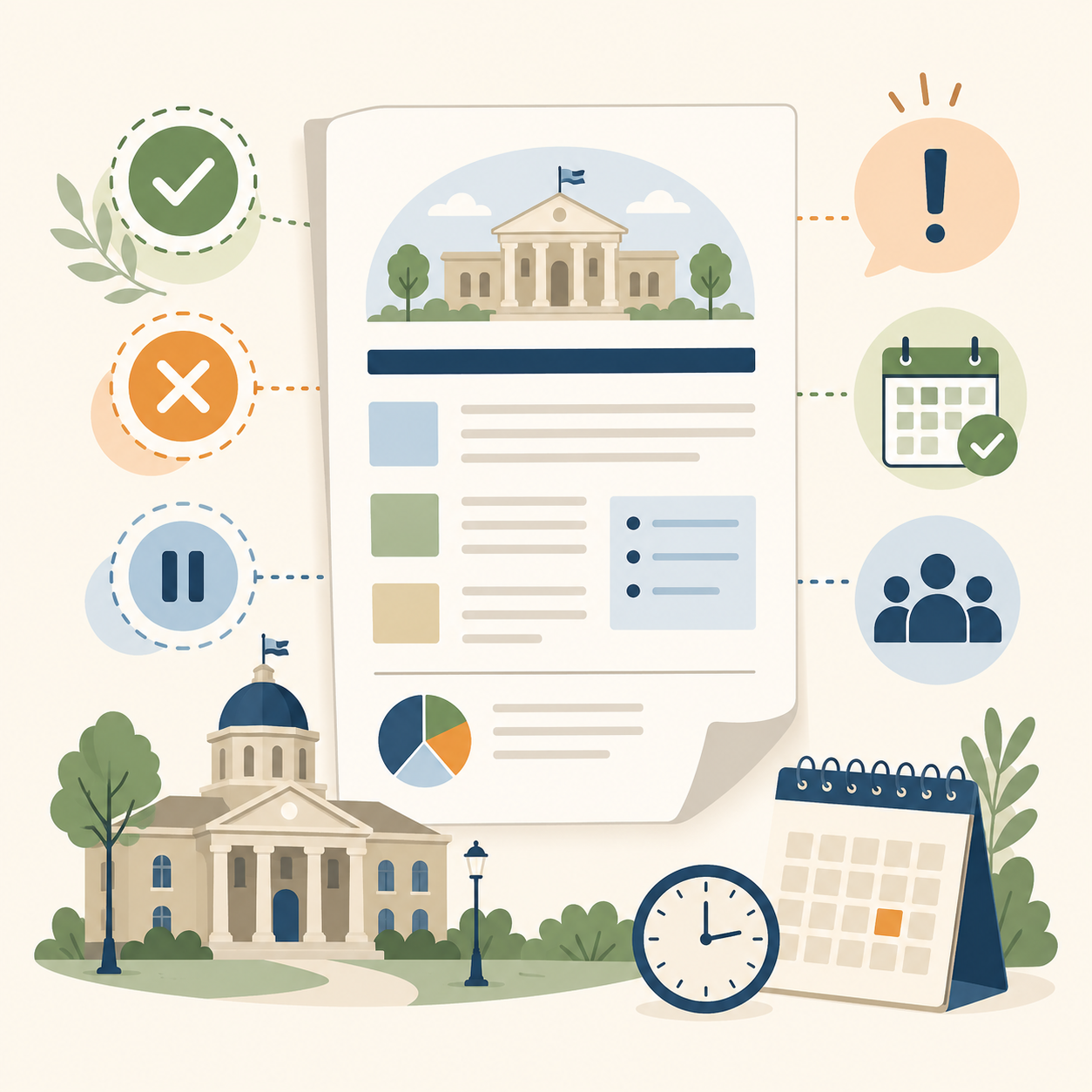 A short, well-designed survey is one of the most efficient ways to collect community input on a specific question or set of questions. The word short is essential: a survey that takes more than five to ten minutes to complete will not be completed by most residents, regardless of how interested they are in the topic. The constraint is not the residents’ interest or intelligence. It is their time and their reasonable expectation that a small local government’s survey will respect the value of their contribution without demanding more than they can reasonably give.
Effective short surveys for small local governments ask specific, actionable questions that can inform real decisions. A survey about priorities for the next road improvement project should ask residents to rank the roads they use most frequently and to identify what aspects of road condition concern them most. A survey about park programming should ask residents what activities they currently use the park for, what activities they wish were available, and what times they typically visit. A survey about proposed changes to a service should ask residents how frequently they currently use the service and what aspects of it they value most. These are questions that produce information the governing body can actually use, which gives the survey a clear purpose that residents can recognize.
Surveys distributed through utility bills or property tax statements reach every household in the service area, not just those who follow the agency’s social media or website. A simple one-page survey printed on card stock with a prepaid return envelope, included with a billing cycle that will reach every customer, is a low-cost and highly accessible distribution method. The response rate will not be high, but even a modest number of responses from the full customer base is more representative than a large number of responses from the subset of residents who actively follow agency communications.
Online surveys through free or low-cost platforms are accessible to residents who prefer digital response and can be distributed through social media, email, and the agency’s website. They should always be offered alongside a paper option rather than as the only format, because requiring online response excludes residents who do not have reliable internet access, who are not comfortable with online forms, or who have limited digital literacy. Providing both paper and online formats doubles the distribution and collection effort but significantly expands the potential respondent pool.
The survey should be accompanied by enough context for residents to understand why they are being asked and how the responses will be used. A brief introduction that explains what decision the agency is working on, why community input matters to that decision, and when and how results will be shared gives residents a reason to invest the time in completing the survey rather than treating it as junk mail.
Engaged & Connected: Communication Strategies for Small Towns, Villages, Townships, and Rural Communities
This article is part of our series on strategic communication for Small Towns, Villages, Townships, and Rural Local Governments. To learn more and to see the parent article, which links to other content just like this, click the button below.
Open Houses and Drop-In Information Sessions
Open houses are an underutilized format for community engagement in small governments because they are often confused with formal public hearings. An open house is not a public hearing. It is an informal information-sharing and input-collection event where residents can arrive at any time during a defined window, review materials about a project or decision at their own pace, ask questions of staff directly, and provide feedback in writing or verbally without the formality and time pressure of a hearing format.
The open house format has several advantages over the formal hearing for genuine community engagement. Residents who are intimidated by public speaking can engage with staff one-on-one without the anxiety of speaking before a board and an audience. Residents who have questions can ask them immediately rather than waiting for a designated comment period. Residents with different schedules can arrive at different times within the open window rather than needing to be present at a specific hour. And the informal setting encourages the kind of authentic conversation that reveals what residents actually think rather than what they have prepared to say in a formal comment.
A successful open house does not need a large venue or elaborate production. A room at the township hall, a library community room, a fire station, or another accessible public space is sufficient. Display materials on tables or boards that explain the project or decision and invite resident questions and comments, one or two staff members available to answer questions and collect feedback, and a sign-in sheet and feedback form for residents who want to provide input in writing are the essential components. The entire event can be set up in an hour and staffed by existing employees.
Timing matters significantly for open house attendance. An open house held during a weekday afternoon will not reach residents who work during the day. An open house held on a weekday evening from five to seven will reach many working residents who can stop in after work. An open house held in conjunction with another community event, such as a farmers market, a community celebration, or a school event, can attract residents who might not have come specifically for the engagement opportunity but who are receptive to a conversation while they are already in a community setting.
The drop-in format, which offers more flexibility than a scheduled open house by allowing staff to be available at a community location during regularly scheduled hours, is even lower cost and lower planning burden. A staff member who is available at a library branch or a community center one afternoon a week during a decision-making process effectively creates an ongoing open house that residents can access on their own schedule. This format is particularly effective in rural communities where residents may travel significant distances and appreciate knowing they can stop in whenever they pass through a specific location rather than having to plan their schedule around a single event.
Listening Sessions and Small Group Conversations
A listening session is a structured conversation format in which a small group of residents, typically between six and twenty people, is invited to discuss a specific topic with a staff member or local official who is genuinely present to listen rather than to present. The name is both accurate and important: the purpose of a listening session is for the agency to hear from residents, not for the agency to explain itself. That distinction in purpose produces a significantly different conversation than a presentation followed by questions.
Small group listening sessions work particularly well for gathering input from residents whose perspectives are not well represented in general public engagement processes. Younger residents who do not attend public meetings. Agricultural producers who have concerns about drainage and road weight limits that general residents may not share. Small business owners whose access and operational needs during construction projects differ from residential users. Senior residents who may have specific concerns about service changes and program availability. Organizing listening sessions specifically for these groups, rather than relying on their participation in general engagement processes where their needs may be overlooked, produces input that is both more specific and more representative of the full community.
The format of a listening session should be as informal as possible. A round table rather than a presentation-and-audience arrangement. A facilitator who asks questions and ensures that everyone has an opportunity to speak, rather than a presenter who delivers information. Written materials that serve as reference rather than as content to be talked through. The physical setup communicates the agency’s intention: is this a setting where residents are expected to listen and respond, or one where everyone around the table is genuinely part of the conversation?
Listening sessions held at locations that are part of residents’ existing routines are more accessible than those that require a special trip to a government building. A session at a diner or coffee shop where local farmers typically gather in the morning. A session at a senior center during a regularly scheduled program. A session at a faith community’s meeting space where a specific demographic group regularly gathers. Going to where residents already are, rather than asking them to come to where the government is, demonstrates both respect for their time and seriousness about reaching beyond the residents who already engage regularly with official channels.
Library Pop-Ups and Community Location Outreach
Libraries are among the most accessible and trusted public spaces in most small and rural communities, and they offer an engagement platform that local governments have largely underutilized. A library pop-up engagement station, where agency staff set up an information display and feedback opportunity during busy library hours, can reach residents who would never attend a public hearing or an open house but who are already present in a community space they trust.
The library pop-up works best when it is integrated into the library’s normal traffic pattern rather than set up as a separate event that requires residents to alter their behavior to engage. A display near the checkout desk that residents can look at while waiting. A feedback opportunity adjacent to the community bulletin board where residents already look for local information. A brief conversation with the person who is picking up holds or returning materials. These low-pressure interactions can produce genuine resident feedback without the formality that makes traditional engagement feel demanding.
Beyond libraries, small and rural governments have access to a range of community locations that serve as gathering places where residents can be reached. Post offices, where rural residents may visit regularly, particularly in communities with limited delivery service. Feed stores and agricultural supply businesses, which serve as social gathering places for farming communities in ways that urban residents may not recognize. Local diners and coffee shops, where informal community conversation happens continuously. Faith communities, which maintain trusted relationships with portions of the community that official government channels may not reach effectively.
Building partnerships with the operators of these community locations, asking permission to display information or conduct brief engagement opportunities during normal business hours, is a low-cost and low-burden approach that significantly extends the agency’s reach. The partnership should be reciprocal: the agency should also consider how it can support the community locations that are helping it engage, whether by posting their events on the agency’s website, by including them in community partner communication, or by acknowledging their role in the agency’s engagement communications.
Community Event Outreach
Small and rural communities gather around events in ways that provide natural engagement opportunities for local governments. Fairs, festivals, markets, sporting events, school activities, and community celebrations are moments when residents are relaxed, present in a community setting, and often receptive to conversations about local issues. An agency that tables at a community fair with informational materials and a brief survey, that sends a representative to a farmers market to talk with residents about an upcoming project, or that sets up an engagement station at a school event can reach a far more representative cross-section of the community than any formal government event would attract.
Community event outreach requires a different posture than formal engagement. The agency representative at a community fair is not there to present information or to defend decisions. They are there to be present, to answer questions from residents who approach them, to collect whatever feedback residents want to offer, and to demonstrate that the agency is interested in community connection beyond the formal business of governance. The informality of the setting permits conversations that would not happen in a formal setting, and those conversations often provide the most authentic insights into what residents actually think and value.
The materials brought to community events should be appropriate for the setting. A brief, visually engaging one-pager about a current project or decision. A short survey that residents can complete while standing. Contact information for residents who want to follow up with a question or a more detailed response. Full technical documents or lengthy explanations do not work in community event settings. The goal is a genuine human connection that opens a communication relationship, not a comprehensive information transfer that requires residents to sit still and focus.
For agencies that want to sustain community event outreach as an ongoing engagement practice rather than a one-time effort, designating a staff member to represent the agency at major community events throughout the year and preparing a general agency presence kit that can be quickly adapted for different projects or topics makes the practice manageable. The investment is modest. The return in community presence, resident relationships, and accessible informal feedback is significant.
Printed Questionnaires and Direct Mail
In rural communities with significant populations who are not digitally connected or who have limited internet access, printed questionnaires and direct mail remain important engagement tools. A printed questionnaire that arrives in the mail, asks specific questions about a local issue, and includes a prepaid return envelope is accessible to virtually every resident regardless of their digital capacity, their language, or their mobility. It can be completed at the kitchen table, returned in the next day’s mail, and processed without any technology on either end.
Direct mail engagement is more expensive than digital alternatives, but the expense is often justified by the representativeness it achieves. Engagement processes that rely exclusively on digital channels systematically underrepresent older residents, lower-income residents, residents in areas with poor connectivity, and residents who have chosen not to participate in digital services. Direct mail reaches those residents at a cost that, for most small government decisions, is modest relative to the value of the input and the representativeness it provides.
Property records provide the mailing list for direct mail engagement without requiring any additional data collection. A mailing to all property owners in the service area, or to all property owners in the affected geographic area for decisions with geographically concentrated impacts, reaches the relevant population efficiently. For areas where renter households represent a significant share of the population, supplementary outreach through landlord communication or distribution through rental housing complexes may be needed to reach non-owner residents.
The printed questionnaire should be designed for ease of completion. Clear, simple questions. Adequate space for written responses. A visual design that is organized and readable without requiring any specialized literacy. An explanation of why the input is being sought and how it will be used. A return deadline that gives residents adequate time to respond without creating an extended period during which the agency is waiting for input before it can proceed. These design elements are not complicated, but they make a significant difference in response rates and in the quality of the responses received.
Conducting Interviews and Informal Conversations
 Sometimes the most direct way to understand what residents think and need is simply to ask them directly, one person at a time. Structured interviews with a deliberately selected set of residents, or informal conversations with residents encountered in community settings, can produce insights that survey data and group discussions cannot capture because they allow for follow-up questions, for the kind of nuanced exchange that reveals underlying values and priorities rather than just surface preferences, and for the trust that develops when a resident feels genuinely heard rather than processed.
A small set of structured interviews conducted by the administrator, a department head, or an elected official with residents selected to represent a range of community perspectives, property types, geographic areas, and demographic characteristics is a legitimate and often underused engagement approach for small governments. The interviews do not need to follow a rigid script, but they should cover a consistent set of questions that allows the results to be compared and summarized. The value of interviews is both in the individual insights they produce and in the signal they send: that the agency cares enough about community input to have a real conversation rather than collecting survey data at arm’s length.
Informal conversations are not a substitute for structured engagement processes, but they are an important complement to them. A town supervisor who regularly talks with residents at community events, who participates in the informal social life of the community, and who brings those conversations back to the governing body as input alongside formal engagement results is practicing a form of continuous community listening that makes formal engagement processes more effective because they are not the only channel through which community perspectives reach decision-makers.
Meetings Through Trusted Community Organizations
Residents who do not attend local government meetings may regularly attend meetings of organizations they trust: agricultural cooperative meetings, fire department auxiliary gatherings, faith community services, school parent organization meetings, senior center programs, and local civic organization events. These established gatherings represent ready-made audiences that are often more representative of specific community segments than anything a local government could assemble through its own invitation.
An administrator or elected official who attends a farm bureau meeting to present a drainage project and invite questions, or who asks to speak at a senior center’s monthly luncheon about a proposed change to transportation services, or who participates in a school parent organization meeting to explain a road project that will affect school bus routes, is practicing engagement that is both lower cost and more effective than a formal public meeting on the same topics. The residents who attend these gatherings are not there because they are interested in local government. They are there because they belong to a community organization they value. Bringing the local government to them rather than asking them to come to the local government removes a significant barrier to engagement.
Building and maintaining relationships with the leaders of trusted community organizations is a standing engagement investment that pays dividends on every project and every decision where those organizations can serve as intermediaries. The township administrator who has a relationship with the local farm bureau president, the water district director who knows the senior center director by name, and the village council member who is active in the local faith community are all in positions to reach residents through trusted channels when formal engagement processes are not sufficient.
Closing the Feedback Loop After Engagement
Community engagement loses credibility quickly when residents participate and never hear what happened to their input. A survey that was completed by two hundred residents but whose results were never shared with the respondents teaches those residents that participation is a one-way transaction rather than a genuine exchange. An open house that collected comments from thirty residents but produced no visible change in the project or any communication about what the agency learned from the comments teaches the same lesson.
Every engagement process should have a designated closing step that tells participants what input was received, what the main themes were, how the input influenced or informed the decision, and what the decision was. This closing communication does not need to be elaborate. A brief summary posted to the agency’s website and shared through social media and the agency’s email list, explaining what was heard and how it was used, is sufficient for most engagement processes. The summary should be honest: if the input was mixed, the summary should say so. If the governing body’s decision differed from the majority preference expressed in the engagement, the summary should explain why.
The feedback loop closure is as important for future engagement as it is for current participants. Residents who see that their local government shares engagement results, explains how input was used, and produces a governing body decision that reflects genuine engagement with community perspectives are residents who are more likely to participate in future engagement processes. Residents who never hear what happened to their input are residents who conclude that future participation is not worth their time, which progressively reduces the quality and representativeness of subsequent engagement.
Business and Agricultural Community Engagement
Small and rural governments frequently need to engage with businesses and agricultural producers whose perspectives on local decisions differ meaningfully from those of residential property owners. A proposed road weight restriction that reduces operational costs for the township may significantly increase costs for trucking operations that use that corridor. A drainage improvement that benefits residential areas may create temporary disruptions for agricultural operations adjacent to the project. A zoning change that accommodates residential expansion may conflict with long-standing agricultural uses in the area. These tensions are real, and they require engagement strategies that deliberately seek the perspectives of business and agricultural community members rather than relying on general public engagement processes that those groups typically do not attend.
Business engagement for local government decisions works most effectively through the channels that business owners already use for information and community connection. Local chambers of commerce, business associations, industry-specific organizations, and the informal networks through which business owners share information are all more effective paths to meaningful business engagement than a notice posted on the agency website. An administrator who can present to a chamber of commerce breakfast meeting, or who can arrange for a business-specific comment opportunity to be distributed through a local business association, is reaching business owners in contexts where they are already gathering to address common interests.
Agricultural community engagement requires understanding where and how farmers gather, communicate, and form views about local government decisions. Cooperative meetings, extension office programs, agricultural lending institution events, and commodity organization gatherings are all settings where farm operators discuss shared concerns and where a local government representative can present relevant information and collect meaningful input. Farm operators who have never attended a township meeting may regularly attend cooperative meetings, and the farm bureau meeting that the supervisor attends may be the most efficient path to genuine agricultural community engagement on issues affecting farming operations.
For both business and agricultural engagement, the input collected needs to be genuinely weighted in the decision-making process and reported back to participants as part of the engagement feedback loop. Business and agricultural community members are busy, and they allocate time to engagement activities that produce visible results more readily than to those that appear to produce none. An agency that consistently takes business and agricultural input seriously, acts on it where appropriate, and explains honestly when it cannot will build relationships that make future engagement both easier and more productive.
Youth and Young Adult Engagement
Young people are among the most systematically excluded populations from local government engagement, and they are among those whose long-term interests are most at stake in local government decisions about infrastructure, land use, services, and fiscal sustainability. A small government that makes all of its major decisions without any meaningful input from residents under thirty is making decisions about a future where those residents will live far longer than those currently in the governing body.
Youth engagement requires going to where young people are rather than expecting them to come to formal government processes designed for older adults. Schools are the obvious starting point. An agency that works with school administrators to incorporate local government issues into civic education programs, that invites student groups to attend governing board meetings for educational visits, or that conducts brief classroom engagement sessions on relevant local topics is reaching a population that no other engagement strategy consistently reaches. School-based engagement is also efficient: it reaches a large and geographically concentrated audience with a single engagement event.
Young adult engagement, reaching residents in the eighteen to thirty-five age range who are past school age but not yet in the established community routines of older adults, is more challenging because there is no comparable gathering institution. Social media platforms where young adults are most active, local recreation programs and sports leagues, young professional organizations where they exist, and community events that attract younger crowds are the most productive channels. Engagement through those channels requires content and formats that respect the attention and communication styles of younger adults, including brevity, visual appeal, and a clear explanation of why the issue matters to their lives and futures specifically.
When young people participate in engagement processes, their contributions should be taken seriously rather than being noted and set aside as the perspective of people who will understand better when they have more experience. Young residents often have important insights about the services they use, the community they want to live in, and the long-term implications of current decisions that older residents may discount because of familiarity with how things have always been done. An agency that genuinely engages younger community members and demonstrates through its decisions that their input was considered will build the next generation of engaged residents that every local government ultimately depends on.
Documenting and Using Engagement Results
The quality of community engagement is only as good as the use that is made of the input it produces. Documentation of engagement results, from the raw data of survey responses through the themes identified in listening sessions to the specific comments collected at open houses, is the foundation for that use. Without systematic documentation, the insights from engagement may be partially remembered by the staff who conducted it but cannot be fully integrated into the decision-making process or transparently reported back to participants.
Documentation should capture both the quantitative and qualitative dimensions of engagement. For surveys, the quantitative results include response counts, percentages selecting each answer, and patterns in written responses. The qualitative dimension includes the themes, the outlier perspectives, and the specific comments that illuminate how residents are thinking about an issue in ways that aggregate numbers cannot capture. Both are important. A survey that found strong majority support for a proposed project but that also produced consistent comments expressing concern about a specific aspect of its implementation contains important information in both the numbers and the comments.
The presentation of engagement results to the governing body should be organized to support decision-making rather than simply to report data. A summary that describes what was asked, who participated, what the main findings were, what the range of perspectives included, and what the staff’s assessment of the implications for the decision is, gives the governing body the context it needs to incorporate the engagement input into its deliberation. The governing body should be able to see both what residents said and what decisions the input is most relevant to.
Engagement documentation should be preserved in a form that is retrievable for future reference. Decisions made in light of specific community engagement can be defended more effectively when the documentation of that engagement is available. An agency that faces a challenge to a decision and can point to a specific documented engagement process that informed it is in a stronger position than one that can only recall that engagement was conducted without specifics about what it found. The documentation is both a governance record and a communication resource.
Strategic Communication Support for Small and Rural Governments
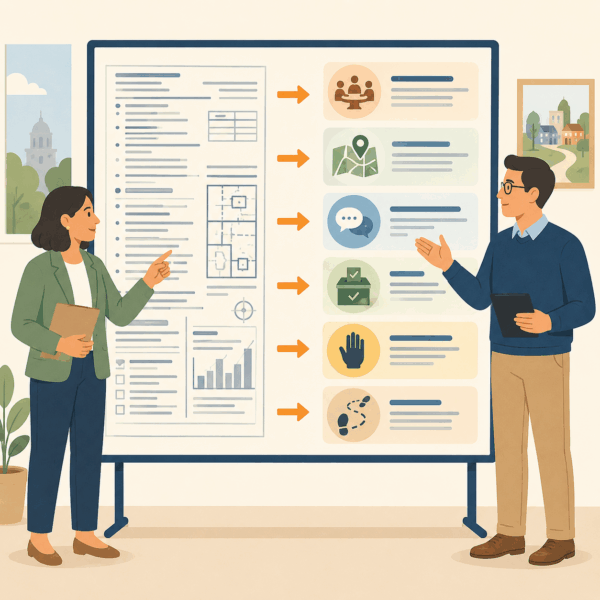 Community engagement is not communication’s opposite. It is communication’s most demanding form, because it requires not just sending information out but genuinely receiving it back and demonstrating through decisions and explanations that what was received mattered. Small and rural governments that build a repertoire of low-cost, accessible engagement practices and that commit to closing the feedback loop consistently will find that their decisions are better informed, their community relationships are stronger, and their ability to explain and defend difficult decisions is significantly improved.
Building that repertoire requires some deliberate design: identifying which engagement approaches work best for which types of decisions in the specific community context, developing the materials and processes for each approach, training staff on how to facilitate engagement in different formats, and establishing the feedback loop communication as a standing commitment rather than an afterthought. Outside support can help with that design work, particularly for agencies that are building engagement capacity for the first time or that want to significantly improve on a current approach that is not producing representative or useful input.
Stegmeier Consulting Group (SCG) helps small and rural governments develop community engagement strategies that are appropriate for their scale, their community, and their specific decision-making contexts. That work includes engagement approach selection, survey and questionnaire design, open house and listening session facilitation support, community event outreach planning, feedback loop communication design, and the training that helps staff conduct genuine engagement rather than performative consultation. Whether your agency is designing an engagement process for a specific decision or building the long-term engagement capacity to handle a range of future decisions well, SCG can help you develop the approach that produces the community understanding and trust that good local governance requires.
Future Trends in Community Engagement for Small Governments
The tools and expectations for community engagement are evolving in ways that create both new opportunities and new responsibilities for small and rural local governments. Several trends are worth noting for agencies building or improving their engagement capacity.
Digital engagement platforms are becoming more accessible for small governments, including tools specifically designed for local government use that allow agencies to conduct surveys, collect comments, host virtual open houses, and manage engagement processes online. These platforms can significantly reduce the logistical burden of engagement and can reach residents who find digital participation easier than in-person. For small governments, the most relevant developments are not the most sophisticated platforms but the most accessible and affordable ones that do not require technical expertise to implement and maintain.
Hybrid engagement formats that combine in-person and virtual participation are becoming a standard expectation rather than a pandemic accommodation. Residents who cannot attend an in-person meeting because of work schedules, transportation limitations, disability, or distance can participate in a hybrid format that provides equivalent opportunities. For small and rural governments, hybrid formats can be a significant accessibility improvement for residents in geographically dispersed communities where the distance to a meeting location is a genuine barrier to participation.
Equity in engagement is receiving growing attention as practitioners and governing bodies recognize that standard engagement processes systematically underrepresent certain populations. Young people, renters, low-income residents, residents of color, immigrants, and residents with disabilities are consistently underrepresented in traditional local government engagement. Agencies that actively design their engagement processes to reach underrepresented populations, whether through targeted outreach, multilingual materials, accessible formats, or engagement at trusted community locations, will produce more representative input and more defensible decisions. That equity orientation is both ethically appropriate and practically important for agencies that want their decisions to reflect the full community they serve.
Conclusion
Community engagement is not a luxury that small and rural governments can afford to forgo because they lack the resources for sophisticated programs. It is a fundamental component of accountable local governance that can be pursued effectively with creativity, intentionality, and the willingness to meet residents where they are. The approaches described in this article, from short surveys to listening sessions to library pop-ups to community event outreach, are all achievable for any small government that is committed to genuine engagement rather than procedural compliance.
What makes engagement meaningful is not its cost or its production value. It is the sincerity of the invitation, the accessibility of the format, the genuineness of the listening, and the honesty of the feedback loop communication that follows. Residents who experience those qualities in their local government’s engagement practices will participate more actively, trust decisions more readily, and feel more connected to the governance of the community they live in. Those outcomes are worth the modest investment that low-cost engagement strategies require, and they are well within the reach of every small and rural local government that chooses to pursue them.
Stegmeier Consulting Group’s Strategic Approach to Communication Systems
Align your agency’s engagement strategies with the community you serve and the decisions you need to make.
Small and rural governments need community engagement approaches that are genuinely accessible, honestly conducted, and consistently closed with communication about what was heard and how it was used. Building those approaches requires selecting formats appropriate to the decision and the community, designing materials that invite rather than demand participation, and committing to the feedback loop that converts one-time engagement into an ongoing community relationship.
SCG helps public agencies develop community engagement strategies that reflect the specific characteristics of their communities and their governance contexts. Whether your agency needs to design engagement for a specific decision or build the long-term engagement capacity to handle a range of future decisions well, SCG can help you develop the approach that produces the community understanding and trust that effective local governance requires.
Use the form below to connect with our team and explore how low-cost, high-impact community engagement strategies can help your agency make better decisions, build stronger community relationships, and govern with the genuine participation that residents deserve.